© 2017, IRJET | Impact Factor value: 5.181 | ISO 9001:2008 Certified Journal | Page 1275
An Approach of Mobile Wireless Sensor Network for Target Coverage and
Network Connectivity with Minimum Movement
Daler Kaur
1, Mrs. Maninder Kaur
21
M.Tech Student, Dept. of Electronics and Comm., DIET, Kharar, Punjab, India.
2HOD (M.Tech), Dept. of Electronics and Comm., DIET, Kharar, Punjab, India.
---***---Abstract -
A Mobile wireless sensor network is a set ofphysically distributed sensor nodes. Sensor node is a small wireless device with limited battery life, radio transmission range and storage size. A sensor node performs the task of collecting important data, processing the data, monitoring the environment, etc. This property of sensors i.e. mobility can be very efficiently used to improve the target coverage quality and network connectivity in randomly deployed mobile sensor networks. Target coverage (TCOV) and Network connectivity (TCON) are two main challenging issues of mobile sensor networks. This paper focuses on the challenges of the Mobile Sensor Deployment (MSD) problem and investigates how to deploy mobile sensors with minimum movement and energy consumption to form a WSN that provides both target coverage and network connectivity.
Key Words: Mobile Wireless Sensor Network (MWSNs), Target Coverage (TCOV), Network Connectivity (NCON), Mobile Sensor Deployment (MSD).
1. INTRODUCTION
A Mobile Wireless Sensor Network (MWSN) can simply be defined as a wireless sensor network (WSN) in which the sensor nodes are mobile. MWSNs are a smaller, emerging field of research in contrast to their well-established predecessor. MWSNs are much more versatile than static sensor networks as they can be deployed in any scenario and cope with rapid topology changes [14]. Basically, Mobile Wireless Sensor Networks (MWSN) are the collection of the small and the light weight wireless nodes [4].
F igure -1: Mobile Wireless Sensor Network
1.1 Coverage in MWSNs
Coverage is the primary evaluation metric for a wireless network. It is always advantageous to have the ability to deploy a network over a larger physical area. This can significantly increase a system’s value to the end user. It is important to keep in mind that the coverage of the network is not equal to the range of the wireless communication links being used [3]. Multi-hop communication techniques can extend the coverage of the network well beyond the range of the radio technology alone.
Coverage is a measure of the quality of service provided by a sensor network. Due to the attenuation of energy propagation, each sensor node has a sensing gradient, in which the accuracy and probability of sensing and detection attenuate as the distance to the node increases. The total coverage of the whole network can therefore be defined as the union (including possible cooperative signal processing) of all nodes’ sensing gradients. It represents how well each point in the sensing field is covered [6]. Coverage is a fundamental issue in a WSN, which determines how well a phenomenon of interest (area or target) is monitored or tracked by sensors. Each sensor node is able to sense the phenomenon in a finite sensing area.
1.2 Connectivity in MWSNs
Connectivity is an important issue in WSNs which concerns with delivering the sensed data from the source sensor to the destination (sink node) via radio transmissions. As sensors are low-cost devices with constrained resources, each sensor node has only limited communication range compared with the size of the monitored area. Multi-hop communications are necessary when a sensor cannot reach the sink node directly [5]. Two sensors are called neighbors if they are within each other's communication range. The sensor nodes and the communication links between each pair of neighbors build the network topology, which is required to be connected by the connectivity requirement.
© 2017, IRJET | Impact Factor value: 5.181 | ISO 9001:2008 Certified Journal | Page 1276 communicate via wireless medium, a node can only directly
talk to those that are in close proximity to itself (within its communication range). If a sensor network is modeled as a graph with sensor nodes as vertices and direct communication links between any two nodes as edges, by a connected network we mean the graph is connected [3].
1.2 Network Lifetime in MWSNs
Network lifetime is one of the most important and challenging issues in WSNs which defines how long the deployed WSN can function well. Sensors are unattended nodes with limited battery energy. In the absence of proper planning, the network may quickly cease to work due to the network departure or the absence of observation sensors deployed close to the interested phenomenon. Since a sensor network is usually expected to last several months without recharging, prolonging network lifetime is one of the most important issues in wireless sensor networks [9].
A sensor node is generally composed of four components: sensing unit, data processing unit, data communication unit and power unit. The power unit supplies power to the other three units. Any activity of the other three units - sensing, data processing, data transmitting and data receiving-will consume battery energy. Experiments show that wireless communication (data transmitting and receiving) contributes a major part to energy consumption rather than sensing and data processing. Therefore, reducing the energy consumption of wireless radios is the key to energy conservation and prolonging network lifetime [11].
2. LITERATURE SURVEY
Zhuofan Liao, Jianxin Wang, Shigeng Zhang, Jiannong Cao and Geyong Min, “Minimizing Movement For Target Coverage and Network Connectivity in Mobile Sensor Networks” (2015).In this paper, the Mobile Sensor Deployment problem is divided into two sub-problems, Target COVerage (TCOV) problem and Network CONnectivity (NCON) problem. For the TCOV problem, it is NP-hard. For a special case of TCOV, an extended Hungarian method is provided; for general cases, two heuristic algorithms are proposed based on clique partition and Voronoi diagram, respectively. For the NCON problem, first propose an edge constrained Steiner tree algorithm to find the destinations of mobile sensors, then use the extended Hungarian to dispatch rest sensors to connect the network [1] .
Sonali Karegaonkar and Archana Raut, “Improving Target Coverage and Network Connectivity of Mobile Sensor Networks” (2015). In this paper, in addition to Basic algorithm and TV-Greedy algorithm, LWZ compression algorithm is applied while sending data from sensor node to sink node, hence the computation speed of transmission is maximized. Simulation result obtained validates the
performance of the proposed algorithm. Hence the issues of TCOV and NCON in MSNs are successfully overcomes and increase the network lifetime [2].
D.Prasad, “Enhancing Target Coverage and Network Connectivity of Mobile Sensor Networks” (2016). In this paper the issue of Target Coverage (TCOV) and Network Connectivity (NCON) in Mobile Sensor Networks (MSNs) are taken into consideration. To solve TCOV problem, two algorithms are proposed: Basic algorithm and TV Greedy algorithm. TV Greedy algorithm achieves less movement than basic algorithm because it selects the sensor which is very close to target to achieve that target. Hence, the proposed scheme overcomes the issue of TCOV & NCON in MSNs & increase the network lifetime [3].
Mr. Mayur C. Akewar and Dr Nileshsingh V. Thakur, “A study of Wireless Mobile Sensor Network deployment” (2012). In this paper, fundamental problem of deployment in mobile sensor network is discussed. The issues of mobile sensor network deployment are investigated in detail. It further discusses the types of algorithm and different ways of deployment like deterministic, random and incremental deployment along with self deployment. Different approaches for mobile sensor network deployment are discussed in detail with their comparisons. Modeling of deployment problem with other real world problem is also discussed [4].
E. Mathews and C. Mathew, “Deployment of mobile routers ensuring coverage and connectivity,” (2012). In this paper, two new localized and distributed algorithms for creating an ad-hoc mobile router network has been discussed that facilitates communication between the agents without restricting their movements. The first algorithm, agent assisted router deployment, is used in scenarios where a proactive pre-deployment is not feasible due to the limited speed of the routers compared to the speed of the agents and the second one self-spreading is used in scenarios where the proactive pre-deployment is feasible. The algorithms have a greedy deployment strategy for releasing new routers effectively into the area and a triangular deployment strategy for connecting different connected components created from different base stations [5].
3. PROPOSED METHOD
© 2017, IRJET | Impact Factor value: 5.181 | ISO 9001:2008 Certified Journal | Page 1277 3.1 Methodology
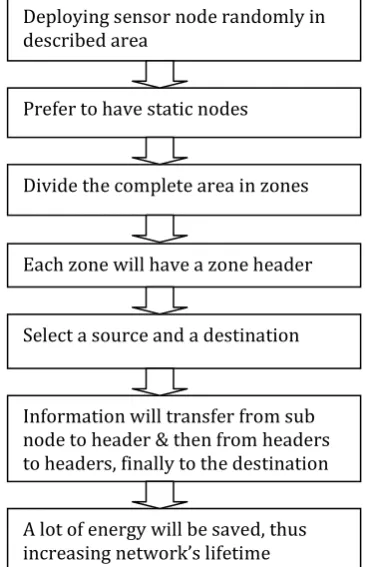
[image:3.595.308.563.143.288.2]In present work, firstly sensor nodes should be deployed in such a way that they cover the complete area. We prefer to have static nodes. Then divide the complete area into the zones. Each zone will have a zone header. Zone headers should be at a convenient distance from each sub nodes. Then we will select a source and a destination. Information will transfer from sub nodes to headers and then from headers to headers, finally to the destination. A lot of energy will be saved, thus increasing network’s lifetime.
Figure 2 show the flow chart of the methodology.
Figure -2: Flow chart of methodology
4.
RESULT ANALYSIS
The proposed technique is implemented using MATLAB
which is developed by MathWorks,
allows matrix manipulations, plotting of functions and data, implementation of algorithms, creation of user interfaces, and interfacing with programs written in other languages, including C, C++, Java, and Fortran. The MATLAB software provides communication for control and manipulation of virtual reality objects using MATLAB objects.
Following is the complete program flow and results associated with it:
First step is to create a deployment area with entering the value of length and breadth. Length and breadth are entered
according to the desired requirements. Length and breadth of the deployment area is 10. Length and breadth are on x-axis and y-x-axis respectively.
Figure -3: Deployment of area
After deploying desired area, second step is to divide this deployed area into equal zones. Number of zones should be selected as per requirement to divide the deployment area into zones. As shown in figure 4, the deployment area is divided into 5 zones. These 5 zones are equally spaced.
[image:3.595.35.218.257.541.2]Third step is to deploy the sensor nodes in each of the zone. Each zone will have a zone header. The rest of the nodes are sub-nodes. The number of sensor nodes to be deployed in one zone is selected by desired required. Sensors are deployed in uniform manner. Each sensor node has a sensor id number. The position or sensor id number of each sensor node is saved in Excel file.
Figure -4: Divided deployment area
As shown in Figure 5, each zone has a zone header which is shown by red color. The rest of the nodes are sub-nodes. Deploying sensor node randomly in
described area
Prefer to have static nodes
Divide the complete area in zones
Each zone will have a zone header
Select a source and a destination
Information will transfer from sub node to header & then from headers to headers, finally to the destination
[image:3.595.310.562.475.634.2]© 2017, IRJET | Impact Factor value: 5.181 | ISO 9001:2008 Certified Journal | Page 1278 Figure -5: Deployment of nodes in each zone
After deployment of nodes, fourth step is to select a sender and receiver from different zones. Sender will first communicate with its respective zone header.
Figure -6: Comm. between sender and receiver
The sender zone’s header will then search for receiver’s zone header. Once found, receiver’s zone header will transmit to the receiver node. Sender and receiver can be from any zones available. For selecting the sender, refer to the Excel file which contains sensor id numbers.
Once communication is complete, next step is to calculate the energy. This is the energy depletion across the nodes that were involved in the communication process. By this step, we get the information about the energy consumed in the transfer process.
The graph between nodes involved and energy values is shown in figure 7. This is the energy depletion across the nodes that were involved in the communication process. By this step, we get the information about the energy consumed in the transfer process.
Figure-7: Graph of nodes involved info. transfer versus energy at those nodes
Table no. 1 shows the detail of percentage of energy at each sensor node which are involved in the communication between sender and the receiver.
Table-1: Energy distribution at sensor nodes involved in communication.
Serial No. ID no. of sensor node Energy at sensor
node (in percentage)
1. 104 100
2. 103 96.66
3. 101 93.33
4. 102 90.00
5. 201 86.66
6. 202 83.33
7. 301 80.00
8. 302 76.66
9. 401 73.33
10. 402 70.00
11. 501 66.66
12. 503 63.33
Overall energy distribution shows the energy across all the sensor nodes which are deployed. This is the broader view of node wise energy across all the nodes deployed. Now same energy distribution values can be seen on all the nodes put together.
[image:4.595.303.549.357.648.2]© 2017, IRJET | Impact Factor value: 5.181 | ISO 9001:2008 Certified Journal | Page 1279 energy wastage of other sensor nodes is there. Hence, this
will lead to increasing the lifetime of whole network as no energy wastage is there.
Figure-8: Graph of overall energy distribution
Next to the energy graphs, graph of impact of number of sensor and impact of number of targets is shown. We then investigate the impact of the number of mobile sensors on the movement distance of the algorithms used and our proposed algorithm. The comparison shows that proposed system shows better results than previous methods.
Figure-9: Impact on number of sensors
In Figure 9, comparison of impact on number of sensor by Ex-Hungarian algorithm, Basic algorithm, TV-Greedy algorithm and proposed algorithm is shown. It is clear from the graph that the movement by proposed algorithm which is shown by blue line has minimum impact on number of sensors as compared to all the other algorithms. So, by proposed algorithm there is minimum impact on number of sensors.
In figure 10, comparison of impact on number of targets by Ex-Hungarian algorithm, Basic algorithm, TV-Greedy algorithm and proposed algorithm is shown. It is clear from the graph that the movement by proposed algorithm which is shown by blue line has less impact on number of target as compared to all the other algorithms.
Figure-10: Impact on number of targets
5. CONCLUSIONS
In this work, we have studied the Mobile Sensor Deployment (MSD) problem in Mobile Sensor Networks (MSNs), aiming at deploying mobile sensors to provide target coverage and network connectivity with requirements of moving sensors. As sensors are usually powered by energy limited batteries and thus severely power-constrained, energy consumption should be the top consideration in mobile sensor networks. Specially, movement of sensors should be minimized to prolong the network lifetime because sensor movement consumes much more energy than sensing and communication do. However, most of the existing studies aimed at improving the quality of target coverage, e.g., detecting targets with high detection probability, lowering false alarm rate and detection delay. Little attention has been paid to minimizing sensor movement. To fill in this gap, this work focuses on moving sensors to cover discrete targets and form a connected network with minimum movement and energy consumption.
REFERENCES
[1] Zhuofan Liao, Jianxin Wang, Shigeng Zhang, Jiannong Cao
and Geyong Min, “Minimizing Movement For Target Coverage And Network Connectivity In Mobile Sensor Networks”, IEEE Transactions on Parallel and Distributed Systems, Vol. 26, No. 7, July 2015.
[2] Sonali Karegaonkar and Archana Raut, “Improving Target
Coverage and Network Connectivity of Mobile Sensor Networks”, International Journal of Science and Research (IJSR), Vol.4, Issue No. 4, April 2015.
[3] D. Prasad, “Enhancing Target Coverage and Network
Connectivity of Mobile Sensor Networks”, International Journal of Innovative Research in Computer and Communication Engineering (IJIRCCE), Vol.4, Issue 1, January 2016.
[4] Mr. Mayur C. Akewar and Dr. Nileshsingh V. Thakur, “A
© 2017, IRJET | Impact Factor value: 5.181 | ISO 9001:2008 Certified Journal | Page 1280
[5] E. Mathews and C. Mathew, “Deployment of mobile
routers ensuring coverage and connectivity,” Int. J. Comput. Netw. Commun., vol. 4, no. 1, pp. 175–191, 2012.
[6] Gao Jun Fan and ShiYao Jin, “Coverage Problem in
Wireless Sensor Network: A Survey”, Journal of Networks, Vol. 5, No. 9, September 2010.
[7] I. E. Korbi and S. Zeadally, “Energy-aware sensor node
relocation in mobile sensor networks,” Ad Hoc Netw., vol. 16, no. 1, pp. 247– 265, 2014.
[8] I. F. Akyildiz, W. Su, Y. Sankarasubramaniam and E.
Cayirci, “Wireless Sensor Networks: A Survey,” in Elsevier Computer Networks, Volume: 38, Issue:2, Page(s):393-422, 2002.
[9] Raymond Mulligan and Habib M. Ammari, “Coverage in
Wireless Sensor Networks: A Survey”, Macrothink Institute, ISSN 1943-3581, Vol.2, No.2, 2010.
[10] V. Blessy Johanal Selvarasi and A. Aruna Devi, “Sensor
Deployment and Scheduling using Optimization”, International Journal of Science Technology & Engineering (IJSTE), Volume 2, Issue 10, April 2016.
[11] Wei Shen and Qishi Wu, “Exploring Redundancy in
Sensor Deployment to Maximize Network Lifetime and Coverage,” 8th Annual IEEE Communications Society
Conference on Sensor, Mesh and Ad-hoc Communication and Networks, 2011.
[12] X. Bai, S. Kumar, D. Xuan, Z. Yun, and T. H. Lai,
“Deploying wireless sensors to achieve both coverage and connectivity,” in Proc. 7th ACM Int. Symp. Mobile Ad-hoc Netw. Comput., 2006, pp. 131– 142.
[13] X.R. Wang, G.L. Xing, Y.F. Zhang, C.Y. Lu, R. Pless, and
C. Gill, “Integrated Coverage and Connectivity Configuration in Wireless Sensor Networks,” Proc. ACM Conf. Embedded Networked Sensor Systems (SenSys ’03), pp. 28-39, 2003.
[14] Y. Yang, M. I. Fonoage, and M. Cardei, “Improving
network lifetime with mobile wireless sensor networks,” Comput. Commun., vol. 33, no. 4, pp. 409–419, 2010.
[15] Y. Zou and K. Chakrabarty, “A distributed coverage- and
connectivity-centric technique for selecting active nodes in wireless sensor networks,” IEEE Transactions on Computers, vol. 54, no. 8, pp. 978–991, August 2005.
BIOGRAPHY
Daler Kaur has received B.Tech degree in Electronics and Communication Engineering from Indo Global College of Engineering, Mohali, under I.K.Gujral Punjab Technical University, Jalandhar, Punjab. She is currently pursuing M.Tech degree in Electronics and