© 2017, IRJET | Impact Factor value: 5.181 | ISO 9001:2008 Certified Journal | Page 930
TO STUDY THE BEHAVIOR OF CONCRETE WITH THE REPLACEMENT OF
FINE AGGREGATE BY QUARRY DUST USING RECYCLED COARSE
AGGREGATES
Dheekshith K
1, Esha S J
2, Anusha
31 B.E student, Department of Civil Engineering, Malnad College of Engineering, Hassan 2 B.E student, Department of Civil Engineering, Malnad College of Engineering, Hassan 3 B.E student, Department of Civil Engineering, Malnad College of Engineering, Hassan
---***---Abstract -
Concrete plays the key role and a large quantumof concrete is being utilized in every construction practices. Natural river sand is one of the key ingredients of concrete, is becoming expensive due to excessive cost of transportation from sources. Also large scale depletion of sources creates environmental problems. To overcome these problems there is a need of cost effective alternative and innovative materials. Quarry dust is a waste obtained during quarrying process. It has very recently gained good attention to be used as an effective filler material instead of fine aggregate.Also, the use of quarry dust as the fine aggregate decreases the cost of concrete production in terms of the partial replacement for natural river sand. Design mix of M25grade concrete with replacement of 0%, 20%, 25%, 30%, and 35% of quarry dust organized as M1, M2, M3, M4 and M5 respectively have been considered for laboratory analysis viz. slump test, compaction factor test, compressive strength ,split tensile strength and flexural strength of hardened concrete. In the present paper, the hardened properties of concrete using quarry dust were investigated. The amount of construction waste has been dramatically increased in the last decade, and social and environmental concerns on the recycling of the waste have consequently been increased. Waste concrete is particularly crucial among the construction wastes. Recent technology has also improved the recycling process. In this rapid industrialized world, recycling construction material plays an important role to preserve the natural resources.
Key Words: QUARRY DUST, RECYCLED COARSE
AGGREGATES.
1. INTRODUCTION
Waste arising from construction and demolition (C & D) constitutes one of the largest waste streams. Of this a large proportion of potentially useful material disposed of as landfill. The environmental and economic implications of this are no longer considered sustainable and, as a result, the construction industry is experiencing more pressure than ever before to overcome this practice. On the other hand, in recent years the wisdom of continued wholesale extraction and use of aggregates from natural resources has been
questioned at an international level. This is mainly because of the depletion of quality primary aggregates and greater awareness of environmental protection. The results of an extensive experimental project aimed at examining the performance of Portland-cement concrete produced with recycled aggregates and Quarry dust. The effects of up to 100% coarse recycled concrete aggregate on a range of fresh, engineering and durability properties have been established and assessed its suitability for use in a series of designated applications.
Concrete is the world’s second most consumed material after water, and its widespread use is the basis for urban development. It is estimated that 25 billion tons of concrete are manufactured each year. Twice as much concrete is used in construction around the world when compared to the total of all other building materials combined. In India, 27% of the total waste generated is construction and demolition waste (C&DW), and of this concrete represents 25%, i.e. 7% of the total waste. Many countries have recycling schemes for C & DW to avoid dumping to landfill, as suitable landfill sites are becoming scarce particularly in heavily populated countries. Charges or levies on landfill dumping often make recycling concrete aggregate a preferred option.
© 2017, IRJET | Impact Factor value: 5.181 | ISO 9001:2008 Certified Journal | Page 931 materials from other industries such as crushed glass
can be used as secondary aggregatesin concrete. All these processes avoid dumping to landfill whilst conserving natural aggregate resources, and are a better environmental option. Recycling or recovering concrete materials has two main advantages - it conserves the use of natural aggregate and the associated environmental costs of exploitation and transportation, and it preserves the use of landfill for materials which cannot be recycled. Whilst crushed concrete can be used as a sub-base material for pavements and civil engineering projects, this Best Practice Guide outlines its use as a higher grade resource - as aggregate in new concrete. However, recycled concrete aggregate that is significantly contaminated may not be economical to decontaminate for use as concrete aggregate, whereas it may be suitable ‘as is’ for use as sub-base material. Green building schemes such as Green Star India recognize C&DW reuse and provide credits for the use of recycled materials including recycled concrete aggregate. Because waste minimization and reducing the burden on landfills is a global issue, extensive research has been carried out worldwide on the use of recycled aggregate in concrete. Globally the concrete construction industry has taken a responsible attitude to ensuring its natural resources are not over exploited. In some cases the preservation of dwindling natural aggregate sources is a significant issue driving the use of recycled aggregates. Reduction in the impact of aggregate cartage on cost and environmental issues is also a factor where material processed from the demolition phase of a project, using a portable aggregate processing plant, can be reused in concrete for the construction phase of the project. This is a better option than transporting natural aggregates from quarries which through urbanization are located at an ever increasing distance from city areas.
1.1 NEED FOR UTILIZATION OF CRUSHED CONCRETE AS COARSE AGGREGATE AND QUARRY DUST AS FINE AGGREGATE
Rapid industrial development causes serious problems all over the world such as depletion of natural aggregate sand creates enormous amount of waste material from construction and demolition activities. One of the ways to reduce this problem, is to utilise recycled concrete aggregate (RCA) in the production of concrete. Many significant researches have been carried out to prove that recycled concrete aggregate could be are liable alternatives aggregate in
production of concrete. As widely reported, recycled aggregates are suitable for non-structural concrete applications. RCA is the main component of old concrete and for many reasons there is a need to re-use them. Such recycling operations have the added benefit of reducing landfill disposal, while conserving primary resources and reducing transport costs. There are large amount of concrete wastages during construction and demolition stages in India. RCA can be obtained from these wastages for the production of new concrete. 2. MATERIALS AND MATERIAL TESTING
2.1 MATERIALS USED
The materials used are cement, fine aggregates, coarse aggregates, quarry dust, recycled coarse aggregates and water.
2.2 MATERIAL TESTING
[image:2.595.303.556.387.557.2]The tests were conducted during the project are as follows:
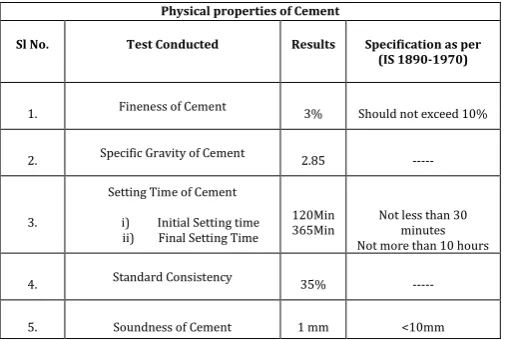
Table -1: Tests on Cement
Physical properties of Cement
Sl No. Test Conducted Results Specification as per
(IS 1890-1970)
1. Fineness of Cement 3% Should not exceed 10%
2. Specific Gravity of Cement 2.85 ---
3.
Setting Time of Cement
i) Initial Setting time ii) Final Setting Time
120Min
365Min Not less than 30 minutes Not more than 10 hours
4. Standard Consistency 35% ---
[image:2.595.290.557.389.781.2]5. Soundness of Cement 1 mm <10mm
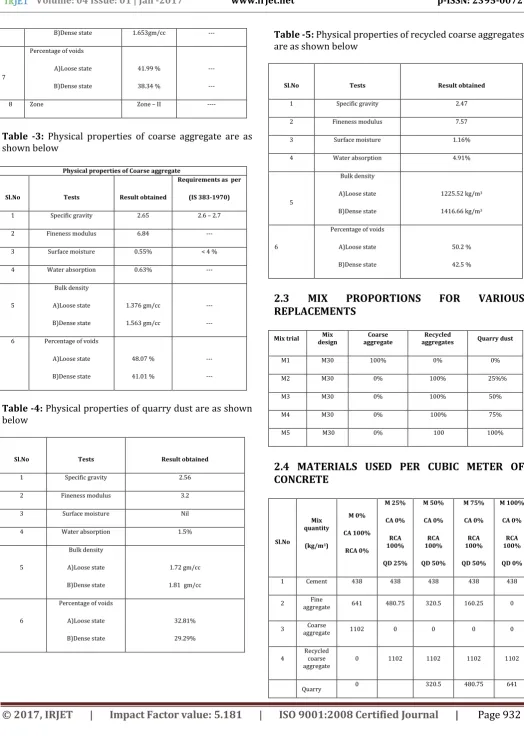
Table -2: Tests on Sand
Physical properties of Sand
Sl.No Tests obtained Result
Requirements as per
(IS 383-1970)
1 Specific gravity 2.62 2.6 - 2.7
2 Fineness modulus 3.3 2.2 – 3.3
3 Bulking 24 % < 40 %
4 Surface moisture 0.28 % < 4 %
5 Water absorption 0.85% ---
6
Bulk density
© 2017, IRJET | Impact Factor value: 5.181 | ISO 9001:2008 Certified Journal | Page 932
B)Dense state 1.653gm/cc ---
7
Percentage of voids
A)Loose state B)Dense state 41.99 % 38.34 % --- ---
8 Zone Zone – II ----
Table -3: Physical properties of coarse aggregate are as shown below
Physical properties of Coarse aggregate
Sl.No Tests Result obtained
Requirements as per
(IS 383-1970)
1 Specific gravity 2.65 2.6 – 2.7
2 Fineness modulus 6.84 ---
3 Surface moisture 0.55% < 4 %
4 Water absorption 0.63% ---
5 Bulk density A)Loose state B)Dense state 1.376 gm/cc 1.563 gm/cc --- ---
6 Percentage of voids
A)Loose state B)Dense state 48.07 % 41.01 % --- ---
Table -4: Physical properties of quarry dust are as shown below
Sl.No Tests Result obtained
1 Specific gravity 2.56
2 Fineness modulus 3.2
3 Surface moisture Nil
4 Water absorption 1.5%
5
Bulk density
A)Loose state
B)Dense state
1.72 gm/cc
1.81 gm/cc
6
Percentage of voids
A)Loose state
B)Dense state
32.81%
[image:3.595.34.559.71.821.2]29.29%
Table -5: Physical properties of recycled coarse aggregates are as shown below
Sl.No Tests Result obtained
1 Specific gravity 2.47
2 Fineness modulus 7.57
3 Surface moisture 1.16%
4 Water absorption 4.91%
5
Bulk density
A)Loose state
B)Dense state
1225.52 kg/m3
1416.66 kg/m3
6
Percentage of voids
A)Loose state
B)Dense state
50.2 %
42.5 %
2.3 MIX PROPORTIONS FOR VARIOUS
REPLACEMENTS
Mix trial design Mix aggregate Coarse aggregates Recycled Quarry dust
M1 M30 100% 0% 0%
M2 M30 0% 100% 25%%
M3 M30 0% 100% 50%
M4 M30 0% 100% 75%
M5 M30 0% 100 100%
2.4 MATERIALS USED PER CUBIC METER OF CONCRETE
Sl.No Mix quantity
(kg/m3)
M 0% CA 100% RCA 0% M 25% CA 0% RCA 100% QD 25% M 50% CA 0% RCA 100% QD 50% M 75% CA 0% RCA 100% QD 50% M 100% CA 0% RCA 100% QD 0%
1 Cement 438 438 438 438 438
2 aggregate Fine 641 480.75 320.5 160.25 0
3 aggregate Coarse 1102 0 0 0 0
4 Recycled coarse aggregate
0 1102 1102 1102 1102
[image:3.595.29.284.235.465.2]© 2017, IRJET | Impact Factor value: 5.181 | ISO 9001:2008 Certified Journal | Page 933
5 dust 160.25
6 Water/cement ratio 0.46 0.46 0.46 0.46 0.46
2.5 CASTING OF CONCRETE CUBES Table-6: Results of slump test
Mix trials Proportion Mix w/c Slump
M1 1: 1.46: 2.51 0.46 120mm
M2 1: 1.46: 2.51 0.46 115mm
M3 1: 1.46: 2.51 0.46 105mm
M4 1: 1.46: 2.51 0.46 90mm
M5 1: 1.46: 2.51 0.46 85mm
Table-7: Compressive strength of concrete cubes with different percentages of mix proportions.
Mix trials
Average compressive strength for 7days.
(N/mm2)
Average compressive strength for 14 days.
(N/mm2)
Average compressive
strength for 28days. (N/mm2)
M1 28.6 37.29 39.45
M2 24.86 32.29 34.84
M3 23.088 27.26 32.219
M4 19.98 24.44 28.88
M5 18.66 22.22 27.55
Table-8: Percentage of increase in strength with respect to days
Mix trials 7-14 days 14-28 days
M1 30.38% 5.79%
M2 29.88% 7.89%
M3% 18.069% 18.19%
M4 22.22% 18.16%
M5 19.07% 23.98%
Table-9: Tensile strength of concrete cylinder with different percentages of mix proportions.
Mix trials
Average tensile strength for 7days.
(N/mm2)
Average tensile strength for 14 days.
(N/mm2)
Average tensile strength for
28days.
(N/mm2)
M1 1.90 2.54 2.95
M2 1.76 2.40 2.80
M3 % 1.55 2.10 2.47
M4% 1.25 1.92 2.17
M5 1.18 1.82 2.06
Table-10: Percentage of increase in strength with respect to days
Mix trials 7-14 days 14-28 days
M1 33.68% 16.14%
M2 36.36% 16.66%
M3 35.48% 17.61%
M4 53.6% 13.02%
M5 54.23% 13.18%
2.6 GRAPHS
2.6.1 COMPRESSIVE STRENGTH v/s DAYS
© 2017, IRJET | Impact Factor value: 5.181 | ISO 9001:2008 Certified Journal | Page 934
Variation of Compressive strength with number of days for 25% replacement with RCA.
Variation of Compressive strength with number of days for 50% replacement with RCA.
Variation of Compressive strength with number of days for 75% replacement with RCA
Variation of Compressive strength with number of days for 100% replacement with RCA.
Variation of Compressive strength with different mix proportions.
2.6.2 TENSILE STRENGTH v/s DAYS
© 2017, IRJET | Impact Factor value: 5.181 | ISO 9001:2008 Certified Journal | Page 935 Variation of tensile strength with number of days for 25%
replacement with RCA.
Variation of tensile strength with number of days for 50% replacement with RCA.
Variation of tensile strength with number of days for 75% replacement with RCA.
Variation of tensile strength with number of days for 100% replacement with RCA.
Variation of tensile strength with different mix proportions.
3. CONCLUSIONS
After conducting various tests on concrete after replacing coarse aggregate by recycled crushed aggregate and fine aggregate by quarry dust the following observations and conclusions can be drawn.
1. As the replacement of the sand with quarry dust increases the workability of the concrete is decreasing due to the absorption of the water by the quarry dust.
2. The physical and mechanical properties of recycled concrete aggregates and quarry dust are the important factors governing strength characteristics of concrete and these properties are governed by parent source.
3. Compressive strength of Concrete with recycled concrete aggregates and quarry dust shows decrease in compressive strength and thus can’t be recommended. However further studies with help of admixtures can make the concrete effective for lower grade applications.
4. Recycled concrete aggregate and quarry dust in concrete can prove to be better however in less quantity and can be recommended for lower grade applications.
© 2017, IRJET | Impact Factor value: 5.181 | ISO 9001:2008 Certified Journal | Page 936 REFERENCES
[1] Strength and durability properties of concrete containing quarry dust as fine aggregate, R.Ilangovana, N.Mahendrana and K.Nagamanib, Pg.No. 20 to 26, ARPN Journal of Engineering and Applied Science, Vol.3, No.5, October 2008.
[2] Compressive strength of concrete using lateritic sand and quarry dust as fine aggregates, Joseph O. Ukpata, Maurice E. Ephraim and Godwin A. Akeke, Pg.No. 81 to 92, ARPN Journal of Engineering and Applied Science, Vol.7, No.1, January 2012.
[3] Study of Properties of SCC using ‘Quarry Dust’ and ‘Fly Ash’, M.V. Rama Raju, K.V.Vivek, Dr.T.Siva Shankar Reddy and P. Srinivas Reddy, Pg.No. 323 to 332, International Journal if Engineering Science Research, Vol 02, Issue 04, August-September 2011.
[4] Characteristic studies on the mechanical properties of quarry dust addition in conventional concrete, A.Sivakumar and Prakash M, Journal of civil engineering and construction technology, vol. 2(10), Pg.No. 218 to 235, October 2011.
[5] C. S. Poon, Z. H. Shui, L. Lam, H. Fok, S. C. Kou, “Influence of moisture states of natural and recycled aggregates on the slump and compressive strength of concrete,” Cement and Concrete Research, v34, Pages 31-36, 2004.
[6] L. Evangelista, J. de Brito, “Mechanical behavior of concrete made with fine recycled concrete aggregates,” Cement and Concrete Composites, v29, 397-401, 2007.
[7] J. M. Khatib, “Properties of concrete incorporating fine recycled aggregate,” Cement and Concrete Research, v35, 763-769, 2005.