1
The Association between Household Consumer
Durable Assets and Maternal Health-Seeking
Behaviour in Ghana
Abstract
This paper examined the association between household consumer durable assets and maternal health seeking behaviour. Several studies suggest that there is a relationship between
households’ socioeconomic status (SES) and health outcomes. However, SES is a multidimensional concept with other variables that encompass variables such as wealth,
education and income. By lumping these variables together as one construct, prior studies have not provided enough insight into possible independent associations with health outcomes. This study used data from the 2008 Ghana Demographic and Health Survey from women aged between 15 and 49 years to examine the association between household consumer durables (a component of SES) and maternal health seeking behaviour (MHSB) in Ghana. Results from a set of generalized linear models on a sub-sample of 2,065 participants indicate that household consumer durable assets are positively associated with antenatal practices such as seeking prenatal care from skilled health personnel, delivery by skilled birth attendant, place of delivery, and the number of antenatal visits. The study discusses implications for health interventions and policies that focus on most vulnerable households.
2 Background
Human health and wellbeing are important ingredients in the economic and social development of societies and nations. It is argued that, the ability to enjoy the highest and attainable standard of health is a fundamental right that every human being should have
(Deneulin and Shahani, 2009). It is therefore not surprising that the core of the eight Millennium Development Goals1 (MDGs) significantly touch on health. However an estimated 880 women die daily through preventable pregnancy and childbirth related episodes (WHO Report 2010). Similarly, a WHO report in 2012 suggests that nearly all (99%) of these deaths occur in developing countries, especially in predominately rural and poor communities (WHO, 2012). This is primarily due to the lack of access to skilled routine obstetric and emergency care before, during, and after childbirth (Erim, Kolapo and Resch 2012). Arguably, accessing healthcare before, during, and after birth can positively impact the survival of both mothers and children.It is similarly important to point out that, the high concentration of maternal mortality in some areas may be a manifestation of the gross inequalities especially in access to health services between the “haves” and “have-nots”.
Like other Sub-Saharan African countries, Ghana has managed to reduce maternal mortality rate from 550 per 100,000 live births in 2002 to 350 per 100,000 live births in 2010. This feat has been achieved through the MDG Acceleration Framework (MAF), an action plan developed by Ghana’s Ministry of Health (MoH), the Ghana Health Service (GHS), and other domestic and global development partners. The MAF is the Ghana government and Ministry of Health (MoH) framework to intensify efforts to overcome bottleneck in implement evidenced-based interventions around family planning, skilled delivery and emergency obstetric and newborn care in Ghana. Despite this achievement, it is feared that Ghana will still not achieve the MDG target (i.e., MDG goal 5A) of reducing by three quarters, between 1990 and 2015, the maternal mortality ratio which stood at 580 per 100,000 live births (Andoh, 2014). With private
1 Millennium Development Goals (MDGs) are eight development goals established by all 139 United Nations
3 expenditure on health (i.e., out-of-pocket expenditure) in 2011 at 66.3 %, (World Bank 2013) it is feared that poorer households will continue to be burdened by a large share of healthcare cost. This is even more crucial for vulnerable members of households, especially pregnant women from households with fewer resources. In order for Ghana to achieve MDG target 5A2 it is vital that the health seeking behaviour of pregnant women members are given the needed attention so as to help improve practices that engender healthy antenatal and child delivery.
Prior research has provided insights into factors that could engender healthy antenatal and child delivery. Buor and Bream (2004) points out that these determinants of maternal health seeking behaviour can be categorised broadly under social, economic, and psychological
trajectories. Much of what we know about health seeking behaviour have focussed on the
socioeconomic determinants (Ahmed et al., 2005; Amin, Shah and Becker, 2010; Leon-Gonzalez and Tseng, 2011). It should be acknowledged that socio-economic factors are multi-dimensional and can include variables such as income, education, and wealth. Wealth is often denoted by resource endowments which is an essential asset ownership. Chowa, Ansong and Masa (2010) suggest that there is an association between households’ assets ownership and a range of health outcomes including maternal health. To test Chowa, Ansong and Masa’s (2010) postulation, this study examines the association between household consumer durable assets and maternal health seeking behaviour in Ghana.
Theoretical and empirical Framework
Sen’s capability approach (1985; 1992) and the asset-effect framework (Lerman & McKernan, 2008) support the preposition that, personal and household resources and endowments are integral to the functioning and attainment of well-being. The capability
approach to well-being centres on “a person’s ability to do valuable acts or reach valuable state of being” (Nussbuam and Sen, 1993). Hence, the pursuance of good health through the
2 This is the first among the two targets under the fifth Millennium Development Goals which aims to reduce by
4 utilisation of healthcare facilities and systems can be characterised as what people value and have reason to value (Sen, 1985) in the capability approach. For instance, an argument regarding maternal health is that, pregnant members of households should be able to have the freedom otherwise known as real opportunities to pursue appropriate antenatal care including suitable place of delivery, skilled or professional delivery assistance, and postnatal care. Clearly, the capability framework recognises the instrumental role of asset ownership (Ansong, Chowa and Grinstein-Weiss, 2013) in that it provides opportunities for individuals and households to meet health expenditure.
There is empirical support for the theoretical relationship between durable assets and maternal health seeking behaviour (MHSB). However, a major research gap in the knowledge base is that, much of the evidence comes from developed countries (Bronte-Tinkew, 2000; Hemingway et al., 1997; Houweling et al., 2003). In Ghana, studies addressing the factors influencing MHSB are scant. One of the few empirical studies that examine the connection between assets and health seeking behaviour in the Ghanaian context was by Leive (2008). Examining how households in 15 African countries (including Ghana) cope with health
expenditure, the study (ibid) found that poorer households consistently sold household assets in order to meet health costs. Besides this, there was limited emphasis on MHSB in Leive’s study. Thus, as to whether the results will hold specifically for MHSB in Ghana is something research is yet to establish.
5 how household resources may also be associated with health outcomes. Studies that use SES as proxies for households’ wealth or economic status, fails to account for households 'long-running' economic status; they do not demonstrate how key indicators of SES, such as household durable asset ownership alone, may be associated with MHSB. Similarly, income—used as the only proxy for the economic dimension of SES—has also been found in several studies to be a good predictor of health outcomes (Leon-Gonzalez and Tseng, 2011; Ngalula et al., 2002; Urbanos-Garrido, 2012).
6 Maternal health-seeking behaviour (MHSB) primarily centres on women’s interaction with healthcare systems during pregnancy. Much of what we know about health seeking behaviour suggests that household’s SES largely influences health outcomes (ibid). What this study seeks to do is examine the association between household consumer durables and MHSB in the Ghanaian context. In doing so, the following four hypotheses are tested:
Hypothesis 1: Pregnant women with more household consumer durable asset are more likely to seek prenatal care from skilled health personnel (H1)
Hypothesis 2: Pregnant women with more household consumer durable asset are more likely to have a skilled birth attendant during delivery of their new babies (H2)
Hypothesis 3: Pregnant women with more household consumer durable asset are more likely to have facility-based delivery of their new born (H3)
Hypothesis 4: Pregnant women with more household consumer durable asset are more likely to have or frequent prenatal visit to a health facility (H4).
Data and Method of Analysis
This study uses a cross-sectional data from the 2008 Ghana Demographic and Health
Survey (GDHS). The GDHS survey collected information from a nationally representative sample 4,916 women aged 15-49. The GDHS is a nationally-representative household survey that provides data on a wide range of indicators in the areas of population demographics, health, and nutrition for monitoring and evaluation. This study analyses the responses from 2,065 women aged 15-49, who have ever had children and data from their most recent pregnancy and birth before the data collection period. Because the study aimed to explore the nature of health seeking behaviour before and during pregnancy, the sampling inclusion criterion was women who have ever had children.
7
Calverton, Maryland, USA). All information for the survey was collected confidentially and
anonymously. Written and signed informed consent was obtained from all participants (MOH GSS and
ICF Macro, 2009). All identifiers and personal information were removed prior to data analysis.
Dependant variables
This study focuses on four dependent variables related to MHSB during the most recent pregnancy. All but one of the dependant variables was dichotomised. The first dependent variable is use of skilled prenatal care. This variable assesses the type of health professional the respondent received prenatal care from during pregnancy. The original response options were doctor, nurse/midwife, auxiliary midwife, trained (traditional) birth attendant, and traditional birth attendant. These responses were dichotomised to reflect whether or not respondent received antenatal care from skilled birth. Respondents are deemed to have received antenatal care from a skilled attendant if respondent received at least one prenatal care from a doctor or nurse/midwife. These categorisations were based on the level of training and know-how of health personal, and their ability to deal with obstetric complication.
The second dependent is delivery by skilled birth attendant. This variable assesses whether a respondent’s most recent child was delivered by a skilled birth attendant. The original response scale included doctor, nurse/midwife, auxiliary midwife, trained (traditional) birth attendant, traditional birth attendant, relative, no one, and other. These responses were recoded into dummy responses to indicate whether or not respondent used a skilled birth attendant otherwise referred to as professionally assisted delivery (PAD). Again, this dichotomisation was informed by the level of training and know-how of health personal as well as their ability to deal with obstetric complication.
8 These were similarly dichotomised to indicate whether or not the respondent had a facility-based delivery (FBD) for the most recent delivery.
The fourth and last dependent variable is number of antenatal visits. This is a continuous variable and it measures the number of times respondents received antenatal care during their most recent pregnancy. Respondents who said they did not recall were excluded for the corresponding analysis.
Independent variables
The primary independent variable of interest is household durable assets index. This index is a measure of households’ ownership of different types of household consumer durable assets namely television sets, refrigerators, radio, mobile phone, fix-telephone, freezer,
generator, washing machine, computer, DVD, and video cassette recorder (VCR). These
variables were originally binary (i.e., Yes and No), but they are aggregated to form a composite asset index to show the number of these types of household durables the household owns. The higher the number of household consumer durable assets, the more durables household assets the individual has. Ownership of these listed household consumer durable assets has consistently been used to demonstrate one’s wealth and/or SES creation (Kruk et al., 2008; Sahn and Stifel, 2000).
Data Analysis
Two sets of generalised linear models—binary logistic and linear models—were
9 relationship between household durable assets and the dependent variables, the regression
models controlled for household and individual level factors including respondents’ age, gender of household head, level of education, partner’s educational level, occupation, number of children in the household, marital status, rural/urban residence and whether respondent had a health insurance policy. Each model also includes an interaction term between asset index and place of residence (i.e., urban versus rural). Inclusion of this interaction term is based on the differences in how rural and urban households relate to household assets (Chuma, Gilson and Molyneux 2009). Akaike's Information Criterion (AIC) was used to compare the final model with their corresponding null models to assess model fit.
Results
Description of the sample
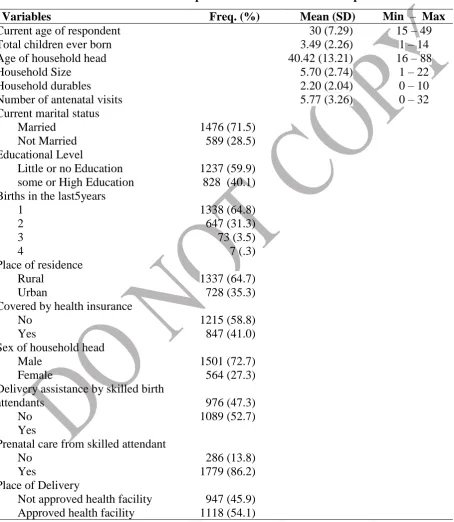
The sample consisted of 2,065 women who have had a child in the past year preceding the study. The average age of respondents was 30 years (SD=7.29). The youngest respondent was 15 years and the oldest was 49 years. Most respondents (72.7%) lived in households headed by males. The sample was predominantly rural with as many as 64.8% respondents living in rural communities. On average, there were nearly six people per household (Mean=5.70, SD=2.74), ranging from one to 22 people. Most respondents (59.9%) had little or no formal education. Majority of respondents (58.8%) were covered by health insurance. The average number of children ever born to the respondent was 3.49 (SD=2.26). Nearly two-thirds of respondents have had one chid in the last five years.
10 pregnant with their last child, the overwhelming majority of respondents (86.2%) received
[image:10.595.52.507.198.721.2]prenatal care from skilled attendant, but just a little over half of respondents (57.5%) delivered the child with the assistance of a skilled birth attendant. The descriptive characteristics are presented in Table 1.
Table 1 Descriptive characteristics of the sample
Variables Freq. (%) Mean (SD) Min – Max
Current age of respondent 30 (7.29) 15 – 49
Total children ever born 3.49 (2.26) 1 – 14
Age of household head 40.42 (13.21) 16 – 88
Household Size 5.70 (2.74) 1 – 22
Household durables 2.20 (2.04) 0 – 10
Number of antenatal visits 5.77 (3.26) 0 – 32
Current marital status Married
Not Married
1476 (71.5) 589 (28.5) Educational Level
Little or no Education some or High Education
1237 (59.9) 828 (40.1) Births in the last5years
1 2 3 4 1338 (64.8) 647 (31.3) 73 (3.5) 7 (.3) Place of residence
Rural Urban
1337 (64.7) 728 (35.3) Covered by health insurance
No Yes
1215 (58.8) 847 (41.0) Sex of household head
Male Female
1501 (72.7) 564 (27.3) Delivery assistance by skilled birth
attendants No Yes
976 (47.3) 1089 (52.7) Prenatal care from skilled attendant
No Yes
286 (13.8) 1779 (86.2) Place of Delivery
Not approved health facility Approved health facility
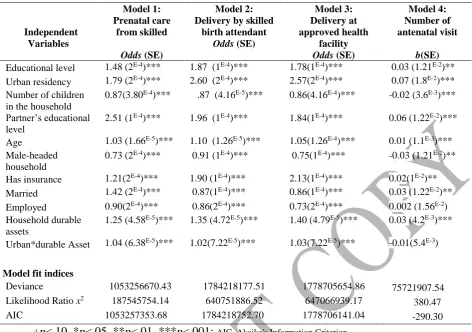
11 Table 2 presents results of all final four models. In the table, the unstandardized
coefficients (odds or b) are presented with the standard errors (SE) in parentheses. Statistically significant regression coefficients for the tested relationships are marked with asterisks.
Relationship between durable assets and prenatal care from skilled attendant
The second column of Table 2 titled Model 1 presents results of the relationship between the level of durable asset ownership and the likelihood that pregnant women sought prenatal care from a skilled birth attendant. Results show that level of ownership of durable assets is
statistically significantly associated with the odd of seeking prenatal care from a skilled personnel (odds=1.25, p < .05). Hence, the data supports the first hypothesis (H1) that “respondents with more household durable assets are more likely to seek prenatal care from skilled personnel”. Thus, for every additional unit increase in household durable assets, the odds that a pregnant woman will seek prenatal care from a skilled personal increases by 25%
controlling for other variables in the models.
Similarly, the data supports the hypothesis that, “respondents living in urban
communities and having more household durable assets are more likely to seek prenatal care from skilled personnel than those living in rural areas” (odds=1.04, p < .05). Thus, for every additional unit increase in household durable assets, the odds that a pregnant woman in an urban community will seek prenatal care from a skilled personal increases by 4% compared to a pregnant woman in a rural community. Results also show that other control variables are statistically significantly associated with the propensity to seek prenatal care from a skilled personnel (see table 2).
Relationship between durable assets and delivery assistance by skilled birth attendants
12 between ownership of durable assets and the odd of seeking delivery assistance from a skilled birth attendant (odds = 1.35, p < .05). Therefore, the data supports the hypothesis (H2)that, “respondents with more household durable assets are more likely to seek delivery assistance from a skilled birth attendant”. Holding all other variables constant, a pregnant woman is 35% more likely to seek assistance from skilled birth attendants when their household durable assets increase by one unit. Similarly, results shows that the number of household durable assets along with living in an urban community has statistically significant association (odds = 1.02, p < .05) with the likelihood that an expectant woman will seek delivery assistance from a skilled birth attendant. This means that for every additional increase in household durable assets of an expectant person in an urban community, the likelihood to seek delivery assistance from skilled birth attendant increases by 2% compared to an expectant woman in a rural area. Results also show that respondents’ age, living in urban community, number of children, educational level, insurance coverage and partner’s education are statistically significantly related to the odds of seeking assistance from skilled birth attendance when in labour (See Table 2).
Relationship between durable assets and place of delivery
13 = 2.13, p < .05), and partner’s education (odds = 1.84, p < .05) are significantly predictive of the likelihood one would deliver at an approved healthcare facility. All variables in this model had statistically significant association with the propensity for expectant mother to have a facility-based delivery.
Relationship between durable assets and frequent antenatal visits
We run a linear model to test the hypothesis that expectant mothers from households with more durable assets are likely to make antenatal visits more often. Results of the test are
presented in Table 2 and labelled Model 4. Because the dependent variable was log transformed, results are back-transformed (i.e., b * 100%) prior to interpretation. The main variable of
14 Table 2: Results of multivariate relationships
Independent Variables
Model 1: Prenatal care
from skilled
Odds (SE)
Model 2: Delivery by skilled
birth attendant
Odds (SE)
Model 3: Delivery at approved health
facility
Odds (SE)
Model 4: Number of antenatal visit
b(SE)
Educational level 1.48 (2E-4)*** 1.87 (1E-4)*** 1.78(1E-4)*** 0.03 (1.21E-2)**
Urban residency 1.79 (2E-4)*** 2.60 (2E-4)*** 2.57(2E-4)*** 0.07 (1.8E-2)***
Number of children in the household
0.87(3.80E-4)*** .87 (4.16E-5)*** 0.86(4.16E-4)*** -0.02 (3.6E-3)***
Partner’s educational level
2.51 (1E-4)*** 1.96 (1E-4)*** 1.84(1E-4)*** 0.06 (1.22E-2)***
Age 1.03 (1.66E-5)*** 1.10 (1.26E-5)*** 1.05(1.26E-4)*** 0.01 (1.1E-3)***
Male-headed household
0.73 (2E-4)*** 0.91 (1E-4)*** 0.75(1E-4)*** -0.03 (1.21E-2)**
Has insurance 1.21(2E-4)*** 1.90 (1E-4)*** 2.13(1E-4)*** 0.02(1E-2)**
Married 1.42 (2E-4)*** 0.87(1E-4)*** 0.86(1E-4)*** 0.03 (1.22E-2)** Employed 0.90(2E-4)*** 0.86(2E-4)*** 0.73(2E-4)*** 0.002 (1.56E-2)
Household durable assets
1.25 (4.58E-5)*** 1.35 (4.72E-5)*** 1.40 (4.79E-5)*** 0.03 (4.2E-3)***
Urban*durable Asset 1.04 (6.38E-5)*** 1.02(7.22E-5)*** 1.03(7.22E-5)*** -0.01(5.4E-3) Model fit indices
Deviance 1053256670.43 1784218177.51 1778705654.86 75721907.54 Likelihood Ratio x2 187545754.14 640751886.52 647066939.17
380.47 AIC 1053257353.68 1784218752.70 1778706141.04 -290.30
+p<.10, *p<.05, **p<.01, ***p<.001; AIC, Akaike's Information Criterion
Discussion of findings
Examining the association between household durable assets and maternal health seeking behaviour in this study was driven by the capability approach and the asset effect framework which posits that, resources at the disposal of individual are crucial as they present the opportunity for people to engage in long-term thinking, orientation towards the future, and general well-being (Ransome, 2010). Using these theoretical perspectives, this study examined predictors of four key elements of MHSB in Ghana.
Relationship between durable assets and prenatal care from skilled attendants
15 point to the association between asset ownership and well-being (ibid). These household
durables can equally have both direct and indirect associations with MHSB. Having the WHO’s recommendation of basic prenatal obstetric care is a step in the right direction as receiving prenatal care from skilled birth attendant does not only ensure that both foetus and mother receive appropriate medical care but also towards ensuring a safe childbirth. In this study, household consumer durables have been found to be associated with MHSB. For instance, having a television set or a radio at home can have a positive effect on MHSB through listening to or watching maternal health education program as well health oriented media broadcasts. Equally, having a mobile phone can influence MHSB if it can be used as a medium to contact skilled health personnel for help and advice. There is currently the upsurge of mHealth (mobile health) in developing countries as ICT has become very integral to healthcare delivery (Krüger and Niemi 2012; Freifeld et al., 2010).
This study like several studies (Dasgupta, 2003) acknowledges the importance of other SES factors in evaluating well-being. However, it is worth disentangling the multidimensional nature of the SES concept to ascertain how individual component may influence MHSB. The model also indicates the disproportioned used of prenatal care from skilled attendants in rural-urban divided (odds=1.79, p < .05) as pregnant women living in rural-urban communities are one and half time more likely to seek prenatal care from skilled birth attendants compared to those in rural communities. Although this could be as a result of people in the urban centres having a wider range of household consumer durable assets, controlling for living in an urban community and have having household asset still indicates that ownership of household durables is crucial to the tendency to seek prenatal care from skilled birth attendant. Results similarly indicated that an increased number of children in households reduce the likelihood (odds=0.87, p < .05) of
16 however important that the ministry of health and other stakeholder provided more information and education on the need for basic obstetric care for every pregnancy.
Relationship between durable assets and delivery assistance by skilled birth attendants
It is vital that all expectant mothers receive assistance during delivery by appropriately trained health personnel with adequate equipment in other to lowering maternal deaths. This study shows that, pregnant woman with more household consumer durables are 35% more likely to receive assistance during delivery from skilled professional birth attendants. Similarly, women living in urban communities are more likely to have skilled birth assistance. However, the level of household durable assets owned and living in an urban community and the propensity to seek skilled birth is statistically significant (odds=1.02, p < 0.05). This is consistent with findings by Ochako et al.,(2011) that highlight the widespread inequalities in accessing prenatal care due to the lack of resources to meet health cost.
Also NHIS coverage is statistically significant and 90% associated with having skilled and professionally assisted delivery. It is important that the GoG, the ministry of health, NGOs and other stakeholders take a cure from this by encouraging pregnant women to seek facility based prenatal care to avail themselves with professional obstetric care through the use of NHIS subscription. Results indicate that with any additional child in a household, the likelihood to seek skilled birth reduces. This could be due to complacency on the part of expectant mothers.
Perhaps having had children in the past gives them a false confidence about their ability to nurture subsequent pregnancies without any need to seek skilled prenatal care. However, education is needed in this regard to encourage skilled delivery.
Relationship between durable assets and place of delivery
17 dealt with when one opts for facility-based delivery. Findings from this study suggest that, household consumer durables are important predictors when it comes to choosing to deliver babies in approved health facility. In other words, household wealth in the form of durable assets is highly associated with facility-based delivery. This study is consistent with findings by Khun (2008) who argue that the lack resources and endowments are crucial barriers for poorer
members of society who have to battle with catastrophic health cost at the point of delivery. Although women with health insurance coverage are twice as likely to have facility-based delivery, 41% of women in the study did not have health insurance coverage. Studies (Marriott and Apoya, 2011) have demonstrated that asset poor households are less likely to have health insurance coverage. This study provides evidence on the how household consumer
durables may influence facility-based delivery. The is consistent with a study by Hounton, et al., (2008) in Burkina Faso where household assets was found to influence whether or not an
expectant mother will deliver in a facility based delivery. Similarly household consumer durables have been shown by Van Damme et al., (2004) to be instrumental in meeting out of pocket health expenditure. With evidence pointing to the crucial role of household consumer durables on place of delivery by expectant mothers, there is the need for a credible health policy to provide a safety net for asset-poor households. As mentioned earlier the Free Maternal Care Initiative (FMHCI) is a good step towards ensuring equitable prenatal and childbirth but the initiative is saddled with hidden chargers by health facilities making the policy initiative counterproductive.
Relationship between durable assets and frequent antenatal visits
18 relationship between household wealth mostly depicted by ones’ SES and maternal health
including the propensity to seek regular antenatal care. This study similarly demonstrates that household consumer durables are statistically significant when it comes to predicting the likelihood that a pregnant mother will seek frequent prenatal care. Interestingly, expectant mothers from male-headed households are less likely to have frequent antenatal visit. This less likelihood for expectant mothers in male-headed households to seek frequent anti-natal visits could be contextual issue. Although household durable assets are generally seen as possession of the general household, it could well that, with 72.7% been male household head, there could be limited control over household possessions by female members of the house. This could be due to the presence of domestic power imbalancesand intra-household inequalities in terms of bargaining power endemic in many developing countries (Iversen, 2003; Robeyns, 2003). Again, the GoG and stakeholder would have to do more by way of user exemptions for the asset-poor and effective educational campaign to inform expectant mothers on the needs for regular antenatal visits to ensure safe delivery of babies and the general health of mothers.
Limitations
This study has limitations that are worth pointing out. First, the study uses a
19 Conclusion
This study finds that ownership of household consumer durables are significantly associated with preventive and precautionary practice by expectant mothers in Ghana. Consequently, improving maternal health (MDG 5) in Ghana needs policy frameworks and initiatives that incorporate ways of mitigating the challenges posed by asset poverty and the lack of resources to meet health expenditure. It must be conceded that the widespread health
inequalities precipitated by poverty and poor socioeconomic status (Chandola and Marmot, 2007; Fotso, 2007) are worst for individuals in asset poor households.
Findings of this study are consistent with other studies that point to the positive
association between holding assets at the household level and health outcomes. This study does not seek to disregard the effects of other ‘traditional’ determinants of MHSB but rather shed light on how household consumer durables can independently influence MHSB. Invariably, this study suggests that if people have the needed resources to meet the pregnancy related healthcare cost, then they may be ultimately healthy enough to effectively participate in socio-economic
development. It is therefore vital that a study of this nature be conducted to ascertain the determinants of MHSB in Ghanaian context. The study focuses on maternal and health seeking behaviour (HSB) which is a vital measure toward being healthy in order to be able to fully participate in sustainable development. With results in this study pointing to a positive
20 References
Adetunji, J. A. (1995) 'Infant mortality and mother's education in Ondo State, Nigeria', Social Science & Medicine, 40(2), pp. 253-263. doi: 10.1016/0277-9536(94)e0067-3.
Ahmed, S. M., Tomson, G., Petzold, M. and Kabir, Z. N. (2005) 'Socioeconomic status
overrides age and gender in determining health-seeking behaviour in rural Bangladesh', Bulletin of the World Health Organization, 83(2), pp. 109-117.
Amin, R., Shah, N. M. and Becker, S. (2010) 'Socioeconomic factors differentiating maternal and child health-seeking behavior in rural Bangladesh: A cross-sectional analysis', International Journal for Equity in Health, 9, pp. 9-19. doi: 10.1186/1475-9276-9-9.
Andoh, D. (2014) 'Ghana Struggles to achieve MDGs 4&5'. Daily Graphic. Accra. (Politics).
Ansong, D., Chowa, G. A. N. and Grinstein-Weiss, M. (2013) 'Future Orientation as a Mediator between Assets and Perceived Household Economic Stability: A Structural Equation Modeling Approach', Social Work Research, 37(2), pp. 147-158. doi: 10.1093/swr/svt012.
Appoh, L. Y. and Krekling, S. (2005) 'Maternal nutritional knowledge and child nutritional status in the Volta Region of Ghana', Maternal & Child Nutrition, 1(2), pp. 100-110. doi: 10.1111/j.1740-8709.2005.00016.x.
Buor, D. and Bream, K. (2004) 'An Analysis of the Determinants of Maternal Mortality in Sub-Saharan Africa', Journal of Women's Health (15409996), 13(8), pp. 926-938.
Carroli, G., Rooney, C. and Villar, J. (2001) 'How effective is antenatal care in preventing maternal mortality and serious morbidity? An overview of the evidence', Paediatric & Perinatal Epidemiology, 15(s1), pp. 1-42. doi: 10.1046/j.1365-3016.2001.0150s1001.x.
Chandola, T. and Marmot, M. (2007) 'Health and Socioeconomic Status'. in George
FinkAssociate Editors:Bruce, M., Kloet, E.R.d., Robert, R., George, C., Andrew, S., Noel, R., Ian, C. and Giora, F. (eds.) Encyclopedia of Stress. New York: Academic Press, pp 255-262.
Chowa, G., Ansong, D. and Masa, R. (2010) 'Assets and child well-being in developing
countries: A research review', Children and Youth Services Review, 32(11), pp. 1508-1519. doi: 10.1016/j.childyouth.2010.03.015.
Dargent-Molina, P., James, S. A., Strogatz, D. S. and Savitz, D. A. (1994) 'Association between maternal education and infant diarrhea in different household and community environments of Cebu, Philippines', Social Science & Medicine, 38(2), pp. 343-350. doi:
10.1016/0277-9536(94)90404-9.
21 Deneulin, S. and Shahani, L. (2009) An Introduction to the Human Development and Capability Approach: Freedom and Agency. London: Earthscan.
Erim DO, Kolapo UM, Resch SC (2012) A Rapid Assessment of the Availability and Use of Obstetric Care in Nigerian Healthcare Facilities. PLoS ONE 7(6): e39555.
doi:10.1371/journal.pone.0039555
Filmer, D. and Pritchett, L. (2001) 'Estimating Wealth Effects without Expenditure Data or Tears: An Application of Educational Enrolment in States of India', Demography, 38(1), pp. 115-132.
Fotso, J.-C. (2007) 'Urban-rural differentials in child malnutrition: Trends and socioeconomic correlates in sub-Saharan Africa', Health & Place, 13(1), pp. 205-223. doi:
10.1016/j.healthplace.2006.01.004.
Freifeld C.,C., Chunara R., Mekaru S.,R., Chan E.,H., Kass-Hout T, et al. (2010) Participatory Epidemiology: Use of Mobile Phones for Community-Based Health Reporting. PLoS Med 7(12): e1000376. doi:10.1371/journal.pmed.1000376
Ghana Statistical Service, G. H. S., ICF MacroS (2009) Ghana Demographic and Health Survey 2008: Key Findings. Calverton, Maryland, USA: Ghana Statistical ServicesGhana Health
ServicesICF Marco.
Grinstein-Weiss, M., Curley, J. and Charles, P. (2007) 'Asset Building in Rural Communities: The Experience of Individual Development Accounts', Rural Sociology, 72(1), pp. 25-46.
Guliani, H., Sepehri, A. and Serieux, J. (2012) 'What impact does contact with the prenatal care system have on women’s use of facility delivery? Evidence from low-income countries', Social Science & Medicine, 74(12), pp. 1882-1890. doi: 10.1016/j.socscimed.2012.02.008.
Hounton, S., Chapman, G., Menten, J., De Brouwere, V., Ensor, T., Sombié, I., . . . Ronsmans, C. (2008) 'Accessibility and utilisation of delivery care within a Skilled Care Initiative in rural Burkina Faso', Tropical Medicine & International Health, 13, pp. 44-52. doi: 10.1111/j.1365-3156.2008.02086.x.
Iversen, V. (2003) 'intra-Household Inequality: A Challenge For The Capability Approach?', Feminist Economics, 9(2/3), p. 93.
Khun, S. and Manderson, L. (2008) 'Poverty, user fees and ability to pay for health care for children with suspected dengue in rural Cambodia', International Journal for Equity in Health, 7, pp. 1-8. doi: 10.1186/1475-9276-7-10.
22 Medicine & International Health, 13(12), pp. 1442-1451. doi:
10.1111/j.1365-3156.2008.02173.x.
Krüger, C., Niemi, M. (2012) A Telemedicine Network to Support Paediatric Care In Small Hospitals In Rural Tanzania. Journal of Telemedicine and Telecare 18: 59-62
Leive, A. and Ke, X. (2008) 'Coping with out-of-pocket health payments: empirical evidence from 15 African countries', Bulletin of the World Health Organization, 86(11), pp. 849-C. doi: 10.2471/blt.07.049403.
Leon-Gonzalez, R. and Tseng, F. M. (2011) 'Socio-economic determinants of mortality in Taiwan: Combining individual and aggregate data', Health Policy, 99(1), pp. 23-36. doi: 10.1016/j.healthpol.2010.07.005.
Luis Alvarez, J., Gil, R., Hernández, V. and Gil, A. (2009) 'Factors associated with maternal mortality in Sub-Saharan Africa: an ecological study', BMC Public Health, 9, pp. 462-469. doi: 10.1186/1471-2458-9-462.
Marriott, A. and Apoya, P. (2011) Achieving a Shared Goal: Free Universal Health Care in Ghana. Oxfam International. 68 pp. Available.
McTavish, S., Moore, S., Harper, S. and Lynch, J. (2010) 'National female literacy, individual socio-economic status, and maternal health care use in sub-Saharan Africa', Social Science & Medicine, 71(11), pp. 1958-1963. doi: 10.1016/j.socscimed.2010.09.007.
Meer, J., Miller, D. L. and Rosen, H. S. (2003) 'Exploring the health–wealth nexus', Journal of Health Economics, 22(5), pp. 713-730.
Montgomery, M. R. and Hewett, P. C. (2005) 'urban Poverty And Health In Developing Countries: Household And Neighborhood Effects', Demography, 42(3), pp. 397-425.
Ngalula, J., Urassa, M., Mwaluko, G., Isingo, R. and Ties Boerma, J. (2002) 'Health service use and household expenditure during terminal illness due to AIDS in rural Tanzania', Tropical Medicine & International Health, 7(10), pp. 873-877. doi: 10.1046/j.1365-3156.2002.00922.x.
Nussbuam, M. and Sen, A. (1993) The Quality of Life New York: Oxford University Press.
Ochako, R., Fotso, J.-C., Ikamari, L. and Khasakhala, A. (2011) 'Utilization of maternal health services among young women in Kenya: Insights from the Kenya Demographic and Health Survey, 2003', BMC Pregnancy & Childbirth, 11(1), pp. 1-9. doi: 10.1186/1471-2393-11-1.
Ransome, B. (2010) 'Sen and Aristotle on Wellbeing', Australian Journal of Social Issues, 45(1), pp. 41-52.
23 Robeyns, I. (2003) 'Sen's Capability Approach and Gender Inequalities: Selecting Relevant Capabilities', Feminist Economics, 9(2/3), p. 61.
Rothwell, D. W. and Han, C.-K. (2010) 'Exploring the Relationship Between Assets and Family Stress Among Low-Income Families', Family Relations, 59(4), pp. 396-407. doi:
10.1111/j.1741-3729.2010.00611.x.
Sahn, D. E. and Stifel, D. C. (2000) 'Poverty Comparisons Over Time and Across Countries in Africa', World Development, 28(12), p. 2123.
Sarpong, N., Loag, W., Fobil, J., Meyer, C. G., Adu-Sarkodie, Y., May, J. and Schwarz, N. G. (2010) 'National health insurance coverage and socio-economic status in a rural district of Ghana', Tropical Medicine & International Health, 15(2), pp. 191-197. doi: 10.1111/j.1365-3156.2009.02439.x.
Sen, A. (1992) Inequality Re-examined. Oxford: Clarendon Press.
Sherraden, M. (1991) Assets and the Poor: A new American Welfare Policy. New York: M. E. Sharpe, Inc.
Sherraden, M. S. and Wallace, S. P. (1992) 'Innovation in primary care: Community health services in Mexico and the United States', Social Science & Medicine, 35(12), pp. 1433-1443. doi: 10.1016/0277-9536(92)90046-s.
Sherrraden, M., Guo, B. and Zhang, L. (2008) 'Household Assets and Health in China: Evidence and Policy Implications', Center For Social Development, Csd Working Papers No. 08-28.
Urbanos-Garrido, R. M. (2012) 'Social inequalities in health: measuring the contribution of housing deprivation and social interactions for Spain', International Journal for Equity in Health, 11(1), pp. 77-90. doi: 10.1186/1475-9276-11-77.
Van Damme, Wim, Luc Van Leemput, Ir Por, Wim Hardeman and Bruno Meessen. 2004. “Out-of-pocket health expenditure and debt in poor households: Evidence from Cambodia.” Tropical Medicine and International Health 9(2):273-280.
Van den Boom, G. J. M., Nsowah-Nuamah, N. N. N. and Overbosch, G. B. (2004) 'Healthcare Provision and Self-medication in Ghana'
24 Zere, E., Kirigia, J., M.,, Duale, S. and Akazili, J. (2012) 'Inequities in maternal and child health outcomes and interventions in Ghana', BMC Public Health, 12(1), pp. 252-261. doi: