3570
DYNAMIC SELECTION OF CHILD PCE
USING SDN CONTROLLED PARENT PCE
1P.SELVARAJ, 2V.NAGARAJAN
1Research Scholar, SRM University, School of Computing, Kattankulathur, India
2V.Nagarajan, Consultant, SRM University, School of Computing, Kattankulathur, India
E-mail: 1[email protected], 2[email protected]
ABSTRACT
The next generation optical network is expected to handle the needs of an emerging applications in a cost effective way while complying with the QoS requirements. With the emergence of software-defined networking, the control plane can be lifted out from the networking devices and kept at a central location. This logical separation of layered functionalities with centralized control and management, enables the operators to offer the new range of services in an on demand and agile manner. With software defined networking, the needs of an emerging applications can be catered in real time. This paper analyzes the problem of optical light-path computation and proposes a novel mechanism for the next generation optical networks. As by the fact, any single light-path computation algorithm does not behave consistently under the varying traffic scenarios, as each algorithm/heuristic explores the search space in a unique way. So choosing the appropriate light-path computation algorithm/heuristic according to the traffic scenario is a viable approach. Considering the strict QoS requirements and global optimization aspects of the next generation applications such mechanism would be highly preferrable. This paper proposes a novel algorithm selection methodology for the next generation software defined optical network. The parent and child path computation element based optical networking was considered. The match fields used with the software defined networking were considered in designing the algorithm selection mechansism. A simulational study of QoS constrained path establishment in ONOS based software defined controller environment was performed. A java based NOX controller was configured with the parent and child path computation elements. Each of the child path computation elements were configured with different path computation algorithms. The ability of the appropriate selection of child path computation element was tested in ONOS simulation environment. This algorithm selection mechanism would be an amenable solution for the next generation software-defined optical network in which the intelligent and cognitive behaviors are inevitable.
Keywords: Next generation optical networks, Routing and wavelength assignment problem, Algorithm selection, Path computation element (PCE), software defined networking (SDN).
1. INTRODUCTION
The IP-based networks and optical networks have been managed independently with layered protocol stack approach. Both of them were over-provisioned to manage any unprecedented traffic anomalies and failures. The optical network consists of three layers such as service layer, SONET, and optical layer. The Synchronous Optical Networking (SONET) is the proprietary protocol for the optical network which runs over ATM and in-trun over the Internet Protocol (IP). The data traffic enters into the network through service layer. The SONET
3571 the number of costlier and energy hungry transceivers to be deployed in the optical cross connects. In optical neworking the routing will be done based on some fixed light path computation algorithm. Such algorithm will be decided by the optical device manufacturers while considering the proprietary hardware issues [2]. This paper focuses on the optical path computation algorithms with an intention to improve the QoS of every user demands and thereby propagate the optimal performance throughout the network. As there exists variety of optical path computation algorithms [3] choosing the appropriate algorithm with respect to the current traffic parameters will improve the overall network performance.
With SDN, different path computation algorithms can be simultaneously executed as the pluggable software modules wherein each of them will be consuming the required amount of monitoring information. The software-defined networking (SDN) was mainly developed to overcome the issues and the rigidity of the conventional traffic management [4]. This work was embraced with SDN and proposes that, the optical path computation algorithm can be dynamically modified as the control plane is centrally managed at the controller’s end. And in such SDN-based optical networking, a centralized controller has to take any critical decisions about when to configure or reconfigure the set of light paths (optical connections). Nevertheless the controller has to trade with multiple and simultaneously ongoing light-paths in a dynamic and cost effective manner.
This work proposes the mechansim to dynamically select the appropriate light path computation algorithm (routing and wavelength allocation or assignment algorithm) based on the traffic scenario. The problem of choosing the appropriate path computation algorithm was rephrased as the problem of choosing the appropriate child PCE (path computation element). With the programming interfaces and the logical abstractions of SDN, each child PCE can be coupled with different path computation algorithms. As a simulational study, the parent PCE was programmed inside the SDN controller to orchestrate the child PCEs’. And the controller was programmed to choose the appropriate child PCE using the algorithm selection mechanism. In this way different types of traffic were ported onto the various path computation algorithms
with the help of SDN. This work proposes the SDN inspired match-fields based mechanism for the appropriate selection of path computation algorithms with required performance. The simultaneous deliberation of different path computation algorithms has resulted in network wide performance improvement. As each algorithm/heuristic was capable of exploring the various regions of the solutions space, the traffic has been distributed in a much controlled way. A simulational study was performed in ONOS SDN controller environment [5] to analyze the characteristics of the proposed algorithm/heuristic selection mechanism.
This paper is organized as follows: Sec.2 provides a detailed view of the benefits of SDN along with its architectural details , Sec.3 explains about the advantages of SDN based PCE architecture, sec.4 describes about the GMPLS based PCE architectures, Sec.5 briefly explains the problem of routing and wavelength assignment in optical networks, Sec.6 reviews about the table driven approach of SDN, Sec.7 explains a novel match fields based algorithm selection method, Sec.8 discusses the simulation study and its results and, Sec.9 concludes the paper.
2. SOFTWARE DEFINED NETWORKING (SDN)
3572 decouple the control and data plane. With SDN the network can be dynamically controlled by the custom made softwares.
Most of the SDN related aspects are being looked after and encouraged by organizations like Open Network Foundation (ONF) and Internet Engineering Task Force (IETF) etc. The OpenFlow as a south bound interface (SBI) enables the communication between the data and control plane. The application plane and the control plane can be interfaced through the north bound interfaces (NBI) like RESTful API etc (Ref.Fig.1). The data plane deals only with the forwarding of packets according to the instructions of the control plane. All the SDN applications including the stable tasks like physical equipment setup, assigning resources will be managed by the management plane that coordinates with the other layers of SDN. The SDN was commonly characterized by five properties namely plane separation, centralization of the controller, automation, virtualization, and openness. With SDN the customer can define their own requirements in the form of constraints. The SDN controller can configure the network elements so as to satisfy the customer demands while optimizing the overall network performance. As never before, the SDN can derive a level of convergence with its global network visibility and dynamic reconfigurability. With SDN, the complex and legacy physical devices can be transformed to simple and dump forwarding elements.
Figure.1 Different SDN planes and interfaces
The wide range of applications like data center applications, wide area backbone, and enterprise applications were already started benefitting with the SDN [7]. Hence the SDN
has evolved and become a new network organizing technique to realize more performance with added flexibility.
The OpenFlow specification has been defined in accordance with the various components of the SDN architecture. The OpenFlow controller communicates with the OpenFlow compatible switch using OpenFlow protocol. One of the instantiations of SDN is OpenFlow protocol, which separates the controller and the programmable switch over a secure channel. Through the logical abstraction of layered functions, the controller can gain a level of dynamic configuration.
2.1 Traffic Routing With SDN
With SDN, the traffic can be routed through the networks using the centralized routing logic through which the routers and switches were programmed. The next-generation internet would perform the data transport, routing and switching functions through software controlled/defined algorithms and protocols. And such activities could be activated with even the user end through ‘point and click’ interfaces [8]. There is a strong need for the dynamic and automated mechanism to oversee the complex and mundane network functions like routing etc. The traffic plane transporting the information payload could be operated upon by an overlaid control/signaling/management plane while the application plane providing the necessary support and inputs to tune the network according to the customer needs. The functional networking nodes could be designed with reconfigurable attributes and storage capabilities along with embedded intelligence of matching with the demands for realizing an Intelligent Network Architecture (INA). Along with intelligent architecture, cognitive features can also be embedded in various layers like data, control, management and application with which the network could perform a ‘so called’ self-organizing feat based on cyclic phases of observe, study, learn and execute [9].
3. SDN BASED PATH COMPUTATION ELEMENT
3573 been used as a major element that computes and manages the paths. The following section briefly describes the role of PCE in SDN based optical networking.
3.1 PCE in Optical Networking
The PCE is an entity which computes the paths based on the network graph and the specified constrains (RFC 4655) [10]. The PCE can compute the paths based on the latest real time topology maintained in the traffic engineering database (TED). The PCE can be either embedded inside a routing element or it can function as a separate central entity. The conventional optical networking elements did not have the control plane, routing abilities with required computation power and huge memory. This has led to the development of dedicated path computing entity that computes paths on behalf of all the optical networking nodes.
3.2 PCE under SDN Controller
The SDN controller can interface with the dedicated PCE to customize the path computation process. The SDN controller can configure the flow tables of the openflow compatible switches and routers to realize the desired flows. The algorithms that computes the paths can be loosely coupled with PCE [11]. So the PCE can be dynamically configured with
different algorithms. The PCE
replicas/instances/child PCEs’ with different path computation algorithms could be instantiated at the controller end. The different PCE’s with different algorithms can be coordinated under the control of the single parent PCE. The parent PCE can act as an orchestrator to coordinate between multiple child PCE’s with the centralized TED update/modification synchronization. The parent PCE can be co-located with the SDN controller. All the child PCE’s can act on the same networking domain and share/update a common TED. The parent PCE will coordinate beween the traffic requests and the child PCE’s. And this process can be continued for all the evolving traffic demands.
4. BACKROUND ARCHITECTURE
4.1 Different GMPLS Based PCE Architectures
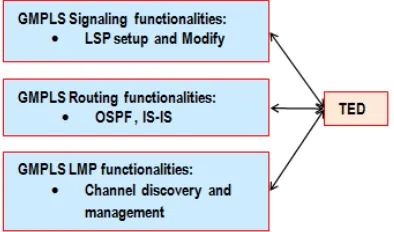
The GMPLS is the underlying protocol that governs the functionalities of PCE. The following section describes about the various
functionalities of GMPLS protocol and the different GMPLS based PCE architectures.
[image:4.612.327.524.338.454.2]With the continuously increasing internet based applications, the reliable and high-speed data transmission has become a major challenge. The MPLS was mainly developed to improve the speed of IP-based data transmission simply by matching the label of the packets with the MPLS table at each LSR routers. Initially, the MPLS was successfully applied to the packet switched networks and later it was enhanced to support the circuit switched networks like WDM and TDM networks. And the MPLS was improved as multi- protocol lamda switching (MPλS). Through MPλS, the incoming lamdas were mapped onto the out-going lamdas by the switching tables. And later the IETF has generalized the MPLS and MPλS and they have formed the GMPLS (Generalized MPLS) protocol [12].
Figure 2. GMPLS functional blocks
3574
4.2 Different SDN Based PCE Architectures
In SDN scenario, the PCE can be directly programmed and controlled by the SDN controller. The hybrid PCE-based SDN controller can get more benefits such as global visibility of the network topology, network optimization with effective resource management etc., The following figures shows various PCE deployment architectures namely a) Active Stateful path computation architecture b) Active State-less path computation architecture c) Active Stateful PCE as SDN application (Ref.Fig.3,4,5).
Figure.3 Active Stateful path computation architecture
Figure.4 Active State-less path computation architecture
The path computation function can be distributed across the many PCC elements or it can be centrally computed by the PCE. Such PCE can also act as an SDN application. Normally the PCE does not have any standard path computation algorithm. In optical networks, the RWA algorithm would be chosen by the device manufacturer based on the implementation scenario. The manufacturers usually follows the open shortest path first
(OSPF) or constrained shortest path first (CSPF) approaches for routing and first-fit approach for wavelength assignment [14]. In most of the PCE implementations the static algorithm will be used. But the PCE with its loosely coupled ability it can be coupled with any algorithm in a dynamical way.
Figure.5 Active Stateful PCE as SDN application
And the PCE can exploit the advantages from many sophisticated algorithms which may even computationally heavy. The PCE can compute many traffic engineered MPLS LSPs according to the transmission requirements. The PCC can be co-located along with the PCE or it can be in a different location. The PCE can communicate with the NMS (network monitoring system ie., provisioning server) and the TED, for the dynamic path computation. Hence the selection of the PCE architecture usually depends on the way the operator wants to run the network. And with PCE the choice of the path computation algorithms can be dynamically changed according to the opertor’s policies.
5. DYNAMIC ROUTING AND WAVELENGTH ASSIGNMENT PROBLEM IN OPTICAL NETWORKS
5.1 The Optical Path Computation Problem
3575 wavelength assignment and wavelength continuity. The collection of such lightpaths which are satisfying or optimizing several QoT parameters (like less congestion, delay, cost etc.,) comprises the virtual topology design (VTD) of the underlying physical topology [15]. The VTD comprises the set of lightpaths computed according to the requirements of all the physical nodes. Before the data is transferred through the optical medium the logical topology of the physical topology has to be computed by solving the RWA (Routing and wavelength assignment) sub problem for the evolving traffic demands. And moreover, such logical topology should be dynamically reconfigured in order to accommodate with the evolving traffic demands. As the performance of the RWA algorithm greatly depends on the environmental conditions, the computational complexity of online RWA algorithms is NP-hard whereas for offline RWA that is NP-Complete [16].
All the light paths composing a virtual topology must adhere with the QoT requirements by maintaining a low Bit Error Rate (BER). The optical path computation algorithms should also consider the major physical impairments in terms of loss and dispersion, in order to meet out the QoT requirements. Moreover to enforce the survivability, both the working and backup path sets must be computed and reserved in advance. The huge bandwidth requirements of the emerging high-performance applications can be effectively handled by the multipath routing approach, which is resource effective in terms of survivability aspects. As the number of nodes increases, the ILP (Integer Linear Programming) formulation of the multipath routing will grow exponentially constlier.
The data traffic of the future world, carried by the core optical networks will exploit the fiber capacity much more than the nowadays networks. And the cost of any network failure is also expected to be much higher. Hence the optical path computation has to be undertaken with effective methods and measures.
5.2 Major Approaches To Solve Optical Path Computation
This section describes about some of the major techniques proposed in literatures to solve problem of optical path computation.
The design of the virtual topology involves
finding the route and wavelength for every connection request while optimizing the overall/long-term network performance like energy efficiency etc. The RWA is one of the core problem in next generation IP based WDM networks. The physical layer impairment aware RWA algorithms proposed in [17] has achieved the desired level of the QoT. In [18] ,the traffic demands were categorized into high or low QoT category and treated accordingly. In [19] they have proposed the traffic scenario based multi-path based routing. And based on the changing traffic scenario and changing resource availability the RWA was done in a dynamic manner. The optical path computation has been considered as a multi-objective optimization problem. As the ability of genetic algorithm in multi objective optimization was promising, they become the promising candidate to solve the multi-constrained RWA problem. In [20], they have used genetic algorithm based RWA, and the solutions were obtained with different tradeoff between the optimization parameters. The genetic algorithms can find, in a single execution, a set of virtual topologies which is otherwise called Pareto Optimal Set (POS). These POS consists set of solutions each with a different tradeoffs’ between the optimization parameters. In [21] they have considered gearing up the genetic algorithm with the learning and generalization ability of neural networks. There are very few works published in the perspective of improving the genetic algorithm with the cognitive abilities. In [22] they had developed two multi-objective genetic algorithms, one with backup path computation and the other with the simple cognition based method. In [23] they have proposed a hetrogeneous cognitive optical network architecture with the cognitive techniques. In [24] they have mentioned about storing the “fit service scenario” in the knowledge base in the form of patterns and periodically updating the same by an offline running system based on genetic algorithm. In [25] they have used the concept of hyper heuristic technique (heuristic to select the heuristic) the RWA problem was solved effectively. The adaptability was the key aspect in all the proposed cognition based multi-objective RWA approaches.
3576 adaptations to make the informed decisions in the future scenario.
5.3 Path Cost Function in Optical Path Computation
The path cost function varies in different RWA algorithms with different optimization requirements with the various levels of knowledge acquired with TED through control and management protocols. So any RWA algorithm will vary from the other one based on the way the path cost function was calculated and the type of monitoring information consumed for the same [26]. For every established light path, the QOT must be with in the acceptable range while the call blocking probability kept very minimal. Because of the real-time execution the RWA algorithms must be very simple.
Most of the RWA algorithms are having the following steps in common:
Step 1: Exploring all the ‘k’ potential candidate working paths by applying certain heuristics.
Step 2: Sorting the paths based on some path selection policy (ex: Number of Hops). For each of ‘k’ paths, the cost function will be calculated. The link cost function varies in different algorithms with a different requirement. The TED will be fed with the network state information). The cost function is a function of shareability, real time resource availability, link cost of the TE link etc.
Step 3: Finding the set of working paths & Backup paths.
Step 4: Selecting the minimum cost path pair {working and backup}.
Step 5: If no path can be found, then return NO_PATH.
Step 6: Updating the path information in LSP DB and TED based on the current network status (weighted total distance will be calculated with this real time updated information)
The un-predictability of the service demand and network availability can be handled by the multi-core/multi-mode and multi-band fiber and its switching capabilities. With the advent of flexi-grid spectrum assignment, the adaptive bandwidth provisioning has been made possible. The wavelengths can be provisioned at wavelength and even sub-wavelength levels.
Considering the aforementioned points,
we have proposed a mechanism which can perceive the user demands and classify them under a profile of contexts and infer the right set of actions (selecting the best path computation algorithm). The advancements in GMPLS, SDN, PCE are the great enablers for the innovative developments in the next generation optical network.
6. SDN BASED PATH COMPUTATION WITH FLOW MATCHING APPROACH
The OpenFlow specification defines the components of a switch, message format and the type of actions that need to be taken in a general manner.
The set of standard messages that are exchanged between the OpenFlow switch and the OpenFlow controller are defined using OpenFlow protocol. These messages let the controller to program the switch. The OpenFlow specification version1.0 defines a generic flow table that contains flow entries like header fields, counters, and actions. When a packet arrives at the Openflow switch, the packet header data will be matched against with the flow table entries and the corresponding action will be taken [27]. The header fields of the incoming packets will be checked with the flow table entries to find the appropriate flow. The counter field provides the statistical information like the number of packets that have been forwarded or dropped. And the action field defines the coresponding action that must be performed upon the matching of packet information. There are twelve fields defined as the packet header information, on which the flow table entries will be matched. (Ref.Table.1).
Table.1. OpenFlow protocol flow table entry fields
3577
Figure.5 SDN Controller Manages The Routes With Flow Table Management At The Device End
The OpenFlow control plane has the following capabilities:
a) Openflow control plane exists as a disjoined entity from the data plane
b) through the unified instance of the controller the various types of data plane elements can be programmed with the standard programming languages.
The communication between the OpenFlow switch and the OpenFlow controller will be done over a secured medium, with TLS-based asymmetric encryption. Three general actions implemented by the OpenFlow switch are forward, drop or send to the controller. In general, the OpenFlow messages [28] will fall into any one of the following three categories namely i) four symmetric messages that may be sent either by the controller or the switch, ii) fourteen controller-switch messages and iii) four async messages that are sent from the switch to the controller (Ref table.2).
Table.2. Various Messages Between The Controller And The Switch
No Controller-Switch Various Message Types
Message Name Description
1 Symmetric Messages HELLO Determines highest Openflow version number supported by end-hosts
2
ECHO_REQUE ST/ ECHO_REPLY
Used by either side to ensure that the connection is still alive
3 VENDOR Specifies vendor related enhancements
4 configuratiSwitch SET_CONFIG Controller uses this message to set
on Messages
configuration parameters in the switch 5 FEATURES_RE QUEST/FEATU RES_REPLY Controller requests the switch to provide the features it supports 6 GET_CONFIG_ REQUEST/GET _CONFIG_REP LY Controller retrieves the switch’s configuration settings 7 Commands from Controller
PACKET_OUT Send the data packets to the switch
8 FLOW_MOD Modify the flow entries in the switch
9 PORT_MOD Modify the status of an Openflow port
10 Statistics
STATS_REQUE ST/STATS_REP
LY
Controller obtains the statistics from the switch 11 Queue configurati on QUEUE_CONFI G_REQUEST/ QUEUE_CONFI G_REPLY
Controller learns how to configure the switch to accomplish desired QoS
12 Messages Barrier
BARRIER_REQ UEST/ BARRIER_REP LY Controller ensures that specific command was executed. 13 Controller-Switch Various Message Types
Message Name Description
14
Async Messages
PACKET_IN
Switch sends back the data packets to the controller
15 FLOW_REMOVED
Switch informs the controller that a flow entry is removed
16 PORT_STATUS Port update information
17 ERROR
Switch notifies the controller about any problems
Thus the SDN has been evolved as a new trend to manage the network functions through the software driven (intelligent) control plane with flow table matching mechanism. Through SDN different data planes can be controlled under a unified control plane algorithm.
7. PROPOSED APPROACH
7.1 Match Fields Based RWA Algorithm Selection
3578 its disjointness nature among the data and control plane. In the proposed approach, every PCC (path computation client) request will be mapped with the particular path computation algorithm based on the instance of the TED and the traffic status (Ref Fig.6). In this way, many virtual overlay networks (VTDs’) can be computed and provisioned on the optical data plane. The different types of services can be provisioned by augmenting the capabilities of many existing routing and wavelength assignment algorithms. All the virtual overlay networks will be controlled by the corresponding co-operating child PCE’s. All the child PCEs’ will be orchestrated by the parent PCE
(Ref.Fig.7). All the child PCEs’ will refere the
common TED in a synchronized and consistent manner.
Figure.6 Dynamic selection of child PCE based on the PCC constraints, TED and LSP DBs’.
7.1.1 Mapping Function
According to this diagram, the mapping function (which performs algorithm/heuristic selection) with the help of TED and LSP DBs’ (which remembers traffic scenarios and the established LSPs’) will implement the algorithm/heuristic selection.
Figure.7 The sequence of activities between the PCC, SDN Controller, Parent PCE & Child PCE.
The fields of the PCC request and response is given below:
PCC Request contains the following fields: Flow ID, APP ID, Group ID, Table ID, Priority, Timeout, Permanent, State, Packets, Bytes, Objective function.
PCC Response contains the following fields: RP, ERO, LSPA, BANDWIDTH, METRIC, IRO, Signaling attributes [29].
The PCEP (Path Computation Element Protocol) is a session based protocol which transmits the PCReq and PCRsp messages over TCP. With the updated LSP DB, the active PCE can able to advise the network with possible optimal paths whenever the congestion accumulates. The PCE can assign flows to paths with different quality requirements (ex: jitter, delay, reliability etc.,) [30].
7.2 Proposed Cognitive Behaviors
3579 7.2.1. Sensing the environment (Perceive)
a) This involves monitoring the traffic demand from the PCC (Path computation Client)
b) And collecting the real time data about the status of the network through TED (Traffic Engineering Database) and LSP DB’s (Label switched path database).
7.2.2. Processing the Collected Data to Derive a Plan of Action (Orient and Decide)
a) The algorithm selection agent will process the collected data and match the requirements/intents with the particular path computation algorithm.
7.2.3. Execution of the planned actions (Act)
[image:10.612.308.518.150.347.2]a) The PCE-based SDN controller will map the traffic demand with the appropriate child PCE replica (Ref.Fig.8).
Figure.8 The sequence of interactions between the PCC, SDN Controller, Parent PCE & Child
PCE.
8. EXPERIMENTAL VALIDATION
8.1 Use case: Optical Path Computation with Dynamic Selection of Child PCE’s
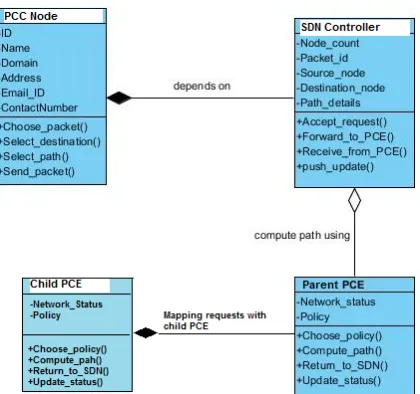
We have written a java based NOX controller to coordinate between the PCC’s and child PCE’s. The class diagram used to write the controller is given in the figure (Ref.Fig.9). The class relationship diagram used to create the java based controller application is given below with their attributes and functions. We have created the custom topology with 6 nodes, 6 switches and 10 ROADMs’ using mininet. After the topology setup when the source tries to send the first packet to the destination, PCC was made to check the flow table entries. The PCC was programmed to send the packet to the controller, if the match for particular packet flow is not
found. Then the controller will compute the paths based on any one of the PCE replicas and modify the entries of the flow tables along the computed path.
Figure.9 Class diagrams used to create the java based controller application
[image:10.612.62.297.357.468.2]8.2. Setting the ONOS SDN Controller Environment
Figure.10 ONOS simulation environment with custom made topology of packet and optical networks
[image:10.612.318.559.390.527.2]3580 GUI web interface [32]. We have observed the instances of the controller over a period of time. The details of hosts, links, switches, and related details are observed for every LSPs’. The traffic flow statistics were noted to analyze the throughput and delay of LSP’s. The various observations made with the LSP creation and updates are monitored. The throughput (Mb/s) and delay (ms) of all created LSP’s are monitored.
8.3 LSP Tunnel Creation/ Updation/Deletion
Using various commands the tunnel creation, updation and deletion has been explored.
Figure.11 LSP established between start node and end node through optical switches
Fig.11 custom optical topology view in ONOS GUI
The information such as source-LSR-ID, destination-LSR-ID, source-interface, destination-interface were obtained from the ONOS GUI. The unique-tunnel-id was quoted in all the tunnel related commands such as creating, deleting, or updating tunnel. The Tunneldb command was used to ensure whether tunnel has been created, updated or deleted. Hence the simulation of constrained label switched path creation has been done in the ONOS environment. And the details of LSP’s were observed (Ref.Fig.11).
8.4 Setting up the Simulation Parameters
8.4.1 Requirements for the Simulation
Linux operating system (Ubuntu), POX Controller , mininet, wireshark packet analyzer Input : Node, Link information, Traffic matrix.
8.4.2 Traffic Matrix Generation
We have generated our own traffic matrix through uniform distribution, which Contains a matrix of offered traffic for each ingress-egress node pair (measured in Gbps).
In what follows we present the model that was used for the creation of the online traffic.
1) arrival_time and duration values:
We assumed that the connections are generated according to a poisson process with average λ connections per “time unit” (and thus the inter-arrival times between two connections follow the exponential distribution – with average 1/λ “time units”) and the duration of each connection follows the exponential distribution with average 1/μ “time units”. (Here the “time units” can be assumed as different values, e.g. sec, min, hours, days, without affecting the creation of the traffic). Note that the important parameter for this traffic creation model is the ratio λ/μ, which does not depend on the time unit.
2) Source and destination values
The source and destination nodes of the connections will be drawn uniformly among all the nodes of the network.
3) Capacity
The capacity that will be requested by each connection demand will be drawn by a uniform and an exponential distribution function with a given average rate. It is the discretion of the online algorithm to decide to split and/or groom the traffic according to the state of the network and the established light-paths at the time that the connection arrives. The requested capacity will not be rounded to the line rates supported by the network.
4) Traffic Creation
3581 interval obtained is sufficiently small as to safely judge the performance of the particular algorithm.
8.4.3 Simulation
We have written python scripts to simulate the behavior of switch and the POX controller. We have programmed the controller to schedule the packets according to its Qos level (priority). We simulated the regular topology network (tree topology) using mininet with depth value 3. We connected the network with the POX controller. We tested the switches by pinging from the mininet. The wireshark analyzer was used to analyze the packets sent between the nodes.
We have made our own ONOS based SDN controller with the behavior (intelligence) of selecting the best algorithm. We have used two path computation algorithms namely ALCA –Adaptive Least Congestive Algorithm and CSPF-Constrained Shortest Path First. Using the PCE (Path Computation Element) and PCC (Path Computation Client) application packages we have activated the PCC REQUEST and RESPONSE mechanisms. We intentionally raised the PCC REQUEST with some metric parameter. Whenever the PCC REQUEST comes with some METRIC parameter [33] mentioned, the algorithm selection agent (ie application running inside the controller) will map the request with the CSPF algorithm. If the METRIC parameter is not mentioned with any value the agent will map the request with the ALCA algorithm. And the paths will be computed with any of the mapped algorithm. The PCC response will be sent to the PCC nodes. The format of the PCC request and response messages are given below (Ref.Table.3 &4).
Table.3. PCC request message
Table.4. PCC response message
Hence the PCC requests were generated and sent to the controller. And the controller was able to map the PCC requests with the appropriate path computation algorithm.
Figure.12 View of IP and Optical Layer with Nodes, IP Switches, ROADMs’ and Optical Links
Figure.13 Measuring the bandwidth of the optical links in ONOS environment
3582
Figure.14 Wireshark trace for the analysis of global network utilization
9. CONCLUSION
The NG-optical network is expected to handle the QoS needs of the emerging applications in a cost effective and resource effective way. The control plane for such NG-optical network, can to address the needs of the generic and abstract service deployment interface. The allocation and the configuration of resources will be handled by the intelligent and cognitive solution. The RWA (routing and wavelength assignment) is an important problem in the optical network. To achieve the performance improvement this RWA has to be solved efficiently. Different RWA algorithms would perform better with different traffic scenarios. In NG-optical networks, there would be a strong need for the solutions, which cope with the varying traffic conditions and tune the network pipes accordingly. This work proposes a novel context aware algorithm selection model which detects and assesses the environmental changes for the selection of suitable protocol suites and network configurations. In this work we have proposed an algorithm selection approach as a viable mechanism for the NG optical networks. The match fields for the selection of algorithm were proposed. A simulation study of constrained path computation was performed to study the characteristics of using different path computation algorithms in the same domain.
10. FUTURE WORK
1. Identification of the parameters by which the existing VTD algorithms can be grouped as a profile of solutions.
2. Identifying the ways to represent the initial “Know-How” knowledge and the learning mechanism.
3. Realizing the pattern recognition ability in inferring the knowledge base and deriving new knowledge out of an experience. 4. Developing the required fitness function to
enhance the existing genetic algorithms by improving its precision and accuracy. 5. Proving the robustness of cognitive methods
in finding the optimal VTs for all the possible scenarios through numerical simulation.
11. ACKNOWLEDGEMENTS
This work is a part of the work done at Tejas-SRM Optical SDN test bed facility, SRM University, Kattankulathur, India. The authors thank the management of SRM University and Tejas Networks for their support.
REFERENCES
[1] Jain R. Optical Networking with IP over DWDM: Recent Advances, Trends, and Issues. IEEE Distinguished Lecture at IIT Delhi, IIT Bombay, IISc Bangalore, and Trivandrum. 2001 Dec 16.
[2] Ozdaglar AE, Bertsekas DP. Routing and wavelength assignment in optical networks. IEEE/ACM Transactions On Networking (ton). 2003 Apr 1;11(2):259-72.
[3] Zang H, Jue JP, Mukherjee B. A review of
routing and wavelength assignment
approaches for wavelength-routed optical
WDM networks. Optical networks
magazine. 2000 Jan;1(1):47-60.
[4] Thyagaturu AS, Mercian A, McGarry MP, Reisslein M, Kellerer W. Software defined
optical networks (SDONs): A
comprehensive survey. IEEE
Communications Surveys & Tutorials. 2016 Oct 1;18(4):2738-86.
[5] Kupalov I. Software Defined Networks Case Study.
3583
[7] Lin T, Kang JM, Bannazadeh H, Leon-Garcia A. Enabling sdn applications on
software-defined infrastructure. InNetwork
Operations and Management Symposium (NOMS), 2014 IEEE 2014 May 5 (pp. 1-7). IEEE.
[8] Medved J, Varga R, Tkacik A, Gray K. Opendaylight: Towards a model-driven sdn
controller architecture. InWorld of
Wireless, Mobile and Multimedia
Networks (WoWMoM), 2014 IEEE 15th International Symposium on a 2014 Jun 19 (pp. 1-6). IEEE.
[9] Palkopoulou E, Stiakogiannakis I, Klonidis D, Jiménez T, Fernández N, Aguado JC, López J, Ye Y, Tomkos I. Cognitive
heterogeneous reconfigurable optical
network: A techno-economic evaluation. InFuture Network and Mobile Summit (FutureNetworkSummit), 2013 2013 Jul 3 (pp. 1-10). IEEE.
[10] Casellas R, Muñoz R, Martínez R, Vilalta R, Liu L, Tsuritani T, Morita I, López V, de Dios OG, Fernández-Palacios JP. SDN orchestration of OpenFlow and GMPLS flexi-grid networks with a stateful hierarchical PCE. IEEE/OSA Journal of Optical Communications and Networking. 2015 Jan;7(1):A106-17.
[11] Paolucci F, Cugini F, Giorgetti A, Sambo N, Castoldi P. A survey on the path computation element (PCE) architecture.
IEEE Communications Surveys &
Tutorials. 2013 Nov;15(4):1819-41. [12] Lee Y, Bernstein G, Imajuku W.
Framework for GMPLS and path computation element (PCE) control of wavelength switched optical networks (WSONs). 2011.
[13] Muñoz R, Casellas R, Martínez R. Dynamic distributed spectrum allocation in
GMPLS-controlled elastic optical networks.
InOptical Communication (ECOC), 2011 37th European Conference and Exhibition on 2011 Sep 18 (pp. 1-3). IEEE.
[14] Giacalone S, Atlas A, Drake J, Ward D. OSPF Traffic Engineering (TE) Express Path. draft-giacalone-ospf-te-express-path-01. 2011 Sep 21.
[15] Dutta R, Rouskas GN. A survey of virtual topology design algorithms for wavelength routed optical networks. Optical Networks Magazine. 2000 Jan;1(1):73-89.
[16] Huiban G, Mateus GR. A multiobjective approach of the virtual topology design and
routing problem in WDM networks. InICT
International Conference on
Telecommunications 2005 May.
[17] Rahbar A. Dynamic impairment-aware RWA in multifiber wavelength-routed all-optical networks supporting class-based traffic. IEEE/OSA Journal of Optical Communications and Networking. 2010 Nov;2(11):915-27.
[18] Jiménez T, Aguado JC, de Miguel I, Durán RJ, Angelou M, Merayo N, Fernández P, Lorenzo RM, Tomkos I, Abril EJ. A cognitive quality of transmission estimator for core optical networks. Journal of
Lightwave Technology. 2013 Mar
15;31(6):942-51.
[19] Zhu Z, Lu W, Zhang L, Ansari N. Dynamic service provisioning in elastic optical networks with hybrid single-/multi-path routing. Journal of Lightwave Technology. 2013 Jan 1;31(1):15-22.
[20] Duran RJ, Fernández N, de Miguel I, Angelou M, Sánchez D, Aguado JC, Jiménez T, Fernández P, Merayo N, Atallah N, Lorenzo RM. Advantages of using cognition when solving impairment-aware virtual topology design problems. InTransparent Optical Networks (ICTON), 2011 13th International Conference on 2011 Jun 26 (pp. 1-4). IEEE.
[21] Fernández N, Durán RJ, de Miguel I, Aguado JC, Jiménez T, Angelou M, Sánchez D, Fernández P, Merayo N, Atallah N, Lorenzo R. Cognitive algorithm to solve the impairment-aware virtual topology design problem in reconfigurable optical networks. InCognitive Methods in Situation Awareness and Decision Support (CogSIMA), 2012 IEEE International Multi-Disciplinary Conference on 2012 Mar 6 (pp. 170-173). IEEE.
[22] Fernández N, Durán RJ, de Miguel I, Merayo N, Sánchez D, Angelou M, Aguado JC, Fernández P, Jiménez T, Lorenzo RM, Tomkos I. Cognition to
design energetically efficient and
impairment aware virtual topologies for optical networks. InOptical Network Design and Modeling (ONDM), 2012 16th International Conference on 2012 Apr 17 (pp. 1-6). IEEE.
3584
InTransparent Optical Networks (ICTON), 2011 13th International Conference on 2011 Jun 26 (pp. 1-4). IEEE.
[24] Schupke DA, Jager M, Hulsermann R. Comparison of resilience mechanisms for dynamic services in intelligent optical
networks. InDesign of Reliable
Communication Networks, 2003.(DRCN 2003). Proceedings. Fourth International Workshop on 2003 Oct 19 (pp. 106-113). IEEE.
[25] Keleş A, Yayimli A, Uyar AŞ. Ant based hyper heuristic for physical impairment aware routing and wavelength assignment. InSarnoff Symposium, 2010 IEEE 2010 Apr 12 (pp. 1-5). IEEE.
[26] Tsuritani T, Miyazawa M, Kashihara S, Otani T. Optical path computation element interworking with network management system for transparent mesh networks. InOptical Fiber communication/National Fiber Optic Engineers Conference, 2008. OFC/NFOEC 2008. Conference on 2008 Feb 24 (pp. 1-10). IEEE.
[27] Hu F, Hao Q, Bao K. A survey on software-defined network and openflow: From
concept to implementation. IEEE
Communications Surveys & Tutorials. 2014 May 22;16(4):2181-206.
[28] Tootoonchian A, Ganjali Y. HyperFlow: A distributed control plane for OpenFlow. InProceedings of the 2010 internet network management conference on Research on enterprise networking 2010 Apr 27 (pp. 3-3).
[29] Farrel A, Vasseur JP, Ash G. A Path Computation Element (PCE). MPLS2008 (Farrel-PCE-Tutorial. ppt). 2006.
[30] Martínez R, Casellas R, Vilalta R, Muñoz
R. Experimental assessment of
GMPLS/PCE-controlled multi-flow optical
transponders in flexgrid networks.
InOptical Fiber Communications
Conference and Exhibition (OFC), 2015 2015 Mar 22 (pp. 1-3). IEEE.
[31] Berde P, Gerola M, Hart J, Higuchi Y, Kobayashi M, Koide T, Lantz B, O'Connor B, Radoslavov P, Snow W, Parulkar G. ONOS: towards an open, distributed SDN OS. InProceedings of the third workshop on Hot topics in software defined networking 2014 Aug 22 (pp. 1-6). ACM.