BIOMETRIC IDENTIFICATION USING GLOBAL
DISCRETEZATION
1,2,3 BAYAN OMAR MOHAMMED, 3
RZGAR SIRWAN RAZA ,1,2 SITI MARIYAM
SHAMSUDDIN
1
UTM Big Data Centre, Ibnu Sina Institute for Scientific and Industrial Research, Universiti Teknologi Malaysia, Johor, Malaysia
2
Faculty of Computing Universiti Teknologi Malaysia, Johor, Malaysia.
3
College of Science and Technology, University of Human Development, Sulaimani, KRG , Iraq. E-mail: 1,2,3 [email protected] , 3 [email protected] , 1,2 [email protected]
ABSTRACT
Biometrics is the science and technology that involves the measurement and analysis of the human body’s biological data. Biometrics involves the extraction a feature set from the obtained data. The feature set is then compared against the template set stored the database. Identification of people must demonstrate reliability and accurately especially in the domains of business transactions and in the access to confidential information. The currently available fingerprint biometric Identification concentrates on feature extraction and task of classification for authorship identification. In fingerprint, the random representation may cause degradation to the performance of classification. Thus, prior to the classification task, certain standards should be present to denote these unique features. In relation to this, the application of the discretization technique would be beneficial. Hence, a new framework for fingerprint biometric identification is proposed. This paper particularly shows the outcome of discretization process on fingerprint samples to attain individual identification. In this paper, the new proposed framework and classic framework were compared using samples. Based on the results, classification accuracies of 90% were obtained when using discretization process with fingerprint biometric identification.
Keywords: Biometric, Fingerprint Identification, Individuality, Geometric Moment Invariant, Discretezation
1. INTRODUCTION
The biometric-based identification and verification systems are expected to become a main technology. This technology would be furnished with applications including computer and building access which will have the capacity to deter illegal immigration and decrease the occurrence of fraudulent transactions in electronic commerce [6].
The conventional personal identification systems are usually either token-based or knowledge–based. An identification system that is token-based includes the use of personal identification number (ID cards), smart cards or magnetic strip for the representation of user’s identity. This would be problematic however, when tokens are shared, stolen or lost, particularly when the token is stolen because it could lead to the presentation of bogus or duplicate identification. Further, during the system usage, the imposter could also use software of social engineering [7] or dictionary attacks [8] and tool to crack password. This could jeopardize the
systems’ security in its entirety. Hence, it can be said that the use of exclusively token-and knowledge-based system is insufficient in assuring safe and reliable determination of identity. Thus, another level of biometric procedure should be added on the present systems. This would make the system more effective. Here, the starting or the ending level of a system is laced by two or three layers of identification process. Each layer stresses on each other. This is called the Biometric-based identification.
In making distinction between one individual from the other, biometrics always uses physiological or behavioral characteristics. There have also been active studies on biometrics for instance studies on DNA, keystrokes pattern on keyboard, geometry of hand, shape of fingerprints, irises, ear, face, handwriting, speech and signature [5, 6, 9, 10].
system, the biological data of human body are measured and analyzed. Then, the data obtained are used to extract a set of features. Comparison is made between these features and the template sets from the database. Relevantly, Unimodal biometric system [3, 4, 12] signifies the Biometric systems with the capacity to identify a user with just one biometric trait namely behavioral or physical trait. In some applications in real life, these systems of biometric have shown success. Fundamentally, the fingerprints, face, ear and irises belonging to a person are based on image. As such, the techniques of image processing, pattern recognition and computer vision are necessary so that the system could be applied. Conversely, within the signal processing and pattern recognition, the speech, keystrokes, signature and hand geometry of individual are applied. Also, some attempts have been made to combine multiple biometrics [13,11,29] (audio-video, faces- fingerprints, etc.).
Being one of the indicators of biometric, fingerprints show the highest degree of reliability [1,14,15,30]. The forensics domain for instance, expansively employs fingerprints in crime investigation [4]. The fingerprint systems are now increasingly included in a wide range of applications for civilian and commercial for the purpose of user authentication. Meanwhile, a number of past works have focused more on feature extraction rather than classification, as exemplified by [2,12,16,17] for instance. Somehow, it should be noted that miss-classification can occur if these features are without specified process. Hence, this study will include fingerprint biometrics and such method can be included in biometric-based identification employing Discretezation. A distinctive representation of individual features for fingerprint identification Individuality in the biometric identification domain can be obtained using this proposed method.
2. INDIVIDUALITY REPRESENTATION
Good features that function as the classifier input are important in generating sound performance in the identification process. In general, the extracted features directly conduct the classification task. This allows the identification of a person. In certain situation, an individual’s fingerprint has very closely identical features and thus, such features do not show the person’s individual features. Such occurrence causes small variance in the fingerprint. This calls for another process; so that the invarianceness of authorship could be improved. This technique of Invariant
Discretization according to the past work of [27] is used in this study. This technique will be applied on the fingerprint. Employing this process, the variance between the features in the fingerprint of an individual can be increased. Overview on the new framework is necessary as an added procedure before the classification task is conducted. This will improve the process of identification of individual fingerprint in terms of performance. Figure 1 illustrates the traditional framework while Figure 2 illustrates the new framework.
3. UNIQUENESS REPRESENTATION IN
FINGERPRINT BIOMETRIC
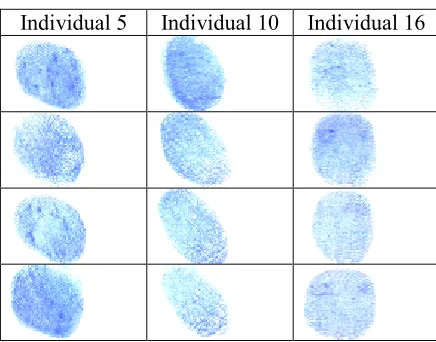
The fingerprint biometric is deemed individualistic. With respect to individuality, fingerprint is bound to the theory that individuals have consistent fingerprint [12]. Figure 3 shows fingerprint of the similar person while Figure 4 shows fingerprint of different persons. The similar person has the general shape of fingerprint differs in part. Somehow, for the fingerprint of other individual, the general shape of fingerprint quite varies. This is known as ‘individuality of fingerprint.’ The measurement and estimation of the same person (intra-class) are illustrated for the features of the fingerprint of the similar person. On the other hand, for different person (inter-class), the measurement and estimation is shown for the fingerprint of different person. The features with the capacity to generate the lowest amount of similarity error for intra-class are the best unique features. With respect to the inter-class, highest similarity error is necessitated. This means that it is vital to obtain unique features from a fingerprint because this will generate efficient fingerprint recognition in biometric identification.
The relevant works conducted in the mostly attained the local features from fingerprint. On the other hand, the global features within fingerprint from the entire shape are yet to be attained sufficiently. The shape also seems to be effective in identification [14,15,16,18,29].
4. FEATURE EXTRACTION
sample of training and simplifies out of sorts to the new samples. At what time the input information is great to be treated at that moment the input information will be converted into a condensed demonstration set of features. It is clearly important to select the type of feature extraction method owing to the fact that in the performance of systems of pattern recognition it is a crucial issue [25]. The form of assortment of feature extraction is dictated by the presentation. Various features are imposed for the identification of fingerprint. It is possible to recruit them in Furies Transform, Invariant Moments, Characteristic Loci and Geometric Moments, just to name a few [23,24]. Geometric moments in this context are used in the identification of the fingerprint for individual . In the pattern recognition and recognition of object application, Geometric Moment is castoff. Features computed to symbolize an entity has to have the capacity to detect the matching purpose using the added potential altered size and orientation [26]. As far as geometric moments are concerned, the computation comprises the steps below [26]:
1) An input image data reading from left to right as well as from top to bottom.
2) The image data thresholding for the area extraction of the target process ,
3) The computation of the image moment value,
until third order using the following formula:
4) Calculation of the intensity moment, ( ) of image using the following formula:
5) Calculation of the central moments, using the following formula:
6) Calculation of the normalized central moment,
to be employed in image scaling until third order using the following formula:
7) Calculation of geometric moments, to in terms of translation, scale as well as in terms of rotation (geometric moment invariants) invariants using the following formulas:
5. INVARIANTS DISCRETIZATION
ALGORITHM
the discretization process and the recognized approaches representing discretization containing Maximum Entropy, Equal Information Gain, and Equal Interval Width are many in number. The work of [27] proposed the use of additional approach. Somehow, the Invariants Discretization approach has been affirmed to be a well-organized approach in creating an advanced precision and accomplishment degrees of identification. The Invariants Discretization approach is classified as a supervised approach. This approach starts by checking the fitting intervals for denoting the individual’s statistics [21, 22, 27]. This is followed by the fixing on the upper and lower boundaries for each interval. The total of required image intervals is similar to the total feature vectors. In this paper, the Invariant Discretization of the identification of the fingerprint is accepted.
In terms of the significance of Invariant Discretization for this study, it is towards achieving the added exact classification of fingerprint biometric . Utilizing some statistics around the classes of each fingerprint image, the algorithm of discretization could demonstrate its practicality and fittingness of group of cuts which illustrate the shape information. The ratio of the smallest and the highest range of information to the dimension of the interval that makes available each cut or interval becomes its lower and upper estimation. The number of vectors of the feature to every single image reflects the number of cuts or intervals. Additionally, the invariant function moment contains several vectors of functional invariant vectors that are retainable to its initial quantity. A single representation has value that is definite to signify every cut or interval. This assures that their conforming feature vectors will be characterized respectively. The algorithm of discretization is as presented [21, 22].
Algorithm of Discretization
For each writer {
Min = min feature; Max = max feature’
No_bin = no_feature_invariant;
Interval = (Max – Min)/No_bin;
For each bin {
Find lower and upper value of interval;
Rep Value = (upper–lower)/2;
}
For (1 to _feature_invariant) {
For each bin {
If (feature in range of interval)
Dis_Feature = Rep Value’
}
}
}
For shapes , all elements are computed like cuts and intervals in order that they are recognizable. This is because each element is bound by its own style. Each element is unique and contains specific meanings. The characteristics features are also saved. Features are discreditable so that more meaning could be generated to allow for better comprehension. Further, to obtain a match for this concept, it is important that each shapes class is separately evaluated. This allows for the appropriate calculation. More details for invariants are evidenced in [27]. Figures 5 and 6 present the transformation for the invariant vector to discredited feature vector.
For shapes , all elements are computed like cuts and intervals in order that they are recognizable. This is because each element is bound by its own style. Each element is unique and contains specific meanings. The characteristics features are also saved. Features are discreditable so that more meaning could be generated to allow for better comprehension. Further, to obtain a match for this concept, it is important that each shapes class is separately evaluated. This allows for the appropriate calculation. More details for invariants are evidenced in [27]. Figures 5 and 6 present the transformation for the invariant vector to discredited feature vector.
6. ANALYSIS OF BIOMETRIC
FINGERPRINT WITH CLASSIFICATION
6.1 Identification performance evaluation rough set classifier
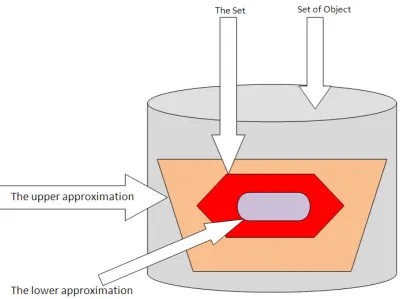
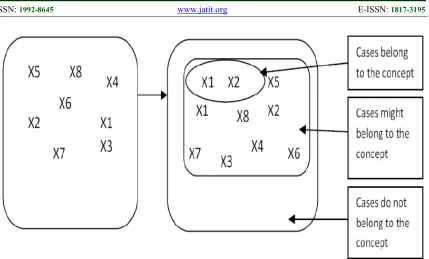
In the task of classification, any method may be selected according to the method’s efficiency and capacity to accomplish the task as necessitated irrespective of the purpose; to reduce the computation time, or to minimize classification errors. Meanwhile, this study selected the rough set theory due to its capacity in handling the set’s upper and lower approximation concepts and this provides a method of classifying objects in a condition that is noisy or incomplete.
For a set, its boundary region is signified by the set difference between its upper and lower approximations [20]. The rough set theory is illustrated in Figure 7 in terms of its concept while the approximation role of Rough set concept is presented in Figure 8. The Rosetta (Rough Set Toolkit) as [19] had proposed is employed in an experiment for assessing the performance of the fingerprint identification between individual. Here, both the discretization and undiscretization techniques are employed. For fingerprint biometric Identification, the experiment considers the additional step. This assists in increasing the densification accuracy via the discretization process. The sample comprises 400 data and these data are split into 2 datasets: training data and testing data. These data were used in the classification task. The performance of discretization process was according to the Invariant Discretization method proposed by Azah Kamilah. Two experiments were conducted with 70% training data, 30% testing data and 60% training data, 40% testing data. Tables 1 present the results and based on this table, it appears that the utilization of discretized data generates higher accuracy in comparison the use of undiscretized data. As such, using the discretized data can considerably enhance the fingerprint biometric Identification in terms of performance.
6.2 Identification performance evaluation with
artificial neural network classifier
In order to accomplish the primary of the research, the ANN classifier is employed on both types of the fingerprint datasets. ANN is employed in this study in the classification of the between-and-within-fingerprint distances while lessening misclassification errors. ANN contains a number of the looked-for properties. It has good statistical procedure, practical software implementation of the Bayesian (optimal) procedure and no presumptions with regard to the data nature, and this
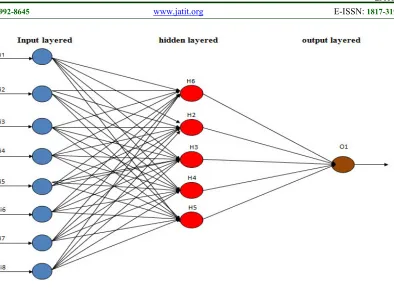
differentiates ANN from other classifiers. ANN also allows the tapping into the full multivariate nature of the data aside from allowing the utilization of a nonlinear discrimination criterion. With respect to this research, 3-layered network is employed. In specific, an input layer containing eight units and a hidden layer containing five units are used in this study. The structure of ANN is shown in Figure 9.
Two experiments were performed using different amount of training data and testing data. In particular, the first experiment employed 70% training data and 30% testing data combining both the undiscretized and discretized datasets. Meanwhile, the second experiment employed 60% training data and 40% testing data. The training process employed ANN while the classification matrix was used to compute the overall accuracy of identification from each training and testing dataset. Table 2 provides the summarized results of both the experiment using 70 and 60% training data. The results demonstrate the effectiveness of the discretized data usage. Specifically, the data can offer an overall rate of identification with the Average Accuracy of above 90.0%. Comparatively, using the undiscretized data generates lower rate of identification (less than 50.0%). Worded simply, using discretized datasets generates better identification and higher level of accuracy.
7. CONCLUSION
REFERENCES:
[1] Y.Koda, T.Higuchi and Anil K. Jain , “Advances in Capturing Child Fingerprints: A High Resolution CMOS Image Sensor with SLDR Method” 2016 International Conference of the Biometrics Special Interest Group (BIOSIG), IEEE, 21-23Sep.2016, pp1-4. DOI: 10.1109/BIOSIG.2016.7736909.
[2] S.Karahan, M.Kılınc, H.Kemal Ekenel, ‘How Image Degradations Affect Deep CNN-based Face Recognition?’, IEEE Conference Publications, 21-23 Sep.2016
pp. 1-5 . DOI:
10.1109/BIOSIG.2016.7736924.
[3] Ch.Kauba , A. Uhl Wavelab, E.Piciucco , E.Maiorana and P.Campisi, ‘Advanced Variants of Feature Level Fusion for Finger Vein Recognition’, IEEE Conference Publications, 21-23Sep.2016,
pp. 1-7 . DOI:
10.1109/BIOSIG.2016.7736908.
[4] S.Easwaramoorthy , Sophia F , Prathik A, ‘Biometric Authentication using finger nails’, 2016 International Conference on Emerging Trends in Engineering, Technology and Science (ICETETS), IEEE Conference Publications,24-26 Feb. 2016, Pages: 1 – 6. DOI: 10.1109/ICETETS.2016.7603054.
[5] S.S. Patil, S.Gudasalamani, N.C. Iyer, V.G. Garagad, ‘Tilt and Scale Invariant Iris Recognition System’, 2016 IEEE International Conference on Current Trends in Advanced Computing (ICCTAC), IEEE Conference Publications,10-11 March 2016, Pages: 1 – 6. DOI: 10.1109/ICCTAC.2016.7567342 [6] Hamid B. , K. Faez, Introducing a New
Multimodal Database from Twins’ Biometric Traits, pp. 1-6 , IEEE Conference Publications , ©2013 IEEE. [7] Mjolsnes, S.F.(2012). A Multidisciplinary
introduction to Information Security . Champan &Hall/CRC.
[8] Narayanan, A., &Shmatikov,V.(2005, November) .Fast dictionary attacks on password using time-space tradeoff . In proceedings of the 12th ACM conference on computer and communication security (pp. 364-372).
[9] M.K. Umair, A.K. Shoab, N. Ejaz, and R. Riaz, “A Fingerprint Verification System using Minutiae and. Wavelet Based Features,” International Conference on
Emerging. Technologies, pp. 291-296, 2009.
[10]N. Nain, B.M. Deepak, D. Kumar, M. Baswal, and B. Gautham, Optimized Minutiae–Based Fingerprint Matching. Lecture Notes in Engineering and Computer Science, vol. 2170(1), pp. 682-687,2008.
[11]L. Hong and A. Jain. Integrating faces and fingerprints for personal identication. In Proc. 3rd Asian Conf. Computer Vision, pages 16-23, 1998.
[12]W. Y. Leng and S. M. Shamsuddin, Fingerprint Identification using Discretization Technique, International Journal of Computer, Electrical, Automation, Control and Information Engineering, Vol:6, No:2,pp;240-248, 2012.
[13]Jain, A. and Zongker D. (1997), “Feature Selection : Evaluation, Application and Small Sample Performance”, IEEE Trans. On Pattern Analysis and Machine Intelligence, Vol. 19. No. 2. pp. 153 – 158. [14]John Berry and David A. Stoney, “The history and development of fingerprinting,” in Advances in Fingerprint Technology, Henry C. Lee and R.E. Gaensslen, Eds., pp. 1–40. CRC Press, Florida, 2nd edition, 2001.
[15]Emma Newham, “The biometric report,” SJB Services, 1995.
[16]AK Jain, S Prabhakar, S Pankanti, On the similarity of identical twin finger prints. Pattern Recogn. 35(1), 2653–2663 (2002) [17]Y Liu, NS Sargur, A Computational
Discriminability Analysis on Twins Fingerprints (Springer, Heidelberg, 2009), pp 43–54
[18]SN Srihari, S-H Cha, H Arora, S Lee, Individuality of handwriting: a validation study, in Sixth IAPR International Conference on Document Analysis and Recognition, Seattle, 2001, pp. 106–109 [19]A Øhrn, J Komorowski, ROSETTA: a
rough set toolkit for analysis of data, in Third International Joint Conference on Information Sciences, Durham, NC, vol 3, 1997, pp. 403–407
[20]Z Pawlak, Rough sets. Int. J. Comput. Inf. Sci. 11, 341–356 (1982)
Advances in Signal Processing 2012, 48 doi:10.1186/1687-6180-2012 48.
[22]Bayan Omar Mohammed and Siti Mariyam Shamsuddin, Feature Discretization for Individuality Representation in Twins handwriting Identification , Journal of Computer Science 7 (7): pp.1080-1087, 2011. [23]H. Takahashi 1991. “A Neural Net OCR
Using Geometrical and Zonal Pattern Features”. In Proc. 1th. Conf. Document Analysis and Recognition, pp. 821-828. [24]K. Azmi, R. Kabir and E. Badi 2003.
“Recognition Printed Letters wit Zonong Features”. Iran Computer Group, 1, pp. 29-37.
[25]ID. Trier and AK. Jain. 1996. “Feature Extraction Methods for Character Recognition- A Survey”, Pattern Recognition, 29, No. 4, pp. 641-662. [26]R. Muralidharan, C. Chandrasekar, 2011.
“Object Recognition Using SVM-KNN Based on Geometric Moment Invariant”, International Journal of Computer Trends and Technology, ISSN: 2231-2803, pp. 215-219.
[27] AK Muda, SM Shamsuddin, A Ajith, “Improvement of Authorship Invarianceness for Individuality Representation in Writer Identification”. Neural Netw. World 3(10), pp. 371-387 (2010).
[28]Fabrice Muhlenbach and Ricco Rakotomalala (2005). “Discretization of Continuous Attributes”. In John Wang (Ed.) Encyclopedia of Data Warehousing and Mining, pp. 397-402.
[29]B.O.Muhammed and S. M.
Shamsuddin.(2017) . “Twins Multimodal Biometric Identification System with Aspect United Moment Invariant” , Journal of Theoretical and Applied Information Technology, Vol.95, issue. 4 . [30]B.O.Muhammed and Z.A.kakarash and
Figure 1: Traditional Framework
Figure 2: New Framework for Fingerprint Biometric Identification
[image:8.612.196.414.541.712.2]Individual 21
Figure 3: Fingerprint with Same Individual
Individual 5
Individual 10
Individual 16
Figure 5: Invariant Feature Vector Data for individual 5
Figure 6: Example of Descritized Feature Data for individual 5
[image:9.612.100.500.315.614.2]Figure 8: Approximation role in Rough set Theory [19]
Table 1. Comparisons of Identification Rates with Different Training and Testing Datasets with Rough set Theory
Technique Accuracy (%)
60% Training Data 40% Testing Data
Accuracy (%) 70% Training Data
30% Testing Data
Datasets
Holte 1R algorithm 20.12 33.4 Un-Dis
90.8 92.6 Dis
Genetic algorithm 21.81 30.7 Un-Dis
92.98 93.4 Dis
Exhaustive algorithm 13.6 11.5 Un-Dis
[image:10.612.82.533.446.563.2]Figure 9: Architecture of ANN
Table 2: Comparisons of Identification Rates with Different Training and Testing Datasets with ANN
Technique Accuracy (%)
60% Training Data 40% Testing Data
Accuracy (%) 70% Training Data
30% Testing Data
Datasets
ANN 48.7654 50.4305 Un-Dis
[image:11.612.83.526.458.526.2]