Technology adoption in the BIM
implementation for lean architectural
practice
Arayici, Y, Coates, P, Koskela, LJ, Kagioglou, M, Usher, C and O’Reilly, K
http://dx.doi.org/10.1016/j.autcon.2010.09.016
Title
Technology adoption in the BIM implementation for lean architectural
practice
Authors
Arayici, Y, Coates, P, Koskela, LJ, Kagioglou, M, Usher, C and O’Reilly,
K
Type
Article
URL
This version is available at: http://usir.salford.ac.uk/11270/
Published Date
2011
USIR is a digital collection of the research output of the University of Salford. Where copyright
permits, full text material held in the repository is made freely available online and can be read,
downloaded and copied for noncommercial private study or research purposes. Please check the
manuscript for any further copyright restrictions.
TECHNOLOGY ADOPTION IN THE BIM IMPLEMENTATION FOR LEAN
ARCHITECTURAL PRACTICE
Y. Arayici, P. Coates, L. Koskela & M. Kagioglou
The School of Built Environment, the University of Salford, Greater Manchester, UK C. Usher & K. O’Reilly
John McCall’s Architects, Liverpool, UK
ABSTRACT
Justification for Research: the construction companies are facing barriers and challenges in BIM adoption as
there is no clear guidance or best practice studies from which they can learn and build up their capacity for BIM use in order to increase productivity, efficiency, quality, and to attain competitive advantages in the global market and to achieve the targets in environmental sustainability.
Purpose: this paper aims to explain a comprehensive and systemic evaluation and assessment of the relevant
BIM technologies as part of the BIM adoption and implementation to demonstrate how efficiency gains have been achieved towards a lean architectural practice.
Design/Methodology/Approach: The research is undertaken through a KTP (Knowledge transfer Partnership)
project between the University of Salford and the John McCall Architects based in Liverpool, which is an SME (Small Medium Enterprise). The overall aim of KTP is to develop Lean Design Practice through the BIM adoption and implementation. The overall BIM implementation approach uses a socio-technical view in which it does not only consider the implementation of technology but also considers the socio-cultural environment that provides the context for its implementation. The technology adoption methodology within the BIM implementation approach is the action research oriented qualitative and quantitative research for discovery, comparison, and experimentation as the KTP project with JMA provides an environment for “learning by doing”
Findings: research has proved that BIM technology adoption should be undertaken with a bottom-up approach
rather than top-down approach for successful change management and dealing with the resistance to change. As a result of the BIM technology adoption, efficiency gains are achieved through the piloting projects and the design process is improved through the elimination of wastes and value generation.
Originality/Value: successful BIM adoption needs an implementation strategy. However, at operational level, it is imperative that professional guidelines are required as part of the implementation strategy. This paper introduces a systematic approach for BIM technology adoption based on a case study implementation and it demonstrates a guideline at operational level for other SME companies of architectural practices.
KEYWORDS
BIM, Technology Adoption, Architectural Practice, Design Process, Lean Efficiency Gains.
1. INTRODUCTION
On the other hand, there are challenges in implementing BIM in the UK construction practice such as (Arayici et al, 2009a, Arayici et al, 2009b, Eastman et al, 2008)
• Overcoming the resistance to change, and getting people to understand the potential and the value of BIM over 2D drafting
• Adapting existing workflows to lean oriented processes
• Training people in BIM, or finding employees who understand BIM
• The understanding of the required high-end hardware resources and networking facilities to run BIM applications and tools efficiently
• The required collaboration, integration and interoperability between the structural and the MEP designers/ engineers
• Clear understanding of the responsibilities of different stakeholders in the new process by construction lawyers and insurers
Hence, implementing BIM effectively requires significant changes in the way construction business work at almost every level within a building process. That is to say, BIM technology implementation not only requires learning new software applications, but also requires learning how to reinvent the workflow, how to train staff and assign responsibilities, and the way of modeling the construction (Bernstein and Pittman, 2004, Eastman et al, 2008). It was seen that most firms are grappling with the same fundamental issues of change in the UK construction sector. Thus, it appears that they could all benefit from a clear set of guidelines outlining an effective strategy and methodology of implementing BIM at organizational level (Bernstein and Pittman, 2004). Therefore, the aim of this paper is to introduce a best practice study of BIM technology adoption as part of the overall BIM implementation for an architectural company practising in social housing and to highlight the implications on the company workflows and efficiency gains achieved. It then recommends the used approach of BIM technology adoption at operational level for other SME architectural companies.
2. THE CASE STUDY COMPANY: JOHN MCCALL’S ARCHITECTS (JMA)
The John McCall Architects were established in 1991 in Liverpool in the UK, focusing primarily on social housing and regeneration, private housing and one off homes and large extensions. JMA works with many stakeholders from the design through to building construction process and the associated information is very fragmented. Projects in which JMA are involved are involving many stakeholders and requiring considerable interoperability of documentation and dynamic information.
Historically JMA used Microstation CAD tool since 1991. All the company staff excluding the 2 administration staff has access to this tool and their range of skills varies from proficiency to advanced and expert. The company also has its own procedures, templates and cell libraries to optimize the way it uses Microstation. However, their current architectural practice with this 2D CAD tool brings about some inefficiency such as timescales, deadline pressures, duplications, lead times, lack of continuity in the supply chain, over processing, reworking, overproduction, conveyacing, distractive parallel tasks, reliability of data and plan predictability, lack of rigorous design process, lack of effective design management and communication.
Hence, the company need to improve its capacity for i) greater integration and collaboration with other disciplines in the production process, ii) adopting technology change to provide a more effective business process, iii) effective intelligent real time response, iv) moving into related building sectors. At strategic level, lean principles (Liker, 2003, Koskela, 2003) which are i) Eliminate Waste, ii) Increase Feedback, iii) Delay Decision, iv) Deliver Fast, v) Build Integrity In, vi) Empower the Team, vii) See the Whole are utilized and they formed the seven pillars of the BIM implementation strategy. Although they had no practical understanding and awareness of BIM in the company at the beginning of the project, some senior managers of the company had only visionary understanding of BIM for investment in order to attain competitive advantages and better position in market place and providing sustainable green design solutions for their clients.
3. TECHNOLOGY ADOPTION APPROACH IN BIM IMPLEMENTATION
implementation of technology but also considers the socio-cultural environment that provides the context for its implementation.
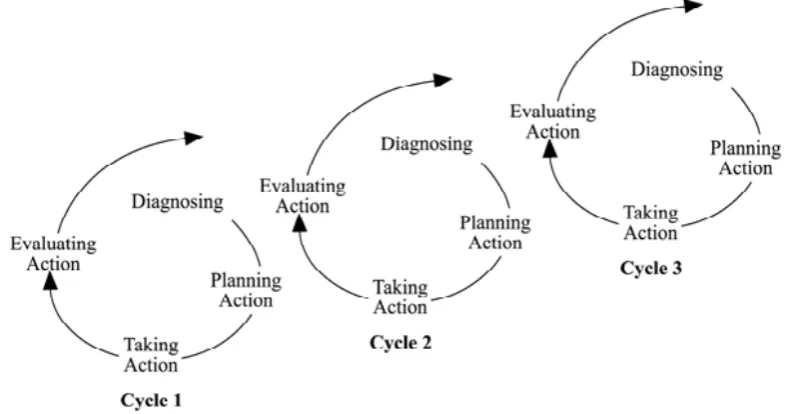
[image:4.595.100.500.256.463.2]The action research oriented qualitative and quantitative research for discovery, comparison, and experimentation has been employed in the research. This is because, the KTP project with JMA also provide an environment for “learning by doing” (Boshyk and Dilworth, 2009). Further, action research provides dual commitments; i) to study a system, which is JMA’s architectural practice and ii) concurrently to collaborate with the members of the system, which is JMA’s staff, in changing the system towards a desirable direction. Accomplishing this twin goal requires the active collaboration of researchers and practitioners, and thus it stresses the importance of co-learning as a primary aspect of the research process (O'Brien, 2001). Several attributes justify the research methodology as action research and separate it from other types of research. Primarily, its focus is on turning the people involved into researchers; people learn best and more willingly apply what they have learnt when they do it by themselves (Coghlan and Brannick, 2001). It also has a social dimension; the research takes place in real world situations and aims to solve real problems. It is illustrated in figure 1 below.
Figure 1: Iterative Action Research Process adopted (Coghlan and Brannick, 2001) These cycles are described below and elaborated in the following subsections respectively.
Cycle 1
Diagnosing Explore BIM tools (presentations, demonstrations, interviews), and identify efficiency gains Planning Action development of test cases and test plans for each BIM tools from JMA’s past projects Taking Action piloting the tools on the case studies by the vendor representatives and JMA’s staff Evaluating comparative analysis of the BIM tools in both quantitative and qualitative manner,
Cycle 2
Diagnosing Decision on ArchiCAD as the BIM tool and need for project support information database Planning Action identifying three different current design projects of JMA for ArchiCAD piloting and system
design of Project Support Information (PSI) database
Taking Action piloting the AchiCAD tool on the identified current design projects and the development of the project support information database
Evaluating assess the performance against the efficiency gains(lean efficiency gains achieved by now)
Cycle 3
Diagnosing Identify needs for further improvement
Action Planning Design and development of object library structure and documenting process and procedures of the BIM tool use in conjunction with the project support information database
Taking Action Implementation of the object library and catalogues specific to social housing, documentation and testing of the new process and procedures on JMA’s current housing design projects Evaluation Measure and assess the performance improvement and impacts on the overall performance of
[image:4.595.68.535.514.755.2]the company, internal and external dissemination of the findings
The following subsections elaborate the action research cycles presented in table 1 above.
3.1. Cycle 1
The main focus of Cycle 1 is to find out which BIM tool is the most appropriate for JMA based on the company’s specific features, priorities and the required efficiency gains required. The project had a steering group involving five key members. These were BIM and lean design experts from the university, a researcher based in the company, one company director and an experienced architect acting as a supervisor for the company.
It was clear from the outset that the company was unwilling to explore any BIM tool as they simply intend to upgrade their Microsation CAD tool to Bentley Architecture as they are provided by the same vendor. Further, as there was hardly any knowledge and awareness of BIM, there was a strong resistance by the company to change their tool. Although the initial attempt to adopt a top-down approach to achieve a speedy adoption, it was not possible due to the resistance. Therefore, a bottom-up approach was utilized even though it slowed down the adoption process, it helped increase JMA’s knowledge and awareness of BIM in the adoption process. Therefore, initial investigations were biased towards Bentley Architecture.
3.1.1. Diagnosis: Exploration of BIM tools and Efficiency Gains Identification
It was also important to identify what efficiency gains are targeted through the BIM adoption, which required to evaluate the JMA’s processes against lean principles (Liker, 2003, Durward and Sobek, 2008). Therefore, the diagnosis also incorporated the analysis of the current practice of the company and areas of wastes and possible value generations are explored via SWOT analysis (see Coates et al, 2010 for the complete efficiency gains and Key Performance Indicators). For JMA, time savings in the production process and consistency of the product were viewed as major gains through the adoption of BIM. Existing problems and the tacit knowledge from JMA staff were extracted using soft system analysis and workshops.
Identification of the efficiency gains led to discussions about how Bentely Architecture tool can help achieve those efficiency gains. They were then extended towards other BIM tools available in the market via literature review initially while the resistance was weakened as potential gains being realized by the company. However, literature reviewed in many cases had particular bias to a particular company or BIM tool and due to development in this field literature has quickly become out of date (Khemlani, 2007). Further, these were not fully useful in the BIM tool selection for JMA because of the potential bias and their potential failure to adequately align with the unique requirements of the JMA business process.
On the other hand, the current market shares of the various BIM software tools are likely not reflect actual usage of those BIM tools because they are provided to the users as an upgrade of the traditional CAD tools. Added to this, the user preferences are also biased for the various architectural BIM tools due to their continuous agreement with their CAD vendors. After this initial comprehensive review via literature, the investigation was narrowed down to four BIM architectural tools, Bentley Architecture v8i, Autodesk Revit Architecture 2010, Graphisoft ArchiCad 13 and Allplan by Nemetschek because these four tools were found potentially usable and applicable to JMA through the focus group workshops as they were the potential solutions against the efficiency gains.
The broad literature review was then followed by the vendors’ presentations and demonstrations in the JMA office. This enabled to see, observe and evaluate the tools’ performance, usability and functionality on social housing projects through interactive discussions with the vendor representatives and demonstrators. As a result of this process, JMA’s preferences for Bentley tool became neutral. However, the project team could not reach at a decision too due to mixed views and the qualitative nature of the exploration. Therefore, interviews with the users of the BIM tools under consideration were carried out to gain insight views and knowledge about them. However, the issue was that very few people were expert about BIM tools they used. The core finding from the interviews that the BIM tools used were used with a limited narrow scope and understanding.
3.1.2. Action Planning: Development of the Test cases from JMA’s past projects
Some members of staff viewed the tools as design tools; some others considered them as tools for production information. The JMA staff developed basic skills using the BIM tools but did not reach a level of proficiency. Thus, two-three weeks trials were not sufficient to make decisions on the selection of a BIM tool.
In order to address the issue of lack of experience in the use of various BIM tools, it was decided to undertake rigorous testing with quantitative analysis and assessment as opposed to qualitative and interpretive judgments. A clear test plan and scenario (including role playing) from one of the past projects of JMA was prepared for testing the BIM tools. Previously identified criteria were refined and designed as the checklist for the tests. Test plan included alpha tests conducted by the vendors’ demonstrators and the beta test undertaken by the selected JMA staff.
3.1.3. Tacking Action: Piloting the BIM tools on the past projects
In the Alpha tests undertaken by the considered vendors’ demonstrators, the JMA staff observed and assessed the test performances against the test checklist. The tests were undertaken in two sessions of one and a half hour periods. Throughout the tests, the level of details in the test case was increased and changes in the design were requested. This was to test the flexibility of tools. What seemed easy in one tool looked particularly difficult in the other one. This was a critical exercise to understand how a BIM tool aligns itself to specific company requirements. As a result of the Alpha tests, JMA staff had a preference towards ArchiCAD tool as it was seen intuitive and straightforward in the following efficiency gains
• The quality, speed and cost of the services JMA provides
• Automatic low-level corrections when changes are made to the design through the use of parametric relationship between objects
• Generate accurate and consistent 2D drawings throughout the design
• Visualizations to allow checking against design intent
• Discovering design errors before construction
• Information sharing
• Greater flexibility to satisfy customers
• Better financial control
• Simultaneous work by multiple disciplines
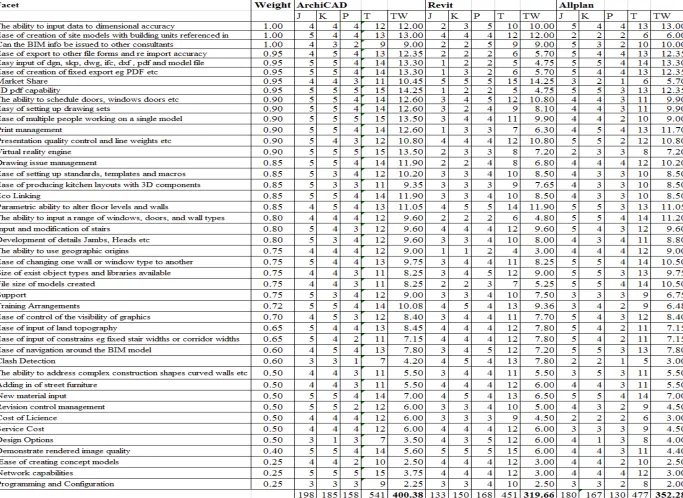
On the other hand, Bentley Architecture tool did not satisfy the staff, therefore, it was dropped off the list. However, it was not sufficient to make the final decision. Therefore, the test records were kept against the specifically designed checklist of 40 criteria. It was now time for the Beta tests by the JMA staff. Three remaining BIM tools were tested by the three selected JMA staff on another past project of JMA. The test results were logged into the checklist document by the three testers individually to form the basis of the quantitative assessment.
3.1.4. Evaluation: Comparative Analysis of the BIM tools
3.2. Cycle 2
Increased understanding and awareness of BIM led to further diagnosis towards lean design process in cycle 2. For example, lean improvements were needed in the marketing, administration, finance, contractual information, which are categorised as project support information (PSI) and cannot be modelled with BIM. However, efficient handling those project support information will certainly have impact on the BIM modelling of the actual design project information.
3.2.1. Diagnosis: ArchiCAD as JMA’s BIM tool and the need for PSI Database
After the decision made on the main BIM tool, it was necessary to how much it would have impact on the process and overall productivity. As it can be seen from table 2, the list of criteria are actually related to actual design information and not comprehensively covering other parts of the practice such as administration and marketing, administration, etc. these activities were carried out fragmentally and causing duplications, lead times, cost and ad hoc management of these activities. Therefore, there was a need for development of a PSI database that will pool all the project support information for all projects and facilitate lean improvements by eliminating wastes due to ad hoc management of those activities and generate value as it will have impact on the actual design project via BIM.
3.2.2. Action Planning: The BIM tool Implementation Plan and Design of PSI Database
In order to gradually increment the use of the ArchiCAD tool in the company, it was decided to use it on three different current JMA’s project by three different members of staff. While this would give the opportunity for training of the staff and increase their skills to proficiency, it also provided the chance to observe how much efficiency can be achieved via the BIM tool. The projects selected were i) a detached house, ii) sheltered housing bungalows and iii) an estate of terraced housing. These projects were monitored closely to distil the lessons learnt.
Secondly, the PSI database development, the scoping and requirements capturing studies were carried out, which was then translated into the system architecture of the PSI database system. Evolutionary prototyping approach was adopted for the development through which continuous user informed development can be made. For example, the Alpha version for the PSI database system was released for the staff use and it was then gradually improved based on the feedback and further requirements from the staff.
3.2.3. Action Taking: Piloting and Development of PSI Database
Through the piloting projects using ArchiCad, an understanding of what is required to construct BIM models was developed. This understanding through three piloting projects gradually improved for how to sequence the steps in efficiently constructing the models. Furthermore, this increased understanding led to an emergence of an systematic approach about how to effectively use reference module files. This could provide particularly efficient in generating design solutions with multiple similar units. This systematic approach was initially tested for the use of object assembles such as kitchens and bathrooms were also undertaken. The major benefit noted at this stage that the increased awareness of the design through rapid generation of 2D and 3D representations. The PSI database was created using MS Access software with both a frontend and a backend component. The database was made accessible to all members of staff by installing an access runtime engine on all staff workstations. The initial concept for the PSI database was as an automated project quality plan and practice management support system. A particular facet of the database that it makes information easy to find even for those unfamiliar with the specific project as it holds a uniform structure across projects.
3.2.4. Evaluation: Assessment of the Lean efficiency Gains Achieved and Dissemination
It became clear that certain efficiency gains were achieved through the piloting exercise on three different current projects of JMA and also development trial of the PSI database towards a lean design practice. These efficiency gains are categorised into 8 wastes elimination. These are (Durward and Sobek, 2008) i) waste of overproduction, ii) The waste of waiting, iii) The waste of transportation, iv) The waste of inappropriate processing, v) The waste of unnecessary inventory, vi) The waste of unnecessary movement, vii) The waste of defects, viii) Other wastes. Some of them are detailed in the JMA context below.
• Holding lessons learnt and experiences from the past projects as company asset in the PSI system
• Linking the PSI system to marketing by storing the project related marketing information in the PSI system
• Ability of top management for project progress monitoring through the PSI system
• Consistent exchange of information through the existing company databases; JMA currently uses several fragmented databases. This raises some issues in handling information such as validity of the data stored, practice specific or project specific information. The PSI system provided linkages to these fragmented databases and allows comparison, interrogation and correction of information held on different databases
• Use of Automation via the adoption of the ArchiCAD tool brought about quality, time and cost efficient practice by generating i) drawings, quantity take-off automatically, ii) instant generation of VR models, iii) discovering design errors and conflict analysis, iv) information sharing and exchange, v) greater flexibility to satisfy customers, vi) simultaneous work by the staff in the company.
• Consistency across the drawing sets via the BIM tool adoption
• Automation of emails and finding consultant offices via the PSI system that facilitates faster access time to useful information, automatically include project information in email, and links postcodes to maps.
• Integration with Energy Assessment tools for “Code for Sustainable Homes” standards such as IES
At this evaluation stage, it was envisaged that this adoption would enable JMA to provide faster and additional services such as i) the analysis of models to confirm compliance with the Code for Sustainable Homes, ii) the potential to provide models for post completion services and iii) output to virtual reality, iv) facilities management services. Furthermore, if the ArchiCad BIM tool is customised for JMA’s practice, even more lean efficiency gains can be achieved towards a leaner design practice.
3.3. Cycle 3
Through the cycles, learning has increased tremendously and better shared understanding about BIM has been established, particularly after witnessing the benefits through the piloting activities and this has led to a forward thinking of how further efficiencies can be gained, which has then led to Cycle 3. However, this has not been completed yet.
3.3.1. Diagnosis: Identification of further needs for further improvement
Although some efficiency gains have been achieved through Cycle 2, it is envisaged further automation can be achieved by establishing standards to BIM modelling. Social housing has its own types, standards and regulations. Even if BIM authoring tool is used, there will still be some repetitions, overworking due to similar requirements of social housing projects. Hence, a leaner process of BIM modelling can be achieved by developing a BIM object library and catalogues based on the ArchiCAD BIM tool. Use of these objects into the design projects can tremendously increase process in terms of time, cost and workforce. However, in order to ensure that this BIM object library is used effectively through a lean process by all in the company, it is also required producing a guidance document of the process and procedures for the use of the BIM object library when modelling in the ArchiCAD tool for social housing projects.
3.3.2. Action Planning: Object Library Development and Documentation of Process and Procedures
Library objects were identified and developed. Firstly furniture libraries were developed with the clear zones required around the furniture marked. While the furniture objects have been developed to comply the design solution with the Housing Quality Index standards (HQI, 2008), which applies to social housing in the UK, the wall types have been developed to comply the design solution with part E of the UK building regulations (reference) and robust and enhanced details. A coding system was also developed to more accurately understand the wall types through the naming convention used. Although there is a time saving by using these components, the major benefit is in knowing preapproved wall types are being used. Later, it is envisaged that composite floor slabs and roof types will also be developed.
In order to provide guidance for staff moving to BIM it was decided to write a guidance manual. In the future it is hoped to integrate this so it is accessible while working with the BIM authoring tool. The guidance manual was aimed to address several issues.
• To explain the concept of BIM
• To explain the working differences between Microstation and ArchiCad
• To explain the expectation of how different building types should be modelled at JMA
• To explain the libraries and resources available
• To explain how to organise drawing sets and issue information
3.3.3. Action Taking: Implementation of Object Libraries according to Document Process and Procedures
It is envisaged that an approval process in the future will be required to ensure all new objects within the libraries comply with the relevant building regulations. Using the objects in production projects will also establish how the objects export and print in other formats.
3.3.4. Evaluation: Impact Assessment on the Company’s Process and Practices
As the action taking stage of Cycle 3 has not been completed yet. Therefore, evaluation is not possible as real data has not been obtained through the action taking stage but the following efficiency gains are expected;
• Lean process of conceptual design and detailed design development via BIM modelling of the housing design projects
• Accurate and timely energy performance assessment for Code for Sustainable Homes
• Effective design and technical review of all the projects in order to avoid potential problems arising from mistakes in the future
• Leading to standardised lean design process across the company
• Better linkage will be established between the project design information with BIM modelling and the project support information with the PSI database system
4. CONCLUSION
The paper explained the technology adoption approach in a BIM adoption and implementation project undertaken through a two year KTP project between the University of Salford and the John McCall Architects in Liverpool. Although the paper had a focus on the BIM technology adoption, it is actually as much about people and processes as it is about technology. Therefore, BIM implementation should have a bottom up approach rather than top down approach in order to i) engage people in the adoption, ii) ensure that people’s skills and understanding increases and companies building up their capacities, iii) to apply successful change management strategies, iv) to diminish any potential resistance to change.
The adoption process can be slower because it is inclusive approach and engaged with people. However, impact of the BIM technology adoption on the company process and practice can be measured too. As part of the bottom up approach, the employed action research philosophy has enabled the “learning by doing”. For example, in the JMA case study, as brief earlier, no one had any knowledge or experience of BIM prior to this BIM implementation project apart from few forward thinking top management members, which shows that top management support is also critical for the success of the BIM adoption. However, after 18 months, the company has already made significant progress in upskilling staff, technology infrastructure development and lean process improvements. This progress has not been stopped. The intention is to enable that company has sufficient capacity to maintain the continuous improvement even after the project by establishing new services offerings such as facilities management. Finally, paper demonstrated a systematic approach for BIM technology adoption based on a case study of BIM implementation and it recommends it as a guide at operational level for other SME companies of architectural practices.
ACKNOWLEDGMENTS
The authors gratefully acknowledge the financial support provided by the UK Government, KTP is a Technology Strategy Board programme, enabling innovation in business. The University of Salford is a participant KTP Knowledge Base providing expertise and resources to businesses via a strategic project.
REFERENCES
Arayici, Y., Khosrowshahi, Y., Ponting, A.M., Mihindu, S., (2009), “Towards Implementation of Building Information Modelling in the Construction Industry”, 5th International Conference on Construction in the 21st Century (CITC-V) “Collaboration and Integration in Engineering, Management and Technology” May 20-22, 2009, Istanbul, Turkey
Arayici, Y., Coates, P., Koskela L., Kagioglou, M., Usher C., O’Reilly, K., (2009b), “BIM Implementation for an Architectural Practice”, Managing Construction for Tomorrow International Conference, October 2009, Istanbul Turkey
Bernstein, P.G., Pittman, J.H. (2004). “Barriers to the adoption of building information modelling in the building industry”, Autodesk Building Solutions, White paper
Boshyk, Y. and Dilworth, R.L. (Eds.) 2009, “Action Learning: History and Evolution”, Basingstoke, U.K.: Palgrave Macmillan
Coates, P., Arayici, Y., Koskela K., & Kagioglou, M., Usher, C., & O’Reilly, K., (2010), “The key performance indicators of the BIM implementation process”, ICCBE 2010, Nottingham, UK
Durward K., Sobek, II, (2008), “Understanding A3 Thinking: A Critical Component of Toyota’s PDCA Management System”, Taylor & Francis Group, New York.
Eastman, C., Teicholz, P., Sacks, R. & Liston, K. (2008), “BIM Handbook: A Guide to Building Information Modeling”, Canada: John Wiley & Sons.
HQI, (2008), “721 Housing Quality Indicators Version 4, Housing Corporation,
Khemlani, L., (2007), “Top Criteria for BIM Solutions: AECbytes Survey Results”, AECbytes Special Report October 2007
Koskela, L. J. (2003), “Theory and Practice of Lean Construction: Achievements and Challenges”, in: Proceedings of the 3rd Nordic Conference on Construction Economics & Organisation. Hansson, Bengt & Landin, Anne (eds). Lund University (2003)
Liker, J. E. (2003), “The Toyota Way”, McGraw-Hill, New York
Mihindu, S., Arayici, Y., (2008), “Digital Construction through BIM Systems will drive the Re-engineering of Construction Business Practices”, 12th international conference of Information Visualisation, London. O'Brien, R. (2001), “An Overview of the Methodological Approach of Action Research”, In Roberto
Richardson (Ed.) “Theory and Practice of Action Research” Brazil: Universidade Federal da Paraíba