THE ROLE OF MANGER EXPERIENCE AND FORMAL
METHODOLOGY IN SOFTWARE DEVELOPMENT
MOHAMMAD MAHMOUD AL_TARAWNEH
Balqa Applied Uinversity / Karak University Collage E-mail: [email protected]
ABSTRACT
This research examines the role of manger experience and formal methodology in software development, such as Reporting to senior management, Communication with users, Planning and scheduling, Coordinating project activities, Budget, schedule, risk, and quality control, people management, Project Definition. Estimating. Risk Assessment. The study population consists of all Jordanian institutions (n = 96) operating in the field of software development. From previous studies that have been reviewed and applied study conducted by researchers at the Jordanian companies show us the importance of manger experience and formal methodology factors. It is therefore important for the project team to deal with these factors in a serious and careful. Should the project manager and his team they have a good knowledge in how to deal with these factors. It should be the project manager and his team have their efficiency in the process of comparison between the benefits of the proposed system do not exist in the old system for each of the groups and individuals in the organization, and convince them of the benefits gained from the proposed system better and more for individuals and groups in the organization of the current system the old one.
Keywords:software Development, Formal Methodology, Manger Experience
1. INTRODUCTION
Software projects today are an important part of almost every business application. The quality and the efficiency and effectiveness of these applications will determine the success or failure of many business solutions. As a result,
they often find harm need information
companies have and giving them a competitive advantage through the effective development and improvement of software projects that help the important business activities. It is determined by the quality of the software project by the quality
of the software development process.
Improvements in the development process can lead to a significant improvement in software quality [Schwalbe 2000].
Over the past few decades, software projects often failed to come up to user expectations, by it were commonly late delivered, and mostly ran over the set budget. Indeed, much of this still holds true today, and it has alerted software. Developers and managers to the fact that these issues have to be addressed in concrete terms, and as a result the area of Software Project Management (SPM) has evolved. SPM includes the management of all issues and aspects that are
involved in the development of a software project, especially scope and objective identification, planning, evaluation, project development approaches, software effort and cost estimation, activity planning, monitoring
and control, risk management, resource
allocation and control, as well as managing contracts, teams of people and quality at first. Proper project planning and control is not
possible without a sound and reliable
management. As a whole, the software industry doesn't management projects well and doesn't use management appropriately (Estbasics, 2015). Project and program managers require accurate and reliable management to allocate and control project resources. In addition, they need to determine whether, for a given system size, the cost of a prospective project is too high to redefine the project or put in place appropriate contingency plans (Fontainebleau, 2015).
2. RELATED WORK 2.1 Formal Methodology
on the nature of the organization and administration, and to be proficient in project planning. There are many examples illustrate the importance of the presence of a formal methodology in software projects. According to Boehm and Turner (2003), documented plans
that are accompanied by quantitative
performance measures, internalized plans and qualitative control are considered a main ingredient in successful organizations practices. According to the Extreme chaos report (2015) the use of a good formal methodology provides a realistic picture of the project. In addition some of formal methodology steps may be reusable which improve project efficiency and stability. Another advantage of the use of a formal methodology that is mention in the above report is that it gives managers the ability to estimate time more accurately, so the risk is reduced. Chaos research showed that 46% of successful projects used a formal methodology compared to 30% of the failed or challenged projects. According to Martin et; al.(1994). The lack of an effective project methodology in software projects can lead to bad implementation of the system. In addition Jones (1998) pointed out the basic for successful software project is strong upfront planning. Many project failures can be referred to poor planning. Unrealistic deadlines and budgets, poorly defined goals and objectives, and a lack of project plan are the most frequently main cause for project fail. In project planning we determine what activities and what resources are needed and how they are to be managed to emphasize successful project completion. In software project planning includes the following activities:
• Project Definition.
• Estimating.
• Risk Assessment.
2.2 Experienced Project Manager.
Experienced project manager (EPM) means “the one who has real world experience in technology domain and has good personal and communication skills” (Lindvall; et; al, 2002). According to the Extreme chaos report (2015), the presence of an experienced project manager is ranked as number three in importance for project success. The above report showed that 79% of project success/failure is attributed to presence/absence experienced project manager. Keil et; al (1998), pointed out that an
experienced software project manager is capable of identifying project risk factor. A study conducted by Nicole (2000), found that a positive relationship between manager’s skills and the success of the software project. In addition In most case the project manager is selected at the end of the conceptual phase when the project is accepted. According to Jurison (1999) the project manager defined by the person who is responsible for managing the entire project. His or her first responsibility is to direct, coordinate and control all activities to meet the objectives and goals of the project within its budget and schedule. This role is quite different from the role of the technical leader or developer, whose responsibility is mainly for the technical integrity of the product. Specific responsibilities of the project manager include the following:
• Reporting to senior management
• Communication with users
• Planning and scheduling
• Coordinating project activities
• Budget, schedule, risk, and quality
control
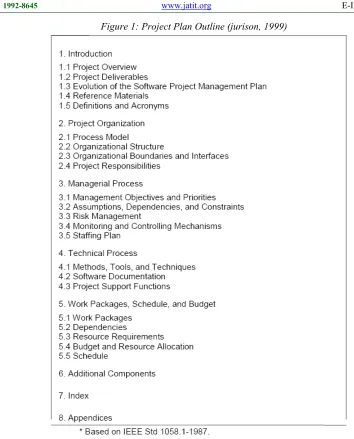
Figure 1: Project Plan Outline (jurison, 1999)
The project manager’s job is to provide clarity and manage commitments. Finding a person who can handle these challenges successfully is challenged. Few people have the qualifications and attitudes essential to succeed in managing complex projects. It is even more challenged to find project manager with good experiences who has the qualifications needed and who is available for a new project. Since good experiences project managers are always busy on existing projects. Many companies create project or program offices folder to provide better management seeing and develop a pool of future professional project managers. Project manger must be planning culminates in a software project plan. That defined by the document that describes in details the overall approach for
resource requirements, schedules, budgets and organizational responsibilities, also defines the management processes. And describe, all risk factors and its management strategies, also define how changes are managed and quality is controlled. So it is a document that gives information to management, team members, and the client. It gives the baseline of the cost and schedule for managing and controlling the project. So that it becomes an effective part of the project control system. To test the efficiency of a project plan, the project manager should ask the following questions:
• Does the plan give me the appreciate
chance to manage the project
• Does it give enough information to the team members in order to plan and do their work efficiently?
• Does it have the commitment of senior
management and the project team?
• A typical software project plan is
outlined.
3. RESEARCH PROBLEM
A project is usually deemed as successful if meets requirements is delivered on time and delivered within budget (May, 1998). Therefore software risk management is an approach that attempts to formalize risk oriented correlates of development success into a readily applicable set of principles and practice (Ropponen and Lyytinen, 2000). Risk management is aimed at taking counter measures to either prevent risk from affecting the project or reduce their impact ( Heemstra and Kusters, 1996). Furthermore Ropponen and Lyytinen (2000) believe that by including risk management in a project the exposure to software risk can be reduced and can
increase software success. Moreover the
implementation of software projects is a complex task involving the successful alignment of both the technical and social system within an organization (Keil. M, et al; 1998). Furthermore after decades of research, systems development and implementation projects remain notoriously hard to mange and many continue to end in failure (Radcliffe. D, 1998). The main problem of this research is the impact of manager experiences and formal methodology on the software development.
Research Questions:
What are the affects of experienced project manager on software development?
What are the affects of formal methodology on software development?
Research Objectives:
This research aims primarily to know the role of experienced project manager and formal methodology on software development, therefore, the research aims to set of objectives are summarized as follows:
Statement of whether the experienced project manager to an active role in software development.
Statement of whether the formal methodology to an active role in software development.
4. METHODOLOGY:
The study has adapted the descriptive, field and analytic methods. An office survey and reviewing of theoretical and field studies and researches were conducted in order to crystallize the bases of the research and to stand at the important previous studies which consists a vital support for the study through their epistemic axes. A comprehensive survey and analyzing data that collected from questionnaires by using statistical ways were conducted to implement the field analytic research. The study based on a
developed questionnaire that organized
depending on the previous questionnaires; this questionnaire has adjusted to fit the Jordanian
environment. A personal interview was
conducted with some managers of engineering projects in Jordanian environment.
Population of the study
The population of the study consists of all Jordanian institutions (n=96) work in three key sectors as shown in the table (3.1) below. 100% of these institutions were selected for this study.
Table 1: Population of the study.
Institution/sector Number
Banks sectors 17
Software engineering 62
Insurance companies 17
5. DATA ANALYSIS:
[image:5.612.71.552.122.589.2]5.1 Formal Methodology Factor
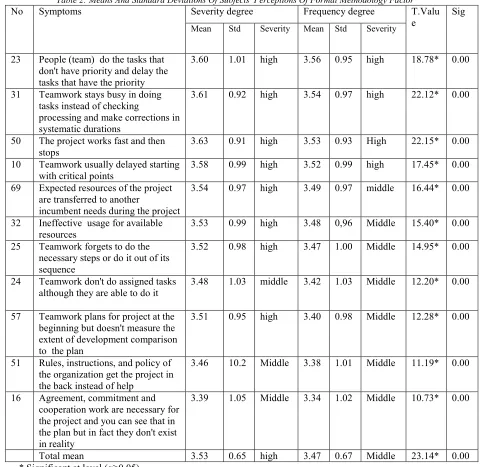
Table 2: Means And Standard Deviations Of Subjects' Perceptions Of Formal Methodology Factor
No Symptoms Severity degree Frequency degree T.Valu
e
Sig
Mean Std Severity Mean Std Severity
23 People (team) do the tasks that
don't have priority and delay the tasks that have the priority
3.60 1.01 high 3.56 0.95 high 18.78* 0.00
31 Teamwork stays busy in doing
tasks instead of checking
processing and make corrections in systematic durations
3.61 0.92 high 3.54 0.97 high 22.12* 0.00
50 The project works fast and then
stops
3.63 0.91 high 3.53 0.93 High 22.15* 0.00
10 Teamwork usually delayed starting
with critical points
3.58 0.99 high 3.52 0.99 high 17.45* 0.00
69 Expected resources of the project
are transferred to another
incumbent needs during the project
3.54 0.97 high 3.49 0.97 middle 16.44* 0.00
32 Ineffective usage for available
resources
3.53 0.99 high 3.48 0,96 Middle 15.40* 0.00
25 Teamwork forgets to do the
necessary steps or do it out of its sequence
3.52 0.98 high 3.47 1.00 Middle 14.95* 0.00
24 Teamwork don't do assigned tasks
although they are able to do it
3.48 1.03 middle 3.42 1.03 Middle 12.20* 0.00
57 Teamwork plans for project at the
beginning but doesn't measure the extent of development comparison to the plan
3.51 0.95 high 3.40 0.98 Middle 12.28* 0.00
51 Rules, instructions, and policy of
the organization get the project in the back instead of help
3.46 10.2 Middle 3.38 1.01 Middle 11.19* 0.00
16 Agreement, commitment and
cooperation work are necessary for the project and you can see that in the plan but in fact they don't exist in reality
3.39 1.05 Middle 3.34 1.02 Middle 10.73* 0.00
Total mean 3.53 0.65 high 3.47 0.67 Middle 23.14* 0.00
* Significant at level (α≥0.05)
Table (2) shows that the general mean of items related to formal methodology variable in terms of its severity is (3.53), SD = ( 0.65); the item (50), the project works fast and then stops , ranked the first rank with mean (3.63) and SD
(0.91); whereas item (16), agreement,
commitment and cooperation work are necessary for the project and you can see that in the plan but in fact they don't exist in reality , ranked the last rank, M (3.39) , SD = (1.05). The means of
which indicates that the success of projects in terms of formal methodology dimension was at high degree except the items (16, 24, and 51) were at middle degree.
commitment and cooperation work are necessary for the project and you can see that in the plan but in fact they don't exist in reality, ranked the last rank, M= (3.34), SD = (1.02). The means for all items of this dimension were at high degree
which indicates that the success of projects in terms of formal methodology dimension was at middle degree except the items (10, 23, 31, and 50) were at high degree
[image:6.612.66.560.180.658.2]5.2 Manager Experience Factor
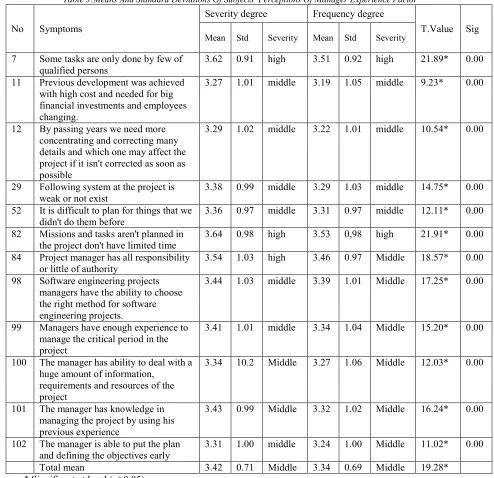
Table 3:Means And Standard Deviations Of Subjects' Perceptions Of Manager Experience Factor
No Symptoms
Severity degree Frequency degree
T.Value Sig
Mean Std Severity Mean Std Severity
7 Some tasks are only done by few of
qualified persons
3.62 0.91 high 3.51 0.92 high 21.89* 0.00
11 Previous development was achieved
with high cost and needed for big financial investments and employees changing.
3.27 1.01 middle 3.19 1.05 middle 9.23* 0.00
12 By passing years we need more
concentrating and correcting many details and which one may affect the project if it isn't corrected as soon as possible
3.29 1.02 middle 3.22 1.01 middle 10.54* 0.00
29 Following system at the project is
weak or not exist
3.38 0.99 middle 3.29 1.03 middle 14.75* 0.00
52 It is difficult to plan for things that we
didn't do them before
3.36 0.97 middle 3.31 0.97 middle 12.11* 0.00
82 Missions and tasks aren't planned in
the project don't have limited time
3.64 0.98 high 3.53 0,98 high 21.91* 0.00
84 Project manager has all responsibility
or little of authority
3.54 1.03 high 3.46 0.97 Middle 18.57* 0.00
98 Software engineering projects
managers have the ability to choose the right method for software engineering projects.
3.44 1.03 middle 3.39 1.01 Middle 17.25* 0.00
99 Managers have enough experience to
manage the critical period in the project
3.41 1.01 middle 3.34 1.04 Middle 15.20* 0.00
100 The manager has ability to deal with a
huge amount of information, requirements and resources of the project
3.34 10.2 Middle 3.27 1.06 Middle 12.03* 0.00
101 The manager has knowledge in
managing the project by using his previous experience
3.43 0.99 Middle 3.32 1.02 Middle 16.24* 0.00
102 The manager is able to put the plan
and defining the objectives early
3.31 1.00 middle 3.24 1.00 Middle 11.02* 0.00
Total mean 3.42 0.71 Middle 3.34 0.69 Middle 19.28*
* Significant at level (α≥0.05)
Table ( 3) shows that the general mean of items related to manager experience variable in terms of its severity is (3.42), SD = ( 0.71); the item (82), missions and tasks aren't planned in the project don't have limited time , ranked the first
of all items of this dimension were at high middle which indicates that the success of projects in terms of manager experience dimension was at middle degree except the items (7, 82, and 84) were at high degree.
Also the table (3) shows that the general mean of items related to manager experience variable in terms of its frequency degree is (3.34), SD= (0.69). The item (82), missions and tasks aren't planned in the project don't have limited time , ranked the first rank, M (3.53), SD = (0.98), whereas the item (11), previous development
was achieved with high cost and needed for big financial investments and employees changing , ranked the last rank, M= (3.19), SD = (1.05). The means for all items of this dimension were at middle degree which indicates that the success of projects in terms of manager experience dimension was at middle degree except the items (7 and 82) were at high degree.
Interview Analysis:
Q1) what is the impact of existence and using a formal methodology on success of the software engineering projects in Jordanian environment?
Table 4: Means percentages for a formal methodology
No Item Mean Percentage Rank
1 Using a clear methodic ways, helps the manager to
control the project management process
11.52 57.60% 1
2 Using a clear template in discourse process among
team work members, or using a clear methods during data collecting process by the user helps in controlling changes in user's requirements and knowing its effects in any part of the project
10.56 52.80% 2
The arrangement of the formal methodology items came as following: Using a clear methodical ways, helps the manager to control the project management process (57.60%). Using a clear template in discourse process among team work members, or using a clear methods during data collecting process by the user helps in
controlling changes in user's requirements and knowing its effects in any part of the project (52.80%).
Q2) what is the impact of the manager's experience on success of software engineering projects in Jordanian environment?
Table 5:Means and percentages for manager experience
No Item Mean percentages rank
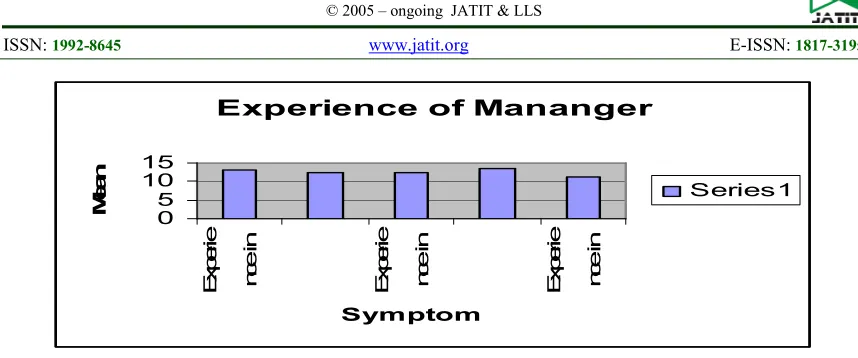
1 Experience in reliable estimation tools 13.19 65.95% 2
2 Experience in managing of project requirements 12.53 62.65% 3
3 Experience in team work management 12.50 62.50% 4
4 Leadership features and dealing with critical times
of the project
13.51 67.55% 1
5 Experience in resources management and tasks
distribution
11.25 56.25% 5
The manager experience items came as following: Leadership features and dealing with critical times of the project (67.55%); experience in reliable estimation tools (65.95%); experience in managing of project requirements (62.65%); experience in team work management (62.50%); and experience in resources management and tasks distribution (56.25%).
Conclusion:
Upon the analysis of the study data through the program of statistical analysis (SPSS), the researcher approached the following results
Formal Methodology
3.3 3.4 3.5 3.6 3.7
P
e
o
p
le
T
h
e
E
x
p
e
c
te
T
e
a
m
w
o
R
u
le
s
,
Symptom
M
e
a
n
[image:8.612.103.507.87.250.2]Series1
Figure 2 Formal Methodology according to questionnaire
Formal Methodology
10 10.511 11.512
Using a clear methodic ways, helps
Using a clear template in
discourse
Symptom
M
e
a
n
[image:8.612.108.504.280.422.2]Series1
Figure 3: Formal Methodology according to interview
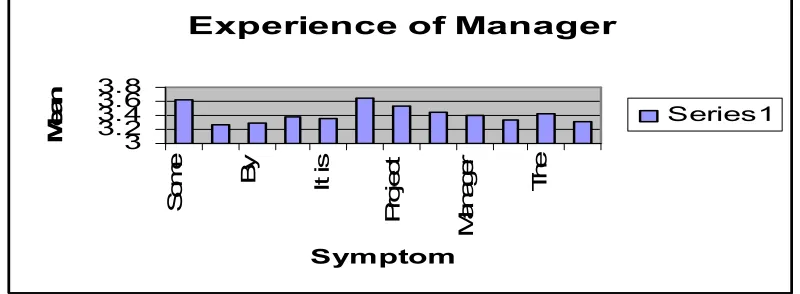
Manager Experience: this dimension indicates that the sample individuals have the ability to work and solving problems within teamwork spirit. Although, manager experience has an important role in success of engineering software, the results indicated that there were significant differences at subjects' perceptions
towards the effective factors in success of software engineering projects that attributed to experience variable; the differences were in favorer to subjects whose experience more than 21 years. As shown table(3),table(5), figure(4) and figure(5)
Experience of Manager
3 3.2 3.4 3.6 3.8
S
o
m
e
B
y
It
i
s
P
ro
je
c
t
M
a
n
a
g
e
r
T
h
e
Symptom
M
e
a
n
[image:8.612.105.505.549.696.2]Series1
Experience of Mananger
0 5 10 15 E x p e ri e n c e i n E x p e ri e n c e i n E x p e ri e n c e i n Symptom M e a n Series1Figure 5 Experience of Manager according to interview
6. RECOMMENDATION
6.1 Formal Methodology:
As project management methodology grow up and mature within an organization current project learn lesson from past software projects
planning experiences also templates and
checklist serve to decrease. Amount of planning time that required at the beginning of project and reduce the possibility of forgetting essential responsibilities.
1.1. Template:
Template which serve in planning of software project like: project organization charts, position, description, standard conflict management and performance appraisals.
1.2. Checklist:
Checklist which help planning of human resource include project responsibility and roles, training program, team ground rules, typical
competencies reward ideas and safety
consideration.
Experience project Manager:
Although experience project manager come in the last rank according to applied study researcher consider the experience project manager is one of most important point for
software project success. Since manager
experience play major essential role for project success. Project manger should be something to guaranty project success:
Managing the team efficiently.
Good knowledge of present organizational culture and decision maker rank in organization that want to do software project.
Focusing on the union team spirit.
Reviewing the documents present in
organization
Taking benefits from his last managing experience and use it in new projects.
Taking benefits from existing improved technology in software project management Using clear formal methodology in project management.
ACKNOWLEDGMENT
This research was sponsored by Al-Balqa Applied University after sabbatical vacation for the year 2015/2016 at Mu'tah University.
REFERENCES:
[1] Boehm, B. and R. Turner. 2003.
Observations on Balancing Discipline and
Agility. Proceedings of the Agile
Development Conference (ADC’03). June. Salt Lake City, Utah, USA.
[2] Heemstra, F.J. and Kusters, R.J. 1996.
Dealing with Risk: A Practical Approach. Journal of Information Technology, Vol 11, 333-346.
[3] (http://www.conferences.esa.int/fontaineblea
u/index.html), accessed at 12/12/2006 on 215 am
[4] (http://www.spc.ca/downloads/resources/esti
mate/estbasics.pdf), accessed at 12/12/2006 on 1:15 am
[5] http://www.standishgroup.com, Accessed
from aabfs website at 31/10/2006
[6] Keil, M., P. Cule, K. Lyytinen, R. Schmidt.
" A framework for identifying software project risks". Communications of the ACM, November 1998, pp. 76-83.
[7] Lindvall, M. et al. 2002. Empirical Findings
in Agile Methods. Proceedings of Extreme
Programming and Agile Methods –
[8] Martin, E. W., Dehayes, D.W., Hoffer, J. A. and Perking. W. C.(1994) Managing Information Technology : What Mangers Need to Know 2nd edition , prentice Hall, new jersey.
[9] May, L.J. 1998. Major Causes of Software
Project Failures.
[10]Nicole Haggerty, “Understanding the Link
between IT Project Manager Skills and Project Success Research in Progress” , ACM 2000, 1-58113-x/00/04.
[11]Radcliffe, D. "Project leadership", Software Magazine, April, 1998 pp. 38-44.
[12]Ropponen, J., AND Lyytinen, K. 2000.
Components of Software Development Risk: How to Address Them? IEEE Transactions on Software Engineering, Vol 26[2], 98-111.
[13]Schwalbe, K. 2000. Information Technology
Project Management. Thompson learning.
[14]Jones, T.C. (1998), "Estimating Software
Costs" New York: McGraw Hill.
[15]Jurison, J. (1999) “Software project
Management: A Manager’s View,”
Communications of AIS, Vol. 2, Article 17,
September 1999.