Full Length Research Article
MODEL LINKING COMMITMENT-BASED HRM PRACTICES AND LEADER-MEMBER EXCHANGE TO
EMPLOYEES’ KNOWLEDGE SHARING AND CREATIVITY
*Yoeung Sothan, Li Baoku, and Wu ZhengXiang
School of Marketing Management, Liaoning Technical University, Huludao 125105, China
ARTICLE INFO ABSTRACT
The purpose of the study was examined the significance of the influences of commitment-based HRM practices, leader-member exchange (LMX) on knowledge sharing and employee creativity. The study was conducted on 17 hotels operating in Cambodia. Based on “personal interview” technique, 342 dyadic data were collected from managerial and non-managerial employees. The questionnaire was developed by using a-5 point Likert scale. Structural equation model (SEM) in AMOS 21.0 was employed to test five research hypotheses. The SEM results demonstrated that commitment-based HRM practices and leader-member exchange made significant contributions to knowledge sharing and employee creativity; the significant correlation between knowledge sharing and employee creativity was also confirmed in this study, too. The findings are to fulfill the gap of literature and empirical study.
Copyright©2016, Yoeung Sothan et al.This is an open access article distributed under the Creative Commons Attribution License, which permits unrestricted use, distribution, and reproduction in any medium, provided the original work is properly cited.
INTRODUCTION
Global hospitality businesses are exposed to rapid growth and continuous changes. They enabled the companies to think about different ways and strategies to gain competitive edge in the market place. Employee creativity and innovation in organizations, particularly for employees in the hotel industry who are repeatedly encouraged to improve service quality and delivery, the idea of a creative workforce has captured managers’ attention. Creative ideas generate psychological and business benefits for both employees and the hotel industry as a whole (Hon, Chan, and Lu, 2013). One way of meeting current business challenges is to rely heavily on employees’ creativity when serving customers seeking quality accommodation and food and beverage (F&B) services. This can substantially contribute to innovation, productivity, and long-term success in the hospitality business (Hon, 2011). Creativity here refers to the development of novel and useful ideas about products services, ideas, procedures, or work processes, generated by individuals working together within a
complex social system (Hon et al., 2013). Increasingly,
creativity has also become valued across a variety of tasks, occupations, and hotel industries.
*Corresponding author: Yoeung Sothan
School of Marketing Management, Liaoning Technical University, Huludao 125105, China
In today’s fast-paced dynamic work environment, managers continue to realize that to remain competitive they need their employees to be actively involved in their work place and trying to generate novel and appropriate products, processes, and approaches (Shalley and Gilson, 2004). Although the level of creativity required and the significant of creativity can differ depending on the tasks’ performance or job in question, most managers would agree that there is pool, in almost every job, for employees to be more creative. Furthermore, because individual creativity provides the foundation for organizational or team creativity and innovation and these have also been linked to company performance and survival, too (Farr and West, 1990), it is very important, if not critical, that employees are creative in their work place.
While a fair amount is known about personality characteristics associated with creative individuals, there is an increasing need for a greater understanding of the contextual factors that may enhance or discourage employees’ creativity as well as the interaction between personal characteristics and the work environment. Moreover, it is a significant to identify the role that commitment-based HRM practices and leader-member exchange can be the key play into encouraged employees to share their knowledge and creativity behavior. That is, most employers and managers would say that they would like their employees to be more creative, but it has not always been
ISSN: 2230-9926
International Journal of Development Research
Vol. 06, Issue, 06, pp. 8204-8211, June,2016
DEVELOPMENT RESEARCH
Article History: Received 16th March, 2016
Received in revised form 28th April, 2016
Accepted 11th May, 2016
Published online 30th June, 2016
Key Words:
HRM Practices;
clear how managers should lead for creative performance to occur.
Literature Review
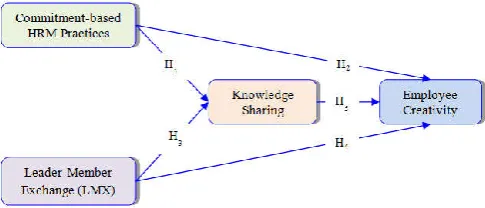
[image:2.595.38.281.226.330.2]To preview our arguments and highlight the theoretical and empirical contributions of this study, we elaborate a model of how commitment-based HRM practices and leader-member exchange influence on employees’ willingness sharing their knowledge and creativity. Figure 1 illustrates this study. We start with defining commitment-based HRM practices and leader-member exchange and by theoretically and empirically linking it to the employees’ knowledge sharing and their creativity, described as following:
Figure 1. Proposed research framework of this study
Commitment-based HRM practices, knowledge sharing, and employee creativity
Human Resources (HRs) refer to people who have the ability physically and wisdom can perform work in the organization and they can contribute to improve the quality of production or services through using their knowledge, skills, and ability, such as working in a hotel, to provide good service to the client is required language abilities in communication, technical problem solving and customer service, technical jobs, as well as the personality of the employee directly. Likewise, they can contribute by using their mental abilities and talents by requesting changes in the methods applied work that effectively, such as in the existing production process or encouraging other workers to increase the both of quality and quantity of the production or services of the organization (Madora, 2007). Similarly, the Human Resources are the people who have enough capacity to work in a business, which generally refers to the personnel or employee. The employee offers expertise, knowledge, experience, and labor needed to make a productive business and get maximum profit level (Glencoe, 2008). HRM practices can be classified as “control” or “commitment” practices in organization.
The control approach aims to optimize and strictly by the rules and prizes are based on the results, while the approach to this commitment aimed at increasing efficiency and reliance on the conditions that encourage employees to identify with the goals of the organization and work hard to achieve those goals. The high commitment of strategic HRM is working well, with the collaboration, which reflects the commitment of the strategy
generally by connecting psychological between the
organization and the employee as a triathlon by the
development, motivation, and discipline to promote
commitment, workforce reliable to use their discretion to carry
out the work, duties, and obligations in ways that are consistent with the goals of the organization. According to Huselid (1995) stated that the best HRM practices dimensions are socialization, job design, recruitment and selection,
training and career development, communication/
participation, work performance management, employee compensation and rewards, and job security. It is believed that when the workers make a judgment on their organization in order to check the accuracy of the organization and their support for the policy, especially in getting treatment relating to the availability and frequency of opportunities to share information, the adequacy of wages and control has been good, positive emotions of well-being will be created, which will likely boost that response by increasing their loyalty to the organization and reducing turnover (Nasurdin, Ramayah, and Osman, 2006).
High commitment to the implementation of HRM in the organization has created a behavior and attitude of the employee, such as job satisfaction and commitment to work with to develop links relationship between the organization and employee goals (Edgar and Geare, 2005). This is agreed by Nishii, Lepak, and Schneider (2008) that implementation of the high commitment urged to pay attention on the work, such as training, team work, reducing tensions, communication with employee involved in the decision-making that has the important influents on the behavior of the employee based on the normative theories logic of HRM practices. Based upon the conceptual review, this study decides to select five dimensions of commitment-based HRM practices including
work design; recruitment and hiring; training and
development; performance appraisal; and compensation and rewards. According to the theory of social change, everyone always had contact with other individuals based on self-interest analysis of the costs and benefits. These benefits should not be tangible, as individuals can participate in the interactive below expectations in the future, which helps boost credibility (Cook, Cheshire, Rice, and Nakagawa, 2013).
improve their management processes, they required to encourage and HR capacity to produce creative idea, the development of innovative methods and the use of new opportunities. The commitment-based HRM practices can affect and modify the capacities, attitudes, and behaviors of
employees to reach the organizational goals (Collins and
Clark, 2003) and they play an important role in creating the conditions necessary for catalyzing and send individuals
towards the development of creative activity (Chen and
Huang, 2009). The companies also can use dimensions of commitment-based HRM practices, such as work design, recruitment and hiring, training and development, performance appraisal, and compensation and rewards, as vehicles to encourage the employees' commitment and get them involved
in creative thinking and innovation (Currie and Kerrin, 2003).
Leader-member exchange, knowledge sharing, and employee creativity
Leader-member exchange (LMX) is part of a study of leadership that was examined during the last two decades. LMX model is defined as a transactional approach, “describes how leaders use their designated power by organization to form relationships change with different various subordinates” (Yukl, 1989). Many years ago, the relationship between leaders and subordinates can be called a LMX and has become another new structure of leadership style. The main principles of the LMX theory is that associated with the transition between a leader and a member of which affect the outcome of several parts, or an organization. LMX has been determined that the difference in quality of relationship between the leaders and their colleagues, which can be obtained ranging from low quality to high quality. Scholar research categorized the relationship leaders could have with their subordinators into two groups: the in-group “high-quality exchange” and out-group “low-quality exchange” (Fisk and Friesen, 2012). Likewise, Graen and Uhl-Bien (1998), stated the value of high-quality leader-member relationships in organizations. Moreover, a high-quality exchange relationship requires both parties to accept their mutual interests and agree to pursue shared superordinate goals.
High-quality exchanges include partnering between
colleagues, in which individuals step further than formal organizational roles to achieve desired goals (Fisk and Friesen, 2012; Graen and Uhl-Bien, 1998). On the other word, low-quality relationship exchanges leaders and subordinators closely obey their respective organizational roles while trust, respect, and feeling of obligations between members and leaders are near to the ground (Barbuto Jr and Gifford, 2012). Despite research efforts to examine organizational and social reasons as well as individual factors that foster or inhibit knowledge sharing (Lu, Leung, and Koch, 2006), there is little knowledge about the mechanisms by which leadership may facilitate employee knowledge sharing, in particular by cultivating a social context in which employees share their knowledge (Carmeli, Atwater, and Levi, 2011). One of these social contexts is LMX quality. The relational identification between leader and subordinators could extend to other types of identifications such as organizational identification. Similarly, some research evidences demonstrated that the best
unique predictor of knowledge sharing, when compared to personality, tenure, team incentives, or goal commitment, is
empowering leadership (Carmeli et al., 2011). Therefore, it
can be said that high quality LMX relationships may help promote knowledge sharing.
Leaders are the most influential promoters of employee creativity at the work place. According to LMX theory, leader-member relationship could consider as a dyadic relationship which forms over time by negotiations. Based on theories, scholars have specified a number of reasons for a positive relationship between LMX and creativity. For instance, high-quality relationships enforce more creativity compared to low-quality relationships because employees are more concentrated on their challenging and difficult tasks in the work place. In addition, in high-quality relationships, employees take higher risks, higher task-elated recognition, support, and appreciation (Tierney, Farmer, and Graen, 1999). Moreover, researchers have suggested that LMX is beneficial for innovation because enjoying a good LMX relationship is accompanied by
encouraging climate perceptions. High-quality LMX
encourages a social climate which motivates a creative work involvement (Scott and Bruce, 1994). Employees enjoy a high-quality LMX relationship, and to reciprocate engage in open and creative work processes. While previous studies (Volmer, Spurk, and Niessen, 2012) examined the relationship between LMX and creative work involvement in high-technology firms in Germany, this study examines this relationship in a less knowledge intensive context (Insurance industry).
Knowledge sharing and employee creativity
Deliberately encouraging factors were influence the behavior of employees. The purpose of this was very influential person to express the possibility that he or she will perform the behavior. However, the kind of incentives encouraging employees to participate in a particular activity or reason for employees’ participation in the activities of the organization (Godin and Kok, 1996). Knowledge sharing behavior is likely to be driven in a similar way to help promote and difficult behavior by providing rewards to encourage and put pressure on employees (Pepall, Richards, and Norman, 2005). In addition, it pointed out that the behavior of the employees shared their knowledge could be important, especially by focusing on increasing autonomous motivation (Gagné, 2009). According to Gagné (2003) stated that autonomous motivation was encouraged through better enforcement and management while could demonstrate motivation and satisfaction reactor and attracting employees to work willingly.
process (van den Hooff and De Ridder, 2004). Thus, past studies have concluded that the main function of the sharing of knowledge is that maintaining a mechanism for inter-unit personnel to continue its creativity and innovation. Learning with the individuals involved, not only to learn from past experience, but also the sharing of knowledge and understanding of current mediation to individuals in organizations.
MATERIALS AND METHODS
Hypotheses to be tested
Based on the literature review and the research model of this study, the hypotheses are developed and tested as following:
Hypothesis 1: Commitment-based HRM practices have positive influence on knowledge sharing.
Hypothesis 2: Commitment-based HRM practices have positive influence on employee creativity.
Hypothesis 3: Leader-member exchange has positive influence on knowledge sharing.
Hypothesis 4: Leader-member exchange has positive
influence on employee creativity.
Hypothesis 5: Knowledge sharing has positive influence on employee creativity.
Data collection and procedure
A questionnaire survey was used to collect primary data in this study. Primary data was collected from non-managerial and managerial employees who are working as full-time employees in four and five star hotels operating in Cambodia. Questionnaire survey was conducted through a personal interview technique, which involved three stages. Firstly, e-mail was sent to appointment with HRM managers to ask permission and to discuss about dateline for doing conduct survey. Secondly, questionnaire survey was distributed to respondents who are in Finance Department, HRM Department, Food and Beverage Department, Engineering Department, Sale and Marketing Department, Spa Department, Front Office Department, and Housekeeping Department with explanations. The purposive sampling technique was adopted to select respondents relationships (Cooper and Schindler, 2014). The questionnaire was offered to 17 hotels and 590 respondents and total of 353 respondents were responded to the survey questionnaire.
However, 11 respondents had to be excluded because their responses were unusable. Finally, a total of 342 respondents from 17 hotels were determined to be usable. The effective responsive rate or yielding was 57.97 percent (342/590). Saunders, Saunders, Lewis, and Thornhill (2011) suggested that the appropriate response rate for “hand-delivered” questionnaires has been found to range between 30 percent and 50 percent, this response rate was viewed as adequate. The
professional and demographic basic information for
respondents contained in the questionnaire survey indicated that 59.94 percent are males and 40.06 percent are females. The sample included 13.16 percent respondents who range in age from 18-23 years, while over 85 percent are older than 24 years. In terms of educational attainment, 31.87 percent of
respondents finished high school, while 17.54 percent have an association’s degree, 43.57 percent hold a bachelor’s degree, and 7.02 percent graduated master’s degree. Among of 8 departments of hotels, the minorities of respondents are working in Finance Department, 7.89 percent and the majorities of respondents are working in Housekeeping Department, 20.76 percent. In terms of position, of respondents, 33.33 percent are working as operational employees, 23.39 percent are supervisor, 25.15 percent hold position as assistant manager, and 18.13 percent have an occupation as manager of hotel organizations. About 10.23 percent of respondents have hotel-organization tenures of 1 year or less, while 72.81 percent respondents have tenures between 2 years to 7 years; 16.96 percent respondents have tenures over 7 years. Furthermore, there are 16.08 percent respondents who have ranged monthly income from 150-300USD, while 83.92 percent respondents who have monthly income over 300USD.
Measurement scales
The procedures of research construct measurement are described as following:
Commitment-based HRM practices: We measured using five dimensions developed by F.-H. Lee (2011), which consisted of a total of 16 items, as following:
Work design contained four items related to the
statement: “Work designs encourage collaboration among employees.”
Recruitment and hiring contained three items related to
the statement: “Selection system focuses on the candidate’s ability.”
Training and development contained three items related
to the statement: “Providing the formal training programs for new employees.”
Performance appraisal contained three items related to
the statement: “Performance appraisal focus on knowledge sharing activities.”
Compensation and rewards contained three items,
which related to the statement: “Compensation system encourages employees to share knowledge.”
Leader-member exchange (LMX):Five items of LMX adopted
by Margaretta (2007), which related to the statement: “The leader has enough confidence in me that he/ she would defend and justify this decision if I were not to do so.”
Knowledge sharing: We adopted five items developed from Margaretta (2007) for this study, which related to the statement: “I will try to share this expertise from my education or training.”
Employee creativity: Six items of employee creativity’s questionnaire were operated by L.-Y. Lee and Veasna (2013), which related to the statement: “Employees come up with new and practical ideas.”
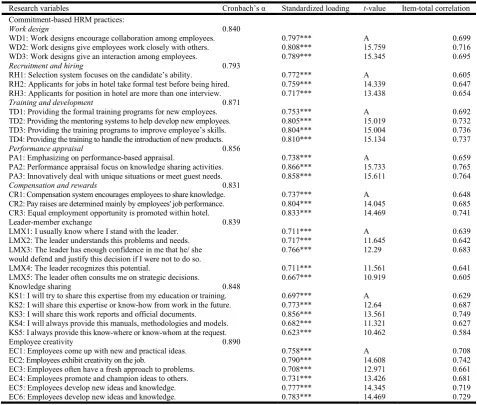
Podsakoff, 2003). To survey in the Cambodian context, original items were translated into Khmer language (Cambodian) by following Brislin’s (1980) translation-back-translation procedure to validate the meanings of measurement items. All items of questionnaire were measured on a-5 point Likert scale (i.e., from 1=strongly disagree to 5=strongly agree). The Cronbach’s alpha reliability for this study is addressed in Table 1.
RESULTS
Convergent and discriminant validity
The research construct reliability and convergent validity test were evaluated by using the guidelines of Anderson and Gerbing (1988). Firstly, the exploratory factor analysis for all the research items resulted in factor solutions, as expected theoretically. The internal consistency analysis (α) for each factor were greater than 0.70 (see Table 1). Secondly, a confirmatory factor analysis (CFA) was performed to assess the distinctiveness of the measures by using AMOS 21.0. There are two procedures of CFA models, namely a first-order factor model and second-order factor model (Koufteros, Babbar, and Kaighobadi, 2009).
In this study, four research constructs and their first-order CFA model were adopted to examine each individual research construct, and the results of this procedure indicated that
standardized loading for all items exceeded 0.60 and that t
-values were higher than 1.96 (p < 0.001). The model fitness
index of each individual research construct was acceptable:
χ2/df < 2; GFI) > 0.90; AGFI > 0.90; RMR < 0.05, and p-value
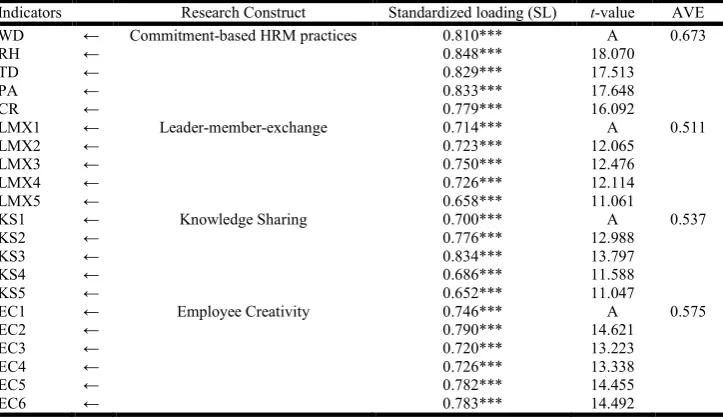
> 0.05 (see Table 2). The second order models, then, was conducted to analyze the fitness of research constructs which contained multiple factors (i.e., commitment-based HRM practices, leader-member exchange, knowledge sharing, and employee creativity) as shown in Table 3. The results of the second-order model were satisfied the threshold as suggested
by Hair, Black, Babin, and Anderson (2010), Koufteros et al.
(2009): l χ2/df) < 2; GFI > 0.90; AGFI > 0.90; RMR < 0.05 (see Table 2). These results demonstrated that our research model held good fit to the data, with adequate convergent
validity and construct reliability (Hair et al., 2010). The
[image:5.595.55.533.354.759.2]descriptive statistics, including the means, standard deviations, and correlations among the research variables are reported in Table 4. Convergent validity was demonstrated, as the average variance extracted (AVE) values for all research constructs was higher than the suggested threshold value of 0.50 (Fornell and Larcker, 1981).
Table 1. Results of CFA: First-order model
Research variables Cronbach’s α Standardized loading t-value Item-total correlation Commitment-based HRM practices:
Work design 0.840
WD1: Work designs encourage collaboration among employees. 0.797*** A 0.699 WD2: Work designs give employees work closely with others. 0.808*** 15.759 0.716 WD3: Work designs give an interaction among employees. 0.789*** 15.345 0.695
Recruitment and hiring 0.793
RH1: Selection system focuses on the candidate’s ability. 0.772*** A 0.605 RH2: Applicants for jobs in hotel take formal test before being hired. 0.759*** 14.339 0.647 RH3: Applicants for position in hotel are more than one interview. 0.717*** 13.438 0.654
Training and development 0.871
TD1: Providing the formal training programs for new employees. 0.753*** A 0.692 TD2: Providing the mentoring systems to help develop new employees. 0.805*** 15.019 0.732 TD3: Providing the training programs to improve employee’s skills. 0.804*** 15.004 0.736 TD4: Providing the training to handle the introduction of new products. 0.810*** 15.134 0.737
Performance appraisal 0.856
PA1: Emphasizing on performance-based appraisal. 0.738*** A 0.659
PA2: Performance appraisal focus on knowledge sharing activities. 0.866*** 15.733 0.765 PA3: Innovatively deal with unique situations or meet guest needs. 0.858*** 15.611 0.764
Compensation and rewards 0.831
CR1: Compensation system encourages employees to share knowledge. 0.737*** A 0.648 CR2: Pay raises are determined mainly by employees' job performance. 0.804*** 14.045 0.685 CR3: Equal employment opportunity is promoted within hotel. 0.833*** 14.469 0.741
Leader-member exchange 0.839
LMX1: I usually know where I stand with the leader. 0.711*** A 0.639
LMX2: The leader understands this problems and needs. 0.717*** 11.645 0.642 LMX3: The leader has enough confidence in me that he/ she
would defend and justify this decision if I were not to do so.
0.766*** 12.29 0.683
LMX4: The leader recognizes this potential. 0.711*** 11.561 0.641
LMX5: The leader often consults me on strategic decisions. 0.667*** 10.919 0.605
Knowledge sharing 0.848
KS1: I will try to share this expertise from my education or training. 0.697*** A 0.629 KS2: I will share this expertise or know-how from work in the future. 0.773*** 12.64 0.687 KS3: I will share this work reports and official documents. 0.856*** 13.561 0.749 KS4: I will always provide this manuals, methodologies and models. 0.682*** 11.321 0.627 KS5: I always provide this know-where or know-whom at the request. 0.623*** 10.462 0.584
Employee creativity 0.890
EC1: Employees come up with new and practical ideas. 0.758*** A 0.708
EC2: Employees exhibit creativity on the job. 0.790*** 14.608 0.742
EC3: Employees often have a fresh approach to problems. 0.708*** 12.971 0.661 EC4: Employees promote and champion ideas to others. 0.731*** 13.426 0.681
EC5: Employees develop new ideas and knowledge. 0.777*** 14.345 0.719
EC6: Employees develop new ideas and knowledge. 0.783*** 14.469 0.729
Discriminant validity was determined by comparing the square root of the AVE with the Pearson correlations among the constructs (see Table 4). All AVE estimates from Table 3 can be seen to be greater than the corresponding interconstruct square correlation estimates in Table 4. Finally, the results shown in Table 4 indicated that correlations among the research variables exceeded 0.50, which suggested higher relative correlations; therefore, a CFA was conducted to assess the distinctiveness of the research variables for commitment-based HRM practices, leader-member exchange, knowledge sharing, and employee creativity, respectively.
Hypotheses testing
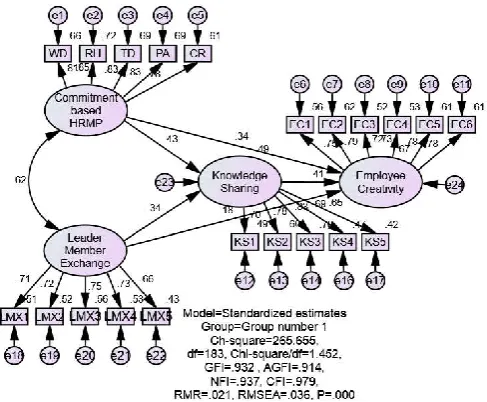
To test the hypotheses, structural equation modeling (SEM) was applied using the likelihood estimation method. The latent variables were adopted in order to proceed with SEM (Anderson and Gerbing, 1988). The results in Table 5 and Figure 2 illustrated that the model fit statistics were acceptable
(i.e., χ2(265.655)/df(183) = 1.452, p = 0.000, GFI = 0.932, AGFI =
0.914, NFI = 0.937, CFI = 0.979, RMR = 0.021, RMSEA = 0.036), indicating that the proposed model was satisfactory
[image:6.595.147.449.73.144.2](Hair et al., 2010). The SEM path coefficients showed
Table 2. Results of CFA: Goodness of fit indices (N=342)
Indices χ2/df GFI AGFI RMR p-value
First-order model:
Commitment-based HRM practices 1.233 0.960 0.943 0.010 0.062 Leader-member exchange 1.715 0.990 0.971 0.013 0.127 Knowledge sharing 1.800 0.990 0.970 0.012 0.109 Employee creativity 1.633 0.986 0.967 0.012 0.100
[image:6.595.120.482.177.386.2]Second-order model: 1.452 0.932 0.914 0.021 0.000
Table 3. Results of CFA: Second-order factor model
Indicators Research Construct Standardized loading (SL) t-value AVE WD ← Commitment-based HRM practices 0.810*** A 0.673
RH ← 0.848*** 18.070
TD ← 0.829*** 17.513
PA ← 0.833*** 17.648
CR ← 0.779*** 16.092
LMX1 ← Leader-member-exchange 0.714*** A 0.511
LMX2 ← 0.723*** 12.065
LMX3 ← 0.750*** 12.476
LMX4 ← 0.726*** 12.114
LMX5 ← 0.658*** 11.061
KS1 ← Knowledge Sharing 0.700*** A 0.537
KS2 ← 0.776*** 12.988
KS3 ← 0.834*** 13.797
KS4 ← 0.686*** 11.588
KS5 ← 0.652*** 11.047
EC1 ← Employee Creativity 0.746*** A 0.575
EC2 ← 0.790*** 14.621
EC3 ← 0.720*** 13.223
EC4 ← 0.726*** 13.338
EC5 ← 0.782*** 14.455
EC6 ← 0.783*** 14.492
[image:6.595.111.486.436.487.2]Note: N = 342; A= Parameter regression weight is fixed at 1; *** p-value <0.001, ** p-value <0.01, *p-value <0.05, and significant level at t-value >1.96; AVE = Average Variance Extracted.
Table 4. Descriptive statistics and correlation matrix among research constructs
Research Constructs Mean Std. D. 1 2 3 4
1. Commitment-based HRM practices 4.419 0.468 0.820
2. Leader-member exchange 4.347 0.623 0.540** 0.715
3. Knowledge sharing 4.368 0.639 0.576** 0.523** 0.733
4. Employee creativity 4.300 0.638 0.651** 0.557** 0.660** 0.758 Note: N = 342; ** Correlation is significant at the 0.01 level tailed), * Correlation is significant at the 0.05 level (2-tailed); Pearson Correlation Test is used.
Table 5. Results of coefficient path relationships
Path Relationships Standardized Coefficient t-value
H1: commitment-based HRM practices → Knowledge Sharing 0.433*** 6.044
H2: commitment-based HRM practices → Employee Creativity 0.340*** 5.254
H3: Leader-member exchange → Knowledge Sharing 0.341*** 4.675
H4: Leader-member exchange → Employee Creativity 0.185** 2.927
H5: Knowledge Sharing → Employee Creativity 0.411*** 5.895 Goodness of fit statistics: χ2(265.655)/df(183) = 1.452, p = 0.000, GFI = 0.932, AGFI = 0.914, NFI = 0.937, CFI = 0.979,
RMR = 0.021, RMSEA = 0.036
commitment-based HRM practices to be positively significant
related to knowledge sharing (γH1 = 0.433; t = 6.044; p <
0.001), and employee creativity (γH2 = 0.340; t = 5.254; p <
[image:7.595.42.286.112.313.2]0.001).
Figure 2. Results of structural equation modeling
Therefore, H1 and H2 were supported. Leader-member exchange was found to be positively and significantly related
to knowledge sharing (γH3 = 0.341; t = 4.675; p < 0.001) and
employee creativity (γH4 = 0.185; t = 2.927; p < 0.01), which
supported H3 and H4, respectively. The relationship between knowledge sharing and employee creativity was also
confirmed in this study, too (βH5 = 0.411; t = 5.895; p <
0.001). Thus, H5 was supported.
DISCUSSION AND CONCLUSION
The findings indicated that commitment-based HRM practices make direct and significant positive contributions to
knowledge sharing and employee creativity (γH1 = 0.433; t =
6.044; p < 0.001; γH2 = 0.340; t = 5.254; p < 0.001),
respectively. Thus, H1 and H2 were supported in this study. These results of finding consistent with the findings of Margaretta (2007), which found that HRM practices are significantly related to employee behavior of knowledge sharing and Chen and Huang (2009) which found that bundled commitment-based HR practices were positively related to employees’ innovation performance. The results also indicated that leader-member exchange (LMX) has significantly positive
influence on knowledge sharing and employee creativity (γH3 =
0.341; t = 4.675; p < 0.001; γH4 = 0.185; t = 2.927; p < 0.01),
respectively. These results are in line with Farzaneh Hassanzadeh (2014), who reported leader-member exchange to be positively and significantly related to knowledge sharing and creative work environment in insurance companies. Conceptually, the relationships between leader-member exchange, knowledge sharing, and employee creativity have mostly ignored with regard to literature and empirical testing; thus, this study may lack the evidence by with to achieve confirmation. The research findings also demonstrated that the knowledge sharing has positive impact on employee creativity
(βH5 = 0.411; t = 5.895; p < 0.001), too. This finding is also in
line with the theoretical foundations and empirical studies as
proposed by previous researcher, such as Nonaka, Von-Krogh, and Voelpel (2006) which concluded that the critical function of knowledge sharing is that of maintaining an
inter-organizational mechanism for employees’ on-going
innovation.
Acknowledgements
The author would like to gratefully acknowledge animus reviewers for useful suggestions and the National Natural Foundation (No. 71172218), Research Fund for the Doctoral Program of Higher Education, China (Grant Number: 20122121110005).
REFERENCES
Anderson, J. C., and Gerbing, D. W. 1988. Structural equation modeling in practice: A review and recommended two-step
approach. Psychological bulletin, 103(3), 411.
Barbuto Jr, J. E., and Gifford, G. T. 2012. Motivation and leader-member exchange: Evidence counter to similarity
attraction theory. Leadership and Entrepreneurship|
Virginia Beach, VA, 18.
Bartol, K. M., and Srivastava, A. 2002. Encouraging knowledge sharing: The role of organizational reward
systems. Journal of Leadership and Organizational
Studies, 9(1), 64-76.
Brislin, R. W. 1980. Translation and content analysis of oral
and written material. Handbook of cross-cultural
psychology, 2(2), 349-444.
Cabrera, E. F., and Cabrera, A. 2005. Fostering knowledge
sharing through people management practices. The
International Journal of Human Resource Management,
16(5), 720-735.
Carley, K. M. (1997). Extracting team mental models through
textual analysis. Journal of Organizational Behavior, 18(s
1), 533-558.
Carmeli, A., Atwater, L., and Levi, A. 2011. How leadership enhances employees’ knowledge sharing: the intervening
roles of relational and organizational identification. The
Journal of Technology Transfer, 36(3), 257-274.
Chen, C.J., and Huang, J.W. 2009. Strategic human resource practices and innovation performance—The mediating role
of knowledge management capacity. Journal of Business
Research, 62(1), 104-114.
Collins, C. J., and Clark, K. D. 2003. Strategic human resource practices, top management team social networks, and firm performance: The role of human resource practices in
creating organizational competitive advantage. Academy of
Management journal, 46(6), 740-751.
Cook, K. S., Cheshire, C., Rice, E. R., and Nakagawa, S. 2013. Social exchange theory: Springer.
Cooper, D. R., and Schindler, P. S. 2014. Business research
methods (12th ed.). New York: McGraw-hill
Currie, G., and Kerrin, M. 2003. Human resource management and knowledge management: enhancing knowledge
sharing in a pharmaceutical company. The International
Journal of Human Resource Management, 14(6),
1027-1045.
Edgar, F., and Geare, A. 2005. HRM practice and employee
attitudes: different measures-different results. Personnel
Farr, J. L., and West, M. A. 1990. Innovation and creativity at work: Psychological and organizational strategies: John Wiley and Sons.
Farzaneh Hassanzadeh, J. 2014. Leader-member exchange, Creative work involvement: The Importance of knowledge
sharing. Iranian Journal of Management Studies, 7(2),
391-412.
Fisk, G. M., and Friesen, J. P. 2012. Perceptions of leader emotion regulation and LMX as predictors of followers' job satisfaction and organizational citizenship behaviors. The Leadership Quarterly, 23(1), 1-12.
Fornell, C., and Larcker, D. F. 1981. Evaluating structural equation models with unobservable variables and
measurement error. Journal of marketing research, 39-50.
Gagné, M. 2003. The role of autonomy support and autonomy
orientation in prosocial behavior engagement. Motivation
and emotion, 27(3), 199-223.
Gagné, M. 2009. A model of knowledge‐sharing motivation.
Human Resource Management, 48(4), 571-589.
Glencoe. 2008. Introduction to Business. United States of
America: McGraw-Hill.
Godin, G., and Kok, G. 1996. The theory of planned behavior: a review of its applications to health-related behaviors. American journal of health promotion, 11(2), 87-98. Graen, G. B., and Uhl-Bien, M. 1998. Relationship-based
approach to leadership: Development of Leader–Member Exchange (LMX) theory of leadership over 25 years: Applying a multi-level multi-domain perspective.
Hair, J. F., Black, W. C., Babin, B. J., and Anderson, R. E.
2010. Multivariate data analysis (7th ed.). New Jersey:
Pearson Prentice Hall.
Hon, A. H. 2011. Enhancing employee creativity in the Chinese context: The mediating role of employee
self-concordance. International Journal of Hospitality
Management, 30(2), 375-384.
Hon, A. H., Chan, W. W., and Lu, L. 2013. Overcoming work-related stress and promoting employee creativity in hotel industry: The role of task feedback from supervisor. International Journal of Hospitality Management, 33, 416-424.
Huselid, M. A. 1995. The impact of human resource management practices on turnover, productivity, and
corporate financial performance. Academy of Management
journal, 38(3), 635-672.
Koufteros, X., Babbar, S., and Kaighobadi, M. 2009. A paradigm for examining second-order factor models
employing structural equation modeling. International
Journal of Production Economics, 120(2), 633-652. Lee, F.H. 2011. Linking Commitment-based HR Pracites and
Innovation Performance: The Influences of Organizational Commitment, Knowledge Sharing, Psychological Contract, and Empowerman Leadership in Taiwanese High-tech
Industry. Doteral Dissertation, National Cheng Kun
Univeristy, Taiwan
Lee, L.-Y., and Veasna, S. 2013. The Effects of Social Exchange Perspective on Employee Creativity: A
Multilevel Investigation. Psychology Research, 3(11), 660.
Lu, L., Leung, K., and Koch, P. T. 2006. Managerial knowledge sharing: The role of individual, interpersonal,
and organizational factors. Management and Organization
Review, 2(1), 15-41.
Madora, J. 2007. Introduction to Business (4th ed.). Canada:
Thomson South-Western.
Margaretta, H. 2007. Multilevel Investigation of Employee’s Knowledge Sharing: A Case of a Telecommunication
Company in Indonesia. Master's thesis, National Cheng
Kun Univeristy, Taiwan
Nasurdin, A. M., Ramayah, T., and Osman, M. 2006. Job Satisfaction and Organizational Commitment among the Malaysian Workforce: Malaysian Publications: April. Nishii, L. H., Lepak, D. P., and Schneider, B. 2008. Employee
attributions of the “why” of HR practices: Their effects on
employee attitudes and behaviors, and customer
satisfaction. Personnel Psychology, 61(3), 503-545.
Nonaka, I., Von-Krogh, G., and Voelpel, S. 2006. Organizational knowledge creation theory: Evolutionary
paths and future advances. Organization studies, 27(8),
1179-1208.
Pepall, L., Richards, D. J., and Norman, G. 2005. Industrial
organization: contemporary theory and practice:
Thomson/South-Western.
Podsakoff, P. M., MacKenzie, S. B., Lee, J.-Y., and Podsakoff, N. P. 2003. Common method biases in behavioral research: a critical review of the literature and
recommended remedies. Journal of Applied Psychology,
88(5), 879.
Saunders, M. N., Saunders, M., Lewis, P., and Thornhill, A.
2011. Research methods for business students (5th ed.).
India: Pearson Education
Scott, S. G., and Bruce, R. A. 1994. Determinants of innovative behavior: A path model of individual
innovation in the workplace. Academy of Management
journal, 37(3), 580-607.
Shalley, C. E., and Gilson, L. L. 2004. What leaders need to know: A review of social and contextual factors that can
foster or hinder creativity. The Leadership Quarterly,
15(1), 33-53.
Tierney, P., Farmer, S. M., and Graen, G. B. 1999. An examination of leadership and employee creativity: The
relevance of traits and relationships. Personnel
Psychology, 52(3), 591-620.
van den Hooff, B., and De Ridder, J. A. 2004. Knowledge sharing in context: the influence of organizational commitment, communication climate and CMC use on
knowledge sharing. Journal of knowledge management,
8(6), 117-130.
Volmer, J., Spurk, D., and Niessen, C. 2012. Leader–member exchange (LMX), job autonomy, and creative work
involvement. The Leadership Quarterly, 23(3), 456-465.
Yukl, G. 1989. Managerial leadership: A review of theory and
research. Journal of management, 15(2), 251-289.