7187
ABOUT THE FUNCTIONING OF THE SPECIAL-PURPOSE
CALCULATING UNIT BASED ON THE LINEAR SYSTEM
SOLUTION USING THE FIRST ORDER
DELTA-TRANSFORMATIONS
1LIUBOV VLADIMIROVNA PIRSKAYA, 2NAIL’ SHAVKYATOVISH KHUSAINOV
1, 2Institute of Computer Technology and Information Security, Southern Federal University,
Rostov-on-Don, Russia
E-mail: 1[email protected], 2[email protected]
ABSTRACT
This paper discusses the theoretical representations of special-purpose calculating unit functioning for the iteration solution of linear systems using the first order delta-transformations and variable quantum. It is considered the algorithm for iterative solution of linear systems based on the first order delta-transformations and variable quantum is adapted for implementation in a special-purpose calculating unit. A special feature of special-purpose calculating unit functioning based on this algorithm is the implementation of the introduction at the beginning of each cycle l of a new variable quantum value that is reflected in the current cycle when the residual values and the unknown variable are formed by shifting them to the left by 1 or 2 bits. Formation of unknown variables in the unit is carried out by adding or subtracting the signs of quantum of the first and second variables differences, taking at each iteration the values ± 1. This feature of variable normalization represents the possibility of organizing a computational process on the basis of an integer data representation. At the final step of the algorithm operation in the unit, it is possible to bring the values of the variables to the original real form, taking into account the weight of the minimum transformation quantum. With the orientation to FPGA, comparative estimates are obtained for the hardware and time resources of the developed algorithm and comprehensive comparative estimate of the effectiveness for special-purpose calculating unit functioning. In this paper for the developed algorithm of the unit functioning, it is shown that it is possible to reduce the execution of one iteration and the iterative process as a whole, the amount of hardware resources and generally improve the efficiency in comparison with the special-purpose calculating unit functioning based on the simple iteration method.
Keywords: Special-Purpose Calculating Unit, Linear System Solution, First Order Delta-Transformation.
1. INTRODUCTION
The issues study of qualitative and quantitative improvement of computing devices perfomence for solving complex practical problems in real time shows that using the most modern universal computer technology there are various difficulties: the need to organize effective parallel computing processes with the decision to reduce the amount of transferred information, the number of simultaneously operating multipliers, multi-bit registers for storing information, simplification of complex systems of information exchange, ensuring high performance of calculators in processing information. Such problems arise, in particular, in the organization in real time of a
parallel solution of practical problems, that can be reduced to problems of computational mathematics, to design of on-board computer systems, specialized control devices, and so on. One of the ways to solve these problems is the creation of specialized computing devices and systems, taking into account the design of their problem-oriented purpose and using special effective methods for implementing the computational process [1].
7188 use of problem-oriented computations under the given conditions allows organizing the computing process in such a way that the processing of information at the level of one iteration is performed with sufficient accuracy, high speed and with an extremely long time step. Then, it is possible to demand the lowest requirements to the performance of computing tools, taking into account the possibility of simultaneous implementation of other algorithms and programs.
The functioning of a special-purpose calculating unit based on known iterative algorithms for solving linear systems [5]-[8] is characterized by a huge amount of hardware resources, which is associated with the need to implement a large number of multi- bit multipliers of coefficients and variables, as well as to transfer of multi- bit codes between the equations of the system at parallel implementation. The number of hardware and time resources increases, when it is necessary to simultaneously solve a large number of linear systems.
The developed algorithms for solving linear systems with constant and variable free terms based on the first order delta-transformations with constant [9]-[10] and variable quantum [11]-[16] when implemented in a special-purpose calculating unit allow organizing a computing process with the exception of operations of a multi-bit multiplication and obtaining a result in one iteration of the steady-state process. However, in papers [9]-[11] the use of a constant quantum is characterized by a much larger number of iterations. The use of an variable quantum greatly reduces the number of iterations [12]-[18].
The essence of these algorithms with a variable quantum lies in the representation of the iterative process in the form of l iteration cycles, in each of which a parallel for all equations of a linear system is performed the formation of variables at a constant modulus of transformation quantum [14]-[16].
In the paper [11] the process of linear systems solution must be preceded by the number of iterations in the cycle, using, in particular, the division operation that under the conditions of the perform these calculations with the help of the special-purpose calculating unit is not appropriate.
Almost all the papers [11]-[13] concerned the algorithmic organization of the iterative process
for linear systems solving with the use of the first order delta-transformations with the variable quantum has not got any information about the theoretical justification for the selection of the best relation between the quanta of the adjacent cycles; on the one hand the ways to specify these relations are introduced heuristically, on the other hand they are not fully cover the theoretical and practical interest of these relations.
In addition, the following observations should be noted. In the papers [11]-[13] the proposed algorithms are characterized by high computational complexity when implementing the iteration process due to the necessity of performing the squaring of the discrepancies across all equations at each iteration, summing them and highlight the smallest of the current according to the amount of values across the iterations. The squaring of the discrepancies is associated with the need to use the multibit multipliers, which is contrary to the original goal – implementation of the special-purpose control units of linear systems solution with the possible of the exception of such devices. The iterations termination moment is fixed either with the use of a certain constant, the determining value of which is uncertain, or according to the number of iterations that is also a problem of the preliminary estimate.
In the papers [14]-[16] is developed a theoretical substantiation of the selection of the number of cycles and the values of the variables quantum, aimed at minimizing the number of iterations in the linear systems solution on the basis of the first order delta-transformations. The algorithms which showed efficiency on ensuring timely completion of iterations, simple in realization and not demanding any numerical assessment with use of special basic data are introduced for the formation of the completion moment of the real iterative processes in the loops.
The architecture of the special-purpose calculating unit can undoubtedly impact on final algorithmic efficiency. And in the design of special-purpose calculating unit using the FPGA peculiarities of algorithmic software allow to achieve the highest quality performance indicators to minimize the costs of resources (equipment) compared with known [19]-[21].
7189 special-purpose calculating unit for the parallel iterative solution of linear systems based on the first order delta-transformations and variable quantum. Next, the paper contains the developed architecture, features and a study of the effectiveness of the special-purpose calculating unit functioning based on the linear system solution using the first order delta-transformations and variable quantum.
2. THE ALGORITHM OF A LINEAR
SYSTEM SOLUTION ADAPTED UNDER REALIZATION IN A SPECIAL-PURPOSE CALCULATING UNIT
There is an linear system that has a matrix of constant coefficients and, in general case, variable free terms, fulfilling convergence conditions described in papers [5]-[8]:
( ) ( )
*
BY t G t . (1.1)
Let's transform the system
( ) ( ) ( )
* *
Y t AY t D t ,
and transfer to writing with residual z t( ) for applying the iteration method:
( ) ( ) ( ) ( )
z t Y t AY t D t . (1.2)
In the given systems B[ ]brj , [ / ]rj rr
A b b are matrices of dimensional coefficients n n ; G t( ), D t( ) are column-vectors of absolute system terms (in particular for the system with fixed absolute terms ( )G t G [ ]gr ,
( ) [ r / rr]
D t D g b ); Y t*( ) are column-vectors of
system unknowns; z t( ), Y t( ) are column-vectors of residuals and approximate unknown values; t is an independent variable; detA0.
Based on the results obtained in [14]-[16], an algorithm for the parallel solution of linear system (1.1) with constant free terms using the first order delta-transformations and variable quantum oriented for special-purpose calculating unit is presented below in the following difference form for i-step under the initial conditions Yr01 0,
01
r r
z D , z01 max , r1,n, * 2 s P
c , sN
[17]-[18]:
- calculating the values of residuals and unknowns before each iteration cycle:
* int,(1,2)
0 ( 1) int,(1,2)
r l rR l
z z R ; (1.3.1)
* int,(1,2)
0 ( 1) int,(1,2)
r l rR l
Y Y R ; (1.3.2)
1,
r n, l1, 2,...,Pint,(1,2);
- creation of first difference quantum signs at each iteration in cycles:
( 1)
( )
ril sign zr i l
; (1.3.3)
{ 1, 1}
ril
; r1,n, * int,(1,2)
1, 2,...,
i R ;
int,(1,2)
1, 2,...,
l P ;
- demodulation:
( 1)
ril r i l ril
Y Y ; (1.3.4)
- creation of residual values at each iteration in cycles:
( , 1, )
ril r jil
z Ф j n
; (1.3.5)
( 1)
ril r i l ril
z z z ; (1.3.6)
- conditions for completion of iterative processes in the iteration cycle:
1. * *
int,(1,2 ) ( int,(1,2 ) 1)
( rR l) ( r R l)
sign z sign z
or (1.3.7)
* int,(1,2 ) 0
rR l
z ;
int,(1,2)
1, 2,...,
l P , r1,n.
2. *int,(1,2 ) int,(1,2 )* *
int,(1,2 )
( ( ))
( )
rR l rR l
rR l
sign z sign z
sign z
or (1.3.8)
* *
int,(1,2 ) int,(1,2 )
( rR l ( rR l)) 0
sign z sign z ;
int,(1,2)
1, 2,...,
l P , r1,n.
In the algorithm (1.3) Pint,(1,2) is the number
of iteration cycles performed at a constant modulus of quantum; Rint,(1,2) – a constant value, that reflects
7190 are set in accordance with those obtained in papers [14]-[16] relations:
01 max *
int,(1,2)
int,(1,2)
ln
ln P z
c P
R
, (1.4)
where *
P
c is the weight of the minimum transformation quantum on the last cycle ( * 0
P c ),
int,1 2
R и Rint,2 4.
The number of iterations of a real computational process in a cycle *
int,(1,2)
R , in accordance with the conclusions obtained in papers [14]-[16], may be larger or smaller relative value
int,(1,2)
R .
In the relations (1.3.1) and (1.3.2), values
0
r l
z and Yr l0 are calculated in the current cycle by
shifting them by 1 bits at Rint,12 or by 2 bits at
int,2 4
R . This procedure reflects the introduction at the beginning of each cycle l before the fulfillment of the relations (1.3.3) - (1.3.8) of the new value of the variable quantum.
At each iteration, the quantum signs are formed as ± 1 values and are used later in next steps of the algorithm to calculate the unknown variable
ril
Y (1.3.4) by adding or subtracting a unit from this current value.
This feature of variable normalization represents the possibility of organizing a computational process on the basis of an integer representation of data. Upon completion of the algorithm, it is possible to form the variables values to the original real representation using the weight of the minimum transformation quantum c*P:
* *
int,(1,2 ) int,(1,2 ) int,(1,2 ) int,(1,2 )
* *
P
rR P rR P
Y Y c , (1.5)
where the combination *
int,(1,2) int,(1,2)
R P in the index denotes the formation of the most recent value of the unknown, that is, the final result.
Completion of iterative processes in the cycles in the algorithm (1.3) is carried out on the basis of the relations (1.3.7) or (1.3.8), when in the cycle for all equations of a linear system
simultaneously or distributed in time, at least one of them is fulfilled.
3. ARCHITECTURE OF THE
SPECIAL-PURPOSE CALCULATING UNIT
FUNCTIONING USING THE FIRST
ORDER DELTA-TRANSFORMATIONS
AND VARIABLE QUANTUM
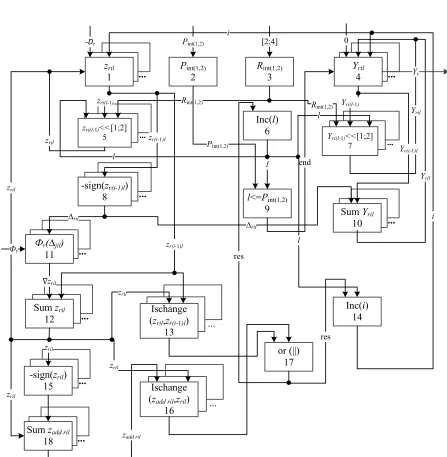
Figure 1 shows the block diagram of the special-purpose calculating unit functioning for the parallel iterative solution of linear systems based on the algorithm (1.3) using the first order delta-transformations and variable quantum.
Blocks 1, 4 are r registers (r1,n), which contain residual zril and unknown Yril values,
1,
r n with initial values zr01 Dr and Yr01 0, respectively.
Blocks 2, 3 are registers that contain the values of the iterative cycles number performed at a constant modulus of quantum, determined before the algorithm (1.3) starts and assumes one of the two values Rint,(1,2), respectively.
Blocks 5, 7 are r shift registers (r1,n), realizing the shift of the values zr l0 (1.3.1) and
0
r l
Y (1.3.2) into 1 bit at Rint,12 or 2 bits at
int,2 4
R at the beginning of each cycle l. The
obtained values zr l0 and Yr l0 after the shift come
to the registers of blocks 1 and 4, respectively. In block 6, the cycles of the algorithm (1.3) are executed, the conditions for the termination of the algorithm (1.3) as a whole are verified in block 9 and the fulfillment of this condition shows the result of solving the linear system from block 4.
Blocks 8, 15 determine, according to the relations (1.3.3), the quantum signs of the first differences of the previous iteration zr i( 1) l and the
current iteration zril for all equations of the system.
7191 In the diagram of Figure 1, the current value of the residual zril is calculated on the basis of the tabular method in the form (1.3.5), where
1 ( )
( , 1, ) n
r jil ril rj ji j
j r
Ф j n a
and storage devices (r1,n) of the block 11 for storing the tables.
The table is organized as a sums collection of multiplication of linear system coefficients by transformation quantum for each equation. Choosing values of the pre-formed multiplication sums is performed based on the set of current values jil, j1,n coming from block 8. Thus, it is possible to exclude the multiplication operation due to the given organization of calculations and to obtain the result for 1 unit of time.
For a large dimension of the matrix A, it is expedient to partition the sum Фr(jil, j1, )n into m blocks:
*
1
( , 1, ) m ( , 1, )
r jil r jil
g
Ф j n Ф j n
and store the table values for each block.
Block 12 is r adders (r1,n), where the input of each receives the residuals zri and values obtained in block 11 corresponding to the system equations. This block ensures the fulfillment of relation (1.3.6).
Blocks 13 and 16 are designed to verify the conditions (1.3.7), (1.3.8) that fix the moments of iterative processes completion in the l-th iteration cycle for each equation of linear system. In the block 17, the generation of these moments for all equations of the system is verified either by (1.3.7) or (1.3.8). If one of the conditions is successfully met, the counter is incremented in the block 6, and the algorithm is organized on a new iterative cycle.
In block 14, the number of iterations is counted within one iteration cycle l. This counter i is reset to zero for each next cycle l.
Blocks 12, 18 are a group of adders (r1,n), in which values of the current residuals
ril
z (1.3.6) and additional ones zadd rilare
calculated, where
( )
add ril ril ril z z sign z .
Performing algorithmic sequence as part of a single iteration of the algorithm (1.3) and according to that shown in Figure 1 a block diagram is carried out for about 3 units of time: at the first clock it is performed the actions of blocks 5,7; at the second clock - blocks 10,12; at the third clock - block 18.
4. EXPERIMENTAL RESEARCH OF THE ALGORITHM OF A LINEAR SYSTEM
SOLUTION ADAPTED UNDER
REALIZATION IN A SPECIAL-PURPOSE CALCULATING UNIT
The algorithm for the parallel solution of linear system with constant free terms using the first order delta-transformations and variable quantum oriented for special-purpose calculating unit has been tested on the solution of various linear systems, characterized by different convergence in the performance of simple iteration method. Following are the results of individual experiments based on linear systems given below on (norm of the matrix coefficient A of examples (26) and (27) greater than one):
. 04 . 1 07 . 0 16 . 0 ; 13 . 1 11 . 0 12 . 0 ; 97 . 0 13 . 0 09 . 0 3 2 1 3 2 1 3 2 1 y y y y y y y y y (24) . 353 . 0 4 . 0 11 . 0 ; 604 . 0 7 . 0 12 . 0 ; 356 . 0 08 . 0 6 . 0 3 2 1 3 2 1 3 2 1 y y y y y y y y y (25) . 13 . 1 7 . 0 4 . 0 ; 98 . 0 2 . 0 8 . 0 ; 37 . 1 2 . 0 3 2 1 3 2 1 3 2 1 y y y y y y y y y (26) . 25 . 1 3 . 0 3 . 1 ; 69 . 0 6 . 0 ; 85 . 0 4 . 0 9 . 0 3 2 1 3 2 1 3 2 1 y y y y y y y y y (27)
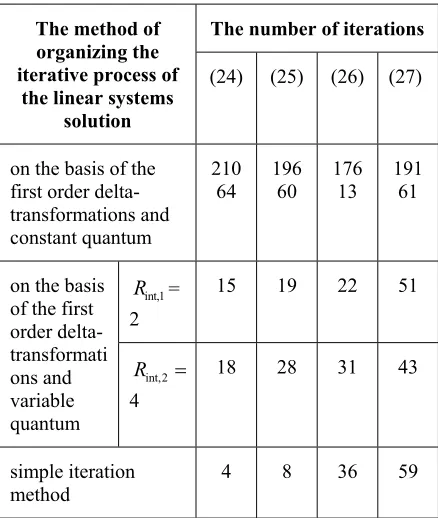
7192 The comparative analysis between methods of linear systems solutions on the condition of ensuring identical accuracy (~ 214) based on the first order delta-transformations and constant quantum c214, by the simple iteration method and by the method which is also considered in this paper based on the first order delta-transformations and variable quantum at Rint,12,
int
R = 4, * 214
P
[image:6.612.85.304.253.512.2]c was carried out during the research.
Table 1: The results of the experiments
The method of organizing the iterative process of
the linear systems solution
The number of iterations
(24) (25) (26) (27)
on the basis of the first order delta-transformations and constant quantum
210 64
196 60
176 13
191 61
on the basis of the first order delta-transformati ons and variable quantum
int,1
R =
2
15 19 22 51
int,2
R
4
18 28 31 43
simple iteration method
4 8 36 59
The analysis of the data in the Table 1 shows that the developed algorithm of iterative process of the linear systems solution with the variable quantum, based on the optimized assessments Rint,12, Rint = 4, and providing the
real time optimization of the iterative processes differs significantly (by the hundreds – thousands times) with the reduction of the number of iterations in relation to the method of the linear systems solution based on the first order delta-transformations and constant quantum, as well as substantial proximity on the number of iterations to the simple iteration method and in some cases represents the advantage over the simple iteration method. According to the Table 1, the ratio of the number of iteration method for the simple iteration
method to the method with the variable quantum is as follows ~ 1.7-0.4.
The data presented in Table 1 shows that iterative processes while ensuring the convergence of linear systems may be successfully implemented even in the norm of the matrix of coefficients greater than one.
5. RESEARCH OF EFFICIENCY OF THE
SPECIAL-PURPOSE CALCULATING
UNIT FUNCTIONING BASED ON THE DEVELOPED ALGORITHM
Complex efficiency of special-purpose calculating unit functioning based on the algorithm (1.3) using delta the first order delta-transformations and variable quantum in comparison with using the simple iteration method can be considered as an interrelated set of comparative estimates of time and hardware resources. Taking into account, as shown in [14]-[16], that the number of iterations using the first order delta-transformations and variable quantum may be greater or less than using the simple iteration method, in the study this amount is assumed to be the same for the methods studied.
The implementation of the block diagram of the unit, shown in Figure 1, can be considered with using FPGA. Resource characteristics of the implementation of the basic arithmetic operations with their hardware performance are significantly unequal. Especially a huge hardware resources, expressed in logical cells, are required for multipliers. The multiplication operation will be considered as the execution of multiplication using single-clock hardware circuits of parallel implementation, as well as with the expansion of the factors bit grid - efficient parallel-serial implementation by performing multiplication at several units of time using algorithm "shift with the accumulation".
7193 multiplier becomes less rational. Thus, in this work, multipliers of higher bit capacity were considered as a combination of multipliers 4 4 [22].
The formation of relative estimates for hardware resources was based on the number of logical gates involved [23], [24]. In accordance with the algorithm (1.3) and the block diagram in Figure 1, the solution of the equations is carried out in parallel. Also, the equations solution is realized in parallel using the simple iteration method.
Let Q be an estimate characterizing the algorithm hardware resources, Qd p. .1 is the estimate
for the algorithm (1.3) based on the first order delta-transformations and variable quantum, Qp r. .
is the estimate for the simple iteration method. For the comparative hardware estimate, it is entered the
ratio . . . .1
p r
d p Q
Q .
Based on the obtained estimates, it was constructed the dependence graph of comparative
estimates . . . .1
p r
d p Q
[image:7.612.311.524.432.602.2]Q on the order of linear systems n (n3), when operating with 32-bit data is shown in Figure 2.
Figure 2: Dependence graph of comparative estimates . .
. .1
p r
d p Q
Q on the order of linear systems n.
The analysis of the obtained estimates showed that using the algorithm based on the first order delta-transformations and variable quantum in a solution of linear systems of the order n = 3 has an advantage in terms of hardware resources of ~2,7 times in comparison with the simple iteration
method, when operating with 32-bit data. At increasing order of the system n, the efficiency increases.
The estimate of time resources amount was performed by units of time. Time resources were calculated in the framework of a single pass through the cycle of the algorithm, realizing algorithmic sequence of actions for all equations of the system.
Let T be an estimate characterizing the algorithm time resources, Td p. .1 is the estimate for
the algorithm (1.3) based on the first order delta-transformations and variable quantum, Tp r. . is the
estimate for the simple iteration method. For the comparative time estimate, it is entered the ratio
. .
. .1
p r
d p T
T .
Based on the obtained estimates, it was constructed the dependence graph of comparative
estimates . . . .1
p r
d p T
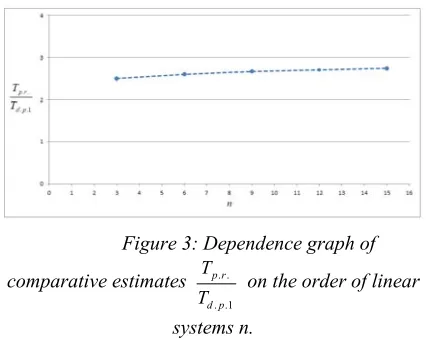
T on the order of linear systems n (n3), when operating with 32-bit data is shown in Figure 3.
Figure 3: Dependence graph of comparative estimates . .
. .1
p r
d p T
T on the order of linear systems n.
[image:7.612.91.300.442.637.2]7194 Complex efficiency of special-purpose calculating unit functioning based on the algorithm (1.3) using delta the first order delta-transformations and variable quantum
The comparative complex estimate of the algorithm implementation efficiency based on using delta the first order delta-transformations and variable quantum was formed as the multiplication of the relative estimates, obtained above, for the time and hardware resources of the system:
. . . .
. .1 . .1
p r p r
d p d p
Q T
E
Q T
. (1.6)
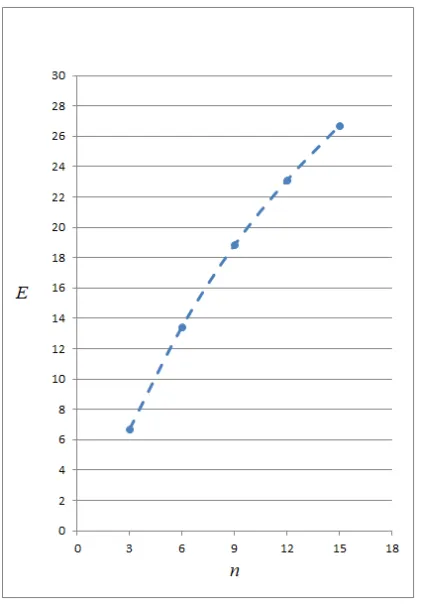
[image:8.612.89.301.358.663.2]In accordance with (1.6), the comparative complex efficiency estimate were obtained. Based on these results, it was constructed the dependence graph of the comparative complex efficiency estimate E on the order of linear systems n and is shown in Figure 4.
Figure 4: Dependence graph of the comparative complex efficiency estimate E of special-purpose calculating unit functioning on the
order of linear systems n.
In accordance with this estimate E, the algorithm based on the first order delta-transformations and variable quantum, when solving linear systems of the n = 3 order, has an advantage ~6.7 times compared to using the simple iteration method, when operating with 32-bit data. The estimate with an increase in the order of the system n sharply increases.
5. CONCLUSION
In paper it is considered principles of special-purpose calculating unit functioning for the iteration solution of linear systems using the first order delta-transformations and variable quantum. A special feature of special-purpose calculating unit functioning based on this algorithm is the implementation of the introduction at the beginning of each cycle l of a new variable quantum value that is reflected in the current cycle when the residual values and the unknown variable are formed by shifting them to the left by 1 or 2 bits. Formation of unknown variables in the unit is carried out by adding or subtracting the signs of quantum of the first and second variables differences, taking at each iteration the values ±1. This feature of variable normalization represents the possibility of organizing a computational process on the basis of an integer data representation. At the final step of the algorithm operation in the unit, it is possible to bring the values of the variables to the original real form, taking into account the weight of the minimum transformation quantum.
In addition, the feature of special-purpose calculating unit functioning is using in the algorithm for forming the moment of iterative processes completion in cycles the condition that requires when in the cycle for all equations of a linear system simultaneously or distributed in time the residuals sign will be changed.
7195 In the paper it is shown the advantages of using the developed features of the special-purpose calculating unit functioning based on the linear system solution using the first order delta-transformations and variable quantum. So with the orientation to FPGA, comparative estimates are obtained for the hardware resources and the speed of the developed algorithm for special-purpose calculating unit functioning. For the developed algorithm of the unit functioning, it is shown that it is possible to reduce the execution of one iteration and the iterative process as a whole in ~2,5 times and the amount of hardware resources in ~2,7 times in comparison with the special-purpose calculating unit functioning based on the simple iteration method, and these estimates increase with increasing order of the system n.
Thus, using the adapted algorithm for building special-purpose calculating unit, the hardware resources are significantly reduced due to the ability to exclude the multiplication operator of the multibit code and increasing the performance of the simple iteration method at the level of the iterative processes. These circumstances create prerequisites associated, in particular, with the expansion of the resource capabilities of FPGAs for the simultaneous realization in real time of complex tasks, as separate components of which are used linear systems.
The results obtained in this work are planned to be used in on-board control and navigation systems by modern aircraft. As a separate component of the navigation task solved within the framework of the creation of on-board specialized computing devices, the task of determining the aircraft coordinates is presented, represented as systems of linear algebraic equations. Based on the results of preliminary studies, using the principles of special-purpose calculating unit functioning, presented in this paper, in on-board specialized devices for the local navigation task makes it possible to determine the aircraft coordinates at each time step of the steady-state process in one iteration and operate with practically significant time steps of the system at a sufficiently large distance of the beginning of the steady process from the origin.
REFRENCES:
[1] P.P. Kravchenko, L.V. Pirskaya and N.Sh. Khusainov, “Delta-transformations and
problem-oriented computations: monograph”. Taganrog: SFedU Press, 2016.
[2] Sh. Khusainov, P.P. Kravchenko, V.N. Lutai, S.A. Tarasov and V.V. Scherbinin, “Radionavigation systems of current-technology and future-current-technology vehicles. P. 1. Fixing methods and autonomous integrity monitoring: Monograph”, Taganrog: SFedU Press, 2015.
[3] O.O. Barabanov and L.P. Barabanova, “Mathematical problems of r-r navigation”,
Мoscow: Phismatlit, 2007.
[4] O.N. Skrypnik, “Aircraft radionavigation systems: Training manual”, Мoscow: INFRA-M, 2014.
[5] C. Vuik, “Iterative solution methods”, The Netherlands: Delft Institute of Applied Mathematics, 2012.
[6] A. Greenbaum, “Iterative Methods for Solving Linear Systems”, Philadelphia, PA: SIAM, 1997.
[7] D.K. Faddeev and V.N. Faddeeva, “Computational methods of linear algebra, 4th ed., reprint”, Saint-Petersburg: Lan', 2009. [8] N. Bakhvalov, et al., “Numerical Methods”,
Laboratory of knowledge. Moscow: BINOM, 2006.
[9] S. Tretyakov, “The algorithms of the specialized processors for solving systems of equations”, Cybernetics, Vol. 5, 1978, pp. 34-36.
[10] P.P. Kravchenko, “The optimised second order delta-transformations. Theory and appication. Monograph”, Moscow: Radio engineering, 2010.
[11] P. Kravchenko, “Incremental methods for solving the systems of the linear algebraic equations”, Multiprocessor computing structures, Vol. 5(XIV), 1983, pp. 30-32. [12] B. Malinowskij, “Algorithms for solving the
systems of the linear algebraic equations, structural-oriented implementation”, Control systems and machines, Vol. 5, 1977, pp. 79-84.
[13] О. Gomozov and Y. Ladyshchenskij, “Incremental algorithms for solving the systems of the linear algebraic equations, and architecture of multiprocessors on programmable logic”, Scientific works of DonNTU, Informatics, cybernetics and computer science, Vol. 12(165), 2010, pp. 34-40.
7196 multidigit multiplication operation”, Izvestia SFedU. Engineerin sciences, Vol. 7 (156), 2014, pp. 214-224.
[15] L.V. Pirskaya, “Iterative Algorithm for Solving of Linear Algebraic Equations Systems without Multi-bit Multiplication
Operation”, Engineering and
Telecommunication (EnT), 2014 International Conference on, Moscow, Russia, 2014, pp. 87-91.
[16] P.P. Kravchenko and L.V. Pirskaya, “The method of organizing the iterative process of the system of the linear algebraic equations solution excluding the multidigit multiplication operation”, Biosciences Biotechnology Research Asia, Vol. 11(3), 2014, pp. 1831-1839.
[17] L.V. Pirskaya, “On the features of the functioning of a specialized computing device for the iteration solution of linear systems based on delta- transformations algorithms”, Proceedings of the XXIV Scientific Conference “Modern Information Technologies: Trends and Development Prospects”; Southern Federal University, Russia, May 25, 2017, pp.159-160.
[18] L.V. Pirskaya, “On the optimized performance of a specialized computing device based on delta transformations of the first and second orders”, Proceedings of the Conference "Information Systems and Technologies: Fundamental and Applied Research", Southern Federal University, Russia, October 23-27, 2017.
[19] Н. Yang and S.G. Ziavras, “FPGA-based vector processor for algebraic equation solvers”, SOC Conference, Sept. 19-23, Herndon, VA, IEEE, 2005, pp. 115-116.
[20] W. Zhang, V. Betz, and J. Rose, “Portable and Scalable FPGA-Based Acceleration of a Direct Linear System Solver”, ICECE Technology, Taipei, IEEE, December 8-10, 2008.
[21] W. Zhang, et al., “Portable and Scalable FPGA-Based Acceleration of a Direct Linear System Solver”, ACM Transactions on Reconfigurable Technology and Systems (TRETS), vol. 5 (1), 6, 2012.
[22] V. Steshenko, “Lesson 6. Implementation of computing devices on FPGA”, Components and technologies, Vol. 6, 2000, pp. 88-91 [23] N.V. Maksimov, T.L. Partyka, I.I. Popov
“Architecture of computers and computer systems”, Moscow: FORUM, 2010.
7197
...
Sum zadd ril
18
... Ischange (zadd ril,zril)
16
... Ischange (zril,zr(i-1)l)
13
...
-sign(zril)
15
...
Sum zril
12
... Yril
4
...
Yri(l-1)<<[1;2] 7
...
Sum Yril
10
...
Фr(∆jil)
11
...
-sign(zr(i-1)l)
8 zril
1 ...
...
zri(l-1)<<[1;2] 5
Pint(1,2)
2
Rint(1,2)
3
zri(l-1)
zril zr(i-1)l
∆ril
Yri(l-1)
Yril
Rint(1,2)
Rint(1,2)
∇zril
Yr(i-1)l
Yril Inc(l)
6
l<=Pint(1,2)
9
l l
l
Pint(1,2)
zril
zril
zril
zril
zril
zadd ril
zr(i-1)l
or (||) 17
res
end
Inc(i) 14
res
l i
i
Pint(1,2) [2;4] 0
∆ril
Фr
-Dr
[image:11.612.101.548.89.546.2]Yr