Full Length Research Article
FIREFLY ALGORITHM FOR ECONOMIC EMISSION DISPATCH WITH NORMALIZED
OBJECTIVE FUNCTION
*Sakthidasan, A.
Department of Electrical and Electronics Engineering, UCEA (A Constituent College of Anna University, Chennai) Arani, Tamil Nadu, India
ARTICLE INFO ABSTRACT
The economic emission dispatch (EED) assumes a lot of significance to meet the clean energy requirements of the society and simultaneously minimizes the cost of generation. The Firefly Algorithm (FA) is a nature-inspired meta-heuristic algorithm for solving multimodal optimization problems. This paper presents an FA based strategy for obtaining the robust solution of EED problem involving normalized objective function. The feasibility of the proposed approach is evaluated through two test systems and the results are presented to demonstrate its effectiveness.
Copyright © 2014 Sakthidasan, A. This is an open access article distributed under the Creative Commons Attribution License, which permits unrestricted use, distribution, and reproduction in any medium, provided the original work is properly cited.
1.0 INTRODUCTION
Economic Load Dispatch (ELD) is a computational process of allocating the total required generation among the available generating units subject to load and operational constraints such that the cost of operation is minimum (Chowdhury and Rahman1990). The generation of electricity from fossil fuels such as coal, oil and gas, releases several contaminants such as sulphur oxides (SOx), nitrogen oxides (NOx) and carbon dioxide into the atmosphere. The enactment of the ‘Clean Air Act Amendment of 1990’ and its acceptance by all nations forces the utilities to modify their operating strategies to meet rigorous environmental standards set by this legislation.
Minimum Emission Dispatch (MED) have been suggested for reducing the emissions, which minimizes only the emissions that result in high operating cost; and efforts initiated by researchers to develop algorithms for Economic Emission Dispatch (EED) that minimizes the cost of generation and emission levels simultaneously. Several researchers have considered emissions either in the objective function or treated emissions as additional constraints (Lamont and Obessis1995).
*Corresponding author: Sakthidasan, A.
Department of Electrical and Electronics Engineering, UCEA (A Constituent College of Anna University, Chennai) Arani, Tamil Nadu, India.
Traditional mathematical programming techniques such as lambda iteration, gradient search, linear programming and Lagrangian relaxation (Chowdhury and Rahman1990) and modern heuristic optimization techniques such as genetic algorithms (Abido M. 2003; Abido MA. 2003), evolutionary
programming (Abido M. A. 2003; Abido M. A. 2006) and particle swarm optimization (Hemamalini and Sishaj P
Simon 2008; Jiejin Cai et al., 2009) have been widely applied in solving the EED problems.
Recently, firefly algorithm (FA) has been suggested for solving optimization problems (Yang et al., 2008). It is inspired by the light attenuation over the distance and fireflies’ mutual attraction rather than the phenomenon of the fireflies’ light flashing. In this approach, each problem solution is represented by a firefly, which tries to move to a greater light source, than its own. It has been applied to a variety of ELD problems (Kuldeep Kumar Swarnkar 2012; Vinod Kumar and Lakshmi Phani 2011) and found to yield satisfactory results. The effort in this article is to solve the EED problem involving normalized objective function using FA with a view of obtaining the global best solution
2.0 FIREFLY ALGORITHM
The FA is a Meta heuristic, nature-inspired, optimization algorithm which is based on the social flashing behavior of
ISSN:
2230-9926
International Journal of Development ResearchVol. 4, Issue, 3, pp. 560-564, March,2014
DEVELOPMENT RESEARCH
Article History:
Received 08th January, 2014 Received in revised form 11th February, 2014 Accepted 15th February, 2014 Published online 14th March, 2014
Key words:
fireflies, or lighting bugs, in the summer sky in the tropical temperature regions. It was developed by Dr. Xin-She Yang at Cambridge University in 2007, and it is based on the swarm behavior such as fish, insects, or bird schooling in nature. It is similar to other optimization algorithms employing swarm intelligence such as PSO and ABC. But FA is found to have superior performance in many cases (Yang et al., 2008). FA initially produces a swarm of fireflies located randomly in the search space. The initial distribution is usually produced from a uniform random distribution. The position of each firefly in the search space represents a potential solution of the optimization problem. The dimension of the search space is equal to the number of optimizing parameters in the given problem. The fitness function takes the position of a firefly as input and produces a single numerical output value denoting how good the potential solution is. A fitness value is assigned to each firefly.
The FA uses a phenomenon known is bioluminescent communication to model the movement of the fireflies through the search space. The brightness of each firefly depends on the fitness value of that firefly. Each firefly is attracted by the brightness of other fire-flies and tries to move towards them. The velocity or the pull a firefly towards another firefly depends on the attractiveness. The attractiveness depends on the relative distance between the fireflies. It can be a function of the brightness of the fireflies as well. A brighter firefly far away may not be as attractive as a less bright firefly that is closer. In each iterative step, FA computes the brightness and the relative attractiveness of each firefly. Depending on these values, the positions of the fireflies are updated. After a sufficient amount of iterations, all fireflies converge to the best possible position on the search space. The number of fireflies in the swarm is known as the population size, nf. The selection of population size depends on the specific optimization problem. However, typically a population size of 20 to 40 is used for PSO and FA for most applications (Yang
et al., 2008). Each
i
-th firefly is denoted by a vector xi as
nd
i 2 i 1 i
i x x x
x , , (1)
The search space is limited by the following inequality
) ( )
(min x x max
xk k k : k1,2,,nd (2)
Initially, the positions of the fireflies are generated from a uniform distribution using the following equation
x max x min
randmin x
xik k( ) k( ) k( ) (3)
Here, rand is a random number between 0 and 1, taken from a uniform distribution. Eq. (3) generates random values from a uniform distribution within the prescribed range defined by Eq. (2). The initial distribution does not significantly affect the performance of the algorithm. Each time the algorithm is executed, the optimization process starts with a different set of initial points. However, in each case, the algorithm searches for the optimum solution. In case of multiple possible sets of solutions, the algorithm may converge on different solutions each time. But each of those solutions will be valid as they all will satisfy the requirements.
The light intensity of the
i
-th firefly, LIi is given by )( i
i Fitness x
LI (4)
The attractiveness between the
i
-th and j-th firefly, Ai,j is given by
2
j i o
j
i A S R
A, exp , (5)
Where Ri,j is Cartesian distance between
i
-th andj-th firefly
nd
1 k
2 k j k i j
i j
i x x x x
R, (6)
o
A is a constant taken to be 1. S is another constant whose value is related to the dynamic range of the solution space. The position of firefly is updated in each iterative step. If the light intensity of j-th firefly is larger than the intensity of the
i
-th firefly, then thei
-th firefly moves towards the j-th firefly and its motion at t-th iteration is denoted by the following equation:
x t 1 x t 1
C
rand 05
A1 t x t
xi() i( ) i,j j( ) i( ) . (7)
C is a constant whose value depends on the dynamic range of the solution space. At each iterative step, the intensity and the attractiveness of each firefly is calculated. The intensity of each firefly is compared with all other fireflies and the positions of the fireflies are updated using (7). After a sufficient number of iterations, all the fireflies converge to the same position in the search space and the global optimum is achieved.
3.0 PROBLEM FORMULATION
3.1 Economic Load Dispatch
The ELD problem may be expressed by minimizing the fuel cost of generating units while satisfying several equality and inequality constraints as
( )
sin ) (
min i G Gi i i ng
1 i
i Gi i 2 Gi i G
P P e d
c P b P a P
F Min
(8) Subject to
0 P P P
ng 1 i
L D
Gi
(9)
max min
Gi Gi
Gi P P
P i1,2,,ng (10) Where
oo ng
1 i
Gi oi ng
1 i
ng 1 j
Gj ij Gi
L P B P B P B
P
3.2 Minimum Emission Dispatch
The objective of MED is to minimize the emissions of all the generating units due to the burning of fuels for production of power to meet the load demand and expressed as
ng
1 i
Gi i i i Gi i 2 Gi i 2
G 10 P P P
P E Min
) exp( )
( (12)
3.3 Economic Emission Dispatch
The EED problem is to determine optimal real power generations that minimize the two conflicting objectives of fuel cost and emissions, while satisfying several equality and inequality constraints. The bi-objective of EED problem can be mathematically formulated as
Min (PG)
F(PG),E(PG)
(13)PROPOSED METHOD
Usually the bi-objective EED problem is formulated as a single objective optimization problem through assigning different weight values for each objective. It requires proper assignment of weight values by trial and error process for obtaining the better compromised solution. The difficulties in assigning the weight values can be eliminated by the modifying the objective function through normalizing the individual objectives as
Minimize
ng
1
i i Gi
Gi i
G
E E
E P E 5 0
F F
F P F 5 0
P
min max
min min
max min
) ( . ) ( .
) (
(14)
The FA based solution process involves representation of problem variables and formation of an augmented cost function. Each firefly comprising the decision variables of real power generations PG can be represented as
] , , , , [
' PG1 PG2 PG3 PGng
x (15)
The FA searches for optimal solution by minimizing a light intensity function, which is obtained from the problem objective and constraint equations. The new firefly during the solution process can be limited to satisfy the generation limit constraint of Eq. (9) but the power balance constraint of Eq. (8) is handled through penalty function approach. The penalty terms are incorporated in the augmented cost function and are set to increase the light intensity of the firefly depending on the magnitude of the violation. The light intensity function can be obtained by transforming the objective function and power balance constraint as
1 1 LI
Max i (16)
Where
2 ng
1 i
L D Gi 2 G
1 P K P P P
K
) (
(17)
The process of generating new swarm can be terminated either after a fixed number of iterations or if there is no further significant improvement in the global best solution. An initial swarm of fireflies is obtained by generating random values within their respective limits to every individual in the swarm through Eq. (10). The light intensity is calculated by considering the values of each firefly and the movements of all fireflies are performed with a view of maximizing the light intensity. The iterative process is continued till convergence. The pseudo code of the PA is as follows.
Read the EED Data
Choose the number of fireflies in the population, nf and
max
Iter for convergence check.
Generate the initial population of fireflies Set the iteration counter
t
0
while (termination requirements are not met) do for i1:nf
Evaluate
(
P
G)
using Eq. (14) andLI
i using Eqs. 16 and 17 fori
-th fireflyfor j1:nf
Evaluate
(
P
G)
using Eq. (14) and LIj using Eqs. 16 and 17 fori
-th fireflyif
LI
i
LI
jCompute Rijusing Eq. (6)
Evaluate Aijusing Eq. (5)
Move j-th firefly towards
i
-thfirefly through Eq. (7)end-(if) end-( j)
end-(
i
)Rank the fireflies
end-(while)
5.0 SIMULATIONS
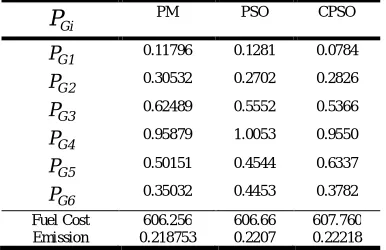
Table 1. ELD Results for Test Case-1
Gi
P
PM PSO CPSO1 G
P 0.11796 0.1281 0.0784
2 G
P 0.30532 0.2702 0.2826
3 G
P 0.62489 0.5552 0.5366
4 G
P 0.95879 1.0053 0.9550
5 G
P 0.50151 0.4544 0.6337
6 G
P 0.35032 0.4453 0.3782 Fuel Cost 606.256 606.66 607.760 Emission 0.218753 0.2207 0.22218
The optimal generations, fuel cost and emissions for the test case-1 for a load demand of 2.834 per unit are given in Tables 1-3. The fuel cost and emissions corresponding to ELD, given in Table-1, obtained through Eq. (8) are 606.256 $/h and 0.218753 ton/ respectively. The algorithm offers the lowest h
fuel cost, while comparing with that of the existing methods. The solution of MED through Eq. (12), given in Table-2, offers the lowest emission of 0.194186 ton/ and fuel cost h
[image:4.612.86.274.352.480.2]of 642.921. The EED results obtained through Eq. (14) are given in
Table 2. MED Results for Test Case-1
Gi
P
PM PSO CPSO1 G
P 0.40888 0.3713 0.4972
2 G
P 0.46179 0.4665 0.6047
3 G
P 0.54160 0.5642 0.4655
4 G
P 0.38734 0.3650 0.3326
5 G
P 0.54180 0.5223 0.4655
6 G
[image:4.612.91.266.512.634.2]P 0.51331 0.5783 0.4990 Fuel Cost 642.921 648.01 663.310 Emission 0.194186 0.19450 0.19685
Table 3. EED Results for Test Case-1
Gi
P
PM PSO CPSO1 G
P 0.34950 0.1761 0.2555
2 G
P 0.42576 0.2819 0.3582
3 G
P 0.55340 0.5408 0.5542
4 G
P 0.50600 0.7696 0.7262
5 G
P 0.54203 0.6502 0.5619
6 G
P 0.47703 0.4457 0.4085 Fuel Cost 629.183 612.35 614.790 Emission 0.195204 0.20742 0.20105
The detailed results in terms of real power generation, net fuel cost and emissions are presented for test case 2 in Table 4. It can be observed from the table that the PM offers an EED solution that lies in between ELD and MED solutions. It is observed from above discussions that the emissions are higher, when the fuel cost is lower and vice versa owing to the conflicting nature of the objectives in the problem. Thus, the PM offers the lowest fuel cost in economic dispatch, lowest
emissions in the emission dispatch and provides a compromise between fuel cost and emissions in EED.
6.0 SUMMARY
A new methodology involving FA for solving EED problem involving normalized objective function has been developed and studied on two example problems. The ability of the PM to produce the global best solution that simultaneously minimizes the fuel cost and emissions has been projected. It has been chartered that the new approach fosters the continued use of FA and will go a long way in serving as a useful tool in load dispatch centre.
NOMENCLATURE
i i ib c
a fuel cost coefficients of the ith generator
oo oB
B B
loss coefficients
i ie
d coefficients of valve point effects of the ith generator
EED economic emission dispatch ELD economic load dispatch FA Firefly algorithm
Gi
i P
E emission cost function of the ith generator in ton/h
Gi
i P
F fuel cost function of the ith generator in h
/ $
i
LI light intensity of the
i
-th firefly maxIter Maximum number of iterations for convergence check.
MED minimum emission dispatch
nd
Number of decision variablesnf Number of fireflies in the populations
ng Number of generators PM proposed method
PSO particle swarm optimization CPSO chaotic PSO
Gi
P real power generation at
i
thgenerator maxmin& Gi
Gi P
P minimum and maximum generation
limits of
i
thgenerator respectivelyD
P total power demand
L
P net transmission loss
ij
R Cartesian distance between the
i
-th andj-th firefly
i
x
i
-th fireflyt
iteration countC Random movement factor
j i
A
, Attractiveness between thei
-th and j-th f ireflyo
A and S Maximum attractiveness and light intensity absorption coefficient respectively
i
i
i i and i emission coefficients of
th
objective function to be minimized
augmented objective function to be minimized
min and max minimum and maximum values respectively
PA Proposed algorithm
REFERENCES
Abido. M. 2003. A niched pareto genetic algorithm for multiobjective environmental/economic dispatch, Electric Power and Energy Systems, 25(2): 97-105.
Abido. MA. 2003. A novel multiobjective evolutionary algorithm for environmental/economic power dispatch, Electric Power Systems Research, 65(1): 71-81.
Abido. MA. 2003. Environmental/Economic power dispatch using multiobjective evolutionary algorithms, IEEE Trans. on Power Systems, 18(4): 1529-1537.
Abido. MA. 2006. Multiobjective evolutionary algorithms for electric power dispatch problem, IEEE Trans. Evol. Comput, 10(3): 315-29.
Chowdhury.BH and Rahman. S. 1990. A review of recent advances in economic dispatch, IEEE Trans. on Power Systems, 5(4): 1248-1259.
Hemamalini. S and Sishaj P Simon. 2008. Emission constrained economic dispatch with valve-point effect using particle swarm optimization, IEEE Technical Conference, 18-21 Nov, TENCON-2008.
Jiejin Cai, Xiaoqian Ma, Qiong Li, Lixiang Li and Haipeng Peng. 2009. A multi-objective chaotic particle swarm optimization for environmental/economic dispatch, Energy Conversion and Management, 50(5): 1318-1325.
Kuldeep Kumar Swarnkar. 2012. Economic load dispatch problem with reduce power loss using firefly algorithm,
Journal of Advanced Computer Science and Technology, 1(2): 42-56.
Lamont. JW and Obessis. EV. 1995. Emission dispatch models and algorithms for the 1990’s, IEEE Trans. on Power Systems, 10(2): 941- 946.
Leandro dos Santos Coelho and Viviana Cocco Mariani. 2010. An efficient cultural self-organizing migrating strategy for economic dispatch optimization with valve-point effect, Energy Conversion and Management, 51, 2580-2587. Vinod Kumar K. and G. Lakshmi Phani. 2011. Combined
economic emission dispatch-pareto optimal front approach,
International journal of computer applications, 30(12): 16-21.
Yang X. S., Nature-Inspired Meta-Heuristic Algorithms, Luniver Press, Beckington, UK, 2008.