3423
AN INTELLIGENT AGENT FOR MONITORING STUDENT’S
BEHAVIOR
HANI HOSNI 1, MOHAMED A. EL-DOSUKY2 , MOHAMED EISA3 ,FIFI FAROUK4
1Technoloy development expert in pre-university stage, Egypt 2Faculty of Computer and Info, Mansoura University, Egypt
3Faculty of Science, Port Said University, Egypt
4Information Technology Department, Port Said University, Egypt
E-mail: [email protected], [email protected], [email protected], [email protected]
ABSTRACT
This paper surveys Multi Agent Architecture, and then it proposes an agent-based personalized E-learning system. This system is implemented then students are allowed to enroll. The system monitors their behavior and produces statistical reports. The agent of system provides new and important features that are not available in the e-learning systems currently in use.
1. INTRODUCTION
The ELearning is an environment for learning. Its qualities are proactiveness, social reactivity; while taking input and producing output [1].Agents are used to ease user learning. It is divided into student and teacher agents [2, 3] .Teacher agent allows the instructor to interact with students, do many Jobs and tasks. Student agent carries out group formation with other student agents behind, Group agent is used for each peer group that monitors, evaluate peer groups[4, 5, 6].The core function of agents is to be social [7, 8].
The hypothesis of this paper is that knowing the learning style shall enhance the learning outcomes.
2. RELATED WORKS.
2.1 Multi Agent Architecture.
It has four layers 1- Interface layer 2- Middle layer 3- Database Controller 4-Database layer [9]. Example the Multi agent based Architecture name [MBLS] has been designed for distance learning on the web. It has some levels. 1-The human level (teacher, student).2- 1-The web level.3- the system level. The Collaboration Agent and this is the interaction between students and teacher.4- The storage level. The MBLS will help the tutor for preparing Course Content and help student in his Learning [10]. Figure 1 shows I-MBLS Architecture. The e-learning system (ELS) is decomposed into a dichotomy of learning materials and grid layers [11].
The Architecture consists of four sub systems [12]:
1. Quiz sub-system. 2. Presentation sub-system. 3. Video Conference sub-system. 4. Discussion system.
The Model action will be recorded by this feature to find the number of students, statistics and analysis. The system records all the data. This help to evaluate the student's level and their level in problems [11, 12]. Other systems may be decomposed into modules [13]. Some systems focus on collaboration [14, 115] while others focus on being self-sufficient with ability to analyze feedback [16].
2.2 Architectural Engineering is a successful system as it Example:[17]
3 Modules Learning Objective. 3 Learning Modality.
3 Knowledge Watch.
ELS gives learners a better understanding [18, 13]. 2.3 Services Based oriented intelligent Agent for learning system.
3424 2.4 The Role of Feedback in Intelligent Tutoring System.
The learning, methods and reaction of students are not easily definable. The sequence of events is a guarantee of successful outcome. We modify the system according to the student's ability [23, 24, 25, 26].
2.4.1 Learning process.
The learning process: there must be interaction between the student and teacher. It has five levels or tasks .1- choose gods. 2- Realizing characteristics of the learner.3- using ideas and motivation. 4- choosing, using ways of learning.5- evaluating, training achievements to find out goals training[27].The learning process is a relationship between the teacher and the student to reach the best results through an able teacher [1].
2.4.2 Adaptability.
The natural environment of the student contains character, reaction, material. The integration is in its analysis mechanisms and reactions to simulate or overcome natural environment achievements [28, 29, 30, 31].
2.5 Feedback.
The possibility to receive feedback the possibility to evaluate forms of feedback .Are the most important role the most important role to process the education task [32, 33, 34, 35].
2.6 Agents and their characteristics.
Mixing all the design tools into comprehensive one makes it achieve its important goals in technology systems. Specify the knowledge levels share them to communicate their knowledge, interact through controlled [36, 37, 38].
2.7 Designing Intelligent Agent.
You can develop an intelligent worker model to assess the level of knowledge and you can assess the level of game and specify to move to the next level of learning or remain [11, 39, 40]. Designing intelligent agent is shown in figure 2. 2.8 Research gap.
There is a gap in developing an intelligent agent that takes into consideration the learning style of students.
3. PERSONALIZED E-LEARNING SYSTEM BASED ON INTELLIGENT AGENT. 3.1 Personalized learning strategies.
The core features of learning system are interactive and personalized. The first task is personalized strategy in e-learning System .The second is the
development aim of interactive to achieve goals [9,41,42,43, 44].
3.2 Agent based recommender system.
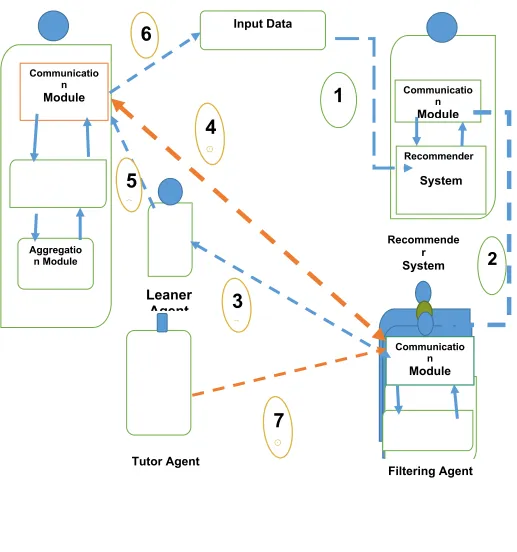
Agent based recommender system as we propose is supported by several types [44] agent-based recommender system is clear in figure 3. 3.3 Why using Multi-Agent System.
A multi - agent system is a system comprised of one / more intelligent agents to achieve their goals [45].
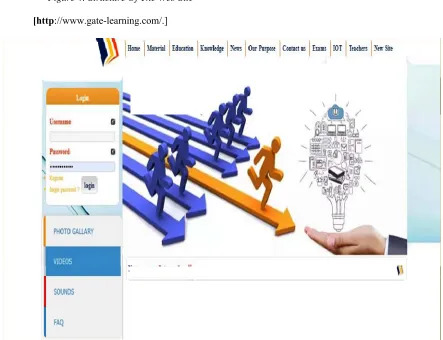
3.4 Structure of the web site [http://www.gate-learning.com/] [46].
Structure of the web site applied module design or online learning and creating better VLE courses. The student can choose one them [home| material| education |knowledge| news |our purpose| contact us |exams| IOT] is clear in figure 4.
3.5 Algorithm design.
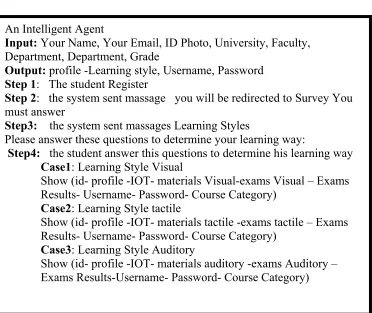
Students learn how to use a system that helps self-learning and makes possible to study curriculum materials using virtual learning environment (VLE). Algorithm for an intelligent agent is shown in figure 5.
4. EXPERIMENTAL RESULTS.
The first researcher chooses a random sample of 400 students from the students of the faculty of Mansoura computers in the first semester. He selected a sample of students who have studied the material-video .He chose another sample of students who have studied the material text and sample students who have studied the material mixture. The following table 2 contains learning style of students. 1. Students who chose a text style:
(95 student) rates 23.75%.
2. Students who chose a video style: (110 student) rate 27.50%.
3. Students who chose text & video style: (195 student) rate 47.75%.
Figure 6 shows the distribution of students according to the view style mode.
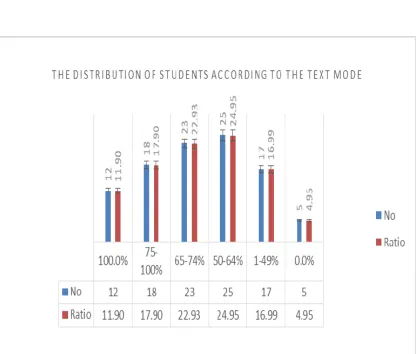
Figure 7 shows the distribution of students according to the view text style mode.
12 students get 100% ratio of 11.9%
18 students get 100-75 ratio of 17.9%
23 students get 74-65% ratio of 22.9%
25 students get 64-50% ratio of 24.9%
17 students get 49-1% ratio of 16%
5 students get 0% ratio of 4.9 5%
3425
18 students get 100% ratio of 16.36%
17 students get 100-75 ratio of 15.45%
30 students get 74-65% ratio of 27.27%
25 students get 64-50% ratio of 22.73%
17 students get 49-1% ratio of 15.45%
students get 0% ratio of 2.73%
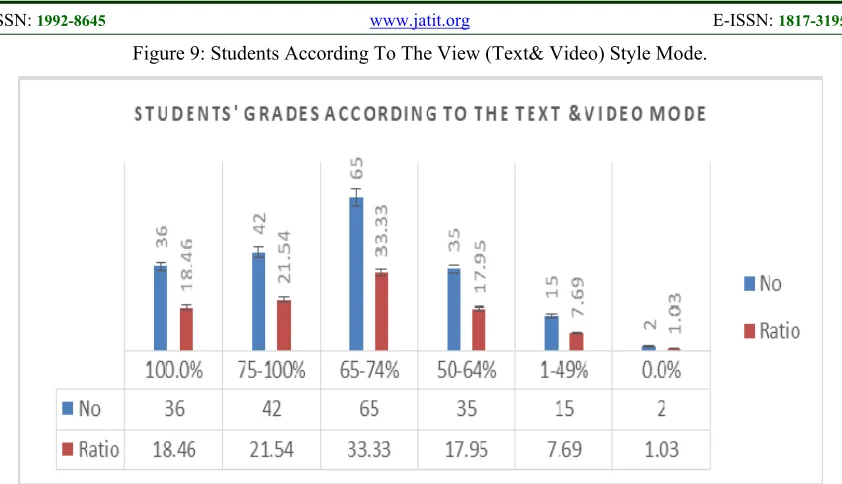
Figure 9 shows students according to the view (video &text) style mode.
36 students get 100% ratio of 18.46%.
42 students get 100-75 ratio of 21.54%.
65 students get 74-65% ratio of 33.33%.
35 students get 64-50% ratio of 17.95%.
15 students get 49-1% ratio of 7.69%.
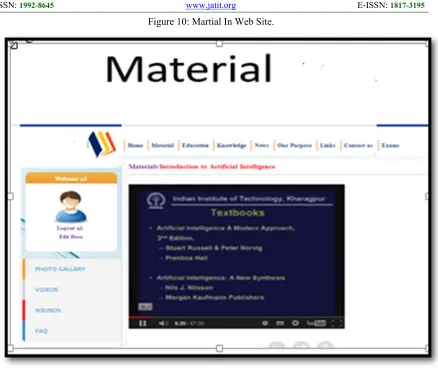
2 students get 0% ratio of 1.03%. Figure 10 shows martial in web site.
Figure 11 shows educational material divided into three groups: -
1. Text material (students who chose the text). 2. Video material (students who chose the
video).
3. Text & Video material (Students who chose Text & Video).
The material is displayed for each group as per the selection is clear Figure 11.
Figure 12 shows exam in web site
.
1. The test is divided into three groups and Shown in the following figure 12.Text test (students who chose the text material). 2. Video test (students who chose the video
material).
3. Text & Video Test (students who chose Text & Video material). The tests are presented to each group as they choose the material.
Figure 13 shows Exam result in web site. This Figure shows the student's grades and displays the correct answer for the student in the case of the answer.
Figure 14 shows the division of students into three groups:
1. Text group (students who chose the text). 2. Video group (students who chose the video
article).
3. Text & Video Group (Students who chose Text & Video).
The test and material are displayed for each group as they choose the material.
Figure 15 shows the numbers of students in each learning style.
Figure 16 shows student’s tracking in web site.
The students' behavior and every activity within the system. The system registers all this behavior for students.
Figure 17 shows teacher panel.
1. The system allows the teacher to do : - 2. Put the educational material and control in
the time of presentation to students. 3. Follow up the grades of students.
4. Put the test for each learning style and control the time of presentation to students. 5. Follow-up attendance of students.
6. Follow-up student's activity. 7. Reporting on students.
Figure 18 shows member's style in learning system.
5. Conclusions.
The agent of system provides new and important features that are not available in the e-learning systems currently in use.
As seen in the previous section, knowing the learning style enhances the learning outcomes of students.
Comparing figures 7 through 9, depicting students’ performance based on learning styles, show that the best performance is of the text and video group
.
This seems logical.The built website is an intelligent agent for
monitoring students’ behavior. It provides
materials according to learning styles. The
website provides examination too and
other learning services.
References:
[1] Michael Wooldridge, An introduction to Multiagent systems, Wiley, 2008. [2] Knapik, M. and Johnson, J.,
“Developing Inteligent Agents for Distributed Systems,” Computing McGraw-Hill, NY:McGraw-Hill, 1998. [3] M. Arif, M. Illahi, A. Karim, S.
Shamshirband, K. A. Alam, S. Farid and V. E. Balas, “An architecture of agent-based multi-layer interactive e-learning and e-testing platform”, Quality & Quantity, (2014), pp. 1-24. [4] H. Mahdi and S. S. Attia, “MASCE: a
multi-agent system for collaborative e-learning”, In Computer Systems and Applications, 2008. AICCSA 2008. IEEE/ACS International Conference on IEEE, (2008) March, pp. 925-926. [5] Soh, Leen-Kiat, Nobel Khandaker, and
3426 computersupported collaborative learning and classroom management," International Journal of Artificial Intelligence in Education 18.2 (2008): 119-151.
[6] Soh, Leen-Kiat, et al., "I-MINDS: an agent-oriented information system for applications in education,"Agent-Oriented Information Systems. Springer Berlin Heidelberg, 2004.
[7] Shen, Z.Q., Gay, R., Miao, Y. : Agent-based E-Learning System—a Goal-Agent-based Approach,Business and Technology of the New Millennium, EdCTLeondes. Kluwer Academic PressInternational, vol. 3, Chap. 6.(2004).
[8] H. Al-Sakran, “An agent-based architecture for developing e-learning system”, Information Technology Journal, vol. 5, no. 1, (2006), pp. 121-127.
[9] P. Ali, H. Dehghan and J. Gholampour, “An agent based multilayered architecture for e-learning system”, In E-Learning and E-Teaching (ICELET), Second International Conference on IEEE, (2010)December, pp. 22-26. [10]M.U. Bokhari, S. Ahmad,(2013),
Design for Interactive E-Learning Based Upon Multi- Agent System: I-MBLS,pp456-460.
[11]R. D. Andreev and N. V. Troyanova, “E-learning design: An integrated agent-grid service architecture”,In Modern Computing, JVA'06, John Vincent Atanasoff 2006 International Symposium on IEEE, (2006) October, pp. 208-213.
[12]J. N. Liu, Y. Wang, L. Jia, S. Shiu, Z. Li and Y. Rao(2011), “Poly-X: An online intelligent tutoring system for e-learning”, In Data Mining and Intelligent Information Technology Applications (ICMiA), 3rd International Conference on IEEE, October, pp. 204-209.
[13]G. Chen,2009., “The research on architecture of intelligent E-learning system”, In Computer Science & Education, ICCSE'09, 4th International Conference on IEEE, July, pp. 1079-1081.
[14]K. Sakthiyavathi and K. Palanivel(2009), “A generic architecture
for agent based E-learning system”, In Intelligent Agent & Multi-Agent Systems, IAMA, Internati2onal Conference on IEEE, July, pp. 1 [15]R. Ponnusamy and T.V.Gopal(2006),“A
user-adaptive self-proclamative multi-agent based recommendation system design for e-learning digital libraries”, In Cybernetics and Intelligent Systems, IEEE Conference on, June, pp. 1-7. [16]T. Chen, 2008, “Mutual Model of
Multiagent Process in E-learning Architecture”, In Information Science and Engineering,. ISISE'08. International Symposium on IEEE, December, vol. 2, pp. 154-158.
[17]P. D. Cristea and R. Tuduce, “Intelligent e-learning environments architecture and basic tools”, In Information Technology Based Higher Education and Training, ITHET Proceedings of the Fifth International Conference on IEEE, (2004) June, pp. 610-615.
[18]X. Li, “A study on e-learning systems integration based on multi-agent technology”, In Education Technology and Computer (ICETC), 2010 2nd International Conference on IEEE, (2010) June, vol. 1, pp. V1-294.
[19]Wei, X. & Yan, J. (2009). An e-learning system architecture based on web services and intelligent agents. International Conference on Hybrid Intelligent Systems - Volume 2 (pp. 173-177). Shenyang, China: IEEE.
[20]P. Fournier-Viger, R. Nkambou and V. S. M. Tseng (2011) , “RuleGrowth: mining sequential rules common to several sequences by pattern-growth”, In Proceedings of the 2011 ACM symposium on applied computing, ACM, March, pp. 956-961.
[21]T. Kawamura, K. Sugahara, S. Kinoshita, R. Nakatani and S. Motomura (2007) , “Backup and recovery scheme for multi-agent-based e-learning system”, In Integration of Knowledge Intensive Multi-Agent Systems, KIMAS, International Conference on IEEE, April, pp. 73-78. [22]M. U. Kumar, J. Mamatha, S. Jain and
3427 Generation Web Services Practices (NWeSP)”, 7th International Conference on IEEE, October, pp. 215-220.
[23]Aroyo, L. and Dicheva, D. (2004) ‘The new challenges for e-learning:the educational Semantic Web’, Educational Technology and Society, Vol. 7, No. 4, pp.59–69.
[24]Baylor, A. (1999) ‘Intelligent agents as cognitive tools for education', Educational Technology,Vol. 39, No. 2, pp.36.
[25]N. Hussain and M. K. Khan, “Service-oriented e-learning architecture using web service-based intelligent agents”, In Information and Communication Technologies, 2005. ICICT 2005. First International Conference on IEEE, (2005) August, pp. 137-143.
[26]P. Phobun and J. Vicheanpanya, “Adaptive intelligent tutoring systems for e-learning systems,” Procedia - Social and Behavioral Sciences, Volume 2, Issue 2, pp 4064-4069, 2010. [27]Gage, N.L. and Berliner, D.C. (Geidžs, N.L. and Berliners, D.C.), 1999.Pedagoģiskā psiholoģija/ Educational psychology Zvaigzne ABC, Riga.662 Pages.
[28]C.Limongelli, F.Sciarrone, M.Temperini and G.Vaste Lecomps5: AFramework for the Automatic Building of Personalized Learning Sequences Book Chapter Lecture Notes in Computer Science, 2008,Volume 5288, Emerging Technologies and Information Systems for the Knowledge Society, Pages 296-303.
[29]N. Medina-Medina, F. Molina-Ortiz, L. García-Cabrera and J. ParetsLlorca Personalized Guided Routes in an Adaptive Evolutionary Hypermedia System Book Chapter Lecture Notes in Computer Science,2003, Volume 2809, Computer Aided Systems Theory - EUROCAST2003, Pages 196-207. [30]Pedrero,V. Alonso, M.A.Villarroel, P.
de la Fuente and
A.S.CabacoPresentation Adaptation: Results from a Case Study Book Chapter 2009, Engineering the User Interface, Pages 1-13.
[31] P.Brusilovsky, 2001 .Adaptive Hypermedia Journal Article User
Modeling and User-Adapted Interaction, 2001, Volume 11, Numbers 1-2, Pages 87-110.
[32] Jānis Dāboliņš1, Jānis Grundspeņķis,(2013), The Role of Feedback in Intelligent Tutoring System,Pages 88-92.
[33]Peter S. E., Bacon E., Dastbaz M., Learning styles, personalization and adaptable e-learning, 2009.
[34]M. S. Desarkar, R. Saxena and S. Sarkar Preference Relation Based Matrix Factorization for Recommender Systems Book Chapter Lecture Notes in Computer Science, 2012, Volume 7379, User Modeling,Adaptation, and Personalization, Pages 63-75.
[35]Horváth, I. (2004). A treatise on order in engineering design research. Research in Engineering Design, 15(3), .
[36]Ferber, J. (1998). Multiagent systems: Towards a collective intelligence. Reading: Addison-Wesley
[37]Jennings, N. R. (2000). On agent-based software engineering. Artificial Intelligence, 117, 277–296.
[38]Wooldridge, M. (2002). An introduction to multiagent systems. New York: Wiley.
[39]Kristijan Kuk, Ivan Milentijevic´, Dejan Rancˇic´ and Petar Spalevic,(2014), Designing Intelligent Agent in Multilevel Game-Based Modules for ELearning Computer Science Course., [40]Christopher Patterson, Moira Stephens,
Vico Chiang, Ann M. Price, Fiona Work, Erna Snelgrove-Clarke,( 2017) “The significance of personal learning environments (PLEs) in nursing education: Extending current conceptualizations”, Nurse Education Today, Volume 48, January 2017, Pages 99-105, ISSN 0260-6917, http://dx.doi.org/10.1016/j.nedt.2016.09 .010.
3428 Sciences”, Volume 176, 20 February 2015, Pages 60-64, ISSN 1877-0428, http://dx.doi.org/10.1016/j.sbspro.2015. 01.444.
[42]Enrica Pesare, Teresa Roselli, Veronica Rossano, Pierpaolo Di Bitonto,(2015), “ Digitally enhanced assessment in virtual learning environments”, Journal of Visual Languages & Computing, Volume 31, Part B, December 2015, Pages 252-259, ISSN 1045-926X, http://dx.doi.org/10.1016/j.jvlc.2015.10. 021.
[43]Rafael H. Bordini, Jomi Fred H¨ubner, and Michael Wooldridge. Programming Multi-Agent Systems in AgentSpeak using Jason. John Wiley & Sons Ltd, 2007.
3429 Figure 1:I-MBLS architecture [10]
Teacher
Student
Human
Level
Web Portal
Student Inter
Face Agent
(SIA)
Test /Evaluation
Agent
Collaboration
Agent
Tutor Inter
Face
Intelligent
Decision
Lesson Planning
Agent
Profile DB
C
ontent KB
Storage
level
3430 Figure 2: Pedagogical Agent in GBMS [40]
Portal
"
E _learn _CS
courses
"DATA
Module
Pedagogical Agent
Intelligent Agent Model
Level1
Level 2
Level 1
Level 2
Level 3
Level 4
Level n
Module 1
Module
2
Module
3Module
4
Module
n
Z_buffer
GBMs System
3431
Figure 3: Agent-Based Recommender System
Input Data
Aggregatio n Module Communicatio
n
Module
CommunicationModule
Recommender
System
Recommende r
System
Leaner
Agent
Communicatio n
Module
Tutor Agent
1
2
5
6
7
1
3
4
1
3432
Figure 4: Structure Of The Web Site
3433
Figure 5: Algorithm for an intelligent agent.
An Intelligent Agent
Input:
Your Name, Your Email, ID Photo, University, Faculty,
Department, Department, Grade
Output:
profile -Learning style, Username, Password
Step 1
: The student Register
Step 2
: the system sent massage you will be redirected to Survey You
must answer
Step3:
the system sent massages Learning Styles
Please answer these questions to determine your learning way:
Step4:
the student answer this questions to determine his learning way
Case1
: Learning Style Visual
Show (id- profile -IOT- materials Visual-exams Visual – Exams
Results- Username- Password- Course Category)
Case2
: Learning Style tactile
Show (id- profile -IOT- materials tactile -exams tactile – Exams
Results- Username- Password- Course Category)
Case3
: Learning Style Auditory
3434
3435
3436
3437
3438
3439
3440
3441
3442
3443
3444
3445
3446
3447
Table 1: Contains Website Menu.
Table 2: Contains Learning Style Of Students.
Item details
Home Home page of web sit
Material Text –video
Knowledge Text –video
Education Text –video
News Article of web sit
Our Purpose Purpose web sit
Links Links web sit
Contact us Contact us with teacher and students
Exams Exams and results of student
Teacher Add Material and exams and tracking results of student
style No Rate
Text &video 195 48.75%
video 110 27.50%
[image:25.612.65.529.417.483.2]![Figure 1:I-MBLS architecture [10]](https://thumb-us.123doks.com/thumbv2/123dok_us/8897672.953706/7.612.26.498.132.626/figure-i-mbls-architecture.webp)
![Figure 2: Pedagogical Agent in GBMS [40]](https://thumb-us.123doks.com/thumbv2/123dok_us/8897672.953706/8.612.94.581.132.516/figure-pedagogical-agent-in-gbms.webp)