© 2018, IRJET | Impact Factor value: 7.211 | ISO 9001:2008 Certified Journal | Page 3078
Implementation of Taguchi Technique for Optimization Of
Performance Parameters Of Turning Process
T. Naga Sushma
1*, P. S. Naga Sree
2, Dr. Doradla Raja Ramesh
31PG Student, Department of Mechanical Engineering, D.M.S.S.V.H College of Engineering, Machilipatnam 2 Assistant Professor, Department of Mechanical Engineering, D.M.S.S.V.H College of Engineering, Machilipatnam
3 Professor, Department of Mechanical Engineering, Sri Vasavi Institute of Engineering & Technology, Machilipatnam, A.P., India
---***---Abstract -
Need of industrial growth for developingcountry gives rapid acceleration in the field of technical research. Industries are very much aware of producing mechanical components with good surface quality without allowing a margin of error. Among the different challenges of industry, Good surface quality of products plays vital role to thrive in the manufacturing sectors. This project attempts on optimizing various machining parameters like speed, feed, depth of cut, type of tool by Taguchi Techniques. Sixteen experimental runs based on Full Factorial Design of Taguchi method were performed. According to Grey Relational Analysis, the normalized experimental results of the performance characteristics are introduced to calculate the Coefficients and Grades. The analysis shows that the predicted values and calculated values are very close and that clearly indicates that the Taguchi GRA is an effective technique to optimize the machining parameters for turning process. Key Words: Turning, Grey Relational Analysis, Optimization, Taguchi Method, Full Factorial Design
1. INTRODUCTION
Manufacturing processes are classified into four principal types: machining, forming, casting and joining. Machining remains the most popular and easily applicable one to a large variety of material. Machining can be defined as the process of removing unwanted material from a work piece to produce the desired shape. Machining process includes five categories: turning, milling, drilling, grinding and boring. Turing is the process of machining external or internal cylindrical and conical surface. The work piece is rotated at a particular speed (cutting speed) and the tool is fed against the work piece (feed) at a certain level of engagement (depth of cut).
To ensure credible performance and prolonged service life of machinery, its components require to be manufactured with good surface finish and geometrical accuracy. Surface texture is one of the most important factors that control friction and transfer layer formation during sliding. The performance of a machined component depends to a large extent on the surface topography, hardness, nature of stress and strain induced on the surface region. Various parameters are used to evaluate surface roughness. In the present study, the arithmetic average
surface roughness Ra, root mean square Rq, skewness Rsk,
kurtosis Rku, are selected to characterize the surface
roughness as it is a key requirement for many relevant applications in industry
The Taguchi method, a well known technique that provides efficient and systematic methodology for process optimization. Taguchi method is a statistical method which was developed for the production of robust products by Professor Genichi Taguchi of Nippon Telephones and Telegraph Company Japan. In Taguchi method, the word “Optimization” implies “determination of best levels of control factors”. Taguchi method was divided into two sub categories i.e., Static Problems, which don’t have signal factor and Dynamic Problems, which have signal factor.
Grey Relational Analysis was developed by a Chinese professor Julong Deng of Huazhong University of Science and Technology. It is also called Deng’s Grey Incidence Analysis Model. It is one of the most widely used models of Grey System Theory. GRA uses a specific concept of information. Wu.H.H.[1] suggested that the situations with no information as black, and those with perfect information as white. Infact, situations between these two extremes are described as grey, hazy or fuzzy. A Grey System is a system in which part of information is known and part of information is unknown.
Four controlling factors including Cutting Speed, Feed, Depth of Cut, and Type of Tool on the surface roughness parameter with two levels for each factor were selected. The grey relational analysis was then applied to examine how the turning parameters influenced the surface roughness and an optimal parameter combination was then obtained. Through analyzing the grey relational grade matrix, the most influential factors for individual quality targets of turning process can be identified. Additionally, the signal-to-noise ratio was also utilized to examine the most significant factors for the surface roughness in turning process.
2. Experimentation Details 2.1 Work Piece Material
© 2018, IRJET | Impact Factor value: 7.211 | ISO 9001:2008 Certified Journal | Page 3079 Brearley was investigating the development of new steel
[image:2.595.300.566.119.454.2]alloys for use in gun barrels. He noticed that some of his samples didn’t rust and were difficult to etch. These alloys contained around 13% chromium.
Table -1: The Chemical composition and mechanical properties of stainless steel is given in table. 1
2.2 Tool and Equipment:
High-speed steel (HSS or HS)and High Carbon Steel are subset of tool steels, commonly used as cutting tool material.
[image:2.595.302.565.123.453.2]
Fig -1: Lathe Fig -2: Mitutoyo SJ-400 The experiments were performed on a Precision lathe and Mitutoyo SJ-400 surface roughness tester was used to measure the surface roughness.
2.3 Process Parameters and Experimentation Measurements:
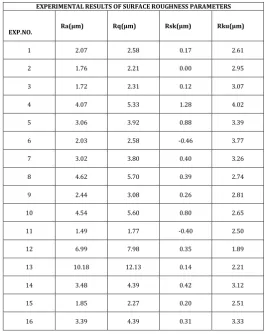
In full factorial design, the number of experimental runs exponentially increases as the number of factors as well as their levels increase. Experimental combinations of the parameters and the measurement of surface roughness are reported in Table. 3. Therefore, 24=16 combinations were
used corresponding to P=4 parameters or Factors and L=2 levels are reported in Table. 2
Table -2: parameters and their levels are given in table. 2
PARAMETERS LEVEL 1 LEVEL 2
SPEED, rpm 314 486
FEED, mm/rev 0.05 0.025
DEPTH OF CUT, mm 0.85 0.9
TYPE OF TOOL HIGH CARBON STEEL HIGH SPEED STEEL
Table -3:The Measurement of Surface Roughness:
EXPERIMENTAL RESULTS OF SURFACE ROUGHNESS PARAMETERS
EXP.NO. Ra(µm) Rq(µm) Rsk(µm) Rku(µm)
1 2.07 2.58 0.17 2.61
2 1.76 2.21 0.00 2.95
3 1.72 2.31 0.12 3.07
4 4.07 5.33 1.28 4.02
5 3.06 3.92 0.88 3.39
6 2.03 2.58 -0.46 3.77
7 3.02 3.80 0.40 3.26
8 4.62 5.70 0.39 2.74
9 2.44 3.08 0.26 2.81
10 4.54 5.60 0.80 2.65
11 1.49 1.77 -0.40 2.50
12 6.99 7.98 0.35 1.89
13 10.18 12.13 0.14 2.21
14 3.48 4.39 0.42 3.12
15 1.85 2.27 0.20 2.51
16 3.39 4.39 0.31 3.33
3. Optimization of Turning Process
3.1 Evaluation of optimal process condition:-
In GRA, Experimental data of expected output feature of quality characteristic is first normalised, ranging from zero to one, called Grey Relational Generation.
The normalised data corresponding to both the criteria are calculate as
(a)When the smaller-the-better is a characteristic of the original sequence, then the original sequence should be normalized as follows:
Xi (k) = max Yi (k) – Yi (k)/max Yi (k) – min Yi (k) (b)For the larger-the-better characteristic of the original sequence can be normalized as follows:
Xi (k) = Yi (k) – min Yi (k)/max Yi (k) – min Yi (k) where Xi(k) is the value after the grey relational
generation, min Yi(k) is the smallest value of Yi(k) for the kth
response and max Yi(k) is the largest value of Yi (k) for the kth
response. An ideal sequence is [X0(k) (k=1,2,3,....n)] for the
responses.
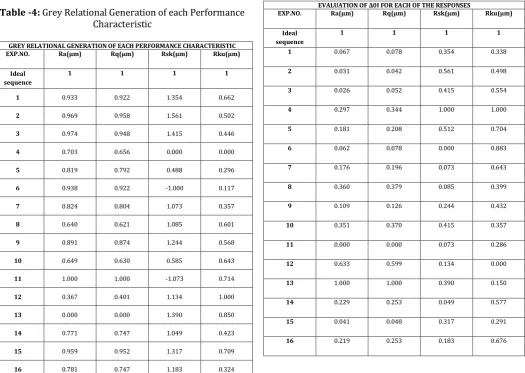
Table -4: Shows parametric optimization was done for turning process by using the following criterion for smaller-the-better concept of all roughness parameters.
Stainless Steel 304
Chemical composition (%)
C Mn Si P S Cr
0.08 2 0.75 0.045 0.03 20
Mechanical
properties Tensile Strength(Mpa) Yield Strength (MPa)
Elongation Hardness
[image:2.595.52.279.185.268.2] [image:2.595.44.286.329.507.2]© 2018, IRJET | Impact Factor value: 7.211 | ISO 9001:2008 Certified Journal | Page 3080
[image:3.595.39.565.122.495.2]Xi (k) = max Yi (k) – Yi (k)/max Yi (k) – min Yi (k)
Table -4: Grey Relational Generation of each Performance Characteristic
GREY RELATIONAL GENERATION OF EACH PERFORMANCE CHARACTERISTIC
EXP.NO. Ra(µm) Rq(µm) Rsk(µm) Rku(µm)
Ideal sequence
1 1 1 1
1 0.933 0.922 1.354 0.662
2 0.969 0.958 1.561 0.502
3 0.974 0.948 1.415 0.446
4 0.703 0.656 0.000 0.000
5 0.819 0.792 0.488 0.296
6 0.938 0.922 -1.000 0.117
7 0.824 0.804 1.073 0.357
8 0.640 0.621 1.085 0.601
9 0.891 0.874 1.244 0.568
10 0.649 0.630 0.585 0.643
11 1.000 1.000 -1.073 0.714
12 0.367 0.401 1.134 1.000
13 0.000 0.000 1.390 0.850
14 0.771 0.747 1.049 0.423
15 0.959 0.952 1.317 0.709
16 0.781 0.747 1.183 0.324
The definition of Grey Relational Grade in the course of Grey Relational Analysis is to reveal the degree of relation between the n sequences [X0(k) and Xi(k), i=1,2,3,....n]. The
Grey Relational Coefficient ξi(k) can be calculated
ξi (k) = [Δmin + Ψ Δmax] / [Δ0i (k) + Ψ Δmax]
where Δoi (k) is the deviation sequence of the reference
sequence and comparability sequence
Δ0i (k) = || Xo (k) – Xi (k) || “Ψ” is the distinguishing coefficient and 0≤Ψ≤1
Table -5: Evaluation of Δ0i for each of the responses
EVALUATION OF Δ0I FOR EACH OF THE RESPONSES
EXP.NO. Ra(µm) Rq(µm) Rsk(µm) Rku(µm)
Ideal sequence
1 1 1 1
1 0.067 0.078 0.354 0.338
2 0.031 0.042 0.561 0.498
3 0.026 0.052 0.415 0.554
4 0.297 0.344 1.000 1.000
5 0.181 0.208 0.512 0.704
6 0.062 0.078 0.000 0.883
7 0.176 0.196 0.073 0.643
8 0.360 0.379 0.085 0.399
9 0.109 0.126 0.244 0.432
10 0.351 0.370 0.415 0.357
11 0.000 0.000 0.073 0.286
12 0.633 0.599 0.134 0.000
13 1.000 1.000 0.390 0.150
14 0.229 0.253 0.049 0.577
15 0.041 0.048 0.317 0.291
16 0.219 0.253 0.183 0.676
Considereing Δ0i value from table.4 and distinguishing
coefficient,Ψ where 0≤Ψ≤1, the grey relational coefficients ξi(k) are calculated by using the following relationship
ξi (k) = [Δmin + Ψ Δmax] / [Δ0i (k) + Ψ Δmax]
where Δmin is the smallest value of Δ0i, Δmax is the largest value
of Δi of the corresponding parameters and ‘Ψ’, the
© 2018, IRJET | Impact Factor value: 7.211 | ISO 9001:2008 Certified Journal | Page 3081
Table -6: Evaluation of Δ0i for each of the responses
GREY RELATIONAL COEFFICIENTS WITH ΨRa = ΨRq = ΨRsk = ΨRku = 0.2 FOR EACH PERFORMANCE CHARACTERISTIC
EXP.NO. Ra(µm) Rq(µm) Rsk(µm) Rku(µm)
Ideal
sequence 1 1 1 1
1 0.749 0.719 0.361 0.372
2 0.866 0.826 0.263 0.287
3 0.885 0.794 0.325 0.265
4 0.402 0.368 0.167 0.167
5 0.525 0.490 0.281 0.221
6 0.763 0.719 1.000 0.185
7 0.532 0.505 0.733 0.237
8 0.357 0.345 0.702 0.334
9 0.647 0.613 0.450 0.316
10 0.363 0.351 0.325 0.359
11 1.000 1.000 0.733 0.412
12 0.240 0.250 0.599 1.000
13 0.167 0.167 0.339 0.571
14 0.466 0.442 0.803 0.257
15 0.830 0.806 0.387 0.407
16 0.477 0.442 0.522 0.228
After averaging the Grey Relational Coefficients, the Grey Relational Grade γi can be computed as
γ i = 1/n
where
γ i represents GRG
n is the number of process responses
The higher value of grey relational grade corresponds to intense relational degree between the reference sequence X0(k) and the given sequence Xi(k). the reference sequence
X0(k) represents the best process sequence, therefore,, higher
grey relational grade means that the corresponding parameter combination is closer to the optimal.
Table -7: Overall Grey Relational Grade
OVERALL GREY RELATIONAL GRADE
EXP.NO. RELATIONAL GRADE OVERALL GREY RANK
1 0.550 6
2 0.560 5
3 0.567 4
4 0.276 16
5 0.379 13
6 0.667 2
7 0.502 9
8 0.435 11
9 0.507 8
10 0.350 14
11 0.786 1
12 0.522 7
13 0.311 15
14 0.492 10
15 0.608 3
16 0.417 12
Table -8: Shows the S/N ratio based on the larger-the-better criterion for overall grey relational grade calculated by using
S/N= -10 Log[1/n 1/yi2 ]
S/N RATIO FOR OVERALL GREY RELATIONAL GRADE
EXP. NO. S/N RATIO
1 -5.192
2 -5.036
3 -4.928
4 -11.182
5 -8.427
6 -3.517
7 -5.986
8 -7.230
9 -5.900
10 -9.119
11 -2.092
12 -5.647
13 -10.145
14 -6.161
15 -4.322
© 2018, IRJET | Impact Factor value: 7.211 | ISO 9001:2008 Certified Journal | Page 3082
4. Result and Discussion:
The main objective of the experiment is to optimize the turning parameters (Speed, Feed, Depth of cut, Type of Tool) The experimental data for the surface roughness values and the calculated signal-to-noise ratio are shown in Table 8, for Stainless Steel. The S/N ratio values of the surface roughness are calculated, using the larger-the-better characteristics.
Table 8, shows the surface roughness along with its computed S/N ratio value. Average S/N ratio for each level of experiment is calculated based on the value of Table 3.
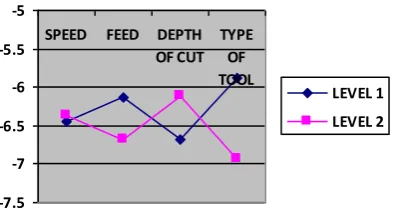
Based on the calculated S/N ratio values, it can be seen that a speed of 485 rpm and a feed rate of 0.025 mm/rev and Depth of cut of 0.9mm with High Carbon steel tool gives the optimum values for turning of Stainless steel.
-7.5 -7 -6.5 -6 -5.5 -5
SPEED FEED DEPTH OF CUT
TYPE OF TOOL
[image:5.595.67.265.320.425.2]LEVEL 1 LEVEL 2
Fig -3: Parameters Vs Avg. S/N Ratio
[image:5.595.72.241.532.602.2]fig – 3:gives an Interaction effects plot for cutting parameters vs Avg. S/N ratio to determine the optimum surface roughness value.
Table -9: Optimum values of factors and their levels
Parameters Optimum
Value
Speed, rpm 485
Feed, mm/rev 0.025
Depth of Cut, mm 0.9
Type of Tool High Carbon
Steel
5. CONCLUSIONS
The present investigation aimed at optimization of surface roughness during turning of Stainless Steel work piece. This analysis was carried out by developing surface roughness models of Ra, Rq, Rsk, Rku based on full factorial in
Taguchi optimization technique. Main effect plots were drawn manually & also using Taguchi design & compared with each other.
Surface roughness & the cutting parameters have highly non-linier relationships among them. The minimal surface roughness is obtained at a combination of speed (485 rpm), feed (0.025 mm/rev), and depth of cut (0.9mm), type of tool (High Carbon Steel).
Experiment no. 11 is obtained as the optimal solution by Grey relational based Taguchi method of optimization. The experiment, when stainless steel is turned with 485rpm speed, 0.025mm/rev feed having 0.9mm depth of cut with high Carbon steel tool is the obtained optimal solution. The same experiment no. 11 is decided as optimal from S/N ratio analysis also.
The predicted values and calculated values are very close to each other, which indicate the Accuracy of the developed model
REFERENCES
[1] Wu, H.H., “The introduction of Grey Analysis”, Gauli
Publishing Co., Taipei, 1996.
[2] Knowles, Peter Reginald (1987), Design of structural
steelwork (2nd ed.), Taylor & Francis, p. 1, ISBN 978-0-903384-59-9
[3] Ziliang.W, and Sifeng.L. Extension of Grey Superiority
Analysis, Liu S.F. et al. Grey system Theory and its application, Science Press, Beijing, China,2004).
[4] Kun-lin Wen, The grey system analysis and its
application in gas breakdown and var compensator finding(invited paper), Int. Journal of computational Cognition 2(1)(2004) 21-44.)
[5] K.C Chang and M-F, Yeh, Grey-relational analysis based
approach for data clustering, IEEE Proc,_Vis. Image Signal Process., Vol.152,No,2, April 2005, pp165-172.
[6] Lu, H.C., Yeh,M-F.: Robot path planning based on
modified grey analysis, Cybern. Syst., 2002, 33,(2), pp 129-159.
[7] R. Nicole, “Title of paper with only first word
capitalized,” J. Name Stand. Abbrev., in press.
© 2018, IRJET | Impact Factor value: 7.211 | ISO 9001:2008 Certified Journal | Page 3083
BIOGRAPHIES
T.Naga Sushma
PGStudent,
Department of Mechanical Engg., DMS SVH College of Engineering, Machilipatnam,
Andhra Pradesh, India.
Smt. P.S.Naga Sree Assistant Professor
Department of Mechanical Engg., DMS SVH College of Engineering, Machilipatnam,
Andhra Pradesh, India.
Dr. Doradla Raja Ramesh Professor & H.O.D,
Department of Mechanical Engg., SVIET, Nandamuru,
Andhra Pradesh, India.
Sri.T.Ravi kumar
Associate Professor & H.O.D, Department of Mechanical Engg., DMS SVH College of Engineering, Machilipatnam,