Munich Personal RePEc Archive
Moving towards appropriability of
academic knowledge: a post-actionalist
perspective
Vaujany, François-Xavier de and Grimand, Amaury
Coactis
2005
Online at
https://mpra.ub.uni-muenchen.de/1317/
MOVING TOWARDS APPROPRIABILITY OF ACADEMIC
KNOWLEDGE: A POST-ACTIONALIST PERSPECTIVE
François-Xavier de Vaujany
Associate Professor
ISEAG, Jean Monnet University
2, rue Tréfilerie
42023 Saint-Etienne
FRANCE
[email protected]
Amaury Grimand
Associate Professor
ISEAG, Jean Monnet University
2, rue Tréfilerie
42023 Saint-Etienne
France
[email protected]
MOVING TOWARDS APPROPRIABILITY OF ACADEMIC
KNOWLEDGE: A POST-ACTIONALIST PERSPECTIVE
Abstract:
Based on recent contributions in managerial research, this article aims to suggest a new perspective for appraising and developing knowledge usability by studying the processes underlying its production: appropriation. The underlying problem is the following: how can the academic community help a community of practitioners appropriate knowledge it produced, co-produced or stimulated? First, a preliminary analysis is put forward as regards management sciences and the concept of knowledge 'actionability'. Some limitations are raised (1.). Then, the authors suggest to move from an 'actionability' (rather coherent with a classic vision of management sciences linked to the "sciences of the artificial") to an 'appropriability' perspective (2.). Lastly, the specificities of both perspectives are discussed (3.). Some limitations of this new vision are also pointed out, especially from a psychological standpoint.
Key-words
:
Management science represents a new discipline in the field of the social sciences. With its first
contributions going back less than a century, it has not yet acquired the legitimacy of sociology
or psychology, or of such “hard” sciences as biology or physics. It is faced today with two very
different difficulties, both linked to the respective communities of the practitioners and the
academics.
The first difficulty concerns the process of assimilating / accommodating academic knowledge
by the practitioners. For the practitioner, assimilating knowledge consists in translating,
transferring academic knowledge so as to viably integrate it into his work routine and transform
it into action. Accommodation is the degree to which the practitioner transforms the new
academic knowledge by using it, and to what extent it affects his mental schemes.
For pedagogical and sometimes political reasons, this assimilation/accommodation process does
not seem to function well and the productions of management research rarely reach operational
managers. In the first place, one can suggest that the interests of academics and practitioners do
not coincide, the separation of both communities being thus desirable. Indeed, researchers may
be more interested in pursuing a " line of inquiry " than in matching the concerns of practitioners
and improving the efficiency of managerial practice (Kelemen and Bansal, 2002). The reason
why many theories look trivial to practitioners lies in the process of theory construction, which
favours validation rather than usefulness (Weick, 2001). Another possible explanation is the
dominant writing conventions of management research, which makes it difficult for practitioners
to grasp the theoretical insights of academics and evaluate their relevance to management
practice. This leads Kelemen and Bansal (2002) to the conclusion that bridging the relevance gap
between academics and practitioners raises mainly issues of style not substance. This resonates
Besides, the intended audience of most research is the academic community itself rather than
" the dual community of scholars and practitioners " (Starkey and Madan, 2001), giving birth to
an " incestuous closed loop within which researchers talked only to each other " (Hambrick,
1994).
The second difficulty is more scientific and addresses the academic community more directly. It
concerns the usability of the knowledge produced. According to Schön (1983), "actionable
knowledge" is knowledge that can serve the purpose of action. The concept of actionable
knowledge has also been widely used and defined by Argyris (1993, 1996a). For him, the aim of
any theory of managing is to produce generalizations that are actionable by managers in the
organization's daily operations. In turn, as managers use such generalizations, it enables them to
test the external validity of the academic corpus. For a theory to be actionable, it must inform the
decision-makers about what is likely to happen under given circumstances but also tell them how
to create the right conditions for such an actioni. Managing can thus be defined as creating
intended consequences. From this standpoint, most modelling tools seem to be the result of the
observation of action rather than at the origin of it.
The two difficulties of communication and validity are linked. Knowledge that is too unclear or
with no action leverage will certainly be non-operational or difficult to transfer to practitioners.
The aim of this article is to suggest a new perspective for knowledge usability by studying
the processes underlying its production: appropriation. The issue we want to deal with is the
following: how can the academic community help a community of practitioners appropriate
- How can the academic community frame its production so as to facilitate the
appropriation process?
- How can it make the knowledge developed by a community of practiceii appropriable by
another community of practice?
In a first attempt, we will define appropriation as the process that consists for scientists in
producing knowledge useful for action for an exogenous community or to transfer a practical
knowledge from one community to another. More broadly, appropriation is the process that
consists in producing useful knowledge, which can result in successful or unsuccessful
trajectories. In the last case, knowledge has finally no practical or rhetorical value in view of the
intentions of the community under study.
Here, we present an appropriative perspective, which takes more into account the lasting of the
process and some political aspects that the 'actionability perspective' do not really integrate. The
aim is to give the academics some landmarks that can help make the product of their research or
any other knowledge more useful, more easily understandable and more legitimate to the
managers. The appropriability perspective emphasizes the emancipatory obligation of social
science towards organizational members (Kilduff and Kelemen, 2001). From this perspective,
the concept of appropriation is tantamount to that of acculturation as evoked by Barley and al.
(1988: 27) : "Acculturation is therefore the process by which the beliefs and practices of one
community diffuse across the boundaries of another and subsequently alter the second
community’s practices and interpretations". This is also reminiscent of the concept of " perspective
taking " as defined by Mohrman and al. (2001: 359) : "a recognition of knowledge, values,
meanings, assumptions and beliefs from a different community" which implies interpretive and
specific social processes. It is also to describe some possible research trajectories each linked to
project implementing a coherent set of theories, methodologies and tools so as to produce
more or less gradually a type of useful knowledge for a given community of practice.
The first part defines the key concepts (management sciences, actionable knowledge and
appropriability) of the problem whose main stakes and mechanisms are then developed. The
third part presents the grounds of an appropriative perspective that might bring solutions to the
problems. Lastly, we discuss some potential limitations of the appropriative perspective we
worked out.
PRELIMINARY INFORMATION ABOUT MANAGEMENT SCIENCES
AND KNOWLEDGE ACTIONABILITY PERSPECTIVE LIMITATIONS
Drawing on Simon’s work (1969), Mohrman et al. (2001: 358) claim that organizations are
"artifacts designed to achieve the purposes of their creators ". Thus, most researchers posit
management mainly as a science of design ("science of the artificial"), stressing the need for
theories and research useful for knowledge creation rather than ex post rationalizations. From
this viewpoint, Romme (2003) argues that organization studies should include design as one of
their primary modes of engaging in research. The idea of design, stresses Romme, does not draw
on a representational view of knowledge (organizational phenomena are empirical objects
endowed with intrinsic properties; the aim of science is to test propositions derived from general
theories) but " involves inquiry into systems that do not yet exist " (p. 558). Consequently, the
aim of a design approach to organization studies is to produce knowledge that is both
actionable and open to validationiii (not in the sense that this knowledge is deemed true but that
it can help users make sense of existing management situations and change them into desired
ones). Hence, "Everyone designs, who devises courses of action aimed at changing existing
So scientifically speaking, management science is both at the crossroads of numerous “natural”
and “artificial” sciences that simultaneously integrate various processes and various works in
other fields of the social sciences. But according to many researchers, its logical aim would
ultimately be to make organisational knowledge "actionable"v, to design comprehensive and
normative tools but also, according to Martinet (1990) to provide modelling tools for users faced
with ill-structured situations.
From our point of view, if we stick to an actionability perspective, there are four types of
actionable knowledge, which reflect the evolution of the companies’ decision-making
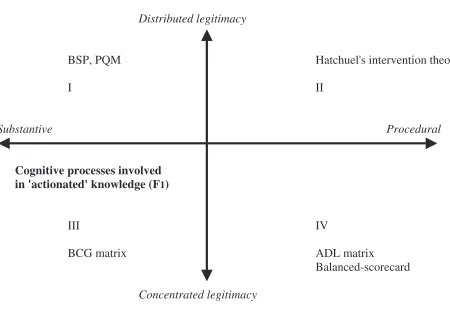
processesvi. They can be determined by using two axes.
One (F1) that characterises the cognitive processes implied in the decision-making. They can either be substantive, based on an algorithm, or procedural, based on heuristics. According to Le
Moigne (1995a: 133), a heuristic approach is “a formalised problem-solving process based on
the great likelihood that this process will result in a satisfactory solution”. An algorithm is “a
formalised problem-solving process whose convergence has first been formally established and
which therefore is certain to yield the solution to the problem.”
The second axis (F2) represents the company’s legitimacy distribution. In some cases, the system is made up of a multitude of coalitions leading toward a collective consensus. In others,
there is a group of key dominant users who lead a majority of individuals with few marginal
resources, little or no group awareness and no collective project. Among the social peripheral
processes presented along F2, it is therefore possible to distinguish between organisations with more unilateral and deliberate processes and organisations with more cohesive, collectively
Social context of knowledge 'actionalization' (F2)
Distributed legitimacy
BSP, PQM Hatchuel's intervention theory
I II
Substantive Procedural
Cognitive processes involved in 'actionated' knowledge (F1)
III IV
BCG matrix ADL matrix
Balanced-scorecard
[image:9.595.74.524.73.382.2]Concentrated legitimacy
Figure 1: Types of actionable knowledge
Cases III and IV correspond to unilateral and deliberate processes. Action results from the
decision. The social processes follow the cognitive decision-making process and are not
supposed to be an issue. There is immediate usability. This is the decision-making paradigm
described by Roy (1993). To give the example of strategic management, the user will choose a
BCG matrix (case III) or an ADL matrixvii (case IV) to boost the management of his company’s
portfolio of activities (see Johnson and Scholes, 1997). In the case of production management, a
manager will use a PERT system or any decision-making tool that can help him rationalise the
decision process. The boundary between III and IV is due to the decision-making criteria as well
as their multi-dimensional nature. What they have in common is their relative easiness of
Cases I and II involve emergent and negotiated processes. Decision is in action. The
actionability of knowledge can be defined by both cognitive and sociological meansviii. The
action process is collective. The problem is not so much the decision-making but the
organisation of coherent and convergent socio-cognitive actions. Moidon’s (1997) and
Hatchuel’s (2001) works and the intervention-research working modes of the management
research center at l’"Ecole des Mines" in Parisix reflect this possible combination of social and
cognitive processes. The appropriation of the management tools is analysed through their effects
on the organisation and their contribution to the social construction of reality. Action is
considered more important than inconsistent decision-making processes. The organisation takes
on a more complex and flexible dimension. Information systems planning methods as BSP or
PQMx presented by Lincoln (1991) correspond to case I. The author’s approach is based on
determining key success factors and designing monitoring schemes based on an emerging
process. Decisions are made and key factors are determined at the end of various transversal
forums.
Hatchuel’s intervention theory (1994) and Chanal, Lesca and Martinet (1997) "Recherche
ingénierique" on the other hand belong to the case II category. It has to do with meta-heuristics,
it is a reflection upon how to produce locally actionable knowledge. In such cases, the social and
cognitive contexts are extremely complex. There are many contradictory projects within the
organisation. The cognitive processes are based on open and iterative mechanisms. The form of
reasoning used are more procedural than in case I, probably because actionable knowledge is
co-produced with the users.
At this stage, after the cartography we have just achieved, we can go a bit further and adopt a
As March (2000a, 2000b) points out, there is a lot of confusion surrounding the notion of
actionable knowledge and the so-called " relevance gap " between the academic and the user
communities. Indeed, actionable knowledge is frequently confused with prescriptive statements,
solutions to immediate problems, diffusion of the last cutting edge best practices. As Starkey and
Madan ironically say, quoting Jerry Porras : " Executives are experienced enough to understand
that best practices come and go and that the only thing that really lasts is the conceptual
underpinnings to current best practice " (2001, p.7).
March also states that the logic of consequence has become a cultural stereotype in most of
academic research, which expresses an aim to order reality ex post but can hardly inform
decision ex ante. He therefore suggests that the traditional and rational perspective on decision
theory that emphasizes consequential choice be supplemented with a theory of collective action
based on a logic of appropriateness and rule following. This logic is driven not only by the will
to pursue desired consequences but by questions of identity.
Furthermore, from the 'actionability perspective', the value of a knowledge is linked to its ability
to better inform the decision making process. K. Weick vigorously questions this assertion: "
Where is it written that " decision making " is a given in human existence ? Whose job is it to
think outside the box and suggest that thinking about human existence as a series of decisions
may be less fundamental than thinking about existence as the search for meaning by means of
sense-making ? " (2001, p.71)
The second part will focus more on the relationship between the management sciences and their
BRINGING TOGETHER RESEARCHERS AND OPERATIONAL USERS:
FROM ACTIONABILITY TO APPROPRIABILITY
The word “appropriation” has two possible meanings, “ the act of making usable” or the fact of
“making something belong, become our property”. It is therefore more encompassing than the
notion of actionability. The actionabiliy of knowledge is grounded both on the knowledge itself
and the processes that support it. The question that remains is how can the knowledge produced
by the management scientists or by any other community be appropriated by an exogeneous
community? This question can be declined in four directions as described by the following table:
ACADEMICS PRACTITIONERS
ACADEMICS
'Scientific appropriation'
[AC1 AC2 or A1 A2] Problem 1: How managerial knowledge developed by AC 1 can be appropriated by AC 2?
'Appropriation as an implementation' of academic development [AC1 CP1] or a co-production of knowledge[AC1 CP1]
Problem 3: how CP 2 can
appropriate knowledge produced by or co-produced by AC (in
interaction with CP 1)?
PRACTITIONERS
'Formative appropriation'
[CP1 AC1]
Problem 2 : How managerial knowledge developped by a CP can be appropriated by an AC?
'Appropriation of best practices'
[CP1 CP2]
Problem 4 : How managerial knowledge produced by CP 1can be appropriated by CP 2 ? How the AC can facilitate the whole process?
• Table 1: Four appropriative directions.
Legend:
CP: Community of Practice
In our analysis, we will focus on the classic AC-CP appropriative direction. Especially as regards
management scientists' actions of facilitation, we will ask which principles can be raised to
leverage the appropriability of a given knowledge.
First, we contend that reflexivity has to be built into the research process, whatever the
appropriative project is. The distinction between mode 1 research (which refers to the traditional
mode of knowledge production) and mode 2 researchxi, exemplified by Gibbons and al. (1994),
followed by Kelemen and Bansal (2002), suggests that reflexivity should not only rely on a
reflection upon the research design employed but should also account for the point of view of all
stakeholders involved in the research processxii. Thus, from an appropriative perspective, one
should treat practitioners not as " cultural idiots " but as " ordinary theoricians " capable of reflexive
distance from their day-to-day practice. As Boland et al. (2001) point out: " managers may be
theorists as well as pragmatists … they are constructors of their own knowledge as well as users of knowledge
created by others ".
Beyond reflexivity, management scientists must also take into account the level of
interpretability of their work. There is often a wide gap between the reference system of the
management academics and the practitioners (Beyer and Trice 1982; Shrivastava and Mitroff
1984; Bruce and Peyton 1990). Research has shown that scientific work and its usability is more
likely to be accepted if it matches “the organisation’s system of references and its context” (Morhman et
al. 2001: 360). Following Calon and Latour’s theory of network sociology, the academics have
to “translate” their work into “another language” (Calon, 1989), producing intermediary objects
between their world and that of the practitioners in order to balance the overall network. Thus,
academics must pay attention to the " accessibility " of their production, that is to say their " style
socialization (Nonaka, 1994), shared face-to-face experience that enables interpretation
processes (Rynes et al. 2001). This process can also be facilitated by the use of figurative
knowledge, such as analogy or metaphors as Boland et al (2001) suggest: "In such figurative
knowledge, intended meanings are ambiguous, and knowledge content is left to readers’ interpretation". Indeed,
individuals learn the practices of a specific community by engaging in language games, joint
action and efforts to surface shared beliefs (Lave and Wenger, 1991). According to Nonaka
(1994), the metaphor is the best means of converting implicit knowledge (knowledge linked to
actual professional experience) into formalised explicit knowledge. It can therefore be used both
ways to translate the language of the operational users into that of the academics and conversely.
This translation theory is strongly linked to Hatchuel’ s principles of intervention research
(1994). Indeed, for him, “all those involved in research should be concerned by the necessity of making
themselves understood” (Hatchuel, 1994: 68) if they aim to produce work that can be appropriated
by the practitioners. This is what he called the "isonomy principle".
Usability is also a fundamental landmark in appropriation. How then can it be defined in the
context of the appropriation of academic knowledge? As suggested by many academics, we
suggest to look at the problem from the users’ perspective. A piece of knowledge can be
qualified as useful for a given operational unit if it reinforces their mastery of the various
management situations they have to face. This instrumentalist approach does not aim to describe
the reality but aims to improve our mastery of the world, thus following in the footsteps of such
American pragmatists as Dewey (1967), who encourages us to turn away from the Greek
philosophy of discovering and unveiling a pre-existing reality and distinguish between the
descriptions of the world and of ourselves which are useful and that which are not. In that
philosophy, theory and action are very closely linked. From this point of view, a " good theory " is
Beyond reflexivity, interpretability and usability, a fourth criterion is also likely to be inevitable
to leverage managerial knowledge appropriability: disturbance. Management science, in its
ideal-typical form, intends to reveal the general patterns and forces that shape and explain the "
real " world. To reach this goal, the production of knowledge has to be protected from the
researcher’s personal bias and subjective influences. The search for consensual objectivity i.e. a
high degree of agreement between peers or between academics and practitioners, guarantees the
validity of organization science as an ideal-typical mode of research. It also implies the use of
specific research methods such as controlled experiments that can safeguard the research setting
from the disturbances of the practice setting (Romme, 2003). We contend that, cognitively,
academic knowledge must disturb the organisational processes so as to reactivate them.
However, a consensus must be found in order to implement the new processes and artifacts
produced. For Berry (1999), the ability to disturb is certainly one of the necessary conditions for
the production of knowledge. For him, it is hard to learn anything about an organisation without
first disturbing it. Schön (1983), advocating a mode of knowing that can inquire into and
transform one’s own practice by developing reflection-in-action, emphasizes that this mode is
initiated by an experience of surprise.
Last, the whole research device can not but stick to a consistence criterion. For the knowledge
produced to be rationally and socially acceptable, the researcher has to make sure of its internal
consistency. Thus, the absence of major contradictions in the foundations of a model or a
managerial tool, the general harmony of artifacts regulating the interaction between the
researcher and the client organization, are necessary conditions for coherence to emerge. This
implies that the researcher must carry out epistemological work that focuses both on the
knowledge produced and the process of knowledge production itself.
understand the managerial knowledge (co-)produced by the academics in management science
(heuristics, algorithm, meta-heuristic…)? We may refer ourselves to the sociological studies of
Giddens (1979, 1984, 1994) to analyse the interaction between the academic and the practitioner
using his three-layered model. According to him, three time cycles are simultaneously at work in
any kind of structural process (Giddens 1994: 28):
-The time span of everyday experiences
-The lifespan according to Heiddegger, which goes from birth to death
-The “long” time span as defined by Braudel, which corresponds to the lifespan of institutions
We suggest that the interaction between the academic and the practitioner and exchange of
knowledge follow the same three kinds of temporal levels: the institutional level, the meso-social
level and the micro-social level.
To conclude on these first two parts, it can be said that (co-)developing academic knowledge
towards practitioners primarily consist in:
- Choosing a level of research (institutional, meso-social or micro-social)
- Choosing an epistemological positioning which is often the result of the researcher’s training
and theoretical research rather than a deliberate decision.
- Defining an appropriative project.
APPROPRIAT-ION PROJECT
OBSERVATION MAIEUTICS ENGINEERING SYSTEMS
DEVELOPMENT Academic vision
of appropriation
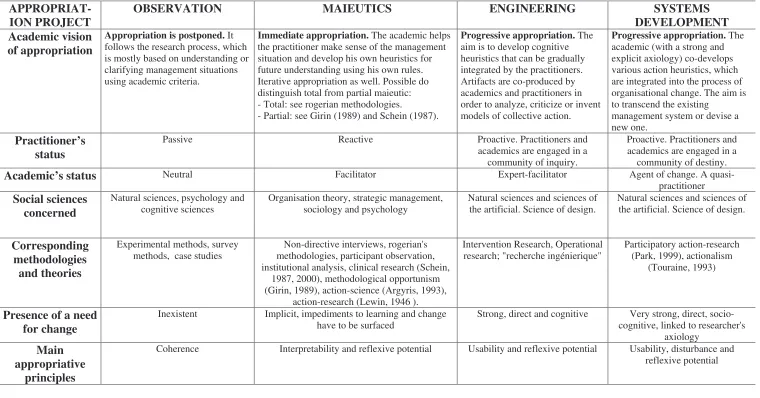
Appropriation is postponed. It follows the research process, which is mostly based on understanding or clarifying management situations using academic criteria.
Immediate appropriation. The academic helps the practitioner make sense of the management situation and develop his own heuristics for future understanding using his own rules. Iterative appropriation as well. Possible do distinguish total from partial maieutic: - Total: see rogerian methodologies.
- Partial: see Girin (1989) and Schein (1987).
Progressive appropriation. The aim is to develop cognitive heuristics that can be gradually integrated by the practitioners. Artifacts are co-produced by academics and practitioners in order to analyze, criticize or invent models of collective action.
Progressive appropriation. The academic (with a strong and explicit axiology) co-develops various action heuristics, which are integrated into the process of organisational change. The aim is to transcend the existing
management system or devise a new one.
Practitioner’s status
Passive Reactive Proactive. Practitioners and academics are engaged in a
community of inquiry.
Proactive. Practitioners and academics are engaged in a
community of destiny.
Academic’s status Neutral Facilitator Expert-facilitator Agent of change. A quasi-practitioner
Social sciences concerned
Natural sciences, psychology and cognitive sciences
Organisation theory, strategic management, sociology and psychology
Natural sciences and sciences of the artificial. Science of design.
Natural sciences and sciences of the artificial. Science of design.
Corresponding methodologies
and theories
Experimental methods, survey methods, case studies
Non-directive interviews, rogerian's methodologies, participant observation, institutional analysis, clinical research (Schein,
1987, 2000), methodological opportunism (Girin, 1989), action-science (Argyris, 1993),
action-research (Lewin, 1946 ).
Intervention Research, Operational research; "recherche ingénierique"
Participatory action-research (Park, 1999), actionalism
(Touraine, 1993)
Presence of a need for change
Inexistent Implicit, impediments to learning and change have to be surfaced
Strong, direct and cognitive Very strong, direct, socio-cognitive, linked to researcher's
axiology
Main appropriative
principles
[image:18.842.54.814.56.454.2]Coherence Interpretability and reflexive potential Usability and reflexive potential Usability, disturbance and reflexive potential
Observation is a sequential appropriation project. The practitioners are passive in the process
of knowledge acquisition, which does not mean they are passive in the research process
itself. The various experimental methods used in information systems (See Desanctis et al.
1989 or Desanctis et al. 1992) are typical of this first type of appropriation project. The more
we move toward the right of the table, the more reflexive the practitioners become on the
knowledge produced by the academics. We move from auto-produced knowledge (total or
partial maieutics) to knowledge production (engineering) to the ultimate step of
co-production (development of management systems).
Appropriation is easier when the artifacts are produced by the practitioners themselves (total
maieutics at the micro-social level). It is worth noting that appropriation may be complicated
or facilitated depending on the project and the structural level at which it takes place. Thus,
an appropriative project linked to the development of management systems will probably be
more easily appropriated at the institutional and meso-social level than at the micro-social
level. On the other hand, the “total maieutics” project will be more easily appropriated at the
micro-social level. Indeed, the knowledge produced at that level will be local and
contextualised, making it difficult to extrapolate at the institutional and meso-social level.
Conversely, an “observation” project, which focuses on global concepts will be more easily
DISCUSSION
FROM ACTIONNABILITY TO APPROPRIABILITY: RESPECTIVE SPECIFICIES
AND SOME LIMITATIONS OF THE MOVE
Finally, actionnability and appropriability perspectives as regards managerial knowledge can be
described by the following table:
ACTIONABILITY APPROPRIABILITY
DEFINITION
Actionable knowledge aims at creating intended consequences by informing decision makers about what is likely to happen under given circumstances.
Appropriation encompasses both the act of making knowledge usable and becoming an individual’s property.
VISION OF MANAGEMENT
Management as a science of design, a "science of the artificial" (Simon, 1969).
Management as a theory of collective action (Hatchuel, 2001) or a "science of creative action" (Lorino, 2002).
NATURE OF MANAGERIAL
KNOWLEDGE
An exogenous technology. Its utility is intrinsic to its features and that of the sociotechnical context.
A socio-cognitive scheme (the manager's one), i.e. a set of cognitive routines linked to social life. It's related value is linked to the very process of appropriation.
LOGIC OF KNOWLEDGE
DIFFUSION
Replication in an organizational setting. Tool is an enabling factor.
Re-invention both in an organizational and institutional setting. Tool is at the same time habilitating and constraining.
MAIN CRITERIA OF JUDGEMENT
Relevance
Emancipation (by means of reflexivity, usability, interpretability, disturbance, coherence).
FOCUS Content Process
THEORETICAL ROOTS
Argyris (1993, 1996) and Schön (1983), Cyert and March (1963), Simon (1947, 1969).
Giddens (1984), Weick (1995, 2001), Lorino (2002), Ciborra (1997, 1999, 2000), Alter (2000), Orlikowski (2000). • Table 3: An actionnability-appropriability comparison.
Lastly, we believe that appropriability really represents a way to overcome some limitations
linked to the notion of actionnability (see first part), especially its mechanistic connotation.
An obvious limit of appropriability relates to the psychological field. Indeed, even if the
appropriative perspective, for the sake of consistency, boils down to cognitive and political
aspects, it puts aside managers’ psychological profiles and their implications as regards some
potential 'drifts'. Two famous characters in French literature epitomize the difficulties and
dangers of any appropriative project. They both appear in the play Lorrenzacio (de Musset
1834). The scene takes place in Florence in 1537. The town had recently signed a peace treaty
with Charles V, emperor of Germany. The latter, with the Pope’s complicity, empowered
Alexander of Medicis, a member of one of the City’s oldest families. The Duke is young and
leads a debauched life. He reigns over the town by means of terror, neglecting both the people
and Florence’s other families. Everybody hates him, but less than his cousin, his damned soul:
Lorrenzo de Médicis, maliciously nicknamed Lorrenzacio. In addition, another family, the
Strozzi, tries to preserve its status. Two characters play a dominant role in this family : Philippe,
the father, and Pierre, his impetuous son.
The former is an intellectual. He qualifies his statements by means of different standpoints,
analyzing problems either from a sociological perspective ("When will the common folk have
learnt enough to stop their daughters laughing while their parents weep? ", Act II, scene I), a
philosophical one (" Is corruption one of Nature’s laws ? Are our so-called virtues the clothes we
wear only on Sundays? ", Act II, scene I), an historical one (" You are insulted so you kill: you
have killed so you are killed. Soon hate puts down its roots. Sons are cradled in the coffins of
their forebears, and whole generations spring from the earth, sword in hand ", Act II, scene V)
or a political one (" Do you know what makes a republic? the craftsman in his workshop, the
labourer in his field, the citizen in the marketplace the life of a whole community and in god’s
justice the simple happiness of men. ?", Act III, scene 2). Action, when taken into account, is
always suggested in a wise and structured manner (" But you’ve reached no firm decision? made
numberless heads to roll at the feet of the executioners! Providence itself is dumb with terror
and, fearful to intervene, leaves it up to men to bring such projects for fruition. ", Act III, scene
II). Even when his daughter’s reputation has been tarnished by the Duke’s words, his analysis is
so intense that it impedes any form of action or revenge (" If you had not spread the word, for
Louisa, for all of us, things would be simpler now! Can’t a virtuous Strozzi ignores the jibes of a
Salviati? Must those who lives in a marble palace know what obscenities the populace has
written on its walls? who cares about the comments of a man like Julian? Will my daughter find
it hard to find an honest husband? will her children respect her less? will I, her father, think of
it, when I’m kissing her good nights? What have we come to, if any insolent braggart can make
men like us draw our swords?" Act II, scene V). Even when he feels that action becomes
necessary, Philippe remains passive, noticing that his " vengeance has grey hair " (Act II, scene
V). Only his motivations linked to his personal analysis of the political situation in Florence will
bring him to action in a cautious and distant manner.
Pierre, his son, is the opposite. The way he expresses himself and appraises the situation are both
linked to the action itself. He can’t help behaving instinctively ("You will think of it, Leon. And
speak of it too. You see, I’m itching to chop off his hears. Who has he slandering this time ? Us?
my father? by the blood of Christ, I’ve no love lost for that Salviati. ", Act II, scene I ; " Any
festering sore can be cured if you lance it.. ", Act III, scene II). His analyses are always factual
(" just like a bloody priest! here am I, hopping with impatience, and you hesitate for words! a
spade is a spade, by heaven, and a word’s a word. God has nothing to do with it! ", Act II, scene
I) and short-term oriented, focusing on his sister’s scorned honour. Pierre always sticks to
common sense, far from the expert logic. He is not aware that power cannot be changed without
putting forward alternatives.
PHILIPPE PIERRE
World vision Broad
Long-term oriented
Narrow
Present-oriented
Decision motives Multidimensional
Aims at breaking common-sense
Factual. Philippe’s son follows his instinct
He respects common-sense principles
Role in collective action He rationalises and gives sense to action
He simply follows action without any personal investment
Sensemaker. Melts into collective action
•
Table 4: Two epitomes of appropriation patternsOne can easily guess the risks linked to appropriative projects corresponding to these two
archetypical characters. As regards the father, the tools, models and concepts worked out by
researchers will strengthen reflection and impede any initiative (over-appropriation). As regards
the son, the bias towards action is so high that the cognitive break and the impetus given to
double-loop learning will often be impossible. At best, tools, concepts and academic models will
be put aside, i.e. integrated in an ex post rationalization of action (under-appropriation). The
researcher, coping with one of the two archetypical characters, will probably have to make use of
pedagogical devices in order to define an appropriative project. Forthcoming research has to be
carried out so that appropriative factors can be adapted to each profile.
Beyond the applicative limitations we have just raised, we also think that the appropriative
perspective suffers from some methodological weaknesses. First, it is not operationalized to the
same extent as the actionability perspective. Thus, the instrumentation of socio-cognitive
arrangements…) are still under-conceptualized (as regards some global integrative variables) and
operationalized.
However promising it may be, there remains much research to be carried out on the
References
Alter, N. (2001). L'Innovation Ordinaire. Paris : Presses Universitaires de France.
Argyris, C. (1993). Knowledge for Action. San Francisco: Jossey Bass.
Argyris, C. (1996a). Actionable knowledge: Design causality in the service of consequential theory, The Journal of Applied Behavioral Science, 32 (4): 390-406.
Argyris, C. (1996b). Unrecognized Defenses of Scholars : Impact on Theory and Research, Organization Science, 7(1): 79-87.
Barley, S.R., Meyer, G.W. & Gash D.C. (1988). Cultures of Culture : Academics, Practitioners and the Pragmatics of Normative Control, Administrative Science Quaterly, 33 : 24-60.
Beyer, J.M. & Trice H.M.(1982), The Utilization Process : A Conceptual Framework and Synthesis of Empirical Findings, Administrative Science Quarterly,27: 591-622.
Boje, D. (1991). The storytelling Organization : A study of Story Performance, Administrative Science Quarterly, 36: 106-126.
Boland, S., Salipante & John A. (2001) Knowledge Representations and Knowledge Transfer, Academy of Management Journal, 44 (2): 393-417.
Bruce, B. & Peyton K.J. (1990). A New Writing Environment and an Old Culture : A Situated Evaluation of Computer Networking to Teach Writing, Interactive Learning Environment, 1: 171-191.
Callon, M. & Latour, M. (1978). Comment Suivre les Innovations ? Clés pour l’Analyse Socio-technique, Prospective et Santé Publique, Numéro spécial sur l’innovation.
Callon, M. (1989). La Science et ses Réseaux. Genèse et Circulation de Faits Scientifiques,
Paris:La Découverte.
Chanal, V., Lesca, H. & Martinet AC. (1997). Vers une ingénierie de la recherche en sciences de gestion, Revue Française de Gestion, Novembre-Décembre : 41-51.
Ciborra, CU. (1997). De profundis ? Deconstructing the concept of strategic alignement, Paper presented at the IRIS conference, n°20, 13 p, http://iris.informatik.gu.se/conference/iris20/60.htm
Ciborra, CU. (1999). A theory of information systems based on improvisation. pp. 136-55, in Currie WL. & Galliers B. (1999), Rethinking management information systems. Oxford university press.
Ciborra, CU. (2000). A critical review of the literature on the management of corporate information infractructure. in Ciborra (eds), From control to drift, Oxford university press.
Desanctis, G., D’Onofrio, Sambamurthy & Poole MS. (1989). Comprehensiveness and Restriction in Group Decision Heuristics : Effects of Computer Support on Consensus Decision Making, Paper presented at the Annual Meeting of the International Conference on Information SystemsBoston, MA, December: 131-140.
Desanctis, Dickson, Jackson & Poole MS. (1992). Interpretative Analysis of Team Use of Group Technologies, Journal of Organizational Computing, 3: 1-29.
de Vaujany FX. & Avenier MJ. (eds) (1998). L’Intervention Délibérée en Situation Complexe : Quelles Connaissances Actionnable ?, Paper presented at the Annual Meeting of the Grand
Atelier MCX au Futuroscope, 19 et 20 Novembre 1998, Dossier MCX n°XVI.
Dewey, J.(1967), Logique, La théorie de l’enquête, Paris : PUF.
Earley, C. (1999). Creating Value from Scientific Endeavor : Can and Should we Translate Research Results for the Practitioner ? in Larwood L. & Gattiker (Eds), Impact Analysis : How Research Can Enter Application and Make a Difference, 97-104. NJ : Erlbaum.
Gibbons, M. ; Limoges, C. ; Nowotny, H. ; Schwartzman, S. ; Scott, P. & M. Trow. (1994). The New Production of Knowledge, Sage, London.
Giddens A. (1984), The constitution of society, University of California Press.
Giddens A. (1994). A Contemporary Critique of Historical Materialism. Mac Millian, First Edition in 1981.
Girin, J. (1989). L'opportunisme méthodique dans les recherches sur la gestion des organisations, Paper presented at the Annual Meeting of AFCET, La recherche action en action et en question, Collège de systémique, Ecole Centrale de Paris, 10 mars, Ecole Polytechnique, 11 p.
Hambrick, D. A. (1994). 1993 Presidential Address : What if the Academy Actually Mattered ?, Academy of Management Review, 19 : 11-16.
Hatchuel, A. (1994). Les Savoirs de l’Intervention en Entreprise, Entreprise et Histoire,7: 59-75.
Hatchuel, A. (2001). The Two Pillars of New Management Research, British Journal of Management, Special Issue, 12(4) : 33-39.
Johnson, G. & Scholes K. (1997). Exploring Corporate Strategy, Hempstead: Prentice Hall.
Kaplan RS. & Norton D. (1997). Translating Strategy Into Action The Balanced Scorecard,
Boston: HBS Press.
Kelemen, M. & Bansal, P. (2002). The Conventions of Management Research and their Relevance to Management Practice, British Journal of Management, 13 : 97-108.
Kilduff, M. & Kelemen, M. (2001). The consolations of organization theory, British Journal of Management, Special Issue, 12 (4).
Le Moigne, JL (1995a). La Modélisation des Systèmes Complexes, Paris: Dunod
Le Moigne, JL. (1995b), Les épistémologies constructivistes, Paris: PUF.
Lave, J. & Wenger, E. (1991). Situated Learning: Legitimate Peripheral Participation, Harvard Business Press.
Lewin, K. (1946). Action Research and Minority Problems, Journal of Social Issues, 2 : 34-46.
Lincoln, T. (1991). Information Systems for Profit,London: John Wiley and sons.
Lorino, P. (2002). Vers un théorie pragmatique sémiotique des outils appliquée aux instruments de gestion, Working paper ESSEC, DR-02015
March, J. (2000a), Citigroup’s John Reed and Stanford’s James March on Management Research and Practice, Academy of Management Executive, 14 : 52-64.
March, J. (2000b). An interview with James G. March, Journal of Management Inquiry, 9(3) : 284-297.
Martinet, AC. (1990). Grandes Questions Epistémologiques et Sciences de Gestion in Martinet AC. (eds), Epistémologies et Sciences de Gestion, Paris: Economica, 9-31
Mohrman, SA., Gibson, C.B.& Mohrman, A.M. (2001). Doing Research that is Useful to Practice : A Model and Empirical exploration, Academy of Management Journal, 44(2): 357-375.
Moisdon, J.C. (eds) (1997). Du mode d’existence des outils de gestion, Paris : Seli Arslan.
Nonaka, I. (1994). A dynamic theory of organizational knowledge creation, Organization Science, 5 : 14-37.
Orlikowski, W. (2000). Using technology and consituting structures : a practice lens for studying technology in organizations, Organization science, 11(4) : 404-428.
Park, P.(1999). People knowledge and change in participatory research, Management Learning, 30(2): 141-157.
Romme A.G.L. (2003). Making a Difference: Organization as Design, Organization Science, 14(5) : 558-573.
Roy, B. (1993). Science de la Décision ou Sciences de l’Aide à la Décision, Revue Internationale de Systémique, 6(5): 497-529. Published also in English in EJOR, “Model Validation in Operations Research” 66, 1993.
Rynes, S.L., Bartunek, J.M. & Daft, R.L. (2001). Across the Great Divide: Knowledge Creation and Transfer Between Practitioners, Academy of Management Journal, 44(2): 340-355.
Schein, E.H (1987). The clinical perspective in fieldwork, Sage publications.
Schön, D. (1983). The reflective practitioner: How professionals think in action, New York : Basic Books.
Shrivastava & Mitroff, I. (1984). Enhancing Organizational Research Utilization : The Role of Decision Makers Assumptions, Academy of Management Review, 9: 18-26.
Simmonds Dawley & Anthony (2001). An exploratory Examination of the Knowledge Transfer of Strategic Management Concepts from the Academic Environment to Practicing Managers, Journal of Managerial Issues,13(3): 360-375.
Simon, HA. (1947). Administrative Behavior, The MacMillan Cy.
Simon, HA. (1969) The Sciences of the Artificial, MIT Press.
Simon, H.A. (1996). The Sciences of the Artificial. 3rd ed., MIT Press.
Touraine, A. (1993). La production de la société, Paris : Seuil.
Van Maanen, J. (1995). Style as theory, Organization science,6(1) : 133-143.
Weick, K.E. (1989). Theory Construction as Disciplined Imagination, Academy of Management Review, 14(4) : 516-531.
Weick, K. E. (1995). Sensemaking in Organizations,Thousand Oaks, CA: Sage.
Weick, K.E. (2001).Gapping the relevance bridge : fashions meet fundamentals in management research, British Journal of Management, Special Issue, 12(4).
Wenger, E. (1998). Community of Practice, Cambridge University Press.
Winston, W. (1991). Operations research: applications and algorithms, 2nd edition, PWS-Kent Pub. Co.
i
For instance, there is a large research field dealing with the relevance of trust in managing strategic alliances but the field has received little attention on how to create trust.
ii
We refer to the term "community of practice" as originally developed by Wenger (1998), i.e. a community made of people sharing common understanding of problems and willing to develop on a free basis common language, concepts, tools, so as to enhance their knowledge of situations.
iii
Romme (2003) has specified the fundamental components of research as design: 1) each management situation is unique just as its context, requiring therefore a unique approach; 2) research as design draws on purposes and ideal solutions which helps focusing on essential aspects of the problem situation; 3) systems thinking is applied so as to make sure that each situation is embedded in a larger set of problems, thus allowing for greater generability. iv
However, some researchers, such as Hatchuel (1994, 2001), have developed a different perspective on the actionability perspective that moves away from the decision paradigm. While acknowledging that the firm is constituted as an artifactual collective action and should not be conceived as a natural phenomenon or an anthropological fact, he positions management science as the science, which can produce knowledge " enabling a company to set its own aims ". Consequently, the essence of management research would lie in " understanding, inventing and criticizing models of collective action " (Hatchuel, 2001: 36). Thus, the purpose of management science would be to conceive the modelling tools for collective action.
v
A point we will at length discuss in the next part by putting forward an alternative to the actionability perspective. vi
We believe that the concept of 'decision-making' is completely consistent with the actionability paradigm. vii
ix
Hatchuel posits the design of artifacts and models of collective action (the so-called intervention-research) as a third mode of knowledge production, besides the “laboratory” and “field” model. The main characteristics of intervention-research can be summed up as follows : 1) knowledge production and action processes are conceived not as separate but simultaneous processes; 2) the aim of research is to surface hidden properties of models of collective action, criticize them and whenever possible contribute to invent new ones; 3) management issues have to be opened up to internal debate and involve all stakeholders of the research process.
x
Business System Planning (BSP) and Project Quality Management (PQM). xi
Mode 1 research refers to the traditional way in which academic research is carried out in organizational studies. Its aim is to construct or test propositions derived from general theories or laws. Issues that are central as well as criteria of relevance are defined by academic peer review. Thus, the knowledge produced is mainly codified and abstract, opening the way for theoretical replicability. Its modes of diffusion rely heavily on institutionalized disciplinary channels. By contrast, mode 2 research is transdisciplinary in nature, aims at producing useful knowledge and gaining insights into a particular context whatever its level (industry, government, society…). Thus, mode 2 research implies a shift away from the search for general statements towards modes of inquiry that contextualize results. Knowledge, both tacit and codified, is co-produced within networks of academics and practitioners, the latter being engaged at all stages of the research process.
xii