http://dx.doi.org/10.4236/ojpc.2015.53008
How to cite this paper: He, B., Zhou, H.W., Yang, F. and Li, W.-K. (2015) A Method for Calculating the Heats of Formation of Medium-Sized and Large-Sized Molecules. Open Journal of Physical Chemistry, 5, 71-86.
http://dx.doi.org/10.4236/ojpc.2015.53008
A Method for Calculating the Heats of
Formation of Medium-Sized and
Large-Sized Molecules
Bing He
1,2, Hongwei Zhou
1,3*, Fan Yang
1, Wai-Kee Li
41Molecular Design Institute, Chengdu Normal University, Chengdu, China
2State Key Laboratory of Biotherapy and Cancer Center, West China Hospital, Sichuan University, and
Collaborative Innovation Center for Biotherapy, Chengdu, China
3IPNL, UMR IN2P3-CNRS-UCBL 5822, Villeurbanne, France
4Department of Chemistry, The Chinese University of Hong Kong, Hong Kong, China
Email: *[email protected]
Received 3 July 2015; accepted 25 July 2015; published 28 July 2015
Copyright © 2015 by authors and Scientific Research Publishing Inc.
This work is licensed under the Creative Commons Attribution International License (CC BY). http://creativecommons.org/licenses/by/4.0/
Abstract
A calculation method for heats of formation (HOF, referred to as ∆Hf) based on the density
func-tional theory (DFT) is presented in this work. Similar to Gaussian-3 theory, the atomic scheme is applied to calculate the heats of formation of the molecules. In this method, we have modified the formula for calculation of Gaussian-3 theory in several ways, including the correction for diffuse functions and the correction for higher polarization functions. These corrections are found to be significant. The average absolute deviation from experiment for the 164 calculated heats of for-mation is about 1.9 kcal·mol−1, while average absolute deviation from G3MP2 for the 149 (among
the 164 molecules, 15 large-sized molecules can not be calculated at the G3MP2 level) calculated heats of formation is only about 1.9 kcal·mol−1. It indicates that the present method can be applied
to predict the heats of formation of medium-sized and large-sized molecules, while the heats of formation of these molecules using Gaussian-3 theory are much difficult, even impossible, to cal-culate. That is, this method provides a choice in the calculation of ∆Hf for medium-sized and large-
sized molecules.
Keywords
Heats of Formation, Gaussian-3 Theory, Energy, Absolute Deviation
*
1. Introduction
Quantum chemical methods for the calculation of thermochemical data have been developed beyond the level of just reproducing experimental data and can now make accurate predictions where the experimental data are un-known or uncertain. The more accurate one in these methods is the Gaussian-n theory [1]-[8], which has been widely used to estimate the heats of formation [7] [8] of small-sized molecules. For example, in an assessment [9] of Gaussian-3 (G3) theory on the 148 calculated heats of formation of neutral molecules, the average abso-lute deviation from experiment is less than 1 kcal·mol−1. This means that G3 theory can be used to predict heats of formation of molecules accurately. However, there are some deficiencies in G3 theory and its variation (commonly referred to as G3MP2 theory and G3B3 theory), such as, i) they can only be used to calculate the heats of formation of small-sized molecules, but become computationally intensive with the increasing number of atoms in molecules, and ii) there are large deviations for some molecules, especially for polynitrogen com-pounds, which are the potential candidates of high energy density materials. Especially, Gaussian-4 (G4) theory [8] and various modifications that recently come out show good accuracy for the calculation of heats of forma-tions, the aforementioned deficiencies still exist.
The correlation method for calculation of heats of formation has drawn tremendous interest to find better ways to match the computational requirements of medium-sized and large-sized molecules, including isodesmic reaction schemes [9]-[14], group additive method, molecular mechanics and semiempirical methods [13] [15]- [17], and linear regression correction approach [18], etc. For the isodesmic reactions method, it is important to construct an appropriate bond separation reaction in which ∆Hf for all components, except the target component,
are known. A bond separation reaction is a reaction which breaks down any molecule composed of three or more heavy atoms, and which can be represented in classical valence structure, into its simplest set of two heavy atom molecules containing the same type of bond, i.e. the number and types of all bonds are retained. Some-times this approach is very difficult. Of cause, it does not incorporate the energy stabilization effect caused by conjugate bonds in polyene or aromatic compounds. For group additive method, molecular mechanics, semiem-pirical methods [13] [15]-[17] and linear regression correction approach [18], the results are strongly dependent on the parameters used and thus are less reliable because they are all parameterized methods. For example, the thermochemical parameters can be obtained easily by the semiempirical methods, but the heats of formation based on these parameters are either underestimated or overestimated. The deviations are so large that a set of terms are introduced to correct the heats of formation in agreement with experimental values. So, semiempirical methods cannot be used to predict heats of formation of compounds if the experimental data are unknown.
Ab initio MO method and density functional theory (DFT), on the other hand, are independent on the experi-mental results and parameters, and have emerged as a very reliable method to calculate geometries, energies, and frequencies of molecules. Hence, they have been used to evaluate the ∆Hf of interested molecules [15] [16]
[19] [20]. Dunning’s correlation consistent basis sets [21]-[23] (cc-pV*Z, where * denotes double, triple, quad- ruple, quintuple-zeta and sextuple-zeta, respectively) have the redundant functions removed and have been ro-tated [24] in order to increase computational efficiency. By combining the DFT with cc-pVDZ, the calculation results will be reliable. However, DFT/cc-pVDZ calculations do not produce ∆Hf directly, so special model
reactions have to be designed to derive the ∆Hf (referred to as DFT ∆Hf) from the calculated total energy and
vibrational analysis results [25]-[27]. This is also the goal we will pursue.
Our objective is to develop a procedure applicable to any molecular system in an unambiguous manner, which can reproduce experimental data to an accuracy of about of 2 kcal·mol−1 even to species having larger experi-mental uncertainty. Recently, we have investigated the relative stabilities of N2n (N6 (D3h), N8 (Oh), N10 (D5h), N12 (D6h), N12 (D3d), N16 (D4d), N18 (D3h), N20 (Ih), N24 (D3d), N24 (D4h), N24 (D6d), N30 (D3h), N30 (D5h), N32 (D4d), N36 (D3d), N40 (D4h), N42 (D3h), N48 (D4d), N48 (D3d), N54 (D3h), N56 (D4h), N60 (D3d) and N72(D3d)) [28] [29] mo-lecules at B3LYP/cc-pVDZ. As the potential candidates of high energy density materials, one important issue is to calculate the ∆Hf of the molecules. However, the calculations of ∆Hf of the molecules from N16 to N72 are
2. Theoretical and Computational Method
For the reaction Reactants → Product:The heats of formation at 298 K (∆Hf) can be calculated by Equation (1).
f rxn exp,0 m– atom
H H H H H
∆ = + ∆ + ∆ ∆ (1)
where Hrxn =Eproduct,0–ΣEatom,0;
exp,0 atom, 0
H = ΣH , which can be obtained from Ref. [30];
m product,0– product,0
H H E
∆ = Σ ;
∆Hatom= ΣHatom, which can be obtained from Ref. [30].
Thereof, terms Hexp,0 and ∆Hatom in Equation (1) are constants for the specified product whatever calculation
methods are used to obtain the thermodynamic data. While terms Hrxn and ∆Hm vary with different
computation-al levels.
Equation (1) is applied to calculate the ∆Hf of a compound in G3 theory and G3MP2 theory (referred to as
G3MP2 ∆Hf), where total energy of the product (Eproduct,0) and total energy of each atom of the reactants (ΣEatom,0)
are referred to as “G3 (0 K)” or and “G3MP2 (0 K)”. G3 (0 K) or G3MP2 (0 K) are modified by a series of cor-rections (referred to as Ec) from additional calculations, including a correction for diffuse functions [9] [10]
( )
MP4/6-31 G d( )
MP4/6-31G d( )
E E E
∆ + = + − (2)
and a correction for higher polarization functions on nonhygrogen atoms and p-functions on hydrogens, [9] [10] etc.
(
2df , p)
MP4/6-31G 2df , p(
)
MP4/6-31G d( )
E E E
∆ = − . (3)
It can be found that the key issue is to obtain Eproduct,0 and Eatom,0. In our work, only the total energy at the level
B3LYP/cc-pVDZ can be obtained. Similar to the G3 theory and G3MP2 theory, the total energy at the level B3LYP/cc-pVDZ is modified by a correction for diffuse functions
( )
B3LYP/6-31 G d( )
B3LYP/6-31G d( )
E E E
∆ + = + − (4)
and a correction for higher polarization functions on nonhygrogen atoms and p-functions on hydrogens.
(
2df , p)
B3LYP/6-31G 2df , p(
)
B3LYP/6 31G d( )
E E E
∆ = − − . (5)
Comparing to the 6-31G (d) basis set, the cc-pVDZ basis set has the redundant functions removed. So, the corrected total energy is described as
(
)
[
]
( )
(
)
0 DFT B3LYP/cc-pVDZ 2df , p
E =E − ∆ + − ∆E E (6)
where E0 (DFT) is the energy of each atom of the reactants that Equation (1) requires. The correction energy is
defined as Ec, which can be written as
( )
(
2df , p)
c
E = ∆ + + ∆E E . (7)
Note that for H (Hydrogen) to O (Oxygen) atoms, ∆E (+) will be removed from E0(DFT), for fluorine atom,
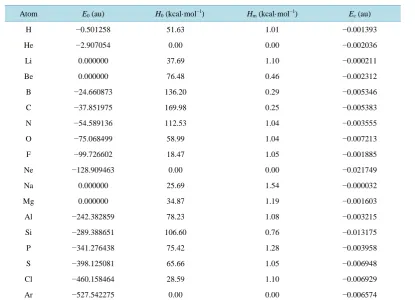
and ∆E (2df, p) will be removed from E0(DFT). According to the above corrections, Ec for the first and second row atoms are listed in Table 1.
A number of deficiencies in the method should be noted and future developments to alleviate them are pro-posed. In particular, this method works poorly on dissociation energies of ionic molecules such as LiF, on inor-ganic molecules such as CO2 (5.6 kcal·mol−1 too low), NH3 (3.7 kcal·mol−1 too large). Also, it works poorly on
the hypervalent species, such as -SO2 group and -NO2 group, where their energies are high by 19 - 21 kcal·mol−1
for the -SO2 group and low by 9 - 10 kcal·mol−1 for the -NO2 group. It was found that additional group
correc-tions might reduce discrepancy so that experimental values could be fitted perfectly.
Table 1. The atomic energies of the first row and the second row.
Atom E0 (au) H0 (kcal·mol−1) Hm (kcal·mol−1) Ec (au)
H −0.501258 51.63 1.01 −0.001393
He −2.907054 0.00 0.00 −0.002036
Li 0.000000 37.69 1.10 −0.000211
Be 0.000000 76.48 0.46 −0.002312
B −24.660873 136.20 0.29 −0.005346
C −37.851975 169.98 0.25 −0.005383
N −54.589136 112.53 1.04 −0.003555
O −75.068499 58.99 1.04 −0.007213
F −99.726602 18.47 1.05 −0.001885
Ne −128.909463 0.00 0.00 −0.021749
Na 0.000000 25.69 1.54 −0.000032
Mg 0.000000 34.87 1.19 −0.001603
Al −242.382859 78.23 1.08 −0.003215
Si −289.388651 106.60 0.76 −0.013175
P −341.276438 75.42 1.28 −0.003958
S −398.125081 65.66 1.05 −0.006948
Cl −460.158464 28.59 1.10 −0.006929
Ar −527.542275 0.00 0.00 −0.006574
E0: energy of each atom of the reactants (au); H0: the experimental heats of each atom of the reactants (kcal·mol−1); Hm: the
correc-tion value of the experimental heat of each atom of the reactants (kcal·mol−1); Ec: the correction energy (au).
directly. The ∆Hexp,0 and ∆Hatom can be obtained from correlative books [30]. The ∆Hf of a molecule at the level
B3LYP/cc-pVDZ can be calculated by Equation (1) via Equation (6).
3. Results and Discussion
In this work, 164 compounds are selected for testing. They are divided into four test sets: i) G2/97 test set, ii) CH test set, iii) NOS test set, and iv) LARGE test set.
3.1. G2/97 Test Set
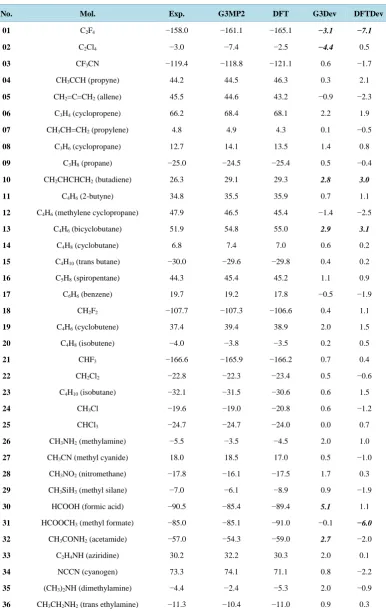
There are 70 neutral molecules in this test set. The structures are taken from Ref. [9]. All calculations are carried out using the GAUSSIAN 98 program package [31]. Density Function Theory has been applied to optimize the structures at basis set cc-pVDZ. The basis sets are the correlation-consistent basis sets of Dunning, specifically the polarized valence double-ζ (cc-pVDZ). The convergence criterion is 10−8. The optimized structures of the 70 species at the level B3LYP/cc-pVDZ and G3MP2 are shown in Table 2. The harmonic vibrational frequencies have been predicted in these optimized structures. All the vibrational frequencies of the molecules both at the levels B3LYP/cc-pVDZ and G3MP2 are positive (not listed). This indicates that the molecules are at a local minimum at the levels B3LYP/cc-pVDZ and G3MP2.
In Table 2, the experimental ∆Hf (Exp. column) are taken from Ref. [9]. Some values have been updated by
values from Ref. [30], such as the experimental value for 02 is changed from −118.4 kcal·mol−1 to −119.4 kcal·mol−1, for 48 from 8.9 kcal·mol−1 to 5.0 kcal·mol−1, etc.
It can be found that the DFT ∆Hf deviations from experiment in some molecules are comparatively high (It is
noted that the absolute ∆Hf deviations which are greater than 2.5 kcal·mol−1 are in bold and italic in Table 2 and
Table 2. The ∆Hf and the deviations from experiment of the 70 selected molecules of the G2/97 test set. All are in kcal·mol−1.
No. Mol. Exp. G3MP2 DFT G3Dev DFTDev
01 C2F4 −158.0 −161.1 −165.1 −3.1 −7.1
02 C2Cl4 −3.0 −7.4 −2.5 −4.4 0.5
03 CF3CN −119.4 −118.8 −121.1 0.6 −1.7
04 CH3CCH (propyne) 44.2 44.5 46.3 0.3 2.1
05 CH2=C=CH2 (allene) 45.5 44.6 43.2 −0.9 −2.3
06 C3H4 (cyclopropene) 66.2 68.4 68.1 2.2 1.9
07 CH3CH=CH2 (propylene) 4.8 4.9 4.3 0.1 −0.5
08 C3H6 (cyclopropane) 12.7 14.1 13.5 1.4 0.8
09 C3H8 (propane) −25.0 −24.5 −25.4 0.5 −0.4
10 CH2CHCHCH2 (butadiene) 26.3 29.1 29.3 2.8 3.0
11 C4H6 (2-butyne) 34.8 35.5 35.9 0.7 1.1
12 C4H6 (methylene cyclopropane) 47.9 46.5 45.4 −1.4 −2.5
13 C4H6 (bicyclobutane) 51.9 54.8 55.0 2.9 3.1
14 C4H8 (cyclobutane) 6.8 7.4 7.0 0.6 0.2
15 C4H10 (trans butane) −30.0 −29.6 −29.8 0.4 0.2
16 C5H8 (spiropentane) 44.3 45.4 45.2 1.1 0.9
17 C6H6 (benzene) 19.7 19.2 17.8 −0.5 −1.9
18 CH2F2 −107.7 −107.3 −106.6 0.4 1.1
19 C4H6 (cyclobutene) 37.4 39.4 38.9 2.0 1.5
20 C4H8 (isobutene) −4.0 −3.8 −3.5 0.2 0.5
21 CHF3 −166.6 −165.9 −166.2 0.7 0.4
22 CH2Cl2 −22.8 −22.3 −23.4 0.5 −0.6
23 C4H10 (isobutane) −32.1 −31.5 −30.6 0.6 1.5
24 CH3Cl −19.6 −19.0 −20.8 0.6 −1.2
25 CHCl3 −24.7 −24.7 −24.0 0.0 0.7
26 CH3NH2 (methylamine) −5.5 −3.5 −4.5 2.0 1.0
27 CH3CN (methyl cyanide) 18.0 18.5 17.0 0.5 −1.0
28 CH3NO2 (nitromethane) −17.8 −16.1 −17.5 1.7 0.3
29 CH3SiH3 (methyl silane) −7.0 −6.1 −8.9 0.9 −1.9
30 HCOOH (formic acid) −90.5 −85.4 −89.4 5.1 1.1
31 HCOOCH3 (methyl formate) −85.0 −85.1 −91.0 −0.1 −6.0
32 CH3CONH2 (acetamide) −57.0 −54.3 −59.0 2.7 −2.0
33 C2H4NH (aziridine) 30.2 32.2 30.3 2.0 0.1
34 NCCN (cyanogen) 73.3 74.1 71.1 0.8 −2.2
35 (CH3)2NH (dimethylamine) −4.4 −2.4 −5.3 2.0 −0.9
Continued
37 CH2O −26.2 −25.9 −28.7 0.3 −2.5
38 CH3CHO (acetaldehyde) −39.8 −38.9 −42.9 0.9 −3.1
39 HCOCOH (glyoxal) −50.7 −46.0 −52.9 4.7 −2.2
40 CH3CH2OH (ethanol) −56.2 −55.2 −55.1 1.0 1.1
41 CH3OCH3 (dimethylether) −44.0 −43.1 −46.6 0.9 −2.6
42 C2H4S (thiirane) 19.6 18.7 20.5 −0.9 0.9
43 (CH3)2SO (dimethyl sulfoxide) −36.2 −34.2 −35.7 2.0 0.5
44 C2H5SH (ethanethiol) −11.1 −10.8 −9.9 0.3 1.2
45 CH3SCH3 (dimethyl sulfide) −8.9 −8.9 −7.4 0.0 1.5
46 CH2=CHF (vinyl fluoride) −33.2 −34.0 −34.8 −0.8 −1.6
47 C2H5Cl (ethyl chloride) −26.8 −26.3 −27.6 0.5 −0.8
48 CH2=CHCl (vinyl chloride) 5.0 5.1 4.3 0.1 −0.7
49 CH2=CHCN (acrylonitrile) 43.2 45.0 43.7 1.8 0.5
50 CH3COCH3 (acetone) −51.9 −50.9 −54.6 1.0 −2.7
51 CH3COOH (acetic acid) −103.4 −101.9 −106.5 1.5 −3.1
52 CH3COF (acetyl fluoride) −106.7 −104.6 −108.5 2.1 −1.8
53 CH3COCl (acetyl chloride) −58.0 −57.4 −62.9 0.6 −4.9
54 CH3CH2CH2Cl (propyl chloride) −31.5 −31.4 −31.8 0.1 −0.3
55 (CH3)2CHOH (isopropanol) −65.2 −64.5 −63.5 0.7 1.7
56 C2H5OCH3 (methyl ethyl ether) −51.7 −51.4 −54.4 0.3 −2.7
57 (CH3)3N (trimethylamine) −5.7 −4.6 −7.4 1.1 −1.7
58 C4H4O (furan) −8.3 −7.7 −11.6 0.6 −3.3
59 C4H4S (thiophene) 27.5 26.1 31.6 −1.4 4.1
60 C4H5N (pyrrole) 25.9 27.0 24.0 1.1 −1.9
61 H2S −4.9 −4.9 −5.6 0.0 −0.7
62 CH4 −17.9 −17.3 −18.2 0.6 −0.3
63 HCN 31.5 31.8 31.7 0.3 0.2
64 CO −26.4 −26.8 −26.6 −0.4 −0.2
65 HCO −26.0 −25.9 −28.7 0.1 −2.7
66 ClH −22.1 −21.8 −22.8 0.3 −0.7
67 H3COH −48.0 −47.1 −47.0 0.9 1.0
68 C2H4 12.5 12.5 12.4 0.0 −0.1
69 C2H6 −20.1 −19.5 −21.0 0.6 −0.9
70 H2NNH2 22.8 25.9 24.2 3.1 1.4
Exp.: experimental ∆Hf taken form Ref. [30]; G3MP2: ∆Hf obtained at the level G3MP2; DFT: ∆Hf obtained at the level
B3LYP/cc-pVDZ; G3Dev: G3MP2 ∆Hf deviation from experiment; DFTDev: DFT ∆Hf deviation from experiment. Deviations
(−2.7 kcal·mol−1), 58 (−3.3 kcal·mol−1) and 65 (−2.7 kcal·mol−1). The 01 (C2F4) is a halide. As known,
Gaus-sian-n theory and other method work poorly on this species. For example, the calculated enthalpy of formation of C2F4 at G3 [9] is too negative by 4.9 kcal·mol−1, whereas at G3MP2 [10] is too negative by 3.1 kcal·mol−1.
Our method works poorly on the molecules 05, 10, which contain cumulated double-bond (-X=C=Y-) because the cumulated double-bond -X=C=Y- can also be written as >X-C≡Y. There should be different ∆Hf between
-X=C=Y- and >X-C≡Y. It can be found that the present method works poorly on the species which contain functional group >C=O. The calculated enthalpies of formation are underestimated too negative by 2.5 to 5.6 kcal·mol−1. The molecules 31, 37, 41, 50, 51, 53, 56, 58 and 65 belong to this category. It can also be found that the present method works poorly on the inorganic species. The molecules 01, 03 and 65 belong to this category. The sum of absolute deviation from experiment for the 70 calculated heats of formation is 110.1 kcal·mol−1. The average absolute deviation from experiment is about 1.6 kcal·mol−1.
The G3MP2 ∆Hf deviations of some molecules from experiment value are also comparatively high: 01 (−3.7
kcal·mol−1), 02 (−4.4 kcal·mol−1), 10 (2.8 kcal·mol−1), 13 (2.9 kcal·mol−1), 30 (5.1 kcal·mol−1), 32 (2.7 kcal·mol−1), 39 (4.7 kcal·mol−1) and 70 (3.1 kcal·mol−1). It can be found that G3MP2 does poorly on the halides, too. 01 and 02 belong to this category. G3MP2 also works poorly on the molecules which contain cumulated double-bond (-X=C=Y-), 01 (−0.9 kcal·mol−1) and 10 belong to this category. Both DFT and G3MP2 work poorly on the bicyclobutane (13 in Table 2). The sum of absolute deviation from experiment for the 70 calcu-lated heats of formation is only 78.6 kcal·mol−1. The average absolute deviation from experiment is about 1.1 kcal·mol−1.
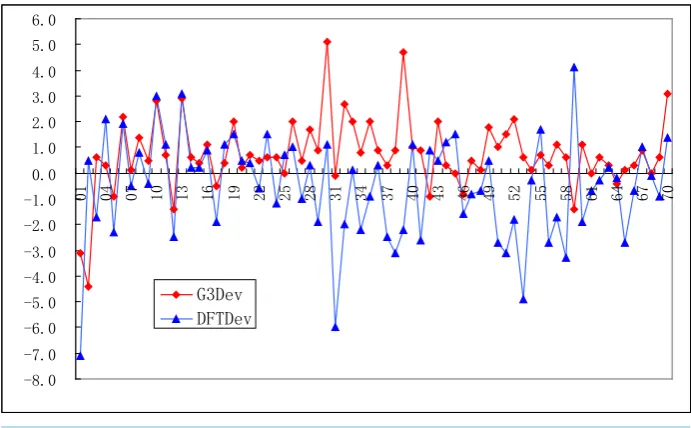
The G3MP2 ∆Hf deviations and the DFT ∆Hf deviations from experiment value are shown in Figure 1. It can
be found that the trends of the two lines are identical for the same molecule if the deviation is neglected. Most of the G3MP2 ∆Hf deviations from experiment are positive, while most of the DFT ∆Hf deviations from
experi-ment are negative.
It is noted that the molecule structures are taken from the original test set of G3 theory [9] (G2/97 test set), where a “higher level correction” (HLC) [9] is added to take into account some deficiencies in the energy calcu-lations.
( )
G3(
combined)
(
HLC)
Ee =E +E
[image:7.595.140.486.498.712.2]The HLC is −Anβ− B(nα− nβ) for molecules and −Cnβ− D(nα− nβ) for atoms (including atomic ions). The nβ and nα are the number of β and α valence electrons, respectively, with nα≥ nβ. The number of valence electron pairs corresponds to nβ. Thus, A is the correction for pairs of valence electrons in molecules, B is the correction for unpaired electrons in molecules, C is the correction for pairs of valence electrons in atoms, and D is the cor-rection for unpaired electrons in atoms. The use of different corcor-rections for atoms and molecules can be justified,
Figure 1. DFT ∆Hf and G3MP2 ∆Hf deviations from experiment of the G2/97 test set. -8.0
-7.0 -6.0 -5.0 -4.0 -3.0 -2.0 -1.0 0.0 1.0 2.0 3.0 4.0 5.0 6.0
01 04 07 10 13 16 19 22 25 28 31 34 37 40 43 46 49 52 55 58 61 64 67 70
in part, by noting that these extrapolations take some account of effects of basis functions with higher angular momentum, which are likely to be of more importance in molecules than in atoms. For G3 theory, A = 6.386 mhartrees, B = 2.977 mhartrees, C = 6.219 mhartrees, D = 1.185 mhartrees. The A, B, C, D values are chosen to give the smallest average absolute deviation from experiment for the G2/97 test set. Obviously, A, B, C and D are the fit parameters which are taken into account the electron structures of molecules in G2/97 test set, and in turn, they are used to calculate the energies of molecules in the same test set. That is, the precisions for calcula-tion energies, especially for the molecules in the test set, are improved by introducing the fit parameters A, B, C, D. In this circumstances, it is not strange that the average absolute deviation of G3MP2 ∆Hf from experiment is
less than that of DFT ∆Hf.
3.2. CH Test Set
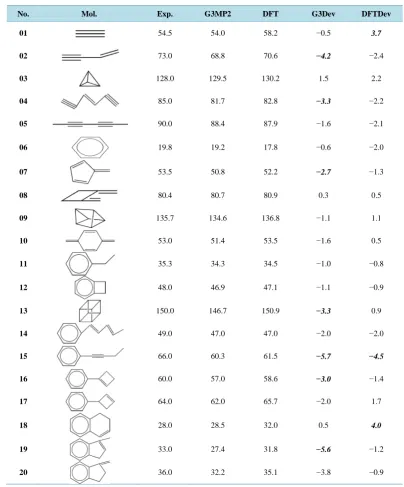
There are 20 neutral molecules which are all typical hydrocarbons in this test set. All calculations are carried out using the GAUSSIAN 98 program package. Density Function Theory (DFT) has been applied to optimize the structures at basis set cc-pVDZ. The optimized structures of the 20 species at the levels B3LYP/cc-pVDZ and G3MP2 are shown in Table 3. The harmonic vibrational frequencies have been predicted in these optimized structures. All the vibrational frequencies of the molecules both at the levels B3LYP/cc-pVDZ and G3MP2 are positive (not listed). This indicates that the molecules are at local minimum at the levels B3LYP/cc-pVDZ and G3MP2.
In Table 3, the experimental ∆Hf (Exp. column) are taken from Ref [30]. It can be found that the DFT ∆Hf
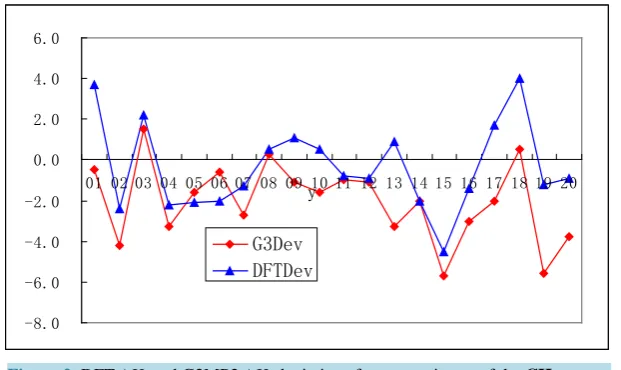
deviations of some molecules from experiment value are comparatively large: 01 (3.7 kcal·mol−1), 15 (−4.5 kcal·mol−1) and 18 (4.0 kcal·mol−1). For 01 and 18, both contain a functional group -C≡C-. It indicates that this method works poorly on the species. As is known, the isodesmic method for calculation does not incorporate the energy stabilization effect caused by conjugated bonds in polyene or aromatic compounds. It can also be found that the present method works poorly on polyene or aromatic species. The molecules 02, 03, 05, 15, 18 belong to conjugated category. The sum of absolute deviation from experiment for the 20 calculated heats of formation is 36.3 kcal·mol−1. The average absolute deviation from experiment is about 1.8 kcal·mol−1.
In this test set, the G3MP2 ∆Hf deviations of some molecules from experiment are also comparatively high: 02 (−4.2 kcal·mol−1), 04 (−3.3 kcal·mol−1), 13 (−3.3 kcal·mol−1), 15 (−5.7 kcal·mol−1), 16 (3.0 kcal·mol−1), 19 (−5.6 kcal·mol−1) and 20 (−3.8 kcal·mol−1). These results show that G3MP2 theory, which is known as the iso-desmic method, for calculation does not incorporate the energy stabilization effect caused by conjugated bonds in polyene or aromatic compounds. Whereas 02, 04, 013, 15, 16, 19, 20 belong to conjugated category. It can be found that the number of G3MP2 ∆Hf deviations is more than that of the DFT ∆Hf deviations. And comparing
the G3MP2 ∆Hf deviations and the DFT ∆Hf deviations, one can find that the former is higher than that of the
later. The sum of absolute deviation from experiment for the 20 calculated heats of formation is 45.4 kcal·mol−1. The average absolute deviation is about 2.3 kcal·mol−1.
The G3MP2 ∆Hf deviations and the DFT ∆Hf deviations from experiment are shown in Figure 2. It can be
found that the trends of the two lines are identical for the same molecule if the deviation sign is neglected. Most of the G3MP2 ∆Hf deviations from experiment are negative, while most of the DFT ∆Hf deviations from
expe-riment are possibly negative or positive. From the view of point of average absolute deviation from expeexpe-riment, DFT ∆Hf method is more preferable than the G3MP2 ∆Hf method in this test set.
3.3. NOS Test Set
There are 60 neutral molecules in this test set. All calculations are carried out using the GAUSSIAN 98 program package. Density Function Theory (DFT) has been applied to optimize the structures at basis set cc-pVDZ. The optimized structures of the 60 species at the levels B3LYP/cc-pVDZ and G3MP2 are shown in Table 4. The harmonic vibrational frequencies have been predicted in these optimized structures. All the vibrational frequen-cies of the molecules both at the level B3LYP/cc-pVDZ and G3MP2 are positive (not listed). This indicates that the molecules are at local minimum at B3LYP/cc-pVDZ and G3MP2.
In Table 4, the experimental ∆Hf (Exp. column) are taken from Ref [30]. In this test set, we selected some
typical molecules which contain special functional groups, such as -NO2, -SO2, -X=C=Y-, etc. The calculation
results show that each -NO2 group may be low by 9.6 kcal·mol−1, and each -SO2 group may be high by 20.0
Table 3. The ∆Hf and the deviations from experiment of the 20 molecules of the CH test set. All are in
kcal·mol−1.
No. Mol. Exp. G3MP2 DFT G3Dev DFTDev
01 54.5 54.0 58.2 −0.5 3.7
02 73.0 68.8 70.6 −4.2 −2.4
03 128.0 129.5 130.2 1.5 2.2
04 85.0 81.7 82.8 −3.3 −2.2
05 90.0 88.4 87.9 −1.6 −2.1
06 19.8 19.2 17.8 −0.6 −2.0
07 53.5 50.8 52.2 −2.7 −1.3
08 80.4 80.7 80.9 0.3 0.5
09 135.7 134.6 136.8 −1.1 1.1
10 53.0 51.4 53.5 −1.6 0.5
11 35.3 34.3 34.5 −1.0 −0.8
12 48.0 46.9 47.1 −1.1 −0.9
13 150.0 146.7 150.9 −3.3 0.9
14 49.0 47.0 47.0 −2.0 −2.0
15 66.0 60.3 61.5 −5.7 −4.5
16 60.0 57.0 58.6 −3.0 −1.4
17 64.0 62.0 65.7 −2.0 1.7
18 28.0 28.5 32.0 0.5 4.0
19 33.0 27.4 31.8 −5.6 −1.2
20 36.0 32.2 35.1 −3.8 −0.9
Exp.: experimental ∆Hftaken form Ref. [30]; G3MP2: ∆Hf obtained at the level G3MP2; DFT: ∆Hf obtained at the level
B3LYP/cc-pVDZ; G3Dev: G3MP2 ∆Hf deviation from experiment; DFTDev: DFT ∆Hf deviation from experiment.
group a molecule contains, and 20.0 kcal·mol−1 is subtracted from the DFT ∆Hf for each -SO2 group a molecule
contains. The listed DFT ∆Hf values in Table 4 are corrected by the two values, 9.6 kcal·mol−1 and 20.0
kcal·mol−1.
In Table 4, it can be found that the DFT ∆Hf deviations of some molecules from experiment are
[image:9.595.104.509.107.595.2]Table 4. The ∆Hf and the deviations from experiment of the 60 molecules of the NOS test set. All are in
kcal·mol−1.
No. Mol. Exp. G3MP2 DFT G3Dev DFTDev
01 CH3NO2 −17.9 −15.6 −17.5 2.3 0.4
02 CH3ONO −15.9 −13.3 −15.7 2.6 0.2
03 CH3ONO2 −29.5 −26.8 −25.8 2.7 3.7
04 (NH2)2CS 4.5 6.0 2.9 1.5 −1.6
05 CH3SiH3 −8.0 −6.1 −8.9 1.9 −0.9
06 111.0 117.5 111.5 6.5 0.5
07 HOOCCOOH −175.7 −169.5 −179.7 6.2 −4.0
08 CH2=C=S 39.0 45.3 45.3 6.3 6.3
09 CH3NHNH2 22.7 27.8 24.0 5.1 1.3
10 CH3NCO −31.0 −24.7 −32.6 6.3 −1.6
11 CH3NCS 31.0 29.7 25.3 −1.3 −5.7
12 CH3SCN 38.0 32.8 34.9 −5.2 −3.1
13 59.0 65.7 59.6 6.7 0.6
14 45.5 48.7 43.6 3.2 −1.9
15 NH2COCONH2 −95.0 −90.4 −96.5 4.6 −1.5
16 19.0 20.2 21.0 1.2 2.0
17 −7.0 −3.3 −7.2 3.7 −0.2
18 CH3COOH −103.3 −101.9 −106.5 1.4 −3.2
19 S=C=S 19.9 18.7 20.4 −1.2 0.5
20 C2H5NO2 −24.4 −22.8 −25.1 1.6 −0.7
21 NH2CH2COOH −92.0 −89.9 −94.2 2.1 −2.2
22 C2H5ONO −25.0 −21.5 −23.7 3.5 1.3
23 C2H5ONO2 −36.8 −35.1 −33.5 1.7 3.3
24 (CH3)2NNO 15.0 16.4 13.1 1.4 −1.9
25 (CH3S)2 −5.9 −5.8 −1.9 0.1 4.0
26 (CH3)2SO −36.2 −34.2 −35.7 2.0 0.5
27 (CH3)2SO2 −89.0 −84.5 −84.9 4.5 4.1
28 (CH3O)2SO −115.5 −106.3 −118.7 9.2 −3.2
29 (CH3O)2BH −138.8 −134.3 −143.4 4.5 −4.6
30 (CH3)2SiH2 −22.0 −20.7 −20.1 1.3 1.9
31 NCCN 73.3 74.5 71.1 1.2 −2.2
32 N≡C-S-S-C≡N 85.0 89.2 84.1 4.2 −0.9
33 CF2=C=CF2 −142.0 −131.8 −138.5 10.2 3.5
34 CH2(CN)2 63.5 62.1 60.8 −1.4 −2.7
[image:10.595.109.504.111.721.2]Continued
36 20.8 21.5 18.9 0.7 −1.9
37 40.0 37.5 41.3 −2.5 1.3
38 35.0 35.6 37.1 0.6 2.1
39 −29.0 −30.6 −27.1 −1.6 1.9
40 22.4 24.8 24.8 2.4 2.4
41 C2H5COOH −107.5 −106.1 −110.2 1.4 −2.7
42 HCOOC2H5 −92.0 −88.3 −94.7 3.7 −2.7
43 n-C3H7NO2 −29.7 −27.9 −29.1 1.8 0.6
44 i-C3H7NO2 −33.2 −31.7 −31.9 1.5 1.3
45 n-C3H7ONO −28.0 −26.6 −28.0 1.4 0.0
46 i-C3H7ONO −32.0 −30.8 −31.4 1.2 0.6
47 B(CH3)3 −28.0 −23.1 −27.9 4.9 0.1
48 12.5 - 9.1 0.0 −3.4
49 33.0 31.6 34.7 −1.4 1.7
50 96.0 93.8 99.4 −2.2 3.4
51 15.0 15.5 9.0 0.5 −6.0
52 21.0 21.6 19.6 0.6 −1.4
53 14.0 14.0 9.0 0.0 −5.0
54 14.0 14.0 9.1 0.0 −4.9
55 16.1 15.0 11.8 −1.1 −4.3
56 48.0 47.6 47.9 −0.4 −0.1
57 48.0 49.4 46.3 1.4 −1.7
58 52.0 50.9 49.6 −1.1 −2.4
59 85.0 84.9 83.7 −0.1 −1.3
60 64.0 65.0 66.0 1.0 2.0
Exp.: experimental ∆Hf taken form Ref. [30]; G3MP2: ∆Hf obtained at the level G3MP2; DFT: ∆Hf obtained at the level
Figure 2. DFT ∆Hf and G3MP2 ∆Hf deviations from experiment of the CH test set.
kcal·mol−1) and 55 (−4.3 kcal·mol−1). Among these molecules, 03, 23, 48, 51, 53, 54, 55 contain the -NO2 group, 27 and 28 contain the -SO2 group, and 07, 18, 41, 42 contain the -CO2 group, while 08, 11, 12, 33, 34 contain
the -X=C=Y- group. As mentioned above, the DFT ∆Hf method works poorly on these species. The sum of
ab-solute deviation from experiment for the 60 calculated heats of formation is 132.3 kcal·mol−1. The average ab-solute deviation is about 2.2 kcal·mol−1.
In this test set, the G3MP2 ∆Hf deviations of some molecules from experiment value are also comparative
high: For the molecules contain the -NO2 group, 02 (2.6 kcal·mol−1), 03 (2.7 kcal·mol−1) and 22 (3.5 kcal·mol−1);
for the molecules contain the -SO2 group, 17 (3.7 kcal·mol−1), 27 (4.5 kcal·mol−1), 28 (9.2 kcal·mol−1) and 32
(4.2 kcal·mol−1); for the molecules contain the -X=C=Y- group, 07 (6.2 kcal·mol−1), 08 (6.3 kcal·mol−1), 10 (6.3 kcal·mol−1), 12 (−5.2 kcal·mol−1), 33 (10.2 kcal·mol−1) and 35 (−4.7 kcal·mol−1); For the molecules contain the -CO2 group, 07 (6.2 kcal·mol−1), 15 (4.6 kcal·mol−1) and 42 (3.7 kcal·mol−1). Furthermore, the G3MP2 ∆Hf
deviations of polynitrogen compounds, 06 (6.5 kcal·mol−1), 09 (5.1 kcal·mol−1), 10 (6.3 kcal·mol−1), 13 (6.7 kcal·mol−1), 14 (3.2 kcal·mol−1), 15 (4.6 kcal·mol−1) and 32 (4.2 kcal·mol−1), and of boron compounds, 29 (4.5 kcal·mol−1) and 47 (4.9 kcal·mol−1), are high. These results show that G3MP2 theory works poorly on these species. The sum of absolute deviation from experiment for the 59 calculated heats of formation, wherein the molecule 48 cannot be calculated at G3MP2, is 157.0 kcal·mol−1. The average absolute deviation from experi-ment for the 59 calculated G3MP2 ∆Hf is 2.7 kcal·mol−1.
The G3MP2 ∆Hf deviations and the DFT ∆Hf deviations from experiment value are shown in Figure 3. It can
be found that most of the G3MP2 ∆Hf deviations from experiment value are positive, while most of the DFT ∆Hf deviations from experiment value are possibly negative or positive. From the judgment of average absolute
deviation from experiment value, the DFT ∆Hf method is more preferable than that of G3MP2 ∆Hf method in
the test set because the average absolute deviation from experiment of the DFT ∆Hf is lower than that of the
G3MP2 ∆Hf.
The sum of the absolute deviations from experiment is 278.7 for the above 150 calculated DFT ∆Hf. While
the sum of the absolute deviations from experiment is 281.0 for the above 149 calculated G3MP2 ∆Hf. Both of
the average absolute deviations are about 1.9 kcal·mol−1 (1.89 kcal·mol−1 for G3MP2 theory, 1.86 kcal·mol−1 for DFT method). The average absolute deviation of G3MP2 theory for the 70 molecules in G2/97 test set is only 1.1 kcal·mol−1, while the average absolute deviations of the remaining two test sets are very high (2.3 kcal·mol−1 for CH test set, and 2.7 kcal·mol−1 for NOS test set) because the former is the original test set while the later are not. Whereas, the average absolute deviations of DFT method the results are from 1.6 kcal·mol−1 to 2.2 kcal·mol−1 for all the three test sets. By taking this into account, we can conclude that the DFT method is the same effective as the G3MP2 theory in predication of ∆Hf of compounds.
3.4. LARGE Test Set
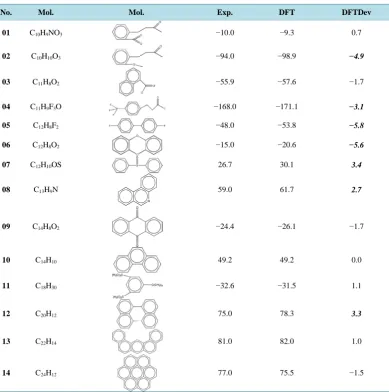
There are 14 neutral molecules in this test set. All calculations are carried out using the GAUSSIAN 98 program package. DFT has been applied to optimize the structures at basis set cc-pVDZ. The optimized structures of the
-8.0 -6.0 -4.0 -2.0 0.0 2.0 4.0 6.0
01 02 03 04 05 06 07 08 09 10 11 12 13 14 15 16 17 18 19 20
G3Dev DFTDev
Figure 3. DFT ∆Hf and G3MP2 ∆Hf deviations from experiment of the NOS test set.
Table 5. The ∆Hf and the deviations from experiment of the 14 molecules of the LARGE test set. All are in
kcal·mol−1.
No. Mol. Mol. Exp. DFT DFTDev
01 C10H9NO3 −10.0 −9.3 0.7
02 C10H10O3 −94.0 −98.9 −4.9
03 C11H8O2 −55.9 −57.6 −1.7
04 C11H9F3O −168.0 −171.1 −3.1
05 C12H8F2 −48.0 −53.8 −5.8
06 C12H8O2 −15.0 −20.6 −5.6
07 C12H10OS 26.7 30.1 3.4
08 C13H9N 59.0 61.7 2.7
09 C14H8O2 −24.4 −26.1 −1.7
10 C14H10 49.2 49.2 0.0
11 C18H30 −32.6 −31.5 1.1
12 C20H12 75.0 78.3 3.3
13 C22H14 81.0 82.0 1.0
14 C24H12 77.0 75.5 −1.5
Exp.: experimental ∆Hf taken form Ref. [30]; DFT: ∆Hf obtained at the level B3LYP/cc-pVDZ; DFTDev: DFT ∆Hf deviation from
experiment.
-8.0 -6.0 -4.0 -2.0 0.0 2.0 4.0 6.0 8.0 10.0 12.0
0
1 04 07 10 13 16 19 22 25 28 31 34 37 40 43 46 49 52 55 58
[image:13.595.116.506.307.700.2]14 species at the level B3LYP/cc-pVDZ are shown in Table 5. The harmonic vibrational frequencies have been predicted in these optimized structures. All the vibrational frequencies of the molecules at the level B3LYP/cc- pVDZ are positive (not listed). This indicates that the molecules are at local minimum at the level B3LYP/cc- pVDZ.
In Table 5, the experimental ∆Hf (Exp. column) are taken from Ref. [30]. In this test set, we selected some
medium-sized and large-sized molecules, of which the calculation of heats of formation of these molecules us-ing G3 or G3MP2 theory is much difficult, even impossible.
From Table 5, it can be found that the DFT ∆Hf deviations of some molecules from experiment value are
comparative large: 02 (−4.9 kcal·mol−1), 04 (−3.1 kcal·mol−1), 05 (−5.8 kcal·mol−1), 06 (−5.6 kcal·mol−1), 07 (3.4 kcal·mol−1), 08 (2.7 kcal·mol−1) and 12 (3.3 kcal·mol−1). Among them, the deviations of the molecules 04 and 05 are mainly caused by the halogen atoms in the molecules. While the deviations of the molecules 02 and 06 are mainly caused by the -CO2 group. The sum of absolute deviation from experiment for the 14 calculated
heats of formation is 36.5 kcal·mol−1. The average absolute deviation from experiment for the 14 calculated heats of formation is about 2.6 kcal·mol−1. It seems that the average absolute deviation is comparatively high in this test set. However, the high absolute deviation 5.8 kcal·mol−1, for example in 05, is acceptable because the molecules are the medium-sized and large-sized.
4. Conclusion
In this work, we have developed a method for calculating the heats of formation of medium-sized and large- sized molecules. This method has the following characteristics: i) The calculation formula for the heats of for-mation is derived from the famous G3 and G3MP2 theory. The atomic energies are obtained from the calculated results. There are no empirical parameters or fit parameters to be introduced to eliminate the deficiencies in the calculation of the heats of formation except the corrections of the chemical functional groups -NO2 and -SO2. ii)
The average absolute deviation from experiment for the 150 calculated DFT ∆Hf is 1.5 kcal·mol−1. While the
average absolute deviation from experiment for the 149 calculated G3MP2 ∆Hf is 1.7 kcal·mol−1. The average
absolute deviation from experiment for the whole 164 calculated DFT ∆Hf is also 1.9 kcal·mol−1. The G3MP2 ∆Hf and DFT ∆Hf can be used to predict the heats of formation when the experimental data are unknown or
un-certain. iii) The present method can be applied to predict the heats of formation of medium-sized and large-sized molecules. The heats of formation of a molecule containing 100 up to 200 heavy atoms can be calculated by this method. Under economical consideration, this method is expected to impact the applications in the calculations of heats of formation of large-sized molecules.
References
[1] Curtiss, L.A., Raghavachari, K., Trucks, G.W. and Pople, J.A. (1991) Gaussian-2 Theory for Molecular Energies of First- and Second-Row Compounds. Journal of Chemical Physics, 94, 7221-7230. http://dx.doi.org/10.1063/1.460205
[2] Curtiss, L.A. and Raghavachari, K. (1995)In: Langhoff, S.R., Ed., Quantum Mechanical Electronic Structure Calcula-tions with Chemical Accuracy, Kluwer Academic, Netherlands, 139.
[3] Pople, J.A., Head-Gordon, M., Fox, D.J., Raghavachari, K. and Curtiss, L.A. (1989) Gaussian-1 Theory: A General Procedure for Prediction of Molecular Energies. Journal of Chemical Physics, 90, 5622-5629.
http://dx.doi.org/10.1063/1.456415
[4] Curtiss, L.A., Jones, C., Trucks, G.W., Raghavachari, K. and Pople, J.A. (1990) Gaussian-1 Theory of Molecular Energies for Second-Row Compounds. Journal of Chemical Physics, 93, 2537-2545.
http://dx.doi.org/10.1063/1.458892
[5] Curtiss, L.A., Raghavachari, K., Redfern, P.C. and Pople, J.A. (1997) Assessment of Gaussian-2 and Density Func-tional Theories for the Computation of Enthalpies of Formation. Journal of Chemical Physics, 105, 1063-1079. http://dx.doi.org/10.1063/1.473182
[6] Curtiss, L.A., Redfern, P.C., Raghavachari, K. and Pople, J.A. (1998) Assessment of Gaussian-2 and Density Func-tional Theories for the Computation of Ionization Potentials and Electron Affinities. Journal of Chemical Physics, 109, 42-55. http://dx.doi.org/10.1063/1.476538
[7] Lau, C.-K., Li, W.-K., Wang, X., Tian, A.M. and Wong, N.B. (2002) A Gaussian-3 Study of N7+ and N7− Isomers. Journal of Molecular Structure (THEOCHEM), 617, 121-131. http://dx.doi.org/10.1016/S0166-1280(02)00411-6
1, 810-825.
[9] Curtiss, L.A., Raghavachari, K., Redfern, P.C., Rassolov, V. and Pople, J.A. (1998) Gaussian-3 (G3) Theory for Mo-lecules Containing First and Second-Row Atoms. Journal of Physical Chemistry, 109, 7764-7775.
http://dx.doi.org/10.1063/1.477422
[10] Curtiss, L.A., Redfern, P.C., Raghavachari, K., Rassolov, V. and Pople, J.A. (1999) Gaussian-3 Theory Using Reduced Moller-Plesset Order. Journal of Chemical Physics, 110, 4703-4709. http://dx.doi.org/10.1063/1.478385
[11] Haworth, N.L. and Bacskay, G.B. (2002) Heats of Formation of Phosphorus Compounds Determined by Current Me-thods of Computational Quantum chemistry. TheJournalofChemicalPhysics, 117, 11175-11187.
http://dx.doi.org/10.1063/1.1521760
[12] Gong, X.D., Zhang, J. and Xiao, H.M. (1999) Studies on the Synthesis of (2S,3R)-3-Hydroxy-3-Methylproline via C-2-N Bond Formation. Proceedingsofthe 26th InternationalPyrotechnicsSeminar, 136.
[13] Chen, Z.X., Xiao, J.M., Xiao, H.M. and Chiu, Y.N. (1999) Studies on Heats of Formation for Tetrazole Derivatives with Density Functional Theory B3LYP Method. TheJournalofChemicalPhysics, 103, 8062-8066.
http://dx.doi.org/10.1021/jp9903209
[14] Hehre, W.J. (1995) Practical Strategies for Electronic Structure Calculation. Wavefunction, Inc., Irvine, 102-134.
[15] Xu, X.J., Xiao, H.M., Ma, X.F. and Ju, X.H. (2006) Looking for High-Energy Density Compounds among Hexaazaa-damantane Derivatives with Bond CN, Bond NC, and Bond ONO2 Groups. InternationalJournalofQuantum Chemi-stry, 106, 1561-1568. http://dx.doi.org/10.1002/qua.20909
[16] Wang, G.X., Gong, X.D. and Xiao, H.M. (2009) Theoretical Investigation on Density, Detonation Properties, and Py-rolysis Mechanism of Nitro Derivatives of Benzene and Aminobenzenes. InternationalJournalofQuantumChemistry,
109, 1522-1530. http://dx.doi.org/10.1002/qua.21967
[17] Ruzsinszky, A., van Alsenoy, C. and Csonka, G.I. (2002) Optimal Selection of Partial Charge Calculation Method for Rapid Estimation of Enthalpies of Formation from Hartree-Fock Total Energy. TheJournalofPhysicalChemistry, 106, 12139-12150. http://dx.doi.org/10.1021/jp026913s
[18] Duan, X.M., Song, G.L., Li, Z.H., Wang, X.J., Chen, G.H. and Fan, K.N. (2004) Accurate Prediction of Heat of For-mation by Combining Hartree-Fock/Density Functional Theory Calculation with Linear Regression Correction Ap-proach. TheJournalofChemicalPhysics, 121, 7086-7095. http://dx.doi.org/10.1063/1.1786582
[19] Jursic, B.S. (2003) Density Functional Calculation of the Heats of Formation for Various Aromatic Nitro Compounds. JournalofMolecularStructure (THEOCHEM), 634, 215-224. http://dx.doi.org/10.1016/S0166-1280(03)00345-2
[20] Chen, P.C., Chieh, Y.C. and Tzeng, S.C. (2000) Computing Heats of Formation for Cubane and Tetrahrane with Den-sity Functional Theory and Complete Basis Set ab Initio Methods. JournalofMolecularStructure (THEOCHEM), 499, 137-140. http://dx.doi.org/10.1016/S0166-1280(99)00293-6
[21] Dunning, T.H. (1989) Gaussian Basis Sets for Use in Correlated Molecular Calculations. I. The Atoms Boron through Neon and Hydrogen. TheJournalofChemicalPhysics, 90, 1007-1023. http://dx.doi.org/10.1063/1.456153
[22] Peterson, K.A., Woon, D.E. and Dunning Jr., T.H. (1994) Benchmark Calculations with Correlated Molecular Wave Functions. IV. The Classical Barrier Height of the H + H2→ H2 + H Reaction. TheJournalofChemicalPhysics, 100, 7410-7415. http://dx.doi.org/10.1063/1.466884
[23] Wilson, A., van Mourik, T. and Dunning Jr., T.H. (1997) Gaussian Basis Sets for Use in Correlated Molecular Calcula-tions. VI Sextuple Zeta Correlation Consistent Basis Sets for Boron through Neon. JournalofMolecularStructure (THEOCHEM), 388, 339-349. http://dx.doi.org/10.1016/S0166-1280(96)80048-0
[24] Davidson, E.R. (1996) Comment on “Comment on Dunning’s Correlation-Consistent Basis Sets”. ChemicalPhysics Letters, 220, 514-518. http://dx.doi.org/10.1016/0009-2614(96)00917-7
[25] Berry, R.J., Burgess Jr., D.R.F., Nyden, M.R., Zacharian, M.R., Melius, C.F. and Schwarz, M. (1996) Halon Thermo-chemistry: Calculated Enthalpies of Formation of Chlorofluoromethanes. The Journal ofPhysical Chemistry, 100, 7405-7410.
[26] Raghavachari, K., Stefanov, B.B. and Curtiss, L.A. (1997) Accurate Thermochemistry for Larger Molecules: Gaus-sian-2 Theory with Bond Separation Energies. TheJournalofChemicalPhysics, 106, 6764-6767.
http://dx.doi.org/10.1063/1.473659
[27] Baboul, A.G., Curtiss, L.A., Redfern, P.C. and Raghavachari, K. (1999) Gaussian-3 Theory Using Density Functional Geometries and Zero-Point Energies. TheJournalofChemicalPhysics, 110, 7650-7657.
http://dx.doi.org/10.1063/1.478676
[28] Zhou, H.W., Wong, N.B., Zhou, G. and Tian, A.M. (2006) Theoretical Study on “Multilayer” Nitrogen Cages. The JournalofPhysicalChemistryA, 110, 3845-3852. http://dx.doi.org/10.1021/jp056435w
JournalofPhysicalChemistryA, 110, 7441-7446. http://dx.doi.org/10.1021/jp062214u
[30] Lias, S.G., Bartmess, J.E., Liebman, J.F., Holmes, J.L., Levin, R.D. and Mallard, W.G. (1988) Gas-Phase Ion and Neu-tral Thermochemistry. JournalofPhysicalandChemicalReferenceData, 17.