A Computational Study for the Graph-Theoretic Version
of the Union-Closed Sets Conjecture
M. I. Moussa
Computer Science Department, Faculty of Computers & Information, Benha University, Benha, Egypt,
E. M. Badr
Department of scientific computing, Faculty of Computers & Information, Benha University, Benha, Egypt,
ABSTRACT
An induced subgraph S of a graph G is called a derived subgraph of G if S contains no isolated vertices. An edge e of G is said to be residual if e occurs in more than half of the derived subgraphs of G. We prove some theorems which calculate the number of derived subgraphs for some special graphs. We also present a new algorithm SDSA that calculates the number of derived subgraphs for a given graph G and determines the residual and non-residual edges. Finally, we introduce a computational study which supports our results.
Keywords
Union closed sets conjecture, induced graphs, derived subgraphs.
1. INTRODUCTION
A union-closed family of sets A is a finite collection of sets not all empty such that the union of any two members of A is also a member of A . The following Conjecture is due to Peter Frankl [1, 2, 3].
Conjecture1. Let A = { A1, A2, . . . , An } be a union-closed family of n distinct sets. Then there exists an element which belongs to at least n / 2 of the sets in A.
Let A =
A
i. If we replace each set Ai by Bi = A - Ai then we get an intersection-closed family of sets, which we call the dual family of A. Therefore Conjecture 1 is equivalent to the following.Conjecture2. Let B = { B1, B2, . . . , Bn } be an intersection-closed family of n distinct sets. Then there exists an element which belongs to at most n / 2 of the sets in B .
[image:1.595.323.537.281.357.2] [image:1.595.378.476.444.544.2]An induced subgraph S of a graph G is called a derived subgraph of G if S contains no isolated vertices. An edge e of G is said to be residual if e occurs in more than half of the derived subgraphs of G otherwise e is non-residual. Let D(G) denote the set of derived subgraphs of G and put nd(G) = |D(G)|. A graph-theoretic version of the union-closed sets conjecture due to El-Zahar [4]. He formulated a weaker version of Conjecture 1 specialized for graphs as the following.
Conjecture 3. Every empty graph contains a non-residual edge.
Example 1. The derived subgraphs of C6 are , C6 and the subgraphs S1, S2, … , S5 together with their cyclic
permutations as shown in Figure 1. In all, we have nd(C6 ) = 29 ( compare to 64 induced subgraphs of C6 ). Each edge of C6 is contained in exactly 12 derived subgraphs and, therefore, is non-residual.
v1
v2
v3
v4
v5
v6
v2
v1 v1
v2
v3 v1 v3
v2 v4
v1 v3 v5
v2 v4
v1
v2v5
v4
C6
S1 S2 S3 S4 S5
Fig.1: Derived Subgraphs of C6
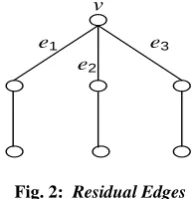
Example 2. Consider the graph G1 of Figure 2. This graph has nd(G1) = 34. Each of the edges e1, e2, e3 occur in 18 derived subgraphs so that it is residual. The remaining edges are non-residual belonging only to 13 derived subgraphs.
v
e1 e3
e2
Fig. 2: Residual Edges
B. Llano et al proved that the every simple graph with at least one edge contains a non-residual edge (Conjecture 3) [5]. In this work, our aim is to introduce a computational study for derived subgraphs.
In Section 2, we prove some theorems which calculate the number of derived subgraphs for some special graphs. In Section 3, we present a new algorithm SDSA that calculates the number derived subgraphs for a given graph G and determines the residual and non-residual edges. In Section 4 we give a computational study which supports our results. Finally, we give our conclusions and discuss possible extensions of the algorithm.
2. THE MAIN RESULTS
Theorem 1. Let Pn be the path v1, v2, v3, …, vn . Then the number of derived subgraphs of Pn is given by the following relation :
1 2 3
1 0,1
( ) 2 2
2 ( ) ( ) ( ) 3
d n
d n d n d n
if n
n P if n
n P n P n P if n
(1)
Proof. We prove this theorem by the Principle of Mathematical Induction. The proof will now proceed in two steps : the initial step and the inductive step.
Initial Step. It is clear that the statement (1) is true for n = 0, 1, 2.
Inductive Step. Here we must prove that the following assertion: " If there is a positive integer k such thatn Pd( k)=
1 2 3
2n Pd( k)n Pd( k)n Pd( k) is true then
1 1 2
( ) 2 ( ) ( ) ( )
d k d k d k d k
n P n P n P n P is true. Thus, we assume there is a positive integer k such that
1 2 3
( ) 2 ( ) ( ) ( )
d k d k d k d k
n P n P n P n P (2)
Since n Pd( k) is the number of all derived subgraphs of Pk so by adding one vertex vk+1 to the relation ( 2 ), we will
1
( )
d k
n P as follows:
1
( { })
d k k
n P v =
1 1 2 1 3 1
2n Pd( k {vk})n Pd( k {vk})n Pd( k {vk}) then n Pd( k1)2n Pd( k)n Pd( k1)n Pd( k2)so the relation
( 1 ) is true for n
0. ■Theorem 2 . Let Cn be a cycle on n 3 vertices. Then the number of derived subgraphs of Cn is given by the relation :
3
1 2
2
( ) = ( ) 2( 1) ( )
n
d n d n d n i
i
n C n P n n P
.Proof. Let Cn be the cycle v1, v2, . . . , vn, v1 . Let x1 denote the number of derived subgraphs of Cn not containing v1, then x1 = n Pd( n1). On the other hand, let x2 denote the number of derived subgraphs which contain v1 . Such a derived subgraph contains a path Pi of length ( i – 1 ) that contains v1 and a derived subgraph of path Pi of order ( n – i – 2 ), where 2 i n 1. Then for fixed i this number is in Pd( n i 2).
Thus
3
2 2
2
( ) ( 2) ( 1)
n
d n i i
x i n P n n
Moreover Cn is a derived subgraph of itself, therefore n Cd( n) = x1 + x2 + 1 so
3
1 2
2
( ) ( ) 2( 1) ( )
n
d n d n d n I
i
n C n P n i n P
■Theorem 3. Let G(n, n) be a bipartite graph with two partitioning sets V1 and V2, where |V1| = |V2| = n and deg(v) = n – 1 for each v
V( G(n, n ) ). Then the number of derivedsubgraphs of G(n, n) ) is given by the relation : ( ( , ))
d
n G n n = 2 1
2n 2 2n 2n
n n
, and each edge
uv
E ( G(n,n) ) is contained in exactly 2n-1(2n-1 -1 ) derived subgraphs.Proof. Let V1= v1, v2, . . . , vn and V2 = u1, u2, . . . , un where uivi E( G(n, n ) ) for each i = 1, 2, . . . , n.
To form a derived subgraph, we take S1S2 where Si Vi for i = 1, 2. If |S1| 2 and |S2| 2 then we get a derived subgraph.
If |S1| =1, say, S1 = vi then
S2V2\ { }ui . This showsthat
( ( , )) d
n G n n = 2
(2n 1) 1 2 (2n 1)
n n
Now we fix an i = 1, 2, . . . , n. We count the number of derived subgraphs which contain the edge v1ui . Such derived subgraph will have the form S1S2 where v1S1V1. Again if |S1| 2 and |S2| 2 then we have a derived subgraph.
If, say S1 = {v1} then u1S2. This shows that the number of derived subgraphs which contain viui is equal to
1 2 2 2 2 1
(2n 1) 2(2n ) 1 2n 2n .■
3. THE SERIAL DERIVED SUBGRAPH
ALGORITHM
In this Section, we introduce a serial derived subgraphs algorithm SDSA which calculates the number of derived subgraphs for a given graph G . The algorithm also determines the residual and non-residual edges. The parameters of the algorithm are :
A[i, j] : the adjacency matrix of G. S [i] : all of the subsets of V(G).
(i,j) : the entry of the matrix E(i,j) which is equal to the number of derived subgraphs that contain vivj . total : the number of all derived subgraphs of G.
Let G be a graph which has n vertices and m edges. We can represent the graph G by the Adjacency-Graph class, where a[i][j] is the entry element (i,j) in the adjacency matrix A. The algorithm finds all subsets of the vertex set V(G); then it checks if the current subset induces a derived subgraph or not. The algorithim finds the number of derived subgraphs that contain any edge e
E(G).Our main algorithm SDSA calls three procedures Initialize-Subset, Get-Next-Subset and Check-Subset as follows:
Algorithm 1: A serial derived subgraphs algorithm SDSA
Input : A[i][j] the adjacency matrix of G.
1: Call Algorithm2 ( Initialize-Subset ) 2: while Not Done do
3: Call Algorithm3 ( Get-Next-Subset ) 4: Call Algorithm4 ( Check-Subset ) 5: if DERIVED then
6: total
total + 17: for i=1
n do8: for j=i+1
n do9: if S[i] = S[j] = 1 then
10: E[i,j]
E[i,j] + 111: endif
12: endfor
13: end for
14: endif
15: end while
16: Return total
17: For each e =(vi, vj) if E[i,j] > total / 2 the edge e is residual otherwise is non-residual.
The Initialize-Subset procedure initializes the initial subset of V(G) as array S[j] = 0. The subgraph induced by the initial S is the empty derived subgraph. We outline below the initialize-Subset procedure which considers the empty subgraph as the first derived one.
Algorithm 2: Initialize-Subset
1: Take the empty set to be the initial subset S 2: Set the value of total = 1
3: For every edge e = ( i, j ) let E[i,j] = 0 4: Done
FalseThe Get-Next-Subset procedure generates all subsets of V(G) by the method is known as
a binary counting representation.
Algorithm 3: Get-Next-Subset 1: j
n + 12: repeat
3: j
j – 14: until (( S[j] = 0) or ( j = 0) 5: if j
0 then6: S[j]
1 7: MAX
j8: for i= MAX +1
n do9: S[i] = 0
10: end for
11: else
12: Done
True 13: end ifThe Check-Subset verifies the current subset S as a derived subgraph or not. A precise description of this process is the following.
Algorithm 4: Check-Subset 1: DERIVED
False 2: count
13: for k = 1
n do4: if S[k] = 1 then
5: sum = 0
6: for j = 1
n do7: sum = sum + a[k][j] *S[j]
8 : if sum
0 then9: sum
110: count
count * sum11: endif
12: endfor
13: endif
14: endfor
15: if count
0 then4- COMPLEXITY ANALYSIS AND
COMPUTATIONAL RESULTS
The SDSA algorithm can be shown to run in O(n2n) time where n is the number of vertices in the given graph G. There are 2n subsets of V(G). We check every one by calling Algorithm 4 (Check-Subset). The Algorithm 3 ( Get-Next-Subset ) requires O(n) time. We need exactly 2n-1 calls of Algorithm 3 (Get-Next-Subset), each one runs in O(n) time. Then the total running time of SDSA algorithm is O(n2n) sequential time.
The algorithm describe in Section 3 has been experimentally implemented. In this Section, the numerical experiments are presented. It must be mentioned that the computational results demonstrates the number of derived subgraphs and its residual edges for some special graphs.
Our numerical experiments were performed on a PC with 2.000 MHz Pentium 4 processor, RAM 512 Mb and windows XP operating system. Our implementation was done under the C environment.
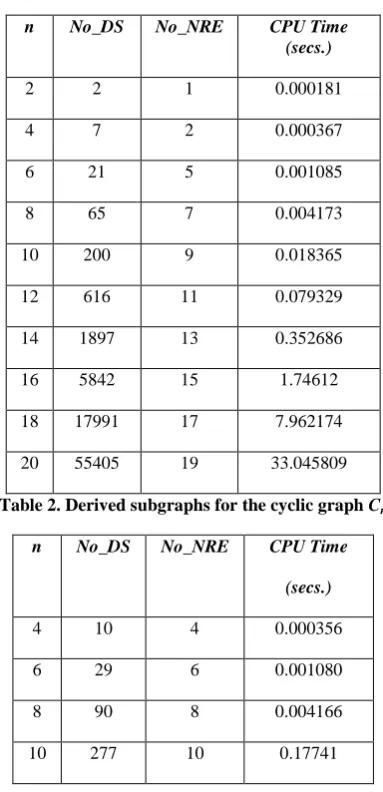
Columns of the following tables contain problems size n and
[image:4.595.335.521.71.177.2]m, number of all derived subgraphs No_DS, number of all non-residual edges No_NREand the running time CPU Time (secs.).
Table 1. Derived subgraphs for the path graph Pn
n No_DS No_NRE CPU Time
(secs.)
2 2 1 0.000181
4 7 2 0.000367
6 21 5 0.001085
8 65 7 0.004173
10 200 9 0.018365
12 616 11 0.079329
14 1897 13 0.352686
16 5842 15 1.74612
18 17991 17 7.962174
20 55405 19 33.045809
Table 2. Derived subgraphs for the cyclic graph Cn
n No_DS No_NRE CPU Time
(secs.)
4 10 4 0.000356
6 29 6 0.001080
8 90 8 0.004166
10 277 10 0.17741
12 853 12 0.079052
14 2627 14 0.355268
16 8090 16 1.593558
18 24914 18 7.371244
[image:4.595.332.527.217.438.2]20 76725 20 33.170715
Table 3. Derived subgraphs for the complete graph Kn
n No_DS No_NRE CPU Time
(secs.)
4 12 6 0.000358
6 58 15 0.001103
8 248 28 0.004330
10 1014 45 0.018671
12 4084 66 0.084653
14 16370 91 0.387049
16 65520 120 1.754086
[image:4.595.70.262.370.767.2]18 262126 153 8.062705 20 1048556 190 37.126845
Table 4. Derived subgraphs for the complete bipartite graph Km,n
m n No_DS No_NRE CPU Time
(secs.)
1 1 2 1 0.000185
2 2 10 4 0.000365
3 3 50 9 0.001098
4 4 226 16 0.004296
5 5 962 25 0.018593
6 6 3970 36 0.084717
[image:4.595.335.524.486.730.2]0 5 10 15 20 0
10 20 30 40
Problem Size
C
P
U
T
im
e
(
s
e
c
s
)
[image:5.595.81.254.76.205.2]Derived subgraphs for the path graph Pn.
Fig.3: Executable time for Pngraph by SDSA
0 5 10 15 20
0 10 20 30 40
Problem Size
C
P
U
T
im
e
(
s
e
c
s
)
[image:5.595.340.517.79.218.2]Derived subgraphs for the cyclic graph C(n)
Figure 4. Executable time for Cngraph by SDSA
0 5 10 15 20
0 10 20 30 40
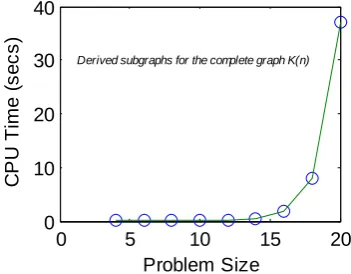
Derived subgraphs for the complete graph K(n)
Problem Size
C
P
U
T
im
e
(
s
e
c
s
)
Figure 5. Executable time for Kngraph by SDSA
0 5 10 15 20
0 10 20 30 40
Problem Size
C
P
U
T
im
e
(
s
e
c
s
)
[image:5.595.80.256.262.398.2]Derived subgraphs for K(n,m).
Figure 6. Executable time for Kn,mgraph by SDSA
From the above Tables, we can note that every graph for any size contains a non-residual edge (Conjecture 3 ) while from the above Plots, we can see that the running time of the algorithm SDSA increases as an exponential time in the problem size n.
5. CONCLUDING REMARKS
In this workwe proved some theorems which calculate the number of derived subgraphs for some special graphs. We also presented a new algorithm SDSA that calculates the number of derived subgraphs for a given graph G and determines the residual and non-residual edges. Finally, we introduced a computational study which supports our results. Our algorithm SDSA has O(n2n) sequential time so there is room for its further improvement as an sequential or parallel algorithm. These possible improvements will be the subject of our future work.
6. REFERENCES
[1] I. Rival (Ed.), Graphs And Order, Reidel, Dordrecht-Boston,(1985), p.25.
[2] R. P. Stanley, Enumerative Combinatorics, vol. I, Wadsworth & Broks/Cole, Belmont, CA, (1986). [3] B. Poonen, Union-Closed Families, J. Combin. Theory, A
59 (1992), 253-268.
[4] M. H. El-Zahar , A Graph-Theoretic Version Of The Union-Closed Sets Conjecture, J.Graph Theory 26 (1997), no. 3, 155-163.
[5] B. Llano, J. Montellano-Ballesteros, E. Rivera-Campo and R. Strauz " On Conjecture of Frankl and El-Zahar" J. Graph Theory 57: 344-352 (2008).
[image:5.595.79.255.443.580.2]