Journal of Chemical and Pharmaceutical Research, 2013, 5(12):290-295
Research Article
CODEN(USA) : JCPRC5
ISSN : 0975-7384
Experimental study of aerobics teaching effectiveness based on
additive cyclic method
Wei Gao
Physical Education Department, Wuhan University of Science and Technology, Wuhan, China
_____________________________________________________________________________________________ABSTRACT
Aerobics has a good effect on female physical health and body shape. This paper analyzes the teaching objectives of female aerobics and explores the teaching efficiency of additive cyclic method teaching mode. This paper analyzes the teaching objectives of female aerobics and the teaching efficiency of additive cyclic method teaching mode, and then use the comparative analysis method to design traditional teaching experiment of the control group and additive cyclic teaching experiment of the experimental group and collect technical features and statistics feature of motion self-confidence, based on which can we analyze the superiority of additive cyclic teaching method’s teaching effectiveness. The experimental results in this paper show that the additive cyclic teaching method has many advantages and it is a very good teaching model worthy of large-scale promotion, so as to contribute to the teaching effects of female aerobics teaching and other subjects.
Key words: Additive cyclic method; significance; aerobics teaching; data statistics
_____________________________________________________________________________________________
INTRODUCTION
Teaching sports is always a core and basic content of school sports. It plays an important role in fully implementing the Party's education policy and achieving the objectives of school sports and tasks of physical education. In the physical education activities, after we determine the teaching content, clear the teaching objectives and master the teaching principles, if we can be able to apply appropriate and innovative teaching methods, the teaching effectiveness of sport can produce better results [1].
Many scholars have made research for female aerobics teaching problems, and these scholars have proposed a number of ideas and methods for the development of aerobics teaching and physical education, including: Zhang Yun, etc. (2012) studied the application of cooperative learning in teaching aerobics, changed a single and boring teaching mode of aerobics, promoted the development of aerobics teaching in university, and provided references for the physical education [2]; Guo Fumo (2012) started from the role and significance of teaching patterns to explore the sports teaching model based on the characteristics of sports teaching model, the development of sports teaching mode and the debate between the reception learning and discovery learning [3]; Li Yan (2010) used the experimental method, survey method and other research methods, and selected the public aerobics elective students of the second semester of 2008-2009 in Ningxia for the study, and selected the three experimental classes of 88 students in total. The total number of two control versions was 75, and she did the experimental research with small group teaching model in the public aerobics class. She changed the small group teaching, organizational forms and a series of content to a large number of experimental data and experimental results to analyze and demonstrate the advantage of aerobics teaching method with the use of small groups [4].
education through the result of combining empirical analysis with data analysis.
THE ANALYSIS OF FEMALE AEROBICS TEACHING METHOD
Aerobics develops by leaps and bounds, until today aerobics combines dance, basic gymnastics, martial arts and music, accompanied by Latin dance movements. Aerobics has been given the power and passion, and with the pursuit of people-oriented it pays more attention to the development of the human healthy. With the continuous improvement of the fitness market and the increase of communication between home and abroad, the study of aerobics teaching characteristics has also been greatly developed. This paper conducts the experimental comparison research aiming to female aerobics teaching characteristics based on additive cyclic method, analyzes aerobics teaching goals and additive cyclic teaching method, and conjectures the teaching effects of additive cyclic method.
The Analysis of Female Aerobics Teaching Target
The teaching objectives of female aerobics are divided into three levels, the first level is the knowledge objective, and the second level is the skill objective, and the third level is the emotional objective. The knowledge objective refers to introduce knowledge and methods of aerobics to students, enable students to master the knowledge and methods of fitness, acquire healthy knowledge, enhance self-protection awareness, combine with the student's interests and hobbies to broaden students' knowledge and cultural of sports and improve the sports qualities and aesthetic ability. The skill objective refers to enable students to master the first three level actions of mass aerobics exercise standards through the primary teaching aerobics, and initially learn how to appreciate aerobics, and fitness with the learned routines. The emotional objective refers to cultivate students’ consciousness of independent learning and mutual cooperation, and experience the joy of creating successful in collaboration with others.
In order to refine and quantize the teaching objectives, this paper summarizes the above three levels of assessment into two indicators: one is technical assessment, and the other is self-confidence assessment.
The technical evaluation is based on the quantitative analysis of five technical features that are the expressive force of the actions, the fluency of the action connection, the body coordination, the validity of the action and the rhythm. Confidence is assessed with skills - confidence test method created by Bandura (1997), which is to give a certain score to the student based on the completed technical questions, then use the value to quantify the self-confidence of the skill. The value range is from 0 to 100, the value the greater and the self-confidence the stronger. The value 0 means no confidence, and the value 100 means the strongest confidence. By adding the completion situation of the five technologies in technical evaluation, we can get the value of the student's self-confidence. In order to ensure the reliability of the confidence assessment, randomly extract more than half of the students to retest confidence after the self-confidence test a week later. We use mathematical statistics to calculate the two measured values by the method of product-moment coefficient. If the correlation of the two tests is higher, the reliability of the method is higher too.
Additive Cyclic Teaching Method
The teaching model of additive cyclic method is shown in Figure 1.
Figure 1: Schematic diagram of additive cyclic method teaching model
The teaching process of additive cyclic method is shown in Figure 1. Study action combination A ,Study action combination B, Consolidate exercise A + B -> Study action combination C -> Consolidate exercise A + B + C -> Study action combination D -> Consolidate exercise A + B + C + D + ... and so on.
Each combination is composed of eight-shot action, and the first four-shot action is same to the last four-shot action, but the direction of the action is opposite. In the teaching process, students usually first learn the first eight-shot action, when the first eight-shot action is mastered, they begin to learn the second eight-shot action, and then link the first eight-shot with the second eight-shot action for repeated exercise, then learn the third eight-shot action, and after mastering the third eight-shot action they should link the first, the second with the third eight-shot action for repeated exercise.
describe additive cyclic method teaching model. Learning the first eight-shot action: march; Learning the second eight-shot action: walk-1; Consolidating actions: march + walk-1; Learning the third eight-shot action: walk-2; Consolidating actions: march + walk-1 + walk-2; Learning the fourth eight-shot action: squat;
Consolidating actions: march + walk-1 + walk-2 + squat; ……, cycling and so on.
The most important feature of additive cyclic method is continuous increasing and cycling between action and action, combination and combination in the process of teaching. Only after mastering an action or combination, can students learn the next action or combination. If they can’t master an action or combination when it is in connection with the previous action or combination, they need to return to relearn in order to ensure the connection between actions or combinations, so as to achieve the gradual supervision.
THE EXPERIMENTAL CONTRASTIVE ANALYSIS OF ADDITIVE CYCLIC TEACHING METHODS Experimental Design Method
Research objects: 60 sophomore female aerobics students. We randomly divided 60 students into two groups on average, one group was the experimental control group used progressive cycle for teaching, and the other was the control group used the traditional teaching methods for teaching.
Research methods: questionnaire method, mathematical statistic method, logic analysis method and the teaching experiment method.
[image:3.595.64.544.502.591.2]Experimental design methods: The method of comparing between groups to examine the differences between the two groups. The experiment was divided into two phases, and in the first phase the experimental teaching time was forty-five days. The thirty students in the experimental group were taught basic part of aerobics using additive cyclic method, and the content of courses is the second predetermined action of the mass aerobics. The thirty students in the control group were taught option basic part of aerobics using traditional teaching method, and the content of courses was same with the experimental group. In order to further control the influence of the teaching experiment factors and prevent the interference with other objective and subjective factors, the teaching experiment of the control group strictly controlled the influences of experimental conditions, teaching content, teaching environment and the instructors (the same person). The differences between additive cyclic method and the traditional teaching method are shown in Table 1.
Table 1- The comparison of teaching model between the experimental group and the control group
Classification The Experimental Group The Control Group
Basic section
To focus on enhancing the interest of exercise and achieving the purpose of fitness and heart health, when they have learnt an action or a combined action, they then connect it with the previous learnt action or combined action together for additive exercise.
To focus on technical action learning and give priority to a single action repeatedly, after a lot of exercises they combine all the actions in series for exercise.
Teaching model
routine introduction -> teachers lead to do, and students imitate and exercise -> find error action and promptly return to re-learn -> targeted technological learning -> Exercise in groups to consolidate and improve
curriculum tasks -> teachers explain -> demonstration -> students exercise -> teachers correct the wrong actions -> exercise in groups to consolidate and improve
In the first phase the experimental teaching time was also forty-five days, and the experiment of the second phase was actually followed by the experiment of the first phase. If we tested the differences between the students from the experimental group and the students from the control group at the same time, the students in the experimental group were taught basic part of aerobics using progressive cycle teaching methods, and the content of courses is the second predetermined action of the aerobics, but the students in the experimental group were taught option basic part of aerobics using traditional teaching methods and the content of courses was same with the experimental group.
Technical evaluation method is that teachers assess students’ technical actions based on the specifications of technical actions and the standards of technical assessment. They set up a technical assessment team which consist of five experts: expert A technical is responsible for the technical assessment of the expressive force in accordance with evaluation criteria; expert B is responsible for the technical assessment of the fluency of the action connection; expert C is responsible for the technical assessment of the body coordination; expert D is responsible for the technical assessment of the validity of the action; expert E is responsible for the technical assessment of the rhythm. In order to reflect students’ master situation of the technical actions more considerable, both before and after the experiment we use the uniform standards and methods.
In the process of score evaluation, we have used three mathematical statistics that are the average score
x
±
s
, theT
value and the significanceP
. The three mathematical statistics are calculated by formula (1).(
1 2 1 2)
(
)
1 2
1 2
2 2
2
1
n
X X X X
x
x
x
x
n
X
X
T
n
σ
σ
γσ σ
+ + +
=
−
=
+
−
−
L
(1)In formula (1),
1
,
2 X Xσ σ
express the sample variance of the two samples of the array,γ
expresses the coefficient of association of the correlated samples,n
expresses the number of samples, the value of the significanceP
in this paper is stipulated byP
>
0.05
.The analysis of experimental data
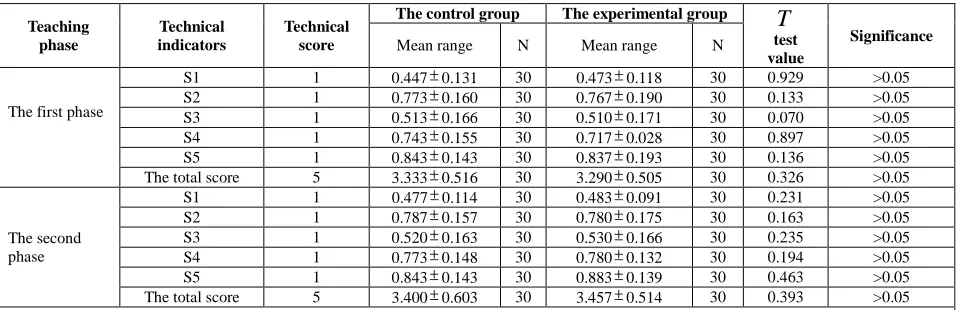
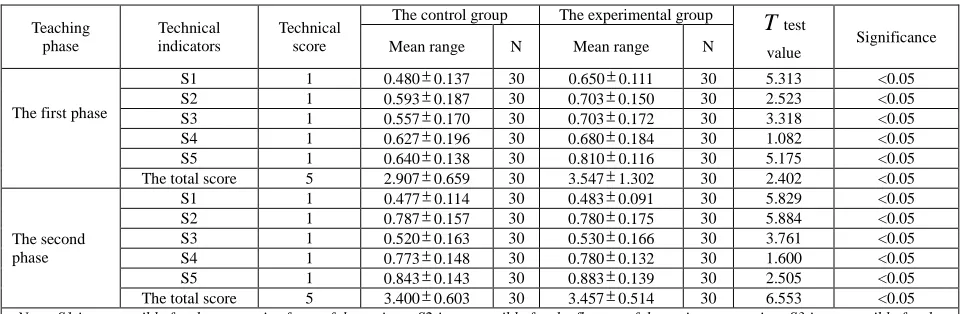
[image:4.595.99.516.421.462.2]The students’ teaching experimental control factors of the experimental group and the control group are shown in Table 2. During the two stages, the whole actions technical assessment situation of the students from the two groups is shown in Table 3. The confidence control data are shown in Table 4.
Table 2- Teaching experimental control factors
Experimental factors Teaching environment
Teaching content
Teaching
[image:4.595.68.549.489.644.2]condition Instructors Teaching method The experimental group √ √ √ √ The traditional teaching method The control group √ √ √ √ The traditional teaching method
Table 3- Two groups of students’ technical assessment list of the entire three-level aerobics actions under the traditional teaching method
Teaching phase Technical indicators Technical score
The control group The experimental group
T
test valueSignificance Mean range N Mean range N
The first phase
S1 1 0.447±0.131 30 0.473±0.118 30 0.929 >0.05 S2 1 0.773±0.160 30 0.767±0.190 30 0.133 >0.05 S3 1 0.513±0.166 30 0.510±0.171 30 0.070 >0.05 S4 1 0.743±0.155 30 0.717±0.028 30 0.897 >0.05 S5 1 0.843±0.143 30 0.837±0.193 30 0.136 >0.05 The total score 5 3.333±0.516 30 3.290±0.505 30 0.326 >0.05
The second phase
S1 1 0.477±0.114 30 0.483±0.091 30 0.231 >0.05 S2 1 0.787±0.157 30 0.780±0.175 30 0.163 >0.05 S3 1 0.520±0.163 30 0.530±0.166 30 0.235 >0.05 S4 1 0.773±0.148 30 0.780±0.132 30 0.194 >0.05 S5 1 0.843±0.143 30 0.883±0.139 30 0.463 >0.05 The total score 5 3.400±0.603 30 3.457±0.514 30 0.393 >0.05
Note: S1 is responsible for the expressive force of the actions; S2 is responsible for the fluency of the action connection; S3 is responsible for the body coordination; S4 is responsible for the validity of the action; S5 is responsible for the rhythm.
Table 4- List of two groups of students’ confidence control data under the traditional teaching method
Teaching phase Group Sample size Mean range
T
test value SignificanceThe first phase The control group 30 62.07±9.677 1.540
>0.05 The experimental group 30 58.17±9.931
The second phase
The control group 30 66.27±10.30
0.808 The experimental group 30 68.17±7.737
Table 5. During the two stages, the whole actions technical assessment situation of the students from the two groups is shown in Table 6. The confidence control data are shown in Table 7.
Table 5- Teaching experimental control factors
Experimental Factors
Teaching Environment
Teaching Content
Teaching
Condition Instructors Teaching Method Experimental Group √ √ √ √ The traditional teaching method
[image:5.595.66.549.189.346.2]Control Group √ √ √ √ The traditional teaching method
Table 6- Students’ technical assessment list of entire three-level aerobics actions after the control experiment
Teaching phase
Technical indicators
Technical score
The control group The experimental group
T
test valueSignificance Mean range N Mean range N
The first phase
S1 1 0.480±0.137 30 0.650±0.111 30 5.313 <0.05 S2 1 0.593±0.187 30 0.703±0.150 30 2.523 <0.05 S3 1 0.557±0.170 30 0.703±0.172 30 3.318 <0.05 S4 1 0.627±0.196 30 0.680±0.184 30 1.082 <0.05 S5 1 0.640±0.138 30 0.810±0.116 30 5.175 <0.05 The total score 5 2.907±0.659 30 3.547±1.302 30 2.402 <0.05
The second phase
S1 1 0.477±0.114 30 0.483±0.091 30 5.829 <0.05 S2 1 0.787±0.157 30 0.780±0.175 30 5.884 <0.05 S3 1 0.520±0.163 30 0.530±0.166 30 3.761 <0.05 S4 1 0.773±0.148 30 0.780±0.132 30 1.600 <0.05 S5 1 0.843±0.143 30 0.883±0.139 30 2.505 <0.05 The total score 5 3.400±0.603 30 3.457±0.514 30 6.553 <0.05
Note: S1 is responsible for the expressive force of the actions; S2 is responsible for the fluency of the action connection; S3 is responsible for the body coordination; S4 is responsible for the validity of the action; S5 is responsible for the rhythm.
Table 7- List of students’ the confidence control data after the control experiment
Teaching phase Group Sample size Mean range
T
test value SignificanceThe first phase The control group 30 68.00±7.861 2.556
<0.05 The experimental group 30 73.20±7.906
The second phase
The control group 30 74.67±6.994
5.594 The experimental group 30 83.67±5.358
The data in Table 3 show that when two groups of students are taught by traditional teaching method, there are no significant differences in terms of the expressive force of the actions, the fluency of the action connection, the body coordination, the validity of the action and the rhythm, therefore the technical level of the two groups of students are basically same and we can prove that there are no significant differences between the two groups at the beginning. In addition to the same teaching factors, there are no differences of students’ qualities and abilities. The data in Table 6 show that the experimental group students are taught by additive cyclic teaching method, but the control group students are taught by the traditional teaching method. There are only differences in teaching method, but the technical evaluation results express significant differences between two groups of students’ various technical scores, and the scores of the experimental group are higher than the scores of the control group. The data in Table 4 and Table 7 show that two groups of students have increased confidence in varying degrees, but students of the experimental group embody significantly higher confidence than students of the control group in motion.
The above data show that, in addition to the different teaching methods, if the rest of the teaching conditions are same, students’ technical level and self-confidence in motion of additive cyclic teaching method are superior to those of the traditional teaching method.
The effect of additive cyclic teaching method
The teaching effectiveness of additive cyclic method is reflected in the acceptance of aerobics teaching and the promotion of students’ interested in aerobics, so in this paper we carry on the questionnaire survey among two groups of after-teaching students. The percentage frequency situation of students’ acceptance is shown in Table 8.
Table 8- Frequency list of students’ acceptance for aerobics
Group Sample size One-level Two-level Three-level Four-level Five-level Control Group
30 19 9 1 0 1
Percentage 63.33% 30.00% 3.33% 0.00% 3.33% Experimental Group
30 3 5 14 6 2
As shown in Table 8, we divide likeability into one-level to five-level, and the lower of the level the greater of the like degree. After the teaching experiment of two different teaching methods, each group of students’ exercise situation after school is shown in Table 9.
Table 9- List of two groups of students’ exercise frequency after aerobics teaching
Group Sample size Often exercise Occasionally exercise Never exercise Total The control group
30 23 5 2 30
Percentage 76.67% 16.67% 6.67% 100%
The experimental group
30 5 14 11 30
Percentage 16.67% 46.67% 36.67% 100%
From the data in Tables 8 and 9, the influences of the additive cyclic teaching method on students in the future are better than the traditional teaching method, so it is obvious that the influences of the additive cyclic teaching method have greater advantages than the traditional teaching method.
CONCLUSION
In this paper, through researching the teaching objectives of female aerobics and analyzing the composition factor of teaching objectives, we design the quantitative methods of target indicators. We use additive cyclic teaching method to teach and analyze the advantages of this teaching method from the perspective of teaching experience. In order to validate the superiority of additive cyclic teaching method, in this paper we design the teaching experiment using control variable method, and analyze the differences between additive cyclic teaching method and traditional teaching method based on the actual teaching situation. We use the questionnaire method to analyze the two groups of students’ likeability after aerobics learning, which indirectly reflect that the effect of additive cyclic teaching method is better than traditional teaching method. We analyze the teaching situation of female aerobics to explore the effects of additive cyclic teaching method on teaching result, so as to provide the analysis method of the teaching method’s reasonable option for physical education in our country.
REFERENCES
[1]Zhang Yun, etc. Social Scientists. 2012.231-231.
[2]Guo Fumo. Journal of Heilongjiang College of Education. 2012.31 (5): 58-59. [3]Zhang Lihong. Youth Literator. 2009.(14).