Rethinking Education – Emerging Roles for Teachers
Fatima Rehan Dar
SZABIST, Karachi-Pakistan
Copyright © 2015Horizon Research Publishing All rights reserved.
Abstract The purpose of the study was to find out how
teachers role modeled and taught empathetic and pro-social skills at the primary level. The study was qualitative in nature and followed a case study approach. Observations of regular English language classes were done from Grades 1-5 to see if class lessons incorporated the said themes and whether teachers displayed the stated skills in classrooms. Another set of observations were conducted after teachers were requested to highlight empathetic and pro-social themes in texts and activities. The second set of observations noticed if the use of empathetic and pro-social textual materials and activities raised awareness among students about the said themes and affected student interest and teacher behaviour in any way. Teachers were also interviewed to register their thoughts on their own empathetic and pro-social behaviours and their experience of teaching the same in classrooms. The deputy curriculum developer from Grades 1-5 was also interviewed to take her opinion about teachers as appropriate role models to teach the said skills and the time given to the development of such skills in the professional development programmes. The findings established teachers as weak role models for the demonstration of empathetic and pro-social skills in classrooms. However, they successfully incorporated and taught the same skills through texts. The paper encourages teachers to exhibit more empathetic and compassionate skills in classrooms so that students can be equipped with sound academic and affective skills for a more positive assimilation in society at large.Keywords Cognitive Development Empathy Pro-social
Skills Role Model Teachers1. Introduction
Teachers play a significant and crucial role in human development. They are the overt as well as covert forces behind academic as well as behaviour development of students at every stage of learning. In Pakistan, however, the role of a classroom teacher is generally reduced to that of a hardy force that mechanically fulfils lesson objectives and helps students obtain steady grades. Flanagan [10, p36]
assures that, “we’re moving away from teacher professionalism toward a teacher-as-technician model.” The ‘teacher as technician model’ is followed due to an excessive emphasis on the development of cognitive abilities of students across all age and grade levels. The stated function indisputably generates academic success for students and aids cognitive development; however, it fails to ensure the systematic growth of affective attitudes among students. Williams [34, p 116] reports the same and states that, “a focus on standard-based teaching has caused many teachers to overemphasize cognitive development to the detriment of affective development.” The result is the mass production of individuals who are cognitively smart but behaviourally challenging.
taking highly matter-of-fact, cognitively inclined and non-compassionate roles in classrooms. Sole focus on intellectual skill development has led to a gradual development of mind sets where the definition of an effective teacher is reduced to that of person who successfully meets the demands of a lesson and enables students to achieve good grades. An effective teacher need not be an affective teacher.
It, therefore, becomes imperative that teachers take up more active, inclusive and participatory roles in depicting empathetic and pro-social roles in classrooms. The need for teachers is to come out of their mechanical roles and model more humanistic and caring roles in classrooms for better student awareness. Moreover, teachers need to incorporate affective themes in texts, activities and teaching methodologies so that the significance of such themes is realized to its full potential. The present study is significant in terms of raising the importance of affective role-modeling by teachers in classrooms so that students become exposed to appropriate empathetic and pro-social behaviours and gain awareness of the same. The significance of the study is further compounded by the use of cognitive-affective themes and activities through texts to raise awareness of the stated skills among students. Unless the skills in question are demonstrated by the teachers and incorporated in the curriculum, the awareness about the same cannot be sought appropriately.
2. Background of the Study
The premise stated above was explored further through a case study. The research study was conducted to raise awareness and restate the value of affective education, empathy and pro-social skills in particular, in primary schools. The study proclaimed that the schools in general did a lot of academic and a little of affective investment in schools. The English language curriculum and texts from Grades 1-5 were examined to see whether they projected empathetic and pro-social elements. Also, classes were observed and teachers and students were interviewed from Grades 1-5 to confirm if students exhibited awareness of empathetic and pro-social skills, teachers acted as appropriate role models for the portrayal of the said skills and satisfactorily taught empathetic and pro-social themes in classrooms.
Although the focus of the study was to investigate the entire primary English language curriculum, textbooks for empathetic and pro-social themes and examine English primary classrooms for the subsequent teaching of such themes, teacher behaviour in the classroom emerged as one of the major impediments towards the successful development of the same skills among students.
In order to investigate the stated problem one of the objectives of the study became the exploration of how teachers taught empathetic and pro-social skills in classrooms and developed awareness of them among
students from Grades 1-5 by using appropriate textual materials and activities with the same themes. The basic question that guided this significant part of the study was to explore what teachers did to promote empathetic and pro-social skills in classrooms. The underlying focus was to examine whether they were appropriate role-models to exhibit such skills or not.
3. Literature Review
Review of literature with respect to teacher behaviour in the classroom attest the fact that teacher affect influences teacher effectiveness. (Erdle, Murray, and Rushton (1985), cited by 32). Other researchers also restate the fact that that a teacher’s personality characteristics play a far greater role in student achievement than do teachers' subject matter knowledge and pedagogical knowledge (Ayers[1]; Bettencourt, Gillett, Gall, & Hull [2]; Noddings[21].
Watson, Miller, Davis, and Carter [32] are of the view that an effective teacher develops social relationships with students and does not limit interactions with them to content and classroom; rather effective teachers take the initiative to speak to their students in the school hallways, cafeteria, gymnasium, or wherever and whenever the opportunity arises. They also cite a study by Witty conducted in 1947 about a popular radio programme, the Quiz Kids, in which children listeners aged nine and up were asked to write an essay titled "The teacher who has helped me most." Twelve thousand letters were generated from this initiative that came from children across the United States. A list of 12 desired teacher qualities was compiled from the letters; the first 11 ranked characteristics were teacher affective traits, the 12th pertained to teaching ability. The highest three rankings of desired teacher qualities were: cooperative, democratic attitudes; kindness and consideration for students; and patience.
Many educators have rated caring to be a chief trait of teachers. According to Stronge (2007) as cited by [32], a caring teacher is interested in what students have to say; listens carefully to and values what students share; and is genuinely interested in students' lives, both inside and outside of school. Students believe a caring teacher is a trustworthy person, a person who will protect them, will be an advocate for them, and will actively listen to their concerns.
skills, rather than fragmented focus on isolated issues. Hamburg [11] again says that by rewarding children’s pro-social statements and actions, educators can develop and strengthen pro-social skills. According to Coppie and Bredekamp [4] teachers can help children develop caring communities in classrooms and support children’s social development.
Taylor and Larson [31] comment that by creating safe and nurturing environments, teachers encourage children to want to come to school. Driscoll and Pianta [6] think that teachers can respond sensitively to children’s everyday’s needs, interact in emotionally supportive ways and listen and converse with sincere attention. Moreover, by making classrooms active forums through empathetic and pro-social programmes teachers can foster these necessary skills among children. Spinrad and Eisenberg [29]; Romano, Kohen and Findlay [27] report that children who attend high quality family child care and centre-based programmes seem to show more empathy and positive behaviour toward other children. In order for such programmes to flourish teachers and the rest of the staff can revisit their school policies and curricula to make them more affective. According to Hyson and Taylor [15] teachers can reexamine everyday routines and activities to see if the pro-social content of activities is being fully tapped. Moreover, teachers can use specialized curricula and other resources that target pro-social behaviour. Hamburg [11] suggests that pro-social behaviour can be fostered when children are given specific empathy training. He thinks that role-taking exercises reduce the level of bias by employing both cognitive and emotional empathy. He further suggests jigsaw classrooms, and intergroup dialogue programmes to teach e & p skills. Elias et al. [8] also claim that when teachers encourage students to restate their ideas in positive terms, tolerate students’ errors, clarify the students’ intent, and give students time to think, more creative and thoughtful responses follow. Moreover, when teachers focus on topics like effects of behaviour on other people’s feelings, well-being and ability to learn students become more sensitive towards such behaviours
Many researchers thus contend that teachers are the binding link and active participants in the systematic development of empathetic and pro-social skills among students. They facilitate in framing curricula, developing texts, and preparing lessons which promote such skills. Taylor and Larson [31] reiterate the same and report that when discussing literature, the teacher can solicit students’ emotional reactions to themes, characters, and plot development. According to them students can identify how characters showed their feelings; explain other ways characters could have expressed themselves; articulate how these alternative actions would have affected other characters in the story; and relate how they feel about a character’s decisions For all this to happen a caring bond between the teacher and the student is vital so that such skills are manifested and experienced in the actual world of the student as well. Stout [30] talks of a caring connection between a teacher and the student. He stresses that teachers
must take an empathetic approach and become facilitators rather than information-providers. On the contrary, the empathetic and pro-social roles of teachers are underrepresented and less attended to in policy documents and national professional standard guidelines. Hargreaves(1998) argues (cited by 32) that teaching is a career field that requires empathy for and a genuine desire to connect with and understand students. NSW Institute of Teachers [23] reiterates the fact that the affective element of teaching is rarely acknowledged in public policy, and professional standards. O'Connor [24] too argues that the emotional dimension of the teaching role is highly ignored in the field of education.
The following section would report the research plan that guided the investigation of this study.
4. Research Methodology
The study was conducted in one of the ‘elite’ chain of English medium schools in Lahore, Pakistan. The school system chosen as the subject of the study was the biggest school system in the country. The school system was selected as it was representative of maximum student population studying in the private sector and hoped to give the greatest amount of the desired information. Grades 1-5 became the subject of study as the focus remained the primary level.
Research Design
The research design selected for the investigation of this study was qualitative in nature. Savenye & Robinson [28] stated that qualitative research involved highly detailed but rich descriptions of human behaviours and opinions. McMillan [20] claimed that researchers using a qualitative approach believed that there were multiple realities represented in participant perspectives, and that context was critical in providing understanding of the phenomenon being investigated. This particular qualitative research further followed a case study approach towards the investigation of the stated problem. According to McMillan [20] a case study was an in-depth analysis of one or more events, settings, programmes, social groups, communities or individuals in their natural context. It was an investigation of one entity, which was carefully defined and characterized by time and place.
texts and textual activities. For the triangulation and authentication of data, focused group interviews were also taken of teachers. Morgan (1988) argued (cited by 3) that focused group interviews were held to foster talk among the participants about the subject of interest. A total of 8 teachers were interviewed. They were the same teachers whose classrooms were observed from Grades 1-5.The intention of the focused group interviews, therefore, was to make teachers introspect about their own empathetic and pro-social behaviours and their experience of teaching the same content in classrooms. The deputy curriculum developer from Grades 1-5 was also interviewed. The deputy curriculum developer was interviewed to explore the value accorded to empathetic and pro-social skills at the policy level and the thought processes involved while framing the English curriculum and prescribing textbooks. A part of the interview was also to seek her opinion about teachers as appropriate role models to teach the said skills and the weight and time given to the development of such skills in the professional development programmes held for teachers. Data Collection
Data was collected from the following sources: Observations of classrooms
Teachers’ behaviour was investigated through two rounds of observations. Round 1 of Observations was conducted to make a situational analysis and note the demonstration of empathetic and pro-social skills by teachers in the classrooms from Grades 1-5 and how the teachers taught those skills through texts and activities. There was no evidence in place to judge how the school raised awareness among students about such behaviours. Neither was there any evidence of their demonstration by teachers and students in the classrooms and the way awareness was raised of the said themes through texts and activities. In order to get a solid evidence of all the above mentioned activities, observations for Round 1 were done. There were 14 observations done for Round 1 from Grades 1-5. Observations were done of the English language classrooms with the same number of students and teachers each time. The focus of observations was the demonstration of empathetic and pro-social skills by teachers and the how they highlighted the empathetic and pro-social themes through texts and classroom activities.
After the observations of Round I, it was concluded that teachers did not raise awareness among students about empathetic and pro-social skills through textual materials and activities, neither were teachers appropriate role models to exhibit empathetic and pro-social skills. Meeting with the teachers reiterated the same and teachers were requested to teach lessons by highlighting the empathetic and pro-social contents in texts and through textual activities. For this a second round of observations was planned and carried out where empathetic and pro-social themes through texts and activities were emphasized by teachers. The same
classrooms and teachers were chosen for the second round of observations. The teachers were asked to carry on with their usual teaching except that in every lesson they were requested to do the following:
identify empathetic and pro-social themes (sharing and caring themes) in texts
identify empathetic and pro-social characters
construct lesson plans with empathetic and pro-social objectives
highlight empathetic and pro-social content of texts highlight empathetic and pro-social character traits build activities around empathy and pro-social
themes
involve students in cooperative and collaborative tasks
The demonstration of empathetic and pro-social skills of teachers and the way they taught the same themes was noted against the same checklist as used in Round 1 of observation.
Teachers’ Interview
Teachers were interviewed after they administered lessons with focus on empathetic and pro-social themes. The purpose of the interview was to take teachers’ points of view about the importance of empathetic and pro-social behaviours and the need of their thematic presence in the English language curriculum from grades 1-5. They were also interviewed to register their impressions about the kinds of students’ responses that came after the administration of empathetic and pro-social themes through texts and activities and whether they noticed any significant changes in their interest while they focused on academic work. Another purpose was to make them introspect on their own behaviours in the classrooms with respect to the skills in question.
Deputy Curriculum Developer’s Interview
Sample Selection
The type of sampling procedure used for the purpose of this particular study was purposeful. According to McMillan [20] in qualitative studies participants were selected purposefully. He went on to claim that in purposeful sampling, the researcher selected particular individuals or cases because they would be particularly informative about the topic. Two branches of the understudy school system were therefore selected for the purpose of this study.
Sample Size
The sample size considered for this particular research study was therefore small. As quoted by Wiersma and Jurs [33], “the sample sizes in qualitative research are typically small” (p.347)
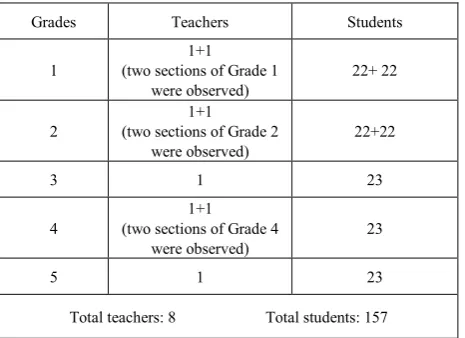
[image:5.595.313.550.91.201.2]The following table would show the number of teachers and students who participated in the study.
Table 1. Number of Teachers and Students Who Participated in Study
Grades Teachers Students
1 (two sections of Grade 1 1+1
were observed) 22+ 22
2 (two sections of Grade 2 1+1
were observed) 22+22
3 1 23
4 (two sections of Grade 4 1+1
were observed) 23
5 1 23
Total teachers: 8 Total students: 157
Data Analysis
According to Bogdan and Biklen [3, p147] in qualitative research, “data analysis means the process of systematically searching and arranging the interview transcripts, fieldnotes, and other materials that you accumulate to enable you to come up with findings.” They explained that data analysis involved working with the data, organizing them, breaking them into manageable units, coding them, synthesizing them, and searching for patterns. Wiersma and Jurs [33] suggested that in qualitative data analysis organization of information and data reduction needed to be done. Since the study in question was a qualitative case study the data accumulated through classroom observations and interviews was analysed and interpreted according to the suggested guidelines mentioned above. The data collected through the mentioned sources was codified for data reduction. Teachers' behaviour with respect to the demonstration empathetic and pro-social skills in the classrooms was, therefore, codified under the following sub-categories:
Table 2.Category and sub-categories for observations
Teachers’ behaviour in classroom
• demonstration of empathetic and pro-social behaviour
• teachers’ enthusiasm & interest in class • attention to student’s needs & showing
respect to them
• teacher’s friendliness in classroom • encouragement given to students to
take responsibility of their actions • encouragement given to students to find
ways to help peers
[image:5.595.315.548.262.304.2]Classroom activities done by teachers during lesson delivery were codified under the following categories:
Table 3. Category and sub-categories for activities done by teachers to raise empathetic and pro-social awareness during lesson delivery
Activities done during
the lesson
lesson had an empathetic and pro-social focus textual themes and class activities were
empathetic and pro-social based students’ interest in lesson activities
[image:5.595.63.296.323.492.2]Use of empathetic and pro-social values during lesson delivery was codified under the following categories:
Table 4. Category and sub-categories for using empathetic and pro-social themes during lesson delivery
Use of empathetic and
pro-social values during lesson delivery
involvement of students to decide what issues to discuss
encouragement of pair/group work taking turns before speaking
encouragement to help others in need during lesson
teachers’ assistance given to the quieter students to interact with others
taking care of intellectual and emotional need of students
encouragement given to students to mentions concerns/problems
exploitation of empathetic /pro-social themes in texts
use of class activities to raise awareness among students about e & p behaviour
Although the focused group interview was meant to record teachers’ experience of using empathetic and pro-social themes through texts and activities, a part of the interview dealt with discerning their impressions about the importance they would accord to such skills. This was thus deciphered as one of the categories. Similarly, one of the categories developed out of the deputy curriculum developer’s interview was teachers as good role models for empathetic and pro-social development and the importance given to the same skills in professional development programmes held for teachers.
5. Results of the Study
[image:5.595.312.551.363.529.2]Grades 1-5.
Results of teachers' behaviour from round 1of observations
All the 8 teachers who were observed emerged as inadequate role models for the portrayal of empathetic and pro-social skills. They lacked empathetic and pro-social awareness themselves and therefore were not able to display the same in classrooms. Only one teacher, referred to as T 8, was seen showing some empathetic and pro-social skills. However, she was unable to use the same in her lessons. Jennings and Greenberg [16] argued that emotionally and socially competent teachers exhibited pro-social values and made responsible decisions in their relationship with others. The teachers specifically lacked these traits and therefore were unable to make appropriate use of them in the classrooms.
All teachers were lesson focused, most of which had a clear cognitive focus. They hardly smiled in the class and had a very matter of fact relationship with students. For example, Teacher 1 in Grade 1 classroom said in a mechanical way, “All those who have done, close your books, and put them in the middle of the table.” She collected the books, gave two more minutes to those students who did not finish and quickly wrapped up things for the next class. Her work looked very mechanical. she worked without any solid emotional input. Teacher 5, in Grade 3 classroom, remained consistently harsh to the students. At one juncture she said harshly to a student, “Who told you to do this? Rub it away.” On another occasion she rudely said to another student, “Why did you write an ‘i’ here. Rub it out and do it again.” Her tone was very harsh and demeaning. Again when one student asked her about the number of words to be written in a paragraph, she curtly responded, “Open your book and read instructions carefully.” Her manner was impolite. Hyson and Taylor [15] stated that if adults were warm, nurturing and responsive, children were likely to notice and imitate aspects of their behaviour, including pro-social actions. Teachers who had those characteristics had a good chance of promoting children’s empathy, helpful, caring, generous behaviour by demonstrating that behaviour themselves. Unfortunately, the teachers could not demonstrate such behaviour for students to internalize and emulate.
All the teachers remained focused on the lessons and hardly encouraged students to ask questions or seek help from peers in case of any confusion. They did not emphasize empathetic and pro-social elements in the texts nor could they reinforce empathetic and pro-social activities in lessons. There were 3 texts in Grade 1, 4 and 5 which had vivid empathetic and pro-social themes, yet the themes could not be highlighted well enough. Activities could not be made around them for better student awareness. For example, Teacher 6, in Grade 4, asked students to make sentences and one student made a sentence with the word ‘worst’. He said, “May 21 was the worst day in my life.” She never drew upon
the experience of the student for elaboration. This could have become an active point for the discussion on empathy, but she missed the point.
It could, therefore, be inferred that teachers did not possess adequate awareness of empathetic and pro-social skills themselves. They, therefore, emerged as bad role models for the demonstration of the skills in question. Moreover, they lacked the awareness to integrate empathetic and pro-social themes in the lessons. All this could be attributed to their lack of professional development training in the affective domain. Jennings and Greenberg [16] reiterated the same and commented that there was explicit lack of pre-service and in-service training aimed at teachers’ personal development in the affective domain. Noddings (1992) also hinted (cited by 5) at the perspective of lack of training about caring of teachers. From the observations it was, therefore, concluded that the teachers were not given adequate training in the cognitive-affective domain for the smooth integration of empathetic and pro-social themes in the regular English curriculum.
Results of teachers' behaviour from round 2 of observations
All teachers except one, referred to as T 8, still remained weak models to portray empathetic and pro-social behaviours. Their prime concern again remained to finish the lesson plans. However, all of them taught empathetic and pro-social themes well and integrated them well in their regular lessons plans. Jennings and Greenberg [16] opined that a teacher who was able to empathize with a student’s emotional responses may be better prepared to integrate social and emotional targets in the regular curriculum.
It was, however, noteworthy that the teachers integrated empathetic and pro-social skills really well in the regular lesson plans. They exploited the empathetic and pro-social values extremely well in all lessons through the following strategies:
Linking empathetic and pro-social values with academic language targets
Bridging the gap between theory and practice by linking empathetic and pro-social values to real life contexts
Relating the textual themes and characters to real life situations
Making empathetic and pro-social awareness emerge through the use of all language resources, i.e. listening, speaking, reading, writing, grammar and vocabulary. Reinforcing empathetic and pro-social themes through
recaps
work to be shown to her, ,she read it and responded, “Wonderful. It is so nice.” She also encouraged students to help their peers and accommodated individual differences. In the lesson, when students wrote stories, she waited for students to finish their work, “We are waiting for Subhan, Hamza and Farhan.” Similarly, teacher 5 made the lessons very participative. In the 3 lessons that she taught she involved the students in discussions, group presentations, collaborative dialogue and paragraph writing. She ensured that students worked in cooperative groups. Johnson and Johnson (1999) shared (cited by 35) the belief that cooperative learning produced more positive relationships among students and promoted social competence. Likewise, the concept of empathy was integrated very well with the cognitive objectives by teacher 6 in Grade 4. She reinforced adjectives and adverbs well by asking students to think of empathetic and pro-social adjectives and adverbs which they later added to a paragraph of a text. This was a wonderful attempt to reinforce the e & p themes as well. Students came up with adjectives like helpful, friendly, poor, and kind and adverbs like badly and deadly which invoked empathy. Teacher 6 took the matter further and held a discussion with students regarding adjectives and adverbs based on empathy. However, the teachers themselves could not emerge as better role models for the demonstration of empathetic and pro-social skills. They seldom smiled and showed genuine concern for students. The main concern for them was to conduct the classes well. Willert and Willert [35] firmly opined that teacher training programmes should give social skills training to teachers so that they could promote social and character goals in classrooms.
It could, therefore, be concluded that teachers taught empathetic and pro-social values really well through adequate integration with academic targets. The teachers were able to raise awareness among students about the said themes by making linkages to real life contexts. Apart from raising awareness, the said integration enlivened the classrooms and raised student interest to a considerable level. It was also observed that the group and pair works in classroom made students work together in an amicable and cordial manner. No student disruption was observed in Round 2 of observations. Student led disruptions, however, were a noticeable feature in Round 1 of observations.
Round 2 of observations attested the fact that professional and targeted awareness about empathetic and pro-social skills could lead to their integration in lessons. Teachers could safely highlight and emphasize the said skills because of their professional prowess. However, changes could not come in their own behaviour with respect to such skills. This needed more work and time as behavioural changes required a sustained and long term effort.
Focused group interview results of teachers
In focused group interviews, teachers confessed their lack of training in the affective domain. Some of the teachers showed their surprise at the integration of empathetic and pro-social themes in the regular lessons and frankly admitted
that they could never think of such integration before. They valued the cognitive-affective link and expressed their desire to get further training for better integration of the two domains. They, therefore, recommended more training for teachers in the affective domain for better integration of empathetic and pro-social skills in the lessons and for better handling of the same issues in classrooms. One of the teachers, referred to as Teacher 2 remarked, “As I have recalled the readers that they have done in the first term and they knew that there was a helping and caring over there…but at that time when we were doing the reader we didn’t know that these elements were there.” (Saira. Conversation with: Fatima Dar. 2012 May 21). Referring to their lack of knowledge in the said field, another teacher, referred to as Teacher 1 confessed, “We are not professionals in that regard.” (Sibyl. Conversation with: Fatima Dar. 2012 May 21). This honest admission led to the conclusion that affective education was perhaps never a part of teachers’ professional training. Marzano, Marzano and Pickering (2003) reported (as cited by 16) that when teachers lacked the resources to effectively manage the social and emotional challenges within a particular context of their school and classroom, children showed lower levels of on-task behaviour and performance. The need, therefore, was to make empathetic and pro-social training a strong component of professional development activities organized for teachers by the school system under study. Jennings and Greenberg [16] continued to assert that teachers influenced their students not only by how and what they taught but also by how they related, taught and modeled social and emotional constructs.
The teachers, however, reported that they had a wonderful experience teaching empathetic and pro-social skills through texts and activities. They felt that through the integration of the said themes with regular academic objectives students were able to come up with good ideas, relate issues to real life contexts and find relevance in what they were doing. Teacher 3 reported, “Things were really good, positive and strong because you see sometimes we take children for granted. We don’t think that they can go through that level but when we gave them the initiative they really came up with good ideas. I had a very good experience.” (Ayesha. Conversation with: Fatima Dar. 2012 May 21). Teacher 1 added the same, “In my case, I found some people who would never think, but this time I was there to involve them…and they came up with something that surprises me as well. There were a few students from whom I was not expecting.” (Sibyl. Conversation with: Fatima Dar. 2012 May 21). Teacher 1 commented on the comparison between a routine lesson she taught and Round 2 of teaching and reported that, “..generally when we come and talk about manners and etiquettes and all, they listen and forget and don’t give an input. Their response is not there. This time they were all involved, creating something or the other.” (Saira. Conversation with: Fatima Dar. 2012 May 21).
empathetic and pro-social skills in lessons. However, they highly valued the same skills and considered them very important for student awareness. Goleman [9] stressed the same and claimed that teachers must build instructional activities that also fostered students’ abilities to understand, engage, and express their feelings and to engage in rewarding interactions with others. Also, they considered the practice of teaching through the integrated cognitive-approach a highly rewarding experience
Interview results of the deputy curriculum developer The Deputy Curriculum Developer was non-committal in terming teachers as good or bad role-models for the empathetic and pro-social awareness. She hoped that they became good role-models but was not sure. However, Jennings and Greenberg [16] strongly opined that teachers were role models who continuously induced and responded to the emotional reactions of their students. Willert and Willert [35] also asserted that teachers should offer systematic and developmental approaches for reinforcing good habits on a day to day basis. The ambivalent attitude of the Deputy Curriculum Developer and Round 1 of observations clearly revealed that teachers were not good role models for the development of empathetic and pro-social awareness among students.
She, however, indicated clearly that the professional development programmes held for teachers never included empathetic and pro-social themes. Affective training was not the focus of professional development programmes held by the school system. She was quite honest in admitting the school system’s inadequacy in providing training in empathetic and pro-social content. She said,
“As far as professional training is concerned, Beaconhouse has a planned system of providing in - service teacher training. This includes subject specific training; however, let me be honest; no training is designed aiming at teaching empathy and pro – social themes. Empathy and pro social themes do somehow come up during discussions held for various topics and themes.” (Murtaza, Tabbasum. Conversation with Fatima Dar. 2012 August 17)
This stance explained the lack of empathetic and pro-social skill demonstration in both rounds of observations.
6. Data Analysis
Analysis of round 1 of observations
In Round 1 of observations the 8 teachers who were observed emerged as inappropriate role models to demonstrate empathetic and pro-social skills. All of them manifested a routine and transactional presence in classrooms. They hardly smiled during lesson delivery and barely made efforts to build good rapport with students. Neither did they encourage students to collaborate with each other. During group work assignments, students were
noticed hiding work from each other. For example, Teacher 2, in Grade 1, did not smile throughout the lesson and was observed stressed to finish her lesson plan on time. When one student complained to her that, “Teacher, he is cheating my work”, she replied, “hide it”. Interestingly, minutes before, she asked the students, “What did you learn from the story ‘The lion and the mouse’. The students replied, “It is good to help each other.” This appeared in stark contrast to her earlier response. On other occasions, students were observed to be throwing stationery or nudging at each other. On all such occasions, teachers kept a sullen calm. No reaction was given by teachers to counter the inappropriate social behaviour of students. This was safely attributed to their lack of empathetic and pro-social awareness and training. For example, Teacher 6 did not come up with more caring words to acknowledge students. While conducting a lesson, she asked one student to make a sentence. The student told her that she had not made a sentence. Teacher 6 simply replied, ‘OK” and moved on. Her reply was very mechanical and suggested a lack of concern for the student. Teachers thus fell short of emerging as appropriate role models to manifest more caring attributes in classrooms. Hojat [14] attributed role modeling to be the most appropriate and effective approach to teach empathy. Unfortunately the same was not demonstrated by teachers in the classrooms.
All teachers were seen under pressure to finish the lessons, most of which had a clear cognitive focus. They did not highlight empathetic and pro-social themes in the texts appropriately and did not reinforce empathetic and pro-social activities well in lessons. Also, they could not effectively highlight empathetic and pro-social values inherent in the texts for students to notice and recognize. This led to a clear lack of focus on the same. For example, Teacher 2, in Grade 1, was unable to adequately highlight the empathetic and pro-social content of the text, 'The elves and the shoemaker'. The students were asked to explain the pictures in the text which they did not do well. Even when students were told to make story on ‘helping someone’, they could not do so appropriately and came up with lukewarm responses.
It could, therefore, be interpreted that teachers did not harbour adequate awareness of empathetic and pro-social skills themselves. Jennings and Greenberg [16] stressed that teachers’ willingness to integrate social and emotional skills in the lessons was dependent on their own knowledge of the same skills Moreover, they lacked the awareness and training to integrate empathetic and pro-social themes in the lessons. All this could be attributed to their lack of professional development training in the same domain.
Analysis of round 2 of observations
methodology part very well. However, their own lack of behavioural demonstration of the same skills remained a recurring feature due to their own lack of awareness to exhibit the same skills themselves.
In Round 2 of observations, it was observed that teachers still could not become better role models to teach empathetic and pro-social skills. Jennings and Greenberg [16], however, recommended teachers to become strong role-models for the development of social and emotional learning among students. They opined that a teacher who was able to empathize with a student’s emotional responses may be better prepared to integrate social and emotional targets in the regular curriculum. But, in this case the teachers seldom smiled in classrooms and did not demonstrate caring behaviours in classrooms. The focus remained largely on meeting the requirements of the lessons plans. This was attributed to the lack of professional training in the said field.
All teachers, however, were able to use empathetic and pro-social values very well in lessons. They exploited the empathetic and pro-social values extremely well in all lessons through linking empathetic and pro-social values with academic language targets, bridging the gap between theory and practice by linking empathetic and pro-social values to real life contexts, relating the textual themes and characters to real life situations, making empathetic and pro-social awareness emerge through the use of all language resources, i.e. listening, speaking, reading, writing, grammar and vocabulary and reinforcing empathetic and pro-social themes through effective recaps.
Analysis of focused group interviews of teachers and interview of deputy curriculum developer
The interview findings of teachers as well as the deputy curriculum developer candidly attested the fact that teachers were inadequate role-models for empathetic and pro-social skills. Moreover, the curriculum had a clearly defined cognitive focus because of which affective attention could not be given in classrooms. All teachers and the deputy curriculum developer felt that the English curriculum was heavily driven by academics. The teachers’ views indicated that most of the objectives set in the curriculum geared towards academic development. No deliberate effort was done to incorporate the affective objectives into the regular English curriculum. It could, therefore, be analyzed that affective objectives were not regarded vital at the policy level. Kohn [19, p 500] termed it as lack of interest in the idea of cognitive-affective integration at the school level. He continued to stress that:
It is possible to integrate pro-social lessons into the regular curriculum; as long as children are learning to read and spell and think critically, they may as well learn with texts that encourage perspective-taking. Indeed, to study literature or history by grappling with social and moral dilemmas is to invite a deeper engagement with those subjects.
Teachers also felt that for better awareness of the said
themes and behavioural adjustment to them it was important for these themes to be part of the school culture. One teacher, referred to as Teacher 8 strongly recommended it and said, “It starts from entering the gate and leaving the gate and even in the break. You can make them think about it even when you are on duty during break. You can make them think about issues.” (Samina. Conversation with: Fatima Dar. 2012 May 02) In the same interview another teacher, referred to as Teacher 5 reported that, “school is the only medium left” through which such themes could be inculcated among students. However, they themselves did not candidly point out at the dearth of manifestation of such skills on their own part. Schools could only become empathetic and pro-social, once all stakeholders, teachers being on the top, became better role-models for the same skills.
Furthermore, the teachers and the deputy curriculum developer were vocal in admitting that the professional development programmes conducted for in-service teachers did not include aspects of affective education. The deputy curriculum developer stated it clearly that the teachers were not trained in the affective field to portray the same behaviours in classrooms.
7. Conclusions
The study led to the conclusion that teachers did not do enough in classrooms to emerge as satisfactory role models for affective skills, empathetic and pro-social in particular, in classrooms. This was mainly attributed to their own lack of awareness to exhibit such skills in classrooms and lack of professional preparation in the same field. The teachers showed pedagogical awareness to teach cognitive-affective integrated lessons, however were unable to display affective skills themselves. They were professionally skilled but behaviourally inadequate for the demonstration of empathetic and pro-social behaviours. This was attributed to their own lack of awareness about the importance of such skills and insufficient focus of the same in in-service professional development programmes.
The need, therefore, is to make teachers self-realize the importance of caring and social attitudes in classrooms. Noddings [22] points out that a happy teacher positively influences the atmosphere of the classroom, which, in turn, psychologically influences students, who are then more likely to experience academic success.
contemplates that it is hard for anyone to detach reason from emotion because the two are entwined and the ability to make decisions and to think critically is determined by emotions. It is, therefore, essential to work with the backdrop of a cognitive-affective educational philosophy. This focus will pave the way for appropriate affective teacher and student behaviours.
8. Recommendations
The findings, analysis and conclusions drawn from the data collected through observations of classrooms and interviews have led to the following recommendations: Professional development programmes need empathetic and pro-social focus
The findings and analysis from both rounds of observations and interviews of teachers and the deputy curriculum developer clearly revealed that teachers were not appropriate role-models to reflect and teach empathetic and pro-social skills to students. Elias [7] expressed the same concern and opined that teachers were rarely given sufficient preparation to develop the necessary skills and attitudes to successfully teach empathetic and pro-social skills. Moreover, the findings and analysis of Round 2 of observations revealed that if properly guided to integrate empathetic and pro-social themes in texts and activities, teachers were able to teach well with an empathetic and pro-social focus and bring out empathetic and pro-social themes well from texts and activities for better student awareness.
It is, therefore, important to make teachers and administrators recognize the need to embed affective skills in the curriculum and regular school and teaching activities. For this it is recommended that professional development programmes, with a focus on empathetic and pro-social development, be organized for teachers and administrators. Moreover, the professional development programmes should also focus on:
Self-development of teachers with respect to the affective domain
Role-modeling as an important tool to teach empathetic and pro-social skills to students
Raising teachers’ awareness about affective skills, empathetic and pro-social skills in particular
Enabling teachers to do lesson planning with cognitive-affective theme integration
Highlighting of empathetic and pro-social themes in texts and building activities around them
Promoting empathetic and pro-social behaviours in classrooms through team building activities
Promoting a school culture that is more empathetic and pro-social
It is hoped that the above mentioned inclusion of ideas in the professional development programmes for teachers and
administrators will go a long way in bringing about the desired changes in the behaviour and teaching applications of teachers and classroom learning experiences of students. Emphasis on teachers' affective behaviours
Hargreaves [12] posits that teaching is a career field that requires empathy for and a genuine desire to connect with and understand students. On the contrary, the affective element of teaching is hardly acknowledged in public policy documents and professional standards for teachers. It is, therefore, recommended that all policy documents including National Education Policy, National Professional Standards for Teachers and school based policy documents must be reviewed for the reiteration and manifestation of affective behaviours by teachers. Teachers must realize that maintenance of professional standards is incomplete without the demonstration of appropriate affective skills.
Emphasis on an affective culture in educational institutions
Affective behaviours, empathy and pro-social in particular, need to be a formidable part of the school culture and reflected well enough through the hidden as well as the formal curriculum. A school culture that resonates with affection, care and compassion automatically encourages all stakeholders to take the same stance. It has been observed and seen through the process of this particular research that the school culture did not emanate an affective ambience. The environment of the school did not promote caring and helpful attitudes. The wall paintings, classroom and corridor displays, movement and interaction of school staff, behaviour of school children in playgrounds all projected bland, routine like, uncaring and self-seeking stances.
It is, therefore, recommended that the school culture be rebuilt and rethought of with a more altruistic standpoint. The teachers, staff and students surely read through the hidden curriculum and try to absorb behaviours which the hidden curriculum advocates. It is, thus, vital for schools to push for more caring, helpful, concerned and loving attitudes through wall displays and paintings, more plants and foliage, cleanliness, empathetic and pro-social behaviours of teachers, administration and lower school staff and meaningful and concerned interactions with parents and community. Philips [25, p 46] shares the same views and states that, “by creating a caring environment inside the school, we can give our students the freedom to learn to their highest potential.” A change at the macro level of the school is, therefore, important to bring in favourable changes at the micro level of classrooms.
school culture is redefined with an empathetic and pro-social focus, attitudes of all stakeholders, including teachers will by design change for the better.
Rewards for empathetic and pro-social behaviour demonstration by teachers
During the process of collecting data for the present research it was observed that the general ambience of school did not reflect empathetic and pro-social elements. This was particularly evident from the behaviour of students, teachers and the general staff. Teachers in their interviews also reported at the indifferent and uncaring behaviour of students on school premises. Moreover, the classroom observations revealed that the teachers were inadequate role-models for the demonstration of the said skills.
It is, therefore, recommended that the presence and importance of empathetic and pro-social skills be acknowledged and made more emphatic through some extrinsic motivation. End of term rewards on the best demonstration of affective skills by students, teachers and administrative staff can be given by the school. This might brighten the prospects of affective skills being noticed and considered important by all stakeholders including school staff, students, teachers and parents.
Future Directions
The present research has indicated that empathetic and pro-social behaviours have not caught enough empirical attention in Pakistan. Hojat [14] indicates the same and adds that most often scholars of human behaviour have focused on abnormal personality development. As a result, positive aspects of personality, such as pro-social behaviour and empathy, have not received sufficient empirical attention. More research, therefore, needs to be done on the said skills and behaviour development in Pakistani school children, teachers and administrators at the primary and secondary levels. The findings of the research can then be used for creating better awareness of affective skills and behaviours among them.
It has also been noticed during this study that schools do not campaign for affective skills and themes appropriately through their culture, curriculum, teacher, staff and student behaviour. It is, therefore, important to conduct empirical studies to further validate these concerns. For this, effective tools need to be prepared to record various aspects of affective traits in students and teachers. Moreover, studies that advocate and bring in affective reforms in various aspects of school existence need to be done to further raise the importance of the affective skills.
REFERENCES
[1] Ayers, W. C. To become a teacher: Making a difference in children's lives. NewYork, NY: Teacher's
College Press;1995
[2] Bettencourt, E., Gillett, N., Gall, M., & Hull, R. Effects of teacher enthusiasm and training on student task, behavior and achievement. American Educational Research Journal. 1983; 20, 435-350.
[3] Bogdan, R., & Biklen, S. Qualitative Research for education. (5th ed.) Boston: Pearson; 2003
[4] Chaskin, R.J., & Rauner, D.M. Youth and caring: An introduction. The Phi Delta Kappan. 1995; Vol. 76, No. 9, pp. 667-674.
[5] Coppie, C., & Bredekamp, S. Developmental appropriate practice in early childhood programmes serving children from birth through age 8 (3rded.). Washington, DC: NAEYC; 2009
[6] Driscoll, K.C.,& Pianta, R.C. Banking time in Head Start: Early efficacy of an intervention designed to promote supportive teacher-child relationship. Early Education and Development. 2010; Vol.21, No.1, 38-64.
[7] Elias, M.J. Academic and social-emotional learning. Brussels, Belgium: International Academy of Education; 2003 [8] Elias, M. J., Zins, J.E., &Weissberg, R.P. Promoting social
and emotional learning: Guidelines for educators. Alexandria, VA, USA: Association for supervision & curriculum development; 1997
[9] Goleman, D. Emotional intelligence: Why it can matter more than IQ. London: Bloomsbury; 1996
[10] Flanagan, N. Take back teaching now. Educational
Leadership. [Internet] 2014 [ cited 2014 October 14] Vol.71, pp. 34-38. Available from:
http://www.ascd.org/publications/educational-leadership/jun 14/vol71/num09/Take-Back-Teaching-Now.aspx
[11] Hamburg, D.A.,& Hamburg, B. A. Learning to Live Together: Preventing Hatred and Violence in Child and Adolescent Development. Cary, NC, USA: Oxford University Press; 2004
[12] Hargreaves, Andy. "Emotional geographies of teaching." The Teachers College Record 103.6 (2001): 1056-1080.
[13] Hoffman, M..L. Empathy and moral development: Implications for caring and justice. New York: Cambridge University Press; 2000
[14] Hojat, M.R. Ten approaches for enhancing empathy in health and human services cultures. Journal of Health and Human Services Administration. [Internet] Spring 2009 [cited 2012 June 14] ; Vol.31, No.4, 412-450. Available from: http://www.jstor.org/discover/10.2307/25790741?sid=21105 078779801&uid=2&uid=4
[15] Hyson, M., & Taylor, J.L. Caring about caring: What adults can do to promote young children’s prosocial skills. Young Children. [Internet] July 2011 [cited 2012 May 24] Vol. 66, No.4, 74-84. Available from:
https://www.naeyc.org/files/yc/file/201107/CaringAboutCari ng_Hyson_OnlineJuly2011.pdf
http://rer.sagepub.com/cgi/content/abstract/79/1/491 [17] Johansson, E. Empathy for inter subjectivity?
Understanding the origins of morality in young children. Springer Science + Business Media. [Internet] June 2007 [cited 2012 June 13] 27, 33-47. Available from:
http://link.springer.com/article/10.1007/s11217-007-9046-2 [18] Kay, K. Middle Schools Preparing Young People for 21st
Century Life and Work.Middle School Journal. [Internet] May 2009 [cited 2014 September 15] 40.5 : 41-45. Available from:
http://www.p21.org/index.php?option=com_content&id=688 &Itemid=79
[19] Kohn, A. Caring kids: The role of the schools. The Phi Delta Kappan. [Internet] March 1991 [cited 2012 April 24] Vol.72. No.7, 496-506. Available from:
http://www.alfiekohn.org/article/caring-kids/
[20] McMillan, J. H. Educational Research: Fundamentals for the consumer. Boston: Pearson Education Inc; 2008
[21] Noddings, S. What makes an expert teacher of the gifted? Learning Matters. 2002; 7(1), 42-44.
[22] Noddings, N. Happiness and education. New York, NY: Cambridge University Press; 2005
[23] NSW Institute of Teachers. Framework of professional teaching standards. [Internet] 2005 [cited 2012 June 12] Retrieved from:
http://www.nswteachers.nsw.edu.au/Main-Professional-Teac hing-Standards.html
[24] O'Connor, K. E.. "You choose to care": Teachers, emotions and professional identity. Teaching and Teacher Education. [Internet] January 2008 [cited 2014 November 24] 24, 117-126. Available from:
http://libra.msra.cn/Publication/41196044/you-choose-to-car e-teachers-emotions-and-professional-identity
[25] Philips, L.C. Nurturing empathy. Art Education. 2003; Vol.56, No. 4, 45-50.
[26] Piaget. J. Six psychological studies. New York: Random House; 1967
[27] Romano, E., Kohen, D.E. & Findlay, L.C.. Associations among child care, family and behavior outcomes in a nation-wide sample of pre-school-aged children. International Journal of Behavioural Developments. 2012; Vol.34, No.5, 427-40.
[28] Savenye, W., Robinson, R.S. Qualitative issues and methods: An introduction for educational technologists. In: Jonassen, D, editor. Handbook on research in educational communications and technology. New York: McMillan; 1996. (pp.1171-1195) [29] Spinrad, T.L.& Eisenberg, N. Empathy, pro-social behaviour, and positive development in schools. In: R. Gilman, E.S. Huebner, & M.J. Furlong, editor. Handbook of positive psychology in schools. New York: Routledge / Taylor & Francis Group.2009. (pp. 119-29)
[30] Stout, C.J. The art of empathy: Teaching students to care. Art Education. 1999; Vol.52, No.2, 21-24 +33-34.
[31] Taylor, H.E., & Larson, S. Social and emotional learning in middle school. The Clearing House. 1999; Vol.72, No.6, 331-336.
[32] Watson, S.; Miller, T.; Davis, L.; Carter, & P. Teachers' Perceptions of the Effective Teacher Research in the Schools. Fall 2010; 17.2 : 11-22.
[33] Wiersma,W.,& Jurs, S.G. Research methods in Education: An Introduction. (9th ed.) Boston: Pearson; 2009
[34] William, H.R. Widening the lens to teach character education alongside standards curriculum. The Clearing House. 2010; 83: 115-120 pp.115-119
[35] Willert, J.,& Willert, R. An ignored antidote to school violence: Classrooms that reinforce positive social habits. American Secondary Education. 2000; Vol.29, No.1, 27-33. [36] Zembylas, M. Emotions and teacher identity: A post