1
A Comparative Analysis on the
Wavelet-Based Image Compression Techniques
Nik Shahidah Afifi Md Taujuddin and Rosziati Ibrahim
Abstract—As the coming era of digitized image information, it is critical to produce high compression performance while minimizing the amount of image data so the data can be stored effectively. Compression using wavelet algorithm is one of the indispensable techniques to solve this problem. The Wavelet Algorithm contains transformation process, quantization process, and lossy entropy coding. Wavelets are functions which allow data analysis of signals or images, according to scales or resolutions and it provides a powerful and remarkably flexible set of tools for handling fundamental problems in science and engineering, such signal compression, image de-noising, image enhancement and image recognition. The aim of this paper is to compare the image quality by using 4 wavelet-based image compression techniques; namely Set Partitioning In Hierarchical Trees (SPIHT), Embedded Zerotree Wavelet (EZW), Wavelet Difference Reduction (WDR) and Adaptively Scanned Wavelet Difference Reduction (ASWDR). While for analysis, Peak Signal to Noise Ratio (PSNR), Mean Square Error (MSE), Compression Ratio (CR) and Bit Per Pixels (BPP) analysis are used. From the obtained results, it shows that WDR outperform in terms of compression efficiency.
Index Terms—Wavelets, SPIHT, EZW, WDR, ASWDR
—————————— u ——————————
1 I
NTRODUCTIONAVELET is a flexible tool with rich mathematic content and has enormous potential in many ap-plications and greatly being used in the field of digital images. Wavelet algorithm work as signal cessing in such a way like the human vision do. It pro-vides a much more precisely in digital image, movies, color image and signal [1]. It also has widely used in data compression, fingerprint encoding and also image pro-cessing.
Wavelet will give different perception when something is observed at different location. Like the eyes of human do, for example, when the forest is observed from the above, it is spotted as a splash of green, while if we ob-serve in moving vehicle, it can be obob-served as a flashing forest. Conversely, if we observe the forest by walking, we can see the forest in more detail, such as the leaves, the root, trunk as well as the structure of the trunk.
Wavelet has special features in which it has flexible window size to determine accurately either time or fre-quency. It use narrower window at high frequency for a better resolution while using wider window at low fre-quencies for better frequency resolution.
2 W
AVELETF
EATURESWavelet coefficient has good time resolution at higher frequency to capture the image and good frequency
reso-lution at lower frequency to capture image background. Human eyes is less sensitive to high frequency but very sensitive to low frequency [2].
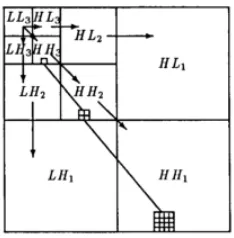
The filter banks in Wavelet consist of analysis bank and synthesis bank (Refer to Figure 1). The analysis bank has a low pass and high pass filter to separate the input signal into frequency band (downsampling) [4]. It breaks the input signal into 4 lower resolution components (Refer to Figure 2). They are given as LL (low resolution approxi-mate image), HL (intensity variation along column, hori-zontal edge), LH (intensity variation along row, vertical edge) and HH (intensity variation along diagonal). The LL can further be divided to obtain another level of divi-sion. This process can be repeated to perform a desired number of division levels [3].
The quantization is done on the decomposed image on different component to maximizing the amount of neces-sitate detail and ignoring ‘not-so-wanted’ details. Here, some coefficient value for pixel in image are thrown out or set to zero [5]. This is called as the thresholding process and it give some smoothing effect to the image.
In order to compress the image, Wavelet analysis can be used to divide the information of an image into ap-proximation and detail sub-signals. The apap-proximation sub-signal shows the general trend of pixel values, and three detail sub-signals show the horizontal, vertical and
————————————————
Nik Shahidah Afifi Md Taujuddin is with the Faculty of Computer Science and Information Technology, Universiti Tun Hussein Onn Malaysia, 86400 Parit Raja, Johor, Malaysia.
Rosziati Ibrahim is with the Faculty of Computer Science and Information Technology, Universiti Tun Hussein Onn Malaysia, 86400 Parit Raja, Johor, Malaysia.
[image:1.558.290.539.385.430.2]W
diagonal details or changes in the image. If these details are very small then they can be set to zero without signifi-cantly changing the image. The value below which details are considered small enough to be set to zero is known as the threshold. The greater the number of zeros the greater the compression that can be achieved [6].
In inverse of analysis bank, the synthesis bank will do the upsampling to reconstruct the original fine scale coef-ficient by combining the scale and wavelet coefcoef-ficients at lower coarser scale. During upsampling the value of zero will be inserted between 2 coefficients because during the downsampling, the every second coefficient is thrown away. Figure 3 show the general process of downsam-pling and upsamdownsam-pling in Wavelet packet composition.
Wavelet algorithm enables the computer to decompose an image into various levels with different-value resolu-tion. The apparent advantage is it enables to isolate and manipulate data with specific properties. For example, more vertical details is keep instead of keeping all the horizontal, diagonal detail when the image has more ver-tical aspect[7]. This will allow some unwanted value of horizontal and diagonal detail without degrading the quality of image in human perception.
The amount of information retained by an image after compression and decompression is known as the energy retained and this is proportional to the sum of the squares of the pixel values. If the energy retained is 100% then the compression is known as lossless as the image can be re-constructed exactly. This occurs when the threshold value is set to zero, meaning that the detail has not been changed. If any values are changed then energy will be lost and this is known as lossy compression. Ideally, dur-ing compression the number of zeros and the energy
re-tention will be as high as possible. However, as more ze-ros are obtained more energy is lost, so a balance between the two needs to be found.
2.1 Wavelet-Based Algorithm
There are many Wavelets generic being introduced now-adays. Sophisticated wavelets produce smoother and more satisfactory compressed image. It makes no as-sumption concerning periodicity of the data. As a result, Wavelets are suitable for demonstrating sharp changes or even discontinuities. Some of the common Wavelet meth-ods used in image processing are Haar Wavelet, EZW and SPHIT. While the extended versions that already be-ing well accepted in committee are WDR and ASWDR. Wavelets has offer great compression ratio without harm-ing the image quality and it became a solemn challenger to DCT[8].
2.2 Haar Wavelet
Haar Wavelet is a certain sequence of rescales ‘square-shaped’ function and the simplest wavelet. It is not con-tinuous therefore not differentiable, thus giving a good analysis on signal with sudden transition or discontinui-ty. As can be seen in Figure 4, Haar starts by averaging the pixel together to get new lower resolution image. To recover the original pixel from the averaged pixels some detail coefficient are stored. Repeating this process on the averages gives the full decomposition. Some of the nota-ble advantages of Haar are, it gives the best performance in term of computation time, memory efficient and can exactly reversible without the edge effect [9].
2.3 Embedded Zerotree Wavelet (EZW)
EZW was the first image coder that use zero-tree con-cept for significant-map information. It uses ‘parent-child’ dependencies between subband coefficients at same spa-tial location (Refer to Figure 4). It generates encoded bits in specific order of importance. It finds the largest coeffi-cient magnitude in 8 x 8 fixed block size image. Then ini-tial threshold is chosen based on the coefficient interval. Every single value of the pixel is then examined in the first dominant pass to determine the sign and the recon-struction value. It continues with first subordinate pass and second dominant pass with new threshold value to get more finer reconstructed magnitude value. EZW is using Discrete Wavelet Transform (DWT) to transform the image and embedded coding is done by using
[image:2.558.99.200.133.237.2]Succes-Fig. 2. Ideal decomposition of 2D spectrum [6]
Fig. 3. Upsampling and downsampling in Wavelet packet composition [6]
Fig. 4. Parent child dependencies of subbands [10]
[image:2.558.24.271.385.484.2] [image:2.558.356.472.442.566.2]sive Approximate Quantization (SAQ) [2] [10] .
2.4 Set Partitioning In Hierarchical Trees (SPIHT)
SPHIT algorithm is an extension of the EZW algo-rithm. It significantly improved the performance of its predecessor by changing the way subsets of coefficients are partitioned and how refinement information is ex-pressed (Figure 5). The uniqueness of SPHIT is its pactness. The bitstream from SPHIT algorithm is so com-pact that passing it through an entropy coder would only produce very insignificant gain in compression. No order-ing information is explicitly transmitted to the decoder. As an alternative, the decoder reproduces the execution path of the encoder and recovers the ordering infor-mation [11]. However, SPIHT have some limitation such as high-memory requirement, frequently repeat seeking process and also complex management of list.
2.5 Wavelet Different Reduction (WDR)
WDR is used to ease the transmission over small bandwidth by generating an embedded bit stream. It con-sists of 3 basic steps: Discrete Wavelet Transform, Differ-ential Coding and Binary coding. Significant transform value is indexed to facilitate Region of Interest (ROI) and compression process. After applying wavelet transform, difference reduction method based on their successive differences is applied. Encoding can be stopped at any point, allowing a target rate to be met accurately. To im-prove the compression performance, arithmetic coding technique is used. WDR produce low bit rate reconstruct image in affect of the decoding process can be terminated at any point.
2.6 Adaptive Scanned Wavelet Different Reduction (ASWDR)
ASWDR is the enhanced version of WDR algorithm addition with the new scanning orders that dynamically adapts to the location of edge details in intention to re-duce the length of symbol string for encoding the distanc-es and enhancdistanc-es the rdistanc-esolution of edgdistanc-es. The ASWDR method is well described in [12]. ASWDR suggests a bet-ter prediction scheme that will significantly reduce the coding output of WDR. The advantage of ASWDR is can protect the details at low bit rates and it was beneficial for medical imaging.
Table 1 shows the summary of five wavelet-based al-gorithms.
TABLE1
SUMMARY ON FIVE WAVELET-BASED ALGORTHMS
3 E
XPERIMENTALR
ESULTS ONW
AVELET-B
ASEDC
OMPRESSION METHODSThere are three sample standard images used for the experiment; Lena.bmp, Cameraman.tif and Barbara.bmp. The image dimension of Lena.bmp is 256 x 256, while Cameraman.tif and Barbara.bmp is 512 x 512. In this analysis, the images are compressed by Set Partitioning In Hierarchical Trees (SPIHT), Embedded Zerotree Wavelet (EZW), Wavelet Difference Reduction (WDR) and Adap-tively Scanned Wavelet Difference Reduction (ASWDR).
The quantitative and perceptual quality measures of the compression performance are done on the sample image. Qualitative measure is done via compression per-formance, that is evaluated using compression ratio (CR) and Bit-Per-Pixel (BPP). The compression ratio means the ratio of the original image size over the compressed im-age size, while the BPP is the number of bits required to store one pixel of the image [14].
For perceptual quality, Mean Square Error (MSE) and Peak Signal to Noise Ratio (PSNR) are used [15]. MSE represent the mean squared error between compresses and the original image, while PSNR stand for a measure of the peak error and is expressed in decibels [16].
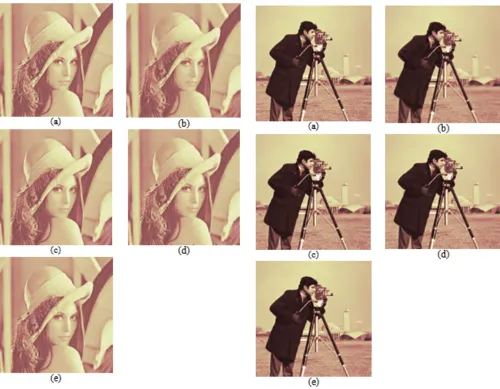
[image:3.558.91.208.108.227.2] [image:3.558.289.531.126.343.2]Figure 6 and Table 2 shows the subjective and objec-tive compressions performance of Lena image respecobjec-tive- respective-ly. It is difficult to observe any differences at all between any of these images. This illustrates that all compression methods produce equally good compressions at moder-ately high bit rates.WDR shows the greatest performance in compression ratio, PSNR, MSE and BPP compared to another 4 algorithm. In almost every case the PSNR and MSE value for EZW, WDR and ASDWR is the same. The-se numerical results are consistent with the increaThe-sed preservation of details within EZW, WDR and ASDWR.
Non-expert observer (engineering student) has com-mented that WDR and ASWDR compressed images (as can be seen in Figure 7) appear sharper than SPHIT and EZW compressed images. Human Visual System center of attention is on edges when analyzing images. The ASWDR and WDR compressions have higher edge corre-lation than SPIHT compression. The WDR compression ratio is slightly higher than ASWDR edge correlation as can be seen on Table 3.
TABLE2
QUANTITATIVE AND PERCEPTUAL QUALITY MEASURES OF C OM-PRESSION PERFORMANCE ON LENA IMAGE
TABLE3
QUANTITATIVE AND PERCEPTUAL QUALITY MEASURES OF C OM-PRESSION PERFORMANCE ON CAMERAMAN IMAGE Fig. 6. Compression of Lena (a) original (b) SPIHT compression
(c) EZW compression (d) WDR compression (e) ASWDR compression
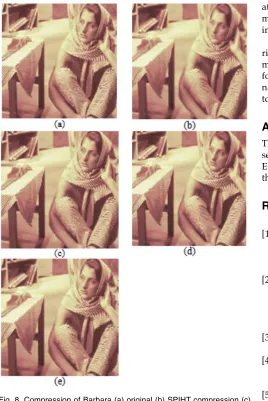
[image:4.558.34.534.60.449.2] [image:4.558.38.275.531.585.2]By referring to Figure 8 and Table 4, it can be noticed that the compression ratio and BPP of WDR for Barbara image is clearly superior to both ASWDR and SPHIT. While PSNR and MSE value for EZW, WDR and ASWDR retain the same.
C
ONCLUSIONBased on the four quality measures done on four type wavelet based compression algorithms, it shows that WDR is a promising method that provide improved preservation of details at low bit rates. Protecting details
at low bit rates is crucial for sensitive data such as remote medical diagnosis via rapid transmission of compressed image and rapid retrieval of image in databases.
The tree-based character of all wavelet-based algo-rithms applies to identical subband coding. Therefore, modification on prediction procedure should be per-formed to construct new scanning order that can elimi-nate blocking or edge effect. Extended research is a must to produce better quality of image.
A
CKNOWLEDGEMENTThe authors would like to thank the Universiti Tun Hus-sein Onn Malaysia (UTHM) and Malaysian Ministry of Education for providing the research grant for facilitating this research activity.
R
EFERENCES[1] J. Wang and K. Huang, “Medical image compres-sion by using three-dimencompres-sional wavelet trans-formation.,” IEEE transactions on medical imag-ing, vol. 15, no. 4, pp. 547–54, Jan. 1996.
[2] R. Loganathan and Y. S. Kumaraswamy, “Active Contour Based Medical Image Segmentation and Compression Using Biorthogonal Wavelet and Embedded Zerotree,” Indian Journal Science and Technology, vol. 6, no. April, pp. 4390–4395, 2013. [3] R. K. Sahi, “Image Compression Using Wavelet
Transform,” San Jose State University, 2002. [4] A. Skodras, C. Christopoulos, and T. Ebrahimi,
“The JPEG 2000 Still Image,” IEEE Signal Pro-cessing Magazine, no. September, pp. 36–58, 2001. [5] K. Pateriya, “Comparison of Image Compression
Through Neural,” Internationl Journal of Com-puter Science and Information Technology and Security, vol. 2, no. 1, pp. 152–159, 2012.
[6] E. Kofidis, N. Kolokotronis, A. Vassilarakou, S. Theodoridis, and D. Cavouras, “Wavelet-based medical image compression,” Future Generation Computer Systems, vol. 15, no. 2, pp. 223–243, 1999.
[7] C. Song, R. Feng, F. Liu, and X. Chen, “A Novel Fractal Wavelet Image Compression Approach,” Journal of China University of Mining and Tech-nology, vol. 17, no. 1, pp. 121–125, 2007.
[8] A. Bruckmann and A. Uhl, “Selective medical im-age compression techniques for telemedical and archiving applications.,” Computers in biology and medicine, vol. 30, no. 3, pp. 153–69, May 2000. [9] D. I. Belc, “A Hybrid Wavelet Filter for Medical
Image Compression,” Florida State University, Florida, 2006.
[10] J. M. Shapiro, “Embedded Image Coding Using Zerotrees of Wavelet Coefficients,” IEEE Transac-tions on Image Processing, vol. 41, no. 92, 1993. [11] A. Said, W. A. Pearlman, and S. Member, “A New
[image:5.558.26.294.59.460.2], Fast , and Efficient Image Codec Based on Set Partitioning in Hierarchical Trees,” vol. 6, no. 3,
Fig. 8. Compression of Barbara (a) original (b) SPIHT compression (c) EZW compression (d) WDR compression (e) ASWDR compression
TABLE4
1996.
[12] J. S. Walker, “Lossy image codec based on adap-tively scanned wavelet difference reduction,” Op-tical Engineering, vol. 39, no. 7, p. 1891, Jul. 2000. [13] J. Tian and R. Wells, “A Lossy Image Codec Based
on Index Coding,” IEEE Signal Processing Maga-zine, p. 456, 1996.
[14] S. . Subramanya, “Image compression,” IEEE Po-tentials, vol. 20, no. March, pp. 19–23, 2001. [15] A. Goel and A. Jain, “A method of suppressing
impulse noise using PIE-LT filter,” Journal of Computer Science and Engineering, vol. 3, no. 2, pp. 23–28, 2010.
![Fig. 1. Filter bank [1]](https://thumb-us.123doks.com/thumbv2/123dok_us/8773814.900278/1.558.290.539.385.430/fig-filter-bank.webp)
![Fig. 2. Ideal decomposition of 2D spectrum [6]](https://thumb-us.123doks.com/thumbv2/123dok_us/8773814.900278/2.558.356.472.442.566/fig-ideal-decomposition-d-spectrum.webp)