PREDICTING NOISE-INDUCED HEARING LOSS (NIHL) IN TNB WORKERS USING GDAM ALGORITHM
SYED MUHAMMAD ZUBAIR REHMAN GILLANI
A thesis submitted in fulfilment of the requirements for award of the Degree of Masters
In
Information Technology
Faculty of Computer Science and Information Technology University Tun Hussein Onn Malaysia
ABSTRACT
Noise is a form of a pollutant that is terrorizing the occupational health experts for many decades due to its adverse side-effects on the workers in the industry. Noise-Induced Hearing Loss (NIHL) handicap is one out of many health hazards caused due to excessive exposure to high frequency noise emitted from the machines. A number of studies have been carried-out to find the significant factors involved in causing NIHL in industrial workers using Artificial Neural Networks (ANN). Despite providing useful information on hearing loss, these studies have neglected some important factors.
The traditional Back-propagation Neural Network (BPNN) is a supervised Artificial Neural Networks (ANN) algorithm. It is widely used in solving many real time problems in world. But BPNN possesses a problem of slow convergence and network stagnancy. Previously, several modifications were suggested to improve the convergence rate of Gradient Descent Back-propagation algorithm such as careful selection of initial weights and biases, learning rate, momentum, network topology, activation function and ‘gain’ value in the activation function.
ix
Thyroid disease, Heart disease, Breast Cancer, Pima Indian Diabetes, Wine Quality, Australian Credit-card approval problem and Mushroom problem.
TABLE OF CONTENT
ACKNOWLEDGEMENT...vii
ABSTRACT ... viii
TABLE OF CONTENT ... x
LIST OF AWARDS ... xiv
LIST OF PUBLICTIONS ... xv
LIST OF TABLES ... xvii
LIST OF FIGURES ... xix
LIST OF SYMBOLS AND ABBREVIATIONS ... xxii
LIST OF APPENDICES ... xxiv
CHAPTER 1 ... 1
INTRODUCTION ... 1
1.1 Background of the Research... 1
1.2 Problem Statement ... 3
1.3 Objectives of the Study ... 4
1.4 Scope of the Study ... 4
1.5 Significance of the Study ... 5
1.6 Thesis Outline ... 6
CHAPTER 2 ... 8
LITERATURE REVIEW ... 8
2.1 Introduction ... 8
2.2 Sound ... 9
2.2.1 Measurement of Sound ... 9
2.2.2 Noise ... 10
2.3 Audiology and Noise-Induced Hearing Loss (NIHL) ... 11
2.3.1 Hearing Impairment ... 12
2.4 How to Determine the Hearing Loss ... 14
xi
2.4.2 Hearing Loss due to Noise Pollution Worldwide ... 17
2.4.3 Hearing Loss due to Noise Pollution in Malaysia ... 21
2.5 Artificial Neural Networks (ANN) ... 23
2.6 Multilayer Perceptrons Artificial Neural Networks (MLP-ANN) ... 24
2.7 Back Propagation Neural Network (BPNN) ... 26
2.8 BPNN with Momentum Coefficient
α ... 272.9 Hearing Loss Observation using Artificial Neural Networks ... 29
2.10 Summary ... 31
CHAPTER 3 ... 32
RESEARCH METHODOLOGY... 32
3.1 Introduction ... 32
3.2 The Proposed GDAM Algorithm ... 35
3.3 The Derivation of GDAM Algorithm ... 35
3.4 Data Collection ... 38
3.5 Variable Selection ... 38
3.6 Data Pre-Processing ... 39
3.7 Data Partitioning ... 40
3.8 Network Architecture ... 40
3.9 Performance Comparison ... 41
3.10 Accuracy Measurement ... 42
3.11 Summary ... 43
CHAPTER 4 ... 44
SIMULATION RESULTS AND ANALYSIS ON CLASSIFICATION PROBLEMS ... 44
4.1 Introduction ... 44
4.2 Preliminaries ... 45
4.3 Wine Quality Classification Problem ... 46
4.4 Mushroom Classification Problem ... 47
4.5 Thyroid Disease Classification Problem ... 49
4.6 Breast Cancer (Wisconsin) Classification Problem ... 50
4.7 IRIS Classification Problem ... 52
4.8 Australian Credit Card Approval Classification Problem ... 53
4.10 Heart Disease Problem ... 56
4.11 Summary ... 58
CHAPTER 5 ... 59
PREDICTING HEARING DETERIORATION IN TNB WORKERS ... 59
5.1 Introduction ... 59
5.2 Preliminaries ... 60
5.3 Hearing Loss Prediction Accuracy using GDAM ... 61
5.3.1 Noise-Induced Hearing Loss (NIHL) in Worker 1 ... 63
5.3.2 Noise-Induced Hearing Loss (NIHL) in Worker 2 ... 65
5.3.3 Noise-Induced Hearing Loss (NIHL) in Worker 3 ... 66
5.3.4 Noise-Induced Hearing Loss (NIHL) in Worker 11 ... 67
5.3.5 Noise-Induced Hearing Loss (NIHL) in Worker 12 ... 68
5.3.6 Noise-Induced Hearing Loss (NIHL) in Worker 13 ... 69
5.3.7 Noise-Induced Hearing Loss (NIHL) in Worker 14 ... 70
5.3.8 Noise-Induced Hearing Loss (NIHL) in Worker 15 ... 72
5.3.9 Noise-Induced Hearing Loss (NIHL) in Worker 16 ... 73
5.3.10 Noise-Induced Hearing Loss (NIHL) in Worker 17 ... 74
5.4 Hearing Loss Observation in TNB Workers using HDI ... 75
5.5 Summary ... 78
CHAPTER 6 ... 79
Conclusions Contributions and Future Works ... 79
6.1 Summary ... 79
6.2 Recommendation for Future Works ... 81
REFERENCES ... 83
APPENDIX ... 93
APPENDIX A: Gantt-Chart of Project Activities ... 94
xvii
LIST OF TABLES
TABLE TITLE PAGE
2.1 Common sources of Noise in daily life (Rabinowitz, 2000).
13
4.1 Algorithm Performance for Wine Quality Problem (Cortez et al., 2009).
45
4.2 Algorithm Performance for Mushroom Problem (Schlimmer, 1987).
47
4.3 Algorithm Performance for Thyroid Disease (Quinlan et al., 1986).
48
4.4 Algorithm Performance for Breast Cancer Problem (Wolberg & Mangasarian, 1990).
50
4.5 Algorithm Performance for IRIS Problem (Fisher, 1936). 51 4.6 Algorithm Performance for Australian Credit Card
Approval (Quinlan, 1987).
53
4.7 Algorithm Performance for Pima Indians Diabetes Problem (Smith et al., 1988).
54
4.8 Algorithm Performance for Heart Disease Problem (Detrano, et al., 1989).
56
5.1 TNB workers (1-3, 11-17) for NIHL prediction using GDAM algorithm.
60
5.2 Accuracy (%),MSE and Correlation Coefficient (R) Values For Left and Right Hearing Loss Predictions.
61
Worker 1.
5.4 GDAM Performance on Actual and Predicted Data on Worker 2.
64
5.5 GDAM Performance on Actual and Predicted Data on Worker 3.
65
5.6 GDAM Performance on Actual and Predicted Data on Worker 11.
66
5.7 GDAM Performance on Actual and Predicted Data on Worker 12.
67
5.8 GDAM Performance on Actual and Predicted Data on Worker 13.
68
5.9 GDAM Performance on Actual and Predicted Data on Worker 14.
70
5.10 GDAM Performance on Actual and Predicted Data on Worker 15.
71
5.11 GDAM Performance on Actual and Predicted Data on Worker 16.
72
5.12 GDAM Performance on Actual and Predicted Data on Worker 17.
73
5.13 Hearing Loss observations made using Hearing Deterioration Index (HDI) on selected workers of TNB.
xix
LIST OF FIGURES
FIGURE TITLE PAGE
2.1 Perception of Sound in Mammals and other species. 9 2.2 Anatomy of the Human Ear (Chittka & Brockmann,
2005).
11
2.3 Comparison of damaged and intact hair cells in Cochlea (Chittka & Brockmann, 2005).
12
2.4 Hearing threshold shift (Audiometry) (Morioka, Miyashita, & Takeda, 1997).
14
2.5 Audiogram of a Worker in the year 1995 and 2000 (Yahya & Ghazali, 2006).
15
2.6 Hearing damage as a function of exposure (Bies & Hansen, 2003).
17
2.7 Multilayer Perceptron-Artificial Neural Network (MLP-ANN).
25
2.8 Schematic error functions for a single parameter w, showing four stationary points, at which . point A is a local minimum, point B is local maximum, point C is a saddle point and, and D is the global minimum (Nazri, 2007).
26
4.1 Comparison of average Accuracy and Mean No. of Epochs required for convergence using the GDM, GDM-AG and GDAM algorithms for Wine Quality classification problem.
46
4.2 Comparison of average Accuracy and Mean No. of Epochs required for convergence using the GDM, GDM-AG and GDAM algorithms for Mushroom classification problem.
47
4.3 Comparison of average Accuracy and Mean No. of Epochs required for convergence using the GDM, GDM-AG and GDAM algorithms for Thyroid disease classification problem.
49
4.4 Comparison of average Accuracy and Mean No. of Epochs required for convergence using the GDM, GDM-AG and GDAM algorithms for Breast Cancer classification problem.
50
4.5 Comparison of average Accuracy and Mean No. of Epochs required for convergence using the GDM, GDM-AG and GDAM algorithms for IRIS classification problem.
52
4.6 Comparison of average Accuracy and Mean No. of Epochs required for convergence using the GDM, GDM-AG and GDAM algorithms for Australian Credit Card Approval classification problem.
53
4.7 Comparison of average Accuracy and Mean No. of Epochs required for convergence using the GDM, GDM-AG and GDAM algorithms for Pima Indians Diabetes classification problem.
55
4.8 Comparison of average Accuracy and Mean No. of Epochs required for convergence using the GDM, GDM-AG and GDAM algorithms for Pima Indians Diabetes classification problem.
xxi
5.1 GDAM Training/Testing Performance for Hearing Loss Prediction on Left Ear using TNB dataset.
61
5.2 GDAM Training/Testing Performance for Hearing Loss Prediction on Right Ear using TNB dataset.
61
5.3 Noise-Induced Hearing Loss (NIHL) Prediction on Right and Left Ears for Worker 1.
62
5.4 Noise-Induced Hearing Loss (NIHL) Prediction on Right and Left Ears for Worker 2.
63
5.5 Noise-Induced Hearing Loss (NIHL) Prediction on Right and Left Ears for Worker 3.
65
5.6 Noise-Induced Hearing Loss (NIHL) Prediction on Right and Left Ears for Worker 11.
67
5.7 Noise-Induced Hearing Loss (NIHL) Prediction on Right and Left Ears for Worker 12.
68
5.8 Noise-Induced Hearing Loss (NIHL) Prediction on Right and Left Ears for Worker 13.
69
5.9 Noise-Induced Hearing Loss (NIHL) Prediction on Right and Left Ears for Worker 14.
70
5.10 Noise-Induced Hearing Loss (NIHL) Prediction on Right and Left Ears for Worker 15.
71
5.11 Noise-Induced Hearing Loss (NIHL) Prediction on Right and Left Ears for Worker 16.
73
5.12 Noise-Induced Hearing Loss (NIHL) Prediction on Right and Left Ears for Worker 17.
74
5.13 Hearing Deterioration Index (HDI) found in Worker 13-17 for minimum, average and maximum sound pressure levels.
LIST OF SYMBOLS AND ABBREVIATIONS
ANN - Artificial Neural Networks
BMI - Body-Mass-Index
BPNN - Back-Propagation Neural Network
BPAM - Back-Propagation with Adaptive Momentum
DOSH - Department of Occupational Safety and Health, Malaysia GDAM - Gradient Descent with Adaptive Momentum
GDM - Gradient Descent with Momentum
GDM-AG - Gradient Descent with Momentum and Adaptive Gain HDI - Hearing Deterioration Index
high - highest value in the interval [0,1]
Hz - Hertz
KHz - Kilo-Hertz
L - lower bound
low - lowest value in the interval [0,1] LHL - Left Hearing Loss
MLP-ANN - Multilayer Perceptrons Artificial Neural Networks NIHL - Noise-Induced Hearing Loss
NIOSH - National Institute of Occupational Safety and Health PTS - Permanent Threshold Shift
rand - Random number generator built-in function of Matlab RHL - Right Hearing Loss
RSI - Rothman Synergy Index SPL - Sound Pressure Level TNB - Tenaga Nasional Berhad TTF - Time-To-Failure
TTS - Temporary Threshold shift
xxiii
k
t - Desired output of the kth output unit k
O - Network output of the kth output unit k
- Momentum coefficient j
O - Output of the jth unit i
O - Output of the ith unit ij
w - Weight of the link from unit i to unit j jk
w - Weight of the link from unit j to unit k net
w - Total Network Weights
j net
a , - Net input activation function for the j th
unit j
- Bias for the jth unit new
y - new value obtained old
y - old value in the data
max
y - maximum and minimum of the old data range min
y - minimum of the old data range
i
T - predicted data
i
A - actual data
n - total number of input patterns
N - Number of values or elements '
X - first score
i
x - number of input patterns
'
Y - second score
i
y - predicted patterns
% - percentage sign
LIST OF APPENDICES
APPENDIX TITLE PAGE
A Gantt-Chart of Project Activities 92
CHAPTER 1
INTRODUCTION
1.1 Background of the Research
In the last three decades, Malaysian Industry has progressed a lot and has not only benefited Malaysian citizens in many ways but it also has caused adverse health effects on the Malaysian industrial workers. One of the major occupational health problems that an Industrial worker faces today is Noise-Induced Hearing Loss (NIHL). Noise-Induced Hearing Loss (NIHL) usually occurs due to continuous exposure to the noise levels of 90 plus decibels emitting from the heavy machines.
Human ear plays a vital role in the human body; it is not only a source of hearing in humans but it also helps human body in maintaining its balance. Any problem with the hearing ability damages the human’s life by reducing the quality of communication (Zaheeruddin & Jain, 2004). Noise-Induced Hearing Loss (NIHL) can be categorised as temporary or permanent, depending on how much sensorineural loss has occurred in the patient. Usually Noise-Induced Hearing Loss (NIHL) progresses unnoticed until it began to interfere with the communication and thus decreases the quality of life.
Seeing Noise-Induced Hearing Loss (NIHL) as a growing problem in the Malaysian Industry, Factories and Machinery (Noise Exposure) Regulations, 1989 has been passed by Department of Occupational Safety and Health, Malaysia (DOSH) in order to control the level of noise to permissible limits. In line with this, employers are required to abide the following stated regulations;
I. No Employee shall be exposed to noise level exceeding equivalent continuous
sound level of 90 dB (A) or exceeding the limits specified in the first schedule
or exceeding the daily dose of unity.
II. No employee shall be exposed to noise level exceeding 115dB (A) at any time.
III. No employee shall be exposed to impulsive noise exceeding a peak sound
pressure level of 140 dB(A).
3
information about the form of function (Zheng, Meng, & Gong, 1992, Kosko, 1994, Basheer & Hajmeer, 2000, Krasnopolsky & Chevallier, 2003, Coppin, 2004).
Artificial Neural Networks (ANN) techniques, particularly Back-Propagation Neural Network (BPNN) algorithm has been widely used as a tool for discovering a mapping function between a known set of input and output examples. Despite providing effective solutions, the training process for an Back-Propagation Neural Network (BPNN) entail the designer to arbitrarily select parameters such as network topology, initial weights and biases, learning rate value, the activation function, value for gain in activation function and momentum. An improper choice of any of these parameters can result in slow convergence or even network paralysis, where the training process comes to a standstill or get trapped at local minima. Therefore, this research focuses on using Back-Propagation Neural Network (BPNN) model with an improvement on the momentum value to predict Noise-Induced Hearing Loss (NIHL) in industrial workers. Results from the prediction will be used in determining the noise hazards which directly influence the worker’s health.
1.2 Problem Statement
proposed algorithm by comparing with the conventional BPNN algorithm and GDM-AG proposed by Nazri (2007), on selected classification problems. This study will prove the effectiveness of the proposed algorithm by predicting the Noise-Induced Hearing Loss (NIHL) in the workers of Tenaga National Berhad (TNB).
1.3 Objectives of the Study
This study encompasses the following three objectives:
i. To propose an improved algorithm which improves the accuracy in the existing GDM-AG (Nazri, 2007) algorithm by choosing the optimal values for momentum coefficient.
ii. To assess the performance accuracy of the proposed algorithm with the conventional BPNN and GDM-AG algorithms on selected benchmark classification problems.
iii. To validate the proposed algorithm in predicting NIHL in Malaysian Industrial workers by using TNB data sets.
1.4 Scope of the Study
5
1.5 Significance of the Study
1) The ‘Gradient Descent Adaptive Momentum (GDAM)’ is proposed in this study. GDAM uses adaptive momentum to remove oscillations in the gradient path by making the path much smoother whereas GDM-AG uses ‘adaptive gain’ to add more slopes to the gradient path to avoid local minima problem (Rehman, Nazri, Ghazali, 2011).
2) In the first phase, this study investigates the accuracy of the proposed GDAM algorithm with the GDM-AG (Nazri, 2007) and the conventional BPNN algorithms. The performance of GDAM is verified by means of simulation on the eight classification problems. The final results show significant improvements in the convergence rate and thus pave way for GDAM to be used as an alternate approach to GDM-AG (Nazri, 2007).
3) In the second phase, this study predicts Noise-Induced Hearing Loss (NIHL) in Tenaga Nasional Berhad (TNB) workers in order to improve the deteriorating health condition of industrial workers in Malaysia. At present, BPNN is not widely utilized for predicting NIHL in industrial workers. So far, the studies (Yahya & Ghazali, 2006) used to predict NIHL have not achieved high accuracy in predicting NIHL.
1.6 Thesis Outline
This thesis is subdivided into six chapters including the introduction and conclusion chapters. The following is the outline of each chapter.
Besides providing an outline of the thesis, Chapter 1 contains the overview on the background of the study, scope of the study, objectives and significance of the research undertaken.
Chapter 2 reviews the previous studies made on back-propagation neural network (BPNN), its applications and problems with training efficiency are discussed. The problem of slow convergence and the use of adaptive gain value by Nazri (2007) to speed-up convergence training of BPNN are also noted. Studies on noise and hazards related to noise especially Noise-Induced Hearing loss (NIHL) are acknowledged globally and locally. This chapter also reviews the previous contributions made by various researchers on predicting NIHL using neural networks. In the end, this chapter discusses the possibility of modifying the GDM-AG algorithm by introducing adaptive momentum in it to predict NIHL in humans with more accuracy.
On the foundations laid by Chapter 2, Chapter 3 present an improved and efficient gradient descent with adaptive momentum (GDAM) algorithm to increase the accuracy of the existing GDM-AG algorithm with gain introduced by Nazri (2007), by choosing the optimal values for momentum coefficient. Other sections elaborate on the data collection, data partitioning, pre-processing, post-processing, network architecture and performance comparison of the proposed GDAM algorithm with GDM-AG and conventional BPNN algorithms.
7
In Chapter 5, the proposed GDAM algorithm is further validated for its accuracy and efficiency on real dataset on NIHL obtained from TNB. The NIHL is predicted with high accuracy and hearing deterioration indexes (HDI) of the selected workers are calculated. Again the comparison of the results generated by GDAM is done with GDM-AG and conventional BPNN algorithms.
CHAPTER 2
LITERATURE REVIEW
2.1 Introduction
9
2.2 Sound
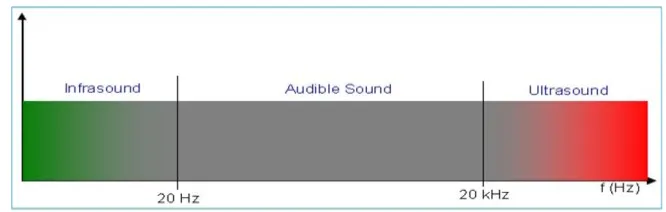
[image:23.612.157.490.340.446.2]Sound may be defined in terms of either psychological or physical phenomena. In the psychological sense a sound is an auditory experience- the act of hearing something. In the physical sense sound is a series of disturbances of molecules within, and propagated through, an elastic medium such as air (Martin & Clark, 2012). When sound is propagated it carries useful information such as voice, music and so on. But, it also carries unwanted elements like noise which can be further divided into vexation and prosaic (Yahya & Ghazali, 2006). National Institute of Occupational Safety and Health (NIOSH) classifies sound on the basis of varying sound sensitivity among different animal species. These ranges are categorized as infrasonic (0-20 Hz), audible (20Hz-20KHz), and ultrasonic (greater than 20KHz) as shown in the figure 2.1.
Figure 2.1: Perception of Sound in Mammals and other species
2.2.1 Measurement of Sound
Sound Pressure Level (SPL) is measured in decibels (dB) and expressed mathematically as:
dB p p SPL
re
2
2 10 log
10 (2.1)
where;
SPL : Sound Pressure Level (dB) re
p : Reference sound pressure (2105Pa)
p : Sound pressure of the source
2.2.2 Noise
The word “Noise” is derived from the Latin word “Nausea” meaning sea sickness. Noise is considered as an intense sound by people but strictly speaking noise is a non-harmonic and non-periodical sound without having any agreeable music quality. The sound called noise, can be thus additionally alternating, multi-frequency and impulsive in nature. In short, noise is a wrong sound, in the wrong place and at the wrong time (Singal, 2005).
11
2.3 Audiology and Noise-Induced Hearing Loss (NIHL)
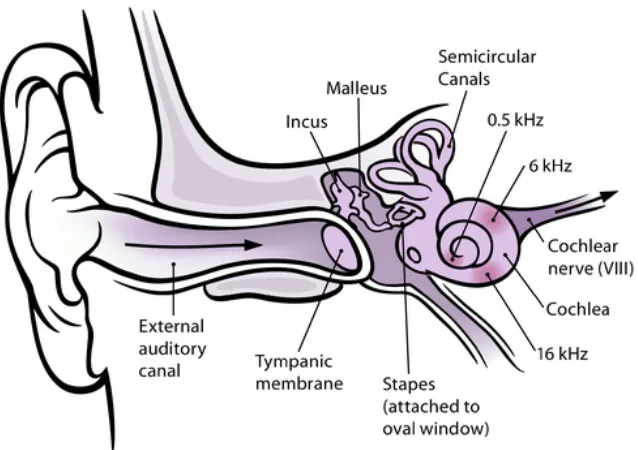
[image:25.612.159.478.368.593.2]Audiology is the study of hearing, balance and related disorders and the organ involved in hearing is the ear which works on the basic principles of mechanical energy. A human ear consists of three parts, the outer ear, the middle ear, and the inner ear. Sound pressure waves enter the outer ear and travel through the ear canal to the middle ear. The ear canal channels the waves to the eardrum, a thin, sensitive membrane stretched tightly over the entrance to your middle ear. The waves cause your eardrum to vibrate. It passes these vibrations on to three tiny bones in your ear causing them to vibrate and pass the mechanical signals into the inner ear. The cochlea, which is shaped like a shell contains hundreds of special cells (hair cells) attached to nerve fibers, which then transmit information of nerve impulses to the brain via the auditory nerves (Sataloff & Sataloff, 2006) (Martin & Clark, 2012). The anatomical structure of the ear is shown in the Figure 2.2.
Figure 2.2: Anatomy of the Human Ear (Source: Chittka & Brockmann, 2005)
hair cells of the basilar membrane of the cochlea in the inner ear; when excessive, these forces can cause cell death (Rabinowitz, 2000). Figure 2.3, shows the comparison of healthy hair cells in cochlea with the damaged ones.
Figure 2.3: Comparison of damaged and intact hair cells in Cochlea (Source: Chittka & Brockmann, 2005)
Noise-Induced Hearing Loss (NIHL) is of two types, reversible and irreversible. Reversible NIHL is called temporary threshold shift (TTS) while permanent NIHL is called permanent threshold shift (PTS). When a person is exposed to excessive noise for longer duration of time, then temporary threshold shift (TTS) occurs. A person with temporary threshold shift (TTS) usually recovers over a period of 16-48 hours. But if the person is continuously exposed to high intensity noise, permanent injury such as breaks in rootlet structures, mixing of endolymph and perilymph, hair cell apoptosis and degeneration of cochlear nerve fibres may result. This causes a permanent threshold shift (PTS) (Mitchell & McCombe, 2009).
2.3.1 Hearing Impairment
Clinically, NIHL begins with a temporary threshold shift (TTS). The extent of the temporary threshold shift (TTS) is related to noise intensity, frequency and temporality (Mitchell & McCombe, 2009). Noise can cause permanent threshold shift (PTS) at chronic exposures equal to an average Sound Pressure Level (SPL) of 85 dB (A) or higher for an eight-hour period. Based on the logarithmic scale, a 3 dB increase in Sound Pressure Level (SPL) represents a doubling of the sound intensity.
13
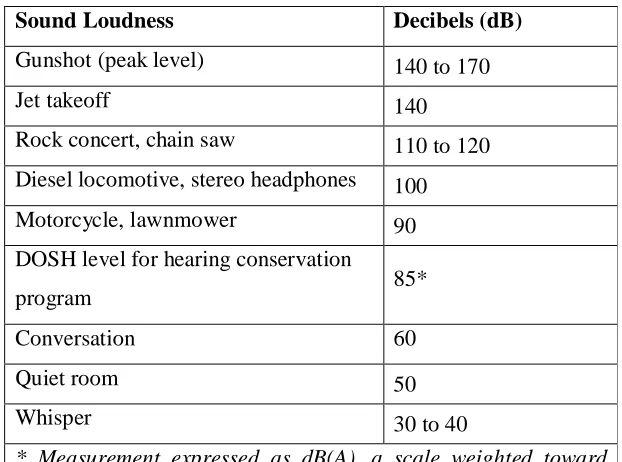
[image:27.612.170.481.219.450.2]Therefore, four hours of noise exposure at 88 dB(A) is considered to provide the same noise "dose" as eight hours at 85 dB(A), and a single gunshot, which is approximately 140 to 170 dB(A), has the same sound energy as 40 hours of 90-dB(A) noise (Rabinowitz, 2000). Table 2.1 describes the common sources of noise that we experience knowingly or unknowingly in our environment.
Table 2.1: Common sources of Noise in daily life (Source: Rabinowitz, 2000)
Sound Loudness Decibels (dB)
Gunshot (peak level) 140 to 170
Jet takeoff 140
Rock concert, chain saw 110 to 120 Diesel locomotive, stereo headphones 100
Motorcycle, lawnmower 90
DOSH level for hearing conservation
program 85*
Conversation 60
Quiet room 50
Whisper 30 to 40
* Measurement expressed as dB(A), a scale weighted toward sounds at higher frequencies. 8-hour time-weighted average.
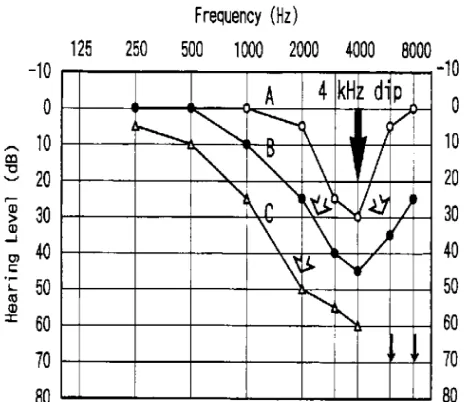
Continuous exposure to noise of high frequency causes Noise-Induced hearing Loss (NIHL) at 4KHz. As the noise exposure continues, the 4KHz notch deepens and damages other higher frequencies (Morioka, Miyashita, & Takeda, 1997)(Rabinowitz, 2000) (Mitchell & McCombe, 2009).
Figure 2.4: Hearing threshold shift (Audiometry) (Source: Morioka, Miyashita, & Takeda, 1997)
2.4 How to Determine the Hearing Loss
Hearing loss can happen to anyone belonging to any age group. Whether an infant or an adult, if exposed to high frequency noise for a long duration of time then Noise-Induced Hearing Loss (NIHL) deficit can be experienced by anyone. Hearing Impairment can be found on both ears or on one, a person experiencing hearing loss may find it difficult to interpret words at low or high frequencies and ultimately quality of life will be affected due to ill-perception of sounds (Patel & Ingle, 2008) (Yahya & Ghazali, 2006).
15
Figure 2.5: An Audiogram of a TNB Worker in the year 1995 and 2000 (Source: Yahya & Ghazali, 2006)
2.4.1 Hearing Loss Observation using HDI
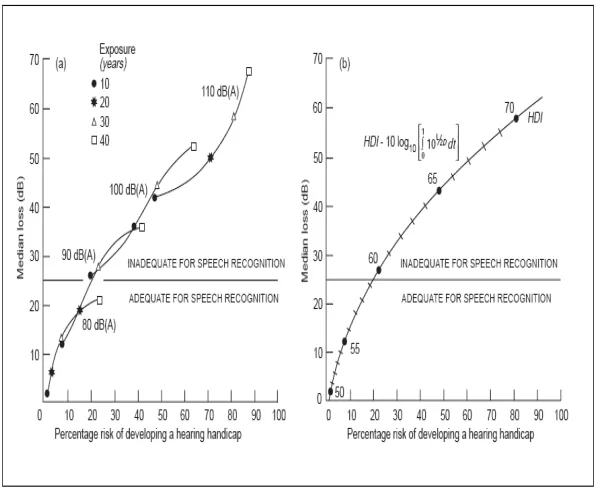
There are scientific correlations between the noise levels, exposure, and hearing damage risk. Extensive work undertaken in Dresden, Germany (Kraak, 1981) shows the percentage risk of developing a hearing handicap and the median loss incurred with exposure as (Leong, 2003)(Bies & Hansen, 2003):
a) a function of mean sound pressure level in the workplace (dBA) and exposure (years).
b) a function of hearing deterioration index, HDI. The formula is shown below:
t L dt HDI 0 20 / 10 10 log10 (2.2)
where;
HDI stands for hearing deterioration index,
L is the mean exposure level (dBA), and t is the time exposure.
17
Figure 2.6: Hearing damage as a function of exposure (Source: Bies & Hansen, 2003)
2.4.2 Hearing Loss due to Noise Pollution Worldwide
Noise-Induced Hearing Loss (NIHL) is rated among the top-10 work related and most prevalent occupational health hazard (Borchgrevink, 2003) caused due to excessive exposure to high frequency noise emitting from the machines in the industry (Rehman, Nazri and Ghazali, 2011). Due to the severe nature of hearing handicap experienced by Noise-Induced Hearing Loss (NIHL) patients, it is extensively studied throughout the world since the late 18th century using different analytical methods and techniques. In the recent years, developed countries have been able to control Noise-Induced Hearing Loss (NIHL) to an extent in the working environment. But Noise-Induced Hearing Loss (NIHL) still exists as a living menace to a worker’s health in an industry.
(NIHL) is often not considered as a major health problem and often neglected (Debray, Mishra, & Ghosh, 2002). Either the machines used are very old and not well-maintained or the working environment is very poor in the industry (Patel & Ingle, 2008). Currently, the labour inside the steel rolling mills, bottling factories, mining industry, power plants, forging and the weaving units are highly affected by Noise-Induced Hearing Loss (NIHL). This situation demands for the emergency implementation of the laws and regulations by the enforcement officers inside the industry. Also, this situation stresses on the review of practices and methods used by the occupational health experts to identify Noise-Induced Hearing Loss (NIHL) in an industry more accurately, as the variables involved now are far greater as they were a century before.
Since the industrial revolution in the developed countries like America, Noise-Induced Hearing Loss (NIHL) is acknowledged as the second most common occupation disease after presbycusis (age related hearing loss). An estimated 28 million case of partial hearing impairment are reported until the end of the 20th century. While 10 million people have hearing loss caused due to excessive noise caused in the workplace or in the recreational activities. Besides Noise-Induced Hearing Loss (NIHL), the economic costs of occupational hearing loss are estimated to be in billions of dollars (Rabinowitz, 2000).
Palmer et al. (2002) discovered severe hearing deficit in the 153,000 male and 26,000 female workers in Great Britian. The problem was again associated with the lack of noise control both at the receiver and the source. In France Riviere et al.
19
Prevalence of Noise-Induced Hearing Loss (NIHL) was found quite significant among the workers in the lime-stone mining industry located in the eastern part of Turkey. Work experience, noise levels and miners age were considered as the variables involved in causing Noise-Induced Hearing Loss (NIHL). Out of 23 employees who were running different operations and working on different sites, crushing workers and lorry drivers were the ones expreiencing high hearing loss on both ears. Although, lorry drivers were exposed to a daily noise dose of 70-79 dB(A) but middle-aged drivers were the ones experiencing hearing loss. Also, stone crushing plant workers, exposed to a daily noise dose of 90-99 dB(A) with a work experience of 4-11 years were among the ones experiencing Noise-Induced Hearing Loss (NIHL) (Onder, Onder, & Mutlu, 2011).
Noise-Induced Hearing Loss (NIHL) is considered as a major threat to the health of the workers in the continent of Africa. Audiometric experts from the valley of Nile have greatly contributed to the field of occupational hearing loss. In Cairo, Egypt, the major sources of noise are the industrial complexes located at the northern and southern parts of the city. Multiple studies were done in 1984, 1988 and 1991 to measure Noise levels in Cairo and Amman.The studies were conducted in the commercial areas for 10-hour periods. The noise levels reached a peak of 92dB(A), varying to 76dB(A) from noon to 3 p.m. In 1984, workers in a forge-hammering plant also showed significant hearing threshold-shift in the 2-4 KHz range. While in Amman, Jordan, noise levels reached a peak of 81dB(A) from 8a.m. to 12noon which is quite low if compared with Egypt (World Health Organization (WHO): Prevention of Noise-Induced Hearing Loss, 1997).
not under the control of the company may affect the employee as well. Ologe, Akande, & Olajide (2006), studied Noise-Induced Hearing Loss (NIHL) on 150 subjects in a steel rolling mill in Nigeria. During the noise mapping of the workplace the minimum noise level was 49 dB(A) while maximum noise level was found to be at 93 dB(A). About 28.2 percent worker were reported with mild to moderate hearing loss in the better ear while 56.8 percent had mild to moderate hearing loss in their worse ears. All the workers showed considerable hearing threshold shifts at 4KHz due to increasing noise exposure.
In Asia, countries like Pakistan, Iran, India, Taiwan, and Thailand are trying their best to avoid work related injuries in the factories. Despite every effort the prevalence of Noise-Induced Hearing Loss (NIHL) is still growing and a lot of blue collared employees are identified with severe hearing losses. And thus the quality of life is deteriorating instead of becoming better for the middle class people in these countries. In Pakistan, Industrial Noise is greatest in steel mills, large textile industries and in bottling factories. Ashraf et al. (2009) found the non-permissible noise levels of 88.4- 104dB (A) in the weaving units of five textile industries in Karachi Pakistan. This cross-sectional audiometric study included 248 worker exposed to noise for some time period. It was observed that hearing loss was greatly increasing due to overtime and long duration of work such as prolong period of 10 years. Attarchi, Labbafinejad, and Mohammadi (2010) indicated smoking as a new variable in accelerating hearing loss during a NIHL study on 478 employees working in an automobile company in Iran.
21
Chou, Lai, & Kuo (2009) found the occurrence of Noise-Induced Hearing Loss (NIHL) among the workers of a large semi-conductor factory in Taiwan. The 218 workers exposed to fluctuating noise levels of 80-90 dB(A) showed significant notches at 4KHz frequency. Besides high noise other factors such as chemicals and gases like Toulene, carbon monoxide and carbon disulphide were found to have an added effect on hearing loss.
Since the last two decades, Thailand started becoming a semi-industrialized country. In Bangkok the noise become a problem due to traffic, construction and industry. The National Environmental Board of Thailand has recommended levels of 85 dB(A) for 8 hours shift. But the noise problem is not solved because of the lack of public awareness of the effect of noise on hearing and the difficulties in controlling noise. A recent study for the National Committee on Noise Pollution Control measured noise exposure and hearing impairment in various occupational groups and found 21.1 to 37.7 % with Noise-Induced Hearing Loss (NIHL) (World Health Organization (WHO): Prevention of Noise-Induced Hearing Loss, 1997).
2.4.3 Hearing Loss due to Noise Pollution in Malaysia
In the past 30 years, Malaysian Industry has progressed a lot and emerged as a key player in maintaining the economical stability. Despite providing efficient solutions for Malaysian economical progress most of the major industries face a nemesis in the form of Noise. The high frequency noise emitted from the machines is causing adverse side-effects to the health of the blue-collared employees. One of the most common health injury caused due to exposure to high frequency noise is known as Noise-Induced Hearing Loss (NIHL).
stations were producing the noise within permissible limit and according to the Factories and Machinery Act 1967(Noise Exposure 1989). The noise producing stations were Engine room, nut braking room, kernel plant, Winding, external, and internal boilers. Also the questionnaire given to 32 workers indicated that 19 percent of workers were having Tinnitus (continuous ringing in the ears) while other 13 percent workers were having Noise-Induced Hearing Loss (NIHL) on one or both ears. In the results, he suggested strict use of ear-muffs by all the workers in the facility to reduce strain to ears due to exposure to high noise levels.
In another study on Power Plant Noise Analysis at Stesen Janakuasa Sultan Ismail, Paka, Terengganu, Rizal (2002) indicated that steam turbine, gas turbine, boiler, and pump stations produced noise levels of more than 90 decibels. The highest Sound Pressure Level (SPL) was recorded at Gas Turbine Station which was between 94.4-101.9 dB(A). Also, the audiometric results showed that 39.6 percent workers out of a selected 37 workers had developed Noise-Induced Hearing Loss (NIHL). He also suggested removing noise both at the source and at the receiver.
In a similar cross-sectional study, Mohd. et al. (2004) tried to find hearing impairment in 261 workers due to noise exposure at Power Stations in Sarawak. The purpose of this study was to determine the prevalence of hearing impairment among these workers and factors associated with it. Age, duration of employment and types of electricity generators used in the power stations were factors found to be significantly associated with hearing impairment. The water-turbine generator produced less noise and had resulted in lower prevalence of hearing impairment (39.4%) when compared with that of the gas-turbine type (58.3%) which was producing more noise. Logistic regression analysis shows that duration of employment variable has significantly contributed to the hearing impairment. This study raises high concerns on the prevalence of hearing loss among workers. And also asks for the aggressive implementation of hearing conservation programs.
23
working in rubber product manufacturing, metal stamping, publication and printing industries. A questionnaire consisting of all the negative aspects of noise on humans was distributed among the workers and the responses were collected for analysis. In the results, Chi-Square test indicated that the physiological, hearing loss, auditory and sleep disturbance effects of noise were statistically significant while the psychological effects were found to be insignificant.
Rus et al. (2008) in a most recent study tried to unearth the knowledge, attitude, and practice of sawmill workers towards Noise-Induced Hearing Loss (NIHL). For the purpose of study, a total of 83 workers were selected in Kota Bharu, Kelantan. Age, sex, duration of working years, smoker, non-smoker, salary per month and level of education were some of the factors considered during the study. The results showed that the workers knowledge, attitude and practice related to Noise-Induced Hearing Loss (NIHL) was quite low which was quite discouraging. Therefore to educate the workers and change their attitude towards the Noise-Induced Hearing Loss (NIHL), it is required to start a workers awareness program. In recent years, analytical techniques have been successfully applied in conjunction with Artificial Neural Networks (ANN) to better predict the cause of NIHL problem. The next sections will describe ANN and the previous studies on NIHL prediction using ANN.
2.5 Artificial Neural Networks (ANN)
An Artificial Neuron can be trained to store, recognize, estimate and adapt to new patterns without having the prior information of the function it receives. This ability of learning and adaption has made ANN superior to the conventional methods used in the past. Due to its ability to solve complex time critical problems, it has been widely used in the engineering fields such as biological modelling, financial forecasting, weather forecasting, decision modelling, control systems, manufacturing, health and medicine, ocean and space exploration etc. (Zheng, Meng, & Gong, 1992, Kosko, 1994, Basheer & Hajmeer, 2000, Krasnopolsky & Chevallier, 2003, Coppin, 2004, Lee, 2008).
2.6 Multilayer Perceptrons Artificial Neural Networks (MLP-ANN)
83
REFERENCES
Amedofu, G. K. (2002). Hearing-impairment among workers in a surface gold mining company in Ghana. African Journal of Health Sciences, 9 (1-2), 91-97.
Ashraf, H. D., Younas, M. A., Kumar, P., Siddiqui, M. T., Ali, S. S., & Siddiqui, M. I. (2009). Frequency of hearing loss among textile industry workers of weaving unit in Karachi, Pakistan. Journal of Pakistan Medical Association , 59 (8), 575-579.
Attarchi, M. S., Labbafinejad, Y., & Mohammadi, S. (2010). Contemporary exposure to cigarette smoke and noise of automobile manufacturing company workers.
Journal of Public Health, 18 (3), 245-249.
Basheer, I. A., & Hajmeer, M. (2000). Artificial Neural Networks: fundamentals, computing, design and application. Journal of Microbiological Methods, 43 (1), 03-31.
Bies, A. D., & Hansen, H. C. (2003). Engineering Noise Control: Theory and
Practice (3rd Edition ed.). London: Spon Press, London.
Borchgrevink, H. M. (2003). Does health promotion work in relation to noise? Noise Health, 5 (18), 25-30.
Chittka L., Brockmann A. (2005). Perception Space:The Final Frontier. PLoS Biol 3(4), 564-568.
Concha-Barrientos, M., Campbell-Landrum, D., & Steenland, K. (2004).
Occupational Noise" Assessing the Burden of disease from Work Related hearing
impairment at National and local levels". Geneva: World Health Organisation (WHO), International.
Coppin, B. (2004). Artificial Intelligence Illuminated. Jones and Bartlet illuminated Series, USA.
Cortez, P., Cerdeira, A., Almeida, F., Matos, T., & Reis, J. (2009). Modeling wine preferences by data mining from physicochemical properties. Decision Support Systems, 47 (4).
Debray, P., Mishra, J., & Ghosh, C. (2002). Peak Expiratory Flow Rate and Cardio-Respiratory Fitness of Bengali Workers Exposed to Dust and Plant Source Particulate Matters. Indian Journal of Community Medicine, 27 (4), 171-176.
Deng, W. J., Chen, W. C., & Pei, W. (2008). Back-propagation neural network based importance-performance for determining critical service attributes. Journal of
Expert Systems and Applications, 34 (2), 1-26.
Detrano, R., Janosi, A., Steinbrunn, W., Pfisterer, M., Schmid, J., Sandhu, S., et al. (1989). International application of a new probability algorithm for the diagnosis of coronary artery disease. American Journal of Cardiology, 64, 304-310.
Dunham, M. H. (2003). Data Mining: Introductory and Advanced Topics. Prentice Hall, USA.
Fisher, R. A. (1936). The use of multiple measurements in taxonomic problems.
Annual Eugenics, 7, 179-188.
Fkirin, M. A., Badwai, S. M., & Mohamed, S. A. (2009). Change Detection Using Neural Network in Toshka Area. NSRC-2009, 1-10, Cairo.
Foraita, R. (2009). A conditional synergy index to assess biological interaction.
85
Ghazali, R. (2007). Higher Order Neural Networks for Financial Time Series
Prediction. Liverpool John Moores University, School of Computing and
Mathematical Science. United Kingdom: Ph.D Eng. Thesis.
Ho, Y., Bryson, A., Baron, S (1965). Differential games and optimal pursuit-evasion strategies. Automatic Control, IEEE Transactions, 10(4), 385 - 389.
Hole, J. A., & Pande, D. M. (2009). Worker productivity, occupational health, safety and environmental issues in thermal power plant. IEEE International Conference
on Industrial Engineering and Engineering Management 2009, 1082-1086, Hong
Kong.
Jansen, E. J., Helleman, H. W., Dreschler, W. A., & Laat, J. A. (2009). Noise induced hearing loss and other hearing complaints among musicians of symphony orchestras. International Archives of Occupational and Environmental Health, 82 (2), 153-164.
Kosko, B. (1994). Neural Network and Fuzzy Systems (1st Edition ed.). Prentice Hall of India.
Kotsiantis, S., Kanellopoulos, D., & Pintelas, P. (2006). Data Preprocessing for Supervised Leaning. International Journal of Computer Science, 1 (2), 111-117.
Kraak, W. (1981). Investigation on Criteria for the Risk of Hearing Loss Due to Noise. Hearing Research and Theory. San Diego: Academic Press, USA.
Krasnopolsky, V. M., & Chevallier, F. (2003). Some Neural Network applications in environmental sciences. Part II: advancing computational efficiency of environmental numerical models. Neural Networks, 16 (3), 335-348.
Lee, K., Booth, D., & Alam, P. A. (2005). Comparison of Supervised and Unsupervised Neural Networks in Predicting Bankruptcy of Korean Firms.
Lee, T. L. (2008). Back-propagation neural network for the prediction of the short-term storm surge in Taichung harbor, Taiwan. Engineering Applications of artificial Intelligence, 21 (1), 63-72.
Leong, M. S. (2003). Noise and Vibration Problems: How they affect us and the
Industry in the Malaysian Context. Skudai, Johor: University Teknologi Malaysia
(UTM) Press, Malaysia.
Lesage, F.-X., Jovenin, N., Deschamps, F., & Vincent, S. (2009). Noise-induced hearing loss in French police officers. Occupational Medicine, 59 (07), 483-486.
Lesperence, M. M., & Burmeister, M. (2008). Commentary on “Occupational Noise, Smoking and a High Body Mass Index are Risk Factors for Age-Related Hearing Impairment and Moderate Alcohol Consumption is Protective: a European Population-Based Multicentre Study” by Fransen et al., J. Assoc. Res. Otol.
Journal of the Association for Research in Otolaryngology, 9 (3), 261-263.
Lindgren, T., Wieslander, G., Nordquist, T., Dammstrom, B.-G., & Norback, D. (2009). Hearing status among cabin crew in a Swedish commercial airline company. International Archives of Occupational and Environmental Health, 82
(7), 887-892.
Malaysia (1989). Factories and Machinery (Noise Exposure) Regulations: P. U. (A) 106/89 1989.
Martin, F. N., & Clark, J. G. (2012). Introduction to Audiology. Pearson Publishers, USA.
Mitchell, J., & McCombe, A. (2009). Noise-Induced Hearing Loss. Journal of ENT Master Class, 2 (1), 107-110.
Mitchell, R. J. (2008). On Simple Adaptive Momentum. CIS-2008, 01-06.
87
Mokhtar, M., Kamaruddin, S., Khan, Z. A., & Mallick, Z. (2007). A STUDY ON THE EFFECTS OF NOISE ON INDUSTRIAL. Jurnal Teknologi, 46 (2), 17-30.
Mohd. N., J., Khiew, S. K. & Noor, H. I. (2004). Prevalence and factors associated with hearing impairment among workers working in Power Stations in Sarawak.
Jurnal Kesihatan Masyarakat.
Morioka, I., Miyashita, K., & Takeda, S. (1997). Noise-Induced Hearing Loss in Working Environment and its background. Journal of Occupational health, 39, 5-17.
Namura, K., Nakao, M., & Yano, E. (2005). Hearing loss associated with smoking and occupational noise exposure in a Japanese metal working company.
International Archives of Occupational and Environmental Health , 78 (3),
178-184.
Nazri, M. N. (2007). Computational Issues in Process Optimization using historical
data. United Kingdom: Ph.D Eng. Thesis.
Nazri, M. N., Ransing, M. R., & Ransing, R. S. (2007). An improved Conjugate Gradient based learning algorithm for back propagation neural networks.
International Journal of Computational Intelligence, 4 (1), 46-55.
Norhamreeza, A. H., Nazri, M. N., & Ghazali, R. (2011). The effect of Adaptive Gain and Adaptive Momentum in improving training time of Gradient Descent Back Propagation Algorithm on Classification Problems. ICASEIT 2011, 178-184. Bangi.
Norhamreeza, A. H. (2011). The effect of Adaptive Parameters on the Performance of Back Propagation. Universiti Tun Hussein Onn Malaysia (UTHM): Master in Information Technology Dissertation.
Ologe, F. E., Akande, T. M., & Olajide, T. G. (2006). Occupational noise exposure and sensorineural hearing loss among workers of a steel rolling mill. European
Onder, M., Onder, S., & Mutlu, A. (2011). Determination of noise induced hearing loss in mining: an application of hierarchical loglinear modelling. Environmental
Monitoring and Assessment, 1, 1-9.
Palmer, K. T., Griffin, M. J., Syddall, H. E., Davis, A., Pannett, B., & Coggon, D. (2002). Occupational exposure to noise and the attributable burden of hearing difficulties in Great Britain. Occupational and Environmental Medicine, 59, 634-639.
Patel, V. S., & Ingle, S. T. (2008). Occupational noise exposure and hearing loss among pulse processing workers. The Environmentalist, 28 (4), 358-365.
Pyle, D. (1999). Data Preparation for Data Mining. Los Altos, California: Morgan Kaufmann Publishers.
Qiu, G., Varley, M. R., & Terell, T. J. (1992). Acceleration training of Backpropagation Networks by using adaptive momentum step. IET Electronic Letters, 28 (4), 377-379.
Quinlan, J. R. (1987). Simplifying Decision Trees. Man-Machine Studies, 27, 221-234.
Quinlan, J. R., Compton, P. J., Horn, K. A., & Lazurus, L. (1986). Inductive knowledge acquisition: A case study. Second Australian Conference on
Applications of Expert Systems. Sydney.
Rabinowitz, P. M. (2000). Noise-Induced Hearing Loss. American Family Physician , 61 (9), 2759-2760.
89
Rehman, M. Z., Nazri, M. N., & Ghazali, M. I. (2011). Noise-Induced Hearing Loss (NIHL) Prediction in Humans using a Modified Back Propagation Neural Network. ICASEIT-2011, 185-189, Bangi.
Rehman, M. Z., Nazri, M. N., & Ghazali, M. I. (2011). Predicting Noise-Induced Hearing Loss (NIHL) and Hearing Deterioration Index (HDI) in Malaysian Industrial Workers using GDAM Algorithm. MUiCET 2011. Batu Pahat: Publisher UTHM.
Riviere, S., Schwoebel, V., Lapierre-Duval, K., Warret, G., Saturnin, M., Avan, P., et al. (2008). Hearing status after an industrial explosion: experience of the AZF explosion, 21 September 2001, France. International Archives of Occupational
and Environmental Health, 81 (4), 409-414.
Rizal, K. (2002). Power Point Noise Analysis at Stesen Janakuasa Sultan Ismail,
Paka, Terenggannu. Universiti Tun Hussein Onn Malaysia: Degree Thesis.
Rosenblatt, F. (1958), The Perceptron: A Probabilistic Model for Information Storage and Organization in the Brain, Cornell Aeronautical Laboratory, Psychological
Review, 65(6), 386–408.
Rumelhart, D. E., Hinton, G. E., & Williams, R. J. (1986). Learning Internal Representations by error propagation. Parallel Distributed Processing:
Explorations in the Microstructure of Cognition .
Rus, R. M., Daud, A., Musa, K. I., & Naing, L. (2008). Knowledge, attitude and practice of sawmill workers towards noise-induced hearing loss in Kota Bharu, Kelantan. Malaysian Journal of Medical Sciences, 15 (4), 28-34.
Rus, R. M., Naing, L., Daud, A., & Musa, K. I. (2010). Validation of Noise Induced Hearing Loss Questionnaire Among Malay Sawmill Workers in Kelantan Malaysia. International Medical Journal Malaysia, 9 (2), 51-56.
Sazgar, A. A., Dortaj, V., Akrami, K., Akrami, S., & Yazdi, A. R. (2006). Saccular damage in patients with high-frequency sensorineural hearing loss. European
Archives of Oto-Rhino-Laryngology, 263 (7), 608-613.
Schlimmer, J. S. (1987). Concept Acquisition through Representational Adjustment
(Technical Report 87-19), University of California: Doctorial Dissertation.
Shao, H., & Zheng, H. (2009). A New BP Algorithm with Adaptive Momentum for FNNs Training. GCIS-2009, 16-20, Xiamen.
Singal, S. P. (2005). Noise Pollution and Control Strategy. Alpha Science International Limited, USA.
Smith, J. W., Everhart, J. E., Dickson, W. C., Knowler, W. C., & Johannes, R. S. (1988). Using the ADAP learning algorithm to forecast the onset of diabetes mellitus. Symposium on Computer Applications and Medical Care, 261-265, IEEE Computer Society Press.
Stephen F. (2002) Continuous Noise-Induced Hearing Loss. Austin State University Press. Austin, USA.
Sun, Y. J., Zheng, S., Miao, C. X., & Li, J. M. (2007). Improved BP Neural Network for Transformer Fault Diagnosis. Journal of China University of Mining and
Technology, 17 (1), 138-142.
Swanston, D. J., Bishop, J. M., & Mitchell, R. J. (1994). Simple adaptive momentum: New algorithm for training multilayer Perceptrons. IEEE Journal of Electronic Letters, 30 (18), 1498-1500.
Thomas, N., Mariah, A. N., Fuad, A., Kuljit, S., & Philip, R. (2007). Noise exposure and noise induced hearing loss among Kuala Lumpur traffic point duty personnel.
Medical Jornal of Malaysia, 62 (2), 152-155.
91
Torabi, Z. (2010). Report of Audiogram. International Journal of Occupational and
Environmental Medicine, 01 (01), 45-48.
Wagiman, A. (2001). Noise Analysis at Palm Oil Factories. Universiti Tun Hussein Onn Malaysia: Degree Thesis.
Wolberg, W. H., & Mangasarian, O. L. (1990). Multisurface method of pattern separation for medical diagnosis applied to breast cytology. National Academy of
Sciences, 9193-9196.
World Health Organization (WHO): Prevention of Noise-Induced Hearing Loss.
(1997). 01-55. Geneva.
Yahya, M. N., & Ghazali, M. I. (2005). Hearing Impairment Prediction on Malaysia Industrial Workers by using Neural Network. 8th International Conference on Quality in Research. Bali, Indonesia.
Yahya, M. N. (2006). Noise Level Analysis and Hearing Loss Prediction in a Power
Generation Plant. University Tun Hussein Onn Malaysia (UTHM): Masters
Thesis.
Yan, H., Jiang, Y., Zheng, J., Ping, C., & Li, Q. (2006). A Multilayer Perceptron-Based Medical Decision Support System for Heart Disease Diagnosis. Expert
Systems with Applications, 30 (2), 272-281.
Yu, C. C., & Liu, B. D. (2002). A Backpropagation algorithm with adaptive learning rate and momentum coefficient. IJCNN, 1218 – 1223, Honolulu.
Yu, X. H., Chen, G. H., & Cheng, S. -X. (1993). Acceleration of Backpropagation learning using optimised learning rate and momentum. Electronic Letters , 29
(14), 1288-1290.
Zaheeruddin, & Garima. (2005). Application of Artificial Neural Networks for the Prediction of Human Work Efficiency in Noisy Environment. CIMCA 2005, 842-846, Vienna, Australia.
Zaheeruddin, & Jain, V. K. (2006). A Fuzzy Expert System for noise-induced sleep disturbance. Exert Systems with Applications, 30 (4), 761-771.
Zaheeruddin, & Jain, V. K. (2004). An Intelligent System for Noise-induced Hearing Loss. Proceedings of International Conference on Intelligent Sensing and
Information Processing (ICISIP – 2004), 378-384. Chennai, India.
Zaheeruddin, & Jain, V. K. (2005). Fuzzy Modeling of speech interference in noisy environment. ICISIP 2005, 409-414.
Zaheeruddin, Jain, V. K., & Singh, G. V. (2006). A Fuzzy Model for Noise-Induced Annoyance. IEEE Transaction on System, Man and Cybernatics , 36 (4), 697-705.
Zaheeruddin, Singh, G. V., & Jain, V. K. (2003). Fuzzy Modeling of Human Work Efficiency in Noisy Environment. Proceedings of the IEEE Int. conf. on fuzzy
systems (FUZZ-2003), 120-124, St. Louis, USA.
Zaweri, Y. H., Seneviratne, L. D., & Althoefer, K. (2005). Stability Analysis of a Three-term Back-propagation Algorithm. Neural Networks, 18 (10), 1341-1347.