2016 International Conference on Wireless Communication and Network Engineering (WCNE 2016) ISBN: 978-1-60595-403-5
An Energy Efficient Clustering Algorithm Based on Queue for MANET
Xin-yu HE, Ping WANG
*and Mao-heng SUN
College of Electronic and Information Engineering, Tongji University, China
Keywords: Energy efficient, MANET, Cluster, Queue.
Abstract. Energy is important for MANET. In this paper, we propose a new energy efficient clustering algorithm based on queue to prolong the lifetime and improve the utilization rate of MANET. Nodes in the network will be divided into several clusters. The node which has maximum energy will be the cluster head, and takes the first place in the queue, and other nodes enter the queue in order according to the amount of energy. After a period of time, on the basis of residual energy, the cluster head will be re-selected. Through simulation analysis, the cluster algorithm proposed in this paper can significantly improve the survival rate of nodes and save the energy of network.
Introduction
Wireless mobile ad-hoc networks (MANET) do not relay on any fixed network structure and infrastructure [1]. However, limited battery power and frequent node mobility perturb the efficient network services [2]. The energy of the nodes is provided by the built-in battery, so the lifetime of the entire network is limited by the capacity of the battery. To prolong the lifetime of the whole network and improve the utilization rate of the network, we need to find an appropriate algorithm to save the energy of the network. Clustering technology is an important and effective means to reduce the number of collisions and transmission distance of data packets, which greatly reduces the energy consumption of each node. This paper analyzes the characteristics and shortcomings of the existing clustering algorithms. A new clustering algorithm used in MANET is proposed. According to the initial energy of the nodes, which with more energy will become cluster heads. Energy consumption model of wireless communication is introduced. After a period of time, the network will re-cluster according to the residual energy of nodes, and the proposed clustering algorithm will make the energy consumption of the whole network become smaller.
Research Status
Now, the battery energy storage technology has not yet made a breakthrough. How to use finite energy efficiently, has always been an important topic in ad-hoc network research. For the cluster network, the interaction of control information and security message, will bring extra energy consumption. Besides, cluster head nodes inevitably consume more energy than other nodes. Therefore, in the cluster structure, we need to balance the energy consumption of cluster head nodes and other members. And the main purpose of energy efficient clustering algorithm is to prolong network lifetime.
According to summarize the relationship between the transmit power, received power, idle power, sleep power with the energy consumption of the nodes, literature [3] puts forward that, In MANET, sending and receiving energy consumption accounts for a large part of the total energy consumption. In order to reduce energy consumption, the literature suggests reducing the transmitting and receiving power or reducing the number of transmission and reception.
has larger VID will be the cluster head. Every fixed time, the VID value of the non-cluster head nodes plus 1. When the cluster head node is unable to continue working, the neighbor node which has the largest VID will become the new cluster head. The clustering mechanism of IDLBC algorithm is simple and efficient, since long time energy consumption of cluster head can be avoided, and the lifetime of network can last longer.
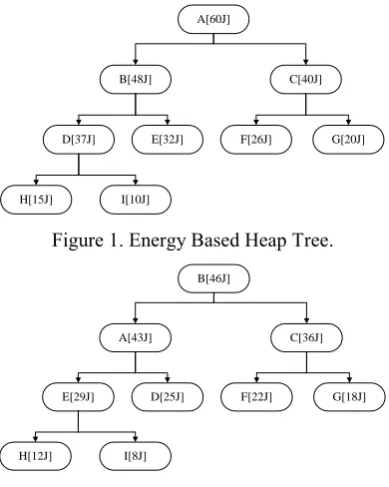
Madhvi Saxena and Neelam Phate [5], have presented a new energy efficient clustering algorithm that forms structured clusters using max-heap tree. In the clustering process, the energy of each node of cluster is calculated, and an index number is assigned to each node. The highest energy node will serve as the cluster head, and it will also be at the root position of max-heap. The remaining nodes come under the root node and thus form a tree (refer with: Figure 1). The cluster head will continuously reduce energy. After a period of time, if the energy of the cluster head is lower than the subsequent nodes at lower level, the algorithm will change the position of cluster head with maximum energy level node (refer with: Figure 2). By using this mechanism cluster head will never die.
But, in IDLBC algorithm, VID can not accurately reflect the node whether it is suitable for the cluster head or not. Besides, nodes do not have specific energy values. Instead, the cumulative time of nodes as cluster heads will be computed in the algorithm, but it can not completely reflect the energy consumption of these nodes. In the literature [5], although it introduces specific energy, it does not establish the model of wireless communication energy consumption. So the calculation of communication energy consumption is not accurate, and there is no simulation analysis in literature [5]. In order to solve the above problems, a new clustering algorithm is proposed in this paper.
A[60J]
B[48J] C[40J]
D[37J] E[32J] F[26J] G[20J]
H[15J] I[10J]
Figure 1. Energy Based Heap Tree.
B[46J]
A[43J] C[36J]
E[29J] D[25J] F[22J] G[18J]
[image:2.595.201.396.360.604.2]H[12J] I[8J]
Figure 2. Interchanging of Cluster Head.
System Model
the nodes move towards the same direction at their respective speed. So the mobile states of all the nodes on the road are closely related.
Cluster Algorithm
Overview
Limited to built-in battery, the endurance ability of nodes in MANET is relatively poor. Besides, the nodes need to send and receive messages with wireless communication devices, so energy will be consumed faster. In order to save the energy of nodes in MANET and prolong the lifetime of the whole network, we propose a new clustering algorithm based on queue. Every node has an index number and random initial energy. At the beginning of clustering, the node with the maximum energy will become the cluster head, and rank first in the queue. According to the magnitude of the energy, the remaining nodes entry the queue successively. Sending and receiving information will cost some energy, and the cluster head will consume more energy than the other nodes. The energy consumption of nodes is calculated according to the model of wireless communication energy consumption. After a period of time, on the basis of residual energy, the node which has the maximum energy will be the new cluster head. Each cluster head gets connected with the other cluster head in the network. For communication between cluster heads, GPSR routing protocol is used. Cluster head has 1-hop connectivity with its own cluster members.
Wireless Communication Energy Consumption Model
In this paper, we learn from the wireless communication energy consumption model in literature [7].
While node a sends data packets to node b, the energy consumption of a is composed of emission
energy consumption and the consumption of power amplification (refer with: Eq. 1).
𝐸(𝑘, 𝑑) = {𝑘𝐸𝑒+ 𝑘𝜀1𝑑
2, 𝑑 < 𝑑 0
𝑘𝐸𝑒+ 𝑘𝜀2𝑑4, 𝑑 ≥ 𝑑0
. (1)
𝑑 = 𝑎𝑏𝑠(𝑖𝑛𝑑𝑒𝑥𝑜𝑓(𝑎) − 𝑖𝑛𝑑𝑒𝑥𝑜𝑓(𝑏)). (2) Where 𝐸𝑒 represents the emission energy consumption, and 𝑘 represents the number of bits transmitted by node a. If the transmission distance is less than the threshold value 𝑑0, then the consumption of power amplification will use free space model. Otherwise, multipath attenuation
model will be adopted. 𝜀1 and 𝜀2 are the energy required to amplify the power of these two models
respectively. 𝑑 represents the distance between the two nodes. While node b receives data packets
from node a, the energy consumption is:
𝐸(𝑘) = 𝑘𝐸𝑒. (3) In clustering algorithm, the cluster head plays a key role. It not only receives the information of other nodes in the cluster, but also sends the information to other cluster heads. And we suppose that ch is a cluster head in the network. So the energy consumed by ch in a data transmission process is:
𝐸𝑐ℎ = 𝑘𝑙𝐸𝑒+ 𝑘(𝑛 − 1)𝐸𝑒+ 𝑘𝑙𝐸𝑒+ 𝑘𝜀1∑ 𝑑𝑖2
𝑙
𝑖=1
+𝑘(𝑛 − 1)𝐸𝑒+ 𝑘𝜀1∑ 𝑑𝑖2+ 𝑘𝜀2∑𝑛−1−𝑗𝑖=1 𝑑𝑖4
𝑗
𝑖=1 . (4)
Where 𝑙 is the number of cluster members, and 𝑛 is the number of cluster heads in the network, and the number of cluster heads that are within 𝑑0 away from ch is 𝑗. 𝑘𝑙𝐸𝑒 is the energy consumption of ch receiving data packets from its cluster members; 𝑘(𝑛 − 1)𝐸𝑒 is the energy consumption of ch
receiving data from the other cluster heads; ch which sends data to its cluster members will expend
𝐸1 = 𝑘𝑙𝐸𝑒+ 𝑘𝜀1∑𝑙𝑖=1𝑑𝑖2. (5)
ch which sends information to the other cluster heads in the network will expend energy 𝐸2 (refer
with: Eq. 6).
𝐸2 = 𝑘(𝑛 − 1)𝐸𝑒+ 𝑘𝜀1∑ 𝑑𝑖2+ 𝑘𝜀2∑𝑛−1−𝑗𝑖=1 𝑑𝑖4
𝑗
𝑖=1 . (6)
The simplified formula is as follows:
𝐸𝑐ℎ = 2𝑘𝐸𝑒(𝑙 + 𝑛 − 1) + 𝑘𝜀1(∑𝑙𝑖=1𝑑𝑖2+ ∑𝑗𝑖=1𝑑𝑖2) + 𝑘𝜀2∑𝑛−1−𝑗𝑖=1 𝑑𝑖4. (7)
Energy Saving Clustering Algorithm Based on Queue (CABOQ)
Cluster Head Selection. At the beginning of clustering, several nodes with the maximum initial energy will become the cluster heads. There are two ways to choose the cluster heads. The first one is:
According to the magnitude of energy of nodes, select n (a number of the most suitable clusters in the
network) nodes to be cluster heads in the network at a time. If there are two or more selected nodes adjacent, the node with larger energy will be the cluster head.
Although the first method is relatively easy to understand, the complexity of the calculation is high. So we put forward a second method to select cluster heads. The calculation is simple, and it is not
easy to make mistakes. First, select node 𝑖 with the maximum energy in the network to be the cluster
head. The most appropriate number of members in the cluster is assumed 𝑚. So from node[ 𝑖 −𝑚
2] to
node[ 𝑖 +𝑚
2], in addition to node 𝑖 there is no other cluster head. Beyond the range from node[ 𝑖 − 𝑚
2]
to node[ 𝑖 +𝑚
2], we re-select the other node 𝑞 with maximum energy to be the next cluster head. From
node[ 𝑞 −𝑚
2] to node[ 𝑞 + 𝑚
2], in addition to the node 𝑞 there is no other cluster head. The last step,
repeat the work mentioned above until all the nodes in the network are traversed. Assume there are 10 nodes in the network (refer with: Figure 3) and 𝑚 = 4, we select cluster heads according to the proposed method. As shown in Figure 3, the second node has the maximum energy in the network, so it will be the cluster head first. And from the first node to the 4th node, there is no other cluster head. Then we select the 6th node to be the second cluster head from the 5th node to the 10th node. And there is no other cluster head from the 5th node to the 8th node. At last, the third cluster head is the 10th node. So the second node, the 6th node and the 10th node are three cluster heads of the network.
[10]28J [9]12J [8]17J [7]20J [6]42J [5]39J [4]10J [3]45J [2]60J [1]32J
Figure 3. 10 Nodes In the Network.
Cluster Formation. After cluster head selection is completed, the next task is to allocate the nodes in the network to the appropriate cluster. Because nodes enter the straight road in order and move towards the same direction at their respective speed, in order to simplify the calculation, we assume that the subtraction of index number is the distance between two nodes. Here, we introduce the idea of queue. The non-cluster head nodes calculate the distance from cluster heads nearby according to the index number, and choose the cluster with the shortest distance to join. After determining the cluster head and cluster members, on the basis of the amount of energy, each complete cluster will form a queue. And the cluster head will be the first place in the queue.
[10]28J [9]12J
[1]32J
[8]17J
[2]60J
[7]20J [5]39J [6]42J
[image:5.595.201.397.67.142.2][4]10J [3]45J
Figure 4. Cluster Based on Queue.
Cluster Head Reselection. Cluster head inevitably consumes more energy than cluster members. To prolong the lifetime of the whole network and save the energy of nodes in MANET, we need to reselect cluster head on the basis of residual energy after a period of time. If re-clustering of the whole network, the overhead will be great, and the calculation will be complicated. So the method used in this paper is that: Keep the structure and membership of the cluster stable. According to residual energy, we re-select the node with the maximum energy to be the new cluster head, and rearrange the queue (refer with: Figure 5).
[1]27J [3]40J
[4]6J [2]38J
Figure 5. Cluster Head Re-selection.
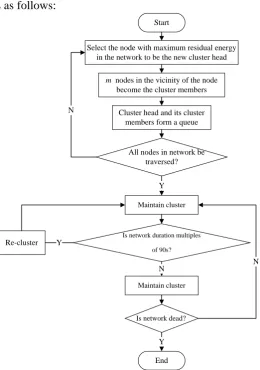
Algorithm Flow
The algorithm flow is as follows:
Start
Select the node with maximum residual energy in the network to be the new cluster head
m nodes in the vicinity of the node become the cluster members
Cluster head and its cluster members form a queue
All nodes in network be traversed?
Maintain cluster
Is network duration multiples of 90s?
Maintain cluster
Is network dead?
End Y N N
Y
N Y
[image:5.595.160.421.346.717.2]Re-cluster
Simulation Analysis
[image:6.595.184.412.249.388.2]In this section, we use network simulation tool OMNET, by comparing the cluster network with the network without clustering, to verify the performance of the proposed clustering algorithm based on queue (CABOQ) described above. The performance indicators to be analyzed in this section are as follows: the energy consumption of nodes, the number of survival nodes in the network, the energy consumption of the whole network. In the simulation parameter settings, we need to be aware that: All the nodes are running on the same straight road in the same direction, and the length of the road is infinite. When the remaining energy of the node is less than 10% of its initial energy, it is believed to have died. Network survival time generally has two definitions [8]: the death time of the first node or the death time of the last node in the network. In this paper, we use the second definition. And the specific simulation parameters are set as follows (Refer with: Table 1):
Table 1. Simulation Parameters. Parameter Value
Node Number 30
Initial Energy 10-50 [J]
𝐸𝑒 500 [nJ/bit] 𝜀1 5 [nJ/bit*m2] 𝜀2 3 [pJ/bit*m4]
k 1600 [bit]
m 5
𝑑0 18
Time of Re-cluster 90 [s] Transmission Interval 10 [Hz]
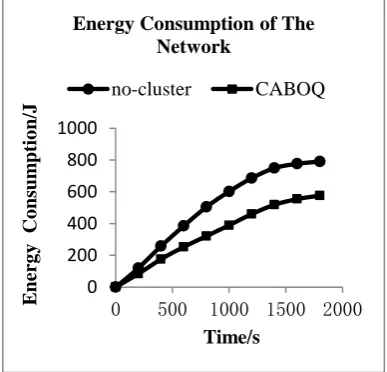
By comparing the overall energy consumption of the network without clustering and the clustering network based on CABOQ (refer with: Figure 7), we can easily find that, the network without clustering consumes more energy, and the energy consumption is faster. The main reason is that: In the MANET without clustering, all nodes are equal. Every node needs to send messages to other nodes and receive messages from other nodes in the network. However, in the cluster network, cluster head plays an important role. It receives the messages of its own cluster members and the other cluster heads. Cluster members do no need to send their messages to all the nodes in the network, And they just need send information to their corresponding cluster head.
In addition, it can be observed from the graph: In the initial stage of simulation, the non-clustering network and the clustering network will both consume more energy in the unit time; As time goes on, fewer nodes are surviving in the network. So, in the later period of simulation, energy consumption of the whole network is less. In general, using the CABOQ can save a lot of energy of the network.
Figure 7. Energy Consumption of the Network.
0 200 400 600 800 1000
0 500 1000 1500 2000
E
nerg
y
Co
ns
um
ptio
n/J
Time/s Energy Consumption of The
Network
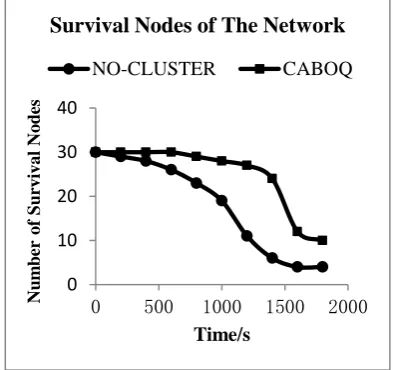
[image:6.595.201.395.574.760.2]Through the comparison of the survival nodes of the network without clustering and the clustering network based on CABOQ (refer with: Figure 8), the following conclusions can be made: First, in the initial stage of simulation, the energy of nodes is sufficient, so the death of nodes is very few; Along with the simulation, nodes need to consume a lot of energy to communicate with each other, so the survival nodes are less and less in the network. Second, the nodes in the non-clustering network ruins faster than the nodes in the clustering network. In other words, nodes in the clustering network based on CABOQ survive longer. When the simulation reaches 1800 seconds, there are only 4 survival nodes in the non-clustering network, while there are still 11 survival nodes in the clustering network. From above analysis, we can draw a conclusion that: By using CABOQ for the network, the lifetime of network becomes longer. Because we will re-cluster the network at regular intervals, each node dose not consume a large amount of energy constantly. At last, the number of survival nodes in the clustering network is more and the clustering network survival time is longer.
Figure 8. Survival Nodes of The Network.
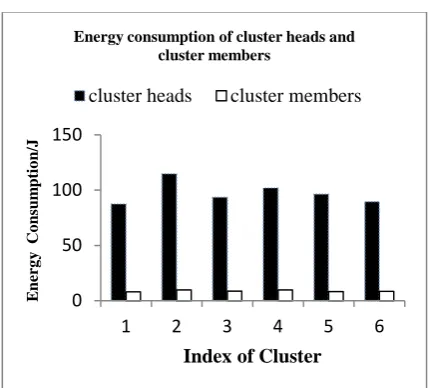
There are 6 clusters in the network. And there are 5 nodes in each cluster. By comparing the energy consumption of the cluster head and the average energy consumption of cluster members in each cluster (refer with: Figure 9), we can know that: The energy consumed by the cluster head is more than the energy consumed by all the members of the cluster. From the view of the whole network, the energy consumption of cluster heads accounts for 73.5% of the total energy consumption of the network. If we do not replace the cluster head for a period of time, the cluster head is going to die too fast. Therefore, by using the CABOQ to change cluster head, it is reasonable to make the energy consumption of each node in the network more average. It can avoid the premature death of the cluster head.
0 10 20 30 40
0 500 1000 1500 2000
Nu
m
b
er
o
f
S
u
rv
iv
a
l
No
d
es
Time/s
Survival Nodes of The Network
Figure 9. Energy Consumption of Cluster Heads and Cluster Members.
Summary
In this paper, based on the analysis of the existing energy saving clustering algorithm, the CABOQ is proposed. First we divide the network into several regions, and in each region, the node with maximum residual energy becomes the cluster head. Second, the cluster head will be the first place in the queue. According to the value of the remaining energy, the other nodes enter the queue in order. Third, because the cluster head will inevitably consume more energy, the system will count the remaining energy of the nodes at regular intervals to replace cluster head. Simulation shows that, the CABOQ can effectively save energy of nodes and prolong the network cycle.
References
[1]Chinara and S.K. Rath. "Mobility Based Clustering Algorithm and the Energy Consumption
Model of Dynamic Nodes in Mobile Ad Hoc Network." International Conference on Information
Technology IEEE Computer Society, 2008:171 - 176.
[2]S. Chinara and S.K. Rath. "Energy Efficient Mobility Adaptive Distributed Clustering Algorithm
for Mobile Ad Hoc Network." International Conference on Advanced Computing and
Communications IEEE, 2008:265-272.
[3]Y.K Jain and R.K. Verma. "Energy Level Accuracy and Life Time Increased in Mobile Ad-Hoc
Networks Using OLSR." International Journal of Advanced Research in Computer Science and
Software Engineering. 2.7(2012).
[4]Y. Gu and W. Lu. "On the Scalability of Ad Hoc Clustering Protocols." (2007).
[5]M. Saxena, N. Phate and K.J. Mathai. "Clustering Based Energy Efficient Algorithm Using
Max-Heap Tree for MANET." International Conference on Communication Systems and Network
Technologies 2014:123-127.
[6]F. Foroozan and S. Datta. "A Low-Maintenance Energy-Aware Clustering Algorithm for Wireless
Ad-hoc Networks." IEEE International Conference on Wireless and Mobile Computing, Networking
and Communications IEEE Computer Society, 2006:457-462.
[7]Zhi-Min Li and XG Chen. "Research and Application of WSN Node Communication Energy
Consumption Model Based on Asynchronous MAC Protocol." Beijing Ligong Daxue
Xuebao/transaction of Beijing Institute of Technology. 35.2(2015):171-175.
[8]W. Chen and Y. Zhang. "A Multi-constrained Routing Algorithm based on Mobile Agent for
MANET Networks." International Joint Conference on Artificial Intelligence 2009:16-19.
0 50 100 150
1 2 3 4 5 6
Energ
y
C
o
n
su
m
p
ti
o
n
/J
Index of Cluster
Energy consumption of cluster heads and cluster members