2016 International Conference on Artificial Intelligence: Techniques and Applications (AITA 2016) ISBN: 978-1-60595-389-2
A Robust Visual Tracking Method through Deep Learning Features
Jia-zhen XU
*, Ming-zhang ZUO, Lin YANG
and Lei HUANG
School of Educational Information Technology, Central China Normal University, Wuhan, China
*Corresponding author
Keywords: Visual tracking, Correlation filter, Deep learning, Convolutional neural network.
Abstract. Object tracking is one of the most important components in many applications of computer vision. Among numerous methods developed in recent years, correlation filter based trackers have aroused increasing interests and have achieved extremely compelling results in different competitions and benchmarks. In this paper, we propose a novel approach based on correlation filter framework for robust scale estimation through deep learning features. Experiments are performed on benchmark sequences with occlusion, background clutter, pose change and significant scale variations. Our results show that the proposed algorithm performs favorably against state-of-the-art methods in terms of accuracy and robustness.
Introduction
Object tracking is one of the most important components in many applications of computer vision and widely used in different applications such as smart surveillance, information retrieval, human-computer interaction, augment reality and robotics. The task can be described briefly as tracking the object through video sequence according to its manually designated bounding box in the very first frame without any other prior knowledge like the target’s classification or its appearance learned in advance. Though the task seems simple and has been extensively studied over the last several decades, it remains very challenging in real-world scenes because the tracker will be severely disturbed by illumination variation, partial occlusion, background clutter, pose change, etc.
To solve these problems, numerous approaches based on machine learning theory are proposed in recent years. These approaches handle the task of object tracking as training a classifier which classifies all candidate image patches into object class and background class. The location of the object’s first occurrence is labeled by user or some automatic detection mechanism and is defined as positive examples, while the other image patches relatively away from it are sampled as negative examples. After the classifier is trained, it will predict the locations of the object in the next frames, and these predictions will be reused as training data for future learning.
[1] is the first tracker trained online without prior knowledge, learning object’s appearance and predicting its position at the same time. Inspired by Online Adaboost method (OAB) in machine learning, this approach combines an ensemble of weak classifiers into a strong classifier which captures the most discriminative features of the tracking object. Samples more examples in the nearby region except the obvious positive and negative ones, assigning a continuous value to each of these samples as a soft label according to certain measurement. A classifier is trained by both labeled examples and soft labeled examples. To achieve better robustness, [2] designs a Multiple Instance Learning algorithm (MIL). Examples are divided into bags, which are labeled as positive if at least one positive instance exists in the bag, otherwise are labeled as negative. Various types of features are attempted in object tracking, among which Haar-like feature is the most popular one. Other types of features include histogram of color, histogram of oriented gradient, LBP, SIFT and raw pixels. In [3], a long-term learning by classification framework is combined with rectified examples gathered by classic short-term tracking algorithm like Lucas-Kanade method.
into the Fourier domain as element-wise multiplication, the proposed method effectively reduces the computational load. [5] improved the MOSSE filter by introducing kernel methods with histogram of gradient features and applied color-attributes to better represent the input data. By further handling the scale changes, [6] have achieved state-of-art results and have beaten all other attended trackers in terms of accuracy in a recent competition.
Learning features by convolution neural network from raw image pixels on large scale dataset has made impressive progress compared with hand-crafted features [8]. The deep learning technology shows great promise in almost every field artificial intelligence, especially computer vision, such as image classification, detection and segmentation. [7] proposed deep learning tracker to augment tracking performance. However, these trackers setup fixed bounding box size and are not suitable for target’s scale change which is very common in real condition and benchmark sequences.
In this paper, we propose a novel approach based on correlation filter framework for robust scale estimation through deep learning features. The rest of the paper is organized as follows: Section 2 briefly explains the correlation filter tracking framework. Section 3 demonstrates how our tracking method combine correlation filter framework, deep learning features and scale estimation algorithm. Section 4 presents experimental results. We conclude in Section 5.
Correlation Filter Tracking Framework
The goal of correlation filter is to train a function that minimizes the squared error over samples and their regression targets
(1) The is a regularization parameter that controls overfitting as in ridge regression. By solving this minimizer, the parameter w can be given in a closed form
(2) where X is a matrix whose rows are training examples, y is a vector of corresponding labels and I is identity matrix.
To improve the performance, input data will be mapped to a non-linear feature space with , and w can be expressed by linear combination of the inputs . In this case, the function
f(xi) takes the form:
(3) where is the kernel function.
Given K is the kernel matrix with element , the solution of (1) with (3) can be expressed as:
(4)
Circulant Matrix
An major difference between tracking and other machine learning task like detection and classification is that tracking samples have latent structures if densely pixel-wise sampled, i.e. sampling each position in searching window. For simplicity, consider an vector representing a patch with the object of interest, denoted as base sample . The goal of tracking is to train a classifier with both base sample x (as positive sample) and several virtual samples obtained by translating it (negative samples). To compute a regression with shift samples, a circular data matrix X
(5) The most interesting property of circulant matrix is that a circulant matrix can be made diagonal with the Discrete Fourier Transform (DFT) of its base sample x:
(6) where F is DFT matrix. Then the solution of w in (2) can be expressed in the form:
(7) which is equivalent to a simpler form in frequency domain:
(8) And can be calculated:
(9) All the computations in frequency domain are element-wise multiplications and divisions, which can be performed much more efficiently comparing with those in spatial domain.
Online Updating Strategy
The above correlation filter tracking model is trained by the first frame where the initial position target is manually labeled then predicts the target’s position in the next each frame which maximizes . Each prediction will be considered as supplement to enhance the initial model. To keep it efficiency in kernel correlation filter framework, a simple online updating strategy is applied. The model directly update parameter in frequency domain by:
(10)
(11) where t is the index of frame, and is a hyper-parameter which controls updating rate.
Scale Variation Estimation through Deep Learning Features
As we aim to use deep learning features to estimate scale change of target in visual tracking, we first describe visual features learned from convolutional neural network, then present its integration in correlation filter tracking framework.
Deep Learning Features
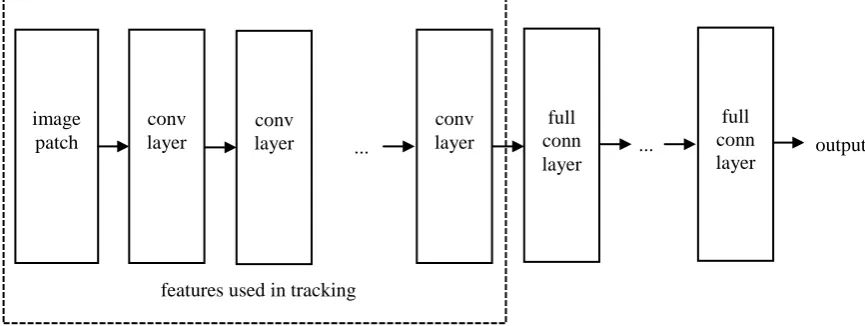
because it is not unusual when multiple instances of same category appears in the same frame. Moreover, after the processing of fc layers, it is hard to determine exact position and scale of target object. Therefore we use conv and fc layers to learn invariant features offline but just use conv layers in online tracking. In practice, we adopt vgg-19[9] network structure and use the 4th and 5th conv layers outputs as our deep learning features.
Figure 1. The structure of convolutional neural network used in visual tracking.
Scale Estimation
We separate position estimation and scale estimation into two phases in each frame. The first phase does nearly the same thing as normal correlation filter tracking, except the deep learning features are used instead of HoG features and color features. To handle scale variation, a pool of trackers in S
different scales is introduced. After position is predicted, different scaled searching windows in estimated position are cropped and interpolated into the fixed same size before sent to convolutional neural network. The outputs of conv layers are concatenated as features then reshaped into 1-dimensional W*H*D vectors for each scale. An isolated correlation filter based scale tracker is trained to predict the best scale. The reason we use two isolated tracker instead of unique one is that the measure of correct scale is not as clear as position, which makes the tracker drifting if the unique tracker keeps putting different scale samples in the same model. We use Gaussian function to enforce the current scale with higher value and other scales with lower value. Intuitively, it means if the tracker believes the current scale is not good enough, it has to find another scale which perform much better score. In practice, this strategy will suppress drifting caused by scale estimation jitter.
Experiments
We evaluate the proposed method on OTB13 benchmark which includes 51 challenging sequences with comparison to more than ten state-of-the art trackers. Many of these sequences has scale variation issues along with other challenging problems such as illumination variation, motion blur, background clutter and occlusion.
Implementation Details
The ridge regression parameter is set to 0.0001 and temporal updating parameter is set to 0.01. The ReLU output of conv4 and conv5 layers are used as deep learning features with same weights. The size of searching window is set to 2 times target size. 15 different scales are used as candidates with scale factor equals to 1.05. The proposed method is implemented in Matlab on an Intel Xeron 1620 CPU and 32G RAM, with a Titan GPU for convolutional neural network feature calculation. The average tracking speed is about 7fps.
Experimental Result
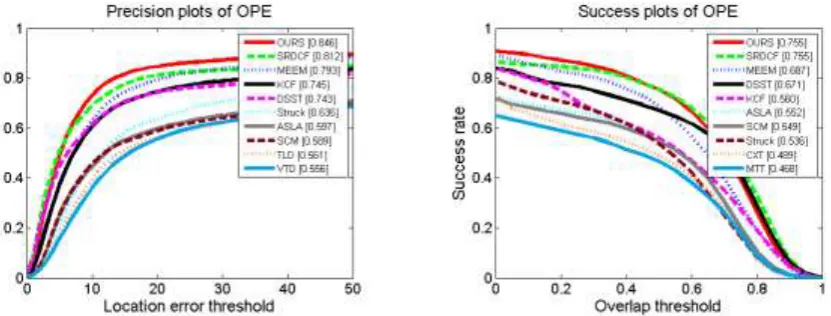
We use two quantitative metrics for evaluation: distance precision rate, which shows the percentage of frames whose center location error is within some fixed number of pixels; overlap success rate,
conv layer image
patch
conv layer
full conn layer conv
layer ...
full conn layer
... output
which is the percentage of frames where the bounding box overlap surpasses some fixed rate. Precision and Success plots measure the overall performance and the sequences in which target has apparent scale variations. Figure 2 and Figure 3 show that our proposed method performs favorably against state-of-the-art trackers in terms of both distance precision and overlap success.
Conclusion
In this paper, we propose a novel approach based on correlation filter framework for robust scale estimation through deep learning features. Experiments are performed on benchmark sequences with occlusion, background clutter, pose change and significant scale variations. Our results show that the proposed algorithm performs favorably against state-of-the-art methods in terms of accuracy and robustness.
Acknowledgement
This research was financially supported by the National Key Technology Research and Development Program of the Ministry of Science and Technology of China (2015BAK33B00).
[image:5.595.89.505.311.469.2]
Figure 2. The experimental results of different trackers on 51 sequences in OTB13 benchmark. OURS represent the proposed method in this paper.
[image:5.595.83.503.500.662.2]
Figure 3. The experimental results of different trackers on sequences in which target has apparent scale variations in OTB13 benchmark. OURS represent the proposed method in this paper.
References
[1] H. Grabner, H. Bischof, On-line boosting and vision, CVPR, 2006, 260-267.
[3] Z. Kalal, K. Mikolajczyk, J. Matas, Tracking-learning-detection, IEEE Transactions on Pattern Analysis and Machine Intelligence, 6(1), 2010, 1409-1422.
[4] D. S. Bolme, J. R. Beveridge, B. A. Draper, Y. M. Lui, Visual object tracking using adaptive correlation filters, CVPR, 2010.
[5] J. F. Henriques, R. Caseiro, P. Martins, J. Batista, Exploiting the circulant structure of tracking-by-detection with kernels, ECCV 2012.
[6] M. Danelljan, G. Hager, F. S. Khan, Felsberg, Accurate scale estimation for robust visual tracking, BMVC, 2014.
[7] N. Wang, D. Yeung, Learning a deep compact image representation for visual tracking, NIPS, 2013.
[8] G. Hinton, S Osindero, Y. Teh, A fast learning algorithm for deep belief nets, Neural Computation, 2006.