2017 2nd International Conference on Computer Engineering, Information Science and Internet Technology (CII 2017) ISBN: 978-1-60595-504-9
Research on Energy-saving Algorithm
of Wireless Sensor Network
YUANHUA WEN
ABSTRACT
In wireless sensor networks, the nodes around the base station have higher energy consumption due to the forwarding task of all the detected data. In order to balance the energy consumption of the nodes around the base station, this paper proposed a reasonable and effective mechanism of node rotation dormancy. In this way, a large number of redundant nodes in the network are in a dormant state, so as to reduce the load of important nodes around the base station. In this paper, we analyzed the problem of the redundant nodes in the sensor network, and proposed a new method to distinguish the redundant nodes based on local Delaunay triangulation and multi node election dormancy mechanism. The experimental results showed that this method could effectively distinguish the redundant nodes in the network; at the same time, through the multi round election mechanism, we make part of redundant nodes dormant and reduce the network energy consumption on the condition of guaranteeing the original coverage.
KEYWORDS
Wireless sensor networks, redundant node dormancy, dynamic power management, energy-saving coverage.
INTRODUCTION
Wireless sensor network is the multi hop and self-organizing network system composed through wireless communication of a large number of nodes with a probability distribution model randomly deployed in the monitoring region [1]. Wireless sensor technology has been gradually extended from the earliest military defense applications to agriculture, environmental monitoring, biological medicine, traffic management, remote management of dangerous areas and even home and other fields [2-3]. For high density network application, there are a large number of dormant redundant nodes. We can design the redundant node identification algorithm, to make parts of the nodes have alternate dormancy without affecting the network coverage and connectivity requirements, thus reducing the flow for sending data flow to an important node, and saving the energy of essential nodes. For the important nodes, the energy consumption level is higher, able to dispense the relay node around an important node and help the important node to share the task of transmitting large amount of data flow. In this way, it can guarantee the service life of an important node.
_________________________________________
The method of solving this problem at present mainly focuses on designing an effective MAC protocol, identifying the redundant nodes and making it dormant, so as to ensure prolonging the life cycle of important nodes and design a rational network topology and node rotation dormancy [4].
PROBLEM OF REDUNDANT COVERAGE AND RELATED ALGORITHMS
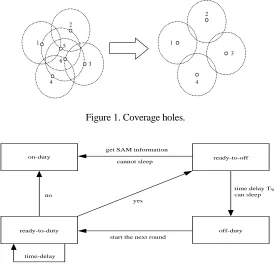
The premise of the redundant node dormancy algorithm is the determination of redundant nodes, that is to say, the nodes judge whether the covered area can be completely detected by the neighbor nodes according to the information of neighbor nodes. After the judgment of redundant nodes, because it is a distributed algorithm, each node, only based on the neighbor information, judges whether it belongs to the node. However, since that the correlation of the node coverage is not that each node can be dormant, for example in Figure 1, node 5 and node 6 can determine itself as redundant nodes but not dormant at the same time of node 5 and node 6, otherwise, between node 1, 2, 3 and 4, it will produce the coverage holes. Therefore, how to design the redundant node algorithm is an important part of the research on the coverage problem of wireless sensor networks.
At present, the main algorithms for judging redundant nodes are Di Tian algorithm [5] and CCP algorithm [6]. The study found that these algorithms have a certain degree of problems. In the following, we will analyze and elaborate in details.
In the aspect of redundant node algorithm, Nicolas D. Georganas proposed a "qualified sleep criterion" for random delay messages to make the redundant nodes dormant, (COBS) algorithm [7-8], as shown in Figure 4:
1 1
2 2
3 3
4 4
5
6
Figure 1. Coverage holes.
on-duty ready-to-off
off-duty ready-to-duty
start the next round yes no
time delay TW
can sleep get SAM information
cannot sleep
time-delay
[image:2.612.162.436.400.664.2]judge whether redundant nodes
COBS algorithm makes use of a random delay of the multi round selection mechanism, and in each round, all nodes in the network need to determine whether it is a redundant node and whether it can be dormant. As shown in Figure 4, the node has a total of four states, that is, ready-on-duty (preparatory work), on-duty (work), to-off and off-duty. At the beginning of each round, all nodes are in the ready-on-duty state. At the beginning of the algorithm, each node generates a random delay
d
T , and in Td, finishes to determine whether they are redundant nodes. If not, directly
enter the on-duty state for continuing the work; if it is, then enter the ready-to-off (pre
dormancy) state and generate a random delay Tw.
In the process of T1Tw, if the node receives the message and cannot sleep, then the
node directly enters the on-duty (working) state. To the end of Tw , the node
determines whether they can sleep based on the coverage situation at that time, that is, whether the detection area of its own is detected by the neighbor nodes. If judging that their dormancy does not generate new coverage holes, then the node enters the off-duty (dormant) state. That is to say, the node gets dormant and does not participate in the next round of selection, and transmits a message notification to the neighbor node in the meanwhile. If determining that the dormancy will create a new vulnerability, then the node enters the on-duty state and continues to work.
ALGORITHM DESIGN
In this paper, the design of the algorithm is divided into two parts, namely: (1) to identify the redundant nodes; (2) in the case of ensuring the original coverage, make dormant of the redundant nodes.
Distinguish the redundant nodes
In the randomly deployed sensor nodes, each node, according to the relative position of the neighbor node information, first of all constructs local Delaunay triangle graph. This paper will adopt the method of establishing the local Delaunay triangle graph in distributed environment. The node, according to the relative position of the nodes in the communication range (i.e., neighbor nodes), constructs the corresponding perpendicular bisector of the line segment. The smallest convex polygon surrounded by the bisector is Voronoi polygon corresponding to that node, the corresponding node is Delaunay neighbor nodes of the node, so it can get local Delaunay triangle graph.
In this algorithm, we use two different concepts: neighbor node and Delaunay neighbor node:
Neighbor nodes: all nodes with distance to the node i less than RC are called neighbor node of the node i.
Delaunay neighbor node: in the local Delaunay triangulation graph constructed by the node i, all nodes of the Delaunay triangle edge with the node i.
Based on the analysis of local Delaunay triangle graph, this paper proposes a new criterion for distinguishing redundant nodes:
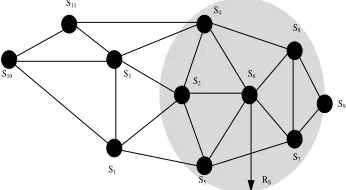
For any node S , it there does exist i max
siDelaunay triangleneighbor linelength
Rs,node to the S6 Delaunay neighbor nodes S , 2 S , 4 S5, S7 , and S9 is S6S5 and
S 5
6S R
S , so S6 is distinguished as the redundant node.
Make redundant nodes dormant in the case of ensuring the coverage unchanged
[image:4.612.210.383.394.489.2]Independent redundant nodes can go directly to the dormant state, and for the dependent redundant nodes, direct dormancy will lead to the formation of the coverage holes. As a result, we can only choose parts of the nodes to enter the dormant state. In this paper, we propose a new algorithm for the selection of dormancy: first of all, the redundant nodes are grouped according to the Delaunay correlation, and then the multiple voting mechanism is implemented in each group to select the redundant nodes that can get dormant at the same time. In each round, active redundant nodes within a group send the news containing its own ID and dependence to the other node within the group, while receive news released by other nodes, and compare the dependence of the messages received with that of itself. If its dependence is the lowest in the node received, then it will be judged as dormant redundant nodes, while sending a message to the Delaunay neighboring nodes to give a statement of itself dormancy and entering the dormancy state. The node that receives the dormant message remains active state and does not participate in the election any more, that is, not handling the relevant messages. All the active redundant nodes that do not receive the dormancy message enter the next election. The schematic diagram of the process is shown in Figure 6.
S1
S4
S5
S6
S7
S2
S3
S8
S9
S10
S11
RS
Figure 3. The judgment of redundant node.
S1
S2
S3
S4
S5 S6 S7
S1
S2
S3
S4
S5 S6 S7
(a) (b)
S1
S4
S5 S6 S7
(c)
Active node
Dormant node
[image:4.612.151.455.539.679.2]7 1~S
S in Figure 4 has been determined to be dependent redundant node. From
the definition above, the dependency of S , 1 S , and 4 S7is 1, and the dependency of S , 2
3
S , and S6is 2, and the dependence of S5is 3, as shown in Figure 4 (a). In the first
round of the election, S , 2 S3, and S6 enter a dormant state, and send message to
Delaunay neighbor nodes S , 2 S3, and S6, S , 2 S3, and S6receive the news, that is, to
maintain the active state, and no longer participate in the elections, and S5 enters the
next round of elections, as shown in Figure 4 (b). As there is only S5left to participate
in the election, S5 is directly into the dormant state, as shown in Figure 4 (c).
EXPERIMENTAL RESULTS AND ANALYSIS
This paper has several dispensers of different number of nodes in the same coverage area, and from the following two aspects, compares the existing algorithms and the algorithm in this paper:
(1) The proportion of redundant nodes to all nodes: calculate the proportion of the number of judged redundant nodes selected by the algorithm of the total number.
(2) The number of active nodes: calculate, in the case of different dispenser of the number of nodes within the same region, the number of active nodes that a variety of dormancy algorithms select.
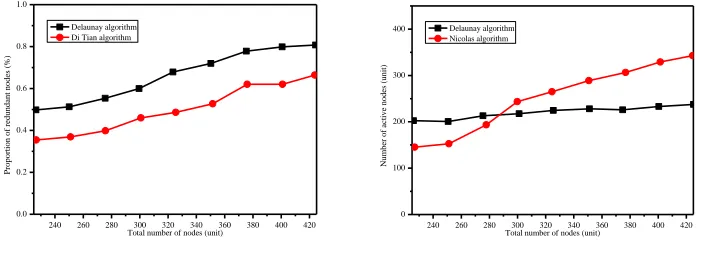
Figure 5 and Figure 6 show, in the case of different dispenser of the number of nodes within the same region, the proportion of redundant nodes accounted for the total number of nodes and the proportion of redundant nodes in the total number of active network nodes.
It can be seen from Figure 5 that, the Di Tian algorithm and the algorithm results are with the increase in the number of nodes for WSNs, the proportion of redundant nodes is increasing. It is mainly because that the dispenser density of nodes increases, and the coverage holes under the initial conditions reduce, resulting in the increasing proportion of redundant nodes. For dispensing the same number of nodes, the number of redundant nodes judged by the algorithm in this paper is much more than that of Di Tian.
240 260 280 300 320 340 360 380 400 420
0.0 0.2 0.4 0.6 0.8 1.0
Propor
ti
on
of
r
edundant
nodes
(
%
)
Total number of nodes (unit) Delaunay algorithm
Di Tian algorithm
240 260 280 300 320 340 360 380 400 420
0 100 200 300 400
N
um
ber
of
act
ive
nodes
(
uni
t)
Total number of nodes (unit) Delaunay algorithm
[image:5.612.119.471.521.648.2]Nicolas algorithm
Figure 5. Proportion of redundant nodes. Figure 6. Number of active nodes.
same coverage area, as long as there is a certain number of active nodes can it achieve full coverage. As a result, the number of active nodes chosen will not increase with the increase of dispenser nodes, and the number of active nodes obtained by Nicolas algorithm continuously increase with the increase of nodes, which means that there are still a large number of dormant nodes working in the network.
CONCLUSION
In this paper, for the node dormancy problems in the high density randomly dispersed sensor network, we put forward a new redundant node judgment and dormancy algorithm based on local Delaunay triangle graph. The algorithm is divided into two steps, namely, distinguishing the redundant nodes and selecting the dormant nodes. The premise of the algorithm is to construct the local Delaunay triangulation graph of the neighbor nodes, nodes according to the information of the graph to judge whether itself is off redundant nodes, and then to determine the independent redundant nodes and the redundant nodes and the dependence. The experimental results showed that the algorithm can effectively judge the redundant nodes in the network and make sure that some redundant nodes enter the dormant state in the case of ensuring the initial coverage situation unchanged. Compared with other algorithms, it is shown that the number of redundant nodes judged by the algorithm in this paper is more than that of the existing algorithm. In addition, in the case of dispersing different number of nodes in the same area, the number of active nodes obtained by the algorithm is very small in change, which can achieve coverage of monitoring area with fewer nodes. The algorithm is suitable for large networks with many nodes, and it has certain practical value.
REFERENCES
1. Aloi, G., Bedogni, L., Bononi, L., Briante, O., Felice, M. D., &Loscrì, V., et al. (2015). Stem-net: how to deploy a self-organizing network of mobile end-user devices for emergency communication. Computer Communications, 60, 12-27.
2. Javadhosseini, M., Hosseinalipour, A., & Sabamoniri, S. (2014). A new approach for covering wireless sensor networks with optimum number of nodes in order to prolonging network lifetime. International Journal of Computer Applications,89(6), 37-41.
3. Lanteigne, E., & Jnifene, A. (2014). Biologically inspired node generation algorithm for path planning of hyper-redundant manipulators using probabilistic roadmap. International Journal of Automation and Computing,11(2), 153-161.
4. Shao, C. K. (2013). Application of wireless sensor technology in the training of martial arts and specification motion detection. Advanced Materials Research,791-793, 926-930.
5. Tian, J., Gao, M., & Ge, G. (2016). Wireless sensor network node optimal coverage based on improved genetic algorithm and binary ant colony algorithm. EURASIP Journal on Wireless Communications and Networking, 2016(1), 1-11.
6. Wagner, D., Vogt, S., Jamal, F. I., Guha, S., Wenger, C., & Wessel, J., et al. (2016). Application of microwave sensor technology in cardiovascular disease for plaque detection. Current Directions in Biomedical Engineering,2(1), 273-277.
7. Xu, D., & Wang, K. (2015). An adaptive traffic mac protocol based on correlation of nodes. EURASIP Journal on Wireless Communications and Networking, 2015(1), 258.