2017 International Conference on Electronic and Information Technology (ICEIT 2017) ISBN: 978-1-60595-526-1
Minimum Spanning Tree-Based Single-Chain Structure Optimization Method in Power Communication Network
Yang HAO1,*, Qi SHAO1, Teng SONG1 and Bing-bing LIAO2
1
Henan Electric Power Co., Ltd. Zhengzhou, China
2
Guangdong Yitaida Technology BC1 Ltd., Guangdong, China
*Corresponding author
Keywords: Power communication network, Single-chain optimization, Cut points optimization.
Abstract. Aiming at the large amounts of single-chain structure in the power communication network, based on minimum spanning tree, we propose a single-chain structure optimization algorithm for power communication network, which can optimize the single-chain structure as a circle, after that, the cut points in the topology are processed. The simulation results show that the proposed algorithm can optimize the single-chain structure as a circle and eliminate the cut point in the topology, and it has a better indicator performance when network has larger amounts of single-chain structure.
Introduction
With the rapid development of communication technology, the communication network carries more and more resources, and the reliability of the communication system is more demanding. However, the current power communication network in China there are many single-chain structure, single-chain structure with poor stability, in the transmission network business, often the problem of network business interruption [1]. Therefore, to improve the reliability of the communication network and ensure the normal operation of the service, the research and optimization of the single-chain structure in the communication network is also paid more and more attention for the research of the circle network.
At present, the research on the identification of single-chain structure in electric power communication network and optimizing it into circle network mainly includes the following steps: one is to establish a backup link and the backup link with a fixed connection, and then combined with long-distance communication channel to build a spare link circle; the other is through the use of the link multiplex section to single structure configuration multiplex group protection group, in order to achieve the role of improving link reliability.
However, the above methods are required to know the position that the single-chain of the communication network, and the construction scheme of the single-chain circle requires manual design, which results in the inefficiency of the single-chain circle work; and when the communication network is more complex, often will miss some single-chain, thus affecting the quality of single-stranded circle work.
single-chain structure of the automatic positioning problem. And on this basis, to provide the corresponding single-chain circle structure, and in the circle after the top of the cut points to deal with, to further improve the stability of the power communication system.
Network Model
The single-chain circle-forming problem studied in this paper is limited to the assumption that a physical communication network is required for circle optimization, and that the physical location of each node in the network is known and that only the physical distance is used as the cost of increasing the link between nodes Considerations. The whole power communication network constitutes a connected undirected graph , where is the set of communication nodes, , is the collection of edges in . In addition, the network is connected to the static network, the communication node will not move after deployment.
Algorithm Detailed Design
The algorithm proposed in this paper first locates the single-chain structure in the network topology, then uses the algorithm based on the minimum spanning tree to the single-chain implementation of the circle calculation, and finally, the cut points in the network topology to be re-optimized to prevent communication problems caused by cut points faults.
Basic Definition
Let topology , where represents the set of N nodes in graph G, where represents the set of M edges in graph G.
Definition 1. The k-length path . is an intersection of vertices and edges,
denoted as , where .
Definition 2. The k-length circle . is a path, where .
Definition 3. The k-length single-chain . is a path, where
, and the degree of is 1.
Definition 4. Circle node. Circle node is the node on the single-circle structure, let the set of nodes be .
Definition 5. Chain node. Chain node is the node on the chain, let the set of nodes be .
Definition 6. The subgraph of the circle node . is a chain node and edge that are directly connected to and are connected to all the chain nodes and edges of the point . Among them, except for the circle nodes directly connected with , all points are chain nodes.
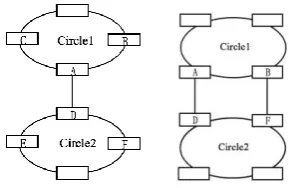
As shown in Fig.1, Ae1Be2Ce3De4A is a ring and a simple circle. Ae5G and Ce6Ee7F
Fig. 1. Schematic diagram of circle-chain Fig. 2. Cutting point processing (a,b)
Steps of Circle-forming Algorithm
In this paper, we propose two circle-forming algorithms, which are circle algorithm based on minimum spanning tree and circle algorithm based on nearest circle nodes.
A. Circle-forming Algorithm Based on Minimum Spanning Tree. The circle optimization algorithm first needs to locate the single-chain structure in the topology, and then traverse each circle node in the topology to calculate the minimum spanning tree corresponding to the subgraph of each circle node. The edges in the spanning tree are the communication links that need to be added. Where, the physical distance between two points is used as a basis for increasing the link, giving priority to adding a communication link between two nodes with the smallest distance. Here, node partitioning is the basis for single-chain positioning and circle-forming algorithms.
The procedure for single-stranded circle is described as follows:
Step1. The nodes in the topology are divided into circle nodes or chain nodes to obtain the circle node set and the chain node set .
i. Pop a point which has not yet visited and mark it as visited;
ii. From , use the Depth First Search(DFS) algorithm to place the nodes passing into the node set . If we can find a simple circle of , all nodes in are circle nodes, is merged into , and mark all nodes are already visited, empty ;
iii. Go back to step 1.i until there are no nodes that have not yet been visited in ; iv. Empty the visited tag.
Step2. Single-chain positioning
i. Pop a node that has not yet been visited from , marked as visited;
ii. From , use the DFS algorithm to find the simple path of to all nodes of the leaf chain node (chain node whose degree is 1, the same below). That is, all the single chains of , except for , the remaining nodes are chain nodes;
iii. Go back to step 2.i until there are no nodes that have not yet been visited in ; iv Empty the visited flags.
Step3. Optimize chain nodes into circle.
i. Pop a node from , calculate its subgraph as , and mark as visited. ii. (a) If there is a single-chain containing , then:
Let , where represents the set of points of the subgraph ,
represents the set of all the non-leaf nodes in the graph ;Let the cost of all the circle
nodes in to be ;
The minimum spanning tree containing the undirected complete graph of the node
set is obtained, then add the edge set in to . Here, there is a special case:
When all the leaf nodes are directly connected with , the minimum spanning tree cannot be constructed normally. At this time, use another circle strategy, find the node
, which is the nearest one for each leaf circle node from , get the edges set
(b)Other: enter step 3.iii;
iii. Go back to step 3.i until there are no nodes that have not yet been visited in ; iv. Empty the visited flags.
B. Circle Algorithm Based on the Nearest Circle Node. This algorithm first divides the nodes into circle node sets and chain node sets, then traverses each leaf chain node, finds a non-straight chain node closest to it, and adds a link between two points. Each single-chain structure in the topology can be optimized as a circle through this procedure.
Step1. The nodes in the topology are divided into ring nodes or chain nodes, and the ring node set and the chain node set are obtained. This is the same as Circle algorithm based on the minimum spanning tree.
Step2. Leaf chain node location. That is, to find the nodes set of all nodes with a degree of 1.
i. Traverse each row/column of the adjacency matrix H, and record the for each row/column, where the value is not zero, and if the number of records is 1, the degree of the node is 1. Add the node to .
Step3. Single-chain to circle.
i. Remove a node that has not yet been visited from , make it has visited, and the set of circle nodes directly connected to it is ;
ii. Traversing the ith row in the adjacency matrix H, adding the circle node directly connected to to ;
iii. Let the target circle node set be . Traverse , find a node closest to , connect to , add to ;
iv. Go back to step 3.i until there are no nodes that have not yet been visited in ; v. Empty the visited flags.
Cut Point Processing
There are two processes in the processing: 1) Cut point positioning; 2) the calculation of the split point of the circle optimization program. The specific algorithm is described as follows:
Step1. Cut point positioning.
i. Pop a point that has not yet been visited from ,mark it as visited.
ii. The is added to ; otherwise, is not a cut point. If the is , the is added to . Restore ;
iii. Go back to step 1.i until there are no nodes that have not yet been visited in ; iv. Empty the visited flags.
Step2. Deal with all the points, the single node interchange structure into two-node interoperability, as shown in Fig. 2 (a)→(b).
i. Pop a point from , mark it as visited;
ii. Pop from , get some connectivity components, take two of them, denoted and , find the two points that be directly connected to from and , recorded as and ; Find the point set that are directly connected to , , respectively, as and ; Find the two points that are the least cost of and , add the edge to the .
Optimization of Circle Formation Results
Entropy is a measure of system energy distribution equalization, which can be used to describe the stability of the state of the system. In this paper, based on the entropy theory, the reliability evaluation of the topology network generated by the proposed algorithm is carried out.
The connection relation of the topological network can be determined by the adjacency matrix , and denotes that the node is connected to the node . The number of nonzero elements in row i or column i is the degree of node , denoted by . In [2], the entropy of the network structure is defined as follows:
The section headings are in boldface capital and lowercase letters. Second level headings are typed as part of the succeeding paragraph (like the subsection heading of this paragraph). The importance of defining a node is:
(1) Define the network structure entropy as:
(2) The more balanced the topology, the more stable the corresponding network system, and therefore the higher the reliability, the performance of the entropy value is higher and more stable entropy. For example, when the network structure is pure star, its structure is the most unstable, the lower the reliability, the entropy of ; when the network structure is the fully connected network, its structure is the most stable, the reliability is the highest, the entropy is , but the cost is the highest.
However, Equation (2) only determines the stability of the circle from the point of view of the node, ignore the consideration of the circle cost, and cannot comprehensively evaluate the quality of the circle-forming result. In view of the above problems, this paper considers the structural entropy of the topological network and the cost of circle formation, and defines the following evaluation criteria:
(3)
(4)
(5) Where W represents the mean of the link cost in the original topology, represents the cost of the edge in the original topology, K represents the number of new links, and represents the cost of the new link . For a certain topology G, the higher the I
value, the better the circle quality.
Algorithm Simulation Experiment
To verify the effectiveness of the algorithm, some test topologies are optimized by simulation experiments in this paper, which will be based on the minimum spanning tree algorithm and the circle algorithm based on the nearest circle node. The simulation tool uses MATLAB 2016b.
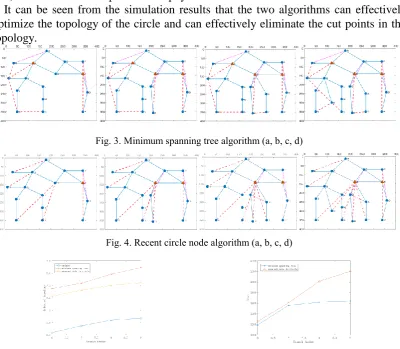
1) The circular node represents the ordinary communication node, and the triangular node represents the point that it’s cut point after executing the circle-forming algorithm, and it needs to perform the secondary circle operation in the subsequent processing.
2) The dotted line is the link added by the algorithm. Sparse dashed line is added to the circle algorithm, the dotted line is added when the dotted line is added;
3) The vertical axis represents the physical location of the node.
[image:6.595.98.499.155.504.2]It can be seen from the simulation results that the two algorithms can effectively optimize the topology of the circle and can effectively eliminate the cut points in the topology.
Fig. 3. Minimum spanning tree algorithm (a, b, c, d)
Fig. 4. Recent circle node algorithm (a, b, c, d)
Fig. 5. Comparison of topological indicators Fig. 6. Comparison of circle-forming costs
As can be seen from Fig. 5 and Fig. 6, the minimum spanning tree algorithm has better performance than the nearest circle node, especially when the branch is more. In addition, since the algorithm based on the minimum spanning tree considers the factors that make up the cost of the circle, the cost of the circle is lower, that is, the length of the link that needs to be laid is shorter and thus has better economic benefits.
Conclusions
Acknowledgement
This work is supported by the Science and Technology Project of Henan Electric Power Co. Ltd. “Research and Application of Henan Power Communication Backbone Network Modeling Based on Simulation Technology” (SGHAXT00GCJS1700185)
References
[1] Ying Zeng: submitted to Power system communication (2011), 32(08):13-16. In Chinese.
[2] Yue-jin Tan, Jun Wu: submitted to System Engineering Theory and Practice (2004), 24(6):1-3. In Chinese.
[3] Zhen-mei Li: submitted to China Science and Technology Information (2005 08). In Chinese.
[4] Zong-jun Huang. A distribution network reconfiguration algorithm based on least weight tree for service restoration after faults [D]. Sichuan University 2004