2017 3rd International Conference on Electronic Information Technology and Intellectualization (ICEITI 2017) ISBN: 978-1-60595-512-4
Design and Implementation of Distribution
Live-Line Working Simulation Training
System Based on Multi-User Collaboration
Lei Zhou, Wenxiong Mo, Jianbin Luo and Zhijun Wang
ABSTRACT
Aimed at the disadvantages of existing Power Operation Simulation Training Systems which can not participate in cooperative operation, this paper presents a new system design based on user collaboration, and has developed the multi-user collaboration interaction technology. The system enables the multi-user to perform skills collaborative training in the same virtual scenes playing different work roles by controlling virtual characters, and experience more realistic power operation workflow. The multi-user online interaction technology is achieved with behavior prediction and regional speculation methods to improve the efficiency of synchronization and reduce network latency. This system improves the user's experience and cooperation, and also opens up a new idea for the future development direction of power operation simulation training.
INTRODUCTION
In recent years, distribution live-line working simulation training system have developed rapidly [1], and play an irreplaceable role in improving safety awareness and standard operation. But most of these systems are stand-alone program, and can’t make people to the same virtual scene for online collaborative training. This has become a research direction of electric power training simulation researchers.
_________________________
Lei Zhou, Beijing Kedong Electric Control System Co., Ltd. Beijing, China
This paper presents a study of distribution live-line working simulation training, and developed the multi-user collaboration interaction technology to build a new system. The system enables the user to perform collaborative training in the same virtual scenes playing different work roles by controlling virtual characters, and experience more realistic power operation workflow. Compared with tradition techniques, the system uses the behavior prediction and regional speculation methods to solve the problem of spatiotemporal consistency of operation process and improve the efficiency of synchronization and reduce network latency.
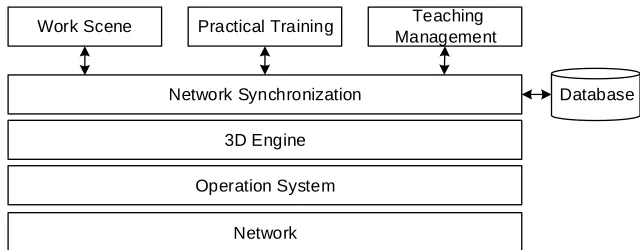
Operation System 3D Engine
Work Scene Practical Training Teaching
Management
Network Synchronization
Network
[image:2.612.144.464.208.333.2]Database
Figure 1. System Architecture Design.
The research results of this paper have been applied in Guangzhou Power Supply Bureau. The following will focus on system architecture, key technology and applications.
SYSTEM ARCHITECTURE AND FUNCTIONS
Multi-user online collaboration distribution live-line working simulation training system follows the client-server model, and its system architecture includes work scene, practical training, evaluation and teaching management modules through network synchronization module to achieve time synchronization, spatial synchronization, information interaction and coordinated control (see Figure 1).
and perform multi-user collaboration practice through the network synchronization module in the virtual environment provided by work scene module. The teaching management module is responsible for the whole process of management, monitoring and controlling. It consists of training management, process management, evaluation management, user management and other functions. The database module is used for storage of modules, scenes, components, operation data, process data, historical data and supporting data, etc.
KEY TECHNOLOGIES
The core of is multi-user collaboration interaction technology based on the synchronization mechanism of network communication, which mainly includes 2 aspects: the synchronization between client and server and the synchronization between clients. No matter what kind of synchronization mechanism, they need to reduce the network delay problem in order to all participants have the same view of the simulation objects at any time. That will ensure the spatiotemporal consistency of multi-user collaboration.
The synchronization between client and server uses a behavior prediction method. When sending operation message to server, the client predicts the feedback from the server according to the state of the client and context information, and immediately perform actions, and sends the prediction results to the server. The server compares the prediction results with the feedback generated by the server. If the same, the feedback will not be sent to the client. If not, the feedback will be sent to the client and notify the client to roll back to the previous state, meanwhile the client performs actions according to the feedback.
The synchronization between clients uses regional speculation method. The client sends operation message to server at the same time, also speculates how many virtual roles in the surrounding area according to the visual range of the use, and broadcast the above behavior prediction results to the clients in order to make the same screen display for all users, If the prediction results are different from the feedback, immediately issue the correction command and broadcast the other clients.
The regional speculation method is based on Area of Interest (AOI)[2] mechanism and judges virtual objects using the Axis-Aligned Bounding-Box (AABB)[3]. The detailed steps are as follows: first, we divides the 3D scene into large cells; second, defines the distance radius of the virtual role, and calculate the smallest cube that surrounds the circle of view; third, calculate other virtual role's AABB.
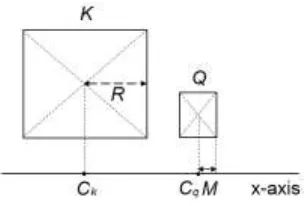
X, Y, Z are the minimum value (xmin, ymin, zmin) and maximum value (xmax, ymax, zmax) of the vertex coordinates of all geometric elements in the virtual role models. Finally, we determine whether AABB projection range on X, Y axis is in the cell contained by the smallest cube. If in the cell, the range will be the object of the synchronization operation information, otherwise, do not perform synchronization. For example, to detect weather conditions of the work scene, the distance radius of work director is R. Assuming that the operator on ground's AABB is Q, the projection of the center point on the X axis is Cq, half of the projected length on the X axis is M, the projection of the center point of the cube K on the X axis is Ck (see Figure 2).
Figure 2. Area of Interest.
TABLE I. TEST RESULTS OF THE NETWORK LATENCY.
1 2 3 4 5 6 7 8
User-to-server synchronization delay (Second)
0.1304 0.1952 0.1211 0.1552 0.1473 0.1510 0.1764 0.1652
Synchronization delay between users (Second)
0.3528 0.3859 0.3360 0.3245 0.3406 0.3496 0.3370 0.3221
If | Cq -Ck | + M ≤ R, it means that operator on ground is in the vision field of the
work director, so the status of the operator on ground will be synchronized to the work director, if | Cq -Ck | + M> R, it means that operator on ground is left the vision
field of the work director, the status of the operator on ground will not be synchronized. This will greatly improve the efficiency of network synchronization.
APPLICATIONS
[image:4.612.231.383.250.353.2]This paper has tested the network latency of multi-user online collaboration. Test environment is the following: CPU: Intel E6700(3.2GHz), memory: 4G, network bandwidth: 1.5Mbps. As the maximum delay of the synchronous is 0.38 second, the test results of the network latency meets the simulation requirements(see Table I).
CONCLUSIONS
This paper adds multi-user online interaction technology on the basis of the virtual reality, to solve the shortcoming of the existing simulation training system which cannot provide collaboration function. The developed system has many advantages, for example, a high real-time and immersion, good interaction, objectivity and comprehensive of the evaluation and so on. The system enables the user to perform skills collaborative training in the same virtual scenes playing different work roles by controlling virtual characters, and experience more realistic power operation workflow. It can effectively improve the efficiency of professional skills, shorten the training time, improve the quality of training
REFERENCES
1. Xiangyi Lin. 2005. Application of Virtual Reality in Educational Training[J]. Computer Simulation, 22(4):241-243, 268.
2. Xu Zhang, Huizhong Wu, Liang Xiao. 2008. Interest Management Method for Large Scale Collaborative Virtual Environment[J]. Journal of System Simulation, 20(3):657-661.