2381
RANDOM LINEAR NETWORK CODING BASED
MULTIPATH TRAFFICS OVER HETEROGENEOUS CLOUD
RADIO ACCESS NETWORK
ABSTRACT
Bringing relays near to the user equipments enhances the network capacity and robust to the transmission erasure. So the dense deployment of Remote Radio Heads (RRHs) with higher frequency operation and lower transmission power within the coverage area of Micro Base Stations (MBSs) with higher transmission power compared to RRH consists of Heterogeneous Network. When the most of the computing algorithms are executed at computationally powerful shared nodes, the network is heterogeneous cloud radio access network (H-CRAN). Further area network capacity can be enhanced with multipath transmission with the availability of radio resources and security issues can be addressed with network coded transmission over the unlicensed channel or high frequency channels. Use of better channel for network coded transmission can enhances the network throughput compared to traditional transmission. Further network coding scheme deployed for multi hop network is robust to erasure channel. In this research work further enhancement of network throughput is carried out with random network coding for multi-hop network which enhances the resilience of the transmission over erasure network channel and transmission of network coded packets over different transmission links ensures security over the data
transmission.
Keywords:Random Network Coding, Multipath Transmission, Secure Transmission, H-CRAN, Robustness
1. INTRODUCTION
With the integration of multi radio interfaces to
mobile devices, transmission of network
information and user data is possible through different relays or base stations. So, in the next generation wireless to keep backward compatibility, signaling can be done through existing MBS and user data can be communicated through densely deployed RRHs in small cells increasing the area traffic capacity which bring the user devices closer to the relays which reduce the latency. New
perspective on cloud computing based
heterogeneous architecture to enhance the energy efficiency and spectral efficiency and to address the high area traffic capacity, H-CRAN has been
introduced in [1-3]. Peng et al. [1] studied the
performance of conventional HetNets and cloud computing based heterogeneous cloud radio access
network is validated to be multi-tier H-CRAN with high energy efficiency and also simulated to have high ergodic capacity performance under higher number of RRHs with varying transmission power.
Later Peng et al. [2] introduced Node C as base
band unit (BBU) pool responsible to high computational power in which large scale cooperative signal processing and cooperative radio resource management were performed and studied which results performance gain of the network with capacity constraint backhaul links. Simultaneous transmission of user data through both the MBS and RRHs with the availability of radio resources results further increment of network capacity which costs higher signaling overheads to the MBS so the coordinated multi-point (CoMP) transmission. Since radio channels are dynamic nature and its
1DHAWA SANG DONG, 2KARISHMA KHATRI,4,5MOHAMMED B. MAJED, 3ANAND
GACHHADAR
1,2,3Department of Electrical and Electronics Engineering, School of Engineering, Kathmandu
University, Dhulikhel, Nepal
4Wireless Communication Centre, Faculty of Electrical Engineering, Universiti Teknologi Malaysia,
Johor, Malaysia.
5College of Science and Technology, University of Human Development (UHD), Assulaymaniyah,
2382 occupancy, continuous scanning to check availability of radio resources is necessary that cost the higher computational.
Multipath transmission for uplink and downlink enhances the throughputs but at same time adds the time minimization challenges in splitting and reordering of packets at sending and receiving node respectively and challenges in handling balanced the traffic flows over the multipath. For the solution dynamic load balancing algorithm as introduced by
Delgado and Labeau [4] can be deployed for fair
use of radio resources resulting enhanced throughputs and reliability, paying higher cost in complex computation for effective resource management. Cooperative scheduling can be used for the increased transmission over the wireless using multi input multi output (MIMO) antenna as
studied by Gao et al. [5]. Although performance of
the network depends on channel states, network and traffic information, channel scheduling and network topologies, channel scheduling is the one over which operator can manipulate. So, the random channel access (RMCA) or scheduled multi-channel access (SMCA) can be used for the balanced traffic through nodes and to update availability of radio resources, either cognitive radio access techniques or continuous system signaling through MBS can be deployed adding signaling overhead to MBS as studied by Hong and Li [6].
Ahlswede et al. [7]were first to introduce network
coding technique in information theory for the network with single source and multiple destination nodes. Theoretically they demonstrated to achieve upper bound given by max-low min-cut theory resulting enhanced network capacity. Network coding process are deployed to intermediate nodes between source and destination within which incoming packets or symbols from a finite field combine to generate functions with some algebraic operations defined over the field and forwarding to next nodes towards destination nodes as defined in (1). Mathematically the outgoing message symbols
(xe) from node (v) are transformed from the
incoming message symbols (xd) with transfer
function ϕv deployed at intermediate node (v)
within which, the algebraic operations are defined.
Li, Yeung, and Cai. [8] simplified the coding process defined in (1) to linear network coding defined as in (2) which is rate optimal within
multicast networks and kd,e is coding coefficients.
So, the liner network coding follows the linear algebra defined over the finite field. Li et al. [9] reviewed construction algorithm to acyclic network for rate optimal linear network code. It can be observed in (2) that for almost all incoming symbols, there is only one outgoing symbol and outgoing symbol carries information content of all incoming symbols. Hence, reduce number of transmissions and lesser number of transmission channel used. Network coding scheme has great applications in multipath transmission and peer to peer communication reducing the queue length at intermediate nodes in contrast to conventional store and forward scheme. Even for unicast type transmission, there is increased throughput and no queue at intermediate nodes so no need of backpressure algorithm and lower latency.
For multicast transmission, there is increased network information flow over the network as network coded transmission shares the resources available in the network maximizing the
throughputs with the cost of time complexity O(|v|2)
during the execution of network coding scheme at intermediate nodes (v). Wang and Lin [10] introduced primal solutions to reduce the time complexity to O(|v|) for network coded network information flows in feedback path for faster resource allocation. In wireless sceneries, some unnecessary nodes may cause interference during the time of transmission, which is useful in wireless network coding [11] and opportunistic routing is used to reduce the number of transmission that’s results greater network capacity and better utilization of network resources. Opportunistic coding and routing can be implemented to reduce the unwanted hearing by closer nodes [11], which is efficient utilization of radio resources.
2383 candidates for network information flow and depending upon the availability of channels assigned to MBSs, user data or user information can be communicated through MBS too, so the multipath transmission is possible in H-CRAN.
A. Problem Formulation
High area traffics or user data demanding applications like telemedicine, video conferencing and live telecasting are major applications of next generation wireless. Dense deployment of RRHs bringing users devices closer to the relays address high data traffic demand but dynamics of radio channels reduces the network throughputs which is one of the problems. Since RRHs operate at either higher frequency or unlicensed frequency channels, data confidentiality is another problem.
B. Proposed model
Higher user data demand problems can be solved using multipath transmission provided users are integrated with multiple radio interfaces and confidentiality of the transmission over unlicensed or high channels can be addressed with network coding process at nodes. Simplified network coding
scheme COPE by Katti et al. [12], encodes the
packets to be transmitted and forwarded to destination node. Opportunity for network coding and availability of radio channels are accessed with the information from MBSs in our research work. Better conditioned channels were used to transmit the data packets for single hop random network coding process and implementation of random network coding at two hop networks from BBU Pool to end users further enhances the network throughputs as random network coding is error resilient.
2. LITERATURE REVIEW
Katti et al. [12] were first to introduce first
coding-aware COPE for wireless transmission in two hop networks. Three techniques; opportunity discovery for routing, routing path discovery and neighbor state learning were used to determine the coding opportunity for the next hop transmission at intermediate node. The coding scheme introduced was limited to two hop networks. Le, Lui, and Chiu [13] introduced distributed coding aware routing (DCAR) extending the limitation of coding scheme
introduced by Katti et al. [12], which discover
routing and coding opportunities over the entire
network. Mohseni and Zhao [14] studied the throughput of star topology with two heuristic channel selection algorithms. Concurrent Node Selection and Channel Assignment (SNSCA) was found to have higher network throughputs compared to Sequential Node Selection and Channel Assignment (SNSCA) with the cost of computational overhead.
Yu, Cheng, and Xiong [15] studied the performance of network coding over input and output queued crossbar switching using simplified network coding XOR scheme. They validated enhanced throughputs using vandermonde matrix as coefficient matrix for network coding-based switching scheme. Osseiran
et al. [16] deployed and concluded wireless
network coding scheme to enhance the network capacity to 70% in user grouping and relay selection network. In the network, users communicate to single destination over common relay where the network coding scheme was
executed. Osseiran et al. [16] studied different
capacity gains for different scenario and coding algorithm, such as user grouping and relay selection, coding over binary and non-binary symbols.
Zhang and Qian [17] studied the performance of opportunistic network coding for fairness scheduling in ‘X’ network topology with a relay at cross point consisting two source and two destination nodes. In their coding scheme, packets from different nodes were network coded or forwarded without coding depending upon queue length. The network coding opportunity was determined with queue length and Bernoulli arrival process. Since the queue length has effect on packet loss and latency, if there was availability of packets from different source packets would be network coded else node had to wait for the next arrival till acceptable queue length for reasonable loss and delay. They validated their scheme to have better latency and better services fairness over traditional network coding scheme. In multipath environment, regeneration of small packets from data stream adds overhead of sequencing and reordering at
destination nodes. Xu et al. [18] introduced pipeline
2384 Li, Ban, and Zhang [19] proposed efficient BS and Relay Competitive Scheduling (BRCS) with relay node for redundant transmission for optimal quality of delay sensitive data. Depending upon maximal network throughput, encoded packet will be either transmitted through BS or Relay with feedback information from user nodes using status matrix indicating successful delivery of encoded packets or loss. Simulation showed BRCS had enhanced the average network throughputs over traditional
random network coding scheme. Xi et al. [20]
proposed retransmission scheme in broadcast network based on random network coding and the packets involved was based on feedback matrix which indicates the lost packets during the transmission. In their scheme, if each receiver lost different single packets, then single network coded retransmission was enough to recover lost packets. But random number of packets lost generates feedback matrix with larger number of zeros in a row indicating more than one packet lost by a receiver results higher number of transmission required but reliability increases in real scenario.
Data transmissions in wireless sensor networks (WSNs) are prone to error and failure. So, improvements in loss resistant and fail resistant capabilities are requirements of WSNs. Liu, Gong, and Zheng [21] proposed random network coded cooperative communications over WSNs where RNC enhances loss resistant by introducing redundancy and fail resistant with cooperative communication in which network status was broadcasted to its neighbor nodes. Coding schemes were implemented in source clusters and intermediate nodes while decoding at sink nodes. They studied reliability, delay and complexity and analyzed the parameters in both theoretic and experimental approach and found their algorithm to be outperformed over network coding based multi routing and packet based cooperative diversity for data transmission.
Li et al. [22] introduced adaptive network coding and scheduling techniques where lower triangle coefficient matrix was used to make users capable of decoding packets partially. Network status information will be fed back to transmitter once packet was decoded and the status information was used to decide the steps for sliding window. Thus, they introduced adaptive sliding window random network coding (ASWRNC) algorithm and the performance was observed better in terms of network throughput and reduced feedback
information over network. Later, Li et al. [23]
implanted the Adaptive random network coding similar in [22] with feedback system for retransmission if hard deadline is not exceeded on prioritized multimedia data packets. Retransmission system enhances the network throughputs while adaptive coding facilitates the sink nodes for partial decoding right after receiving the encoded packets.
Zhang et al. [24] studied cooperative adaptive
random network coding (ARNC) which combines adaptive random network coding and space diversity for improved network throughput in wireless environment. In the proposed algorithm, at first packets were assigned with prioritized for first time slot of transmission, ARNC would used those packets with highest priority and transmitted encoded packet for which feedback would be receive from receiver. Depending upon feedback information different scheduling would be made for the next transmission. In receiver side, packets could be decoded using all packets received previously with the same generation which are of higher priorities. So, for the application with acceptable packet loss such as video streaming, this scheme is useful where lower prioritized packets are acceptable to be lost.
Cai and Chan [25] introduced necessary and
sufficient conditions decodability and independency of tapped information by the eavesdropper and information delivered to the sink nodes; to be
Network Code secure. Geng et al. [26] proposed
secure multi-path for sensor networks. For the construction of secure multi-path, matrix rank of incoming symbols in intermediate nodes were enforced to be less than maximum information rate from source to sink node which was network capacity in their network model to ensure no information could be leaked in intermediate nodes.
Chen et al. [27] proposed two security models for
2385
Dong, Khatri, and Gachhadar [28]implemented the
random network coding scheme-based packet transmission in the H-CRAN and validated the
improved network performance over the
conventional routing scheme for random network coding deployed at BBU Pool. In the scheme network coding process was deployed only at BBU Pool, not in other relay nodes and demonstrated the enhanced security measures with the use of network coding. The network coding scheme implemented was efficient in terms of radio resource to enhance the throughputs.
3. SIMULATION NETWORK MODEL
In wireless network environment, broadcasting type transmission beneficiary for network coding scheme. In our simulation model, broadcasting type transmission was used to transmit signal from MBS to RRH1 and RRH2 which leads to second hop
network coding implementation. Network
information such as buffer state of each nodes RRHs, MBS and channel conditions were transmitted to BBU Pool through MBS in regular basis. In our simulation, MBS and RRH were transmitting signals at different frequency band. RRHs are transmitting at higher frequency band as proposed for next generation wireless. So overlaped deployment of RRHs was possible and in our simulation model, RRH1 and RRH2 cells were overlapped to some extend so that users can communicate to both RRH1 and RRH2.
Depending up on network information obtained through MBS, BBU Pool deployed first hop network coding and second hop network coding scheme was deployed at RRH1 and RRH2 depending up on the packets destined to single users. Our simple simulation network model was as shown in figure. 1 where BBU Pool works as computing based cloud. Since the MBS and RRHs have different transmission power level and different frequency of operation, the network was more or less equivalent to heterogeneous cloud radio access network (H-CRAN) which is proposed next generation wireless network architecture.
Figure1: Network Topology
A. Assumptions
i. ∅RRH1(t, f) is always available at RRH for
users which are attached to the RRH
ii. Channels are of unit capacity (one
symbol/packet per unit time)
iii. Computational time is comparatively very
small to transfer packet from input to output buffer.
iv. Wired links between cloud and MBS are
error free and links between cloud and RRH as well.
B. Algorithm for Opportunistic Coding If (ψ0, k+1(λ, K) is non-overflow?)
oIf (∅RRH2(t, f) available?)
If (∅MBS(t, f) available?) First time slot
Evaluate C1= P1 and transmit
through RRH1
Evaluate C2= P1+P2 and transmit
through MBS
Evaluate C3= P1+ P2 + P3 and
transmit encoded packet through RRH2
Second time slot
Broadcast C2 both RRH1 and
RRH2
Evaluate C4=C2+C1 and transmit
through RRH1
Evaluate C5=C2+C3 and transmit
through RRH2
Remove packets P1, P2 and P3
2386 Else
First time slot
Evaluate C1= P1 and transmit
through RRH1,
Evaluate C2= P1+P2 and transmit
through MBS or RRH2 Second time slot
Broadcast C2 to RRH1 and RRH2
if C2 is transmitted through MBS
Evaluate C4=C1+C2 and transmit
through RRH1
Evaluate C5=C2 and transmit
through RRH2
Remove packets P1 and P2 from
the buffer Else
Transmit packet without encoding through
RRH1
Remove packet P1 from the buffer
Else
oStop Transmission.
Where ∅(t, f) is time varying channel state and
function of flow(f) dependent and ψ(λ, K) is BBU Pool input buffer state (k) which is function of buffer size(K) and packet arrival rate λ. Availability of channels and nodes are to be checked to make sure multipath transmission and occupancy of channels were used to consider the interference to the transmission.
For single hop network coding scheme, coding scheme was deployed at BBU Pool and the network coded packets were transmitted over the MBS and RRHs. In the case of multi hop random network coding, coding processes were deployed at BBU Pool depending upon the channel availability at MBS and RRHs for user data transmission and recoded the packet received at nodes MBS and RRHs.
4. PERFORMANCE EVALUATION
Since this research work focuses on the different user data transmission flows over the heterogeneous cloud radio access network, different transmission models were studied such as single path
transmission, multipath transmission. Random Network coding scheme was deployed for the multipath network flows and advantages of network coding scheme was studied over the H-CRAN. Two schemes of network coding; one with network coding deployed at BBU Pool and transmission through RRHs and MBS and another is deployed at BBU Pool and recoding of encoded packet received at relays MBS and RRHs were studied.
A. Throughputs Analysis
Decoding process of encoded packet received at end users depends on transmission status matrix of error free packet with logic ‘1’ and error packets with logic ‘0’. The decoding process was followed with encoded packet delivered successfully through different links and time slots or we can say resource blocks(RB). Though some of the transmissions were erroneous, successful delivery of recoded packets at another different time slots may lead to extraction of information, so random network coding is said to be robust to erasure transmission. Values of transmission status matrix as shown in table 1 are used to decode the packets according to logic values in the status.
Let probability of successful transmission over the
ith resource block is denoted as . So, the
probability of successful decoding symbols ‘a’, ‘b’ and ‘c’ can be formulated using resource blocks as indicated in table 1.
∗ ∗
∗ 3
2387
∗ ∗
∗ 4
In the similar manner, probability of decoding ‘c’ can be expressed as in equation (5). All the decoding operations are possible since the coding is simply the XOR logical operation and reverse XOR operation is enough to decode the symbols.
∗ ∗
∗
∗ 5
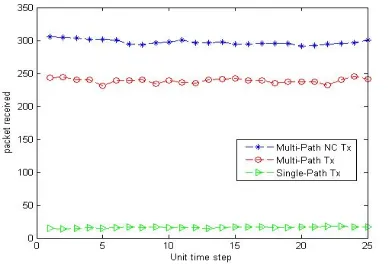
From the figure. 2, multipath transmission obviously has better network throughputs over
single path transmission and with random network
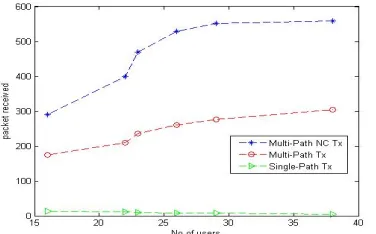
coding deployed network throughput was further enhanced as the network coded transmission is robust to erroneous transmission. In other word, decoding probability is increased as described in the equations (3), (4) and (5). Similar enhancement can be observed for the increasing user nodes as shown in the figure. 3 indicating increased user nodes increases the packet received if there is free radio channel available. There is steady number of packet received after all the channels had been occupied.
B. Network Security Analysis
[image:7.612.78.273.580.712.2]For the secure transmission, network coded packets were not transmitted through the same channel in sequence one after another as probability of decoding by eavesdropper rises. Further erasure channel enhances the security purpose provided same information content of symbol polluted by the channel can be extracted from network coded packet through other channels in multi hop network coded transmission. From table 2, it can be observed that if the packets are not coded, then tapping a channel is equivalent to getting information of user data transmitted through the tapped channel. But extracting information from tapped network coded packet is not possible unless the coding matrix is known, and all the encoded packets are not tapped for random network coding scheme.
Table 1: Transmission Status Matrix
Time slot RRH1 MBS RRH2
1st a (RB1) a⨁b (RB2) a⨁b⨁c (RB3)
2nd a⨁(a⨁b) (RB4) 0 (a⨁b)⨁(a⨁b⨁c) (RB5)
Figure 2: Packet Received Over Unit Sample Time
Table 2: Security Analysis in Wire Tapped Network
No. of channels tapped
Information eavesdropped by malicious users Conventional
transmission Random network coded transmission
1 1 0
2 2 0
3 3 3
2388
5. SIGNIFICANCE AND CHALLENGES
Deployment of network coding process enhances the both security measures and network throughputs with the cost of computational complexity at nodes for encoding and end users for decoding. Since the deployment of random network coding in multi hop
network reduces the error probability,
[image:8.612.100.288.340.457.2]retransmission mechanism is no more beneficent which reduces the queue length at nodes and no need of feedback system for retransmission facility. Maintenance of transmission status of coded packets for the decoding process is one of the challenges in the multi hop random network coding scheme. Multi hop network coding further requires the high computational resources at intermediate nodes. Network information from MBS to BBU Pool is another challenging task as the network status and characteristics are time functions though some mathematical prediction models can be used which could not be accurate.
Figure 3: Packet Received With Increased User Nodes
6. CONCLUSION
Deployment of Network coding enhances both network throughputs and security measures of the multi path data transmission over the network. In multipath transmission, implementation of network coding makes the transmission secure and information content of each transmission along with efficient channel selection of better conditioned enhances the throughputs. Another multipath transmission, with multi hop random network coding scheme deployed further enhances the network throughputs so the network capacity as the transmission has robustness to erroneous. Thus, multipath transmission is secure and efficient in the sense better conditioned and different channel selection for same generation packets of a single user to secure the transmission and error robust random network coding to optimize the network throughputs.
REFERENCES:
[1] M. Peng, Y. Li, J. Jiang, J. Li, and C. Wang,
"Heterogeneous cloud radio access networks: a new perspective for enhancing spectral and energy efficiencies," IEEE Trans. on Wireless Commun., vol. 21, no. 6, pp. 126-135, Dec. 2014.
[2] M. Peng, Y. Li, Z. Zhao, and C. Wang,
"System architecture and key technologies for 5g heterogeneous cloud radio access networks," IEEE Trans. on Network, vol. 29, no. 2, pp. 6-14, Mar. 2015.
[3] J.-C. Guey, P.-K. Liao, Y.-S. Chen, A. Hsu,
C.-H. Hwang, and G. Lin, “On 5g radio access architecture and technology,” IEEE Trans. on Wireless Commun., vol. 22, no. 5, pp. 2-5, 2015.
[4] O. Delgado and F. Labeau, "Uplink load
balancing over multipath heterogeneous wireless networks," in Proc. IEEE 81st Vehicular Technology Conf. (VTC Spring), May 2015, pp. 1-6.
[5] Q. Gao, G. Chen, L. Liao, and Y. Hua,
"Full-Duplex cooperative transmission scheduling in fast-fading MIMO relaying wireless network," in Proc. Int. Conf. on Computing, networking and Communication (ICNC), 3-6 Feb. 2014, pp. 771-775.
[6] J. Hong and V. O. Li, "Optimal resource
allocation for transmitting network
information and data in wireless network," in Proc. IEEE Int. Conf. on Commun. (ICC), 23-27 May 2010, pp. 1-5.
[7] R. Ahlswede, N. Cai, S.R. Li, and R.W.
Yeung, "Network information flow," IEEE Trans. Inf. Theory, vol. 46, no. 4, pp. 1204-1216, Jul. 2000.
[8] S.-Y.R. Li, R.W. Yeung, and N. Cai, “Linear
Network Coding”, IEEE Tans. Inf. Theory, vol. 49, no. 2, pp. 371-381, Feb. 2003.
[9] S. -Y. R. Li, Q. T. Sun, and Z. Shao, “Linear
network coding: theory and algorithm,” in Proc. IEEE vol. 99, no. 3, pp. 372-387, Mar. 2011.
[10]C.-C. Wang and X. Lin, "Fast resource
allocation for network-coded traffic - a coded-feedback approach," in Proc. IEEE INFOCOM, 2009, pp. 2801-2805.
[11]T. Mehmood and L. Libman, "Towards
2389
[12]S. Katti, H. Rahul, W. Hu, D. Katabi, M.
Medard, and J. Crowcroft, “XORs in the air: practical wireless network coding,” IEEE Trans. on Networking, vol. 16, no. 3, pp. 497-510, Jun. 2008.
[13]J. Le, J. C. S. Lui, and D.-M. Chiu, “DCAR:
distributed coding-aware routing in wireless networks,” IEEE Trans. On Mobile Computing, vol. 9, no. 4, pp. 596-608, Apr.
2010.
[14]M. Mohseni and D. Zhao, "Channel
allocation and time scheduling in multi-channel wireless networks using network coding," in Proc. IEEE Wireless Commun. and Networking Conf.(WCNC), Apr. 2013, pp. 1504-1509.
[15]L. Yu, W. Cheng, and F. Xiong, "Practical
network coding approach for multicast packet switching," in Proc. Global Inf. Infrastructure Symp. (GIIS’09), 23-26 Jun. 2009, pp. 1-4.
[16]A. Osseiran, M. Xiao, S. B. Slimane, M.
Skoglund, and J. Manssour, “Advanced in wireless network coding for IMT-advanced & beyond,” in Proc. 2nd Int. Conf. on
Wireless Communication., Vehicular
Technology, Info. Theory and Aerospace & Electronic Systems Technology, Mar. 2011, pp. 1-6.
[17]R. Zhang, J. Zhang, and Q. Qian,
“Opportunistic and fairness scheduling mechanism for wireless network coding,” in Proc. 7th Int. Conf. on Wireless Communication, Networking and Mobile Computing (WiCOM), Sep. 2011, pp. 1-4.
[18]C. Xu, P. Wang, C. Xiong, X. Wei, and
G.-M. Muntean, “Pipeline network
coding-based multipath data transfer in
heterogeneous wireless networks,” IEEE Trans. on broadcast., vol. pp, no. 99, pp.
1-15, Aug. 2016. DOI:
10.1109/TBC.2016.2590819.
[19]B. Li, D. Ban, and R. Zhang, “Efficient
scheduling for multicasting multimedia data with adaptive random network coding in relay-aided network,” in Proc. IEEE
Wireless Commun. and Networking
Conf.(WCNC), 2015, pp. 1584-1589.
[20]H. Xi, X. Wang, Y. Zhao, and H. Zhang, “A
reliable broadcast transmission approach based on random linear network coding,” in
Proc. 75th IEEE Vehicular Technology Conf.
(VTC Spring) 2012, DOI:
10.1109/VETECS.2012.6239871.
[21]X. Liu, X. Gong, and Y. Zheng, "Reliable
cooperative communications based on random network coding in multi-hop relay WSNs," IEEE Sensors Journal, vol. 14, no. 8, pp. 2514-2523, 2014.
[22]B. Li, S. Bi, R. Zhang, Y. Jiang, and Q. Li,
"Random network coding based on adaptive sliding window in wireless multicast
networks," in Proc. IEEE 83rd Vehicular
Technology Conf. (VTC Spring), 2016, pp. 1-5.
[23]B. Li, H. Li, R. Zhang, “Adaptive random
network coding for multicasting hard deadline constrained prioritized data,” IEEE Trans. on Vechicular Technology, vol. 65, no 10, pp. 8739-8744, Oct. 2016.
[24]R. Zhang, D. Ban, B. Li, and Y. Jiang, "The
cooperative multicasting based on random network coding in wireless networks," in
Proc. IEEE 83rd Vehicular Technology Conf.
(VTC Spring), 2016, DOI:
10.1109/VTCSpring.2016.7504503.
[25]N. Cai and T. Chan, “Theory of secure
network coding,” in Proc. IEEE vol. 99, no. 3, pp. 421-437, Mar. 2011.
[26]L. Geng, F. Lu, Y.-C. Liang, and F. Chin,
“Secure multi-path construction in wireless sensor networks using nework coding,” in
Proc. 19th Int. Symp. on Personal, Indoor and
Mobile Radio Commun., 2008, DOI: 10.1109/PIMRC.2008.4699459.
[27]J. Chen, R. Du, Q. Wang, and S. Yao,
“Secure routing based on network coding in
wireless sensor networks,” in Proc. 12th
IEEE Int. Conf. on Trust, Security and Privacy in Computing and Commun. 2013, pp. 58-64.
[28]D.S. Dong, K. Khatri, and A. Gachhadar,