Microloans, Climate Change Adaptation, &
Stated Investment Behaviour in
Small Island Developing States
– A Fiji Case-Study
Sindra D Sharma-Khushal
A thesis submitted to the Department of Geography and Environment of the London School of Economics and Political Science (LSE) in fulfilment of the requirements for the degree of
III
DECLARATION
I certify that the thesis I have presented for examination for the PhD degree of the London School of Economics and Political Science is solely my own work other than where I have clearly indicated that it is the work of others (in which case the extent of any work carried out jointly by me and any other person is clearly identified in it).
The copyright of this thesis rests with the author. Quotation from it is permitted, provided that full acknowledgement is made. This thesis may not be reproduced without my prior written consent. I warrant that this authorisation does not, to the best of my belief, infringe the rights of any third party. The photos used within this thesis are the property of the Author unless otherwise stated.
I declare that my thesis consists of 99,070 words.
JOINT WORK
Chapter 2 was published as:
Laurent, E., & Sharma-Khushal, S. (2015). Climate Change and SIDS – A Voice at
COP21 for Small Farmers. Issues Paper. Technical Centre for Agricultural and Rural Cooperation .
IV “There is no economic imperative that will condemn us to deplete our vital resource base,
but neither is there an invisible hand that will prevent us from doing so.” – Jeffrey D. Sachs, ‘Common Wealth: Economics for a Crowded Planet’
“Economic development is something much wider and deeper than economics, let alone
econometrics. Its roots lie outside the economic sphere, in education, organisation, discipline and, beyond that, in political independence and a national consciousness of self-reliance.”
– E.F. Schumacher, ‘Small Is Beautiful: Economics as if People Mattered’
“The truth is that we have never conquered the world, never understood it; we only think we
have control. We do not even know why we respond in a certain way to other organisms, and need them in diverse ways so deeply.”
– E.O Wislon, ‘Biophilia’
Dedicated to My Amazing Parents
&
V
Microloans, Climate Change Adaptation,
& Stated Investment Behaviour in Small
Island Developing States
– A Fiji Case-Study
VII
ABSTRACT
Anthropogenic climate change and environmental degradation impacts are no longer a worry for the distant future but a real concern for the present. Small Island Developing States (SIDS) and the poor, who often live by fragile ecosystems, are amongst the most vulnerable and exposed to the impacts of climate change. For these populations, climate related risks exacerbate other stressors and negatively impact livelihoods, security, and health. For low lying SIDS in particular, an additional fear is that climate change endangers their whole way of life, with their nationhood and culture being slowly engulfed by the approaching sea.
Whilst the need to adapt is apparent, adaptation funding and motivating people to take up adaptive behaviours is a serious challenge. According to the ODI, financing climate change adaptation in the developing world can cost upwards of US$ 100-450 billion a year. Building adaptive capacity through cost effective solutions such as microloans for adaptive investments can be a promising strategy. By utilising the case study of Fiji, this Thesis attempts to unpack the cognitive drivers of climate change adaptive stated investment behaviour through a survey-based experiment (N=205). The prominent empirical method employed in this thesis was mediation analysis and specifically path analysis whereby the model specified is driven by theory. The choice of this method is justified through a comparison with multinomial logit.
In the first instance, the antecedents of climate adaptive stated behaviour and the impact of information on subsequent stated behaviour were assessed through the framework of the Theory of Planned Behaviour. In addition perceptions to climate change in Fiji were explored through guided interviews (N=50). Overall positive attitudes, subjective norms and perceived behavioural control towards conservation and adaptation positively influenced intention to invest in adaptive strategies though intention only significantly influenced subsequent stated behaviour when information on climate change adaptation was provided.
VIII We also found that ethnicity was a strong positive moderator of behavioural antecedents and subsequent stated investment behaviour.
Lastly the moderators of stated behaviour and its antecedents were examined by exploring resource dependence, perceived shocks, and perceived severity of environmental and other issues. Again, it was found that green incentives were successful in engaging people to take up adaptive investments more so then under a dynamic (whereby loans are contingent on repayement) and a no incentive condition. It was found that perceived shocks, and resource dependence could significantly impact cognitive antecedents of behaviour as specified by the Theory of Planned Behaviour and in particular perceptions of behavioural control. Shocks, resource dependence and perceived severity also moderated subsequent stated behaviour, with greater variability between between adaptive and non-adaptive investment choices under the no incentive and dynamic incentive conditions. The latter had a greater probablity of agents choosing non-adaptive over adaptive investments whilst in the former the opposite was true. Overall the results can be useful for adaptation policies, microloan best practice, and behavioural change interventions in SIDS in particular.
IX
TABLE OF CONTENTS
Abstract ... VII Acknowledgements ... XVIII
1 A Review of Ecosystem-Based Adaptation, Microloans & Psychological Theories of
Behaviour ... 19
1.1 Introduction ... 20
1.2 Climate Change as a Commons Dilemma ... 23
1.2.1 Nature of Rights ... 24
1.2.2 Cooperative Behaviour ... 27
1.3 Integrated Development and Conservation Projects ... 30
1.3.1 Key Problems of ICDPs ... 34
1.4 An Introduction to Microfinance – The Grameen Bank ... 37
1.4.1 Criticisms of Microfinance ... 39
1.4.2 Microcredit and Common Pool Resources ... 41
1.4.3 Microcredit and ICDPs ... 42
1.5 Attitude and Behaviour... 43
1.5.1 The Value Belief Norm (VBN) Model ... 44
1.5.2 The Theory of Planned Behaviour (TPB)... 45
1.5.3 Structural Developmental Theory ... 47
1.5.4 Environmental Concern and Self-Construal ... 47
1.5.5 The Significance to Microcredit ... 49
1.6 The Case of Sub-Saharan Africa ... 50
1.7 WWF West Africa Marine Eco-region (WAMER) – Senegalese Case Study ... 54
1.8 The Annapurna Conservation Area Project (ACAP) - Protecting Snow Leopards ... 56
1.9 Kanchenjunga Conservation Area Project ... 57
1.10 Microcredit at Caohai Nature Reserve – A Less Successful Model ... 58
1.11 Bio-rights ... 59
1.12 Bio-Rights in Berbak-Sembilang National Park – Sumatra ... 61
1.13 References ... 64
2 Scope, Research Questions and Main Contribution of this Thesis ... 75
2.1 Scope and Research Questions ... 76
2.2 Contributions ... 80
2.3 References ... 80
3 Climate Change, Small Island Developing States, and SmallHolders ... 81
3.1 The Case of Small Island Developing States (SIDS) ... 82
3.2 The Problem ... 83
X
3.2.2 More Frequent and Severe Weather and Climate Events ... 85
3.2.3 Weather Changes Including in Rainfall Patterns and Drought ... 86
3.2.4 Sea-Level Rise ... 87
3.2.5 Ocean Acidification and Deoxygenation... 88
3.2.6 Vulnerability to Invasion by Invasive Species ... 89
3.2.7 Displacement in Small Island States ... 90
3.2.8 Consequences for Small Farmers in SIDS ... 91
3.2.9 Varying Impacts on Smallholders ... 92
3.3 International Commitments – The SAMOA Pathway ... 94
3.3.1 Mauritius and Beyond, Queries Around Progress ... 96
3.4 Solutions for SIDS ... 98
3.4.1 Mitigation of Climate Change ... 98
3.4.2 LowEmissionsAgriculture... 99
3.4.3 Building Resilience and Adaptation ... 101
3.4.4 Adaptation ... 101
3.4.5 Climate Smart Agriculture ... 102
3.5 Disaster Risk Reduction... 106
3.6 Participatory Value-Chains ... 106
3.7 Adaptation Finance ... 108
3.8 Case Studies of Cliamte Change Impacts on Smallholders in SIDS ... 109
3.8.1 Hurricane Ivan in Grenada... 109
3.8.2 Banana Production in the Windwards ... 111
3.8.3 Taro Cultivation and Sea Level Rise in the Republic of the Marshall Islands (RMI) 111 3.8.4 Case Study: Smallholder Adaptation to Cocoa Pod Borer in Papua New Guinea . 112 3.8.5 Palau Land to Sea Approach to Climate Change Adaptation ... 113
3.8.6 Case Study: Organic Cocoa in São Tomé and Principe ... 114
3.9 References ... 115
4 Fiji Case Study ... 122
4.1 Fiji Biodiversity ... 123
4.2 Microfinance in Fiji ... 130
4.3 The Fiji Locally Managed Marine Area (FLMMA) ... 132
4.4 References ... 135
5 The Research Journey – A PERSONAL Account of The Research Process ... 140
6 Researh Methodology ... 148
6.1 Survey-Based Experiment ... 149
6.2 Sampling Strategy and Psychological Constructs Survey Construction ... 151
XI
6.2.2 Survey – Psychological Constructs ... 152
6.3 Survey-Based Experiment ... 161
6.3.1 Outcome Variable Coding ... 166
6.4 Descriptive Statistics ... 167
6.5 References ... 168
7 Climate Change Perception in Fiji ... 171
7.1 Abstract ... 172
7.2 Perceptions ... 172
7.3 Mental Models ... 173
7.4 Method ... 174
7.4.1 General Interview Guide Approach ... 174
7.5 Discussion ... 177
7.6 References ... 179
8 Cognitive Drivers, and The Effect of Information on Stated Climate Change Adaptive Investment Behaviour ... 181
8.1 Abstract ... 182
8.2 Introduction ... 182
8.3 Conceptual Framework ... 185
8.4 Research Design ... 189
8.5 Empirical Method ... 189
8.6 Results... 193
8.6.1 Descriptive Statistics ... 193
8.6.2 Multi-Group Path Analysis with WLSMV Estimator ... 194
8.6.3 Multi-Group SEM Model ... 197
8.7 Discussion ... 200
8.8 References ... 202
9 Microloans for Climate Change Adaptation – Incentivising Adaptive Investments ... 209
9.1 Abstract ... 210
9.2 Introduction ... 210
9.2.1 Microcredit ... 213
9.3 Conceptual Framework ... 215
9.3.1 Incentives ... 215
9.3.2 Behavioural Antecedents ... 222
9.3.3 Demographic and contextual Factors ... 223
9.4 Research Design and Empirical Method ... 225
9.5 Results... 228
9.5.1 Path Analysis ... 229
XII
9.7 References ... 243
10 A Comparison of Statistical Analysis Methods ... 250
10.1 Abstract ... 251
10.2 Mediation Analysis ... 251
10.3 The Random Utility Model ... 252
10.3.1 Empirical Method ... 253
10.4 Results... 255
10.4.1 Antecedents of Behavioural Intention ... 256
10.4.2 Adaptive Portfolio ... 256
10.4.3 Moderately Adaptive Portfolio ... 258
10.4.4 Mixed Portfolio ... 260
10.4.5 Moderately Non-Adaptive Portfolio... 261
10.4.6 Non-Adaptive Portfolio ... 263
10.5 Discussion and Concluding Remarks ... 264
10.6 References ... 268
11 The Effect of Shocks, Resource Deependence and Perceived Severity Environmental and Social Issues on the Internal Drivers of Behaviour, and Stated Adaptive Investment Behaviour 271 11.1 Abstract ... 272
11.2 Introduction ... 272
11.2.1 Wider Moderators of Behaviour... 274
11.2.2 The Protection Motivation Theory (PMT) ... 275
11.2.3 Collective-Risk Social Dilemma... 278
11.3 Case-Study Climate Risk Characteristics ... 279
11.4 Research and Empirical Method ... 280
11.5 Results... 282
11.5.1 Descriptives ... 282
11.5.2 Path Analysis ... 284
11.6 Discussion ... 295
11.7 References ... 299
12 Conclusion ... 304
12.1 Summary ... 305
12.2 Policy Contribution ... 309
12.3 Limitations and Future Directions ... 311
12.4 Final Remarks... 313
12.5 References ... 316
13 Appendix A ... 318
XIII
15 Appendix C ... 330
16 Appendix D ... 332
17 Appendix E ... 336
18 Appendix F ... 338
TABLE OF FIGURES
Figure 1-1: Growth in Protected Areas (1872-2007) ... 32Figure 1-2: Schematic diagram of bio-rights approach ... 60
Figure 3-1: The Vulnerability of SIDS ... 83
Figure 3-2: A Summary of Climate Change Impacts on SIDS ... 85
Figure 3-3: Top 5 SIDS with highest percentage of population living 5m or less above Sea-Level ... 88
Figure 3-4: Climate Change Impacts of Smallholder Agriculture ... 91
Figure 3-5: Top Production in SIDS – 2012 ... 94
Figure 3-6: Previous Commitments on Sustainable Development ... 95
Figure 3-7: Food Imports (% of merchandise imports)... 97
Figure 3-8: Number of People Affected by Natural Disasters in SIDS ... 97
Figure 3-9: CO2 emissions (kt) ... 98
Figure 3-10: Agricultural Participatory Value-Chain ... 107
Figure 3-11: Net ODA Receipts to SIDS in US$ Millions ... 108
Figure 3-12: Impact of Hurricane Ivan on Agriculture In Grenada ... 110
Figure 4-1:Map of Flood Heights and Inundated Areas – Nadi ... 126
Figure 4-2: Nadi Flood Adaptation ... 127
Figure 4-3: Slum Settlement Near Colo-i-Suva Forest Reserve... 129
Figure 6-1:Viti-Levu Island-Scape Map ... 152
Figure 6-2: Framed Field Experiment High Level Summary... 162
Figure 6-3: Investment Choice ... 163
Figure 6-4: Possible Investment Portfolios ... 166
Figure 7-1: Themes Relating to Knowledge of Climate Change ... 175
Figure 7-2: Themes Relating to Source of Climate Change ... 176
XIV
Figure 7-4:Actions to Counteract Negative Effects of Climate Change ... 177
Figure 7-5: Resources Needed to Take Action ... 177
Figure 8-1: The Theory of Planned Behaviour ... 186
Figure 8-2: Frequency Distribution Of Investment Choice ... 194
Figure 8-3: Path Model for the Group In Receipt Of Climate Change Information ... 195
Figure 8-4: Path Model for the Control Group ... 196
Figure 8-5: SEM Model for the Group In Receipt Of Climate Change Information ... 198
Figure 8-6: SEM Model for the Control Group ... 199
Figure 9-1: Demographic and Contextual Variables ... 225
Figure 9-2: Incentive Choice across treatments and conditions ... 229
Figure 9-3: Path Model ... 230
Figure 9-4: Green Incentive Coefficients and Predicted Probabilities ... 234
Figure 11-1: Path Diagram ... 284
Figure 11-2: Coefficients And Probabilities – Green Incentive ... 293
TABLE OF TABLES
Table 3-1: Smallholder Holdings by Size in Selected SIDS ... 92Table 3-2: Agriculture’s Contribution to Total Emissions in SIDS ... 99
Table 4-1: Value of Ecosystem Services - Fiji, 1994 ... 124
Table 6-1: Attitudes Towards Conservation - Descriptives ... 155
Table 6-2: Attitudes Towards Conservation - Matrix of Correlations ... 155
Table 6-3: Subjective Norms - Descriptives... 156
Table 6-4: Subjective Norms - Matrix of Correlations ... 157
Table 6-5: Perceived Behavioural Control - Descriptives ... 157
Table 6-6: Perceived Behavioural Control - Matrix of Correlations ... 158
Table 6-7: Behavioural Intention - Descriptives ... 158
Table 6-8: Behavioural Intention - Matrix of Correlations ... 158
Table 6-9: Matrix of Investment Choices across the Two Collection Periods ... 166
Table 6-10: Descriptives of Demographic and Contextual Variables... 167
Table 6-11: Expenditure Per Month ... 168
Table 6-12: Use of Loans ... 168
XV Table 8-2: Path Coefficients and Probabilities for Group in Receipt of Climate Change
Information ... 196
Table 8-3: Path Coefficients and Probabilities for the Control Group ... 197
Table 8-4: SEM Coefficients and Probabilities for Group in Receipt of Climate Change Information ... 198
Table 8-5: SEM Coefficients and Probabilities for the Control Group ... 199
Table 9-1: Frequency Distribution of Investment Choice ... 228
Table 9-2: Behavioural Antecdents and Demographic Moderators ... 231
Table 9-3: No Incentive Coefficients and Predicted Probabilities ... 232
Table 9-4: Dynamic Incentive Coefficients and Predicted Probabilities ... 233
Table 9-5: Covariance Coefficients ... 234
Table 9-6: Matric of Correlations ... 235
Table 10-1: Marginal Effects of Independent Variables on Behavioural Intention ... 256
Table 10-2: Marginal Effects - Adaptive Portfolio under the No Incentive Condition ... 257
Table 10-3: Marginal Effects - Adaptive Portfolio Under the Dynamic Incentive Condition ... 257
Table 10-4: Marginal Effects - Adaptive Portfolio Under the Green Incentive Condition ... 258
Table 10-5: Marginal Effects - Moderately-Adaptive Portfolio Under the No Incentive Condition ... 258
Table 10-6: Marginal Effects - Moderately-Adaptive Portfolio Under the Dynamic Incentive Condition ... 259
Table 10-7: Marginal Effects - Moderately-Adaptive Portfolio Under the Green Incentive Condition ... 259
Table 10-8: Marginal Effects - Mixed Portfolio Under the No Incentive Condition ... 260
Table 10-9: Marginal Effects - Mixed Portfolio Under the Dynamic Incentive Condition ... 260
Table 10-10: Marginal Effects - Mixed Portfolio Under the Green Incentive Condition ... 261
Table 10-11: Marginal Effects - Moderately Non-Adaptive Portfolio Under the No Incentive Condition ... 261
Table 10-12: Marginal Effects - Moderately Non-Adaptive Portfolio Under the Dynamic Incentive Condition ... 262
Table 10-13: Marginal Effects - Moderately Non-Adaptive Portfolio Under the Green Incentive Condition ... 262
Table 10-14: Marginal Effects - Non-Adaptive Portfolio Under the No Incentive Condition ... 263
XVI Table 11-1: Frequency and Descriptive Statistics for Demographic Variables, Resource
Dependence, Perceived Threats and Severity of Environmental and Other Issues ... 282
Table 11-2: Coefficients and Predicted Probablity - Antecedents of Intention ... 285
Table 11-3: Coefficients and Predicted Probablity - Moderators of Attitudes ... 286
Table 11-4: Coefficients and Predicted Probablity - Moderators of Subjective Norms ... 287
Table 11-5: Coefficients and Predicted Probablity - Moderators oF Perceived Behavioural Control ... 288
Table 11-6: Coefficients and Probabilities - No Incentive ... 289
Table 11-7: Coefficients and Probabilities – Dynamic Incentive ... 291
Table 17-1: Measurement Model Coeficcients – Treatment Group ... 336
Table 17-2: Measurement Model - Control Group ... 337
TABLE OF EQUATIONS
Equation 6-1 Attitudes ... 153Equation 8-1 Path Equation ... 191
Equation 8-2 Probabilities ... 191
Equation 8-3 SEM Equation ... 191
Equation 8-4 SEM Equation ... 192
Equation 8-5 Probabilities ... 192
Equation 9-1 Path Equation ... 226
Equation 9-2 Probabilities ... 227
Equation 10-1Utility ... 253
Equation 10-2 Multinomial Logit ... 253
Equation 10-3Multinomial Logit ... 254
Equation 10-4 Marginal Effects ... 254
Equation 10-5 Probability of Categorical Membership ... 254
Equation 11-1 Path Equation ... 281
XVII
LIST OF ABBREVIATIONS
ASAP Adaptation for Smallholder Agriculture
CBC Community Based Conservation
CBD Convention on Biological Diversity
CFI Comparative Fit Index
COP 21 UNFCCC 21st Conference of the Parties
CPR Common Pool Resources
FLMMA Fiji Locally Managed Marine Area
ICDPs Integrated Conservation and Development Projects IFAD International Fund for Agriculture Development IPCC Intergovernmental Panel on Climate Change
LDC Least Developed Country
MDG Millennium Development Goals
MFIs Microfinance Institutions
NEP New Environmental Paradigm
ODI Overseas Development Institute
PD Prisoners Dilemma
PMT Protection Motivation Theory
RMSEA Root Mean Square Error Approximation SAMOA Pathway SIDS Accelerated Modalities of Action
SEM Structural Equation Modelling
SIDS Small Island Developing States
SRMR Standardized Root Mean Square Residual
TPB Theory of Planned Behaviour
UNDP United Nations Development Programme
UNFCCC United Nations Framework Convention on Climate Change WLSMV Mean and Variance Adjusted Weighted Least Squares
XVIII
ACKNOWLEDGEMENTS
I take this opportunity to thank my supervisor Salvatore Di Falco for his support and guidance, and the London School of Economics not only for feeding my mind with hopeful ideas and exposing me to some of my heroes, but also for the studentships which helped me fund my PhD. I would also like to extend my gratitude to my examiners, Professor Fredrik Carlsson and Professor Susana Mourato, for their useful feedback.
I cannot begin to convey my indebtedness to Nalini and Athil Narayan for their kindness and hospitality in Suva and my research assistants, Josephine and Solo for their efforts. Additional thanks go out to the Fiji Sugar Cane Growers Council for their hospitality and assistance with my fieldwork in Fiji’s Western Division.
To all my beautiful family and friends I lost during the process of this PhD; I love you and miss you – K you were such a big inspiration for me – you showed me that I could find an endless space of wonder and meaning by looking to the earth and the beauty of our natural world. I miss you every single day my friend and I carry you in my heart always.
To my sweet husband and best friend; your confidence in me, even when my own had failed, has pushed me forward up this tremendous and volatile mountain. You have been an inspirational source of support for me. Thank you.
19
1
A REVIEW OF ECOSYSTEM-BASED ADAPTATION,
MICROLOANS & PSYCHOLOGICAL THEORIES OF BEHAVIOUR
1
1
20
1.1 INTRODUCTION
A prominent challenge in promoting environmental conservation and climate change adaptation behaviours centres on the creation of pecuniary and non-pecuniary value around common pool resources such that it leads to improved environmental stewardship. New strategies will need to be sought where possible such that the objectives of conservation and development are maintained. One strategy which may show promise in meeting the triple bottom line of sound economic, social and environmental objectives is microloans. Over the last several decades microfinance has transformed into a social movement and has widened its focus from poverty alleviation to addressing the myriad problems that surround poverty such as (but not limited to) empowering women, environmental degradation, lack of education and access to healthcare. In recent years we have seen a greater movement towards microfinance being used as a tool in the struggle to conserve the natural world. Some have put forth the usefulness of microfinance as a positive adaptive strategy against climate change as it enables the diversification of incomes and provides a buffer against shocks (Anderson & Locker, 2002; Araya & Christen, 2004; Agrawal & Carraro, 2010; Polman & Uniyal, 2008). Indeed Microfinance Institutions (MFIs) are picking up on its utility as a strategy to promote positive environmental behaviours alongside social and economic agendas, with popular microfinance databases such as the ‘themix.org’ showing a growing number of MFIs paying attention to their social responsibility to the environment.
A lack of impact assessments and literature means that there remains a gap in understanding whether microfinance is a viable tool in reaching conservation and climate change adaptation objectives. This thesis focuses on the microcredit2 component of MFIs. It attempts to unpack some of the processes at work in environmentally responsible applications of microloans by exploring the effect of endogenous behavioural antecedents (specifically attitudes, subjective norms, perceived behavioural control and behavioural intention), exogenous variables (such as exposure to information and threat) and explicit microloan incentives on climate adaptive investment behaviour.
As those most vulnerable to the effects of climate change also live within fragile ecosystems, it is important to look at climate change adaptation and conservation in conjunction. In doing so we are referring to ecosystem-based adaptation. Ecosystem-based adaptation is a term coined by the Convention on Biological Diversity (CBD). It refers to
2
21 “[the integration of] biodiversity and ecosystem services into an overall adaptive strategy [which] can be cost-effective and generate social, economic and cultural co-benefits and contribute to the conservation of biodiversity” (Secretariat of the Convention on Biological Diversity, 2009, p9.) At its core such adaptation looks at the impact of climate change on humans and nature, taking into consideration the indirect and direct impact of climate change on conservation targets, ecosystem processes and human communities. Strategies are focused on the restoration and conservation of ecosystems which in turn help people adapt to the impacts of climate change. It includes strategies such as: mangrove restoration for coastal defense and flood regulation, agro-biodiversity conservation (crop diversity) and sustainable land management for soil health.
Ecosystem-based adaptation is important as it does not only focus on human well-being but the well-well-being of the planet as a whole. The state and quantity of natural capital provide flows of value to human well-being and is known as ecosystem services. Ecosystems provide supporting (for example soil formation and photosynthesis), provisioning (for example crops and fresh water), regulating (for example carbon sequestration and climate regulation) and cultural services (for example spiritual and recreational values). Anthropogenic climate change directly threatens ecosystem services by placing pressure on natural systems and species that are unable to naturally adapt at the current rate of warming. Ecosystems and species which inhabit narrow geographic and climatic ranges such as mangroves, montane forests, and overall island ecosystems are particularly vulnerable to adverse impacts of climate change (TEEB, 2010; Secretariat of the Convention on Biological Diversity, 2009). Such important and unique ecosystems constitute what we refer to as ‘fragile ecosystems’. The fact that much of the rural poor are also clustered around such fragile ecosystems and rely on the resources it provides for subsistence, can compound degradation of the system and poverty of the populations which call it home (Barbier, 2012).
22 adaptation and conservation measures as they possess critical knowledge and experience in agriculture, food security, livelihoods, income generation, management of households and natural resources in diverse eco-systems (Goh, 2012). By including environmental dimensions to microcredit, the potential to empower women and protect ecosystems seems viable yet we are still at the embryonic stages of understanding how such tools can change behaviour.
In 1794, as the revolution raged in France, Condorcet wrote his masterwork, Sketch for a Historical Picture of the Progress of the Human Mind. In it he put forth the idea that the laws that govern nature need not be limited to the natural sciences. In fact, he proposed that the development of intellectual and moral faculties have similar laws which govern them. Condorcet opened the realm of the social sciences with his optimistic intellectual and social history of humanity (Wilson, 1999) urging us to examine every nook and cranny of why we are who we are. Why is this relevant to this thesis? The fact is that humanity resides in a space which is not separate from the natural world. We were born from it and one day we will return to it. We do not own it, but we are its stewards. In the last few centuries our stewardship has faltered and we have begun to view the earth no longer as a vital component to our being but as a commodity to be used. In fact, the prevailing school of thought is that nature needs to be treated as a commodity to justify saving it. However such a view is short-sighted as it presents the intact value of natural resources as implicitly for those alive at the present time and into the relatively near future (a few generations at best). Indeed novel financing methods are being developed to bridge capital from microloans to the local and global value of intact environmental resources to facilitate environmental stewardship. However at the same time there is much potential of the same tools to create value around good behaviour, for instance through the use of incentives. In doing so you have the potential to create lasting change, for instance; through shifting attitudes and values, the social norm may become one of environmentally responsible behaviour which is passed down to future generations.
23 (CPR), Integrated Conservation and Development Projects (ICDPs), microfinance, theories of environmentally protective behaviours and ecosystem-based adaptation initiatives which have incorporated microfinance within its strategy. The gaps in the literature are identified and wider contributions stated.
Chapter two is very brief. It arranges the scope, contribution and research questions for this thesis. Chapter three looks at the problems climate change poses to Small Island Developing States and smallholders. It presents solutions and illustrates the issues through case-studies. Chapter four introduces the case study of Fiji.
Chapter five is a personal narrative of the research experience. Chapter six introduces the research methodology and also discusses survey based experiments and the design of the psychological survey instrument.
The next three chapters are three different studies. Chapter seven builds an understanding of climate change perceptions of people living by fragile ecosystems in Fiji. Chapter eight, Employing Structural Equation Modelling utilizes the psychological framework of the Theory of Planned Behaviour (TPB), to examine the cognitive antecedents of adaptive microloan investment behaviour and the role of information in inducing behaviour change. Chapter nine looks at whether extrinsic motivation can crowd-in adaptive behaviour. It does so through a path analysis that extends the TPB to understand how contextual factors and microloan incentives impact subsequent adaptive investment behaviour. Chapter 10 weighs up the empirical method employed in the previous chapter by replicating the study but this time using the analytical method of multinomial logit. Chapter 11 further extends our understanding of incentives. It borrows the concept of threat appraisal from Protection Motivation Theory (PMT) which is added to the TPB framework to assess the effect of perceived shocks and threats on subsequent adaptive investment behaviour. Chapter 12 draws together findings and draws the thesis to an end.
1.2 CLIMATE CHANGE AS A COMMONS DILEMMA
24 the economic price of concerted political action, one thing is clear; the price of inaction is far too great. Whilst mitigation remains crucial, the speed at which warming is now occurring highlights the urgency of climate change adaptation. To better understand how such decisions are made, it is important to consider the nature of climate change from a commons and game theoretic perspective.
1.2.1 NATURE OF RIGHTS
The subject of rights to property is already complex and becomes more so when dealing with natural resources such as water, oil or land. To start, let us look at some basic features of property rights. Firstly, it is important to note that it is not the property that is owned but rather the rights to use the property. It is the nature of the rights which will determine how we are able to use the property. The delineation of types of property can be summarised by the excludability and rivalness of the resources in question. Generally private property is owned by a private entity which controls access, withdrawal, management and exclusion of the resource. Public property is owned by all but access and use is controlled by the state. Open access is property which is not owned by anyone and thus no one has the right to exclude anyone (Guerin, 2003). Lastly, the ‘commons’ refers to resources that are non-excludable as its sufficient size makes it costly to exclude potential beneficiaries. As such the resource is held in common, or shared between or within communities. Natural resources such as land, water, and the atmosphere and man-made resources such as the Internet can be seen as common pool resources (CPR).
25 outcome for a country would be to free ride by defecting (and continue producing GHG’s at the same rate) whilst other countries cooperate and reduce emissions, thus giving the free rider an economic advantage. Traditionally the pareto optimum outcome would be for all countries to cooperate, whilst the worst outcome would be for all to defect. Unfortunately such a simple model does not take in the complexity of anthropogenic climate change which elicits a problematic payoff structure.
Scientific uncertainty over the magnitude and distribution of negative effects makes it unclear whether total cooperation will be able to significantly halt the hypothesised harmful effects of climate change. Thus countries, in reducing dependence on fossil fuels, may still experience potentially catastrophic, negative outcomes. In addition the distribution of these outcomes may mean that some countries are relatively better off than others which further complicates the game theoretic model as these countries can essentially contribute less to avoid future costs. Furthermore, as the causes of anthropogenic climate change are deeply rooted within our social and economic structures, incentives to switch to a low carbon-economy can create distortions in rent-seeking behaviour with countries attempting to maximise any advantage they can attain from their individual quotas; and companies attempting to arbitrage between geographic production caps (Helm, 2008; Gardener, 2006).
26 Fülöp & Prill, 2005), plays out like a chess game. Each player has one move in a given sequence. Once all players have moved then the next round begins. Here the best strategy will depend on the results of the preceding round.
Returning to the general game theoretic model of the PD game, Ostrom (2000) notes that generally those who envision the commons through such a game fall into two camps when it comes to the management of CPRs. One promotes the role of a central government to effectively govern the commons whilst the other advocates converting the commons into smaller units of private property thereby incentivising people to take up optimal use patterns. Looking at the latter, neoliberal’s have long held that the absence of clear private property rights is the greatest institutional barrier to economic development and human welfare. For neoliberals, state deregulation and privatisation of assets are necessary to not only preserve resources but to allocate it to its best possible use. Private property rights in distinguishing individual vs public rights creates scarcity of the resource/property thus giving it value which is argued to be the best way in which to conserve resources (Thobani, 1995). Furthermore it creates competition thereby improving efficiency and productivity, and lowers prices according to true market values thereby controlling inflationary tendencies (Harvey, 2005).
27
1.2.2 COOPERATIVE BEHAVIOUR
An alternative view point regarding the management of CPRs is presented by Gardener, Ostrom, and Walker (1989). They attempt to explain the many examples of cooperation in real world commons dilemmas by turning to cultural evolution. They put forth that cooperative behaviour was an integral component to adaptive fitness in the early development of our species. As such, regarding resource use, we learnt to adopt coordinated strategies that would lead to positive joint and individual payoffs. Learning social norms and being able to identify deceit and trustworthiness in members would have been a select advantage. Indeed it is argued that social problem solving alongside ecological conditions were integral in the evolution of our cognitive adaptations. According to the Ecological Dominance-Social Competition model, competition with conspecifics and reciprocity based coalitions were integral to the evolution of our vast and highly complex cognitive abilities (Flinn, Geary & Ward, 2005). She puts forth an indirect evolutionary approach as an alternative to the standard rational choice theory.
Within the indirect evolutionary approach she accounts for different types of resource users as participants in a collective action problem as their levels of conformity to social norms of trust and reciprocity will elicit differential intrinsic preferences over outcomes (Ostrom 2000). The types of resource users she identifies are rational egoists, norm users and conditional co-operators. For rational egoists, the social norm of reciprocity is not valued, whilst norm users will behave in accordance to the level that they value conforming to a norm. Conditional co-operators are trustworthy users to begin with who reward trust with further trustworthy behaviour. Payoffs will depend on the players type and the level of information available regarding other players. Ostrom (2000) shows that those who adopt conditional cooperation strategies are better able to survive in dilemma situations if some conspecifics are also norm driven and some information about other users is also known. The level of cooperative behaviour is impacted by a plethora of contextual factors however a consistent finding is that CPR users are more likely to sustainably manage the use of the resource when they are left to organise their own strategy for its management over externally imposed rules.
28 of this collective management of water which was the key to water conservation and harvesting. Collective management has the power of social capital, group norms, trust, tradition, and group sanctions which guides sustainable use and conservation of a resource. For Shiva (2002), eroding community control, introducing private property rights and new technologies violates the water cycle. As a consequence scarcity becomes inevitable. She warns that the public-private partnerships (whereby private property rights are assigned to certain assets) operate under the guise of democracy, accountability and public participation, but in fact such partnerships involve the transfer of public funds to privatise public goods.
Indeed such public-private partnerships can exacerbate negative externalities (such as further environmental degradation) in an attempt to provide a cost-efficient service (Lee & Floris 2003). Furthermore, with resources such as water, which is integral to all life, assignment of private property rights can exclude vulnerable populations who do not have the capacity to attain rights or purchase water from the rights owner. Such issues do not necessarily mean the removal of private property rights, in fact, when looking at conservation, public-private partnerships can enhance resilience as they can bring in a unique profit motive which may not exist for a public entity (Andonova, 2010). Yet it is important to keep in mind that if the use of such market-based instruments is appropriate in managing the commons, then factors such as the independence of the judiciary, the existence of corruption within the judiciary, and the ability of individuals and businesses to enforce contracts must be considered for fair outcomes (Scott, 2002).
The commons need not be seen in Hardin’s (1969) stark view. Many studies have shown the power of the commons in preserving resources if certain conditions are met. Agrawal’s (2003) review of three studies show that these conditions pertain to: 1) aspects of social capital3 (such as group norms, solidarity and size), 2) the characteristics of the resource (whether it has well-defined boundaries, riskiness of the resource, etc.), 3) institutional regimes (monitoring, sanctions, regulations) , 4) the external environment (considering linkages with state, as in power and governance structures and adequate compensatory measures for resource conservation and 5) the availability of technological means through which to exploit the commons. The effectiveness of the type of right assigned will depend on the context within which it is legislated. In collectivist cultures with strong social norms, resource users’ management of common property may be the way to go whilst in more
3Social capital brings together people through shared norms, values and understandings that
29 individualistic cultures and perhaps the domain of the rational-egoist, other solutions may be sought.
For Ostrom (1990), the design principles which lead to sustainable common pool resource use regimes have been identified as:
Clear boundary rules which delineate the population effected by the resource use regime and importantly with whom social norms are formed.
Acknowledgement of local resource use traditions, a clear indication of how much, when, and how resources are to be harvested as well as allocating benefits in proportion to inputs.
Resource users are actively involved in making and modifying resource use rules. This enables the creation of mutually accepted rules in line with local traditions.
Monitors who are accountable to resource users or are in themselves resource users. They are tasked with not only monitoring the state of the resource but also user behaviour.
The use of graduated sanctions whereby the seriousness of the rule infraction is taken into consideration. This acknowledges small infringements such that the rule breaker is aware that their behaviour is observed and may then take corrective measures to step in line with norms, or may escalate infractions at the risk of higher sanctions and potential exit out of the group.
Access to local conflict resolution platforms to deal with resource use grievances in order to maintain rule conformance.
Some level of legitimacy regarding the local-users resource use regime is necessary by the local or national government so that they are not undermined by the entrance of other potential resource users.
The need for nested regimes when dealing with large scale CPR problems.
30 NGOs and Intergovernmental Organisations who can provide an interesting array of resources to its management and which in itself are influenced by exogenous factors. Edwards and Stein (1999) argue that such external actors require greater representation within the design principles to be able to elicit contextual analysis. The debate of self governance of the commons will continue as the nature of our planet places us in such a dilemma. That self governance has worked in some instances but failed dramatically in others (as the story of man-made climate change attests too) requires alternative solutions to be sought when necessary. One such solution came in the form of Integrated Development and Conservation Projects (ICDPs).
1.3 INTEGRATED DEVELOPMENT AND CONSERVATION PROJECTS
In the decades preceding Our Common Future, and the Millennium Declaration, the link between poverty and environmental degradation has strengthened. This is evident in the Millennium Development Goals (MDGs) which comment on the poverty-environment nexus and the mutually reinforcing relationship between poverty and environmental degradation. Thus poverty reduction and environmental protection have come to be seen as complementary goals (Dasgupta, Deichman, Mesiner & Wheeler, 2005).
Such shifts in discourse have manifested itself in movements away from the traditional ‘fences and fines’ approaches to conservation, where generally local users are excluded, to more holistic Integrated Conservation and Development Projects (ICDPs); an umbrella term housing within it concepts such as Community-Based-Conservation (CBC). Incorporating local development with conservation saw ICDPs enjoy a rapid period of growth over the last three decades. However from its earliest days the approach has garnered much criticism with some stating the crucial links between conservation and development has remained nonexistent (Barrett & Arcese, 1995). Regardless, such strategies have drawn considerable amounts of donor funding directed at conservation (Hughes & Flintan, 2001) and though there remains criticisms, the use of microfinance and credit lending models by ICDPs to facilitate its developmental agenda, can provide insights into the use of microloans in ecosystem-based adaptation.
31 entering the global discourse as evidenced by the 1972 United Nations Conference on the Human Environment and the subsequent creation of the United Nations Commission on Environment and Development in 1983.
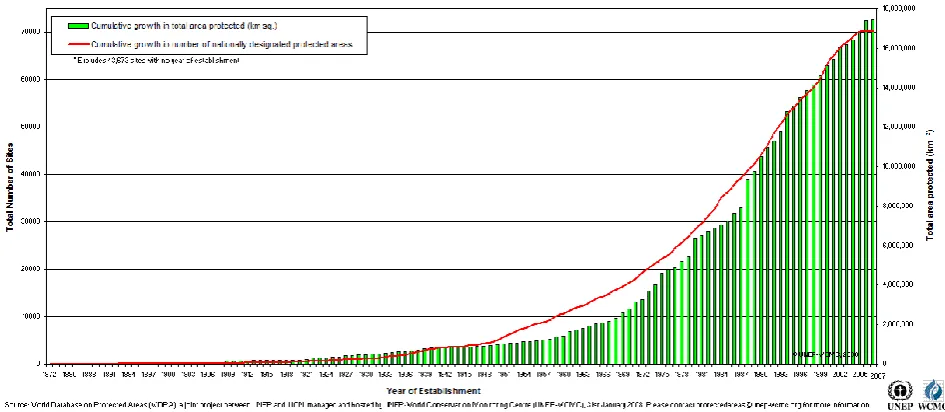
It was during this time that the world saw an exponential growth in protected areas (Figure 1.1). Foremost, protected areas were envisioned as a means through which to protect species and conserve biodiversity (Lee, Sodhi & Prawiradulaga, 2007). There are many types of protected areas, allowing differing levels of user rights in an attempt to curb the increasing fragmentation and conversion of habitats to address the significant loss in biodiversity in the last several decades4. Naturally this growth would come at a price. Often, the costs and benefits generated by such areas are not evenly distributed. Benefits are felt globally and nationally whilst the costs are more so borne locally. Indigenous communities, dependent on the land and the resources that had shaped and given life to their cultures were suddenly faced with displacement through physical translocation and/or restrictions on access to resources, impacting upon their livelihoods and traditions (Krueger, 2009).
The growth in protected areas was also followed by a period of intense wildlife exploitation within certain of these areas. With 1.1 billion of the poorest people living in biodiversity hotspots, the links between development and conservation became harder to ignore (Araya & Christen, 2004). To address the dual needs of the local community and species, conservationist begun taking a more ecosystem or landscape approach towards conservation whereby the inclusion of local communities within and around protected areas was seen as potentially aiding in achieving conservation objectives (Mackinnon, 2001). The ICDP approach was thus born.
4
32
FIGURE 1-1: GROWTH IN PROTECTED AREAS (1872-2007) ) - (UNEP-WCMC, 2012)
ICDP is more of an umbrella term. It has been applied to a diverse range of projects each sharing a common goal; attempting to preserve the biological diversity of ecosystems through linking conservation efforts within protected areas with poverty alleviation strategies for those living within buffer zones (Wells, 1999).
Over the years the definition of ICDPs has evolved, in essence it is an adaptive term that incorporates concepts of decentralisation, community participation, and sustainable development amongst other things. Furthermore such projects range in size and scope, reflected not only in project design and implementation but in the different types of organisations spearheading efforts (Damania et al., 2008). For instance, in its early days the projects were largely run by small NGOs before being embraced by global actors such as the World Bank Group’s Global Environmental Facility (GEF). For GEF, ICDPs enabled the engagement in projects to empower and benefit local communities living by protected areas through small scale poverty alleviation strategies to large scale programs that could integrate conservation with regional and national development goals (Jansen & Shen, 1997). It is perhaps this flexibility and the promised benefits which added to the popularity of ICDPs at that time. To enable biodiversity conservation, increased local community participation, more equitable sharing of benefits and economic development for the rural poor is alluring (Mckinnon, 2001).
33 (CBC), wildlife management, eco-tourism, and agricultural based methods (Agrawal & Redford, 2006). The seemingly broad body of practices utilised by ICDPs do display underlying similarities. These are displayed by Peters (1998) who identifies four basic strategies utilised by ICDPs linking conservation with development. These are: management of protected areas, the establishment and maintenance of buffer zones, compensating or enabling viable substitutes to local people, and promoting local and social development.
Some of these strategies are evident in the CBC approach wherein the key aspect is the community focus. Management of resources is carried out primarily by the community relevant user groups but it also involves locally and nationally relevant institutional and private stakeholders. This makes optimum use of social capital, existing (or assigned) resource rights, local governance, traditional and local information, interest and self-enforcement capacity (Govan, 2007). CBC is therefore a collaborative approach to management which shifts the power balance in conservation decision making from top-down to bottom-up. Importantly it utilises the motivating force of the community to drive conservation. Keeping in mind Ostrom’s (1990) design principles, well set-up Community Based Natural Resource Management with well defined user rights can be very fruitful to conservation efforts by including stakeholders at every level of design and management.
In addition, CBC is foremost conceptualised as a conservation initiative (Tai, 2007) and assumes the following: biodiversity conservation will succeed only if local communities receive sufficient benefits and participate in its management therefore having a stake in conserving the resource (Mehta and Kellert, 1998). Furthermore it assumes that conservation and development are complementary and can be achieved in concert. Lastly the locus of ‘blame’ is placed upon the community – it is internal factors, representing local people and their subsistence practices, rather than external factors, such as market demand for protected goods, which pose the greatest threat to conservation in protected areas. These assumptions of CBC are mirrored in ICDPs. With Hughes and Flintan (2001), in a review of the ICDP literature, collating the following list of the assumptions behind ICDPs:
1) Through diversification of livelihoods, the exploitation of resources integral to maintaining biodiversity can be reduced, thus improving conservation.
34 3) ICDPs are a sustainable alternative to the protectionist approach to the management of
local areas. (Hughes & Flintan, 2001)
1.3.1 KEY PROBLEMS OF ICDPS
However, it is these unexamined assumptions which have been attributed to the often mediocre performance of ICDPs (Herrold-Menzies, 2006). In particular, a search of the literature revealed the following key issues emerging from ICDPs linked to these assumptions. Firstly ICDPs see local rural populations as the problem rather than solution to habitat destruction (Horwich & Lyon, 2007) but clearly this is not always the case. For example, external interests in wildlife trade and forest products place pressure on PA’s globally as does corruption within governance structures. This leads to the second issue whereby ICDPs are foremost designed to address the environmental problems arising from local livelihood practices. In doing so, they cannot address issues that arise from external sources such as the demand for illegal wildlife products that drives the activity of poachers, or inefficient/contesting policies (Damania et al., 2008; Herrold-Menzies, 2006). Winkler (2011) suggests that ICDPs need to cover a wider policy base to be successful with more encompassing tax and subsidy regimes.
Another concern surrounding ICDPs is that the provision of alternate employment opportunities may further deteriorate, rather than ameliorate, conservation objectives. In the first instance, alternative livelihoods are seen as complements rather than substitutes for activities that degrade the ecosystem (Engel et al, 2008). Secondly it has been shown that in some instances new sources of income are more likely to be complementary to existing exploitative activities as households attempt to maximise their incomes (Ferraro & Kiss, 2002). Kiss (2002) gives the example of the CAMPFIRE project in Zimbabwe where incomes generated by trophy hunting fees were invested into the expansion of agriculture into wildlife areas rather than conserving wildlife habitats. Furthermore as disposable income increases it is possible that demand for resources will also increase, placing further pressure on ecosystems (Herrold-Menzies, 2006).
35 addition, Winkler (2011) shows that ICDPs often are unable to achieve optimal levels of conservation because of externalities associated with the local communities. Thus the success of ICDPs will largely depend upon the strength of traditional local governance structures and the power relations therein. As such successes may be misleading with powerful actors within the community benefiting more than others (Locher, 2006; Damania et al., 2008).
For many the concepts of conservation and development are mutually exclusive. Invariably you cannot have one without sacrificing the other (Brosius & Russell, 2003). For instance Peters (1998) finds that the local people viewed conservation within the Ranomafana National Park in Madagascar to occur at the cost of development with villagers struggling to meet subsistence needs. Peters (1998) found that the western ideals prevailing over the Ranomafana ICDP failed to take into account the longstanding traditional land-use practices and the deep seated cultural norms governing them. Furthermore the Ranomafana ICDP urged an unequivocally biocentric agenda, placing preservation above and beyond the needs of local residents thereby further alienating communities which invariably would be detrimental to nature (Peters, 1998).
An example that incorporates some of these issues is the Sundarbans (West Bengal) eco-region. The last of the great mangrove forests, this region is fed by the deltas of the mighty Ganges, the Brahmaputra and the Meghna, forming a unique habitat for many rare and endangered species. The human population is dependent on the land to meet their subsistence needs and thus frequently clash with other local species, having converted vast areas of the forest into paddy fields and shrimp farms (Gopal & Chauhan, 2006). The rich biodiversity of the region is threatened by anthropogenic activities that regulate river flow upstream for human needs causing changes in sedimentation, fresh water inflow, and increased salinity (Gopal & Chauhan, 2006).
36 For the Sundarbans eco-region, competing interests complicated conservation and development objectives from the offset. On the one hand, the eco-region has been shown to be of great global significance, and is designated as a World Heritage Site and Biosphere Reserve. Locally however, for its inhabitants the region is seen as a ‘great provider’, allowing people to meet their subsistence needs. Nationally the Ministry of Environment and Forest recognised the significance of the region as a biodiversity hotspot and have attempted to protect various aspects of it. However the Ministry of Renewable Energy viewed the region as an unbounded source of energy, constructing a full-scale tidal power station next to the sanctuary, without clear assessments of how such an action would impact the already fragile ecosystem. In addition, by blocking off vital waterways, the power station would negatively impact the rural poor within the region. Furthermore, within the eco-region competing conservation interests became an issue with marine and forest conservation placing differing demands on the local population, and often leading to alternate livelihoods which were counterfactual to overall conservation goals (Danda, 2002). Having faced opposition from local communities and NGOs, The ADB/GEF funded ICDP closed half way through implementation. It was argued that the project lacked social and environmental impact assessments, that the needs of the local resource users were not met, and benefits from eco-tourism and other initiatives were largely being realised by outsiders rather than the local communities in addition to lacking accountability and transparency (Griffiths, 2005).
37
1.4 AN INTRODUCTION TO MICROFINANCE – THE GRAMEEN BANK
The notion of development is not static; it evolves with emerging practices and worldviews. For instance, the nation or society, once the standard unit of development, has now been displaced by concepts such as regionalisation and globalisation. The state, which once stood as the conventional agent through which development occurred is no longer the sole focus, with international institutions and market forces emerging as new drivers of change. There is change underfoot with ‘traditional’ development ideas such as modernisation and westernisation being challenged as cultural diversity is re-examined and environmental sustainability has pervasively entered the agenda (Pieterse, 2002).
Microcredit and microfinance are development initiatives which have evolved with the shifting trends in development theory. It is a concept which has informed theory as much as it has been guided by it. Microfinance refers to the provision of financial services such as small loans, savings, fund transfers and insurance to the rural and urban poor whilst microcredit solely refers to the provision of small loans to this same population (Crichton, 2009). Microfinance as such typically includes a microcredit component. There are various strands of microfinance utilising different lending models such as associations, bank guarantees, rotating savings and credit associations, cooperatives, credit unions, Non-Governmental Organizations, for-profit banks and the group lending/ Grameen community banking model. Essentially models differ in how funds are governed and from where they are sourced. Here we will focus on the Grameen model popularised by Muhammad Yunus.
Microfinance has become a worldwide movement with the microcredit summit campaign (Daley-Harris, 2009) reporting 3552 microfinance institutions reaching 106.6 million of the poorest clients in 2007. In spite of the hype, microcredit and microfinance remain controversial as their contributions as well as effects on poverty alleviation have rightly come under scrutiny. So it bears careful scrutiny when these tools spread into new domains such as environmental protection.
38 Bangladesh. Yunus saw that the governmental institutions were ineffective and incapable of solving the abject poverty and that quite a different structure would be required that could enable the people of his country to live outside of such deprivation. The ensuing Grameen Bank, owned by the poor borrowers (Grameen Bank, 2009), would merge profit maximisation - the foremost value of conventional economics - with a novel humanist approach to development by realising that financial systems could in fact operate within the bounds of social values which sees each person as having the right to credit, growth and development (Fuglesang, Chandler & Akuretiyagama, 1993).
The neoliberalist approach of microcredit to alleviate poverty has been widely supported by the World Bank, International Monetary Fund and the United Nations since the 1980’s (Weber, 2002) as it falls within their dual sided development framework. This framework joins sound economic policy with social and institutional reform which espouses participatory tactics to empower the poor who are not seen as liabilities but as assets (Taylor, 2004). The support of high level donor agencies, NGO’s and political leaders enabled the proliferation of Grameen-like models of microcredit and microfinance institutions. Instigating these models as ‘best practice’ poverty alleviation tools (Bateman & Chang, 2009).
The concept of microfinance is simple. As with any retail bank it provides financial services and loans which are repaid along with interest. Although unlike normal banking institutions, the main difference is with the clients and loan amounts. Microfinance institutions commenced by lending to the poorest of the poor, namely women living below the poverty line, by providing them with minute loans at affordable interest rates. These women tend to have no collateral therefore making them high risk clients. To get around this many microfinance institutions employ a novel group lending method through which social collateral is formed.
39 from their account to enable greater returns. Each withdrawal must be approved by every member of the group (Fuglesan, Chandler & Akuretiyagama, 1993). A further characteristic of the Grameen credit system is that the lenders meet with the borrowers thus opening up banking services to isolated and marginalised populations who cannot leave their villages or slums for various reasons as disparate as cultural traditions or lack of transport (Panos, 1997). For some, Grameen Bank has been an overwhelming success story, distributing US$8.26 billion worth of loans since its inception in 1976 to 7.93 million clients, of which 97 per cent are women. Grameen (2009) reports its loan recovery rate at 97.89 per cent, which is surely to be applauded in a time of such global financial unrest. From its inception, Yunus and Grameen have since inspired thousands (Gutierrez-Nieto, Serrano-Cinca & Mar Molinero, 2007) of microfinance banks and programmes the world over. Whilst the methods employed in delivering their service differs according to context and objectives, each entity shares the same ideals as the Grameen Bank – the poor need not be seen as unskilled beneficiaries, but rather as clients striving for a better life through dignified employment (Bornstein,1997).
1.4.1 CRITICISMS OF MICROFINANCE
When done right, research has shown the successes of microfinance, for instance it builds strong communities through building social capital, it enables skills development, rewards entrepreneurship, it empowers women, significantly improves standards of living, and contributes to sustainable economic development (Crichton, 2009). Yet, microfinance cannot be seen as a panacea. Its rapid growth and the profit which exists at the base of the pyramid have left some questioning the impact it has upon the poor, and on ecosystems. For instance Ellerman (in Bateman, 2010) questions the viability of impact assessments utilised by MFIs. The current methodologies evaluate client versus non-client impact, with differences viewed as a consequence of microfinance. However without assigning true counterfactuals, the resulting assessments can be grossly misleading as it does not compare one development intervention with another but rather with no intervention at all.
40 demonstrated in impact assessments. Only the stories of successful micro-entrepreneurs are ever recorded even though most microenterprise programmes are faced with failure. Bateman (2010) states that such failure can indeed push the poor individuals into a spiral of ever greater poverty as they must bear the associated social costs (for instance shame) and the termination of a vital income stream.
In addition to these failings, it has also been argued that by emphasising on financial sustainability (thereby needing no donor aid) such institutions are not able to meet broader welfare needs for instance disaster relief for all citizens (Panos, 1997). Contrarily it can be argued that by providing insurance and savings to clients that these institutions in fact provide an effective safety net in times of trouble. For instance the macroeconomic role of microfinance during times of financial unrest has been questioned with conflicting findings. Marconi and Mosley (2006) argue that minimalist microcredit institutions could in fact intensify financial unrest, whilst microfinance institutions tended to be more resilient.
In relation to empowerment, it has been argued that such programmes can actually lead to disempowerment with tensions increasing between women over loan repayment, and between spouses as men have been shown to withdraw their own income as women begin earning. An additional concern that became apparent was the difficulty women had in retaining ownership over their earnings (Mayoux, 1999). Furthermore, microfinance can increase the burden on women as they must continue their traditional roles within the informal economy whilst also dealing with running a business with the added stress, responsibility and pressure of not defaulting on loans thereby bringing about social consequences upon themselves and their family (Bateman, 2010).
41 driven interest rates up. The consequence is that such institutions regress to the level of informal moneylenders, encouraging debt rather than savings. An additional criticism concerns the reach of such institutions. The World Bank estimates the potential market for microfinance to be 3 billion adults, of which only 5 million are able to receive loans (World Bank, 2007).
1.4.2 MICROCREDIT AND COMMON POOL RESOURCES
So what has microcredit in particular have to do with conservation, and ICDPs? The fact is that microcredit has recently extended into an array of different applications such as the provision of loans to support water and sanitation facilities, energy needs, etc. Microcredit, although typically seen as a development aid for reducing poverty and stimulating economies, can also be applied directly or indirectly to environmental sustainability and as a strategy to reach the goals of ICDPs. For instance Anderson and Locker (2002), through an e-mail survey to 147 members of the Microcredit Summit, identified how three central tenets of many microfinance institutions indirectly encourages the sustainable use of common pool resources such as forest resources which is characterised by high subtractability and high exclusion costs.
42 and equitable use. In effect group lending becomes the vital mechanism through which to check and enforce adherence to social norms, which form an important component of CPR management (Ostrom, 1990).
1.4.3 MICROCREDIT AND ICDPS
In regards to ICDPs, the popularity of microredit, and its design as a development tool for those at the bottom of the pyramid theoretically makes it a readily available and often well established strategy through which to reach the 1.1 billion poor who live within biological hotspots (Agrawal & Carraro, 2010). Araya and Christensen (2003) argue that microfinance can aid in abating the unsustainable resources use practices of these communities by providing: loans for asset building, insurance to protect against unforeseen shocks, opportunities for livelihoods diversification, and social infrastructure. In addition microcredit with its lending requirements can indeed help to raise the productivity of the poor by enabling them to invest in eco-agricultural techniques and skill development which otherwise would not be available to them. Thus Araya and Christensen (2004) argue microfinance can contribute to the triple bottom line of sustainable use of natural resources, sustainable livelihoods for those living in buffer zones and sustainable financial institutions.