Munich Personal RePEc Archive
Rational equity bubbles
Zhou, Ge
11 June 2012
Online at
https://mpra.ub.uni-muenchen.de/39398/
Rational Equity Bubbles
Ge ZHOU
Department of Economics,
Hong Kong University of Science and Technology,
Clear Water Bay, Kowloon, Hong Kong
E-mail: ‡[email protected]
June 2012
Abstract
This paper discusses the existence of a bubble in the pricing of an asset that pays positive dividends. I show that rational bubbles can exist in a growing economy. The existence of bubbles depends on the relative magnitudes of risk aversion to consumption and to wealth. Furthermore, I examine how an exogenous shock in technology might trigger bubbles.
Keywords: bubbles, the spirit of capitalism, growth
JEL Classi…cation: E2, E44
1
Introduction
People use to believe that no bubble can exist in an in…nite-horizon model with a …nite number of rational individuals. However, the opinion is true only for the baseline case. In the baseline model, wealth merely provides consumption ‡ows, which individuals only care about. No one likes to hold an asset, whose price is above its fundamental value, forever. Sooner or later, individuals will sell out the asset for the purpose of material rewards. It is the behavior that rules bubbles out.
Conditions that restrict the behavior, however, can help cause a bubble in an in…nite-horizon model. The constraint on debt accumulation (or, no-Ponzi-game condition) is one of them, as argued by Kocherlakota (1992). Furthermore, Kocherlakota (2009) shows that the credit constraint naturally leads to a bubble in the pricing of the collateral. The reason is simple. An asset that works as collateral helps to relax credit constraints. Individuals facing credit constraints have incentives to hold the asset forever, regardless of a bubble in its pricing. These constraints make bubbles not to be ruled out from an in…nite-horizon model. A bubble modeled by this way improves the e¢ciency of resource allo-cation. So it is good for the economy. But, the result is not consistent with our wisdom.
Another way to restrict individuals’ behaviors that rule bubbles out is in-troducing the “spirit of capitalism”. Based on the idea of Max Weber (1958), individuals, in an economy with the “spirit of capitalism”, not only care about the material rewards provided by their wealth, but also enjoy holding the wealth itself. If individuals always enjoy the increase of their wealth but not just for the purpose of material rewards, they would like to hold an asset with a bubble in its pricing forever. Kamihigashi (2008, 2009) models the bubble in an in…nite-horizon model by requiring the marginal bene…t of holding wealth always to be positive. However, Zhou (2011) stresses the relative degree of the marginal bene…t of holding wealth and the marginal utility of consumption. A bubble in the pricing of a zero-dividend asset might arise provided that the ratio of the marginal bene…t of holding wealth to the marginal utility of consumption is positive at the end of the world. Zhou (2011) suggests that the bubble crowds out investment and retards economic growth.
the “spirit of capitalism”, I follow the method of Heng-fu Zou (1991) to set the wealth term directly into the utility function. Dividends of the equity are the total pro…ts of homogenous …rms. I model the endogenous growth by a production function with positive externality. Given the standard preference function (1), I prove that the existence of an equity bubble depends on values of parameters that measure the degree of constant relative risk aversion (CRRA). When the value of the CRRA parameter to the consumption term is larger than that to the wealth term, a bubble possibly arises in the pricing of the equity. If the rate of time preference is larger than the real interest rate, an unstable bubbleless steady state also exists.
The reason why an equity bubble can exist is same as that given by Zhou (2011). The restriction on CRRA parameters helps to guarantee that an indi-vidual in a bubbly economy will still feel happy by holding one more unit of wealth itself, relative to from one more unit of consumption, at the end of the world. Therefore, the individual would like to hold an asset with a bubble in its pricing for enjoying the increase of his wealth itself, so that the bubble cannot be ruled out. The “spirit of capitalism” is important to cause a bubble. How-ever, it might appear that there is a simple explanation why the equilibrium price of the equity could stay above its fundamental value. This explanation attributes the bubble term to ‡ows of utility by holding the asset itself. This simple intuition is however incorrect because with another restriction on time preference, no bubble could exist, namely that the equilibrium price has to be equal to the fundamental value.
This paper also provides the dynamic analysis on both bubbly equilibrium and bubbleless equilibrium. Basing on the analysis, I use the phase diagrams to illustrate a scenario about the birth of a bubble. A sudden innovation in technology will force the initial bubbleless economy to jump onto the trajectory, which …nally converges to the bubbly balanced growth path. It implies that the new higher technology would trigger bubbles, just like our conventional story.
2
The Model
Time is continuous. An in…nite number of identical individuals, who live forever, are continuously and evenly distributed in the area of [0,1]. Every individual can rent his physical capital to …rms, and receives a rental at the rate ofr:The capital stock is denoted byk:Each individual is also able to invest in …nancial assets. For convenience, I suppose that there is only one kind of asset, the equity, in this economy. The total supply of this asset is normalized by 1. One unit of equity receives a dividend every period. The value of this dividend is equal to the total pro…t of …rms, , which is endogenous.
Each individual wishes to maximize the sum of time discounted utility values
Z 1
0
e t(c
1 1
1 +
a1 1
1 )dt; >0; 1; 1; >0; (1)
subject to below budget constraint.
_
a=rk c+ ( _q+ )s; (2)
where is the rate of time preference, ; ;and are all preference parameters. Here,sdenotes the amount of the equity held by the representative individual, the price of this asset is given by q; c is the amount of consumption, and
a qs+kis the amount of wealth, which is equal to the sum of values of equity and physical capital. Following the methodology of Heng-fu Zou (1991), I set the wealth term directly into utility function to model “the spirit of capitalism”.
The …rst order conditions are given by the Euler equation
_
c
c =
c
a r; (3)
and the non-arbitrage condition
_
q+
q =r: (4)
Below two transversality conditions should also be satis…ed.
lim
t!1e
t k= 0; (5)
lim
t!1e
The non-arbitrage condition (4) can be rewritten as
eR0t ridi( _q rq) = e
Rt
0 ridi = d(e
Rt
0 ridiq)
t :
From the second equality sign, we can obtain that
eR01 ridiq
1 e
Rt
0 ridiq=
Z 1
t
eR0t ridi dt:
It is easy to …nd that
q=
Z 1
t
eRtj ridi
jdj+e
R1
t ridiq 1:
Here, the …rst term that I denote byqfin the following, is the standard de…nition
of fundamental value of equity in the literature, the second term is the equity bubble, which is denoted byqb. That is,
qf
Z 1
t
eRti rjdj idi; (7)
and
qb eRt1 ridiq 1:
Taking derivative ofton both sides of the above two equations, respectively, we can obtain that
_
qf= +rqf; (8)
and
_
qb=reR1
t ridiq1=rqb: (9)
This implies that the rational equity bubble always grows at the speed of real interest rate once it exists.
Since the fundamental value of the equity and the bubble term are both non-negative, the transversality conditions (6) can be rewritten as
lim
t!1e
tc qf = 0; (10)
lim
t!1e
tc qb = 0: (11)
Given the fact that
=f(k) f0
the non-arbitrage condition (4) can be rewritten as
_
q=f0
(k)(q+k) q f(k):
At equilibrium, we know that
a=q+k:
Together with equation
_
k=f(k) k c;
we obtain that
_
a= (f0
(k) )a c: (13)
When the production function is of decreasing return to scale, the real econ-omy will converge to some steady state. If a bubble exists, i.e., qb
0 > 0; by
equation (9), it should eventually grow at the speed ofr ;which would be the constant rate of real interest at this steady state:Since this rate of real interest must be positive1, wealthawill converge to in…nity. Based on the speci…cation
of the utility function, it is easy to see that
lim
t!1
c a = 0:
Thus, the transversality condition (11) does not hold. This means that this kind of equity bubble cannot exist in a neo-classical growth economy. The reason can be brie‡y interpreted by the fact that the real economy, with the production function of decreasing returns to scale, cannot support the growth of a bubble. Therefore, in this paper we focus on the production function that could generate endogenous growth. For convenience, the production function is given by
f(k) Ak k1 ;0< <1; (14)
where A is the technology level, k is the average capital stock. This type of production also can guarantee positive dividends of …rms’ equities.
Under this special setup, the real interest rate,r;is given by
Ak 1k1 :
1When real interest rate is negative or zero, by equation (13), the wealth will …nally
The pro…t, ; is given by
(1 )Ak k1 :
At equilibrium, individuals’ capital stocks are all equivalent, i.e.,
k=k
Thus, we have
r= A >0;
and
= (1 )Ak:
Furthermore, this aggregate economy is determined by the following system of equations.
_
c
c =
c
a ( A ) (15)
_
a= ( A )a c (16)
_
k=Ak k c (17)
lim
t!1e
tc a= 0 (18)
3
The Existence of A Bubbly Economy
The following two propositions show that > is the necessary and su¢cient condition to guarantee a bubbly economy. The details of proofs are included in the appendix.
Proposition 1 When ; a bubbly economy does not exist.
The contrapositive of this proposition actually proves that > is the necessary condition for the existence of bubbles. The su¢cient condition is provided by the proposition below.
Proposition 2 When > ; a bubbly economy does exist.
‡ow by holding the asset. However, from the proposition, we do …nd that when
;the price of the equity is just equal to its fundamental value, which is from the discounted dividend ‡ows. In the economy with the “spirit of capitalism”, the direct utility of holding the asset is still positive. But, the bubble is gone. Obviously, above simple intuition cannot explain this result.
However, the direct utility of holding wealth is truly important to guarantee the existence of bubbles. But, it does not generate bubbles. It works by prevent-ing the transversality conditions from rulprevent-ing bubbles out. Zhou (2011) provides more technique details for how the direct utility of holding wealth works. Here, I just explain it intuitively. In this speci…ed economy, when > ;the marginal utility of holding wealth relative to the marginal utility of consumption, is al-ways non-trivial, even when the time goes to in…nity. Thus, even at the end of the world, people still have incentives to hold wealth but not for the purpose of consumption. Therefore, people are willing to hold an asset with a bubble in its pricing, even if the price of the asset is not supported by material reward ‡ows. Given the necessary and su¢cient conditions for the existence of bubbles, it is natural to ask whether the bubbleless economy exists or not in the environment where bubbles might exist. The following proposition shows that only if the rate of time preference, ; is larger than the real interest rate, r, a bubbleless economy can exist.
Proposition 3 In the case of > ;when A ;the bubbleless economy does not exist; when > A ;the steady state, wherec = [ ((AA ))] 1 ; a = [ ((AA ))] 1 corresponds to the unique bubbleless steady state in space ofcand
a.
4
Dynamic Analysis
This section discusses the dynamics of both the economy where > and the economy where < .
The optimal behaviors of the representative agent can be described by the Euler equation (3) and the following equation
_
a=ra c;
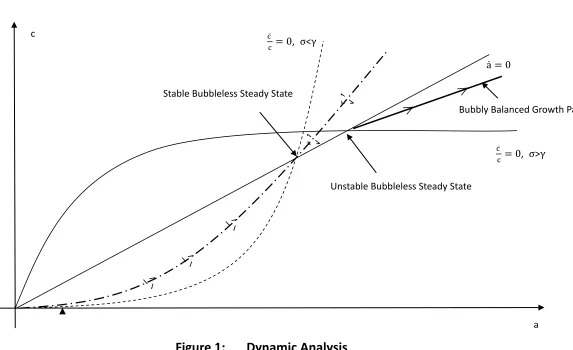
A is less than the rate of time preference, : As illustrated by Figure 1, in the space of c and a; the a_ = 0 locus is a straight line through the origin, and the c_
c = 0locus is convex when < ;and concave when > :It is clear
that a saddle path shown by the dash-dot line approaches a stable bubbleless steady state when < :When > ;the bubbleless steady state is unstable and a trajectory shown by the bold solid line converges to the bubbly balanced growth path that is given by Proposition 2.
Using the similar method as that given by Zhou (2011), we also can obtain another two-dimensional dynamic system in the space ofqandk, which consists of the following pair of di¤erential equations.
_
q= ( A )q (1 )Ak; (19)
and
_
k= (A )k c(k; q); (20)
where
@c @k >0;
@c @q >0:
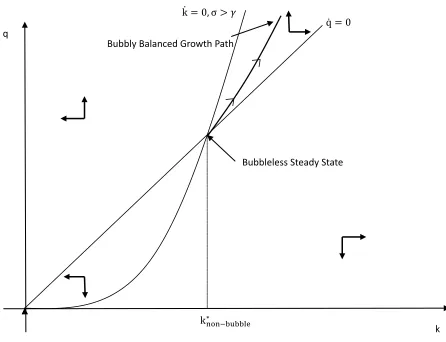
Figure 2 gives the phase diagram for the case of > . With the increasing of capital stock, thek_ = 0 locus should eventually be above the q_ = 0 locus. From the indication of arrows which show the directions of motion of equity price and capital stock, we can easily …nd an unstable bubbleless steady state at the level of capital,knon bubble. To the right of the vertical dot-dash line of
k=knon bubble;there is one trajectory that eventually converges to the bubbly balanced growth path. To the left of this vertical line, all trajectories converge to the origin and this has no economic meaning. Therefore, in this case, when the initial capital is just equal toknon bubble;the economy will always stay at the bubbleless steady state; when capital stockkis larger than knon bubble; equity priceq must be along the trajectory approaching the bubbly balanced growth path and includes a bubble term. The economy along this trajectory must be a bubbly economy.
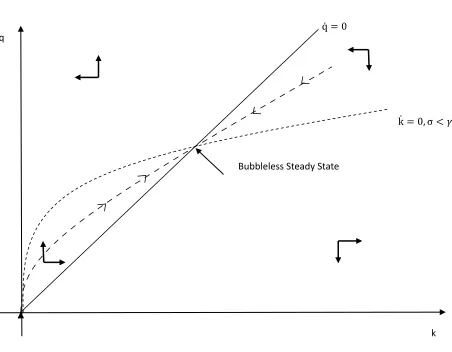
Figure 3 provides the phase diagram for the case < :In the …gure, the _
price, q; must be along the saddle path and excludes any bubble term. The economy along this saddle path is a bubbleless economy.
5
The Birth of Bubbles
This section provides a scenario about how the equity bubbles might arise. The mechanism can be described by the phase diagrams given above.
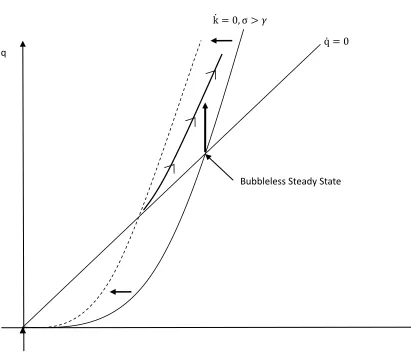
In an environment where the preference parameter is larger than ;suppose that the initial economy is just at the bubbleless steady state. For convenience, I set the rate of capital depreciation, ; to be zero: As Figure 4 illustrates, an unexpected innovation of technology, or, a sudden news about the innovation, would shift the k_ = 0 locus to the left. But, the locus of q_ = 0 would not change. People cannot adjust their stock of capital immediately. However, the economy has to immediately jump on the new trajectory that approaches the new bubbly balanced growth path, which is described by the bold solid line. Therefore, equity price would increase. The increase of equity price is not only from higher expected dividends, but also because a bubble has been created.
6
Conclusion
References
[1] Blanchard, O. J., and M. W. Watson, 1982, Bubbles, rational expectations and …nancial markets. NBER Working Paper Series.
[2] Brunnermeier, 2009, Bubbles. Unpublished Manuscript.
[3] Diba, B. T., and H. I. Grossman, 1988, The theory of rational bubbles in stock prices. The Economic Journal, Vol. 98, No. 392, 746-754.
[4] Kamihigashi, T., 2008, The spirit of capitalism, stock market bubbles and output ‡uctuations. International Journal of Economic Theory 4, 3-28.
[5] Kamihigashi, T., 2009, Status seeking and bubbles. International Trade and Economic Dynamics – Essays in Memory of Koji Shimomura. Edited by T. Kamihigashi and L. Zhao: Springer-Verlag Berlin Heidelberg.
[6] Kocherlakota, N. R., 1992, Bubbles and constraints on debt accumulation. Journal of Economic Theory 57, 245-256.
[7] Kocherlakota, N. R., 2008, Exploding bubbles in a macroeconomi model. Unpublished Manuscript.
[8] Kocherlakota, N. R., 2009, Bursting bubbles: consquences and cures. Un-published Manuscript.
[9] Kurz, M., 1968, Optimal economic growth and wealth e¤ects. International Economic Review, Vol. 9, No. 3, 348-357.
[10] LeRoy, S. F., 2004, Rational exuberance. Journal of Economic Literature, Vol. 42, No. 3, 783-804.
[11] Martin, A., and J. Ventura, 2010, Economic growth with bubbles. NBER Working Paper.
[12] O’Hara, M., 2008, Bubbles: some perspectives (and loose talk) from history. The Review of Financial Studies, v21, n1, 11-17.
[13] Santos, M. S., and M. Woodford, 1997, Rational asset pricing bubbles. Econometrica, Vol. 65, No. 1, 19-57.
[15] Web, Max, 1958, The Protestant Ethic and The Spirit of Capitalism. New York: Charles Scribner’s Sons.
[16] Yanagawa, N., and G. M. Grossman, 1992, Asset bubbles and endogenous growth. NBER Working Paper.
[17] Zhou, Ge, 2011, Rational bubbles and the spirit of capitalism. MPRA Paper 33988, the Munich University Library, Germany.
Appendix A: Necessary Claims and Lemmas
In this appendix, I give some claims and lemmas. These claims and lemmas are necessary to help us …nd the necessary and su¢cient conditions that guarantee a bubbly economy. Their proofs are also provided.
For convenience, we need to make an equivalent transformation of the equa-tions system given by equaequa-tions of (15), (16), and (17). Under the de…niequa-tions of
x c
a ; y c a; z
c k;
we …nd that
c= ( x
y )
1
; a= ( x
y )
1
; k= (
x y ) 1 z ; and _ x x = _ c c _ a a; _ y y = _ c c _ a a; _ z z = _ c c _ k k:
Thus, the Euler equation (15) and equation (16) can be rewritten as follows,
_
x
x =x+ y ( 1)( A ) ; (A.1)
_
y
y =
x
+y ( 1)( A ) + ; (A.2)
and equation (17) can be rewritten as
_
z
z =
x
+z+( A ) (A ): (A.3)
In this new equation system, x; y; and z cannot converge to any balanced growth path, but do converge to some steady states. These steady states corre-spond to the balanced growth path or the steady state in the original equation system of (15), (17), and (16). Thus, the existence of bubble can be exam-ined more easily by checking the property of the steady states in the space of {x; y; z}.
Steady State 1: x = 0; y = 0;
Steady State 2: x = 0; y = ( 1)( A )+ ; Steady State 3: x = ( 1)( A ) + ; y = 0; Steady State 4: x = ( A ); y = A :
It is easy to see that only steady state 4 corresponds to the steady state in the space of {c; a}, the other three steady states correspond to balanced growth paths. It is because that only at the steady state 4 the growth rate of consumption, c_
c;and that of wealth,
_
a
a;are both zero.
In the following analysis, it is necessary to discriminate which steady states correspond to the bubbleless economy and which correspond to the bubbly econ-omy.
We begin our analysis at the only steady state in the space of {c; a}. Claim 4 contends that this steady state and trajectories to it, represent a bubbleless economy.
Claim 4 No bubble exists at the steady state corresponding to the steady state 4 in the space of x and y; no bubble exists on the trajectory approaching this steady state.
Proof. First, suppose that a bubble exists on trajectories to the steady state. By equation (9), the bubble grows at the rate ofr: Since c converges to some positive constant, the capital level cannot be always decreasing. Or, the con-sumption level cannot be supported.
If qb
0 >0; given that a= qf+qb+k; a will diverge. This contradicts the
fact that the trajectory goes to the steady state. If qb
0 < 0; to guarantee that a would converge to some positive constant,
qf+kneeds to always grow. Given the de…nition ofqf; kneeds to always grow.
Sinceq=qf+qb=a k; asset price eventually becomes negative.
Therefore, no bubble exists on these trajectories. This is similar to proving that there is no bubble at the steady state.
Before checking whether bubbles exist on balanced growth paths in the space ofcanda;we need to know some basic properties of economies on the balanced growth path. These properties are described by the following two Lemmas.
Proof. At the balanced growth path, equation (7) can be rewritten as
qf = (1 )Ak
Z 1
t
e[gk ( A )](n t)dn:
Whengk is less than A ;we obtain thatqf = (1A )Agkk:This implies that
gqf =gk < A :
However, whengk A ;by equation (8), we obtain gqf A :
Given the fact thata =qf +qb+k; ifg
k > r; the growth rate of wealth,
ga;will eventually converge togk:From equation (13), we see thatga =r ca:
Ifga …nally converges togk; which is larger thanr; then the ratio of ac should
eventually converge to a negative constant:This is impossible.
Ifgk = A ;thenga will eventually converge to A so thatga =gk:
By equation (13), the ratio of c
a …nally converges to 0: This means that the
growth rate of consumption, gc; will be less than gk at the balanced growth
path. However, from equation (17), we can obtain that k_ k =A
c k: Given
gc< gk, the ratio of ck will …nally converge to0:Thus,gkwill converge toA ;
which is larger than A :This is contradictory to the previous assumption ofgk= A .
Therefore,gqf =gk < A :
This lemma is helpful in proving the next lemma, which can be used as a discriminant theorem on whether bubbles exist or not.
Lemma 6 At the balanced growth path, when the growth rate of wealth, aa_ is equal to the real interest rate, A , then bubbles exist, i.e., qb>0;and, vice
versa.
Proof. When bubbles exist, that is,qb>0;from the fact thata=qf+qb+k;
we obtain _ a a = _ qf qf qf qb +
_
qb qb+
_ k k k qb qf
qb + 1 +qkb
:
By Lemma 5 and equation (9), it can be easily obtained that the ratios ofqqfb and
k
qb will both converge to zero: Thus, at the balanced growth path, the growth
rate of wealth, a_
a will eventually converge to A :
When a_
a = A ; and if no bubble exists; by Lemma 5, then
_
a
a =gk <
A :This is contradictory to a_
a = A . Thus, bubbles must exist:
this result.
Claim 7 No bubble exists on the balanced growth path corresponding to the steady state 2 in space ofxandy;no bubble exists on the trajectory approaching this balanced growth path. However, steady state 1 and steady state 3 correspond to the balanced growth paths in space ofcanda; which include bubbles.
Proof. At steady state 2, we know that y > 0; which means a_
a < A :
By Lemma 6, we know that no bubble exists on this balanced growth path. In addition, it is also easy to prove that no bubble exists on the trajectory approaching this balanced growth path. If there is a bubble on this trajectory, then there must be a bubble on the balanced growth path. This means that
_
a
a = A by Lemma 6. But, this is contradictory toy >0:
However, at steady state 1 and steady state 3, it is clear thaty = 0;which means a_
a = A :By Lemma 6, bubbles exist on the balanced growth paths
Appendix B: Proofs of Propositions
This appendix provides the proofs of three propositions in section 3.
Proof of Proposition 1
Proof. Steady state 1 means that a_
a = A ; and c
a = 0: From Euler
equation (3), we obtain that c_
c = ( A );which means that
_
+a_ a = :
Given the fact that a > 0; the transversality condition is violated in this case. Therefore, the bubbly economy corresponding to this steady state and the trajectory approaching this steady state, does not exist.
Steady state 3 means that a_
a = A ;
_
c
c = ( A ); c
a = ( 1)( A
) + >0; and c
a = 0: Given ;we know that
_
c c
_
a
a: Given the fact that
bubbles exist and the capital stock and fundamental value of shares cannot be negative, the wealthashould be positive. Thus, unlessc= 0;we cannot obtain
c
a equal to zero. However,c= 0;implies c
a = 0;which is contradictory to the
previous …nding c
a >0:Thus, a bubbly economy corresponding to this steady
state does not exist.
Therefore, no bubbly economy exists when :
Proof of Proposition 2
Proof. There is still no bubble economy on the trajectory approaching steady state 1 in the space ofxandy:The proof is same as the corresponding section in Proposition 1.
However, at steady state 3, we obtain that a_
a = A ;
_
c
c = ( A )<
_
a a;
c
a = 0; and c
a = ( 1)( A ) + >0: It is easy to see that
_ +a_
a < ;
which ensures that the transversality condition holds. By equation (A.3), we obtain thatz is0; or,A ( A );which is a positive constant:
z = 0means that k_
k =A ;which implies that
_
a
a eventually converges to
A unless k = 0: When k6= 0; this is contradictory to a_
a = A : When
k = 0; consumption has to be equal to zero. This contradicts ac > 0 given the fact that bubbles exist at this steady state. Thus, z = 0 cannot be an equilibrium.
When z = A ( A ); we obtain k_ k =
( A )
= c_
c <
_
a a;
c k =A
( A )
In addition, it is also necessary to mention that the long-run growth rate of the bubbly economy, r= ; is larger than the growth rate in the traditional endogenous growth model, (r )= : This is because that the existence of “the spirit of capitalism” stimulates the accumulation of capital, which in turn promotes the long-run growth.
Proof of Proposition 3
Proof. In the space ofxandy;steady state 2 and 4 correspond to the possible non-bubble economies.
At the balanced growth path corresponding to steady state 2, we obtain
c a =
( 1)( A )+
> 0: This means that c_ c =
_
a
a: However, x = 0 means c
a = 0: Given > ; onlyc = 0 and a6= 0 can guarantee above equality to
hold. However,c = 0 and a 6= 0; imply that c
a = 0: This is contradictory to c
a >0:
Steady state 4 corresponds to a non-bubble steady state in the space of c
anda:When < A ; x <0; it means that there are negative values forc
ora; when = A ; steady state 4 coincides with steady state 2. Thus, in the case of A ;the steady state corresponding to steady state 4 is not an economic equilibrium. When > A ;at steady state 4, we obtainc = [ ((AA ))] 1 ; a = [ ((AA ))] 1 : By equation (17), we obtain k = c
A :
From the de…nition ofqf given by equation (7), we obtainqf = (1 )Ak A :We
also …nd thatqf +k is exactly equal toa :Thus, this is the unique bubbleless
ċ
c= 0, σ<γ
ȧ = 0
a c
ċ
c= 0, σ>γ
Unstable Bubbleless Steady State Stable Bubbleless Steady State
[image:20.842.151.724.113.463.2]Bubbly Balanced Growth Path
q̇ = 0
k̇ = 0,σ>𝛾
k q
Bubbleless Steady State Bubbly Balanced Growth Path
[image:21.842.204.650.113.455.2]knon−bubble∗
q̇ = 0
k q
Bubbleless Steady State
[image:22.842.208.660.109.461.2]k̇ = 0,σ<𝛾
q̇ = 0
k̇ = 0,σ>𝛾
k q
[image:23.842.206.617.94.454.2]Bubbleless Steady State