PLASMA PHYSICS
BY
J. G. LINHART
EURATOM/CNEN Association
Frascati (Rome) Italy
1969
Published by
the European Atomic Energy Community — EURATOM
Brussels (Belgium),
OCTOBER1969
NOTE
PREFACE TO THE THIRD EDITION
During the years preceding 1960 plasma physics developped rapidly and the pioneering mood of those days influenced many, including the author of this book, to come out with articles and books in which a fermenting, partial and somewhat hasty spirit prevails. T h e times have changed and nowadays it is possible to attempt to write a text book rather than a work demonstrating novel or revolutionary features
of the subject. This edition is meant for graduate and post-graduate students; wherever possible the treatment insists on physical insight rather than on mathematical rigour. I have tried to treat the subject in all its aspects without indulging in details and specialities (for which exist now several excellent books) and nevertheless aiming at students having a good background in physics and even having some acquaint ance with the concepts of physics of ionized gases. This should put the present edition in a bracket between elementary books on plasma physics and those dealing thoroughly with special domains, some of which will be found among the recommended literature on p. 332.
Frascati, spring 1967.
Acknowledgment
C O N T E N T S
P R E F A C E T O T H E T H I R D E D I T I O N V
I N T R O D U C T I O N 1 CHAPTER 1
1.1. Plasma state 6 1.1.1. Degree of ionisation — Sana's equation 6
1.1.2. Electric fields in plasma 16 1.1.3. Radiation in plasma Hi 1.1.4. Classification of plasmas 2 1 1.2. Plasma in n a t u r e and in l a b o r a t o r y 22
1.2.1. Stars and interstellar space — The diagramme of Hertzsprung
and Russell 22 1.2.2. Planets 2 4 1.2.3. Plasma produced by man 24
References to C h a p t e r 1 26 List of symbols used in C h a p t e r 1 27
CHAPTER 2 : M O T I O N O F E L E C T R O N S A N D I O N S I N E L E C T R I C AND M A G N E T I C F I E L D S
I n t r o d u c t i o n 28 2.1. Motion in an electrostatic field 28
2.2. Motion in a magnetostatic field 31 2.2.1. Motion of charged particles in a toroidal magnetic field 37
2.2.2. Motion of charged particles in the field of a magnetic lens 39 2.2.3. Motion of charged particles in a helical magnetic field 45 2.2.4. Superimposed toroidal magnetic field and betatron magnetic
field 46 2.3. Motion of charged particles in crossed electric and
magnetic fields 52 2.3.1. Electric vortex field and magnetic lens field 56
2.4. Motion in crossed R. F. electric field and a magnetostatic
VIII CONTENTS 2.5. T h e movement of a charged particle in the field of an
electromagnetic wave 62 2.6. Radiation from accelerated charges 66
2.6.1. Bremsstrahlung 6 8 2.6.2. Cyclotron (betatron, synchrotron) radiation 71
2.6.3. Cerenkov radiation 77 References to Chapter 2 85 List of symbols used in Chapter 2 85
CHAPTER 3 : FLUID D E S C R I P T I O N O F PLASMA
Introduction 87 3.1. Stationary distributions 91
3.2. T h e collisionless Boltzmann equation 92
3.2.1. Non-relativistic ensemble 94 3.2.2. Relativistic ensemble 97 3.3. Integrals of Boltzmann's equations over t h e velocity
space 98 3.3.1. Non-relativistic case 9 8
3.3.2. Relativistic case 104 3.4. Fluid models 106 References to Chapter 3 110
List of symbols used in Chapter 3 110 CHAPTER 4 : E Q U I L I B R I U M C O N F I G U R A T I O N S
(PLASM ASTATICS)
Introduction I l l 4.1. Plasma in an external magnetic field 112
4.4.1. Cylindrical and cusp geometry 120 4.2. Confinement by magnetic fields generated by currents
in the plasma 126 4.2.1. Non-relativistic streams 126
4.2.2. Relativistic streams 131 4.3. Plasma equilibrium in external and self-fields . . . . 135
C O N T E N T S IX CHAPTER 5 : W A V E S AND I N S T A B I L I T I E S I N PLASMA
I n t r o d u c t i o n 143 5.1. Electron oscillations in plasma 144
5.1.1. The longitudinal oscillations 147 5.1.2. The transversal oscillations 147 5.1.3. Hybrid transversal and longitudinal waves 151
5.1.4. Reflection of electromagnetic waves by plasma 152
5.1.5. Electron waves on a plasma cylinder 155 5.1.6. Effects of random velocities on waves in plasma 160
5.2. Positive ion oscillations 171 5.2.1. Electrostatic ion oscillations 172 5.2.2. Hydromagnctic oscillations in a stationary infinite plasma —·
waves on a plasma cylinder 174 5.2.3. Hydromagnetic oscillations in plasma streams 180
5.3. Growing waves and instabilities 183 5.3.1. Conversion of kinetic energy of particle streams into the
energy of longitudinal plasma oscillations 185
5.3.2. Rayleigh-Taylor instability 1 8 8 5.3.3. Magnetohydrodynamic instability 192 5.3.4. Hydrodynamic instability 2 0 8 References to C h a p t e r 5 213 List of symbols used in C h a p t e r 5 214
CHAPTER 6 : SHOCK W A V E S I N PLASMA
I n t r o d u c t i o n 216 6.1. Relations of Rankine-Hugoniot. Shock-speed . . . . 220
6.2. Structure of t h e shock front in absence of magnetic
field 222 6.3. Shocks in a gyrotropic plasma 225
6.4. Diverging and converging shocks 227
6.4.1. Diverging shocks 227 6.4.2. Converging shocks 2 2 9 References to C h a p t e r 6 232 List of symbols used in C h a p t e r 6 232
CHAPTER 7: PLASMA DYNAMICS
X C O N T E N T S
7.1. Plasmoids 233 7.2. Steady plasma flow 242
References to C h a p t e r 7 245 List of symbols used in C h a p t e r 7 245
CHAPTER 8: COLLISION AND R E L A X A T I O N P R O C E S S E S
I n t r o d u c t i o n 246 8.1. Dynamics of a collision of two charged particles . . . 247
8.2. Fokker-Planck equation 251 8.2.1. Conduction of electricity in plasma — conduction of elec
tricity in a gyrotropic plasma 256 8.2.2. Stopping power — relaxation to Maxwellian distribution —
equipartition of energy 2 6 4 8.3. Diffusion in configuration space 267
8.3.1. Flux of particles 269 8.3.2. Conduction of heat and electricity 2 7 3
8.3.3. Diffusion of momentum. Viscosity 276
References to C h a p t e r 8 278 List of symbols used in C h a p t e r 8 278
Applications 280
CHAPTER
9: RESEARCH ON CONTROLLED FUSION
I n t r o d u c t i o n 281 9.1. Sources of nuclear energy 281
9.1.1. Elementary nuclear concepts 2 8 1
9.1.2. Binding energy 2 8 3 9.1.3. Nuclear fusion 2 8 7 9.1.4. Fission and fusion reactions as sources of energy 2 9 2
9.1.5. Uncontrolled fusion reactions 2 9 5 9.2. Controlled fusion reactors 298
9.2.1. Stationary fusion reactors 3 0 3 9.2.2. Pulsed fusion reactors 306 9.2.3. Experiments in the research on controlled fusion 309
CONTENTS XI
CHAPTER
10: OTHER APPLICATIONS
10.1. Generation of electromagnetic waves 313
10.2. Direct conversion of chemical energy into electrical
energy
316
10.3. Applications to particle-accelerators 322
10.3.1. Plasma betatron 322 10.3.2 Collective ion-acceleration 324
10.4. Rocket propulsion 326
10.5. Energy storage 328
List of symbols used in Chapter 10 331
References to Chapter 10 331
GENERAL LITERATURE 332
BOOKS ON SPECIAL TOPICS 332
I N T R O D U C T I O N
Plasma physics is concerned with the behaviour of systems of many free electrons and ionised atoms where the mutual Coulomb interactions cannot be disregarded. In a restricted sense, such systems of particles consist of nearly equal numbers of positive and negative charges. Systems of this type are examples of a medium known as plasma which in many respects behaves differently from the solid, liquid and gaseous state of matter.
All states of matter represent different degrees of organization, to which there correspond certain values of binding energy. Thus, in the solid state the important quantity is the binding energy of molecules in a crystal; in fact, a crystal could be considered as a macro- or super-molecule. If the average kinetic energy per molecule W exceeds the binding energy U (a fraction of an eV) the crystal structure breaks u p , either into a liquid or directly into a gas. A similar law operates in the case of liquids, and in order to change a liquid into a gas, a certain m i n i m u m kinetic energy per molecule is required to break the bonds of
the van der Waals forces. Matter can exist as plasma, i.e., in its fourth state, when the kinetic energy W per plasma particle exceeds the ionising potential of atoms which is usually a few eV. Thus the average kinetic energy per particle determines the state in which matter exists. A precise mathematical statement of this theorem is an equation of the Saha type. However, a simple criterion can be written as
Un < W < Un+1 (1)
where U„, U„+\ are the respective binding energies, expressing that matter exists in the (n -\- l ) s t state.
T h e plasma state will correspond to an order-of-magnitude relation ship
1 < WA < 10" (eV).
Extrapolating this principle to higher states of matter, so far unex plored, one may define the fifth state of matter as one in which
1 < Wr, < 500 (MeV).
This will be a gas of free nucléons and electrons — a "nugas". T h e sixth state would be, consequently, defined as
2 I N T R O D U C T I O N and would contain free mesons, nucléons in various states of excitation and electrons. The fifth and sixth states of matter can be expected to exhibit an even greater variety of behaviour than a plasma owing to the action of short range internucleon forces in addition to long range Coulomb forces.
On the other hand, according to eq. (1) for ÎV, plasma spans a broader energy band than any other state of matter; it encompasses about 20 octaves on the kinetic energy scale. This width of the kinetic energy spectrum of the plasma state is the reason for much common ground between plasma physics and many other fields of physics, such as the dynamics of single charged particles (in which many-particle interactions are not considered), or the physics of electrical discharges in gases (in which interaction between charged particles and neutral atoms and molecules is of great importance), whereas some methods of description and analysis used in plasma physics belong to the subject of hydrodynamics, particularly magneto-hydrodynamics. Another phy sical discipline, indispensable for the theory of a plasma, is statistical mechanics and there are yet other fields from which plasma physics draws its mathematical formulation and its terminology.
Although probably more than 99.9 % of matter in our Universe is ionised and therefore in the plasma state, on our planet plasma has to be generated by special physical processes and under special conditions. These processes are the subject of the physics of electrical discharges in gases and this is the reason for the parental relationship between the latter and plasma physics.
Using an anthropomorphic analogy one may say that whereas the physics of electrical discharges is more specifically concerned with the birth and metabolism of plasma, plasma physics concentrates mostly on the anatomy and motion of plasma.
I N T R O D U C T I O N 3
of m a t t e r is not very m u c h at h o m e on our dense and cold p l a n e t and that special conditions must be realized in order to generate a plasma like m e d i u m in t h e laboratory. Investigation of these conditions were the subject of the physics of electrical discharges in gases. I t was only when electrical and vacuum techniques developed to t h e point when longlived and relatively stable electrical discharges were available t h a t plasma physics emerged as a separate field of study.
A r o u n d 1923 I. L a n g m u i r developed the a p p r o p r i a t e basic theory of an ionised gas and gave the m e d i u m t h e n a m e " p l a s m a " *. D u r i n g t h e period 19231938 the subject developed further due to t h e efforts of L. Tonks, R. Seeliger, Β . Klarfeld, M. Steenbeck, Α. ν . Engel, L.B. Loeb, W. B e n n e t t , F.M. P e n n i n g , J. Townsend, W. Rogowski and m a n y others.
At t h e beginning of this century astrophysicists became aware of the i m p o r t a n c e played by ionised m a t t e r in t h e processes in outer space and subsequently some of t h e finest contributions to plasma physics came from t h e i r ranks. H e r e one may m e n t i o n t h e work of M.N. Saha, S. C h a p m a n , T.G. Cowling, V.C. F e r r a r o , S. C h a n d r a s e k h a r , L. Spitzer, H . Alfvén and t h e german astrophysical school at t h e Max P l a n c k Institute.
In 1929 F. H o u t e r m a n n s and R. Atkinson suggested t h a t t h e m a i n source of energy in stars is the fusion reactions among t h e nuclei of t h e light elements. After 1945 a similar m e c h a n i s m was exploited in the construction of h y d r o g e n b o m b s and at the same time some physicists became interested in a controlled release of fusion energy.
However, it was appreciated t h a t the energy o u t p u t from fusion reac tions depends critically on t h e kinetic energy of t h e colliding nuclei and t h a t fusion outputs of practical interest depend on one's ability to p r o d u c e t e m p e r a t u r e s of at least several million degrees Kelvin. If explosions are to be avoided, then t h e pressure of m a t t e r at this t e m p e r a t u r e must be balanced by external forces. This is w i t h i n t h e power of our engineers only if t h e density of the n u c l e a r fuel is sub stantially less t h a n t h e density of our a t m o s p h e r e . T h e search for a mechanism of a controlled release of fusion energy in the 1950's b e c a m e , therefore, synonymous with the study of high t e m p e r a t u r e , low density plasmas. However, it should not be forgotten t h a t t h e notion of con trolled fusion is not inconsistent with controlled explosions as will be mentioned on p. 308. I n accord with such an extension of t h e scope of
4 I N T R O D U C T I O N controlled fusion is also tlie recent extension of our interest to very high density plasmas.
The prospect of nuclear fusion gave a new lease of life to plasma physics which was becoming rather unfashionable and as one of my friends put it, regarded by most other physicists as a rather charming subject, full of small, colourful experiments, where there was little left to discover and whose only real justification was the amusement of those who bothered to waste their time on it. With the goal of a fusion reactor as an incentive, plasma physics became a subject of interest to many physicists and engineers. More recently many other applications of plasma physics have appeared, such as plasma rockets, direct conversion of thermal energy into electrical energy, transmission of radio and tele vision signals through ionosphere and others. These are more than able
to sustain the interest of physicists and engineers in plasmas.
When the first edition of this book was written in 1959 only very few experiments on plasma had been carried out and those that had been done were useful onlv for a general orientation and could not be com pared with clear and precise experiments in other branches of physics. In five years this situation has changed considerably and there exist now some "classical" experiments on waves, shocks, diffusion and dyna mics of plasma. I have attempted, therefore, to illustrate at least some of' the theoretical statements by means of related experiments. Owing to the interplav of theorv and experiment in the last decade it was possible to gain a feeling for the plasma medium, appreciate its many aspects which predominate according to the values assumed by the density and by the temperature of the plasma and also according to whether or not there is a magnetic field in the plasma. In order to transmit some of this feeling the book starts with a rather lengthy chapter on the general properties of the different types of plasma.
As in many problems dealing with a large ensemble of individuals (e.g., star clusters), plasma physics uses two complementary modes of description: the analysis of the movement of a single particle and the fluid model. These two treatments are the subjects of chapters 2 and 3. These modes of description are subsequently applied to equilibrium configurations, i.e., to plasma statics (chapter 4), to wave-motion and instabilities in plasma (chapter 5) and to shocks in plasma (chapter 6). This brings us to consider the dynamics of a plasma (chapter 7).
I N T R O D U C T I O N 5 T h e eight chapters provide us with models of plasma processes
CHAPTER I
1.1. Plasma State
Let us first restrict the applications of t h e word plasma to systems in which the positive ions are not bound in any lattice in space. This will exclude systems in which the positive ions belong to a conducting or semi-conducting solid body, it will also exclude liquid conductors and electrolytes in spite of the fact that the lattice in these latter cases is ever changing. Such a restriction amounts to the requirement hat the density of the kinetic energy of positive ions be much higher than the density of binding energy corresponding to a lattice. By making this restriction no offence is meant to thus excluded types of plasma, the behaviour of electron plasma in conductors (ref. 1, 2) and semi conductors (ref. 3, 4) is of considerable theoretical and experimental interest, however, it is more fitting to discuss such systems in another book entitled perhaps "Electron plasmas in solids". For similar reasons it is advisable not to mix the physics of electron and of ion beams with that of plasma physics proper, besides several books have already been written on that subject (ref. 5, 6).
At this point it may be better not to go on deciding what is not a plasma, instead we shall study some important properties of a system consisting of many free electrons and ions and decide which are the parameters corresponding to a typical plasma *.
Let us first consider a special case in which the system is of infinite extension, with no fields of force imposed from the outside and the velocity vectors of the particles randomly distributed both with respect to their direction and their amplitude. Let the average density of either type of particle he n. Let us try to find out how the lines of force e of the electric field E of an electron Q are distributed in space. Obviously most of these lines will be attached to the nearest positive ions Pi ... P-M some go to the more distant ones such as P4, Pr, and some (e') leak out and travel far before they, too, get attached to positive charges (fig. 1). It is easy to see that no e' lines would exist in a per fectly ordered lattice. There all the lines emanating from the charge Q finish on the oppositely charged nearest neighbours. Evidently the
PLASMA STATE
Electric
Li'nes
emanating
from
an
electron ¡n
plasma
o iions
•
electrons
Fig. 1.®
only elinei
Fig. 2.
a) perfect lattice.
b) elines transformed into e'lines as a result of disturbance in the eflectron lattice resulting from the shift of 3 electrons.
8
PLASMA STATE
reaching out of e' lines is due only to t h e imperfections of a lattice, i.e. to a local accumulation of charge of one sign *. This is shown graphi cally in fig. 2.
Such fluctuations in plasma are limited as can he seen from the following argument. Let a layer of electrons escape from a layer of positive ions (fig. 3). T h e field E in the separated layers can be calculated from the Poisson's law
dE
~dx~
= ± 4 7Γ n e(1)
CTS
5
VJ
03
SX.
I
5
CU
s:
+
+
-r-
-+--h
—
+ +
+ +
+^±
+ +
+
H-
4-+
4-£
+
+
-f-+
+
+
-h
-h
"S.
- S
* It is also due to the dependence of electrical forces. A short-range force
P L A S M A S T A T E 9
„ . . ) + valid for χ > 0 l h e sign s
j — valid for χ < 0
w h i c h gives for u n i f o r m n: E — — 4 π η e (d — |x|).
T h e electrical energy stored in this field per cm2 of t h e surface of t h e layer is
.i
We = 2 I dx = — Tr n2 ë d' ( e r g / c m2) (2)
J 8 T T 3
<>
T h i s energy could h a v e been generated only by drawing on t h e r a n d o m kinetic energy of t h e electronlayer. Since each electron has 3 degrees of freedom, each of w h i c h should b e endowed w i t h an energy equal to 1/2 kT, we get for t h e available k i n e t i c energy W't c a p a b l e of being converted into We.
(3)
P u t t i n g
we get
w
t = — η d k Τ (erg/cm)w
t< W
t— kT > — π η e2 d2
2 — 3
o r
V 2 V 4 π η , (4)
I n t h e following we shall take for this critical distance, k n o w n as t h e Debye distance, t h e expression
/ kT
d = \
V 4 π e2 nr
(4a)
the n u m e r i c a l factor \ / 3 / 2 having been i n t r o d u c e d by t h e oversimpli fied n a t u r e of o u r analysis.
T h e m a x i m u m electric field corresponds to *
E
max= y^rnkT
(5)
£2„„.x 3
* D e f i n i n g t h e e n e r g y d e n s i t i e s to„ = a n d w¡ = — nkT r e s p e c t i v e l y , t h e 87Γ 2
1 e q u a t i o n (5) c a n a l s o be w r i t t e n iv„ — —· w¡.
10 PLASMA S T A T E
Considering a spherical r a t h e r t h a n p l a n e geometry we obtain using similar arguments a critical distance dSPh ■—' d and EmaxBph <~' Emax. T h e E field is composed only of t h e e' lines a n d t h e distance d is t h e n the longest distance to w h i c h the field of a charge in plasma can p e n e t r a t e before being screened.
These ideas are similar to those used by Debye and Hiickel in t h e theory of electrolytes (ref. 7) ) and t h e distance d is called t h e Debye distance. In their theory, Debye and Hiickel have shown t h a t the distribution of electric field a r o u n d a fixed charge q in an electrolyte
corresponds to a "screened p o t e n t i a l " φ = — exp
K)
Using asimplified a r g u m e n t we shall show how such a p o t e n t i a l distribution arises a r o u n d a fixed charge q in a plasma of density η and tempera t u r e T. I n absence of charge q the charge density of t h e electronic a n d positive ion fluid is
n¡ ,6)
I n t r o d u c i n g the charge +q creates a spherical, positive potential wall
</>(r), and the electric field E — — d φ will tend to b e n d t h e electron trajectories towards the charge and deflect the ion trajectories. I n a spherical geometry the Poisson's e q u a t i o n for φ, ne and re¡ reads
dr
I
dr J
= 4 (ne — n, (7)According to a wellknown t h e o r e m of statistical mechanics (ref. 8) the distribution of electrons ( t e m p e r a t u r e T ) in t h e r m o d y n a m i c equi l i b r i u m in such a potential well is given by
ne (r) = ne · exp
id of ions n, (r) = n¡ · exp
βφ(Γ)
+ e<ft(r)
kT —βφ(τ)
kT
(8a)
(8b)
F o r radii r so large t h a t
kT
<^ 1, the electron and ion distri bution will not be greatly p e r t u r b e d and we can writee<Mr)
ne,i (r) = η 1
AT
(8c)1 d
r dr
PLASMA STATE
11
' dò \ 8ττηβ'
kT
T h e expression m u s t h a v e a dimension of (length)2. F r o m 8nree2
e q u a t i o n (4a) it is clear t h a t this length d' is
1 / kT
d' = — = d = \ (10)
χ/2 V 8ne
T h e solution of e q u a t i o n (9) must satisfy two b o u n d a r y conditions. At r = oo the p o t e n t i a l φ = 0 and for r —> 0 t h e solution m u s t converge
1
to t h a t of a p o i n t charge q in vacuum, i.e., φ (r —» 0) = — .
Such a solution is
* = 7-
εχΡ ~ " ?
( i i )If t h e ions owing to t h e i r inertia connot reach t h e r m o d y n a m i c equili b r i u m and t h u s cannot distribute themselves in t h e p o t e n t i a l well according to e q u a t i o n (8b) one finds in t h e solution (11) t h e Debye length d instead of d'.
As long as t h e charge q is m u c h larger t h a n t h e e l e m e n t a r y charge e a potential distribution of t h e type given by equation (11) will develop and is encountered in experiments using spherical probes in a plasma in w h i c h t h e Debye length is larger t h a n t h e r a d i u s of t h e p r o b e (ref. 9 ) . W h e n t h e analysis is e x t r a p o l a t e d to t h e p r o b l e m of potential distribution a r o u n d a positive ion, i.e. for q = je, it ceases to be valid. E a c h ion creates and carries its own potential well and, as t h e m e a n distance between t h e ions is re"1'3, t h e formula (11) cannot b e a p p l i e d to r < re1'3, as t h e m e a n n u m b e r of electrons w i t h i n a volume
1 e
— c a p a b l e of modifying t h e — p a r t of φ c a n n o t exceed u n i t y . On t h e rer
o t h e r h a n d for r ^> re1'3 t h e field of this ion is relatively weak and t h e formula (11) is, therefore, of little interest.
12 PLASMA STATE
binary collisions — in plasma the trajectories of an electron or an ion are dictated by long-distance Coulomb forces produced, in absence of external fields, by at most Nd particles, where
1 ( kT \ Nd = 2 · 4 / 3 - dJ · re = ^ ^
SyJriTT ν e2 t
3/2
(12) i.e., all the particles within the Debye sphere. Only when Nd ^ 2 do we recover binary interactions. T h e curve Nd = 2 is plotted in the n,T diagramme (fig. 7) separating thus the region belonging to plasmas
Classical plasma — collective interactions Degenerate plasma
Classical plasma — binary interactions
Relativistic electron plasma — classical + degenerate 5th state of matter
PLASMA STATE
13exhibiting many-body interactions from that corresponding to binary
collisions *.
Let us estimate the probability that electrons within a Debye sphere
or a Debye layer will all have their velocity vectors pointed in a
special direction. The probability that the velocity vector of a particle
lies in the
v,
> 0 hemisphere of the velocity space (fig. 4) is 1/2.
Nä
The probability that all the
hemisphere is, therefore,
electrons belong to the
V
x>
O
Pa = (
l/
2)
Ì /2* , ,
(13)
y
y
v
x
Fig. 4
provided the velocities of the particles are not correlated. Although
the probability of finding such an extreme velocity distribution is
small, once such a distribution is created it may reappear periodically
many times afterwards. The reason is that the electron layer (fig. 3)
having transformed its kinetic energy into the energy of the electric
field
E
will be pulled back into its original kinetic energy, correspond
ing to a velocity in the
-x
direction. The process is obviously limited
only to these electron and positive ion layers as all the electric field
(e
7lines) appears only in the space between these layers (see also fig. 2)
14 PLASMA STATE
and consequently the oscillations are not transmitted to the rest of the plasma.
Later on (chapter 5.1.6) we will see that such a process can propagate owing to the randomness of ν and that it is d a m p e d ; nevertheless, its persistence suggests that once an oscillating electric field is created in the plasma it may be difficult to get rid of it and that there may be a tendency in a plasma to establish an equilibrium between the stored electric energy in oscillating fields and the energy of the random motion of particles.
T h e frequency corresponding to the electron oscilations resulting from a departure in the electric neutrality of a plasma can be obtained from the motion of an electron in the field Emax . βίηωί.
Thus
eE
c i f r i l i ! » . .- . .
8ΐηω£ (14)
■'max
from w h i c h follows after double integration and p u t t i n g xmax = d t h a t
eE
rei d
F r o m equations (4) and (5)
'-'max .
r— = 4nree
(15)
T h i s substituted into eq. (15) gives for ω (which we shall call t h e plasma frequency ωρ)
l i l , ,
- V ^
(16
>
ν rei
T h i s is quite generally t h e frequency with w h i c h any charge accumu lation in a plasma of density re will be neutralised by t h e inflow of oppositely charged particles.
Having discussed t h e u p p e r limit of the Coulombian interaction of a charge in a plasma, let us say a few words a b o u t t h e shortest distance δ corresponding to such an interaction. A n a t u r a l choice for 8 is t h e
re de B r o g u e ' s wave length λ„ = .
reír'
Expressing
we get
PLASMA STATE 15
rei2ir = 2rei ( j ^ fret)2) = 3mkT
= %B = _ — _ (17)
\/3mfc - 2 - \ / T
If the density of a plasma is such that n%Bs ^ 1, the interactions have to be treated by q u a n t u m methods — let us call such a plasma a quantum plasma or a degenerate plasma. T h e degenerate plasmas can be described statistically by the Fermi-Dirac statistics — whereas t h e non-degenerate plasmas are subject to the Boltzmann statistics. T h e above mentioned inequality can be written as
> 1 (18) 2TT (2mkyi- Tl
l-This relation is also plotted in the re,T diagramme (fig. 7), giving us thus a boundary between degenerate and Boltzmannian plasmas. I t is often necessary that the Coulomb interaction has to be truncated at distances larger than XB. When an electron encounters another in a head-on collision the m i n i m u m distance between t h e m is given by energy consideration. T h u s when their kinetic energy is spent the electric
e2
potential energy is equal to . Taking for the kinetic energy the
o
mean thermal energy for two particles in one degree of freedom, i.e., A: Τ we get *
. . - - £ (19) Much the same argument could be m a d e about p-p and e-p collisions.
In the latter case the minimum distance δ corresponds to a deviation of the electron trajectory by an angle π/2.
Let us find a criterion for the classical and q u a n t u m close-interaction. Obviously when δ/, > X the close interaction will be described by classi cal mechanics, in the opposite case by q u a n t u m mechanics. T h e limit is decribed by X = 8 giving Τ < ( 2 - )2 · (3 e'rei/fere2) S 10(i (°K) for classical interaction.
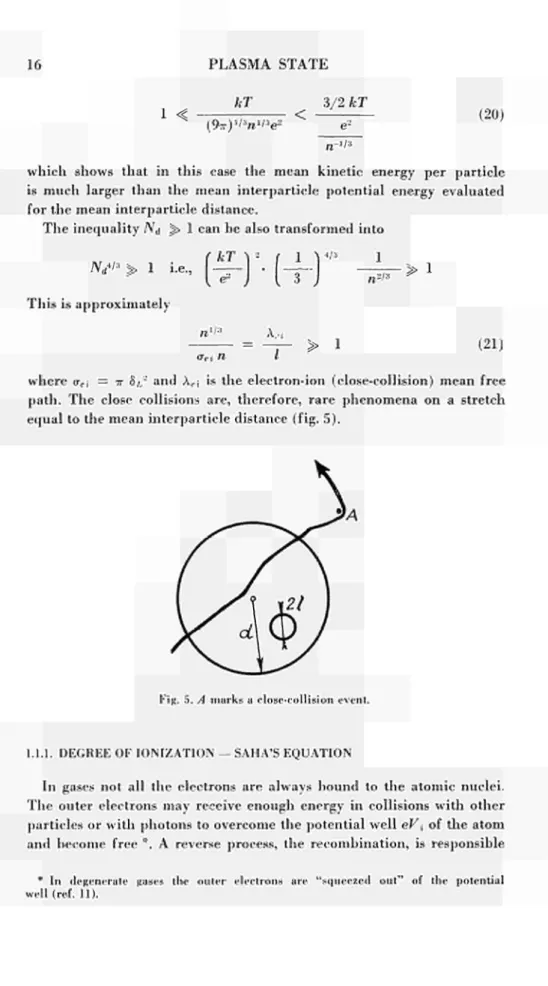
Let us observe a region of space in plasma whose volume is equal to that of the Debye sphere. Let us consider the case in which Nd <ζ 1, which is also equivalent to /V// 3 ^> 1. F r o m the latter we get using eq. (12).
16 P L A S M A S T A T E
kT 3/2 kT
1 < ; < — (20)
(91r)1/3re1/3e2 e2 '
-1/3
w h i c h shows t h a t in t h i s case t h e m e a n k i n e t i c energy per particle is m u c h larger t h a n t h e m e a n i n t e r p a r t i c l e p o t e n t i a l energy evaluated for t h e m e a n i n t e r p a r t i c l e distance.
T h e inequality N d ^> 1 can be also transformed into
f kT Ì 2 ( 1 Ì *!> 1
T h i s is a p p r o x i m a t e l y
re1'3 λ.·ι
■ = — > 1 (21)
ae¡ re í
where σ,,· = π Sj,2 and λΡ1· is t h e electronion (closecollision) m e a n free p a t h . T h e close collisions are, therefore, r a r e p h e n o m e n a on a stretch e q u a l to t h e m e a n i n t e r p a r t i c l e distance (fig. 5).
Fig. 5. A marks a closecollision event.
1.1.1. DEGREE OF IONIZATION — SAHA'S EQUATION
In gases not all the electrons are always b o u n d to t h e atomic nuclei. T h e outer electrons may receive enough energy in collisions w i t h o t h e r particles or with photons to overcome t h e potential well eV¡ of t h e atom and become free *. A reverse process, t h e recombination, is responsible
PLASMA STATE
17
for t h e c a p t u r e of free electrons by ions. T h e relative frequencies of these two processes: t h e ionization and t h e r e c o m b i n a t i o n , d e t e r m i n e to w h a t degree t h e m e d i u m is ionized, i.e., to w h a t extent it resembles an ideal plasma. T h e corresponding r e l a t i o n for a m e d i u m in t h e r m o d y n a m i c e q u i l i b r i u m is k n o w n as t h e Saha e q u a t i o n and it reads (ref. 10)
reerej λ / 2 - r e i Ä ;
exp
_i T3/2
(22,
kT
where ne, re¡ and re are respectively t h e densities of electrons, ions and n e u t r a l atoms a n d Vi is the ionization potential. W h e n kT > eV{, t h e n the exponential t e r m is almost e q u a l to u n i t y and since for once ionized atoms ne = re¡ we have
( y¿Trmk
γι-P 4 — J "-
1/2T3
"·
(23)
I n o r d e r t h a t kT > eV¡ t h e t e m p e r a t u r e m u s t be of t h e o r d e r of 10r'
and it follows t h a t t h e ratio is very h i g h as long as re < 1022. T h e re
d e p e n d e n c e T3'4 is to b e expected, t h e h i g h e r t h e t e m p e r a t u r e , t h e h i g h e r is t h e electron velocity and t h e h i g h e r t h e frequency of ionizing collisions.
I n t h e o t h e r extreme, i.e., kT < eV¡ t h e degree of ionization is dictat ed mainly by t h e exponential term. T h e ionization can be accomplished only by t h e relatively few energetic electrons in t h e tail of t h e Maxwel lian distribution.
T h e dividing line between plasmas and gases can be fixed as cor responding to a certain degree a of ionization. If, e.g., we t a k e
ree
a = = 1 for h y d r o g e n we get a relation
( — 158 000 Ì
T3'2 exp = 1.45 . 1 01 8 ■ re. (23a)
A n o t h e r and m o r e precise criterion for deciding w h e t h e r a m e d i u m is plasma or only a weakly ionized gas is provided by considering t h e electronion and electronneutral atom collisionfrequencies (ve¡ and
ve„). One m a y t h e n define plasma by
ve¡ ^ iv«
w h e r e (using eq. (21) and eq. (856) )
ve _ e4 iii
= Λ/2 π · — J r e A
18 PLASMA S T A T E
and
/ 2/c
Ven = Λ/
V m
Jl/2
w h e r e aen is t h e collision crosssection between electrons a n d n e u t r a l atoms.
Substituting into these expressions for re¡ and re from eq. (22) we get a function of T and (re + re¡) w h i c h is plotted in fig. 7 (curve C) and represents the above m e n t i o n e d criterion.
1.1.2. ELECTRIC FIELDS IN PLASMA
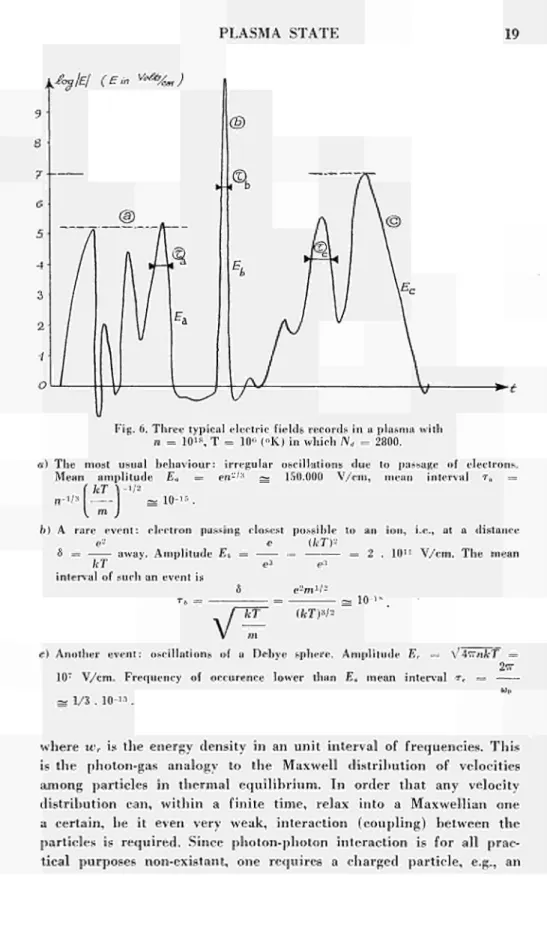
I t is possible now to visualize t h e type of electric field an observer will register inside a plasma in w h i c h collective interactions predomi nate. This is shown in fig. 6 w h e r e we have chosen a typical plasma having re = 10l s a n d T = 10°.
W h e n external fields p e n e t r a t e into a plasma t h e m o t i o n of individual particles does n o t change a p p r e c i a b l y . T h i s is d u e to t h e external fields being usually weaker t h a n the microfields E„, Eb and EL. t h a t are always present in a plasma. T h i s can b e a p p r e c i a t e d from the e x a m p l e shown in fig. 7 and noting t h a t in l a b o r a t o r y it is difficult to generate electric fields m u c h h i g h e r t h a n 105 V / c m . T h e same a r g u m e n t is valid, t h o u g h to a lesser extent, for magnetic fields. I n l a b o r a t o r y it is feasible to generate fields of the o r d e r of 100 KGauss. An electron moving in a magnetic field sees an equivalent electric field
E = ^— B.300 ( V / c m , Gauss). (24)
c
For a typical plasmaelectron t h i s is
E = 3.7 ΙΟ"3 Β Λ / Τ ( V / c m ) . (24a)
T h u s for Τ = 10" ("Κ) and Β = W Gauss we get E = 3.7 · IO5 V / c m , again not a very high field c o m p a r e d to E„ or E¡, in fig. 6.
1.1.3. RADIATION IN PLASMA
In any m e d i u m in t h e r m o d y n a m i c e q u i l i b r i u m t h e r e should be a radiation field whose photons are distributed in frequency according to the P l a n c k ' s law
8 ref
!«,(ƒ) = — 25)
PLASMA STATE 19
ME/ (Ein **4m)
Fig. 6. Three typical electric fields records in a plasma with π = 101S, Τ = 10" ("Κ) in which Nd = 2800.
a) The most usual behaviour: irregular oscillations due to passage of electrons.
Mean amplitude E« = en-!'-' ^ 150.000 V/cm, mean interval τ , =
(kT \
n-i/3
l m
j~ 10-15
6) A rare event: electron passing closest possible to an ion, i.e., at a distance
e- e (kT)2
S = away. Amplitude Eb = = = 2 . 1011 V/cm. The mean
kT e* e* interval of such an event is
S e-m1/'2
τ, = = ~ 10 -'s
V
kT (fcT)3/2c) Another event: oscillations of a Debye sphere. Amplitude Er = V4^nfeT
10" V/cm. Frequency of occurence lower than E, mean interval TC
s 1/3 . IO-13 .
2ττ
ω,,
20 PLASMA STATE
electron, in order that an arbitrary frequency distribution of photons could relax into a Planck's distribution. This condition for coupling is satisfied in a plasma and consequently in an infinite plasma one will find apart from thermal energy density Wt — ZnkT also radiation energy density Wr = ƒ wr · dj which is the well known
α
Wr = Ίτσ Τ4 (26)
c
T h e behaviour of a plasma in which WT > Wt will be largely dictated by the contained radiation fields. This will occur, therefore, when
9 „ „ T<
- > 1 (27) 3 ck
T h e line corresponding to this boundary is also found in the re,T diagramme (fig. 7).
In most laboratory plasmas, however, no such equilibrium can occur. This is due to the small optical dimensions of such plasmas, i.e. to their transparency. T h u s most of the radiation generated by various emissive processes in a plasma has no chance of being reabsorbed or trapped and is lost out of the system. Let us find the m i n i m u m radius Β of a plasma sphere, which could approach the state of radiation equili brium. Such a sphere will tend to radiate as a black body, in which case the radiation loss will amount to 4ττΒ2σΤ4. This must be continually replaced by generation of radiation within the sphere. Let us put g(T,n) equal to the rate of radiation energy generation and neglect the absorption of this radiation. Then
4 τ τ Β2σ Τ4^ 4 π ƒ r2-g.dr
Let us assume for simplicity that re and Τ are constant within the sphere. This will yield an order of magnitude value of B . We get
( 3 o - T4) / g < B (28)
One of the most important radiation-emission processes in a fully ionized plasma is that corresponding to the radiation emitted by electrons during their collisions with positive ions, known as brems-strahlung. T h e ion deflects t h e electron and, therefore, changes its
β
velocity. T h e electron radiates at a rate (v)2.
c
It will be shown later (p. 70) that, averaging over all the electrons, this process gives
P L A S M A S T A T E 21
Substituting into eq. (28) we get
Β > — Γ. (29)
Ζ re,,
E x a m p l e : Ζ — 1, Τ = IO5, ree = IO17 (a typical l a b o r a t o r y p l a s m a ) , t h e n Β > 30 K m .
I t is to be understood t h a t since t h e absorption of r a d i a t i o n h a s been neglected, the criterion for Β is valid only as long as Β / λΓ ^> 1 w h e r e λΓ is t h e m e a n free p a t h of a p h o t o n w h i c h in a completely ionized h y d r o g e n is
λΓ = w h e r e στ = 6.65 · IO25 (cm2).
re σψ
P l a s m a whose dimension is smaller t h a n Β can still r a d i a t e as a b l a c k body, b u t only over t h a t p a r t of frequency s p e c t r u m in w h i c h e i t h e r g(n,T) is h i g h e r t h a n t h a t given b y t h e b r e m s s t r a h l u n g process or t h e p h o t o n s can be conserved an a p p r e c i a b l e time in t h e plasma.
1.1.4. CLASSIFICATION
I t is now possible to discuss t h e re,T d i a g r a m m e (fig. 7) w h i c h permits us to divide plasmas into different types.
T h e realm of plasmas is limited on t h e low Τ side by t h e Saba's e q u a t i o n (eq. (22) ). W h e t h e r one agrees t h a t t h e degree of ionization corresponding to a gaseous state of m a t t e r is 50 ψο or 10"2 % does not m a k e m u c h difference to the position of this low Τ b o u n d a r y (see t h e two curves S i , S2 corresponding to t h e abovementioned degrees of ionization).
On the low re side t h e l i m i t a t i o n is somewhat a r b i t r a r y , we shall t a k e n = l as t h e l i m i t since this value corresponds to t h e m e a n interstellar density and it is, therefore, unlikely t h a t one will encounter in our galaxy a plasma density lower t h a n 1 p a r t i c l e / c m3.
22 PLASMA IN N A T U R E AND IN L A B O R A T O R Y
On the high density side there is first the boundary XB — I defined by eq. (18) which can be written as
re1'3 ^ 2TT · IO5 T1'2.
For re higher than that which follows from this equation, there will be more than 1 particle in a cube whose dimension is equal to the Broglie wave length and the interaction of the particle will be governed by q u a n t u m mechanics. T h e region to the right of the XB = I cor responds, therefore, to quantum plasmas. These are often called de generate plasmas since the relevant Fermi-Dirac description of such plasmas uses the notion of degenerate degrees of freedom for the particles. An interesting corner between the curve S2 and the boundary X„ = / corresponds to a plasma in which Ζ ^ d. I n such a plasma collective interactions, such as the oscillation of a Debye layer or sphere, are impossible as the corresponding volumes contain less than one electron. T h e particles thus interact mainly by means of binary collisions.
To XB < I < δ (region Ω), does not correspond any plasma. One can e2
show easily that in such a case > kT and, therefore, the binding β2
energy of an ion is larger than the mean kinetic energy kT in one degree of freedom which means that the electrons are no longer free.
T h e greatest part of the following chapters will be devoted almost exclusively to the physics of classical, i.e., Boltzmannian plasmas, which correspond to the clear area in fig. 4.
1.2. Plasma in Nature and in Laboratory
T h e most conspicuous condensations of matter in the Universe are the stars. T h e stellar material is mostly in the plasma-state. In order to represent the stellar plasmas in the re,T diagramme it is necessary to discuss the types of stars and determine to which physical conditions these correspond.
1.2.1. STARS AND INTERSTELLAR SPACE —
THE DIAGRAMME OF HERTZSPRUNG AND RUSSEL
PLASMA IN NATURE AND IN LABORATORY
23
the star) and the spectral type (related to the superficial temperature).
There are three main agglomerations — the stars of the main sequence,
white dwarfs and red giants (fig. 8).
k absolute
mac/niiude
cfiani
dwarfs
red
dwarfs
hot
stars
cold Spectral
stars type
Fig. 8.
The hottest stars of the main sequence are the white giants whose
superficial temperature is typically about 10
5(°K). Their structure
should be sensibly different from other stars, the temperature of the
centre may be about 10
7(° K), however, this estimate depends very
much on the model one uses for their internal composition.
In the middle of the belt representing the main sequence is our
sun and the stars resembling it. Their superficial temperature is of the
order of 10
4(° K), the central temperature should be about 20-30 .
10° (°K). The ion density in the centre is probably between 10
24and
10
25ions/cm
3.
In the lower tail of the main sequence are red dwarfs whose surface
and central temperatures are well below those of our sun.
24 PLASMA IN N A T U R E AND IN L A B O R A T O R Y
temperatures, and above all, to high densities. T h e central densities of some white dwarfs may reach 10:io ions/cm3.
Apart from the stars mentioned sofar, all of whom are in equilibrium, there exist also pulsating stars and exploding stars. Some of these may reach a state in which the central part of their mass reaches such temperatures and densities that an almost complete collapse of the star occurs; the densities in the center of such a collaps ing mass may reach 103S-1039 ions/cm3. This corresponds to the density of nucléons in an atomic nucleus and such stars are called neutron-stars. All the stars possess an atmosphere, thus e.g., our sun's atmosphere consists of a so called reversing layer, then a layer known as the chromo sphere and finally the outermost - the corona. T h e temperature ranges from 104 to 10", the densities from 101K-10" ions/cm3.
Most stars, especially the unstable ones, emit streams of plasma in the interplanetary and interstellar space. T h e temperature and the den sity of these ejected plasmas diminish as the stream propagates away from the star and as it expands, until in the interstellar space t h e density drops to about 1 ion/cm3 and the temperature to an order of one thousand degrees. T h e zones corresponding to all these states of matter are plotted in fig. 9.
1.2.2. PLANETS
T h e plasma state is represented relatively poorly on planets. Those planets possessing their own magnetic field are capable to reflect and deviate the solar streams. T h e plasma free cavity is known in the case of our earth as the geomagnetic cavity. Very energetic particles can penetrate deeply into this cavity and create ionization in u p p e r layers of earths ionosphere. I m p o r t a n t and interesting regions filled with such plasma resembling onion-shells have been discovered recently and are known as the Van Allen belts.
Electric fields can be generated in planetary atmosphere giving rise to storms — during which electrical discharges occur. T h e gas in the inner core of these discharges may reach very high temperatures
(T ~ 104 (° K) ) and must be, therefore, highly ionized. This is the nearest, short-lived sample of a plasma-state in nature accessible to h u m a n experience in the past.
1.2.3. PLASMA PRODUCED BY MAN
PLASMA I N N A T U R E AND IN L A B O R A T O R Y
25
relstivisiic elecivon gas <NeMvo\) slavs < \ >—7—
Fig. 9. Occurrence of plasma in the Universe.
Explosions of atomic and hydrogen bombs produce dense (re > 1022 ions/cm3) and hot, short-lived plasmas. A thermal method for the generation of stationary plasmas uses high-temperature ovens (T > 2000° K) in which vapors of caesium are admitted. T h e caesium atoms are ionized on contact with the incandescent walls of the oven. T h e den sity and temperature of such plasmas are low.
Pulsed electrical discharges are used to produce plasmas for experi ments on controlled nuclear fusion. T h e temperature of such plasmas may be as high as 108 ( ° K ) , the density may range from 108 to 1017 ions/cm3. T h e life-time of such plasmas is usually limited to micro seconds (the low density plasma to milliseconds), consequently in most cases such plasmas are not in thermal equilibrium and some of the observations we made for a plasma in thermal equilibrium do not apply (e.g., the W,- = Wt line has no sense).
26 P L A S M A I N N A T U R E A N D I N L A B O R A T O R Y
discharges corresponds to very low ionic t e m p e r a t u r e , electron temper a t u r e of t h e o r d e r of 104 (° K) and to densities re < 1013. As t h e power i n p u t of t h e electrical discharge increases, t h e ionic t e m p e r a t u r e a p p r o a c h e s t h e electron t e m p e r a t u r e , t h e density increases and one o b t a i n s an arc. T h e density in arcs may be as h i g h as 1018 ions/cm3, t h e i r t e m p e r a t u r e may reach 105 (° K ) .
T h e zones corresponding to these plasmas are outlined in t h e n,T
d i a g r a m m e i n fig. 10.
Fig. 10. Plasmas produced by man.
REFERENCES TO CHAPTER 1
1) L. liri I lun i η : Electrons dans les métaux, Hermann et Cie. Ed., Paris 1934. 2) D. Pines: Elementary excitations in solids, W.A. Benjamin Inc., 1963.
R. A. Ferrell, Univ. Maryland Tech. Report 101 (1958). 3) Semiconductors and semimetals, 1, Acad. Press, New York.
4) 7th Int. Conf. on phvsics of semiconductors, 2 (plasma effects in solids) Paris Dunod, 1965.
5) A. H. Beck: Spacecharge waves, Pergamon Press, 1958.
27
7) P. Debye and G. Hiickel, Phys. Zeit., 24, p. 305 (1923).
G. Joos: Theoretical Physics, pp. 548-550, Blackie and Son Ltd (1960 Ed.). 8) G. Joos: op. cit., pp. 586-589.
9) Guthrie and Wakerling (editors): Characteristics of electrical discharges in magnetic fields, pp. 77-86 (D. Bohm), Mc Graw-Hill Co., 1949.
10) M. N. Saha, Phil. Mag., 40, p. 472 (1920). G. Joos: op. cit., pp. 539-542 and p. 862.
11) G. Lehner: Reports Laboratorio Gas Ionizzati, L.G.I. 65/2 - L.G.I. 66/8. A. A. Vedenov, Proc. conf. phys. quiescent plasmas, p. 107, Frascati 1967. 12) M. Schwarzschild: Structure and evolution of stars, p. 1, Princeton Univ.
Press, 1958.
List of symbols used in Chapter 1
B
cd
eE
f
re kι
m η<1
Β
Τ
magnetic field strength
velocity of light
Debye distance
elementary charge
electric field strength
frequency
Planck's constant
Boltzmann's constant
mean distance between particles
electron mass
particle density
charge
radius
temperature
x, r
Vv,
w
ζs.
λ λΒ σ °"e, » Ο" τΦ
ω ρcoordinate
velocity
ionization potential
energy density
atomic number
Landau distance
mean free path
De Broglie length
Stefan's constant
electron-ion cross-section
Thompson cross-section
potential
CHAPTER 2
MOTION OF ELECTRONS AND IONS ES ELECTRIC
AND MAGNETIC FIELDS
Introduction
This chapter is concerned with the study of the motion of charged particles in the various fields of force and in combinations of such fields, that are of interest in the study of plasmas. T h e most important of these motions is the interaction of charged particles with various magnetic fields. T h e last section of this chapter will be devoted to radiation emitted by single charges.
2.1. Motion in an Electrostatic Field
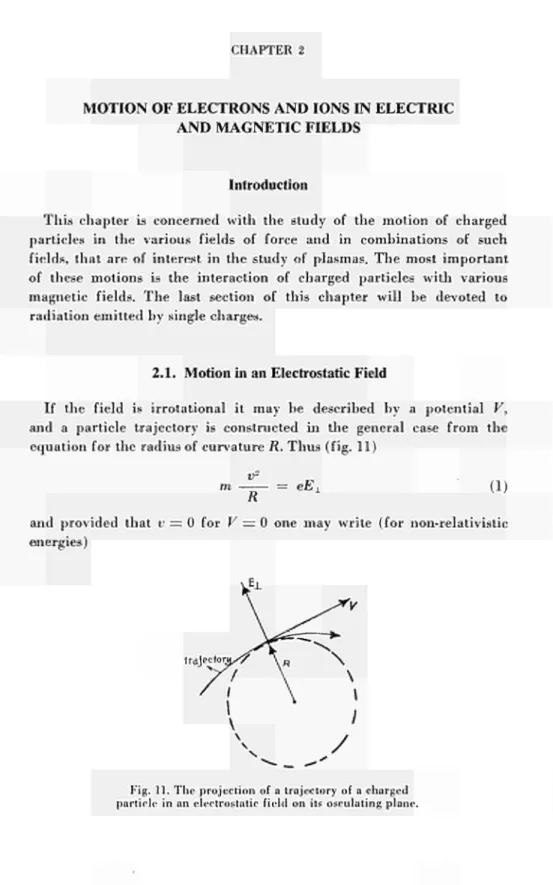
If the field is irrotational it may be described by a potential V, and a particle trajectory is constructed in the general case from the equation for the radius of curvature R. T h u s (fig. 11)
m —— = eEL (1)
and provided that ν = 0 for V = 0 one m a y write (for non-relativistic energies)
M O T I O N I N AN E L E C T R O S T A T I C F I E L D 29 2eV
R
" Φ .
and therefore,2V
R = ^ r ^ r r ^ (cm). (2)
(τ),
This formula can be used very simply in a step by step graphical plotting of the trajectory. I t is also used in automatic trajectory tracing in an electrolytic tank (ref. 1).
Motion of this type is of great interest in electron optics; in plasma physics it enters only in connection with the classical description of Coulomb scattering.
Let us give a brief treatment of this last problem, since it is connected with many important phenomena such as particle diffusion and emis sion of the bremsstrahlung.
Let us consider first the motion of a particle having charge e and mass ire in the electric field of a relatively heavy particle of mass M and charge Z.e. T h e motion is determined by the laws of conservation of energy and of angular momentum. Let the velocity of the light par ticle at infinity be vn and let the distance of M from the line deter mined by vu be pu, the so called collision-parameter (fig. 12).
T h e vectors r0 and pu determine t h e plane of motion. Using polar coordinates in this plane, the two conservation laws can be written
y 2
r2 + r2 Θ2 ± 2 = t v (3)
PoV„ = r2 θ (4)
the -j- is valid for charges of the same sign, the — for oppositely charged particles.
T h e time derivatives can he eliminated by means of d · d
= θ
dt de and substituting for θ from equation (4) we get
dr \ ( p„v0 \2 ( p0v0 \2 2 Ze2
{-de-}
[ — J
+
I — J
±
-ΊϋΓ
=
v
°'
(5)
30
MOTION OF ELECTRONS AND IONS
Fig. 12. Geometry of eletron-positive ion scattering.
de =
PoVowhich can be integrated giving
iPoVo/a)
2 Ze2 1/2 dr
1 ± cos θ
M O T I O N I N A M A G N E T O S T A T I C F I E L D 31
w h e r e
Ze2
m p„v0
A = Λ / t v + a2.
E q u a t i o n (6) is an expression for a h y p e r b o l i c or eliptic trajectory. I n the case of charge e starting its m o t i o n from infinity t h e m o t i o n can be only h y p e r b o l i c . Considering t h e event as a collision of two particles it is customary to talk of strong and weak collisions. I n order t h a t a collision b e considered strong it is necessary t h a t t h e total devia
tion of v0 is e q u a l or larger t h a n 90°, i.e., π — θ0 <Ü τ / 4 . T h e angle
θ0 = τ / 4 corresponds to t h e position r = oo and can b e realized only if i n e q u a t i o n (6) t h e d e n o m i n a t o r is e q u a l to zero. T h u s t h e criterion far strong collisions becomes
A IT
1 cos = 0
mpoV0- = i ( 7 )
Z e2
All particles, having velocity νΌ, whose collision parameter is smaller Ze2
than p0 = will effect strong collisions. T h e cross-section repre-m i v
sented by the field of Ze corresponding to such strong collisions is, therefore,
- Z2e4
σ0 = τ ρ0 2 — ——— . (8)
2.2. Motion in a Magnetostatic Field
In a homogeneous magnetostatic field Β a charged particle moves on a helical trajectory (fig. 13) with an angular frequency
«.c = — B. (9)
T h e projection of the trajectory on a plane perpendicular to Β is a circle whose radius
m(vhB)
Ρ = — (10) ^ B 2
32 MOTION O F E L E C T R O N S AND IONS
helical I raj e e Tory
Fig. 13. Trajectory of a charged particle in a uniform magnetostatic field.
For non-relativistic electrons whose kinetic energy is W 3.37 Λ/Ψ
<oc = 1.76 Χ ΙΟ7 Β (rad/sec, gauss), ρ =
Β (cm, eV, gauss). For nuclei of atomic mass n u m b e r A and charge Ζ
u,c = 0.957 X 10⁴ — Β (rad/sec, gauss), A
145v^
yw
ρ = (cm, e v , gauss). Ζ Β
T h e motion of the particle parallel to the magnetic field vector Β is independent of the magnetic field.
Let us now consider the effect of magnetic field non-uniformities on t h e motion of a charged particle.
In order to appreciate clearly the effects of such non-uniformities let us first consider a simple example, treated by means of a simplified analysis.
Let us have a magnetic field B: which only increases with increasing
S B - S B - S B - , χ (fig. 14). Thus = = 0, > 0. A particle whose
δ y δ ζ S .r
velocity vector lies in the xy plane will move on an orbit whose mean radius of curvature below the y axis will be larger by Ar than that corresponding to the orbit above the y axis. After one complete turn,
2 τ . .
i.e. after a time τ the particle will advance in the -y direction
01
M O T I O N IN A M A G N E T O S T A T I C F I E L D
33
r + Δ Γ =
we get 2 Δ Γ
Β
f ΔΒ
Ι
1B
2
mv
_.ΔΒ Β2
(11)
y
5 - 4 Β
Fig. 14. Motion of a charged particle in a non-uniform magnetic field.
where ΔΒ = α · r δ Β
δ ι and α is a factor of the order of 1 which can be evaluated averaging Β over the orbit and later will be shown to be equal to .
T h e particle drifts in the -y direction with a "drift-speed' 2 Δ Γ 1 την2
V =
2 e grad Β (12)
34 M O T I O N O F E L E C T R O N S AND I O N S
Let us now derive a general formula for t h e drift motion of a charged particle in a nonuniform field.
If t h e nonuniformities cause only small p e r t u r b a t i o n s in t h e angular speed and radius of gyration d u r i n g one rotation, it is m o r e convenient to follow the curve traced by t h e instantaneous centre of gyration of the p a r t i c l e r a t h e r t h a n t h e p a r t i c l e itself. W e shall now derive t h e e q u a t i o n of motion of the centre of gyration.
At a p o i n t P ( r ) t h e p a r t i c l e possesses a velocity ν (fig. 15). T h e corresponding centre of gyration is at G ( r \ p) w h e r e
c ΡΛΒ
e Β2 (13)
Fig. 15. The drift of the centre of gyration in a nonuniform magnetostatic field.
T h e force acting on the p a r t i c l e is
F = — ν Λ Β c
and t h e change in the m o m e n t u m d u r i n g a time d i is
dp = F dt.
T h e radius vector of gyration changes d u r i n g t h e same time into
'-H
ρ Λ Β dpAB ρ Λ d ß ΡΛΒΒ2
+
Β2+
Β2 Β 'dB
(14)
(15)
M O T I O N I N A M A G N E T O S T A T I C F I E L D 35
T h e translation of t h e centre of gyration is, therefore,
GG' = d | = d r + p' — ρ
dp Α Β ρ Λ d ß D A ß
+ — 2 d ß *> (17)
d | =
where
and
dp
ΛΒ
e
dr + —
e
i
e VAK C
Β- Β- Β3
d r = ν dt
Λ Β
e e ß ( » . ß )
d i = « dt Η dt.
Β2 Β2 c c Β2
T h e e q u a t i o n for άξ becomes
B(vB) c ( PA dB PAB )
di = — -dt+— I— 2 - dB} (18)
ß2 e \ Β2 Β3 j
from w h i c h t h e velocity of t h e centre of gyration, often called t h e drift velocity, is
c f ρ AV grad · Β ρ Α Β ) η=ξ = υ,+— I · & g 2 2 — — ν grad Β j . (18a)
If t h e character of t h e particle motion is d e t e r m i n e d m a i n l y b y t h e magnetic field Β and t h e influence of v grad · ß , grad ß and dB/dT
can b e treated as small p e r t u r b a t i o n s one m a y e x p a n d t h e velocity vector ν into t h r e e p a r t s
V = Vc + »|| + «c (19)
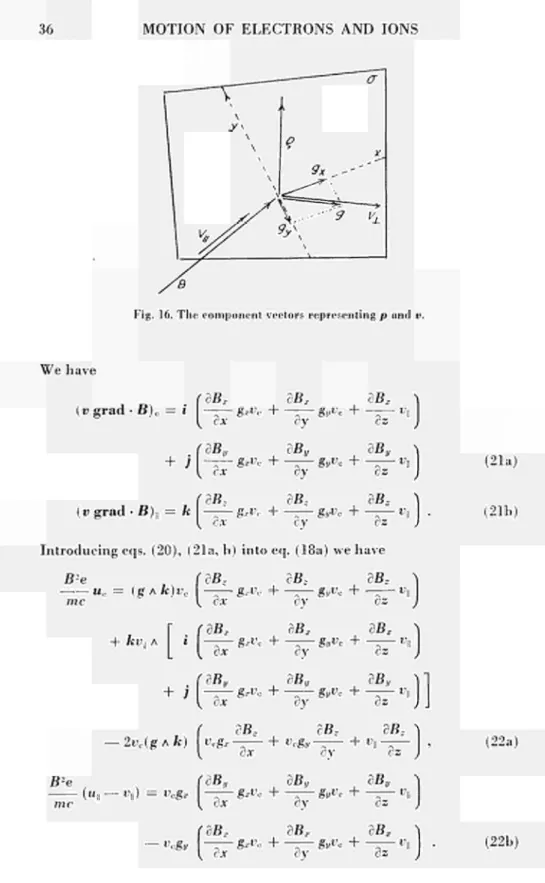
where vc is t h e velocity vector of t h e cyclotron m o t i o n w h i c h rotates in a p l a n e σ,. p e r p e n d i c u l a r to Β with t h e a n g u l a r speed ω0 and v¡¡ is t h e c o m p o n e n t parallel to Β and uc is t h e c o m p o n e n t of u in oc. According to our assumption uc is small c o m p a r e d w i t h vc and vu
(fig. 16).
T h e vectors v grad · ß and grad Β can be similarly considered as having one c o m p o n e n t parallel to Β and a second one lying in t h e ac plane. T h u s , for e x a m p l e ,
grad Β = grad„ β + gradc Β . (20)
Let us now i n t r o d u c e in t h e p l a n e σ0 orthogonal cartesian coordinates
x, y, with unit vectors i, j . T h e coordinate axis ζ and t h e corresponding u n i t vector k are t h e n parallel to B. Let us also w r i t e * vc = g · vc.
36 M O T I O N O F E L E C T R O N S A N D I O N S
Fig. 16. The component vectors representing ρ and v.
W e have
(v g r a d · ß )c = i
cBT dBj cBz
- ς — 8'υ* + —r- 8uVc + ——
dx oy dz
'dBv 3ß„
+ J ~r~ 8*vc + r — gvVc +
ex 3y dz
dBy \
(v g r a d ß)ι. k —— g,v, \ ex
dB. dB. ι
+ r — gyVc + —r— ν
3y dz
I n t r o d u c i n g eqs. (20), (21a, b) into eq. (18a) we h a v e
Be
u,. = (g Ak)vc
mc
+ kv¡ A
+ j
— 2vc(g A fe)
(«II —*Ίι) = Vc8*
'dB. dB. dB, grVc + —— guVc +
-k dx (dBr
<y dz
dBx dBx
g*vc + —— guvc + —— W|| dx oy dz
>.
o xdB,,
gxVc + — — gyVc + ?y
dBy dz
·)]
dB. dB. dB. ι Vogx — l· Vcgy — h V|dx 9y
3z J
B2 δΒ,, 3B„
aß
u«*t>0 + —— gyVc + — — V,|
k 3x 3y 3z
f3ßx
Vogt, l ^ g x f .
3Βχ 3ßx
+ r — gVvc + —— V
3y 3z
(21a)
(21b)
(22a)