H
IMI, "!! Ζ' 'Β·* 'Γ"* ■'■"■ '•'Axllrw*' S í " "ι ¿il lu
ι "i
WÊ·
β
¡ i S S i
COMMISSIO
îffli|i
l i i H W i r i l i ï W
y&iMiqHp,. ; ; ■ | | | ¡¡¡¡|
:'1!!i"
Î
i HiBliiïl
IPBP
SEC!P
TRACE:
# 1 1 1 »
A FUEL CYCLE COMPUTER CODE
FOR FAST REACTOR ANALYSü
íliiite
m
ii
LEGAL NOTIC]
This document was prepared under the sponsorship of the Commission of the European Communities.
Neither the Commission of the European Communities, its contractors nor any person acting on their behalf :
Pif'
'îiiîaBW
lähi. Hit fe*
make any warranty or representation, express or implied, with respect to the accuracy, completeness, or usefulness of the information contained in this document, or that the use of any information, apparatus, method
or process disclosed in this document may not infringe privately owned
«irä'aaiiWM
mim
in this document
sHS^iBfli
This report is on sale at the addresses Hsted on cover page 4
at the price of F.Fr. 5.60 B.Fr. 50.— DM 3.70 It.Lire
620.-assume any liabihty with respect to the use of, or for damages resulting from the use of any information, apparatus, method or process disclosed
Fl. 3.60
When ordering, please which are indicated on
quote the EUR number and the title on the cover of each report.
ÍliÍi2fASiilÍfep
!:
Printed by Guyot s.a., Brussels
vVlluMf SSI ÍÜS Tifiti P''™!?ít*;.fí:.*?v,fi' b' WJnkkìnM VZiUN ·!/'(ίΜ^β Luxembourg, August 1971
This document was reproduced on the basis of the best available copy
Ι8Γ"
EUR 4709 e
T R A C E : A F U E L CYCLE COMPUTER CODE FOR FAST REACTOR ANALYSIS by G. GRAZIANI
Commission of the European Communities Joint Nucleax Research Centre
Ispra Establishment (Italy) Nuclear Studies Division
Luxembourg, August 1971 - 34 pages - B.Fr. 50,—
This report describes a two-dimensional computer program written for the IBM 360/66 which calculates the fuel input requirements and the neutron physics behaviour of the equilibrium fuel cycle of a fast reactor using a partial refuelling scheme.
EUR 4709 e
T R A C E : A F U E L CYCLE COMPUTER CODE FOR FAST REACTOR ANALYSIS by G. GRAZIANI
Commission of the European Communities Joint Nuclear Research Centre
Ispra Establishment (Italy) Nuclear Studies Division
Luxembourg, August 1971 - 34 pages - B.Fr. 50,—
This report describes a two-dimensional computer program written for the IBM 360/65 which calculates the fuel input requirements and the neutron physics behaviour of the equilibrium fuel cycle of a fast reactor using a partial refuelling scheme.
EUR 4709 e
T R A C E : A F U E L CYCLE COMPUTER CODE F O R FAST REACTOR ANALYSIS by G. GRAZIANI
Commission of the European Communities Joint Nuclear Research Centre
Ispra Establishment (Italy) Nuclear Studies Division
Luxembourg, August 1971 - 34 pages - B.Fr. 50,—
This report describes a two-dimensional computer program written for the IBM 360/65 which calculates the fuel input requirements and the neutron physics behaviour of the equilibrium fuel cycle of a fast reactor using a partial refuelling scheme.
EUR 4 7 0 9 e
COMMISSION OF THE EUROPEAN COMMUNITIES
T R A C E :
A FUEL CYCLE COMPUTER CODE
FOR FAST REACTOR ANALYSIS
by
G. GRAZIANI
1971
Joint Nuclear Research Centre Ispra Establishment - Italy
A B S T R A G T
This report describes a two-dimensional computer program written for the IBM 360/65 which calculates the fuel input requirements and the neutron physics behaviour of the equilibrium fuel cycle of a fast reactor using a partial refuelling scheme.
KEYWORDS
FAST REACTORS FUEL CYCLE PROGRAMMING IBM 360
2-DIMENSIONAL CALCULATIONS BURNUP
SELF-SHIELDING
NEUTRON DIFFUSION EQUATION NEUTRON SPECTRA
INDEX
1. Introduction
2. The burn-up calculation
3. The self-shielding calculation
4. The diffusion calculation method
5. Spectrum calculation and Buckling Vectors
6. The calculation procedure
7. Output description
8. Acknowledgements
9. References
1. INTRODUCTION
In the process of designing a fast reactor, it is convenient, when fractional core loading is considered, to investigate
the equilibrium fuel cycle before a large effort is spent in the project. Generally speaking it is possible to reach the equilibrium cycle following the so called "approach to equi-librium" procedure. In this case the calculation starts con--sidering the initial charge to be in the core and calculating the flux distribution and the depletion up to the time when the first reloading occurs. At that time a fraction of the burned fuel is replaced with fresh one. The calculation of the flux distribution and the depletion is repeated till the next refueling time. If this procedure is continued long en--ough, the feed fuel requirements will become stationary and the behaviour of the nuclear parameters will repeat at each cycle. The equilibrium cycle is so reached. This approach has the advantage to give all the informations on the way to
the approach to the equilibrium, as well as on the equilibrium cycle itself. However this procedure is quite lenghty and com--puter time consuming. For much of the survey work on fast reactor fuel cycles, data on the approach to equilibrium are not necessary and the calculation of the running in period can be avoided. Actually the selection of a certain number of nuclear parameters from an equilibrium cycle survey is ad-vantageous because the equilibrium conditions of the fuel cycle represent the larger part of the reactor life.
The code TRACE is a two dimensional programme (R-Z) written to investigate the parameters of the equilibrium fuel cycle without generating the data for all the approach cycles. The consequent reduction of informations is counter-balanced by a large gain in computer time (in spite of the complexity of the problem). A further source of time-saving is the assump--tion that the spatial dependence of the flux can be well re-presented by one group diffusion calculation: this is accu-rate enough for this kind of fast reactor calculations. Computer times between 2 or 3 minutes can be obtained for each complete calculation on th¡e IBM 360/65 machine.
2. THE BURN-UP CALCULATION
The code allows a depletion model in which the transmutation of a nuclide can happen by neutron capture and radioactive decay. Each nuclide may have up to two capture parents and
Fission yields may be specified for each individual fission product resulting from a fission of any heavy nuclide.
Provision is made to take into account leakage out of the _1
system of the volatile nuclides by a leakage constant (sec ). The ..restriction imposed is that no nuclide can be produced by another nuclide which is in a lower position in the list of isotopes. This implies that, for example, all fission products must follow the fissionable isotopes. All changes in nuclide densities are represented by the system of firèt order differential equations:
i . i"1
S-
= -
Α.. Ν
1+ Sum Α. .
N
J(i=1 , Nue!)
(ί)
Cit. X_L -î — 1 J
where NUCL is the total number of burnable elements.
The coefficients Aij of the system equations form a triangu-l a r matrix and represent the transmutation rate (by decay or capture) of nuclide j into nuclide i. The diagonal ele-ments Aii are the total removal rate of the isotope i out of the system.
7
-3. THE SELF-SHIELDING CALCULATION
The space and energy distribution of the flux in the fuel cell of a single zone changes during irradiation, thereby affecting the effective cross-sections of the isotopes and the neutron balance. For an heterogeneous core, the calculation of the va riation of the spatial form of the flux with the cell compo--sition is of great importance for the calculation of the iso--topes burn-up. For fast reactors the variation of multigroup cross-sections as a function of the composition is also impor--tant. Therefore a multigroup calculation appears to be neces--sary. However, in order to use time constant cross-sections in the depletion equations (1), without neglecting the spectrum variation in the fuel element, the code assumes that the flux variation in the cell is function of the time averaged composi--tion in the cell itself, by means of the self-shielding fact--ors.
The self-shielding factors are defined as the ratio Let--ween the true reaction rate of the isotope considered and the reaction rate which would be obtained, if the flux in the cell was everywhere equal to a reference flux, say the flux at the
cell boundary or the average flux in a given part of the cell. If the group structure is sufficiently fine, the flux shape in the fuel element can be supposed to depend only on the macroscopic absorption cross-section of the cell in the energy group considered. In this case of spatially heterogene--ous cores few previous transport calculations for the same cell geometry with different compositions will enable to ob--tain a fitting of the self-shielding factors as a function of the cell absorption cross-section. A good fitting is given for example with the formula:
ς Q
0" I E , i
M I E , i
( 2 )
Ί + "alïï ^ 2 I E , i ' *" a l l í ' 3 I E , i
/
w h e r e S5r r-, . i ü . ü h o s e l f - s h i e l d i n g f a c t o r ox ' " I E , , i ra
tl'!e i s o t o p e i i n t h e e n e r g y g r o u p
ν ajE i s t i i e t o t a l m a c r o s c o p i c a b s o r p t
-- i o n c r o s s -- s e c t i o n of t h e c e l l i n t h e g r o u p i E
TV TT-, · ; T„ -, ..; Τ.-,-,., ■ a r e t u e c o e f f i c i e n t s ίΐιρυΐ i o d i n t o I 1 ili , 1 a 1 ¡-i f 1 j i υ , 1
8
-4. '.'HE DIFFUSION CALCULATION METHOD
A diffusion calculation procedure not too time consuming but still accurate is needed, due to the fact that the, code has to perform many such calculations in a single run, taking in to account the flux currents and the different flux levels in the various zones in which the reactor is subvided.
An analytical nodal approach for the solution of the diffusion equation in one energy group is employed. (Ref.1) The basic idea is that the real spatial form of the flux within each region is uninteresting for the code purposes; only the ave rage fluxes in each region are actually needed for the cal culation, while the neutron currents between adjacent regions shalialso be correctly evaluated. The one energy group flux is the solution of the second order differential equation:
with
v 2*R + BR *R = ° ( 3 )
4 = <v 2
f R-2a
R)/D
R(4)
The solution of such equation will require the determination of two functions of the boundary coordinates. In order to ar rive to a simple solution, the approximation is made that the neutron currents are constant on each boundary of each region and equal to an average value. In this way the true "-two-dimension solution can be approximated by the superposi tion of two one-dimension solutions and a total of four coef ficients have to be determined (two for each direction). The two analytical functions which are solution of the equa tion (3) in each direction depend on the component of the
buckling Β in either direction (say α and β , where « +β = R ) If these quantities would be known, the four coefficients
present in the flux solution for each zone could be expressed in terms of the average·fluxes in the zones.
The solution of the equation (3) 'would then become an espres-sion of the type:
9
where ijrij are the region average fluxes, i and j are the in dices of the r&actor regions. The programme starts guessing the quantities «andßrand then solving the system (5); it ob tains the average fluxes in each region and the flux curren t s between adjacent regions. At this point the two componen ts of the buckling« and Fare recalculated and new coeffi cients for the expressions (5) are obtained. This leads to a new solution for the average fluxes and the currents. When this procedure has converged, the reactivity of the system is calculated. If criticality is not achieved, the source term is adjusted and the calculation is repeated till the fluxes and the currents match with a critical system.
The procedure'described assumes the separability of the flux es within each region. The inaccuracy due to this approxima t i o n has been verified to be of no major concern for the e quilibrium fuel cycle calculations for the fast reactors, although improvements can be searched for in this connection. Finally the diffusion calculation in one energy group has been demonstrated to give quite accurate results for this kind of problems in power fast reactor. Figure 1. gives the flux distribution in the radial direction calculated in one energy group with the nodal approach and in 26 energy group with the finite difference method diffusion code SQUID (Ref. 2 ) . The agreement is satisfactory.
5. SPECTRUM CALCULATION AND BUCKLING VECTORS
The flux spectrum in each of the region in which the reactor is subvided must correspond to a critical assembly. The spec trum calculation will then be correct once proper values of multigroup bucklings are introduced into the spectrum routine for each region.
The buckling values supplied are the one deduced by the one group diffusion calculation. The direct use of these va l u e s to describe the leakages can introduce an error into
the spectrum, as the energy dependence of the current;is not properly taken into account by a(single value buckling. FOr
this reason provision is made to introduce into the program me a set of previously calculated buckling vectorsV
With these quantities the energy group bucklings have to sa tisfy the equality:
,2 A / „.„ A ^ *2
Sum DI E BI E 0IE / Sum ^I E = D Β ( 6 )
lb Ih
where
2 2
10
-which imposes that the total leakage has to remain the same. The energy group bucklings obtained from equalities (6) are supplied into the spectrum routine.
When the calculation of the region spectra has converged, the
programme uses the multigroup energy fluxes obtained to
con-dense in one group the macroscopic quantities that have to
be introduced into the one group diffusion equation (3)·
6. THE CALCULATION PROCEDURE
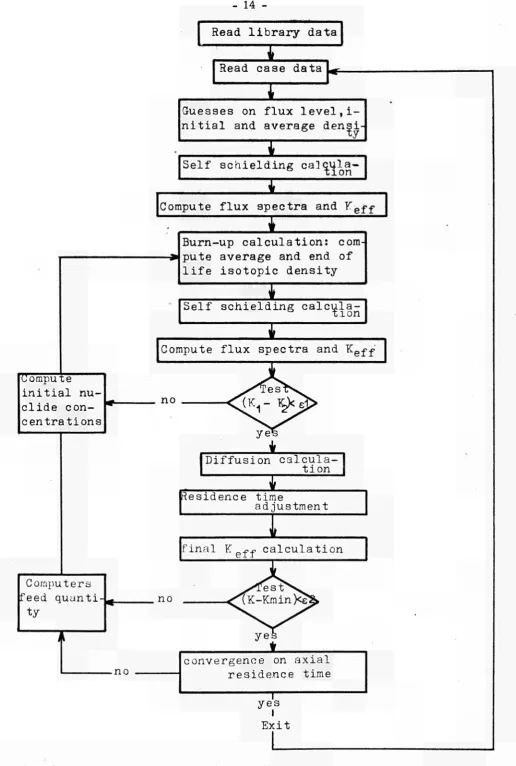
The programme flow diagram is shown in fig. 2 and 3·
First the set of the library data is read in. These data con-sist in cross-section values, fission yields, the fission
source spectrum, the convergence criteria, and the informations needed to generate the isotopes transmutation chains.
Next information are those necessary to describe the reactor. The number of burnable regions, the dimensions of each region,the region compositions and the one group constant for the reflec-tor have to be provided.
The information include the total thermal power of the reactor, the burn-up values for the regions, together with a guess for the axial blanket burn-up, or in turn the burn-up averaged along an axial stripe, and a guess for the feed quantity in
the certain region which has been pre-determined for the search.
To begin the calculation a flux distribution is guessed: flat
in the radial direction and cosinus shaped in the axial direc-tion. The burn-up values of the axial regions are re-adjusted to give equal residence time in every axial stripe, or in turn region burn-up are calculated from the flux cosinus distribu-tion.
Region spectra are then computed from the fuel composi-tions given, taking also into account the fuel guess. Resi-dence times are calculated from the one group flux
distribu-tion and the burn-up values obtained. Using these data pro-gramme estimates the average and final concentrations of each region. Region spectra and K-effee tive are then calcula-ted using the more recent average composition. Up to this point the flux spatial distribution has not been altered.
Provision is made to recycle any fraction of any nuclide in the same or in another zonæ. If this is the case new initial concentrations are obtained adding the fraction of the recy-cled isotopes at the end of the burn-up to the original ini-tial densities.
In any case the depletion and the spectrum calculation are repeated until the multiplication factors of the two consecuti-ve iterations differ by less than the corresponding conconsecuti-vergence
11
-This is the flux spectrum recycle loop and it has been dedu-c e d mainly from the zero-dimensional burn-up dedu-code Gaffee
(Ref. 3 ) .
At this point the code enters into the nodal calculation of the flux spatial distribution. With the new flux levels the resi--dence time values are re-adjusted in each zone. Next, the
programme proceeds with the routine which calculates the reac-tivity at the beginning and at the end of the refueling in-terval. If the smaller of the two corresponding values of the multiplication factorsis within the specified convergen-c e convergen-criterion from the searconvergen-ched value, the convergen-code convergen-controls the residence time of the axial stripes and, eventually after another burn-up calculation in the case these time values have to be re-adjusted, the computation
stops;-If the convergency on the K-effeetive is not achieved, the programme re-enters into the flux spectrum recycle loop and
the calculation is repeated.
7. OUTPUT DESCRIPTION
The programme prints first of all the input data: the libra-r y nuclealibra-r data, the compositions of the libra-regions and the geometry of the reactor.
The iteration procedure can be easily followed in the output list. When convergence is achieved the initial average and the final isotopie compositions are printed together with spectra, macroscopic multigroup cross-section and neutron ba--lance for each region.
Fraction of the power, power densities, specific power, ave--rage reactor conversion ratio and the doubling time of the system are also gixen.
Finally a number of data are edited and punched on cards, which may be used if a calculation of the fuel cycle cost has
tobe performed. These are: initial, average and final, fuel isotopie composition of each region, the region volume (in cm3) and the fuel residence time (in days), the fuel specific power (in watt/gr of fuel) and the power densities, (in watt/ /cm3). '
8. ACKNOWLEDGEMENTS
- 12
9. REFERENCES
Ref. 1 C. Rinaldini - A nodal approach to solve few region
neutron diffusion problems.
Energia Nucleare - Vol. 17 N.7 - Lu-glio 1970.
Ref. 2 SQUID - A multigroup program with criticality searches for the IBM - 360 - EUR 388 2C.
Λ
^ 1
ΙΑ "c 3
£
S
*-·
2
ι-Ο ^ /
Χ
Ξ 0.5
LI
CORE 1
—
,
CORE 2
V
ν*
BLANKET REFLECTOR
One group nodal approach to the diffusion equation
?fi group fini*» difference
calculation
Vv
Ι
NN.
^S^
^ ν ^• Ό ^ , ^
^^^^^^^^^^
ι...
)
i I I W U ) . ^ B W J ~ . ^ = i
I
I—' CO
50 100 150 200
14
Read library data
Read case data
I
Guesses on flux level,i-nitial and average
densi-I
Self scbielding
calcula-I
Compute flux spectra and Keff
Compute
initial nu clide con centrations
Computers feed quanti
ty
.no
Burn-up calculation: com pute average and end of life isotopie density
I
Self schielding calcula-° τ ion
Compute flux spectra and Keff'
no
Diffusion calcula-J tion 1
*
Residence time
adjustment 1
ι
final. Κ eƒƒ· calculation
no
convergence on axial residence time
1
yes
I Exit
[image:18.595.35.552.25.792.2]L
15
Adjust the neutron
source
Guess on the buckling components
in the R,z directions
A d , l u s t
t h e bun'■<.! i n ¿ Comp c n e n t s
< n r >
1
Nodal c o e f f i c i e n t s c a l c u l a t i o n
n o
I
Flux m a t r i x
s o l u t i o n
I
Compute the currents
Are the currents coherent with the buckling componen
ts?
yes
Word
Column
F o r m a t
C a r d
N° A1
Syrnbo 1
1
1-4 I n t e g e r Number of e n e r g y g r o u p s
26
N26
2 5-8
I n t e g e r Number of f a s t
g r o u p s
24 '
N23
3 9 - 1 2
I n t e g e r Number of c r o s s
s e c t i o n b l o c k s
40
NLB
4 1 3 - 1 6
I n t e g e r Number of h e a v y
n u c l i d e s
NHEV
•5 1 7 - 2 0
I n t e g e r Number of m o d e r a t o r n u c l i d e s
3
NLM
6 2 1 - 2 4
I n t e g e r Dummy
NLT
Word
Column
F o r m a t
C a r d
N° A1 c o n t . )
Symbo1
7 2 5 - 2 8
I n t e g e r Number of b u r n u p s t e p d e s c r i b e d i n t h e p r i n t o u t
( u s u a l l y = l )
NCOST
8
2 9 - 3 2 I n t e g e r i d . number of t h e c o n -- t r o l ( s h o u l t be z e r o i f n< X e - o v e r .
c a l c u l a t i o n i s d e s i r e d )
NBORON
9 3 3 - 3 6 I n t e g e r
i d . number of t h e I X e - 1 3 5 i n ) t h e l i b r a r y
NXE5
CT>
Word Column Format Card N° A2 Symbo 1 1 1-4 I n t e g e r
N u c l i d e number
L
2
5-8 I n t e g e r
N u c l i d e number of
1 s t c a p t u r e p a r e n t
NCAP1 (L)
3
9 - 1 2 I n t e g e r
N u c l i d e n u m b e r of
2nd c a p t u r e p a r e n t
NCAP2 (L)
4
1 3 - 1 6 I n t e g e r
N u c l i d e n u m b e r of N, 2N p a r e n t
NN2NN (L)
5
1 7 - 2 0 I n t e g e r
N u c l i d e number of d e c a y
p a r e n t
NBETA (L)
6
2 1 - 2 4 I n t e g e r
N u c l i d e h a s n o n - z e r o
o f ? 0 - No
1 - Yes
KFISS (L)
Comment
Supply one card for each nuclide. Word. Column Format Card tf° A2
( c o n t . )
Symbol
7 2 5 - 2 8 I n t e g e r
N u c l i d e i s a f i s s i o n p r o d u c t ?
0 - No 1 - Yes
KFP (L)
—
8 2 9 - 3 2 I n t e g e r
N u c l i d e
h a s n o n - z e r o ?
n , 2n 0 - No
1 - Yes
KN2N (L)
9 3 3 - 3 6
B l a n k
10 3 7 - 4 8 D e c i m a l
Decay c o n s t a n t
XLAM (L)
11 4 9 - 6 0 D e c i m a l
L e a k a g e c o n s t a n t
XLEAK (L)
12
6 1 - 7 2 D e c i m a l
Atomic w e i g h t
Word
Column
F o r m a t
Card.
N° A3
Symbo1
1
1-4 I n t e g e r
1st n u c l i d e i s p r i m a r y f i s s i l e ? 0 - No
1 - Yes
NFA (1)
2
5-8 I n t e g e r 2nd n u c l i d e i s p r i m a r y f i s s i l e ? 0 - No
1 - Yes
NFA (2)
3
9-12 I n - t e g e r 3rd n u c l i d e i s p r i m a r y f i s s i l e ? 0 - No
1 - Yes
NFA (3)
4
13-16 I n t e g e r
e t c .
e t c .
5
17-20
Word.
Column
F o r m a t
Card. N° A4 Symbol 1 1-4
Integer
1st nuclide
i s p r i m . f i s s
precursor?
0 - No 1 - Yes
-1 Neg c o n t r i
NCR (1)
2 5-8 I n t e g e r 2nd n u c l i d e . i s p r i m . f i s s
p r e c u r s o r ? 0 - No 1 - Yes
bINeg c o n t r i b
NCR (2)
3
9-12 I n t e g e r 3rd n u c l i d e i s p r i m . f i s s p r e c u r s o r ? 0 - No
1 - Yes
1 Neg c o n t r i
NCR (3)
4 13-16 I n t e g e r
9
e t c .
D
e t c .
5 17-20
Comment
Supply one word of d a t a f o r each heavy n u c l i d e .
See card A1 word 4.
Continue on a d d i t i o n a l c a r d s i f n e c e s s a r y .
Comment
03 I
Supply one word of data for each heavy nuclide.
See card A1, word4
Continue on
Word
Column
F o r m a t
C a r d
A 5
Symbo1
1
1-12 D e c i m a l
F i s s . Y i e l d from 1 s t h e a v y
YIELD ( I , i ;
2
1 3 - 2 4 D e c i m a l
F i s s . Y i e l d from 2nd h e a v y
YIELD ( 1 , 2 )
3
2 5 - 3 6 D e c i m a l
F i s s . Y i e l d from 3 r d h e a v y
YIELD ( 1 , 3 )
4
3 7 - 4 8 D e c i m a l
e t c .
e t c .
5
4 9 - 6 0
Comment
S u p p l y a y i e l d v a l u e from e a c h h e a v y n u c l i d e . See c a r d A 1 , word 4 . S u p p l y
y i e l d s
a s e t of f o r e a c h fi¡3 p r o d u c t . B e g i n e a c h
s e t on a new c a r d .
See c a r d A 2 , w o r d 7
Word Column Format-Car d. A6 1 1-6
A l p h a n u m e r i c N u c l i d e
I d e n t i f i c a -t i o n
2 7 - 6 0 A l p h a n u m e r i c O t h e r c r o s s b l o c k i d e n -t i f i c a -t i o n
3 6 0 - 6 4 I n t e g e r
0 - Not a m o d e r a t o r
1 - m o d e r a t o i
4 6 5 - 6 8 I n t e g e r
Read t r a n s f e r m a t r i x ?
• 0 - Y e s 1 - No
: Symbol I CLOG CK AME ¡ NMOD | MATRIX
5 6 9 - 7 2 I n t e g e r
" Read s e l f -s h i e l d i n g f a c t o r s 0 - No
1 - Y e s
NSHLD
Comment Repeat cards A6, A7, A8, A9, and A10 in sets for each cross section .block.
Word
Column
Format
Card
A7
Symbol
1
1-12
v cf
FISIG
2
13-24
°tr
TOSIG
3
25-36
°a
ABSIG
4
3 7 - 4 8
° g , g + l
OUSIG
5
4 9 - 6 0
V
XNU
•
6 61-72
° n , 2 n
XNSIG
Comment
Supply one card for each energy group.
See card A1, word 1.
Word
Column
F o r m a t
Card
A 8
Symbo1
1
1-12
Decimal
0 τ
g>g+l
OUSIG
2
13-24
Decimal
σ
g , g + 2
3
25-36
Decimal
g , g + 3
4
3 7 - 4 8
Decimal
e t c .
5
4 9 - 6 0
D e c i m a l
• · · ·
6
61-72
O p t i m a l
σ, l a s t
g
f a s t
group
to o
Comment
Fast group transf(¡r matrix;Start a new ,card for each
group.
Word Column Format Card A9 Symbo1 ' 1 1-12 D e c i m a l
6 . , 1 s t
ë t h e r m a l
g r o u p
OUSIGM
2
1 3 - 2 4 D e c i m a l
Co., 2nd t h e r m a l g r o u p
3 2 5 - 3 6 D e c i m a l
o¿, 3 r d
& t h e r m a l
group
4
37-48 Decimal
e t c .
5
49-60 Decimal
• · · ·
6
6 1 - 7 2 D e c i m a l
O), , l a s t
° t h e r m a l
g r o u p
OUSIGM
Comment Transfer into
thermal region for moderators only:
Start a new card for each group. Supply this data for all fast and thermal groups. Word Column Format Card A10 Symbo1 1 1-12 D e c i m a l
F i s s i o n s o u r c e f r a c t i o n f o r 1 s t g r o u p
CHI(1)
2 "
13-24 D e c i m a l
F i s s i o n s o u r c e f r a c t i o n f o r 2nd g r o u p
CHI(2)
3 2 5 - 3 6 D e c i m a l
F i s s i o n s o u r c e f r a c t i o n f o r 3 r d g r o u p
CKI(3)
4 3 7 - 4 8 D e c i m a l
e t c .
5 4 9 - 6 0 D e c i m a l
• * · ·
6
61-72 Decimal F i s s i o n s o u r c e f r a c t i o n f o r l a s t group
CHI(N26)
Comment Supply a value for each group,
including thermal groups.
Continue on
Word j 1
Column
Format
Card A11
Symbo1
1-12
Decimal Flux
convergeance c r i t e r i o n
2
ί
3i
413-24 I 25-36 I 37-48 !
! i
Decimal ! Decimal ' Decimal F l u x - r e c y c l e
l o o p c o n v e r gence
c r i t e r i o n
CONK EPS1
F i n a l h „„ eff convergence c r i t e r i o n
EPS2
F r a c t i o n of power
r e d u c t i o n
f o r X e - o v e r r . c a l c u l a t i o n
Comment
CM CO PH
w V
τ—
CO FH
W
V
o o
ΙΓΝ
O
o
O
• m o o o •
o o
o
o •
CD
H
PH
CO
Χ
ω
fH
o
t p
Word.
Column
Format
Card 1 Β
j Symbol
1
1-4
I n t e g e r Number of
s e l f
s h i e l d i n g s e t to be s u p p l i e d
( i f zero skip to card 1)
. , , !
— — ■■ " j
,ο,α I 1
I
,
-
-Format,
η .3 -,-. -^
2 3 Symbo1 14 Integer set number I 2 58 Integer =0 fitting on concen tration formula (ï) =1fitting
on concentr. formula (.2) >1 see next
word NJZSPT(I) 3 712 Integer =0 fitting on a formula (1) =1 fitting on a
formula (2)
4
1316 Integer id. number of the 1st isotope referred'by N$PT=0 or N0PT=1
N#PI(I) i IS(I,1)
5
1720 Integer id. number of the 2nd isotope referred by N$PT=0 or N$PT=1 is.CU.2l 6 2124 Integer id. number of the 3rd isotope referred by N#PT=0 or N$PT=1
_x_sjtxai . .
■." _'■ Γ' I
, . , _ .
i' 0 .7'■'.. -i ί.
3 Β Symbo1 1 2 1-12 13-24 Decimal First coefficient group ( 1 ) formula (1)
Decimal Second
coefficient group ( 1 ) formula ( 1 )
3
25-36 Decimal Third
coefficient group ( 1 ) formula (ï)
4 37-¿3 Decimal First coefficient group (2) formula (1)
T1(I,1) ¡ T2(I,1) T3(I,1) I T1(I,2)
5 42-60 Decimal Second coefficient group (2) formula (1) T2(I,2) 6 61-72 Decimal Third coefficient group (2) formula (1) T3(I,2) Comment only if NSET> 0 (as many) (as NSET) CO CO Comment
Only i f N#PT = 0 or NJØPT 1 and Nj#PI = 0 c o n t i n u e
Word
Column
Format
Card.
4 Β
Symbo1
1
1-12
Decimal
F i r s t
c o e f f i c i e n t
g r o u p ( 1 )
formula (2)
S1 ( 1 , 1 )
2
13-24
Decimal
Second c o e f f i c i e n t
group (1)
f o r m u l a (2)
S2 ( 1 , 1 )
3
2 5 - 3 6
Decimal
t h i r d
c o e f f i c i e n t
group (1)
f o r m u l a (2)
S3 ( 1 , 1 )
4
3 7 - 4 8
Decimal
4 t h
S4 ( 1 . 1 )
5
4 9 - 6 0
Decimal
5 t h
S5 ( 1 . 1 )
6
61-72
Decimal
6 t h
S6 ( 1 , 1 ) .
Comment
Only i f NJ&PT o r NJ&PT 1 NØPI = 1 c o n t i n u e :
1 c a r d e a c h t
= 1
group
Word.
Column Format
Card
5 B
Symbo1
1
1-12
Decimal
C o n s t a n t
s e l f
s h i e l d i n g
s e t i
group 1
S S ( i , l )
2
13-24
Decimal
group 2
S S ( i , 2 )
3
25-36
Decimal
group 3
4
3 7 - 4 8
Decimal
group 4
5
49-60
Decimal
group 5
6
61-72
Decimal
group 6
-—
N3
Comment
Only i f NSET<0 c o n t i n u e on a n o t h e r c a r d n e c e s s a r y .
Vio rd
Column
Format
Card
6 Β
Symbo1
• 1
1-4
Integer
Id. number
of the
self
s h i e l d i n g
s e t for
isotope 1
ISET (1)
2
5-6
Integer
Id. number
of the
self
s h i e l d i n g
s e t for
isotope 2
ISET (2)
3
7 - 8
I n t e g e r
e t c .
ISET (3)
I
t
Comment
Word
Column Format
Card.
N° 1
Symbo1
1
1-72
A l p h a n u m e r i c Case
i d e n t i f i c a t i o n
—
Supply as many words as word 3 card A1;
continue on another card if necessary
ί Kord
I
F o r m o t
Card
N° 2
Symbo1
1
1-4
I n t e g e r
Number of n u c l i d e
c a r d s t o be r e a d
( c a r d 6)
NREAD
2 5-8
I n t e g e r
0-No e f f e c t N-Punch
w e i g h t s f o r Ν t i m e
i n t e r v a l s
NCOST
3
9 - 1 2I n t e g e r
S e a r c h o p t i o n O-Feed q u a n t i t y
1 - b u r n - u p . (MWD/T)
ΝΤΥΡΕ
4 1 3 - 1 6
I n - 1 eg e r
Number of r e l o a d
i n t e r v a l s d u r i n g l i f e on one
b a t c h
IRELO
5
1 7 - 2 0I n t e g e r
Maximum t o t a l
i t e r a t i o n s
JNSTOP
6
2 1 - 2 4
I n t e g e r
Maximum
i t e r a t i o n s ' i n a s i n g l e f l u x - r e c y c l e l o o p
JNNSTP
Wo ^ d
Column
F o r m a t
C^rd.
N° 2
Symbol
7
25-28
I n t e g e r
0-No effect
1-Search
for
recycle
f a c t o r i f
necessary
Word
Column
Format
Card
N° 2
c o n t . )
Symbo1
' 8
2 9 - 3 2
I n t e g e r
0-No e f f e c t 1 - p u n c h a t o m
d e n s i t i e s
NPUN
9
3 3 - 3 6
I n t e g e r
l i b r a r y f o r n e x t c a s e O-Same
1-Read AI-A12 1Read A l l
--A12
NLI3
10
3 7 - 4 0
0-No e f f e c t 1 - P o i s o n o r f e r t . m a t .
s e a r c h
N F I X P O ) • · · ·
18
69-72
I n t e g e r
NFIXP(9)
Word.
Column
Format
Card
N° 3
Symbol
1
1-4
I n t e g e r
Number of r a d i a l b u r n a b l e z o n e s
NZØNE
2 ~
5 - 8
I n t e g e r
Number of a x i a l b u r n a b l e z o n e s
NZETA
3
7 - 1 2
I n t e g e r
i s t h e
s e a r c h t o be p e r f o r m e d i n z o n e 1?
1 y e s 0 n o
ICHANGO)
4
1 3 - 1 6
I n t e g e r
s u p p l y a s many w o r d s
a s word 1
• · * ·
ICHANG(2)
5
1 7 - 2 0
I n t e g e r
ICHANG
6
2 1 - 2 4
I n t e g e r
b u c k l i n g o p t i o n i f ? 0
t h e o n e ρ g r o u p B'~ w i l l b e
s h a r e d among t h e g r o u p s
Word
Column
Format
Card
N° 3
( c o n t . )
Symbol
7 2 5 - 2 8 I n t e g e r
h a s t h e c a l -c u l a t i o n t o be p e r f o r m e d w i t h an a v e r a ge a x i a l
b u r n - u p ? 1 no 0 y e s
NBR
!
, I
!
Word
Column Format
Card
N° 4
Symbol
1 1-12
D e c i m a l = 0 a x i a l symmetry
= 1 no symmetry
i n a x i a l d i r e c t i o n
HEIGHT
2
1 3 - 2 4
D e c i m a l 1 g r o u p d i f f u s i o n c o e f f i c i e n t of t h e r e f l e c t o r
DREFL
3 2 5 - 3 6
D e c i m a l m a c r o s c o p i c a b s o r p t i o n x - s e c t i o n of t h e r e f l e c t o r
SAREFL
4 3 7 - 4 8
D e c i m a l
f i s s i o n p e r w a t t
s e c
FIWATT
5
4 9 - 6 0
D e c i m a l c o r e p o w e r
( w a t t s )
PØWER
6 6 1 - 7 2
D e c i m a l
s h u t - d o w n e f f
Word
Column
Format
Card
N° 5
Symbo1
Ί
1-12 Decimal Minimum feed
q u a n t i t y or burn-up
v a l u e
FMIN
2 13-24 Decimal Maximum feed
q u a n t i t y or burn-up
v a l u e
FMAX
3 25-36 Decimal IF = 0 . 0 DELTFD =1;5
( I F χ 0) MINIF
( x , 1 . 5 )
DELTFD FLOATPd) FL0ATP(2) FL0ATP(3)
Comment
See c a r d 2 , w o r d 3 .
Word
Column
Format
Card
N° 6
Symbol
1 1-12 Decimal r a d i u s (cm)
of t h e f i r s t zone
RZjZfNEd)
2 13-24 Decimal supply as many words
a s NZJØNEH-1
RZJ0NE(2)
3 25-36
Decimal
e t c .
RZJ0NE(3)
to
Word
Column
Format
Card
N° 7
Symbo1
1 1-12 D e c i m a l
a x i a l t h i c k n e s s of t h e f i r s t z o n e (cm)
ZZ(1)
2
1 3 - 2 4 D e c i m a l
s u p p l y a s many w o r d s a s NZETA4-1
ZZ(2)
3 2 5 - 3 6 D e c i m a l
e t c .
ZZ(3)
Word
Column Format
Card
Symbo1
1 1-12 D e c i m a l
b u r n - u p (MWD/T) of t h e f i r s t r a d i a l a n d a x i a l zone
BRUP(1,1)
2
1 3 - 2 4 D e c i m a l
s e c o n d
r a d i a l z o n e f i r s t a x i a l z o n e
BRUP(2,1)
3 2 5 - 3 6 D e c i m a l
s u p p l y a s many w o r d s
a s NZ^NE
t i m e s NZETA e t c .
N.B.
The burn-up values of the first axial region are taken as average b.u. in axial direction when NBR=0.
o
Word
Column
Format
Card
N° 9
Symbol
' 1 1-12
D e c i m a l r e s i d e n c e t i m e g u e s s
( d a y s ) f i r s t r a d i a l and a x i a l z o n e
DELDAY(1,1)
2
13-24
D e c i m a l
s e c o n d r a d i a ! f i r s t a x i a l z o n e
DELDAY(2,1)
3 2 5 - 3 6
D e c i m a l . a s many
w o r d s a s NZ$NE t i m e s NZETA
DELDAY(3,1) ; ! I
CO
Word.
Column Format
Card
N° 10
Symbo1
1
1-12 D e c i m a l f e e d g u e s s
1 s t z o n e
FEED(1,1)
2
13-24 D e c i m a l
FEED(2,1)
3
2 5 - 3 6 D e c i m a l a s amny w o r d s a s ΝΖ$ΝΕ t i m e s NZETA
Word Column Format Card N° 11 Symbo1 1 1-12
D e c i m a l
V e c t o r f o r r a d i a l
b u c k l i n g 1 s t g r o u p
VECTjc5R(l)
2
13-24
D e c i m a l
V e c t o r f o r r a d i a l
b u c k l i n g 2nd g r o u p
VECTJ0R(2)
3 2 5 - 3 6
D e c i m a l
• · · ·
4 3 7 - 4 8
D e c i m a l
• · · ·
-5 4 9 - 6 0
D e c i m a l
• · * ·
6 6 1 - 7 2
D e c i m a l
V e c t o r f o r r a d i a l
b u c k l i n g l a s t g r o u p
VECT$R(N26; Comment Continue on another card if necessary. As many vector sets as NZØNE. Only if word 5 card 3 is not 0. Word Column Format Card N° 12 Symbo1 1 1-4 I n t e g e r
N u c l i d e i d e n t i f i c a -t i o n
number
L
2 5-8
I n t e g e r
0-No e f f e c t Nadd r e
-c y -c l e d p a r t i n t o n u c l i d e N
NSWIT(L)
3 9 - 1 2 I n t e g e r
t h e r e c y c l e d n u c l i d e i s
i n t h e z o n e NSHU
NSHU
4 1 3 - 2 4 D e c i m a l
R e c y c l e f r a c t i o n
QR(L)
5 2 5 - 3 6 D e c i m a l
Feed f r a c t i o n
Z(L)
6 3 7 - 4 8
D e c i m a l
C o n s t a n t f e e d q u a n t i t y
( a t o m s : b a r n - c m )
CDEN(L)
i Comment
S u p p l y a s many n u c l i d e c a r d s
a s r e q u i r e d .
See c a r d 2 , word 1.
(As many s e t s a s t h e t o t a l numb e r of
Word Column Format Card
N° 13
SymbolΊ
1-4 I n t e g e rNumber of Th-232 n u c l i d e s
NW(1)
2
5-8
I n t e g e rNumber of f e d U-233 n u c l i d e s
NW(2)
3
9 - 1 2 I n t e g e rNumber of f e d U-235 n u c l i d e s
NW(3)
4 1 3 - 1 6 I n t e g e r
Number of f e d P u - 2 3 9 , P u - 2 4 1 , and Np-239
n u c l i d e s
NW(4)
5
1 7 - 2 0 I n t e g e rNumber of b r e d P a - 2 3 3 and U - 2 3 3 n u c l i d e s
NW(5)
6
2 1 - 2 4 I n t e g e r
Number of b r e d U - 2 3 5 n u c l i d e s
NW(6)
Comment
S u p p l y a s e t of c a r d s 7 and 8 i f f u e l w t s . a r e t o be p u n c h e d .
See c a r d 2 .
S u p p l y a s e t of ci and 8 i f
2 , word
s e c o n d a r d s 7
t h e r e a r e two f u e l p a r t i c l e t y p e s .
Word
Column Format
Card
N° 13
( c o n t . )
Symbol
7
25-28
I n t e g e rNumber of b r e d N p - 2 3 9 , P u - 2 3 9 , and P u - 2 4 1
n u c l i d e s
NW(7)
8
29-32
I n t e g e rNumber of a l l U-232 n u c l i d e s
NW(8)
9
33-36
I n t e g e rNumber of a l l P a - 2 3 3 and u r a n i u m n u c l i d e s
NW(9)
10 3 7 - 4 0
I n t e g e r
Number of a l l Np-239 and p l u t o n ium n u c l i d e s
NW(10)
11
4 1 - 4 4 I n t e g e r
Number of f u e l p a r t i c l e s 0 - 1 p a r t i c l e
1-2 p a r t i c l e s
Word Column Format
Card N° 14
Symbo1
1 ,
1-4
Integer
Ident. no.
of 1st
nuclide
referred to
by card 7
LISTO)
2
5-8
Integer
Ident. no.
of 2nd
nuclide
referred to
by card 7
LIST(2)
3
9-12
Integer
Ident. no.
of 3rd
nuclide
referred to
by card 7
LIST(3)
4
13-16
Integer
etc.
etc.
Word Column Format
Card
Symbo1
Comment
List the identi-fication number of each nuclide referred to by card 7, words 1 to 10.
Continue on another card if necessary.
(As many sets as the total number of burnable zones)
;
Äl*
ilili
Siili
rj&iJMj
:
H
iHPiiîl
-'■ \θ 'ί·ί
IUP
mmm
N O T I C E T O T H E READER
All Scientific and technical reports published by the Commission of the European
Communities are announced in t h e monthly periodical "euro-abstracts".
For subscription (1 year : US$ 16.40, £ 6.17, Bfr 820,-) or free specimen copies please write to :
H a n d e l s b l a t t G m b H " e u r o - a b s t r a c t s "
D-4 D ü s s e l d o r f 1
P o s t f a c h 1102
G e r m a n y
lliiplii
or
'11*
'■Mw
Bfáb
;
$ ään
m
Office f o r Official P u b l i c a t i o n s of t h e E u r o p e a n C o m m u n i t i e s P.O. B o x 1003 - L u x e m b o u r g 1
imvm
7»w¥*iHaESS
i&3&
m
Wil 'fr ' i JK TÍ ¡ «liiCÍ TOlifflLjllrø.;..
4!ÍÍ¿3tñ* s i*ti<~-!(W¿l£U'*i ·ί®|ι4-»'ι'
www**™?®
111;»
mm
fmWMwmâfË:
- r i l l ; J Γ71·./* íCl?ÍAj
■JH
rili
η
t
htM ^*¿TÜ '\tvi '%
! To disseminate knowledge is t o disseminate prosperity — I mean
general prosperity and n o t individual riches — and with prosperity
disappears t h e greater part of t h e evil which is our heritage from
darker times.
:l::::::::t:::ln:::nu:mi:ir
'ϋ%;3.Μβι
Alfred Nobel
mêm
WwWÊÈSm
WÊÊÊÊmm
mMå
å
ΑΠ reports published by the Commission of the European Communities are on sale at the offices listed below, at the prices given on the back of the front cover. When ordering, specify clearly the EUR number and the title of the report which are shown on the front cover.
OFFICE OF
P.O. Box 1003 - Luxembourg (Compte chèque postal N° 191-' -90,
BELGIQUE — BELGIË L U X E M B O U R G
MONITEUR BELGE OFFICE DE!
R U A rfp Τ n u v a i n iCi./LO . Ρ ί . ΐ η η Λ Τ ΐ η , ν ο Ι Ι α ο DTTTJI i r i T I f
IL „
if Γ »Ρ $1*1 C ι 2·» ¡M
ü i u n i i c u n rsiiu^E. υ±·1*1ι_1ί DES
Rue de Louvain. 40-42 - B-1000 Bruxelles PUBLICATIONS OFFICIELLES DES
BELGISCH STAATSBLAD COMMUNAUTÉS EUROPÉENNES
Leuvenseweg 40-42 - B-1000 Brussel Case Postale 1003 - Luxembourg 1
DEUTSCHLAND
VERLAG BUNDESANZEIGER
Postfach 108 006 - D 5 Köln 1
-IB
ffiiÜ
FRANCE
SERVICE D E VENTE E N FRANCE DES PUBLICATIONS DES
NEDERLAND
STAATSDRUKKERIJ-
ÊÊm
COMMUNAUTÉS EUROPÉENNES r u e D e s a i x , 2 6 - F - 7 5 P a n s l 5 .
^ P ^ P W I Ê A T TA
f ? i ^
Ji$W-':«i%'>8*t \m I T A L r A
mmm
STAATSDRU K K E R I J -en U I T G E V E R I J B E D R I J F Christof iel Plantijnstraat - Den Haag
LIBRERIA DELLO STATO Piazza G. Verdi, 10 - 1-00198 Roma
lã w--À\Wml· Ose Í ^ Í Í ' H B Í W ' ÏI
UNITED KINGDOM
Η. M. STATIONERY OFFICE P.O. Box 569 - London S.E.I
,'K
Û
C
L
ommission of the European Communities D.G. XIII - C.I.D.
2 9 n i p A l f l r i n p p n rue Aldringen
u x e m b o u r g
eiiftlílllll
I
CDNA04709ENC
ft
x e m D o u r g