Analysis Methods in Neural Language Processing: A Survey
Yonatan Belinkov1,2 and James Glass1
1MIT Computer Science and Artificial Intelligence Laboratory
2Harvard School of Engineering and Applied Sciences
Cambridge, MA, USA
{belinkov, glass}@mit.edu
Abstract
The field of natural language processing has seen impressive progress in recent years, with neural network models replacing many of the traditional systems. A plethora of new mod-els have been proposed, many of which are thought to be opaque compared to their feature-rich counterparts. This has led researchers to analyze, interpret, and evaluate neural net-works in novel and more fine-grained ways. In this survey paper, we review analysis meth-ods in neural language processing, categorize them according to prominent research trends, highlight existing limitations, and point to po-tential directions for future work.
1 Introduction
The rise of deep learning has transformed the field of natural language processing (NLP) in recent years. Models based on neural networks have obtained impressive improvements in various tasks, including language modeling (Mikolov et al., 2010; Jozefowicz et al., 2016), syntactic parsing (Kiperwasser and Goldberg, 2016), machine translation (MT) (Bahdanau et al., 2014; Sutskever et al., 2014), and many other tasks; see Goldberg (2017) for example success stories.
This progress has been accompanied by a myriad of new neural network architectures. In many cases, traditional feature-rich systems are being replaced by end-to-end neural networks that aim to map input text to some output pre-diction. As end-to-end systems are gaining preva-lence, one may point to two trends. First, some push back against the abandonment of linguis-tic knowledge and call for incorporating it inside
the networks in different ways.1 Others strive to better understand how NLP models work. This theme of analyzing neural networks has connec-tions to the broader work on interpretability in machine learning, along with specific characteris-tics of the NLP field.
Why should we analyze our neural NLP mod-els? To some extent, this question falls into the larger question of interpretability in machine learning, which has been the subject of much debate in recent years.2 Arguments in favor of interpretability in machine learning usually mention goals like accountability, trust, fairness, safety, and reliability (Doshi-Velez and Kim, 2017; Lipton, 2016). Arguments against inter-pretability typically stress performance as the most important desideratum. All these arguments naturally apply to machine learning applications in NLP.
In the context of NLP, this question needs to be understood in light of earlier NLP work, often referred to as feature-rich or feature-engineered systems. In some of these systems, features are more easily understood by humans—they can be morphological properties, lexical classes, syn-tactic categories, semantic relations, etc. In theory, one could observe the importance assigned by statistical NLP models to such features in order to gain a better understanding of the model.3 In
1See, for instance, Noah Smith’s invited talk at ACL 2017:vimeo.com/234958746. See also a recent debate on this matter by Chris Manning and Yann LeCun:www. youtube.com/watch?v=fKk9KhGRBdI. (Videos accessed on December 11, 2018.)
2See, for example, the NIPS 2017 debate:www.youtube.
com/watch?v=2hW05ZfsUUo. (Accessed on December 11, 2018.)
3Nevertheless, one could question how feasible such an analysis is; consider, for example, interpreting support vec-tors in high-dimensional support vector machines (SVMs).
49
contrast, it is more difficult to understand what happens in an end-to-end neural network model that takes input (say, word embeddings) and generates an output (say, a sentence classification). Much of the analysis work thus aims to understand how linguistic concepts that were common as features in NLP systems are captured in neural networks.
As the analysis of neural networks for language is becoming more and more prevalent, neural networks in various NLP tasks are being analyzed; different network architectures and components are being compared, and a variety of new anal-ysis methods are being developed. This survey aims to review and summarize this body of work, highlight current trends, and point to existing lacunae. It organizes the literature into several themes. Section 2 reviews work that targets a fundamental question: What kind of linguistic in-formation is captured in neural networks? We also point to limitations in current methods for answering this question. Section 3 discusses visu-alization methods, and emphasizes the difficulty in evaluating visualization work. In Section 4, we discuss the compilation of challenge sets, or test suites, for fine-grained evaluation, a meth-odology that has old roots in NLP. Section 5 deals with the generation and use of adversarial examples to probe weaknesses of neural networks. We point to unique characteristics of dealing with text as a discrete input and how different studies handle them. Section 6 summarizes work on explaining model predictions, an important goal of interpretability research. This is a relatively underexplored area, and we call for more work in this direction. Section 7 mentions a few other methods that do not fall neatly into one of the above themes. In the conclusion, we summarize the main gaps and potential research directions for the field.
The paper is accompanied by online supple-mentary materials that contain detailed references for studies corresponding to Sections 2, 4, and 5 (Tables SM1, SM2, and SM3, respectively),
available athttps://boknilev.github.io/
nlp-analysis-methods.
Before proceeding, we briefly mention some earlier work of a similar spirit.
A Historical Note Reviewing the vast literature
on neural networks for language is beyond
our scope.4 However, we mention here a few representative studies that focused on analyzing such networks in order to illustrate how recent trends have roots that go back to before the recent deep learning revival.
Rumelhart and McClelland (1986) built a feedforward neural network for learning the English past tense and analyzed its performance on a variety of examples and conditions. They were especially concerned with the performance over the course of training, as their goal was to model the past form acquisition in children. They also analyzed a scaled-down version having eight input units and eight output units, which allowed them to describe it exhaustively and examine how certain rules manifest in network weights.
In his seminal work on recurrent neural networks (RNNs), Elman trained networks on synthetic sentences in a language prediction task (Elman, 1989, 1990, 1991). Through exten-sive analyses, he showed how networks discover the notion of a word when predicting characters; capture syntactic structures like number agree-ment; and acquire word representations that reflect lexical and syntactic categories. Similar analyses were later applied to other networks and tasks (Harris, 1990; Niklasson and Lin˚aker, 2000; Pollack, 1990; Frank et al., 2013).
While Elman’s work was limited in some ways, such as evaluating generalization or various lin-guistic phenomena—as Elman himself recog-nized (Elman, 1989)—it introduced methods that are still relevant today: from visualizing network activations in time, through clustering words by hidden state activations, to projecting represen-tations to dimensions that emerge as capturing properties like sentence number or verb valency. The sections on visualization (Section 3) and iden-tifying linguistic information (Section 2) contain many examples for these kinds of analysis.
2 What Linguistic Information Is Captured in Neural Networks?
Neural network models in NLP are typically trained in an end-to-end manner on input–output pairs, without explicitly encoding linguistic
features. Thus, a primary question is the fol-lowing: What linguistic information is captured in neural networks? When examining answers to this question, it is convenient to consider three dimensions: which methods are used for conducting the analysis, what kind of linguistic information is sought, and which objects in the neural network are being investigated. Table SM1 (in the supplementary materials) categorizes rel-evant analysis work according to these criteria. In the next subsections, we discuss trends in analysis work along these lines, followed by a discussion of limitations of current approaches.
2.1 Methods
The most common approach for associating neural network components with linguistic properties is to predict such properties from activations of the neural network. Typically, in this approach a neural network model is trained on some task (say, MT) and its weights are frozen. Then, the trained model is used for generating feature representations for another task by running it on a corpus with linguistic annotations and recording the representations (say, hidden state activations). Another classifier is then used for predicting the property of interest (say, part-of-speech [POS] tags). The performance of this classifier is used for evaluating the quality of the generated representations, and by proxy that of the original model. This kind of approach has been used in numerous papers in recent years; see Table SM1 for references.5It is referred to by various names,
including ‘‘auxiliary prediction tasks’’ (Adi et al., 2017b), ‘‘diagnostic classifiers’’ (Veldhoen et al., 2016), and ‘‘probing tasks’’ (Conneau et al., 2018). As an example of this approach, let us walk through an application to analyzing syntax in neural machine translation (NMT) by Shi et al. (2016b). In this work, two NMT models were trained on standard parallel data—English→
French and English→German. The trained models (specifically, the encoders) were run on an annotated corpus and their hidden states were used for training a logistic regression classifier that predicts different syntactic properties. The authors concluded that the NMT encoders learn
5A similar method has been used to analyze hierarchical structure in neural networks trained on arithmetic expressions (Veldhoen et al., 2016; Hupkes et al., 2018).
significant syntactic information at both word level and sentence level. They also compared representations at different encoding layers and found that ‘‘local features are somehow preserved in the lower layer whereas more global, abstract information tends to be stored in the upper layer.’’ These results demonstrate the kind of insights that the classification analysis may lead to, especially when comparing different models or model components.
Other methods for finding correspondences between parts of the neural network and certain properties include counting how often attention weights agree with a linguistic property like anaphora resolution (Voita et al., 2018) or directly computing correlations between neural network activations and some property; for example, correlating RNN state activations with depth in a syntactic tree (Qian et al., 2016a) or with Melfrequency cepstral coefficient (MFCC) acoustic features (Wu and King, 2016). Such correspondence may also be computed indirectly. For instance, Alishahi et al. (2017) defined an ABX discrimination task to evaluate how a neural model of speech (grounded in vision) encoded phonology. Given phoneme representations from different layers in their model, and three pho-nemes, A, B, and X, they compared whether the model representation for X is closer to A or B. This discrimination task enabled them to draw conclusions about which layers encoder phonology better, observing that lower layers generally encode more phonological information.
2.2 Linguistic Phenomena
Different kinds of linguistic information have been analyzed, ranging from basic properties like sentence length, word position, word presence, or simple word order, to morphological, syntactic, and semantic information. Phonetic/phonemic information, speaker information, and style and accent information have been studied in neural network models for speech, or in joint audio-visual models. See Table SM1 for references.
Linzen et al. (2016), for instance, found that long short-term memory (LSTM) language models are able to capture subject–verb agreement in many common cases, while direct supervision is required for solving harder cases.
Another theme that emerges in several
studies is the hierarchical nature of the learned representations. We have already mentioned such findings regarding NMT (Shi et al., 2016b) and a visually grounded speech model (Alishahi et al., 2017). Hierarchical representations of syntax were also reported to emerge in other RNN models (Blevins et al., 2018).
Finally, a couple of papers discovered that models trained with latent trees perform better on natural language inference (NLI) (Williams et al., 2018; Maillard and Clark, 2018) than ones trained with linguistically annotated trees. Moreover, the trees in these models do not resemble syntactic trees corresponding to known linguistic theories, which casts doubts on the importance of syntax-learning in the underlying neural network.6
2.3 Neural Network Components
In terms of the object of study, various neural network components were investigated, including word embeddings, RNN hidden states or gate activations, sentence embeddings, and attention weights in sequence-to-sequence (seq2seq) mod-els. Generally less work has analyzed convo-lutional neural networks in NLP, but see Jacovi et al. (2018) for a recent exception. In speech processing, researchers have analyzed layers in deep neural networks for speech recognition and different speaker embeddings. Some analysis has also been devoted to joint language–vision or audio–vision models, or to similarities bet-ween word embeddings and con volutional image representations. Table SM1 provides detailed references.
2.4 Limitations
The classification approach may find that a certain amount of linguistic information is captured in the neural network. However, this does not necessar-ily mean that the information is used by the net-work. For example, Vanmassenhove et al. (2017)
6Others found that even simple binary trees may work well in MT (Wang et al., 2018b) and sentence classification (Chen et al., 2015).
investigated aspect in NMT (and in phrase-based statistical MT). They trained a classifier on NMT sentence encoding vectors and found that they can accurately predict tense about 90% of the time. However, when evaluating the output translations, they found them to have the correct tense only 79% of the time. They interpreted this result to mean that ‘‘part of the aspectual information is lost during decoding.’’ Relatedly, C´ıfka and Bojar (2018) compared the performance of various NMT models in terms of translation quality (BLEU) and representation quality (classification tasks). They found a negative correlation between the two, suggesting that high-quality systems may not be learning certain sentence meanings. In contrast, Artetxe et al. (2018) showed that word embeddings contain divergent linguistic information, which can be uncovered by applying a linear transformation on the learned embeddings. Their results suggest an alternative explanation, showing that ‘‘embedding models are able to encode divergent linguistic information but have limits on how this information is surfaced.’’
From a methodological point of view, most of the relevant analysis work is concerned with correlation: How correlated are neural network components with linguistic properties? What may be lacking is a measure of causation: How does the encoding of linguistic properties affect the system output? Giulianelli et al. (2018) make some headway on this question. They predicted number agreement from RNN hidden states and gates at different time steps. They then intervened in how the model processes the sentence by changing a hidden activation based on the difference between the prediction and the correct label. This improved agreement prediction accuracy, and the effect persisted over the course of the sentence, indicating that this information has an effect on the model. However, they did not report the effect on overall model quality, for example by measuring perplexity. Methods from causal inference may shed new light on some of these questions.
Figure 1: A heatmap visualizing neuron activations. In this case, the activations capture position in the sentence.
(e.g., tree depth, coordination inversion) gain the most from using a deeper classifier. However, the approach is usually taken for granted; given its prevalence, it appears that better theoretical or empirical foundations are in place.
3 Visualization
Visualization is a valuable tool for analyzing neural networks in the language domain and beyond. Early work visualized hidden unit ac-tivations in RNNs trained on an artificial lan-guage modeling task, and observed how they correspond to certain grammatical relations such as agreement (Elman, 1991). Much recent work has focused on visualizing activations on spe-cific examples in modern neural networks for language (Karpathy et al., 2015; K´ad´ar et al., 2017; Qian et al., 2016a; Liu et al., 2018) and speech (Wu and King, 2016; Nagamine et al., 2015; Wang et al., 2017b). Figure 1 shows an example visualization of a neuron that captures position of words in a sentence. The heatmap uses blue and red colors for negative and positive activation values, respectively, enabling the user to quickly grasp the function of this neuron.
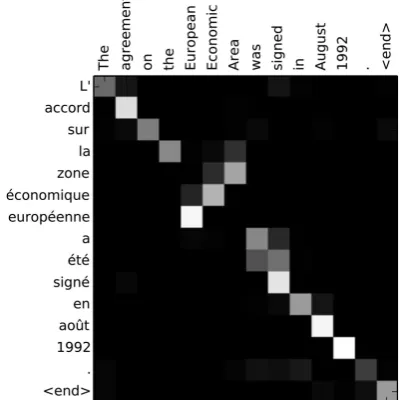
The attention mechanism that originated in work on NMT (Bahdanau et al., 2014) also lends itself to a natural visualization. The alignments obtained via different attention mechanisms have produced visualizations ranging from tasks like NLI (Rockt¨aschel et al., 2016; Yin et al., 2016), summarization (Rush et al., 2015), MT post-editing (Jauregi Unanue et al., 2018), and morphological inflection (Aharoni and Goldberg, 2017) to matching users on social media (Tay et al., 2018). Figure 2 reproduces a visualization of attention alignments from the original work by Bahdanau et al. Here grayscale values correspond to the weight of the attention between words in an English source sentence (columns) and its French translation (rows). As Bahdanau et al. explain, this visualization demonstrates that the NMT model learned a soft alignment between source and target words. Some aspects of word order may also be
Figure 2: A visualization of attention weights, showing soft alignment between source and target sentences in an NMT model. Reproduced from Bahdanau et al. (2014), with permission.
noticed, as in the reordering of noun and adjective when translating the phrase ‘‘European Economic Area.’’
Another line of work computes various saliency measures to attribute predictions to input features. The important or salient features can then be visualized in selected examples (Li et al., 2016a; Aubakirova and Bansal, 2016; Sundararajan et al., 2017; Arras et al., 2017a,b; Ding et al., 2017; Murdoch et al., 2018; Mudrakarta et al., 2018; Montavon et al., 2018; Godin et al., 2018). Saliency can also be computed with respect to intermediate values, rather than input features (Ghaeini et al., 2018).7
An instructive visualization technique is to cluster neural network activations and compare them to some linguistic property. Early work clustered RNN activations, showing that they or-ganize in lexical categories (Elman, 1989, 1990). Similar techniques have been followed by others. Recent examples include clustering of sentence embeddings in an RNN encoder trained in a multitask learning scenario (Brunner et al., 2017), and phoneme clusters in a joint audio-visual RNN model (Alishahi et al., 2017).
A few online tools for visualizing neural net-works have recently become available.LSTMVis
(Strobelt et al., 2018b) visualizes RNN activa-tions, focusing on tracing hidden state dynamics.8
Seq2Seq-Vis (Strobelt et al., 2018a) visual-izes different modules in attention-based seq2seq models, with the goal of examining model deci-sions and testing alternative decideci-sions. Another tool focused on comparing attention alignments was proposed by Rikters (2018). It also provides translation confidence scores based on the distri-bution of attention weights.NeuroX(Dalvi et al., 2019b) is a tool for finding and analyzing indi-vidual neurons, focusing on machine translation.
Evaluation As in much work on
interpretabil-ity, evaluating visualization quality is difficult and often limited to qualitative examples. A few notable exceptions report human evaluations of visualization quality. Singh et al. (2018) showed human raters hierarchical clusterings of input words generated by two interpretation methods, and asked them to evaluate which method is more accurate, or in which method they trust more. Others reported human evaluations for attention visualization in conversation modeling (Freeman et al., 2018) and medical code prediction tasks (Mullenbach et al., 2018).
The availability of open-source tools of the sort described above will hopefully encourage users to utilize visualization in their regular research and development cycle. However, it remains to be seen how useful visualizations turn out to be.
4 Challenge Sets
The majority of benchmark datasets in NLP are drawn from text corpora, reflecting a natural frequency distribution of language phenomena. While useful in practice for evaluating system performance in the average case, such datasets may fail to capture a wide range of phenomena. An alternative evaluation framework consists of challenge sets, also known as test suites, which have been used in NLP for a long time (Lehmann et al., 1996), especially for evaluating MT sys-tems (King and Falkedal, 1990; Isahara, 1995; Koh et al., 2001). Lehmann et al. (1996) noted several key properties of test suites: systematicity, control over data, inclusion of negative data,
8RNNVis (Ming et al., 2017) is a similar tool, but its online demo does not seem to be available at the time of writing.
and exhaustivity. They contrasted such datasets with test corpora, ‘‘whose main advantage is that they reflect naturally occurring data.’’ This idea underlines much of the work on challenge sets and is echoed in more recent work (Wang et al., 2018a). For instance, Cooper et al. (1996) constructed a semantic test suite that targets phe-nomena as diverse as quantifiers, plurals, ana-phora, ellipsis, adjectival properties, and so on.
After a hiatus of a couple of decades,9challenge
sets have recently gained renewed popularity in the NLP community. In this section, we include datasets used for evaluating neural network models that diverge from the common average-case evaluation. Many of them share some of the properties noted by Lehmann et al. (1996), although negative examples (ill-formed data) are typically less utilized. The challenge datasets can be categorized along the following criteria: the task they seek to evaluate, the linguistic phe-nomena they aim to study, the language(s) they target, their size, their method of construction, and how performance is evaluated.10Table SM2 (in the supplementary materials) categorizes many recent challenge sets along these criteria. Below we discuss common trends along these lines.
4.1 Task
By far, the most targeted tasks in challenge sets are NLI and MT. This can partly be explained by the popularity of these tasks and the prevalence of neural models proposed for solving them. Perhaps more importantly, tasks like NLI and MT arguably require inferences at various linguistic levels, making the challenge set evaluation especially attractive. Still, other high-level tasks like reading comprehension or question answering have not received as much attention, and may also benefit from the careful construction of challenge sets.
A significant body of work aims to evaluate the quality of embedding models by correlating the similarity they induce on word or sentence pairs with human similarity judgments. Datasets containing such similarity scores are often used
9One could speculate that their decrease in popularity can be attributed to the rise of large-scale quantitative eval-uation of statistical NLP systems.
to evaluate word embeddings (Finkelstein et al., 2002; Bruni et al., 2012; Hill et al., 2015, inter alia) or sentence embeddings; see the many shared tasks on semantic textual similarity in SemEval (Cer et al., 2017, and previous editions). Many of these datasets evaluate similarity at a coarse-grained level, but some provide a more fine-grained evaluation of similarity or related-ness. For example, some datasets are dedicated for specific word classes such as verbs (Gerz et al., 2016) or rare words (Luong et al., 2013), or for evaluating compositional knowledge in sen-tence embeddings (Marelli et al., 2014). Mul-tilingual and cross-lingual versions have also been collected (Leviant and Reichart, 2015; Cer et al., 2017). Although these datasets are widely used, this kind of evaluation has been criticized for its subjectivity and questionable correlation with downstream performance (Faruqui et al., 2016).
4.2 Linguistic Phenomena
One of the primary goals of challenge sets is to evaluate models on their ability to handle specific linguistic phenomena. While earlier studies emphasized exhaustivity (Cooper et al., 1996; Lehmann et al., 1996), recent ones tend to focus on a few properties of interest. For example, Sennrich (2017) introduced a challenge set for MT evaluation focusing on five proper-ties: subject–verb agreement, noun phrase agree-ment, verb–particle constructions, polarity, and transliteration. Slightly more elaborated is an MT challenge set for morphology, including 14 morphological properties (Burlot and Yvon, 2017). See Table SM2 for references to datasets targeting other phenomena.
Other challenge sets cover a more diverse range of linguistic properties, in the spirit of some of the earlier work. For instance, extend-ing the categories in Cooper et al. (1996), the GLUE analysis set for NLI covers more than 30 phenomena in four coarse categories (lexical semantics, predicate–argument structure, logic, and knowledge). In MT evaluation, Burchardt et al. (2017) reported results using a large test suite covering 120 phenomena, partly based on Lehmann et al. (1996).11 Isabelle et al. (2017)
11Their dataset does not seem to be available yet, but more details are promised to appear in a future publication.
and Isabelle and Kuhn (2018) prepared challenge sets for MT evaluation covering fine-grained phenomena at morpho-syntactic, syntactic, and lexical levels.
Generally, datasets that are constructed pro-grammatically tend to cover less fine-grained linguistic properties, while manually constructed datasets represent more diverse phenomena.
4.3 Languages
As unfortunately usual in much NLP work, es-pecially neural NLP, the vast majority of challenge sets are in English. This situation is slightly better in MT evaluation, where naturally all datasets feature other languages (see Table SM2). A notable exception is the work by Gulordava et al. (2018), who constructed examples for evaluating number agreement in language modeling in English, Russian, Hebrew, and Italian. Clearly, there is room for more challenge sets in non-English languages. However, perhaps more press-ing is the need for large-scale non-English datasets (besides MT) to develop neural models for popular NLP tasks.
4.4 Scale
The size of proposed challenge sets varies greatly (Table SM2). As expected, datasets constructed by hand are smaller, with typical sizes in the hundreds. Automatically built datasets are much larger, ranging from several thousands to close to a hundred thousand (Sennrich, 2017), or even more than one million examples (Linzen et al., 2016). In the latter case, the authors argue that such a large test set is needed for obtaining a sufficient representation of rare cases. A few manually constructed datasets contain a fairly large number of examples, up to 10 thousand (Burchardt et al., 2017).
4.5 Construction Method
Several datasets were constructed by modifying or extracting examples from existing datasets. For instance, Sanchez et al. (2018) and Glockner et al. (2018) extracted examples from SNLI (Bowman et al., 2015) and replaced specific words such as hypernyms, synonyms, and antonyms, followed by manual verification. Linzen et al. (2016), on the other hand, extracted examples of subject–verb agreement from raw texts using heuristics, resulting in a large-scale dataset. Gulordava et al. (2018) extended this to other agreement phenomena, but they relied on syntactic information available in treebanks, resulting in a smaller dataset.
Several challenge sets utilize existing test suites, either as a direct source of examples (Burchardt et al., 2017) or for searching similar naturally occurring examples (Wang et al., 2018a).12
Sennrich (2017) introduced a method for eval-uating NMT systems via contrastive translation pairs, where the system is asked to estimate the probability of two candidate translations that are designed to reflect specific linguistic prop-erties. Sennrich generated such pairs program-matically by applying simple heuristics, such as changing gender and number to induce agreement errors, resulting in a large-scale challenge set of close to 100 thousand examples. This frame-work was extended to evaluate other properties, but often requiring more sophisticated genera-tion methods like using morphological analyzers/ generators (Burlot and Yvon, 2017) or more man-ual involvement in generation (Bawden et al., 2018) or verification (Rios Gonzales et al., 2017). Finally, a few studies define templates that capture certain linguistic properties and instanti-ate them with word lists (Dasgupta et al., 2018; Rudinger et al., 2018; Zhao et al., 2018a). Template-based generation has the advantage of providing more control, for example for obtaining a specific vocabulary distribution, but this comes at the expense of how natural the examples are.
4.6 Evaluation
Systems are typically evaluated by their per-formance on the challenge set examples, either with the same metric used for evaluating the system in the first place, or via a proxy, as in the
12Wang et al. (2018a) also verified that their examples do not contain annotation artifacts, a potential problem noted in recent studies (Gururangan et al., 2018; Poliak et al., 2018b).
contrastive pairs evaluation of Sennrich (2017). Automatic evaluation metrics are cheap to obtain and can be calculated on a large scale. However, they may miss certain aspects. Thus a few studies report human evaluation on their challenge sets, such as in MT (Isabelle et al., 2017; Burchardt et al., 2017).
We note here also that judging the quality of a model by its performance on a challenge set can be tricky. Some authors emphasize their wish to test systems on extreme or difficult cases, ‘‘beyond normal operational capacity’’ (Naik et al., 2018). However, whether one should expect systems to perform well on specially chosen cases (as opposed to the average case) may depend on one’s goals. To put results in perspective, one may compare model performance to human performance on the same task (Gulordava et al., 2018).
5 Adversarial Examples
Understanding a model also requires an under-standing of its failures. Despite their success in many tasks, machine learning systems can also be very sensitive to malicious attacks or adversarial examples (Szegedy et al., 2014; Goodfellow et al., 2015). In the vision domain, small changes to the input image can lead to misclassification, even if such changes are in-distinguishable by humans.
The basic setup in work on adversarial examples can be described as follows.13 Given a neural
network model f and an input example x, we seek to generate an adversarial example x0 that will have a minimal distance fromx, while being assigned a different label byf:
min
x0 ||x−x
0||
s.t. f(x) =l, f(x0) =l0, l6=l0
In the vision domain, x can be the input image pixels, resulting in a fairly intuitive interpretation of this optimization problem: measuring the distance||x−x0||is straightforward, and finding
x0can be done by computing gradients with respect to the input, since all quantities are continuous.
In the text domain, the input is discrete (for example, a sequence of words), which poses two problems. First, it is not clear how to measure
the distance between the original and adversarial examples,xandx0, which are two discrete objects (say, two words or sentences). Second, minimizing this distance cannot be easily formulated as an optimization problem, as this requires computing gradients with respect to a discrete input.
In the following, we review methods for handling these difficulties according to several criteria: the adversary’s knowledge, the specificity of the attack, the linguistic unit being modified, and the task on which the attacked model was trained.14 Table SM3 (in the supplementary
ma-terials) categorizes work on adversarial examples in NLP according to these criteria.
5.1 Adversary’s Knowledge
Adversarial examples can be generated using access to model parameters, also known as white-box attacks, or without such access, with black-box attacks (Papernot et al., 2016a, 2017; Narodytska and Kasiviswanathan, 2017; Liu et al., 2017).
White-box attacks are difficult to adapt to the text world as they typically require computing gradients with respect to the input, which would be discrete in the text case. One option is to compute gradients with respect to the input word embeddings, and perturb the embeddings. Since this may result in a vector that does not correspond to any word, one could search for the closest word embedding in a given dictionary (Papernot et al., 2016b); Cheng et al. (2018) extended this idea to seq2seq models. Others computed gradients with respect to input word embeddings to identify and rank words to be modified (Samanta and Mehta, 2017; Liang et al., 2018). Ebrahimi et al. (2018b) developed an alternative method by representing text edit operations in vector space (e.g., a binary vector specifying which characters in a word would be changed) and approximating the change in loss with the derivative along this vector.
Given the difficulty in generating white-box adversarial examples for text, much research has been devoted to black-box examples. Often, the adversarial examples are inspired by text edits that are thought to be natural or commonly generated by humans, such as typos, misspellings, and so
14These criteria are partly taken from Yuan et al. (2017), where a more elaborate taxonomy is laid out. At present, though, the work on adversarial examples in NLP is more limited than in computer vision, so our criteria will suffice.
on (Sakaguchi et al., 2017; Heigold et al., 2018; Belinkov and Bisk, 2018). Gao et al. (2018) defined scoring functions to identify tokens to modify. Their functions do not require access to model internals, but they do require the model prediction score. After identifying the important tokens, they modify characters with common edit operations.
Zhao et al. (2018c) used generative adversar-ial networks (GANs) (Goodfellow et al., 2014) to minimize the distance between latent repre-sentations of input and adversarial examples, and performed perturbations in latent space. Since the latent representations do not need to come from the attacked model, this is a black-box attack.
Finally, Alzantot et al. (2018) developed an interesting population-based genetic algorithm for crafting adversarial examples for text clas-sification by maintaining a population of mod-ifications of the original sentence and evaluating fitness of modifications at each generation. They do not require access to model parameters, but do use prediction scores. A similar idea was proposed by Kuleshov et al. (2018).
5.2 Attack Specificity
Adversarial attacks can be classified to targeted vs. non-targeted attacks (Yuan et al., 2017). A targeted attack specifies a specific false class,l0, while a nontargeted attack cares only that the predicted class is wrong,l0 6=l. Targeted attacks are more difficult to generate, as they typically require knowledge of model parameters; that is, they are white-box attacks. This might explain why the majority of adversarial examples in NLP are nontargeted (see Table SM3). A few targeted attacks include Liang et al. (2018), which specified a desired class to fool a text classifier, and Chen et al. (2018a), which specified words or captions to generate in an image captioning model. Others targeted specific words to omit, replace, or include when attacking seq2seq models (Cheng et al., 2018; Ebrahimi et al., 2018a).
attacks on Google’s MT system after mapping sentences into continuous space with adversarially regularized autoencoders (Zhao et al., 2018b).
5.3 Linguistic Unit
Most of the work on adversarial text examples involves modifications at the character- and/or word-level; see Table SM3 for specific references. Other transformations include adding sentences or text chunks (Jia and Liang, 2017) or gener-ating paraphrases with desired syntactic structures (Iyyer et al., 2018). In image captioning, Chen et al. (2018a) modified pixels in the input image to generate targeted attacks on the caption text.
5.4 Task
Generally, most work on adversarial examples in NLP concentrates on relatively high-level language understanding tasks, such as text classification (including sentiment analysis) and reading comprehension, while work on text gen-eration focuses mainly on MT. See Table SM3 for references. There is relatively little work on adversarial examples for more low-level language processing tasks, although one can mention morphological tagging (Heigold et al., 2018) and spelling correction (Sakaguchi et al., 2017).
5.5 Coherence and Perturbation
Measurement
In adversarial image examples, it is fairly straightforward to measure the perturbation, either by measuring distance in pixel space, say
||x−x0|| under some norm, or with alternative measures that are better correlated with human perception (Rozsa et al., 2016). It is also visually compelling to present an adversarial image with imperceptible difference from its source image. In the text domain, measuring distance is not as straightforward, and even small changes to the text may be perceptible by humans. Thus, evaluation of attacks is fairly tricky. Some studies imposed constraints on adversarial examples to have a small number of edit operations (Gao et al., 2018). Others ensured syntactic or semantic coherence in different ways, such as filtering replacements by word similarity or sentence similarity (Alzantot et al., 2018; Kuleshov et al., 2018), or by using synonyms and other word lists (Samanta and Mehta, 2017; Yang et al., 2018).
Some reported whether a human can classify the adversarial example correctly (Yang et al.,
2018), but this does not indicate how perceptible the changes are. More informative human stud-ies evaluate grammaticality or similarity of the adversarial examples to the original ones (Zhao et al., 2018c; Alzantot et al., 2018). Given the inherent difficulty in generating imperceptible changes in text, more such evaluations are needed.
6 Explaining Predictions
Explaining specific predictions is recognized as a desideratum in intereptability work (Lipton, 2016), argued to increase the accountability of machine learning systems (Doshi-Velez et al., 2017). However, explaining why a deep, highly non-linear neural network makes a certain pre-diction is not trivial. One solution is to ask the model to generate explanations along with its primary prediction (Zaidan et al., 2007; Zhang et al., 2016),15but this approach requires manual annotations of explanations, which may be hard to collect.
An alternative approach is to use parts of the input as explanations. For example, Lei et al. (2016) defined a generator that learns a distri-bution over text fragments as candidate ratio-nales for justifying predictions, evaluated on sentiment analysis. Alvarez-Melis and Jaakkola (2017) discovered input–output associations in a sequence-to-sequence learning scenario, by perturbing the input and finding the most relevant associations. Gupta and Sch¨utze (2018) inspected how information is accumulated in RNNs towards a prediction, and associated peaks in prediction scores with important input segments. As these methods use input segments to explain predictions, they do not shed much light on the internal computations that take place in the network.
At present, despite the recognized importance for interpretability, our ability to explain pre-dictions of neural networks in NLP is still limited.
7 Other Methods
We briefly mention here several analysis methods that do not fall neatly into the previous sections.
A number of studies evaluated the effect of erasing or masking certain neural network components, such as word embedding dimensions, hidden units, or even full words (Li et al., 2016b;
Feng et al., 2018; Khandelwal et al., 2018; Bau et al., 2018). For example, Li et al. (2016b) erased specific dimensions in word embeddings or hidden states and computed the change in probability assigned to different labels. Their experiments revealed interesting differences between word embedding models, where in some models information is more focused in individual dimensions. They also found that information is more distributed in hidden layers than in the input layer, and erased entire words to find important words in a sentiment analysis task.
Several studies conducted behavioral experi-ments to interpret word embeddings by defining intrusion tasks, where humans need to identify an intruder word, chosen based on difference in word embedding dimensions (Murphy et al., 2012; Fyshe et al., 2015; Faruqui et al., 2015).16
In this kind of work, a word embedding model may be deemed more interpretable if humans are better able to identify the intruding words. Since the evaluation is costly for high-dimensional rep-resentations, alternative automatic metrics were considered (Park et al., 2017; Senel et al., 2018).
A long tradition in work on neural networks is to evaluate and analyze their ability to learn different formal languages (Das et al., 1992; Casey, 1996; Gers and Schmidhuber, 2001; Bod´en and Wiles, 2002; Chalup and Blair, 2003). This trend continues today, with research into modern architectures and what formal languages they can learn (Weiss et al., 2018; Bernardy, 2018; Suzgun et al., 2019), or the formal properties they possess (Chen et al., 2018b).
8 Conclusion
Analyzing neural networks has become a hot topic in NLP research. This survey attempted to review and summarize as much of the current research as possible, while organizing it along several prominent themes. We have emphasized aspects in analysis that are specific to language—namely, what linguistic information is captured in neural networks, which phenomena they are successful at capturing, and where they fail. Many of the analysis methods are general techniques from the larger machine learning community, such as
16The methodology follows earlier work on evaluating the interpretability of probabilistic topic models with intrusion tasks (Chang et al., 2009).
visualization via saliency measures or evaluation by adversarial examples. But even those some-times require non-trivial adaptations to work with text input. Some methods are more specific to the field, but may prove useful in other domains. Challenge sets or test suites are such a case.
Throughout this survey, we have identified several limitations or gaps in current analysis work:
• The use of auxiliary classification tasks for identifying which linguistic properties neural networks capture has become standard practice (Section 2), while lacking both a theoretical foundation and a better empirical consideration of the link between the auxiliary tasks and the original task.
• Evaluation of analysis work is often limited or qualitative, especially in visualization techniques (Section 3). Newer forms of eval-uation are needed for determining the suc-cess of different methods.
• Relatively little work has been done on explaining predictions of neural network models, apart from providing visualizations (Section 6). With the increasing public demand for explaining algorithmic choices in machine learning systems (Doshi-Velez and Kim, 2017; Doshi-Velez et al., 2017), there is pressing need for progress in this direction.
• Much of the analysis work is focused on the English language, especially in constructing challenge sets for various tasks (Section 4), with the exception of MT due to its inherent multilingual character. Developing resources and evaluating methods on other languages is important as the field grows and matures.
• More challenge sets for evaluating other tasks besides NLI and MT are needed.
Acknowledgments
We would like to thank the anonymous review-ers and the action editor for their very helpful comments. This work was supported by the Qatar Computing Research Institute. Y.B. is also supported by the Harvard Mind, Brain, Behavior Initiative.
References
Yossi Adi, Einat Kermany, Yonatan Belinkov, Ofer Lavi, and Yoav Goldberg. 2017a. Anal-ysis of sentence embedding models using prediction tasks in natural language processing. IBM Journal of Research and Development, 61(4):3–9.
Yossi Adi, Einat Kermany, Yonatan Belinkov, Ofer Lavi, and Yoav Goldberg. 2017. Fine-Grained Analysis of Sentence Embeddings Using Auxiliary Prediction Tasks. In Interna-tional Conference on Learning Representations (ICLR).
Roee Aharoni and Yoav Goldberg. 2017.
Morphological Inflection Generation with Hard Monotonic Attention. In Proceedings of the 55th Annual Meeting of the Association for Computational Linguistics (Volume 1: Long Papers), pages 2004–2015. Association for Computational Linguistics.
Wasi Uddin Ahmad, Xueying Bai, Zhechao Huang, Chao Jiang, Nanyun Peng, and Kai-Wei Chang. 2018. Multi-task Learning for Universal Sentence Embeddings: A Thorough Evaluation using Transfer and Auxiliary Tasks. arXiv preprint arXiv:1804.07911v2.
Afra Alishahi, Marie Barking, and Grzegorz Chrupała. 2017. Encoding of phonology in a recurrent neural model of grounded speech. In Proceedings of the 21st Conference on Computational Natural Language Learning (CoNLL 2017), pages 368–378. Association for Computational Linguistics.
David Alvarez-Melis and Tommi Jaakkola. 2017. A causal framework for explaining the predictions of black-box sequence-to-sequence models. InProceedings of the 2017 Conference on Empirical Methods in Natural Language
Processing, pages 412–421. Association for Computational Linguistics.
Moustafa Alzantot, Yash Sharma, Ahmed
Elgohary, Bo-Jhang Ho, Mani Srivastava, and Kai-Wei Chang. 2018. Generating Natural Language Adversarial Examples. In Proceed-ings of the 2018 Conference on Empirical Methods in Natural Language Processing, pages 2890–2896. Association for Computa-tional Linguistics.
Leila Arras, Franziska Horn, Gr´egoire Montavon, Klaus-Robert M¨uller, and Wojciech Samek. 2017a. ‘‘What is relevant in a text document?’’: An interpretable machine learning approach. PLOS ONE, 12(8):1–23.
Leila Arras, Gr´egoire Montavon, Klaus-Robert M¨uller, and Wojciech Samek. 2017b. Explain-ing Recurrent Neural Network Predictions in Sentiment Analysis. In Proceedings of the 8th Workshop on Computational Approaches to Subjectivity, Sentiment and Social Media Analysis, pages 159–168. Association for Computational Linguistics.
Mikel Artetxe, Gorka Labaka, Inigo Lopez-Gazpio, and Eneko Agirre. 2018. Uncovering Divergent Linguistic Information in Word Embeddings with Lessons for Intrinsic and Extrinsic Evaluation. In Proceedings of the 22nd Conference on Computational Natural Language Learning, pages 282–291. Associa-tion for ComputaAssocia-tional Linguistics.
Malika Aubakirova and Mohit Bansal. 2016. Inter-preting Neural Networks to Improve Politeness Comprehension. In Proceedings of the 2016 Conference on Empirical Methods in Natu-ral Language Processing, pages 2035–2041. Association for Computational Linguistics.
Dzmitry Bahdanau, Kyunghyun Cho, and Yoshua Bengio. 2014. Neural Machine Translation by Jointly Learning to Align and Translate. arXiv preprint arXiv:1409.0473v7.
Rachel Bawden, Rico Sennrich, Alexandra Birch, and Barry Haddow. 2018. Evaluating Discourse Phenomena in Neural Machine Translation. In Proceedings of the 2018 Conference of the North American Chapter of the Association for Computational Linguistics: Human Lan-guage Technologies, Volume 1 (Long Papers), pages 1304–1313. Association for Computa-tional Linguistics.
Yonatan Belinkov. 2018. On Internal Language Representations in Deep Learning: An Analy-sis of Machine Translation and Speech Recog-nition. Ph.D. thesis, Massachusetts Institute of Technology.
Yonatan Belinkov and Yonatan Bisk. 2018. Syn-thetic and Natural Noise Both Break Neural Machine Translation. In International Confer-ence on Learning Representations (ICLR).
Yonatan Belinkov, Nadir Durrani, Fahim Dalvi, Hassan Sajjad, and James Glass. 2017a. What do Neural Machine Translation Models Learn about Morphology? In Proceedings of the 55th Annual Meeting of the Association for Computational Linguistics (Volume 1: Long Papers), pages 861–872. Association for Computational Linguistics.
Yonatan Belinkov and James Glass. 2017, Anal-yzing Hidden Representations in End-to-End Automatic Speech Recognition Systems, I. Guyon, U. V. Luxburg, S. Bengio, H. Wallach, R. Fergus, S. Vishwanathan, and R. Garnett, editors, Ad-vances in Neural Information Processing Sys-tems 30, pages 2441–2451. Curran Associates, Inc.
Yonatan Belinkov, Llu´ıs M`arquez, Hassan Sajjad, Nadir Durrani, Fahim Dalvi, and James Glass. 2017b. Evaluating Layers of Representation in Neural Machine Translation on Part-of-Speech and Semantic Tagging Tasks. In Proceedings of the Eighth International Joint Conference on Natural Language Processing (Volume 1: Long Papers), pages 1–10. Asian Federation of Natural Language Processing.
Jean-Philippe Bernardy. 2018. Can Recurrent Neural Networks Learn Nested Recursion? LiLT (Linguistic Issues in Language Tech-nology), 16(1).
Arianna Bisazza and Clara Tump. 2018. The Lazy Encoder: A Fine-Grained Analysis of the Role of Morphology in Neural Machine Translation. In Proceedings of the 2018 Conference on Empirical Methods in Natural Language Processing, pages 2871–2876. Association for Computational Linguistics.
Terra Blevins, Omer Levy, and Luke Zettlemoyer. 2018. Deep RNNs Encode Soft Hierarchi-cal Syntax. InProceedings of the 56th Annual Meeting of the Association for Computa-tional Linguistics (Volume 2: Short Papers), pages 14–19. Association for Computational Linguistics.
Mikael Bod´en and Janet Wiles. 2002. On learning context-free and context-sensitive languages. IEEE Transactions on Neural Networks, 13(2): 491–493.
Samuel R. Bowman, Gabor Angeli, Christopher Potts, and Christopher D. Manning. 2015. A large annotated corpus for learning natural language inference. In Proceedings of the 2015 Conference on Empirical Methods in Natural Language Processing, pages 632–642. Association for Computational Linguistics.
Elia Bruni, Gemma Boleda, Marco Baroni, and Nam Khanh Tran. 2012. Distributional Semantics in Technicolor. In Proceedings of the 50th Annual Meeting of the Association for Computational Linguistics (Volume 1: Long Papers), pages 136–145. Association for Computational Linguistics.
Gino Brunner, Yuyi Wang, Roger Wattenhofer, and Michael Weigelt. 2017. Natural Language Multitasking: Analyzing and Improving Syn-tactic Saliency of Hidden Representations.The 31st Annual Conference on Neural Information Processing (NIPS)—Workshop on Learning Disentangled Features: From Perception to Control.
Aljoscha Burchardt, Vivien Macketanz, Jon Dehdari, Georg Heigold, Jan-Thorsten Peter, and Philip Williams. 2017. A Linguistic Evaluation of Rule-Based, Phrase-Based, and Neural MT Engines. The Prague Bulletin of Mathematical Linguistics, 108(1):159–170.
Franck Burlot and Franc¸ois Yvon. 2017.
Machine Translation Systems. In Proceedings of the Second Conference on Machine Trans-lation, pages 43–55. Association for Compu-tational Linguistics.
Mike Casey. 1996. The Dynamics of Discrete-Time Computation, with Application to Re-current Neural Networks and Finite State
Machine Extraction. Neural Computation,
8(6):1135–1178.
Daniel Cer, Mona Diab, Eneko Agirre, Inigo
Lopez-Gazpio, and Lucia Specia. 2017.
SemEval-2017 Task 1: Semantic Textual Sim-ilarity Multilingual and Crosslingual Focused Evaluation. In Proceedings of the 11th Inter-national Workshop on Semantic Evaluation (SemEval-2017), pages 1–14. Association for Computational Linguistics.
Rahma Chaabouni, Ewan Dunbar, Neil Zeghidour, and Emmanuel Dupoux. 2017. Learning weakly supervised multimodal phoneme embeddings. InInterspeech 2017.
Stephan K. Chalup and Alan D. Blair. 2003. Incremental Training of First Order Recurrent Neural Networks to Predict a Context-Sensitive Language.Neural Networks, 16(7):955–972.
Jonathan Chang, Sean Gerrish, Chong Wang, Jordan L. Boyd-graber, and David M. Blei. 2009, Reading Tea Leaves: How Humans Inter-pret Topic Models, Y. Bengio, D. Schuurmans, J. D. Lafferty, C. K. I. Williams, and A. Culotta, editors, Advances in Neural Information Pro-cessing Systems 22, pages 288–296, Curran Associates, Inc..
Hongge Chen, Huan Zhang, Pin-Yu Chen, Jinfeng Yi, and Cho-Jui Hsieh. 2018a. Attacking visual language grounding with adversarial examples: A case study on neural image captioning. In Proceedings of the 56th Annual Meeting of the Association for Computational Linguistics (Volume 1: Long Papers), pages 2587–2597. Association for Computational Linguistics.
Xinchi Chen, Xipeng Qiu, Chenxi Zhu, Shiyu Wu, and Xuanjing Huang. 2015. Sentence Modeling with Gated Recursive Neural Network. In Proc-eedings of the 2015 Conference on Empirical Methods in Natural Language Processing, pages 793–798. Association for Computational Linguistics.
Yining Chen, Sorcha Gilroy, Andreas Maletti, Jonathan May, and Kevin Knight. 2018b. Recurrent Neural Networks as Weighted
Language Recognizers. In Proceedings of
the 2018 Conference of the North American Chapter of the Association for Computational Linguistics: Human Language Technologies, Volume 1 (Long Papers), pages 2261–2271. Association for Computational Linguistics.
Minhao Cheng, Jinfeng Yi, Huan Zhang, Pin-Yu Chen, and Cho-Jui Hsieh. 2018. Seq2Sick: Evaluating the Robustness of Sequence-to-Sequence Models with Adversarial Examples. arXiv preprint arXiv:1803.01128v1.
Grzegorz Chrupała, Lieke Gelderloos, and Afra Alishahi. 2017. Representations of language in a model of visually grounded speech signal. InProceedings of the 55th Annual Meeting of the Association for Computational Linguistics (Volume 1: Long Papers), pages 613–622. Association for Computational Linguistics.
Ondˇrej C´ıfka and Ondˇrej Bojar. 2018. Are BLEU and Meaning Representation in Opposition? In Proceedings of the 56th Annual Meeting of the Association for Computational Linguistics (Volume 1: Long Papers), pages 1362–1371. Association for Computational Linguistics.
Alexis Conneau, Germ´an Kruszewski, Guillaume Lample, Lo¨ıc Barrault, and Marco Baroni. 2018. What you can cram into a single $&!#* vector: Probing sentence embeddings for linguistic properties. InProceedings of the 56th Annual Meeting of the Association for Computational Linguistics (Volume 1: Long Papers), pages 2126–2136. Association for Computational Linguistics.
Robin Cooper, Dick Crouch, Jan van Eijck, Chris Fox, Josef van Genabith, Jan Jaspars, Hans
Kamp, David Milward, Manfred Pinkal,
Massimo Poesio, Steve Pulman, Ted Briscoe, Holger Maier, and Karsten Konrad. 1996, Using the framework. Technical report, The FraCaS Consortium.
of the Thirty-Third AAAI Conference on Artificial Intelligence (AAAI).
Fahim Dalvi, Nadir Durrani, Hassan Sajjad, Yonatan Belinkov, and Stephan Vogel. 2017. Understanding and Improving Morphological Learning in the Neural Machine Transla-tion Decoder. In Proceedings of the Eighth International Joint Conference on Natural Lan-guage Processing (Volume 1: Long Papers), pages 142–151. Asian Federation of Natural Language Processing.
Fahim Dalvi, Avery Nortonsmith, D. Anthony Bau, Yonatan Belinkov, Hassan Sajjad, Nadir Durrani, and James Glass. 2019b, January. NeuroX: A Toolkit for Analyzing Individual Neurons in Neural Networks. InProceedings of the Thirty-Third AAAI Conference on Artificial Intelligence (AAAI): Demonstrations Track.
Sreerupa Das, C. Lee Giles, and Guo-Zheng Sun. 1992. Learning Context-Free Grammars: Capabilities and Limitations of a Recurrent Neural Network with an External Stack
Memory. In Proceedings of The Fourteenth
Annual Conference of Cognitive Science Society. Indiana University, page 14.
Ishita Dasgupta, Demi Guo, Andreas Stuhlm¨uller, Samuel J. Gershman, and Noah D. Goodman. 2018. Evaluating Compositionality in Sen-tence Embeddings. arXiv preprint arXiv:1802. 04302v2.
Dhanush Dharmaretnam and Alona Fyshe.
2018. The Emergence of Semantics in
Neural Network Representations of Visual
Information. In Proceedings of the 2018
Conference of the North American Chapter of the Association for Computational Linguistics: Human Language Technologies, Volume 2 (Short Papers), pages 776–780. Association for Computational Linguistics.
Yanzhuo Ding, Yang Liu, Huanbo Luan,
and Maosong Sun. 2017. Visualizing and Understanding Neural Machine Translation. In Proceedings of the 55th Annual Meeting of the Association for Computational Linguistics (Volume 1: Long Papers), pages 1150–1159. Association for Computational Linguistics.
Finale Doshi-Velez and Been Kim. 2017.
Towards a Rigorous Science of Interpretable
Machine Learning. In arXiv preprint arXiv: 1702.08608v2.
Finale Doshi-Velez, Mason Kortz, Ryan
Budish, Chris Bavitz, Sam Gershman, David O’Brien, Stuart Shieber, James Waldo, David Weinberger, and Alexandra Wood. 2017. Accountability of AI Under the Law: The Role of Explanation. Privacy Law Scholars Conference.
Jennifer Drexler and James Glass. 2017. Analysis of Audio-Visual Features for Unsupervised Speech Recognition. InInternational Workshop on Grounding Language Understanding.
Javid Ebrahimi, Daniel Lowd, and Dejing Dou. 2018a. On Adversarial Examples for Character-Level Neural Machine Translation. In Proceedings of the 27th International Conference on Computational Linguistics, pages 653–663. Association for Computational Linguistics.
Javid Ebrahimi, Anyi Rao, Daniel Lowd, and Dejing Dou. 2018b. HotFlip: White-Box Adversarial Examples for Text Classification. InProceedings of the 56th Annual Meeting of the Association for Computational Linguistics (Volume 2: Short Papers), pages 31–36. Association for Computational Linguistics.
Ali Elkahky, Kellie Webster, Daniel Andor, and Emily Pitler. 2018. A Challenge Set and Methods for Noun-Verb Ambiguity. In Proceedings of the 2018 Conference on Empirical Methods in Natural Language Processing, pages 2562–2572. Association for Computational Linguistics.
Zied Elloumi, Laurent Besacier, Olivier Galibert, and Benjamin Lecouteux. 2018. Analyzing Learned Representations of a Deep ASR Performance Prediction Model. InProceedings of the 2018 EMNLP Workshop BlackboxNLP: Analyzing and Interpreting Neural Networks
for NLP, pages 9–15. Association for
Computational Linguistics.
Jeffrey L. Elman. 1990. Finding Structure in Time.Cognitive Science, 14(2):179–211.
Jeffrey L. Elman. 1991. Distributed represen-tations, simple recurrent networks, and gram-matical structure. Machine Learning, 7(2–3): 195–225.
Allyson Ettinger, Ahmed Elgohary, and Philip Resnik. 2016. Probing for semantic evidence of composition by means of simple classification tasks. In Proceedings of the 1st Workshop on Evaluating Vector-Space Representations for NLP, pages 134–139. Association for Computational Linguistics.
Manaal Faruqui, Yulia Tsvetkov, Pushpendre Rastogi, and Chris Dyer. 2016. Problems With Evaluation of Word Embeddings Using Word Similarity Tasks. In Proceedings of the 1st Workshop on Evaluating Vector Space Representations for NLP.
Manaal Faruqui, Yulia Tsvetkov, Dani Yogatama, Chris Dyer, and Noah A. Smith. 2015. Sparse Overcomplete Word Vector Representations. InProceedings of the 53rd Annual Meeting of the Association for Computational Linguistics and the 7th International Joint Conference on Natural Language Processing (Volume 1: Long Papers), pages 1491–1500. Association for Computational Linguistics.
Shi Feng, Eric Wallace, Alvin Grissom II, Mohit Iyyer, Pedro Rodriguez, and Jordan Boyd-Graber. 2018. Pathologies of Neural Models Make Interpretations Difficult. In Proceedings of the 2018 Conference on Empirical Methods in Natural Language Processing, pages 3719–3728. Association for Computational Linguistics.
Lev Finkelstein, Evgeniy Gabrilovich, Yossi
Matias, Ehud Rivlin, Zach Solan, Gadi
Wolfman, and Eytan Ruppin. 2002. Placing Search in Context: The Concept Revisited. ACM Transactions on Information Systems, 20(1):116–131.
Robert Frank, Donald Mathis, and William Badecker. 2013. The Acquisition of Anaphora
by Simple Recurrent Networks. Language
Acquisition, 20(3):181–227.
Cynthia Freeman, Jonathan Merriman, Abhinav Aggarwal, Ian Beaver, and Abdullah Mueen. 2018. Paying Attention to Attention: High-lighting Influential Samples in Sequential Analysis.arXiv preprint arXiv:1808.02113v1.
Alona Fyshe, Leila Wehbe, Partha P. Talukdar, Brian Murphy, and Tom M. Mitchell. 2015. A Compositional and Interpretable Semantic Space. InProceedings of the 2015 Conference of the North American Chapter of the Association for Computational Linguistics: Human Language Technologies, pages 32–41. Association for Computational Linguistics.
David Gaddy, Mitchell Stern, and Dan Klein. 2018. What’s Going On in Neural Constituency
Parsers? An Analysis. In Proceedings of
the 2018 Conference of the North American Chapter of the Association for Computational Linguistics: Human Language Technologies, Volume 1 (Long Papers), pages 999–1010. Association for Computational Linguistics.
J. Ganesh, Manish Gupta, and Vasudeva
Varma. 2017. Interpretation of Semantic
Tweet Representations. In Proceedings of the 2017 IEEE/ACM International Conference on Advances in Social Networks Analysis and Mining 2017, ASONAM ’17, pages 95–102, New York, NY, USA. ACM.
Ji Gao, Jack Lanchantin, Mary Lou Soffa, and Yanjun Qi. 2018. Black-box Generation of Adversarial Text Sequences to Evade Deep Learning Classifiers. arXiv preprint arXiv: 1801.04354v5.
Lieke Gelderloos and Grzegorz Chrupała. 2016. From phonemes to images: Levels of repre-sentation in a recurrent neural model of visually-grounded language learning. In Proceedings of COLING 2016, the 26th International Conference on Computational Linguistics: Technical Papers, pages 1309–1319, Osaka,
Japan, The COLING 2016 Organizing
Committee.
Daniela Gerz, Ivan Vuli´c, Felix Hill, Roi Reichart, and Anna Korhonen. 2016. SimVerb-3500: A Large-Scale Evaluation Set of Verb Similarity. In Proceedings of the 2016 Conference on Empirical Methods in Natural Language Processing, pages 2173–2182. Association for Computational Linguistics.
Hamidreza Ghader and Christof Monz. 2017. What does Attention in Neural Machine Translation Pay Attention to? In Proceedings of the Eighth International Joint Conference on Natural Language Processing (Volume 1: Long Papers), pages 30–39. Asian Federation of Natural Language Processing.
Reza Ghaeini, Xiaoli Fern, and Prasad Tadepalli. 2018. Interpreting Recurrent and Attention-Based Neural Models: A Case Study on Nat-ural Language Inference. InProceedings of the 2018 Conference on Empirical Methods in Nat-ural Language Processing, pages 4952–4957. Association for Computational Linguistics.
Mario Giulianelli, Jack Harding, Florian Mohnert, Dieuwke Hupkes, and Willem Zuidema. 2018. Under the Hood: Using Diagnostic Classifiers to Investigate and Improve How Language Models Track Agreement Information. In Proceedings of the 2018 EMNLP Workshop BlackboxNLP: Analyzing and Interpreting Neural Networks for NLP, pages 240–248. Association for Computational Linguistics.
Max Glockner, Vered Shwartz, and Yoav Goldberg. 2018. Breaking NLI Systems with Sentences that Require Simple Lexical
Infer-ences. In Proceedings of the 56th Annual
Meeting of the Association for Computa-tional Linguistics (Volume 2: Short Papers), pages 650–655. Association for Computational Linguistics.
Fr´ederic Godin, Kris Demuynck, Joni Dambre, Wesley De Neve, and Thomas Demeester. 2018. Explaining Character-Aware Neural Net-works for Word-Level Prediction: Do They Dis-cover Linguistic Rules? In Proceedings of the 2018 Conference on Empirical Methods in Nat-ural Language Processing, pages 3275–3284. Association for Computational Linguistics.
Yoav Goldberg. 2017. Neural Network methods for Natural Language Processing, volume 10
of Synthesis Lectures on Human Language Technologies. Morgan & Claypool Publishers.
Ian Goodfellow, Yoshua Bengio, and Aaron Courville. 2016. Deep Learning, MIT Press.
http://www.deepleaningbook.org.
Ian Goodfellow, Jean Pouget-Abadie, Mehdi Mirza, Bing Xu, David Warde-Farley, Sherjil Ozair, Aaron Courville, and Yoshua Bengio. 2014. Generative Adversarial Nets. InAdvances in Neural Information Processing Systems, pages 2672–2680.
Ian J. Goodfellow, Jonathon Shlens, and Christian Szegedy. 2015. Explaining and Harnessing Adversarial Examples. In International Con-ference on Learning Representations (ICLR).
Kristina Gulordava, Piotr Bojanowski, Edouard Grave, Tal Linzen, and Marco Baroni. 2018. Colorless Green Recurrent Networks Dream Hierarchically. In Proceedings of the 2018 Conference of the North American Chapter of the Association for Computational Linguistics: Human Language Technologies, Volume 1 (Long Papers), pages 1195–1205. Association for Computational Linguistics.
Abhijeet Gupta, Gemma Boleda, Marco Baroni, and Sebastian Pad´o. 2015. Distributional vectors encode referential attributes. In Pro-ceedings of the 2015 Conference on Empirical Methods in Natural Language Processing, pages 12–21. Association for Computational Linguistics.
Pankaj Gupta and Hinrich Sch¨utze. 2018. LISA: Explaining Recurrent Neural Network Judg-ments via Layer-wIse Semantic Accumulation and Example to Pattern Transformation. In Proceedings of the 2018 EMNLP Work-shop BlackboxNLP: Analyzing and Interpreting Neural Networks for NLP, pages 154–164. Association for Computational Linguistics.
pages 107–112. Association for Computational Linguistics.
Catherine L. Harris. 1990. Connectionism and Cognitive Linguistics. Connection Science, 2(1–2):7–33.
David Harwath and James Glass. 2017. Learning Word-Like Units from Joint Audio-Visual Ana-lysis. InProceedings of the 55th Annual Meeting of the Association for Computational Lin-guistics (Volume 1: Long Papers), pages 506–517.
Association for Computational Linguistics.
Georg Heigold, G¨unter Neumann, and Josef
van Genabith. 2018. How Robust Are
Character-Based Word Embeddings in Tagging and MT Against Wrod Scramlbing or Randdm Nouse? InProceedings of the 13th Conference of The Association for Machine Translation in the Americas (Volume 1: Research Track), pages 68–79.
Felix Hill, Roi Reichart, and Anna Korhonen.
2015. SimLex-999: Evaluating Semantic
Models with (Genuine) Similarity Estimation. Computational Linguistics, 41(4):665–695.
Dieuwke Hupkes, Sara Veldhoen, and Willem Zuidema. 2018. Visualisation and ‘‘diagnostic classifiers’’ reveal how recurrent and recursive neural networks process hierarchical structure. Journal of Artificial Intelligence Research, 61:907–926.
Pierre Isabelle, Colin Cherry, and George Foster. 2017. A Challenge Set Approach to
Eval-uating Machine Translation. In
Proceed-ings of the 2017 Conference on Empirical Methods in Natural Language Processing, pages 2486–2496. Association for Computa-tional Linguistics.
Pierre Isabelle and Roland Kuhn. 2018. A Chal-lenge Set for French–> English Machine Trans-lation.arXiv preprint arXiv:1806.02725v2.
Hitoshi Isahara. 1995. JEIDA’s test-sets for quality evaluation of MT systems—technical evaluation from the developer’s point of view. InProceedings of MT Summit V.
Mohit Iyyer, John Wieting, Kevin Gimpel, and Luke Zettlemoyer. 2018. Adversarial Exam-ple Generation with Syntactically Controlled
Paraphrase Networks. In Proceedings of the 2018 Conference of the North American Chapter of the Association for Computational Linguistics: Human Language Technologies, Volume 1 (Long Papers), pages 1875–1885. Association for Computational Linguistics.
Alon Jacovi, Oren Sar Shalom, and Yoav Goldberg. 2018. Understanding Convolutional Neural Networks for Text Classification. In Proceedings of the 2018 EMNLP Workshop BlackboxNLP: Analyzing and Interpreting Neural Networks for NLP, pages 56–65. Association for Computational Linguistics.
Inigo Jauregi Unanue, Ehsan Zare Borzeshi, and Massimo Piccardi. 2018. A Shared Atten-tion Mechanism for InterpretaAtten-tion of Neural Automatic Post-Editing Systems. In Proceed-ings of the 2nd Workshop on Neural Machine Translation and Generation, pages 11–17. Association for Computational Linguistics.
Robin Jia and Percy Liang. 2017. Adversarial examples for evaluating reading comprehension systems. InProceedings of the 2017 Conference on Empirical Methods in Natural Language Processing, pages 2021–2031. Association for Computational Linguistics.
Rafal Jozefowicz, Oriol Vinyals, Mike Schuster, Noam Shazeer, and Yonghui Wu. 2016. Exploring the Limits of Language Modeling. arXiv preprint arXiv:1602.02410v2.
Akos K´ad´ar, Grzegorz Chrupała, and Afra
Alishahi. 2017. Representation of
Lin-guistic Form and Function in Recurrent Neural Networks. Computational Linguistics, 43(4):761–780.
Andrej Karpathy, Justin Johnson, and Fei-Fei Li. 2015. Visualizing and Understanding Recurrent Networks.arXiv preprint arXiv:1506.02078v2.
Urvashi Khandelwal, He He, Peng Qi, and Dan Jurafsky. 2018. Sharp Nearby, Fuzzy Far Away: How Neural Language Models Use Context. In Proceedings of the 56th Annual Meeting of the Association for Computational Linguistics (Volume 1: Long Papers), pages 284–294. Association for Computational Linguistics.
Translation Systems. InCOLNG 1990 Volume 2: Papers Presented to the 13th International Conference on Computational Linguistics.
Eliyahu Kiperwasser and Yoav Goldberg. 2016. Simple and Accurate Dependency Parsing Using Bidirectional LSTM Feature Represen-tations. Transactions of the Association for Computational Linguistics, 4:313–327.
Sungryong Koh, Jinee Maeng, Ji-Young Lee, Young-Sook Chae, and Key-Sun Choi. 2001. A test suite for evaluation of English-to-Korean machine translation systems. In MT Summit Conference.
Arne K¨ohn. 2015. What’s in an Embedding? Analyzing Word Embeddings through Multi-lingual Evaluation. InProceedings of the 2015 Conference on Empirical Methods in Natu-ral Language Processing, pages 2067–2073, Lisbon, Portugal. Association for Computa-tional Linguistics.
Volodymyr Kuleshov, Shantanu Thakoor,
Tingfung Lau, and Stefano Ermon. 2018. Adversarial Examples for Natural Language Classification Problems.
Brenden Lake and Marco Baroni. 2018.
Generalization without Systematicity: On the Compositional Skills of Sequence-to-Sequence Recurrent Networks. In Proceedings of the 35th International Conference on Machine Learning, volume 80 of Proceedings of Ma-chine Learning Research, pages 2873–2882, Stockholmsm¨assan, Stockholm, Sweden. PMLR.
Sabine Lehmann, Stephan Oepen, Sylvie Regnier-Prost, Klaus Netter, Veronika Lux, Judith Klein, Kirsten Falkedal, Frederik Fouvry,
Dominique Estival, Eva Dauphin, Herve
Compagnion, Judith Baur, Lorna Balkan, and Doug Arnold. 1996. TSNLP—Test Suites for Natural Language Processing. InCOLING 1996 Volume 2: The 16th International Conference on Computational Linguistics.
Tao Lei, Regina Barzilay, and Tommi Jaakkola. 2016. Rationalizing Neural Predictions. In Proceedings of the 2016 Conference on Empirical Methods in Natural Language Processing, pages 107–117. Association for Computational Linguistics.
Ira Leviant and Roi Reichart. 2015. Separated by an Un-Common Language: Towards Judgment Language Informed Vector Space Modeling. arXiv preprint arXiv:1508.00106v5.
Jiwei Li, Xinlei Chen, Eduard Hovy, and Dan Jurafsky. 2016a. Visualizing and Under-standing Neural Models in NLP. InProceedings of the 2016 Conference of the North American Chapter of the Association for Computational Linguistics: Human Language Technologies, pages 681–691. Association for Computational Linguistics.
Jiwei Li, Will Monroe, and Dan Jurafsky. 2016b.
Understanding Neural Networks through
Representation Erasure. arXiv preprint arXiv: 1612.08220v3.
Bin Liang, Hongcheng Li, Miaoqiang Su, Pan Bian, Xirong Li, and Wenchang Shi. 2018. Deep Text Classification Can Be Fooled. In Proceedings of the Twenty-Seventh International Joint Conference on Artificial Intelligence, IJCAI-18, pages 4208–4215. International Joint Conferences on Artificial Intelligence Organization.
Tal Linzen, Emmanuel Dupoux, and Yoav Goldberg. 2016. Assessing the Ability of LSTMs to Learn Syntax-Sensitive Depen-dencies. Transactions of the Association for Computational Linguistics, 4:521–535.
Zachary C. Lipton. 2016. The Mythos of Model Interpretability. InICML Workshop on Human Interpretability of Machine Learning.
Nelson F. Liu, Omer Levy, Roy Schwartz, Chenhao Tan, and Noah A. Smith. 2018. LSTMs Exploit Linguistic Attributes of Data. InProceedings of The Third Workshop on Rep-resentation Learning for NLP, pages 180–186. Association for Computational Linguistics.
Yanpei Liu, Xinyun Chen, Chang Liu, and Dawn Song. 2017. Delving into Transferable Adversarial Examples and Black-Box Attacks. In International Conference on Learning Representations (ICLR).