I
wmà
ιψΦ
E U R 4 2 2 5 e
mm
EUROPEAN ATOMIC ENERGY COMMUNITY EURATOM
Í S P Ü l i WL
4ϋπ5'fi! .ί
;
Ρ(βϊ»«^8'
l,æe$f«
iSiaii
S W A
nul
AN IBM 1800 PROGRAM PACKAGE FOR
ONLINE AND OFFLINE OPERATION OF A
CALCOMP DIGITAL
«
INCREMENTAL PLOTTER
^vaáiWPWÍEi
BUK
■ 'im
Mmâ
*LTï»îi r
™<mm
f »τΐβίΜΒΛΗ. SCHMID
PSÜ
««E
■nm
1969
Æww
m
Joint Nuclear Research Center Geel Establishment Belgiumi&SS
-'Jan 'Mw'"mmm
lis document was prepared under the sponsorship of the Commission of the European Communities.
Neither the Commission of the European Communities, its contractors nor any person acting on their behalf :
m
Make any warranty or representation, : any warranty or representation, express or implied, with respect
to the accuracy, completeness, or usefulness of the information con-tained in this document, or that the use of any information, apparatus, method, or process disclosed in this document may not infringe
Lit. 3 620 at the price of F F 29.— FB 290.—
'Witt·· ~~
When ordering, please quote the EUR number and the title,which are indicated on the cover of each report.
EUR 4225 e
AN IBM 1800 PROGRAM PACKAGE FOR ON-LINE AND OFF-LINE OPERATION OF A CALCOMP DIGITAL INCREMENTAL PLOTTER by H. SCHMID
European Atomic Energy Community - EURATOM
Joint Nuclear Research Center - Geel Establishment (Belgium) Central Bureau for Nuclear Measurements - CBNM
Luxembourg, April 19G9 - 21G Pages - 4 Figures - FB 290
A set of IBM 1800 programs for on-line and off-line operation of a Calcomp digital incremental plotter using 8-vector input command format is described. All subroutines are written in ASSEMBLER language and can be called by FORTRAN or ASSEMBLER main programs. Data stored as arrays or calcu-lated by a user-written subprogram can be plotted with linear and/or logarithmic scales.
The plotter programs permit three different modes of plotter operation : 1. The plotter is operated by a Calcomp magnetic tape unit 570 (7 tracks).
The tapes for this unit are prepared by the IBM 1800 computer.
EUR 4225 e
AN IBM 1800 PROGRAM PACKAGE FOR ON-LINE AND OFF-LINE OPERATION OF A CALCOMP DIGITAL INCREMENTAL PLOTTER by H. SCHMID
European Atomic Energy Community - EURATOM
Joint Nuclear Research Center - Geel Establishment (Belgium) Central Bureau for Nuclear Measurements - CBNM
Luxembourg, April 19G9 - 216 Pages - 4 Figures - FB 290
A set of IBM 1800 programs for on-line and off-line operation of a Calcomp digital incremental plotter using 8-vector input command format is described. All subroutines are written in ASSEMBLER language and can be called by FORTRAN or ASSEMBLER main programs. Data stored as arrays or calcu-lated by a user-written subprogram can be plotted with linear and/or logarithmic scales.
The plotter programs permit three different modes of plotter operation : 1. The plotter is operated by a Calcomp magnetic tape unit 570 (7 tracks).
The tapes for this unit are prepared by the IBM 1S00 computer.
EUR 4225 e
AN IBM 1S00 PROGRAM PACKAGE FOR ON-LINE AND OFF-LINE OPERATION OF A CALCOMP DIGITAL INCREMENTAL PLOTTER by H. SCHMID
European Atomic Energy Community - EURATOM
Joint Nuclear Research Center - Geel Establishment (Belgium) Central Bureau for Nuclear Measurements - CBNM
Luxembourg, April 1969 - 216 Pages - 4 Figures - FB 290
A set of IBM 1800 programs for on-line and off-line operation of a Calcomp digital incremental plotter using 8-vector input command format is described. All subroutines are written in ASSEMBLER language and can be called by FORTRAN or ASSEMBLER main programs. Data stored as arrays or calcu-lated by a user-written subprogram can be plotted with linear and/or logarithmic scales.
The plotter programs permit three different modes of plotter operation : 1. The plotter is operated by a Calcomp magnetic tape unit 570 (7 tracks).
2. The plotter is operated on-line with the IBM 1800 computer as a slow input/ output device working with character interrupts.
3. Plotter data are buffered on magnetic tape. The plotter is working on-line with the IBM 1800 computer in time-sharing mode.
2. The plotter is operated on-line with the IBM 1800 computer as a slow input/
output device working with character interrupts. : 3. Plotter data are buffered on magnetic tape. The plotter is working on-line
E U R 4 2 2 5 e
EUROPEAN ATOMIC ENERGY COMMUNITY - EURATOM
AN IBM 1800 PROGRAM PACKAGE FOR
ON-LINE AND OFF-LINE OPERATION OF A
CALCOMP DIGITAL
INCREMENTAL PLOTTER
by
H. SCHMID
1969
Joint Nuclear Research Center Geel Establishment - Belgium
FORTRAN or ASSEMBLER main programs. Data stored as arrays or calcu-lated by a user-written subprogram can be plotted with linear and/or logarithmic scales.
The plotter programs permit three different modes of plotter operation : 1. The plotter is operated by a Calcomp magnetic tape unit 570 (7 tracks).
The tapes for this unit arc prepared by the IBM 1800 computer.
2. The plotter is operated on-line with the IBM 1800 computer as a slow input/ output device working with character interrupts.
3. Plotter data are buffered on magnetic tape. The plotter is working on-line with the IBM 1800 computer in time-sharing mode.
KEYWORDS
PROGRAMMING PLOTTERS
C o n t e n t s P a g e
1. I n t r o d u c t i o n 5
2. D i f f e r e n t M o d e s of P l o t t e r O p e r a t i o n 7
2 . 1 . O f f - L i n e U s e w i t h a C a l c o m p M a g n e t i c T a p e Unit 570
2 . 2 . O n - L i n e U s e a s Slow I n p u t / O u t p u t D e v i c e
2. 3. O n - L i n e U s e i n T i m e - S h a r i n g Mode
3. P r o g r a m P a c k a g e 17
4. R e f e r e n c e s 54
F i g u r e s 55
AN IBM 1800 P R O G R A M P A C K A G E F O R O N - L I N E AND O F F - L I N E O P E R A T I O N O F A C A L C O M P DIGITAL
I N C R E M E N T A L P L O T T E R * )
1. I n t r o d u c t i o n
T h i s r e p o r t d e s c r i b e s an IBM 1800 p r o g r a m p a c k a g e for o n - l i n e and off-l i n e o p e r a t i o n of a C a off-l c o m p d i g i t a off-l i n c r e m e n t a off-l p off-l o t t e r u s i n g 8 - v e c t o r in-put c o m m a n d f o r m a t ( s e e b e l o w ) .
The C a l c o m p p l o t t e r i s c o n s t r u c t e d for p l o t t i n g one v a r i a b l e a g a i n s t a n o t h e r v a r i a b l e in d i g i t a l i n c r e m e n t a l s t e p s . X a x i s m o v e m e n t i s c a u sed by r o t a t i n g the c h a r t p a p e r u n d e r t h e p e n . Y a x i s d e f l e c t i o n i s c a u -s e d by l a t e r a l m o v e m e n t of t h e p e n c a r r i a g e . A p p r o p r i a t e c o m b i n a t i o n -s of t h e c a r r i a g e m o t i o n , r o t a t i n g t h e d r u m and p e n u p and p e n d o w n m o -v e m e n t s a r e u t i l i z e d to p r o d u c e 10 d i f f e r e n t p e n m o t i o n s w h i c h a r e t h e
b a s i c e l e m e n t s for a l l d e s i g n s :
p e n - u p , p e n - d o w n and s t e p s in 8 b a s i c d i r e c t i o n s a s s h o w n in t h e f i g u r e ( s o -c a l l e d 8 - v e -c t o r input -c o m m a n d f o r m a t ) .
The l e n g t h of e a c h s t e p i s
0. 01 i n c h for C a l c o m p m o d e l s 560, 563, ~T 565 and IBM 1627,
0. 005 i n c h for C a l c o m p m o d e l s 564 and 566 and
0. 01 c m for C a l c o m p m o d e l 506.
8 - v e c t o r input c o m m a n d f o r m a t
The p r o g r a m s of t h i s r e p o r t r e f e r t o m o d e l 506. H o w e v e r , t h e y c a n e a s i l y be m o d i f i e d for p l o t t e r s w i t h s t e p l e n g t h of 0. 005 i n c h . F o r p l o t t e r s with i n c r e m e n t s of 0. 01 i n c h the s p e c i f i c a t i o n " c e n t i m e t e r " h a s t o be c h a n g e d into " i n c h " in the following d e s c r i p t i o n s .
The p l o t t e r c a n r e c e i v e t h e c o m m a n d s for p l o t t e r o p e r a t i o n by a C a l c o m p m a g n e t i c t a p e unit (offline o p e r a t i o n ) o r d i r e c t l y by t h e IBM 1800 c o m p u -t e r ( o n - l i n e o p e r a -t i o n ) .
The p r o g r a m s s u p p l i e d by IBM ( l ) a r e only b a s i c s u b r o u t i n e s , so t h a t t h e r e i s a c o n s i d e r a b l e p r o g r a m m i n g effort for only s i m p l e d r a w i n g s . F u r t h e r m o r e t h e p o s s i b i l i t y of l o g a r i t h m i c s c a l e s d o e s not e x i s t and t h e r e a r e no p r o g r a m s p r o v i d e d to o p e r a t e the p l o t t e r in t i m e s h a r i n g m o d e . T h e following s u b r o u t i n e s a r e i n d e p e n d e n t f r o m t h e IBM r o u t i n e s , t h e y a r e e n t e r e d by C A L L s t a t e m e n t s and p a r a m e t e r s a r e t r a n s -m i t t e d by t h e s t a n d a r d -m e t h o d for I B M 1800 F O R T R A N , e x c e p t for t h r e e
s u b r o u t i n e s w h i c h a r e not t o be u t i l i z e d by t h e u s e r . The p r o g r a m s do not n e e d t h e p l o t t e r a n d t h e m a g n e t i c t a p e to be m e n t i o n e d in t h e i l O C S c o n t r o l c a r d . All s u b r o u t i n e s a r e w r i t t e n in A S S E M B L E R l a n g u a g e and m a y be c a l l e d by F O R T R A N o r A S S E M B L E R m a i n p r o g r a m s in S T A N D A R D P R E C I S I O N . All s u b r o u t i n e s s a v e and r e s t o r e the 3 i n d e x r e g i s t e r s , but do not s a v e a c c u m u l a t o r , Q - r e g i s t e r and t h e s t a t u s i n d i c a t o r s . T h e y h a v e b e e n w r i t t e n for IBM 1800 T i m e S h a r i n g E x e c u t e S y s t e m (TSX), h o w e v e r a p a r t of t h e m c a n be c h a n g e d to r u n in C a r d / P a p e r t a p e S y s t e m .
The subroutines require the following machine configuration:
1443 printer for e r r o r m e s s a g e s
1053 typewriter for m e s s a g e s for plotter operation mode 3 (see below)
1442 card r e a d e r
Q r e q u i r e d £ o r plotter operation mode 1 and 32402 magnetic tape ) ( s e e b e l o w )
2310 disk
Calcomp plotter
The n e c e s s a r y variable core depends on the number of subroutines
used. About 2900 m e m o r y locations a r e n e c e s s a r y for a complete
package with linear scales (DESSN) and about 4900 for a complete
package with linear or logarithmic scales (DESLF), but without the
IBM l i b r a r y subroutines.
The plotter p r o g r a m s p e r m i t the plotting of data stored in a r r a y s
and/or calculated by a u s e r - w r i t t e n subroutine with linear a n d / o r
logarithmic scales.
Three different modes of plotter operation a r e provided:
1. The plotter is operated off-line by a Calcomp magnetic tape unit
570 (7 t r a c k s , 200 bytes/inch). The tapes for this unit a r e p r e
-pared by the IBM 1800 computer.
2. The plotter is operated online with the IBM 1800 computer s i m i
-lar to any other slow input/output device working with c h a r a c t e r
interrupts.
3. The plotter is operated on-line with the IBM 1800 computer in
t i m e - s h a r i n g mode. Plotter data for one or m o r e plots a r e
buf-fered on magnetic tape (7 or 9 t r a c k s ) . The plotter is started by
a p r o c e s s p r o g r a m reading tape data into a m e m o r y buffer.
Whenever the m e m o r y buffer is empty an interrupt is initiated
so that new tape data can be read.
This manuel contains the description and the listings of the complete
subroutine package, however for nearly all designs it is sufficient to
use the subroutines
P L O T / P L T I R / F I N I M / F I N T R ,SYMBL, DESSN,
DESLG.. DESNF and DESLF. F u r t h e r m o r e a detailed description of
the three plotter operation modes is given as well as the listings and
block diagrams of the interrupt p r o g r a m s , which a r e used when the
plotter is operated on-line in t i m e - s h a r i n g mode.
The following subroutine set r e p r e s e n t s in principle an IBM 1800
version of the Calcomp subroutines of EURATOM Ispra, Italy,
written for the computers IBM 7090 and 360 and published by
P. Moinil and J. P i r e (2). The subroutines already existing have been
rewritten in ASSEMBLER language for the IBM 1800 without those
ones concerning polar coordinates. But they have been extended in
that way, that the data have not n e c e s s a r i l y to be stored-as a r r a y s
but they can be calculated or read from an external storage at
plot-ting time by a u s e r - w r i t t e n subroutine. This is a great advantage for
7
-2. Different M o d e s for P l o t t e r O p e r a t i o n
2 . 1 . O f f - L i n e O p e r a t i o n of the C a l c o m p
The p l o t t e r i s o p e r a t e d by a C a l c o m p m a g n e t i c t a p e unit 570 for 7 t r a c k s . The t a p e s for t h i s unit a r e p r e p a r e d by t h e IBM 1800 c o m p u t e r in t h e following o r i g i n a l C a l c o m p code (3):
P l o t t e r d a t a r e c o r d s a r e s e p a r a t e d by block a d d r e s s r e c o r d s , w h i c h s e r v e for i d e n t i f i c a t i o n . Only t h r e e t r a c k s of t h e 7 - t r a c k t a p e a r e r e a d by t h e t a p e unit 570.
Block a d d r e s s r e c o r d s ( F i g . l) b e g i n w i t h t e n 4 ' s , s e v e n 3 ' s and one 1. The n e x t 6 c h a r a c t e r d e t e r m i n e a t h r e e digit d e c i m a l b l o c k a d d r e s s , w h i c h i s 1 for the b e g i n of the f i r s t d e s i g n , 2 for t h e s e c o n d and so on. The 6 b l o c k a d d r e s s c h a r a c t e r s a r e followed by the 18 s y n c h r o n i s a t i o n c h a r a c t e r s in r e v e r s e o r d e r . F O F t h e p u r p o s e of s y n c h r o n i s a t i o n t h e b l o c k a d d r e s s d a t a h a v e to be s e p a r a -t e d f r o m -the p l o -t -t e r d a -t a by a b o u -t 5 c m of -t a p e . T h i s c a n be done by e l o n g a t i n g t h e b l o c k a d d r e s s r e c o r d by about s i x t y 4 ' s .
P l o t t e r d a t a r e c o r d s ( F i g . 2) b e g i n with t h e s a m e 18 s y n c h r o n i -s a t i o n c h a r a c t e r -s a -s the b l o c k a d d r e -s -s r e c o r d -s , e x c e p t t h a t t h e l a s t m u s t be a 2. The p l o t t e r d a t a a r e r e c o r d e d in g r o u p s of 3 c h a r a c t e r s . The f i r s t c h a r a c t e r in a g r o u p . d e t e r m i n e s t h e X m o t i o n , t h e s e c o n d t h e Y m o t i o n , and the t h i r d the p e n u p o r p e n -down m o v e m e n t a s shown i n t h e following t a b l e :
1 c h a r . 2 c h a r . 3 c h a r .
7 5 6
+X -X
n o - a c t i o n
+Y p e n - d o w n -Y p e n - u p n o - a c t i o n n o - a c t i o n
The t e n p o s s i b l e t r i p l e t s for t h e 10 p e n m o t i o n s t h e r e f o r e a r e :
(5.7,6)
(5,6£)
(55,6)
(6,7,6) (7.7.6)
(7,6,6)
p e n - u p (6, 6, 5) p e n - d o w n (6, 6, 7)
(6Ä6) (7.5.6)
for the slow Calcomp plotter. But there is the disadvantage that
only one reel can be used for one job, because the Calcomp unit
r e q u i r e s each new reel to begin with a block a d d r e s s . However
the changing of r e e l s in the IBM 1800 TSX system is controlled
by EAC ( E r r o r Allert Control) and the p r o g r a m m e r has no pos
sibility to start the new reel with a block a d d r e s s .
2. 2. On-Line Operation of the Calcomp as slow Input/Output Device
The plotter is operated on-line with the IBM 1800 computer as
any other slow input/output device working with c h a r a c t e r in
t e r r u p t s . In this case the subroutines use the IBM l i b r a r y sub
routine PLOTX which has a small buffer of 50 m e m o r y locations.
However for large plots the IBM 1800 is occupied for a long time
looping in the subroutine PLOTX and waiting until a part of the
buffer is free for new data. In this mode the plotter subroutines
use a minimum of m e m o r y locations.
2. 3. On-Line Operation of the Calcomp in Time-Sharing Mode
The plotter is operated on-line with the IBM 1800 computer. Plot
ter data for one or m o r e plots a r e buffered in the following com
pact format on magnetic tape. 9 or 7-track tapes can be used. A
record has a maximum length of 320 computer words. The first
word contains the word count in bit 6-15, bit 0 indicates the last
record for a design. Each of the remaining words contains infor
mation for 4 plotter steps where 1 to 8 specify the 8 basic di
rections, 9 pen-down, A pen-up and B - F are not used. If the
last word is not complete with 4 plotter steps it is filled up with
z e r o e s . The very last design is terminated by an end-of-file
m a r k (EOF).
The plotting of data buffered on magnetic tape is controlled by
TSX interrupt p r o g r a m s (CONSL,PLOTD, PLOTL, PLOTO, PAREA
and USER). The execution of a plot is started by consol i n t e r
9
-Depending on the plotter model and the pen movement to be executed
the service complete interrupt a r r i v e s between 3 and 10 m s e c l a t e r .
The interrupt response routine is included in subroutine PLOTO which
initiates the following plotter step until the buffer is empty. Then
PLO-TO r e a d s the next sector from disk etc. When all s e c t o r s a r e plotted
a CALL LEVEL is executed and the procedure is repeated with i n t e r
-rupt core load PLOTL (Fig. 4).
The p r o g r a m s have been used with the following level assignment:
Calcomp plotter . . . . level 8
CONSL . . . . level 12
PLOTL . . . . level 14
If the IBM 18 00 system executes a RESTART p r o c e d u r e plot operation
is not affected, because the skeleton is not changed. If there is a
RELOAD plot operation is terminated. To avoid this difficulty some
indicators and the buffer a r e a can be storage protected by setting the
storage protection switch on. In this case a part of EAC ( E r r o r Allert
P r o g r a m ) must be changed to avoid the e r r o r m e s s a g e :
WOR xxxx IN SKELETON DIFFERS FROM SKEL ON DISK - GO TO
COLD START.
Operation p r o c e d u r e at system generation t i m e :
1) Assemble subroutines PAREA, PLOTD, PLOTO and USER and
store them in the relocatable u s e r s a r e a .
2) Build or rebuild the skeleton with PAREA and PLOTO included.
PLOTO and PAREA occupy 58 6 core locations.
3) Rebuild all core image p r o g r a m s because the interrupt response
routine for the plotter is included in skeleton.
4) Open a data file with name PLOTA with about 16 or m o r e s e c t o r s
(STOREDATA).
5) Clear the file protection of PLOTA (DWRAD).
6) Assemble p r o g r a m CONSL and build an interrupt core load assigned
to the p r o g r a m m e d interrupt corresponding to the consol interrupt
with sense switch 7 off.
7) A s s e m b l e p r o g r a m PLOTL and build an interrupt core load assigned
to the p r o g r a m m e d interrupt of a low level. If another level than
level 14 is chosen the CALL LEVEL instruction in card PLOTO 104
must be changed.
8) Clear subroutine PLOTX of the IBM 18 00 l i b r a r y and a s s e m b l e and
store the IBM 1800 p r o g r a m package with PLOT3, but without
PLOT1 and PLOT2.
O p e r a t i n g p r o c e d u r e at plotting t i m e :
1) Mount a s c r a t c h t a p e on a t a p e unit and p r e p a r e the t a p e c a r d i i n (see d e s c r i p t i o n of P L O T 3 in 3. 02). E x e c u t e t h e job which p r e p a r e s the C a l c o m p t a p e u s i n g s u b r o u t i n e P L O T 3 . Rewind the t a p e a f t e r e x e c u t i o n of one or m o r e j o b s .
2) P r e s s c o n s o l i n t e r r u p t with s e n s e s w i t c h 4 and 5 on, all o t h e r s off. The following m e s s a g e is p r i n t e d on the t y p e w r i t e r :
CONSOL I N T E R R U P T - P R O G R A M S E L E C T E D = P L O T P R O G R A M E N T E R MAG. T A P E NO. THROUGH SENSE SWITCHES - S T A R T . Set s e n s e switch 6 and 7 to the m a g n e t i c t a p e n u m b e r and p r e s s consol s t a r t . The s e n s e s w i t c h e s a r e r e a d and s t o r e d in s k e l e t o n . The following m e s s a g e i s p r i n t e d :
P L A C E SSW 4, 5 AND 6 TO C O N T R O L P L O T O P E R A T I O N - S T A R T . Set the s w i t c h e s a s follows and p r e s s c o n s o l s t a r t :
Sense switch 4 ON Stop after e a c h d e s i g n . O F F Stop only a f t e r E O F .
5 ON Stop the plot o p e r a t i o n i m m e d i a t e l y and r e s e t all i n d i c a t o r s . To c o n t i n u e with a n o t h e r plot go to s t e p 2). P l o t t e r d a t a on d i s k and in m e m o r y a r e l o s t .
O F F N o r m a l o p e r a t i o n .
6 ON Stop the plot o p e r a t i o n i m m e d i a t e l y , but s a v e all i n d i c a t o r s and p l o t t e r d a t a on d i s k and in m e m o r y . C o n t i n u a t i o n of t h i s d e s i g n i s p o s s i b l e by going to s t e p 2).
O F F N o r m a l o p e r a t i o n . S e n s e switch 4, 5 and 6 m a y be set at any t i m e .
3) The following m e s s a g e s m a y o c c u r at plotting t i m e . In e a c h c a s e plotting i s t e r m i n a t e d . To continue or to s t a r t a g a i n go t o 2). END O F BLOCK F O R P L O T T E R - T I M E = XXXXX ( o c c u r s if SSW4 is on).
P L O T T E R T A P E NOT READY - TIME = XXXXX T A P E E R R O R - T I M E = XXXXX
P L O T T E R E R R O R - S T O P P L O T T I N G ( o c c u r s on C a l c o m p p a r i t y e r r o r or p l o t t e r not r e a d y ) .
11
-P A R E A
T y p e of p r o g r a m : S u b r o u t i n e t o b e i n c l u d e d i n s k e l e t o n .
E n t r y point w i t h c a l l i n g s e q u e n c e (only A S S E M B L E R ) :
C A L L P A R E A ( i m p l i c i t u t i l i z a t i o n of e x t e r n a l s y m b o l s ) ORG * - 2
DC / BSS 1
S u b r o u t i n e s c a l l e d by P A R E A : none
C o r e l o c a t i o n s u s e d : 324 (144 h e x a d e c . )
D e s c r i p t i o n :
PLOTO
Type of p r o g r a m : Subroutine to be included in skeleton.
E n t r y point with calling sequence:
CALL PLOTO
Subroutines called by PLOTO:
TYPEN
)
χ β Μ 1 8 0 0 R b r a r yDISKN
;
LEVEL
)
PAREA ■
Core locations used:
■
262 ( 106 hexadec. )
Description:
PLOTO
Subroutine PLOTO has the m o s t i m p o r t a n t function when
the p l o t t e r is o p e r a t e d in t i m e s h a r i n g mode. It c o n s t r u c t s
and executes the ΧΙΟ o p e r a t i o n s to control the p l o t t e r , d e
cides if new data have to be r e a d from disk or not and when
a CALL L E V E L should be executed. It a l s o contains the
i n t e r r u p t r e s p o n s e routine for the s e r v i c e complete i n t e r
- 13
PLOTD
Type of p r o g r a m : Subroutine
Entry point with calling sequence:
CALL PLOTD
Subroutines called by PLOTD:
TYPEN
PAUSE
PAREA
PLOTO
) IBM 1800 library
Core locations used:
106 ,(6A hexadec. )
Description:
PLOTD Subroutine PLOTD is called by a general p r o g r a m servicing
the consol interrupt with sense switch 7 off.
USER
Type of p r o g r a m : Subroutine
Entry point with calling sequence (only ASSEMBLER)
CALL USER
DC EOFSW
EOFSW DC 0
ERRSW DC 0
TOLSW DC 0
LNGTH DC 0
Subroutines called by USER: none
Core locations used: 38 (26 hexadec. )
Description:
USER Subroutine USER is to be used as the special condition
routine for the read operation in the MAGT routine.
It t e s t s the accumulator and sets the switches EOFSW,
ERRSW, TOLSW, and LNGTH in the following way:
EOFSW is set non z e r o if an end-of-file m a r k has been
read.
ERRSW is set non zero if tape e r r o r s were detected.
TOLSW is set non zero if the r e c o r d on tape was longer
than the I/O buffer.
LNGTH gives the channel word count at the end of the
ope-ration. This length must be added to the length in
the I/O a r e a to obtain the r e a l length of the r e c o r d .
15
CONSL
Type of p r o g r a m : Main p r o g r a m (interrupt core load)
Subroutines called by CONSL:
TYPEN
INTEX
PLOTD
) IBM 1800 l i b r a r y
Core locations used:
38 (26 hexadec. )
Description:
PLOTL
Type of p r o g r a m : Main p r o g r a m (interrupt core load)
Subroutines called by PLOTL:
TYPEN
INTEX
MAGT
DISKN
CLOCK
BIND C
HOLPR
USER
PAREA
PLOTL
IBM 1800
l i b r a r y
Data files on disk used by PLOTL:
PLOTA (as long as possible,
file protection must
be cleared).
Core locations used:
620 (26C hexadec. )
Description:
17
3. The IBM 1800 Calcomp P r o g r a m Package
The IBM 1800 p r o g r a m package for the Calcomp plotter consists of the
basic subroutines
P L O T / P L T I R / F I N I M / F I N T RSYMBL
NUMBR
the subroutines for data stored as a r r a y s
for l i n e a r plots MXMN
DXDY/SCALN
AXIS
SCLIN/SCDAS
SCMRK
DESSN
for logarithmic plots MXMNL
DXLG
S C ALG
AXLOG
SCLLG/SCDLG
SCMLG
for linear a n d / o r logarithmic plots
LINE/DASH
MARK
LINSC/DASSC
MRKSC
DESLG
the subroutines for data stored as a r r a y s a n d / o r calculated by a
u s e r - w r i t t e n subroutine
for l i n e a r plots MXMNF
SCLIF/SCDAF
SCMRF
DESNF
for linear a n d / o r l o g a r i t h m i c plots
MXMLF
LINSF/DASSF
MRKSF
DESLF
and the subroutines not to be called by the u s e r
E I F I X / E F L T
BNEBC
TABLG
According to the t h r e e different m o d e s of plotter operation t h e r e a r e
t h r e e different subroutines PLOT labeled P L O T 1 , PLOT2, PLOT3.
All other subroutines a r e independent from the plotter operation mode.
3. Ol EIFIX
E n t r y p o i n t s with calling s e q u e n c e s : L I B F EIFIX
L I B F E F L T
S u b r o u t i n e s c a l l e d by E I F I X : none
C o r e l o c a t i o n s u s e d : , 90 (51 h e x a d e c . )
D e s c r i p t i o n :
EIFIX The floating point n u m b e r in F A C (floating point a c c u m u l a t o r ) is c o n v e r t e d to a double w o r d i n t e g e r in a c c u m u l a t o r and Q r e -g i s t e r . Bit 12 of w o r d 55 in the l e v e l w o r k a r e a i s set to 1 i f
the i n t e g e r e x c e e d s the m a x i m u m (2^1-1) o r the m i n i m u m (-2 ) v a l u e .
E F L T The double w o r d i n t e g e r in a c c u m u l a t o r and Q - r e g i s t e r is c o n v e r t e d to floating point n u m b e r in F A C .
19
-3 . 0 2 P L O T 1 , PLOT2, PLOT-3
Entry points with calling sequences:
CALL PLOT (X, Y, I)
CALL P L TIR (Χ, Y, I)
CALL FINIM (X, Y)
CALL FINTR
Subroutines called by PLOT1 and PLOT3:
Subroutines called by PLOT2:
F L D
FMPY
CARD N
PRNTN
PAUSE
MAGT
EIFIX
F L D
FMPY
PLOTX
EIFIX
IBM 1800 l i b r a r y
IBM 1800 l i b r a r y
Core locations used by PLOT1
by PLOT2
by PLOT3
788 (314 hexadec. )
240 (FO hexadec. )
708 (2C4 hexadec. )
Description:
PLOT Subroutine PLOT c a u s e s the pen to be moved from its
p r e s e n t position on the chart to the point with the c o o r
dinates X and Y (floating point v a r i a b l e s in cm). This
motion is c a r r i e d out with pen-down if I = 2 and pen-up
if I = 3. F o r all other values of I the pen is not changed
by P L O T . The coordinates of the pen position on the chart
at the first call for PLOT a r e considered as origin (0. , 0. ).
P L TIR PLTIR has the s a m e function as PLOT except that a dashed
line is drawn, dash length is 0. 3 cm. This motion is c a r r i e d
out starting with pen-down if I = 2 and pen-up if I = 3. F o r
1 = 0 the subroutine decides if the line begins with pen-up
or pen-down which m a y be important for strongly curved
lines.
FINIM Subroutine FINIM m o v e s the pen in pen-up position to the
point (X, Y), which is r e g a r d e d as new origin after the e x e
cution of FINIM. F u r t h e r m o r e FINIM t e r m i n a t e s the p r e
ceding design.
FINTR After the l a s t design has been finished by FINIM, FINTR
indicates the final end of all designs.
The different functions of the three versions PLOT1, PLOT2 and
PLOT3 a r e the following:
a) off-line mode (PLOTl)
When the subroutine is entered the v e r y first time a card of the
form is read
i i n
where n in card col. 3 is the magnetic tape unit number (0 to 3).
Then the subroutine w r i t e s the block address 1 on tape. The
sub-routine contains a buffer of 300 m e m o r y words into which the
plot-t e r daplot-ta a r e splot-tored. Each plot-time plot-the buffer is full, plot-the daplot-ta a r e wriplot-t-
writ-ten on tape. A call for FINIM causes the buffer to be writwrit-ten on tape
even when it is not full. Therefore it is n e c e s s a r y to finish each d e
-sign by CALL FINIM to make sure that all calculated plotter data a r e
written on tape. F u r t h e r m o r e FINIM sets an indicator which causes
the following design to begin with a new block a d d r e s s . The block
address is incremented by 1 each time it is written on tape. FINTR
writes a final block a d d r e s s on tape. Only 7 track tapes can be used.
b) on-line mode (PLOT2)
PLOT2 is the shortest version of the PLOT p r o g r a m s . It calls the
PLOTX routine of the IBM l i b r a r y . Entry point FINTR has no meaning,
it s e r v e s only for compatibility with the other v e r s i o n s .
c) on-line mode in t i m e - s h a r i n g (PLOT3)
When PLOT3 is entered the first time a tape card is read as in P L O T l .
The subroutine contains a buffer of 320 words into which the plotter
data a r e stored - 4 steps per word. Each time the buffer i s full, the
plotter data a r e written on tape. A call for FINIM sets an
end-of-de-sign indicator in the first word and writes the buffer on tape even when
it is not full. Each design has to be finished by FINIM.
21
-3. 03 SYMBL
Entry point with calling sequence:
CALL SYMBL (Χ, Y, THETA, EBC, N)
Subroutines called by SYMBL:
F L D / F L D X / F S T O / F S T O X χ
FADD/FADDX/FSUB/FSUBX {
FMPY
FSINE/FCOS
HOLEB
HOLPR
PLOT
) IBM 1800
) l i b r a r y
Core locations used:
626 (272 hexadec. )
Description:
SYMBL
Starting with the coordinates X and Y subroutine SYMBL
designs a c h a r a c t e r string of N symbols with the height
SIZE (floating point v a r i a b l e s in cm) in the direction of the
angle THETA in d e g r e e s (floating point variable) with the
positive X-direction. The coordinates X and Y a r e the lower
left-hand coordinates of the first c h a r a c t e r ex
cept for the centered symbols for which (X, Y)
a r e the coordinates of the c e n t r e . The width
of the symbols is 4/7 of the height, the d i s
tance between two symbols is 2/7 of the height.
EBC is the lower a d d r e s s of an a r r a y con
taining the c h a r a c t e r string in EBCDIC format.
In FORTRAN EBC may be defined by a DATA
statement or the c h a r a c t e r s may be read as in
put data with format A4. Attention must be paid
that the text has to be stored in ascending order
in m e m o r y (inverse to FORTRAN). In ASSEM
BLER the EBC statement fulfils these conditions. F o r nega
tive N the coordinates X and Y a r e changed by the execution
of SYMBL in this way that they contain the coordinates of the
end of the c h a r a c t e r string. This m a y be helpful for a conti
nuation of the plotted text. Of course for negative N X and Y
must not be constants but v a r i a b l e s .
CHARACTERS AVAILABLE BY SUBROUTINE SYMBL
EBCDIC CHRR CRRD EBCDIC CHRR CRRD
CODE CODE CODE CODE
CI R 12-1 F6 6 6
C2 Β 12-2 F7 7 7
C3 C 12-3 F8 8 8
C4 D 12-4 F9 9 9
C5 E 12-5 4E + 12-8-6
C6 F 12-6 60 - .11
C7 G 12-7 4D ( 12-8-5
C8 H 12-8 5D ) 11-8-5
C9 I 12-9 61 / 0-1
Dl J 11-1 7E - 8-6
D2 Κ 11-2 6B , 0-8-3
D3 L 11-3 4B „ 1.2-8-3
D4 M 11-4 40 BLRNK
D5 Ν 11-5 5C - 11-8-4
D6 Q 11-6 6C % 0-8-4
D7 Ρ 11-7 5B $ 11-8-3
D8 Q 11-8 7C
π
8-4
D9 R 11-9 6E > 0-8-6
E2 S 0-2 4C < 12-8-4
E3 Τ 0-3 7R ι 8-2
E4 U 0-4 7F ' 8-7
Ε5 V 0-5 7B # 8-3
E6 U 0-6 50 & 12
E7 Χ 0-7 4F I 12-8-7
E8 Y 0-8 6F ? 0-8-7
E9 Ζ 0-9 7D ' 8-5
FO O O 4R C
+
12-8-2
Fl 1 1 5F C
x
11-8-7
F2 2 2 5R C , 11-8-2
F3 3 3 6D C
D
0-8-5
F4 4 4 5Ε C
0
11-8-6
- 23
3. 04 BNEBC
Entry point with calling sequence (only ASSEMBLER):
CALL BNEBC
DC DEST
Subroutines called by BNEBC: none
Core locations used: 152 (98 hexadec. )
Description:
3. 05 NUMBR
Entry point with calling sequence:
CALL NUMBR (Χ, Y, SIZE, THETA, FLOAT, N)
Subroutines called by NUMBR:
F L D / F S T O SF S U B / F S B R { IBM 1800
FMPY
FAVL
E I F I X / E F L T
BNEBC
SYMBL
l i b r a r y
Core locations used:
168 (A8 hexadec. )
Description:
NUMBR Subroutine NUMBR t r a n s f o r m s the floating point number in
FLOAT to EBCDIC format (F-format) and plots the c h a r a c
t e r s using subroutine SYMBL. P a r a m e t e r s X, Y, SIZE and
25
-3. 06 MXMN
Entry point with calling sequence:
CALL MXMN (Y, N, K, YMAX, YMIN)
Subroutines called by MXMN: none
Core locations used: 154 (9A hexadec. )
Description:
MXMN Y specifies the first value of an a r r a y , K (negative or p o
sitive) is the step size in a r r a y Y. MXMN s e a r c h e s N v a
-lues contained in the a r r a y Y with step size K and r e t u r n e s
the m a x i m u m value as YMAX and the minimum value as
YMIN to the calling p r o g r a m .
The u s e r should be informed about the way in which a r r a y s ,
specially multi-dimensional a r r a y s , a r e stored in m e m o r y .
Example:
DIMENSION A (2, 6)
A(l, 1 = 1.
A ( l , 2 ) = 2.
A(l, 6) = 6.
A(2, 1) = 7.
A(2, 6) = 12.
CALL MXMN (A, 6, 2, YMAX, YMIN)
At this point is YMAX = 6.
YMIN = 1.
because the a r r a y has the following o r d e r in m e m o r y
A(l, 1) A(2, 1) A ( l , 2 ) A(2, 2) . . .
1
K = 2
3. 07 MXMNF
Entry point with calling sequence:
EXTERNAL CAL CF
CALL MXMNF (Y, N, K, YMAX, YMIN, I F , CALCF)
Subroutines called by MXMNF: CALCF (see below)
Core locations used: 196 (C4 hexadec. )
Description:
MXMNF F o r IF = 0 MXMNF works like subroutine MXMN and
p a r a m e t e r CALCF has no meaning.
F o r I F
φ
0 MXMNF calculates Ν values by calling a
u s e r - w r i t t e n subroutine
SUBROUTINE CALCF (VALUE, NI, IF)
where VALUE means the calculated value,
NI signifies an integer variable running from 1 to Ν
and IF has the same value as the input p a r a m e t e r IF in
MXMNF. P a r a m e t e r IF allows to use one subroutine
CALCF for different calls to MXMNF.
Then MXMNF determines -the maximum and minimum
value of the Ν calculated values and r e t u r n s them as
YMAX and YMIN to the calling p r o g r a m . Other p a r a
m e t e r s than NI, IF may be introduced to the subroutine
by COMMON statements. Of course, CALCF is a dummy
name.
Note: Subroutine CALCF may also be used to read
previously calculated data from an external buffer
27
-3. 08 MXMNL
Entry point with calling sequence:
CALL MXMNL (Y, N, K, YMAXL, YMINL)
Subroutines called by MXMNL:
F L D X / F S T O XFADD
FMPY
F L N
MXMN
IBM 1800
l i b r a r y
Core locations used:
58 (3A hexadec. )
MXMNL P a r a m e t e r s Υ, N, K have the same meaning as in
MXMN. MXMNL s e a r c h e s the m a x i m u m and minimum
value of N values contained in the a r r a y Y with step size
K, i n c r e m e n t s these values by 2" 128 to avoid the calcu
lation of log 0, and calculates the l o g a r i t h m s to the base
3. 09 MXMLF
Entry point with calling sequence:
EXTERNAL CALCF
CALL MXMLF (Y, N, K, YMAXL, YMINL, IF, CALCF)
Subroutines called by MXMLF:
FLDX/FSTOX )
FADD )
FMPY
F L N
MXMNF
IBM 1800
l i b r a r y
Core locations used by MXMLF:
68 (44 hexadec. )
Description:
MXMLF F o r IF = 0 MXMLF works like subroutine MXMNL and
p a r a m e t e r CALCF has no meaning.
For IF / 0 MXMLF determines the maximum and m i n i
-mum value of N values calculated by the u s e r - w r i t t e n
- 29
3. 10 DXDY
E n t r y p o i n t s w i t h c a l l i n g s e q u e n c e s :
C A L L DXDY (SIZE, YMAX, YMIN, DY, D Y 1 , D L , N E X P ) C A L L S C A L N (SIZE, Y, N, K, YMIN, DY, DY 1, DL, N E X P )
S u b r o u t i n e s c a l l e d by DXDY:
F L D / F S T O
FADD/FSUB/FSUBX
F A V L
F M P Y / F M P Y X F D I V
FAXI SNR P R N T N D M P H X E X I T
E I F I X / E F L T M X M N
I B M 1800 l i b r a r y
C o r e l o c a t i o n s u s e d : 480 (1E0 h e x a d e c . )
D e s c r i p t i o n :
DXDY S u b r o u t i n e DXDY c a l c u l a t e s t h e n e c e s s a r y p a r a m e t e r s DY, D Y 1 , DL, N E X P for p l o t t i n g an a x i s of t h e l e n g t h S I Z E and the m i n i m u m f u n c t i o n a l v a l u e YMIN and the m a x i m u m f u n c t i o n a l v a l u e YMAX. T h e n it r e c a l c u l a t e s the m i n i m u m v a l u e so t h a t YMIN c o r r e s p o n d s to t h e a s s i g n e d v a l u e of t h e f i r s t t i c m a r k of t h e s c a l e . DY i s t h e f u n c t i o n a l i n c r e m e n t for 1 c m on the c h a r t
p a p e r . Ν Ε χ ρ
D Y l i l O " i s the f u n c t i o n a l i n c r e m e n t b e t w e e n two t i c m a r k s , w h i c h h a v e a d i s t a n c e of D L in c m . T h e e x p o n e n t N E X P i s c h o s e n in t h a t w a y t h a t DY1 c a n be t a k e n f r o m the following t a b l e :
D Y / 1 0 10.
N E X P
13. 16. 2 0 . 2 5 . 3 3 . 40. 50. 66. 8 0 .
3333333
3333333
6666667
DY1 10. 20. 20. 20. 2 5 . 50. 50. 50. 100. 100.
DL 1.
5 25
5 25
5 25
SCALN Subroutine SCALN s e a r c h e s the maximum and minimum
value of N values contained in the a r r a y Y with step size
K and utilizes these values to determine YMIN, DY, DY1,
DL and NÈXP which serve for the graduation of an axis
of the length SIZE. Then it substitutes the N values in the
a r r a y Y by new values according to the following formula:
_,Y-YMIN
DY
There is no check that the N values do not exceed the
a r r a y Y.
If the subroutine detects an e r r o r , it prints a m e s s a g e and
a core dump on the 1443 p r i n t e r . This may occur for
in-correct input values (f. i. YMAX <YMIN) or for
ill-condi-tioned p a r a m e t e r s , for instance: YMIN = - 0 . 1 E + 38
31
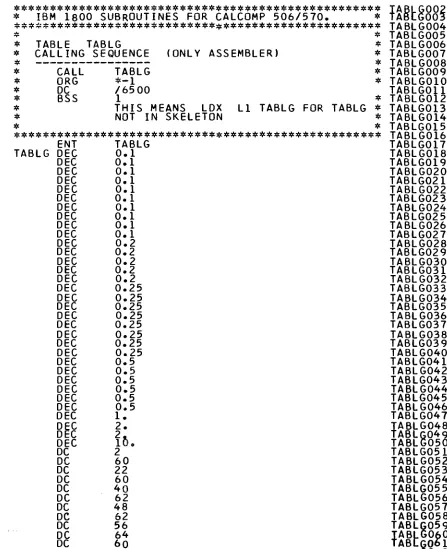
3. 11 TABLG
Entry point with calling sequence (only ASSEMBLER):
CALL TABLG
Subroutines called by TABLG: none
Core locations used: 82 (52 hexadec. )
Description:
3. 12 DXLG
Entry point with calling sequences:
CALL DXLG (SIZE, YMAXL, YMINL, DY, NT, K4, UNIT, JST)
Subroutines called by DXLG:
FLD/FSTO
FADD/FADDX/FSUB/
FSUBX/FSBR
FMPY
FDIV/FDVR
IFIX
FLOAT
FXPN
FLN
PRNTN
DMPHX
EXIT
TABLG
IBM 1800
l i b r a r y
Core locations used:
300 (12C hexadec. )
Description:
DXLG Subroutine DXLG determines from the input values
YMAXL and YMINL - previously calculated by MXMNL
or MXMLF - the p a r a m e t e r s DY, NT, K4, UNIT and
JST which are n e c e s s a r y to design a logarithmic axis
of the length SIZE. Then YMINL is recalculated as the
functional value assigned to the first tic m a r k .
The meaning of DY, NT, K4, UNIT and JST a r e the
following:
DY is the logarithm to the base 10 of the functional
increment per 1 cm of the chart paper.
UNIT is the length in cm for one decade. (UNIT = 1. /DY)
JST is an indicator for calculating UNIT.
F o r JST = 0
For JST / 0
UNIT
YMAXL-YMINL
SIZE
UNIT takes one of the values 27.
33
NT defines the type of logarithmic scale as shown in the following
table:
NT UNIT Type of logarithmic scale
1
2
3
4
5
6
7
8
> 27.
27. >
18. >
12. >
9. >
6. >
4. >
2. 5>
UNIT £
UNIT>
UNIT>
UNIT>
UNITS:
UNIT>
UNITS
18.
12.
9.
6.
4.
2. 5
1.
1. , 1. 1
, 1.9,2. , 2 . 2 , . . . , 3 . , 3.25,
, 5. , 5. 5, 6., 6. 5, 7 . , 7. 5 , 8 . , 9., 1.
1.8, 2. , 2. 25, . . . , 3. , 3.25, . . . , 4. ,
6. , 6. 5, 7. , 8 . , 1.
, 2. , 2. 5, 3 . , 3. 5, 4. , 4 . 5, 5. , 6. ,
4. , 4 . 2 5 , . .
1., 1.2, . . .
4. 5, 5. , 5. 5
1. , 1.25, . .
8. , 1.
1. , 1. 5,2. , 2. 5, 3. , 3. 5,4. , 5. , 7. , 1.
1. , 1. 5 , 2 . , 3 . , 5. , 7 . , 1.
1. , 2 . , 4 . , 6 . , 1.
1. , 3 . , 1.
1., 1.
For UNIT < 1. the following scales a r e plotted:
9 1 > UNITS 1/2 IO1, 10
1 + 1, 10
1 + 2,10 l / 2 > UNIT> 1/3 101, 101 + 2
, 1 0
1 + 4,
i+n . „i+2n
8+n l / n > UNIT> l/(N+l) IO
1, 1 0 , 10
1, . . . (n <; 6)
K4 is an index which indicates the position of YMINL in the table
of scales above.
Example: F o r NT = 5 and YMINL = 2. is K4 = 3, because 2. is
the third number in the scale for NT = 5.
If an e r r o r is detected, m e s s a g e and core dump a r e printed on
the 1443 p r i n t e r . This a r r i v e s for i n c o r r e c t input p a r a m e t e r s
(YMAXL > YMINL) or if JST=0 and UNIT < l / 7 .
3. 13 SCALG
Entry point with calling sequence:
CALL SCALG (SIZE, Y, N, K, YMINL, DY, NT, K4, UNIT, JST)
Subroutines called by SCALG:
F L D / F S T O
)F A D D / F S U B I B M 1 8 0 0
FMPY i l i b r a r y
FLN
'
MXMNL
DXLG
Core locations used:
98 (62 hexadec. )
Description:
SCALG Subroutine SCALG s e a r c h e s the maximum and minimum
value of N values contained in the a r r a y Y with step size
I O Q
K, i n c r e m e n t s them by 2 "
1 ώ° and calculates their loga
rithms (base 10). These r e s u l t s as well as SIZE and JST
serve as input when subroutine DXLG is called. DXLG
calculates the p a r a m e t e r s DY, NT, K4 and UNIT and c a l
culates the minimum and its logarithm and stores it in
YMINL. Finally SCALG r e p l a c e s the a r r a y Y by a new
one which may be directly plotted. The following formula
is used:
Y'(I)
log(Y(l))-YMINL
DY 35
3. 14 AXIS
E n t r y point with calling s e q u e n c e :
CALL AXIS (X, Y, SIZE, THETA, EBC, NO, YMIN, DY1, DL, NEXP)
Subroutines called by a x i s :
F L D / F L D X / F S T O / F S T O X
F A D D / F A D D X / F S U B
F M P Y / F M P Y X
F C O S N / F S I N
SNR
FDIV
IFIX
F L O A T
FAXI
FABS
P L O T
NUMBR
SYMBL
IBM 1800
l i b r a r y
Core l o c a t i o n s u s e d :
464 (1D0 h e x a d e c . )
D e s c r i p t i o n :
AXIS
Starting with the point (X, Y) s u b r o u t i n e AXIS d e s i g n s a
l i n e a r axis of the length SIZE in d i r e c t i o n THETA (in
1d e g r e e s ) to the p o s i t i v e X d i r e c t i o n . EBC d e t e r m i n e s
the l a b e l of the a x i s , it i s the l o w e r a d d r e s s of an a r r a y
containing NO c h a r a c t e r s in EBCDIC f o r m a t . F o r n e g a
tive NO l a b e l , t i c m a r k s and s c a l e n u m b e r s a r e d r a w n
on the negative side of the a x i s , o t h e r w i s e on the p o s i
tive side:
p o s i t i v e side
n°
Γ
^
>
0
n e g a t i v e side
P a r a m e t e r s YMIN, DY1, DL and N E X P should be p r e
viously c a l c u l a t e d by DXDY. YMIN i s the functional v a
lue of the begin of the a x i s , DL m e a n s the length in cm
between two t i c m a r k s , D Y l i l O ^ E X P ¿
sfoe functional
3. 15 AXLOG
Entry point with calling sequence:
CALL AXLOG (X, Y, SIZE, THETA, EBC, NO, YMINL, NT, K4, UNIT)
Subroutines called by AXLOG:
F L D / F L D X / F S T O / F S T O X
FADD/FADDX/FSUB/FSBR
FMPY/FMPYX
FCOSN/FSIN
SNR
IFIX
FLOAT
FXPN
FDIV
FLN
PLOT
TABLG
NUMBR
SYMBL
IBM 1800
l i b r a r y
Core locations used:
566 (236 hexadec. )
Description:
37
3.16 LINE
Entry points with calling sequences:
CALL LINE (X, Y, N, NX, NY)
CALL DASH (X, Y, N, NX, NY)
Subroutine called by LINE:
P L O T / P L T I RCore locations used: 72 (48 hexadec. )
Description:
The a r r a y s X and Y contain each N values with step sizes
NX and NY respectively. These N p a i r s of values a r e the
coordinates of N points.
3. 17 MARK
Entry point with calling sequence:
CALL MARK (X, Y, N, NX, NY, EBC)
Subroutine called by MARK: SYMBL
Core locations used: 58 (3A hexadec. )
Description:
- 39
3. 18 SCLIN
Entry points with calling sequences:
CALL SCLIN (X, Y, N, NX, NY, XMIN, DX, YMIN, DY)
CALL SCDAS (X, Y, N, NX, NY, XMIN, DX, YMIN, DY)
Subroutines called by SCLIN:
FLD/FSTO
FSUB
FDIV
P L O T / P L T I R
IBM 1800
l i b r a r y
Core locations used:
108 (6C hexadec. )
Description:
The subroutine s e a r c h e s N p a i r s of values in the a r r a y s
X and Y with step s i z e s NX and NY and p e r f o r m s the t r a n s
-formation:
XI =
X-XMIN
DX
andYl =
Y-YMIN
DY
The a r r a y s X and Y a r e not affected by the execution of
the subroutine.
SCLIN Subroutine SCLIN d r a w s a full line through the points
with the coordinates (XI, Yl).
SCDAS Subroutine SCDAS draws a dashed line through the points
with the coordinates (XI, Yl).
3. 19 S C L I F
E n t r y p o i n t s with calling s e q u e n c e s : E X T E R N A L C A L C F
C A L L S C L I F (X, Y, N, NX, NY, XMIN, DX, I F X , YMIN, DY, I F Y , C A L C F ) C A L L S C D A F (X, Y, N, NX, NY, XMIN, DX, I F X , YMIN, DY, IFY, C A L C F )
S u b r o u t i n e s c a l l e d by S C L I F : F L D / F S T O )
F S U B )IBM 1800 l i b r a r y FDIV )
P L O T / P L T I R C A L C F
C o r e l o c a t i o n s u s e d : 174 (AE h e x a d e c . )
D e s c r i p t i o n :
F o r IFX = IFY = 0 S C L I F w o r k s a s s u b r o u t i n e SCLIN. If one of t h e s e i n d i c a t o r s i s not z e r o the u s e r h a s to p r o v i d e a s u b r o u t i n e
S U B R O U T I N E C A L C F (VALUE, NI, IF)
w h e r e V A L U E i s the c a l c u l a t e d X o r Y v a l u e NI is an i n t e g e r r u n n i n g f r o m 1 to N and
I F h a s the v a l u e of I F X or I F Y depending on w h e t h e r \ A L U E is the c a l c u l a t e d v a l u e of the X o r Y c o o r d i n a t e .
The s u b r o u t i n e d e t e r m i n e s N p a i r s of v a l u e s e i t h e r f r o m the a r r a y X with s t e p s i z e NX if I F X = 0, r e s p e c t i v e l y Y with s t e p s i z e NY if I F Y = 0, o r by a u s e r - w r i t t e n s u b r o u t i n e C A L C F if IFX a n d / o r I F Y a r e not equal 0. T h e n the s u b -r o u t i n e p e -r f o -r m s t h e t -r a n s f o -r m a t i o n :
X I = X - X M I N DX a n d
Y l = Y-YMIN DY
The a r r a y s X and Y a r e not c h a n g e d by the e x e c u t i o n of the s u b r o u t i n e .
S C L I F S u b r o u t i n e S C L I F d r a w s a full l i n e t h r o u g h the N p o i n t s (XI, Y l ) ·
S C D A F S u b r o u t i n e S C D A F d r a w s a d a s h e d l i n e t h r o u g h the N p o i n t s (XI, Y l ) .
41
3. 20 SCMRK
Entry point with calling sequence:
CALL SCMRK (Χ, Y, N, NX, NY, XMIN, DX, YMIN, DY, EBC)
Subroutines called by SCMRK:
F L D / F S T O )
FSUB )
FDIV )
SYMBL
IBM 1800
subroutines
Core locations used:
92 (5C hexadec. )
Description:
SCMRK The subroutine s e a r c h e s N p a i r s of values in the a r r a y s
X and Y with step sizes NX and NY and p e r f o r m s the t r a n s
formation
XI =
X-XMIN
DX
andY l
Y YMIN
DY
The a r r a y s X and Y a r e not affected by the execution of
the subroutine.
Subroutine SCMRK m a r k s each point (XI, Yl) by the cha
r a c t e r defined by EBC (left-hand adjusted, EBCDIC format).
The centered symbols a r e specially provided for this sub
routine.
3. 21 SCMRF
Entry point with calling sequence:
EXTERNAL CALCF
CALL SCMRF (X, Y, N, NX, NY, XMIN, DX, IFX, YMIN, DY, IFY, CALCF,
EBC)
Subroutines called by SCMRF:
F L D / F S T O»
FSUE
'
FDIV
FSUB
i
IBM 1800 l i b r a r y
SYMBL
CALCF
Core locations used: 154 (9A hexadec. )
Description:
SCMRF For IFX = IFY = 0 SCMRF has the same function as SCMRK.
If one of these indicators is not zero the u s e r has to provide
a subroutine
SUBROUTINE CALCF (VALUE, NI, IF)
where VALUE is the calculated X or Y value,
NI is an integer running from 1 to N and
IF has the value of IFX or IFY depending on w h e t h e r
VALUE is the calculated X or Y coordinate. In this case
X a n d / o r Y a r e dummy p a r a m e t e r s .
The subroutine d e t e r m i n e s N p a i r s of values either from
the a r r a y X with step size NX if IFX = 0, respectively a r r a y
Y with step size NY if IFY = 0, or by a u s e r - w r i t t e n
routine CALCF if IFX a n d / o r IFY not equal 0. Then the
sub-routine p e r f o r m s the transformation:
V 1
_ X-XMIN
Yl
DX
Y-YMIN
DY
43
-3.22 SCLLG
Entry points with calling sequences:
CALL SCLLG (X, Y, N, NX, NY, XMINL, DX, YMINL, DY)
CALL SCDLG (X, Y, N, NX, NY', XMINL, DX, YMINL, DY)
Subroutines called by SCLLG:
F L D / F S T O )FADD/FSUB ) IBM 1800
FDIV ) l i b r a r y
FMPY )
F L N )
P L O T / P L T I R
Core locations used:
124 (7C hexadec. )
Description:
The subroutine s e a r c h e s Ν p a i r s of values from the
a r r a y s X and Y with step sizes NX and NY and p e r f o r m s
the t r a n s f o r m a t i o n
X I
Y l
log X-XMINL
DX
log Y-YMINL
DY
without changing the a r r a y s X and Y.
SCLLG Subroutine SCLLG connects the Ν points (XI, Yl) by a
full line.
SCDLG Subroutine SCDLG draws a dashed line through the Ν
points (XI, Yl).
3.23 SCMLG
Entry point with calling sequence:
CALL SCMLG (X, Y, N, NX, NY, XMINL, DX, YMINL, DY, EBC)
Subroutines called by SCMLG:
F L D / F S T O
FADD/FSUB
FDIV
FMPY
FLN
IBM 1800
l i b r a r y
SYMBL
Core locations used:
108 (6C hexadec. )
Description:
SCMLG The subroutine s e a r c h e s N p a i r s of values from the
a r r a y s X and Y with step sizes NX and NY and p e r
-forms the transformation
XI =
log X-XMINL
DX
_ log Y-YMINL
DY
without changing the a r r a y s X and Y.
45
-3.24 LINS C
Entry points with calling sequences:
CALL LINSC (X, Y, N, NX, NY, IX, XMIN.DX, IY, YMIN, DY)
CALL DASSC (X, Y, N, NX, NY, IX, XMIN, DX, IY, YMIN, DY)
Subroutines called by LINSC:
F L D / F S T O )
FADD/FSUB)
FDIV )
FMPY )
F L N )
IBM 1800
l i b r a r y
P L O T / P L T I R
Core locations used:
132 (84 hexadec. )
Description:
LINSC
DASSC
The subroutine s e a r c h e s N p a i r s of values from the
a r r a y X and Y with step sizes NX and NY and p e r
-forms the transformation
XI =
Yl =
X-XMIN
DX
Y-YMIN
DY
for IX = 0 or XI
for IY = 0 or Yl =
log X-XMIN
DX
for IX = 1
log Y-YMIN for IY = 1
DY
without changing the a r r a y s X and Y.
Subroutine LINSC draws a full line through the N points
(XI, Yl).
Subroutine DASSC d r a w s a dashed line through the N
points (XI, Yl).
3. 25 LINSF
Entry points with calling sequences: EXTERNAL CALCF
CALL LINSF (X, Y, N, NX, NY, IX, XMIN, DX, IFX, IY, YMIN, DY, IFY, CALCF)
CALL DASSF (X, Y, N, NX, NY, IX, XMIN, DX, IFX, IY, YMIN, DY, IFY, CALCF)
Subroutines called by LINSF:
F L D / F S T O
FADD/FSUB
FDIV FMPY FLN
IBM 1800 library
PLOT/PLTIR CALCF
Core locations used: 202 (CA hexadec. )
Description:
The subroutine determines N pairs of values either from the array X with step size NX if IFX = 0, respectively array Y with step size NY if IFY = 0, or by a user-writ ten subroutine CALCF if IFX and/or IFY not equal 0.
Then the subroutine performs the transformation:
„ . X-XMIN , T V _ V 1 log X-XMIN , T V .
XI = — for IX = 0 or X 1 = —b -—— for IX = 1
Y l Y-YMIN DY for IY = 0 or Yl = log Y-YMIN DY for IY = 1
without changing the arrays X and Y.
LINSF Subroutine LINSF draws a full line through the Ν points (XI, Yl).
DASSF Subroutine DASSF draws a dashed line through the Ν points (XI, Yl).
47
3. 26 MRKSC
E n t r y point with calling sequence:
CALL MRKSC (Χ, Υ, N, NX, NY, IX, XMIN, DX, IY, YMIN, DY, EBC)
Subroutine called by MRKSC:
F L D / F S T O
F A D D / F S U B
FDIV
FMPY
F L N
IBM 1800
l i b r a r y
SYMBL
Core l o c a t i o n s used:
116 (74 h e x a d e c . )
D e s c r i p t i o n :
MRKSC
The subroutine s e a r c h e s N p a i r s of v a l u e s from the
a r r a y s X and Y with step s i z e s NX and NY and p e r
f o r m s the t r a n s f o r m a t i o n
XI =
XXMIN
DX
for IX = 0 o r XI
log XXMIN
DX
for IX = 1
Yl =
YYMIN
DY
r
TV
η
τπ
log YYMIN
r TTrfor IY = 0 or Yl = —
&—■—
for IY = 1
without changing the a r r a y s X and Y.
3.27 MRKSF
Entry point with calling sequence:
EXTERNAL CALCF
CALL MRKSF (X, Y, N, NX, NY, IX, XMIN, DX, IFX, IY, YMIN, DY,
IFY, CALCF, EBC)
Subroutines called by MRKSF:
F L D / F S T O»
FADD/FSUB IBM 1800
FDIV
I
l i b r a r y
FMPY
FLN
SYMBL
CALCF
)
Core locations used: 18 0 (B4 hexadec. )
Description:
MRKSF The subroutine d e t e r m i n e s N p a i r s of values either
from the a r r a y X with step size NX if IFX = 0 , r e s
pectively a r r a y Y with step size NY if IFY = 0, or by a
u s e r - w r i t t e n subroutine CALCF if IFX and/or IFY not
0.
Then the subroutine p e r f o r m s the transformation
„ . X-XMIN ,
T V- „ . log X-XMIN ,
T V.
XI = — — for IX = 0 or XI = —
a— — for IX = 1
v
. Y-YMIN ,
T V n__. log Y-YMIN
.
Tv.
Yl = — for IY = 0 or Yl = —
°
— — for IY = 1
without changing the a r r a y s X and Y.
49
3. 28 DESSN
Entry point with calling sequence:
CALL DESSN (X, Y, N, NX, NY, M, MX, MY, SIZX, SIZY, EBCX, NOX,
EBCY,NOY,NC)
Subroutines called by DESSN:
F L D / F S T O )
FSUB )
IBM 1800 l i b r a r y
MXMN
DXDY
AXIS
SCLIN/SCDAS
SCMRK
Core locations used:
334 (14E hexadec. )
Description:
DESSN Subroutine DESSN produces a complete plot of M c u r v e s ,
each with N points, with a linear X-axis of the length
SIZX and a linear Y-axis of the length SIZY. Both axis
a r e starting at (0. , 0. ). The X-axis is labeled by NOX
c h a r a c t e r s given in ÈBCX, the Yaxis by NOY c h a r a c
-t e r s given in EBCY. If -the c h a r a c -t e r coun-t is nega-tive
tic m a r k s , scale n u m b e r s and label a r e drawn on the
negative side of the axis, otherwise on the positive
side.
The coordinates of the M curves a r e found in the following
way from the a r r a y s X and Y:
The first curve is determined by the a r r a y X and Y with
step sizes NX and NY. The s t a r t coordinates for the
follo-wing curves a r e found by incrementing the start a d d r e s s e s
(positions in the a r r a y s ) of the preceding curve by step sizes
MX and MY.
The meaning of NC is the following:
NC = 0 indicates that the points a r e connected by full lines,
NC = 1 indicates that the points a r e connected by dashed lines,
and NC = -1 indicates that the points a r e m a r k e d by centered
symbols, defined by the subroutine. The first curve is m a r k e d
by +, the second by x, the third by i , the fourth by Q and the
fifth by O · If t h e r e a r e m o r e than 5 curves the symbols a r e
repeated.
F u r t h e r m o r e if SIZY is negative the axis a r e not designed
and the scaling constants of the preceding plot a r e utilized.
This p e r m i t s to design s e v e r a l curves with different p a r a
-m e t e r s in one design.
3.29 DESNF
Entry point with calling sequence:
EXTERNAL CALCF
CALL DESNF (X, Y, N, NX, NY, M, MX, MY, SIZX, SIZY, FIX, IFY,
EBCX, NOX, EBCY, NOY, NC, CALCF)
Subroutines called by DESNF:
F L D / F S T O )
FSUB )
IBM 18 00 l i b r a r y
MXMNF
DXDY
AXIS
SCLIF/SCDAF
SCMRF
Core locations used:
340 (154 hexadec. )
Description:
DESNF For IFX = IFY = 0 subroutine DESNF has the same function
as DESSN.
If one of these indicators is unequal zero the u s e r has to
provide a subroutine
SUBROUTINE CALCF (VALUE NI, IF)
where VALUE is the calculated functional value,
NI is an integer running from 1 to N and
IF has the value of IFX or IFY depending on whether
VALUE is the calculated value of the X or Y coordinate.
For M g r e a t e r 1, MX a n d / o r MY is added to IFX r e s
-pectively IFY to define the second function for the second
curve etc.
- 51
Examples:
A:
The X-coordinates have the values 10. , 11. , 12. , . . .
If t h e r e is no place to store these values the following u s e r - w r i t t e n
subroutine may be used:
SUBROUTINE CALCF (VALUE, NI, IF)
DATA X0/9. /
VALUE = X0+FLOAT(NI)
RETURN
END
B:
The function Y = SIN(X) i EXP(X) is to be plotted.
The following statements fulfil the r e q u i r e m e n t s :
main p r o g r a m
EXTERNAL CALCF
CALL DESNF (0. , 0. , N, 0, 0, 1, 0, 0, SIZX, SIZY, 1, 2, EBCX,
NOX, EBCY, NOY, 0, CALCF)
subroutine
1 2 3
SUBROUTINE CALCF (VALUE,
COMMON DX
X = FLOAT
(NI-GOTO (1, 3), IF
VALUE = X
RETURN
VALUE = SIN(X)
GOTO 2
END
1)
i