ISSN Online: 2473-1900 ISSN Print: 2473-1889
Proposing a Meta-Heuristic Algorithm for
Enhanced Oil Recovery Using CO
2
Injection
Mohammadi Raheleh1, Hajnajafi Reza2
1Department of Chemistry, Tehran Centre branch of Islamic Azad University, Tehran, Iran 2Department of Petroleum Engineering, University of New South Wales, Sydney, Australia
Abstract
With the increased global demand for crude oil, the increased reservoir life-time, and the need for enhanced oil recovery methods, CO2 injection has
be-come an efficient choice. This paper aimed to determine optimal CO2
injec-tion choices using genetic algorithm, involving both optimized gas storage and enhanced oil recovery. There was no overlap between the objectives. Each was directly optimized and several optimal scenarios were developed at the same time. An advantage of this optimization method is that it is able to mod-ify production scenario according to variations in optimization parameter values.
Keywords
Gas Injection, Gas Storage, Enhanced Oil Recovery, Genetic Optimization Algorithms
1. Introduction
Enhancing oil recovery by CO2 injection has recently attracted much attention [1] [2]. Since many flooding fields are close to the end of their life, CO2 injection
has become an optimal choice. Gas or water drive methods usually leave 25% - 50% of oil in reservoirs [3]. A considerable portion of the remained oil can be recovered if oil contacts a miscible fluid. Such miscible fluid is formed through the combination of CO2 and oil under the desired conditions [4] [5]. Miscibility
eliminates capillary pressure as the cause of oil immobilization, thereby enabling oil to move towards production wells. CO2 is injected in both miscible and
im-miscible ways. It is used for both tertiary recovery (oil recovery after water injec-tion) and secondary recovery [6]. CO2 may be injected alone or in combination
with hydrocarbon gases and azoth. While immiscible dissolved CO2 injection
method has been used during the past years, miscible anhydride carbonic gas
How to cite this paper: Raheleh, M. and Reza, H. (2016) Proposing a Meta-Heuristic Algorithm for Enhanced Oil Recovery Using CO2 Injection. Open Journal of Yangtze Gas and Oil, 1, 47-58.
http://dx.doi.org/10.4236/ojogas.2016.13007
Received: August 9, 2016 Accepted: October 27, 2016 Published: October 30, 2016
Copyright © 2016 by authors and Scientific Research Publishing Inc. This work is licensed under the Creative Commons Attribution International License (CC BY 4.0).
injection is now the top choice. Miscible CO2 injection is appropriate for light
and medium oils, while immiscible injection is more suitable for heavy oils [7]. Environmental surveys suggest that CO2 constitutes around 64% of total
greenhouse gases and is the main factor in the increased earth temperature and the changed weather conditions. The reduction of greenhouse gases in the at-mosphere is a serious challenge in many industries such as oil and gas. Under-ground storage may be considered as an efficient technology for long-term sto-rage of CO2 emitted from such resources as fossil power plants. A method for
making storage process more economical is to link it to the enhanced hydrocar-bon recovery operation in hydrocarhydrocar-bon reservoirs [8]. CO2 injection is an
effi-cient method for enhanced oil recovery. While CO2 has been used for heavy oil
production, it may also be efficient for light oil [9]. Trivedi et al. (2005) explored optimal conditions for CO2 storage in oil reservoirs using numerical modeling.
In doing so, they studied the greenhouse gas sequestered during the enhanced tertiary oil recovery in western Texas using (CMG-GEM) simulator [10].
Babadagli (2006) investigated optimal conditions to achieve maximum oil production and CO2 storage using numerical modeling combined with a variety
of injection methods such as miscibility and gas injection [11]. Oruganti (2010) studied underground CO2 storage and investigated pressure build-up risks [12].
Finally, Goreki et al. (2012) analyzed the feasibility of CO2 storage process in an
oil reservoir [11] [13]. A global estimation suggests that 450 - 820 billion oil bar-rels and 130 - 240 gigatons of CO2 can be achieved by simultaneous enhanced oil
recovery and CO2 storage process [14], the aim of the present study is to
deter-mine the optimal CO2 storage and enhanced oil recovery by using genetic
algo-rithm.
2. Proposed Method
This study aimed to maximize CO2 storage and enhance oil production
simulta-neously using injection method. In doing so, we performed optimization process as follows. After developing reservoir model, we imaginarily demarcated the wells to prevent overlap between the affected areas. Next, we analyzed the sensi-tivity to determine the most influential parameters. We did so to determine the impact of objective function selection on parameters choice and to determine a suitable interval for parameter quantification during optimization process.
In single-objective approach, after determining the coefficients of storage and production functions according to decision maker, we selected an optimal sce-nario using genetic algorithm. In the developed approach as shown in mul-ti-objective section, we determined the technical objective function while ignor-ing the coefficients of storage and production functions. Thereafter, we designed non-dominated ranking genetic algorithm as an optimization algorithm.
of executions covered the biggest possible region in the studied area [15] [16].
2.1. Multi-Objective Optimization Process
Reflection on most scientific decision problems suggests that multiple objectives or criteria are involved. In the past, the majority of multi-objective optimization problems used to be studied as a single-objective problem due to the lack of effi-cient solutions [17] [18]. However, it should be noted that fundamental differ-ences exist in the nature of multi-objective and single-objective optimization al-gorithms. Solving multi-objective optimization problems by changing them into single-objective problems dates back to four decades ago. Since then on many algorithms have been proposed and many researchers have attempted to classify them based on various observations. In weighted sum model, user reduces mul-tiple objectives into a single one by multiplying them by a proposed weight. With respect to multiple objectives, this method is the simplest solution which comes into mind. For example, where target function consists of function 1 (en-hanced oil recovery) and function 2 (en(en-hanced gas storage), the conventional method makes optimization by maximizing the weighted sum of the functions. While this is a simple idea, it provokes the question that what values the user should use for the weights. Obviously, there is no general answer to this ques-tion. The weight of an objective is typically selected according to relative impor-tance of the objective in the problem. In most nonlinear optimization problems, a uniformly distributed collection of weight vectors does not necessarily lead to a uniformly distributed collection of Pareto optimal solutions. Since this mapping is typically unknown, it is difficult to achieve a Pareto optimal solution in a de-sired region of the objective space of weight vector. Also, different weight vectors do not necessarily lead to different Pareto optimal solutions. In nonlinear prob-lems, it is unclear which weight vectors lead to an optimal solution [17] [18].
2.2. Definition of Objective Function
The majority of objective functions defined and used in separate and simulta-neous investigations about enhanced oil recovery and CO2 storage processes are
on single-objective basis. The general formula of these functions is as follows:
2
Weigh 3 Weigh 1 Enhanced Recovery Process
Weigh 2 CO Storage Process
= ×
+ ×
The majority of cases have a coefficient of 0.5. For instance, Cosk (2004) de-fined an objective function as a combination of oil recovery and CO2 storage.
Jahangiri et al. (2010) proposed an objective function for simultaneous process of enhanced oil recovery and optimized gas storage. As with previous studies, they used the coefficient of 0.5.
2.3. Genetic Algorithm
objective functions. Next, we performed non-dominated sorting. According to the definition, A dominates C if it is not worse than C in any function and is better than it in at least one function. The population members were classified into several groups. The first group consisted of fully non-dominated members. The second group was dominated by the first group members, and this went on the same way in other groups. Every member in each group was allocated a rat-ing accordrat-ing to group number. The aim of multi-objective optimization process was to find Pareto solutions (non-dominated) for the problem. Oil production and gas storage were two objectives in the multi-objective optimization process using non-dominated ranking genetic algorithm. We computed population dis-tance parameter for each member in each group, which represented the disdis-tance of each sample to other members of the relevant group. Next, we selected parent population for reproduction and carried out mutation and intersection steps. Finally, we formed Pareto front, in which every answer was optimal [19] [20].
In this study, we utilized two optimization methods. The following represents single-objective and multi-objective optimization methods:
Single-Objective Algorithm 1. Building reservoir model
2. Zoning
3. Sensitivity analysis 4. Population analysis
5. Evaluation of population from the viewpoint of objective function 6. Selection of parent population
7. Intersection 8. Mutation
9. Going back to step 4 in case of disqualification 10. Optimal single-objective result
Multi-Objective Algorithm 1. Building reservoir model
2. Zoning
3. Sensitivity analysis
4. Determination of objective function 5. Selection of population
6. Evaluation of population from the viewpoint of objective function 7. Applying non-dominated sorting method
8. Computation of distance control parameter 9. Selection of parents population
10. Intersection 11. Mutation
12. Going back to step 6 in case of disqualification 13. Optimal multi-objective result
2.4. Model Description
the reservoir was 15 md and its porosity was 0.09. Horizontal-vertical permea-bility ratio was approximately 3. The empty space volume was 10.5 × 1010 ft3,
while initial oil phase saturation was 0.65. The reservoir included 20 × 20 × 20 grade blocks, out of which 3868 blocks were active. The average dimensions of each block in X, Y and Z directions were 830, 800 and 45 ft respectively.
3. Discussion
3.1. Optimization of Single-Objective Genetic Algorithm
We analyzed the parameters using Design Expert. The required time for opti-mizing oil recovery and CO2 storage using single-objective genetic algorithm in
continuous injection mode is 100 hours. The reservoir has been naturally ex-ploited for 10 years. The injection scenarios have begun from the beginning of eleventh year and will be continued for twenty years. In the meantime, influenti-al operating parameters are going to be optimized. The combination of objec-tives in single-objective genetic algorithm is essential.
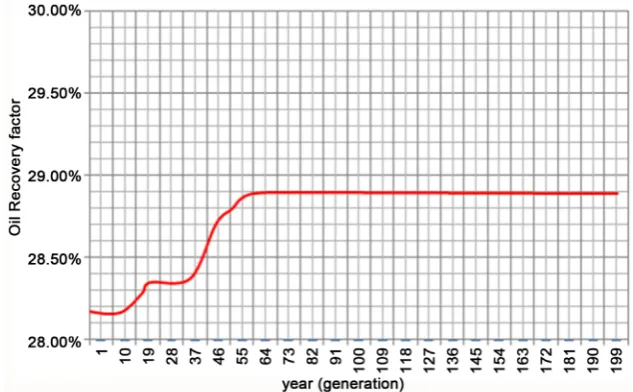
Since the mean value of objective function variations was smaller than 10−6 in
last generations, optimization stopped in 64th generation. The corresponding
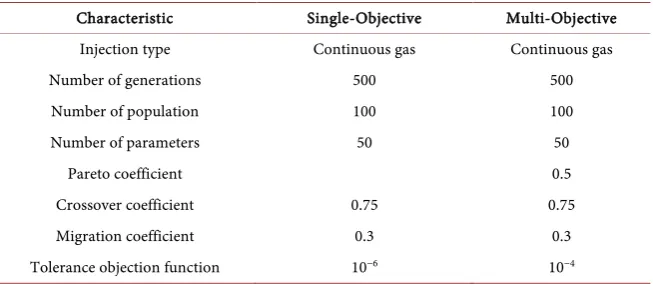
control parameters are shown in Table 1. Injection wells 2 and 3 are approx-imately located in oil zone and injection well 1 is fully located in water zone. In the case of variation in parameter values, the entire optimization process has to be repeated.
3.2. Optimization of Multi-Objective Genetic Algorithm
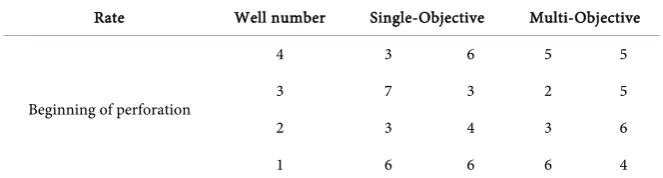
[image:5.595.213.540.590.732.2]In order to utilize non-dominated ranking multi-objective optimization method, we defined two objective functions for oil production value. We selected these objectives independent of theorem economy (technical function) and there was no need for scaling in contrast to single-objective method. The objectives were optimized independent of price fluctuations. In other words, the objectives were directly optimized in contrast to single-objective method where they are opti-mized indirectly (by help of net present value). The corresponding control pa-rameters are shown in Tables 2-7. In this approach, the optimized gas injection
Table 1. Characteristics of single-objective and multi-objective genetic algorithm used for
optimizing continuous CO2 injection process.
Characteristic Single-Objective Multi-Objective Injection type Continuous gas Continuous gas
Number of generations 500 500
Number of population 100 100
Number of parameters 50 50
Pareto coefficient 0.5
Crossover coefficient 0.75 0.75
Migration coefficient 0.3 0.3
Table 2. Oil production rate.
Rate Well Number Single-Objective Multi-Objective
Oil production rate × 500 (STB)
4 9 10 7 7
3 10 14 13 11
2 14 14 14 14
1 14 12 12 13
Table 3. Gas production rate.
Rate Well number Single-Objective Multi-Objective
Gas production rate × 1000 (MSCF)
3 12 18 18 14
2 17 18 18 17
[image:6.595.206.538.90.174.2]1 13 19 17 15
Table 4. Oil production perforation length.
Rate Well number Single-Objective Multi-Objective
Perforation length
4 4 4 4 4
3 5 4 4 4
2 3 4 4 4
[image:6.595.211.538.208.279.2]1 5 4 5 4
Table 5. Beginning of oil production perforation.
Rate Well number Single-Objective Multi-Objective
Beginning of perforation
4 3 6 5 5
3 7 3 2 5
2 3 4 3 6
1 6 6 6 4
Table 6. Beginning of injection well perforation.
Rate Well number Single-Objective Multi-Objective
Beginning of perforation
3 7 4 3 3
2 2 7 3 6
1 1 7 7 6
Table 7. Injection wells situation.
Rate Well number Single-Objective Multi-Objective
Injection wells situation
3 39 40 33 26
2 52 53 54 46
[image:6.595.209.540.312.398.2] [image:6.595.208.540.429.518.2]scenarios were classified into three groups. The first group consisted of optimal solutions in terms of maximized gas storage (oil was also optimized as far as possible). The third group consisted of optimal solutions in terms of maximized oil production. The second group related to ideal solutions in terms of max-imized objective without operating constraints. It should be noted here that all of these points are optimal from the viewpoint of multi-objective optimization process, but the distinguishing feature is the enhanced decision power under various operating conditions. The considerable point was the superiority of op-timal solutions in the third group over single-objective optimization solutions. In the third group, oil production increased by 1,500,000 barrels and CO2
sto-rage increased by 32 billion ft3. These comparisons were made under equal
con-ditions and without operating and economic constraints. Since multi-objective optimization method directly optimizes oil production and CO2 storage, one can
investigate different economic scenarios and select the best mode from among the existing solutions in each scenario. In practice, single-objective method is unable to achieve optimal solutions obtained from multi-objective optimization method. The first reason is that single-objective optimization method has to be executed for different weights, which would be costly and time-consuming in practice. In multi-objective optimization method, the required time for achiev-ing Pareto optimal solutions is 114 hours. The same takes around 1500 hours in single-objective method with the assumption that the weight of each function is known. The second reason is that the weights leading to optimal solutions are unknown.
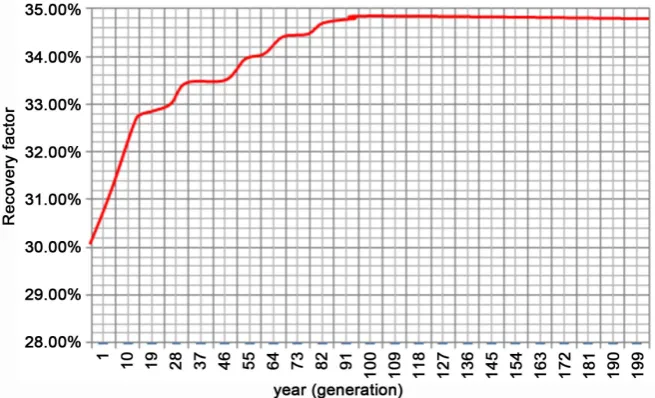
In order to determine the impact of continuous injection scenario on oil re-covery, we first optimized the model on single-objective and multi-objective bases. Figure 1 and Figure 2 illustrate the results.
In this study, we prepared seven samples of Iranian oil reservoirs using CO2
[image:7.595.214.531.518.714.2]injection method. Then we computed production rates of both recovery en-hancement methods, involving six parameters of porosity, permeability, gravity,
Figure 2. Improvement in multi-objective method in 200 generations.
viscosity, temperature and depth. Production rate is obtained from dividing the volume produced under direct influence of recovery enhancement process by total oil production volume (natural production + production obtained from enhanced recovery). This ratio represents the effectiveness of algorithm in the enhanced oil recovery process. We first had to develop a model with the ability to perceive the impact of reservoir parameters on oil production rate obtained from recovery enhancement methods. Then we selected six parameters as net-work input, with the output being the production rate obtained from recovery enhancement methods. Table 8 summarizes some of these samples and Figure 3
shows the effectiveness of the algorithm.
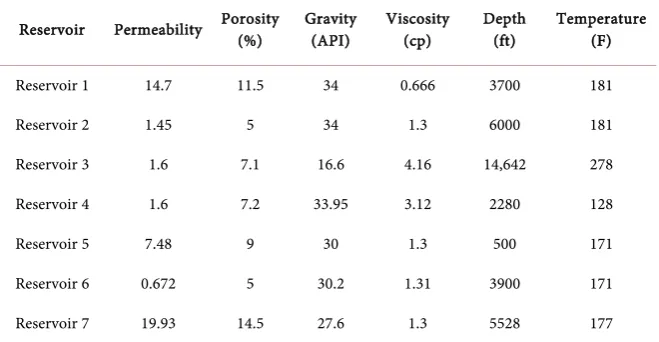
After studying the simulation results, we inputted the data of seven oil reser-voirs located in southwest of Iran into the algorithm and estimated recovery en-hancement share of each. Table 9 summarizes the statistical data of input para-meters together with estimated recovery enhancement shares and Figure 4 illu-strates the algorithm effectiveness on each reservoirs.
Figure 5 compares the data before and after the algorithm. As you can see, the algorithm is able to precisely predict the production rate obtained from recovery enhancement method. Thus, the proposed algorithm achieves the goal by find-ing recovery enhancement shares in which error function reaches its minimum.
4. Conclusions
Multi-objective optimization method, combined with non-dominated sorting
genetic algorithm, enhanced decision power under various economic condi-tions such as CO2 emission tax fluctuations. Storage becomes more important
as CO2 emission tax increases.
Multi-objective optimization method is more efficient than single-objective method. On this basis, oil production increased by 1,500,000 barrels and CO2
Figure 3. Improvement of seven simulated reservoirs.
Table 8. Parameters of seven simulated reservoirs.
Reservoir Permeability Porosity (%) Gravity (API) Viscosity (cp) Depth (ft) Temperature (F)
Reservoir 1 75 18 37 0.6 1900 105
Reservoir 2 30 17 35 0.6 1600 99
Reservoir 3 6 12.5 32 1 4900 110
Reservoir 4 3 10 32 2 5000 107
Reservoir 5 70 16 30 3 6200 115
Reservoir 6 63 15 38.5 2 7260 152
[image:9.595.210.540.517.688.2]Reservoir 7 63 15.2 38 2 7300 152
Table 9. Data of seven reservoirs located in the southwest of Iran.
Reservoir Permeability Porosity (%)
Gravity (API)
Viscosity (cp)
Depth (ft)
Temperature (F)
Reservoir 1 14.7 11.5 34 0.666 3700 181
Reservoir 2 1.45 5 34 1.3 6000 181
Reservoir 3 1.6 7.1 16.6 4.16 14,642 278
Reservoir 4 1.6 7.2 33.95 3.12 2280 128
Reservoir 5 7.48 9 30 1.3 500 171
Reservoir 6 0.672 5 30.2 1.31 3900 171
Reservoir 7 19.93 14.5 27.6 1.3 5528 177
Given that oil recovery has increased by 18%, CO2 injection method may
Figure 4. Improvement of seven reservoirs located in southwest of Iran.
Figure 5. Percentage of error in estimation of the enhanced recovery.
Multi-objective optimization method offers shorter optimization time than single-objective method does. As the result, it offers faster decision-making.
References
[1] Reza, H., Arman, A. and Ghazal, H. (2016) Comparative Study on Oil Recovery Enhancement by WAG Injection Technique in a Fractured Oil Reservoir in the Southwest of Iran. Journal of Petroleum & Environmental Biotechnology, 7, 263. [2] Alkhatib, A. and King, P. (2014) Uncertainty Quantification of a Chemically
En-hanced Oil Recovery Process: Applying the Probabilistic Collocation Method to a Surfactant-Polymer Flood. Computers & Geosciences, 18, 77-101.
https://doi.org/10.1007/s10596-013-9384-9
[3] Perez Rodriguez, S., Soto, B.R. and Soto, D. (2013) The Development of a New Me-thodology to Reduce Uncertainty in Implementing a New EOR Project. Interna-tional Petroleum Technology Conference, 26 March 2013.
[5] Jelic, V., de Bruyn, A.G., Mevius, M., Abdalla, F.B., Asad, K.M.B., Bernardi, G., Brentjens, M.A., Bus, S., Chapman, E., Ciardi, B., Daiboo, S., Fernandez, E.R., Ghosh, A., Harker, G., Jensen, H., Kazemi, S., Koopmans, L.V.E., Labropoulos, P., Bentum, M.J., Best, P., Falcke, H., et al. (2014) Initial LOFAR Observations of Epoch of Reionization Windows: Diffuse Polarized Emission in the ELAIS-N1 Field. Astronomy & Astrophysics, 568, 1-12.
[6] Switzer, E.R. and Liu, A. (2014) Erasing the Variable: Empirical Foreground Dis-covery for Global 21 cm Spectrum Experiments. The Astrophysical Journal. arXiv:1404.7561.
[7] Christman, P.C. and Gorell, S.B. (1988) A Comparison of Laboratory and Field- Observed CO2 Tertiary Injectivity. SPE/DOE Enhanced Oil Recovery Symposium,
Tulsa, 17-20 April 1988, Article No. 17335.
[8] Babadagli, T. (2006) Optimization of CO2 Injection for Sequestration/Enhanced Oil
Recovery and Current Status in Canada. In: Lombardi, S., Altunina, L.K. and Beau-bien, S.E., Eds., Advances in the Geological Storage of Carbon Dioxide, Springer, Houten, 261-270.
[9] Rahman, S., Nofel, W., Al-Majed, A., Arshad, A. and Menouar, H. (2010) Phase Behavior Aspects of Carbon Dioxide (COR2R) Miscible Flooding in Tight Cores: A Case Study. SPE 128467.
[10] Trivedi, J.J. and Babadagli, T. (2005) CO and Flue Gas Sequestration during Ter-tiary Oil Recovery: Optimal Injection Strategies and Importance of Operational Pa-rameters. Canadian International Petroleum Conference, Calgary, Alberta, 7-9 June 2005.
[11] Hamling, G.J.A., Klapperich, R.J., Steadman, E.D.N. and Harju, J.A. (2012) Energy & Environmental Research Integrating CO2 EOR and CO2 Storage in the Bell Creek
Oil Field. Carbon Management Technology Conference, Orlando, 7-9 February 2012.https://doi.org/10.7122/151476-MS
[12] Oruganti, Y.D. (2010) Geologic COR2R Storage: Understanding Pressure Perturba-tions and Estimating Risk Due to Pressure Buildup. The Faculty of the Graduate School of the University of Texas at Austin in Partial Fulfillment of the Require-ments for the Degree of Master of Science in Engineering.
[13] Samira, A.D., Mohammad, T., Mehdi, A.S. and Hamid, G. (2012) Designing Mul-ti-Objective Optimization Algorithm Combined with Biogeography Algorithm and Differential Evolutionary Algorithm. Intelligent Systems in Electrical Engineering, 3, 11-23.
[14] Wilkinson, J.R., Leahy-Dios, A., Teletzke, G.F. and Dickson, J.L. (2010) Use of COR2R Containing Impurities for Miscible Enhanced Oil Recovery. SPE 131003. [15] Triefenbach, F. (2008) Design of Experiments: The D-Optimal Approach an
Im-plementation as a Computer Algorithm. South Westphalia University of Applied Sciences, Iserlohn.
[16] Lawal, A.A. (2007) Applications of Sensitivity Analysis in Petroleum Engineering. The University of Texas, Austin.
[17] Konaka, A., Coit, D.W. and Smith, A.E. (2006) Multi-Objective Optimization Using Genetic Algorithms: A Tutorial. Reliability Engineering and System Safety, 91, 992- 1007.https://doi.org/10.1016/j.ress.2005.11.018
[18] Sbalzariniy, I.F., Ullery, S.M. and Koumoutsakosyz, P. (2000) Multi-Objective Op-timization Using Evolutionary Algorithms. Center for Turbulence Research. [19] Marler, R.T. and Arora, J.S. (2004) Survey of Multi-Objective Optimization
[20] Xie, Q., Li, S. and Yang, G. (2005) Studies on Fast Pareto Genetic Algorithm Based on Fast Fitness Identification and External Population Updating Scheme. Chinese Academy of Science, Beijing.
Submit or recommend next manuscript to SCIRP and we will provide best service for you:
Accepting pre-submission inquiries through Email, Facebook, LinkedIn, Twitter, etc. A wide selection of journals (inclusive of 9 subjects, more than 200 journals)
Providing 24-hour high-quality service User-friendly online submission system Fair and swift peer-review system
Efficient typesetting and proofreading procedure
Display of the result of downloads and visits, as well as the number of cited articles Maximum dissemination of your research work
Submit your manuscript at: http://papersubmission.scirp.org/