Kleiter, G.D. and Fugard, Andrew J.B. and Pfeifer, N. (2018) A process model
of the understanding of uncertain conditionals. Thinking & Reasoning 24 (3),
pp. 386-422. ISSN 1354-6783.
Downloaded from:
Usage Guidelines:
Please refer to usage guidelines at
or alternatively
Full Terms & Conditions of access and use can be found at
http://www.tandfonline.com/action/journalInformation?journalCode=ptar20
ISSN: 1354-6783 (Print) 1464-0708 (Online) Journal homepage: http://www.tandfonline.com/loi/ptar20
A process model of the understanding of
uncertain conditionals
Gernot D. Kleiter, Andrew J. B. Fugard & Niki Pfeifer
To cite this article: Gernot D. Kleiter, Andrew J. B. Fugard & Niki Pfeifer (2018): A
process model of the understanding of uncertain conditionals, Thinking & Reasoning, DOI: 10.1080/13546783.2017.1422542
To link to this article: https://doi.org/10.1080/13546783.2017.1422542
© 2018 The Author(s). Published by Informa UK Limited, trading as Taylor & Francis Group
Published online: 16 Jan 2018.
Submit your article to this journal
Article views: 155
View related articles
A process model of the understanding of uncertain
conditionals
Gernot D. Kleitera, Andrew J. B. Fugardband Niki Pfeiferc
aDepartment of Psychology, Universit€at Salzburg, Salzburg, Austria;bDepartment of
Psychosocial Studies, School of Social Sciences, History and Philosophy, Birkbeck, University of London, London, UK;cMunich Center for Mathematical Philosophy,
Ludwig-Maximilians-Universit€at M€unchen, Munich, Germany
ABSTRACT
To build a process model of the understanding of conditionals we extract a common core of three semantics of if-then sentences: (a) the conditional event interpretation in the coherencebased probability logic, (b) the discourse processingtheory of Hans Kamp, and (c) the game-theoretical approach of Jaakko Hintikka. The empirical part reports three experiments in which each participant assessed the probability of 52 if-then sentencesin a truth table task. Each experiment included a second task: An n-back task relating the interpretation of conditionals to working memory, a Bayesian bookbag and poker chip task relating the interpretation of conditionals to probability updating, and a probabilistic modus ponens task relating the interpretation of conditionals to a classical inference task. Data analysis shows that the way in which the conditionals are interpreted correlates with each of the supplementary tasks. The results are discussed within the process model proposed in the introduction.
ARTICLE HISTORYReceived 20 June 2016; Accepted 4 December 2017
KEYWORDSUncertain reasoning; conditionals; conditional events; coherent probabilities; n-back task
For nearly thirty years I have been vainly trying to convince them that this assumed invariable equivalence between a conditional (or implication) and a disjunctive is an error. (MacColl,1908)
Introduction
Between the 1950s and the 1990s, the psychology of reasoning distinguished deductive and inductive reasoning. Deductive reasoning was oriented at clas-sical logic. The best-known experimental paradigm from this time is the Wason Selection Task. Inductive reasoning was considered to be part of deci-sion theory and judgement under uncertainty. At the end of the previous
CONTACT Gernot D. Kleiter [email protected], [email protected]
© 2018 The Author(s). Published by Informa UK Limited, trading as Taylor & Francis Group
millenium,“probability”entered the research on human reasoning. A special 1993-issue of the journalCognitionis a witness of the beginning of a cross-talk between “reasoning” and “decision-making” research (Johnson-Laird & Shafir,1993). Researchers (Chater & Oaksford,1999,2001; Oaksford, Chater, & Larkin,2000) started to model human reasoning in terms of probabilities and not in terms of traditional logic. Researchers (Chater & Oaksford, 1999; Oaksford & Chater,2007) proposed an account of syllogistic reasoning in line with an interpretation of conditionals in terms of the conditional probability. A group around Evans and Over (Evans, 2003; Evans & Over, 2004; Evans, Handley, & Over,2003; Over & Evans,2003; Hadjichristidis, Over, Evans, Han-dley, & Sloman,2005) published a series of studies on the human understand-ing of indicative conditionals, if–then sentences. They found that the majority of participants interpreted the probability of a conditional as a conditional probability and not as the probability of a material implication. Influenced by the work of de Finetti and the modern extensions of de Finetti's theory of sub-jective probability (Biazzo & Gilio,2000; Coletti & Scozzafava,2002; de Finetti,
1995,1972,1974), Kleiter and Pfeifer proposed to model human reasoning by probabilistic versions of nonmonotonic reasoning (Pfeifer, 2002; Pfeifer & Kleiter,2003,2005). In Fugard, Pfeifer, Mayerhofer, and Kleiter (2011) and Pfei-fer and Kleiter (2005a, 2007), we observed that humans interpret indicative conditionals predominantly as conditional events. Not only indicative condi-tionals were found to be interpreted as conditional events. There is also evi-dence that human reasoning aboutcausalandcounterfactualconditionals is consistent with the conditional event interpretation (Over, Hadjichristidis, Evans, Handley, & Sloman,2007; Pfeifer & Stockle-Schobel,€ 2015). Conditional events also turned out to be important for developing a new rationality framework forcategorical syllogisms (Gilio, Over, Pfeifer, & Sanfilippo,2017). This highlights a tight connection of reasoning about quantified statements and reasoning about conditionals. It was shown that the conditional event interpretation accounts for concessive conditionals (Even if A, then still C) (Skovgaard-Olsen, Singmann, & Klauer,2016). For an extensive overview of the psychology of conditionals and conditional reasoning, see Nickerson (2015).
Thus, the study of conditionals started a paradigm shift in human reason-ing, a shift from classical two-valued logic to probability and probability logic (Elqayam & Over,2012; Pfeifer,2013; Pfeifer & Douven,2014). Why condition-als and why probability?
Probabilitybecause every-day reasoning is uncertain. It is a requirement of ecological validity. Classical logic cannot provide the relevant ques-tions, hypotheses, experimental tasks, or benchmarks for uncertain reasoning.
Within the many interpretations of probability, it is quite natural to favour the subjective approach, that is, an approach in which probabilities are conceived as degrees of belief, as properties of the content of a cognitive system of a reasoner or decision-maker.1
The conditional in the coherence approach
The probabilistic paradigm of reasoning is closely related to the coherence approachin probability theory. This approach goes back to de Finetti (1964,
1974) and his theory of subjective probability. It was and is further developed in three scientific communities: (i) In thecoherencegroup (Coletti & Scozza-fava,2002; Lad,1996), (ii) in theimprecise probabilitygroup (Augustin, Colen, de Cooman, & Troffaes,2014; Walley,1991), and (iii) in a group of logicians working onprobability logic(Adams,1975; Jeffrey & Edgington,1991; Kleiter,
in press; Stalnaker & Jeffrey,1994). In the coherence approach, the conception of a conditional event and of conditional probability differs from the corre-sponding conception in standard theories of probability; it differs especially from the conception in the Kolmogorov approach (Kolmogoroff,1977).
The non-probabilistic and the probabilistic paradigms of reasoning differ (i) in the way in which the premises and the conclusions of an inference are rep-resented, (ii) in the way in which they are valuated, and (iii) in the way in which the quality of inferences is evaluated. The non-probabilistic approach represents, on the background of classical logic, the premises and the conclu-sions bypropositions. The propositions are valuated by binarytruth values, T and F. The inferences are classified asvalidornonvalid.
The probabilistic approach conceives the premises and the conclusions of an inference asevents. Events are valuated by the indicator values0 and 1, that is, by numbers. The numbers may be multiplied by probabilities, the products may be summed up, and thusfinally lead to an expected value. The expected value of the indicators of an event is called itsprevision(Augustin et al.,2014; Coletti & Scozzafava, 2002; de Finetti,1974; Walley, 1991). The indicators areuncertain quantities (de Finetti,1974; Gilio & Sanfilippo,2013; Stalnaker & Jeffrey, 1994). In the literature, propositions and indicators are
often denoted by the same symbols, e.g., when we readE= 1 orE¼02. For the discussion of the semantics of conditionals, the distinction between truth values and indicator values can be helpful, however. We will writeIEorIHfor the indicators ofEandH, respectively. Propositions are logical entities; events, and especially conditional events, are mathematical entities. In the probabilis-tic approach, the quality of inferences is evaluated by one of several different forms ofcoherence.
In many situations, a person considers some propositions and has only
incomplete knowledgewhether they are true or false. The person may, how-ever, make anassumption3about the truth of an event.
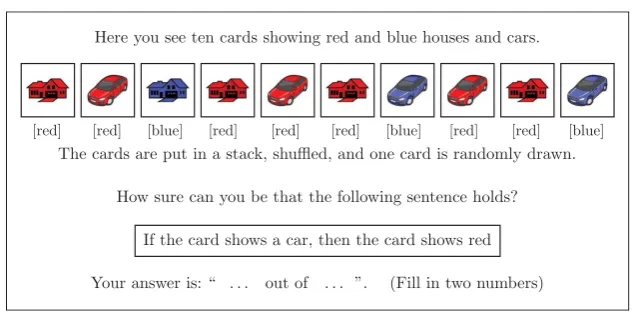
To keep the following sections less abstract, we introduce the example shown inFigure 1. A set of similar tasks will be used in the empirical part of the paper. The response format of the task requires to assess a probability in the form of an“Xout ofY”response. The frequencies of the objects and col-ours are selected so that different interpretations of the conditional corre-spond to differentX¡Ypairs. In the example shown inFigure 1, the answer “8 out of 10”corresponds to a material implication“3 out of 10”to a conjunc-tion, 4 out of 10 to a biconditional, and“3 out of 5”to a conditional event, etc. Using the notation inTable 1, this corresponds to (a+c+d)/n,a/n, (a+d)/n, anda/(a+b), respectively.
The uncertainty of a conditional event is operationalised by a bet onE|H: You win ifH andEare true, you lose ifH is true butEis false, you get your money back ifHturns out to be false (the bet is annulled) (Table 2).
Here you see ten cards showing red and blue houses and cars.
The cards are put in a stack, shuffled, and one card is randomly drawn.
How sure can you be that the following sentence holds?
If the card shows a car, then the card shows red
[image:6.442.62.379.47.205.2]Your answer is: “ . . . out of . . . ”. (Fill in two numbers) [red] [red] [blue] [red] [red] [red] [blue] [red] [red] [blue]
Figure 1.A task that allows to identify your interpretation of an if–then sentence. On the computer screen, the objects are shown in colour; here they are written in brackets below the objects.
2We write both:
EandEfor the negation andE^HandEHfor the conjunction.
3Thomas Bayes introduced conditional probabilities by suppositions:“Hence, of two subsequent events, the probability of thefirst bea
N, and the probability of both together P
N, then the probability of the second, on the supposition that thefirst happens isP
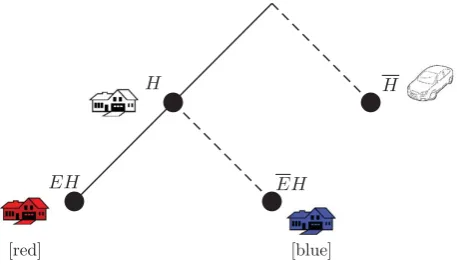
A conditionalE|Hrepresents a person's knowledge aboutE assuming Hto be true. The truth value of a conditional event isTRUEif bothHandEare true,
[image:7.442.82.360.84.126.2]FALSE if H is true and E is false, and “undetermined” if H is false (compare
Figure 2). The logical status of the“undetermined”valuation of a conditional has given rise to discussions. An early paper of de Finetti (1995) may have contributed to this misunderstanding. Speaking of a“defective truth table”, e.g., is misleading. Also, saying false antecedents are“irrelevant”is not right as the“money-back”valuation is of course relevant. Baratgin, Over, and Polit-zer (2013) proposed to use the term“uncertain”instead of“undetermined”. In fact, if the antecedensHis false, then the truth value of the conditional event
E|His substituted by the value of the conditional probabilityP(E|H). In terms of the betting metaphor, this corresponds to the“money back”condition. But of course, the“third”value is not a truth value, but a probability. Mathemati-cally, these relationships are represented by linear spaces and handled by
Table 1.Identification of the interpretation of the conditional in the exam-ple inFigure 1by an X-out-of-Y response: Conditional eventa/(a+b), con-junctiona/n, material implication (a+c+d)/n, biconditional (a+d)/n.
Red Blue P
Car a= 3 b= 2 a+b= 5
House c= 4 d= 1 c+d= 5
P
a+c= 7 b+d= 3 n= 10
Table 2.Valuation of the conditional event E|H.IH,IE, andIE|Hdenote the indicator values of the eventsHandEand of the conditional eventE|H.
IH IE IE|H Bet
1 1 1 Win
1 0 0 Lose
0 P(E|H) Money back
H H
EH EH
[image:7.442.107.336.445.577.2][red] [blue]
linear equations. In the equations, the coefficients are either the indicator val-ues 0 and 1 (replacing the truth valval-ues“true”and“false”) or conditional prob-abilities (jumping in for the unknown truth values of the conditional event in the case the antecedent is false). Formally, the truth-value of a conditional event becomes a random variable; it is not a logical entity anymore.
For an easy-to-comprehend explanation of many of the psychologically rel-evant aspects of the truth values of conditionals and conditional bets, the reader is referred to Over and Baratgin (2017) and to Politzer, Over, and Barat-gin (2010). More mathematically, Lad (1996) gives an introduction to probabi-listic inferences with conditional events with the help of systems of linear equations and linear and fractional programming. The logical side of the interpretation of conditionals as random variables is outlined in an excellent article by Stalnaker and Jeffrey (1994) in the Festschrift for Adams. Stimulating is also an early paper of Jeffrey (1963).
The vertical bar“|”is not a propositional operator. Conditionals cannot be nested or iterated like conjunctions or disjunctions. The conjunction of two conditionals, (E|H)^(G|K), for example, is not a proposition. The vertical bar is a mathematical operator that applies to the indicator values of events, i.e., to 0 and 1, and not to truth values. Conditionals may be nested or iterated if the indicator values are combined with probabilities; degrees of belief are then measured by previsions in conditional random quantities. (Biazzo, Gilio, & Sanfilippo, 2009; Gilio & Sanfilippo, 2013; Gilio, Pfeifer, & Sanfilippo, (2016; Stalnaker & Jeffrey,1994; Sanfilippo, Pfeifer, & Gilio,2017; Sanfilippo, Pfeifer, Over, & Gilio,2018; Van Wijnbergen-Huitink, Elqayam, & Over,2015).
The expected value or, equivalently, theprevisionof a conditional bet is a real number,
EðifH thenEÞ ¼IEH¢uðwinÞ þIEH¢uðloseÞ þIH¢uðprice of the betÞ: (1) Here,u(¢) denotes the utility of winning, of losing, and of the price of the bet, respectively. If the utilities are normalised withu0(win) = 1,u0(lose) = 0, andu0
(price of the bet) =u(price of the bet)/[u(win)¡u(lose)] =P(B|A), the prevision becomes a real number in the interval [0, 1],
EðEjHÞ ¼IEH¢1þIEH¢0þIH¢P Eð jHÞ: (2)
A person has adegree of beliefabout the truth ofEunder the assumption that
His true. The degree of belief may be modelled in a psychological theory by a subjectiveconditional probability P(E|H).
In the example (Figure 1), the probabilities of the various events are esti-mated by the relative frequencies of the according cards. So if the probability of a conditional is assessed by the“X-out-of-Y”format, its probability is simply
Pðif HthenEÞ ¼X
Y: (3)
conditional from XandY. In the construction of the tasks,it is important to choose the frequencies of the different cards such thatone and only one inter-pretation from a set of alternative interinter-pretations can be inferred.
The conditional event interpretation provides a formal logico-mathemati-cal model of the understanding of conditionals. To explain thehuman under-standing of conditionals, the model should be placed into a cognitive “environment”. There are three ways in which this can be accomplished: (i) To give the conditional event interpretation a more procedural flavour, (ii) to connect it with other theories of the conditional, and (iii) to study empirically its relationship to other cognitive functions. Below we willfirst propose a pro-cedural version of the conditional event interpretation. We will then highlight the close relationships to other theories, andfinally report the results of three experimental studies.
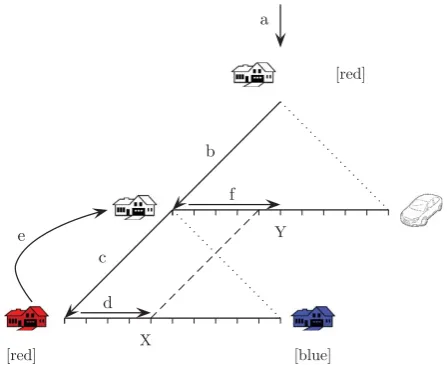
So let us start with the procedural process model. If people have enough time, think carefully, and try to do their best, then they interpret an if–then sentence by the following sequence of steps. The steps are shown inFigure 3.
a. Identify the referents.Identify the typicalreferentsof the antecedent and the consequent. In our example, these are two cards, one showing the shape of a house and one showing the colour red. The shape and the colour are represented in two masks and stored in working memory.
“If the card shows a house, then the card shows red.”
X
Y a
b
c
d e
f
[red]
[image:9.442.99.323.349.534.2][red] [blue]
b. Focus on the antecedent.In one or more passes, the attention scans the universe of the ten images with the mask for the antecedent. The posi-tions of some or all images that match the mask are stored in the work-ing memory.
c. Focus on the conjunction.The masks for the antecedent and the conse-quent are overlayed so that a new mask represents theconjunctionof the antecedent and the consequent.
d. Scan.Count the cases where the conjunction mask matches the instan-ces. The count will be the“X”in thefinal“X-out-of-Y”response.
e. Fix the interpretation.The conjunction and the antecedent are related to each other in the following steps:
Mark as suppositional:mark the antecedent as“hypothetically true”; the hypothetically true cases become the updated universe.
Reprocess the antecedent:turn back to step b and count the number of cases matching the mask of the antecedent and store the count as Y,
f. Re-standardise.Relate X, the count of the conjunctions, to Y, the count of the antecedents. This is comparable to a“zooming-in”on the proba-bility of the antecedent. All cases not verifying the antecedent arefi l-tered out and removed.
g. Search for counterexamples. Especially, in an unfamiliar setting, check the assessments, e.g., by scanning the complements of the antecedent or the consequent.
h. Respond.X out of Y.
If the if–then sentence is interpreted as a conjunction, then the loop (e) in
Figure 3turns back to the original universe with all the ten cards. There is no zooming-in on the set of cases verifying the antecedent.
We next show how the process model relates to two theories on the condi-tional, to the discourse representation theory of Kamp and Reyle and to the game theoretical approach of Hintikka and Carlson.
Discourse representation theory
connectives–like the conditional–provides a rich framework for a more cog-nitive approach to the human understanding of conditionals.
Take as an example the conditional“If the card shows a car, then the card shows red”. It connects the two sentences “the card shows a car” and “the card shows red”. In terms of Kamp's and Reyle's schemes of discourse representation, the following two boxes correspond to the respective two sentences:
x y card(x)
car(y) x shows y
and
u v
card(u) red(v) u shows v
x and u refer to one and the same card. Thecardin the consequent refers to the same card as in the antecedent; it functions as an anaphora. y and v denote the referentscarandred. InFigure 3, the referents are represented in step (a) at the top of thefigure. The representation of the conditional takes the antecedent sentence and supposes it to be verified. The first sentence conveys thesupposition“The card shows a car”. In the process model, this cor-responds to step (e),mark as suppositional.
The box below shows the next steps in Kamp's and Reyle's discourse repre-sentation theory. Both sentences are processed together as indicated in the interior box on the right hand side.“It is only the sentence pair…as a whole which makes a claim, a claim to the effect that if the information carried by thefirst sentence is correct then so is the additional information carried by the second”(Kamp & Reyle,1993, p. 142). In the process model, this corre-sponds to step (c),focus on the conjunction.
x y
card(x) car(y) x shows y
⇒
x y u v
card(x) car(y) x shows y
u = x red(v) u shows v
“…thefirst sentence … describes a hypothetical situation; the second sen-tenceextendsthe description of that situation; and the sentencepairasserts that if a situation is of thefirst kind it is also of the more fully specified second kind”(Kamp & Reyle,1993, p. 142) The“)”denotes thehypothetical relation
The conditional builds a relation between the suppositional antecedent (indicated by the interior box on the left-hand side, corresponding to step (b) in the process model) and the conjunction (indicated by the interior box on the right-hand side, corresponding to step (c) in the process model). When we add a probabilistic valuation to each of the two interior boxes, these valua-tions mirror just the Y- and X-values of steps (d) and (e) in our model, the probability of the conjunction,P(E^H), and the probability of the antecedent,
P(H). The probability of the conditional is just the ratio of the two valuations. The discourse representation model4of Kamp and Reyle invites the proce-dural interpretation of the conditional as presented in the process model.5It also gives a hint how the interpretation by a conjunction may result. If the antecedent is not reprocessed in an extra pass, then only the conjunction on the right-hand side of the scheme remains. Neglecting the supposition in the antecedent results in a conjunction. In terms of the frequencies of the various kinds of cards in the example, thered carsare selected but not related to the number ofcarsbut to the number of allcards.
Game theory
Hintikka and Carlson (1979) and Hintikka (1983) introduced a game-theoreti-cal semantics of conditionals. It is closely related to the conditional event interpretation. After pointing to the inadequacies of the material implication (the game G.), Hintikka proposed an interpretation of the conditional (G. cond1) in terms of two games, thefirst one on the antecedent, the second one on the consequent. There are two players, You and Nature. A conditional is true if and only if for all winning strategies onH, there exists a winning strat-egy onE.“... a winning strategy for the defender ofif H then Eis a function which maps every winning strategy for the defender of H onto a winning strategy for the defender ofE”(Hintikka & Carlson,1979) [changed notation]. In the game-theoretic paradigm, conditionals are also non-classical three-val-ued trievents:“If G(S) [the game on the conditional sentence S] is indetermi-nate (if neither player has a winning strategy), S is neither true nor false” (Hintikka & Carlson,1979, p. 181).
The tree inFigure 4shows the extensive form of a game and matches the
figures in Hintikka and Carlson (1979, p. 184) and Hintikka (1983, p. 53). For each winning strategy in the game onH, there must be a correlated winning strategy onE. To make sure that we consider all winning strategies onH, the players, Nature and You, change roles. If You canfind a falsification
4The more complex version extends the treatment to cases with anaphoric referents that may handle examples like“If he likes it, then Jones owns the Buddenbrooks”.
5
ofH, that is, if, with the changed roles, You can show that Nature loses the game onH, then the overall game on the conditional stops.E“…comes into play only when and afterHhas been verified, and its role will hence naturally depend on the way in whichH turned out to be true” (Hintikka & Carlson,
1979, p. 185) (notation changed).z denotes the set of winning strategies on
H. With changed roles,ξ denotes the set of falsification strategies onH.hare the losing strategies onE.F(z) is a mapping from the set of winning strategies onHinto the winning strategies ofE(technically, a function on a function, i.e., a functional).“…the existence of a functionalFwhich takes us from a suc-cessful strategy in verifyingHto a successful strategy in verifyingE”(Hintikka & Carlson,1979, p. 186). Moreover, the game-theoretic paradigm shows paral-lels to the betting metaphor of de Finetti's coherence approach. One differ-ence between the logical and the probabilistic game is that in a logical game the outcome is binary, You win or lose, while in the probabilistic game, the outcome is an uncertain quantity.
The game-theoretical semantics of conditionals offers many psychologi-cally interesting aspects. The representations in extensive form “… capture the dynamics of natural language semantics” (Hintikka & Carlson, 1979, p. 183) and the proceduralflow of the semantic information. The back and forth of verifying and falsifying instances reminds us of thesearch for counter-examplesin Johnson-Laird's model theory. Johnson-Laird (2006, p. 213, note
You pay
−[λ1·P(EH) +λ2·P(EH) + 0·P(H)]
H H
Nature loses Money back
+[λ1·P(EH) +λ2·P(EH) + 0·P(H)]
E
You lose
λ2
E
You win
λ1
ξ ζ
η
Φ(ζ)
Figure 4.Bet on a conditional: You buy the bet for the price of
λ1¢P EHð Þ þλ2¢P EH þ0¢P H
. If you win, you getλ1; if you lose, you getλ2. IfH
213 on p. 463) refers to Wittgenstein's language games and to Hintikka. Unfortunately, however, he does not refer to the work of Hintikka and Carlson (1979) in which these authors criticise the material implication and present a game-theoretic semantics that coincides with the conditional event interpre-tation. Reasoning often proceeds by inner speech in which dialogues are sim-ulated. Arguments are tested by virtual examples and counter-examples. For a highly stimulating source, see van Benthem (2014).
The amount bet on a conditional event corresponds to a random variable. Assume you know the absolute probabilitiesP(H),P(EH), andP EH . What is your conditionalprobability P(E|H)? While Kolmogorov introduced P(E|H) by definition, that is, by fiat, P(E|H) = P(EH)/P(H) (provided that P(H) > 0), de Finetti derived it from the avoidance of a Dutch book, that is from avoiding losing for sure (Coletti & Scozzafava, 2002; Kleiter, 1981; Pfeifer & Kleiter,
2009). Assume you are willing to pay the pricebfor the bet on the conditional eventE|H;bis conceived as the expected value (or the safety equivalent)
b¼λ1P EHð Þ þλ2P EH þ0P H : (4)
The right-hand side is rewritten byλ1£P(H)P(E|H) +λ2P(H)(1¡P(E|H) orP(H)[P (E|H)(λ1¡λ2) +λ2]. Here,P(E|H) is the unknown term. Solving forP(E|H) gives
P Eð jHÞ ¼P EHð Þλ1þP EH λ2P Hð Þλ2 P Hð Þðλ1λ2Þ :
(5)
Standardising the payoffsλ1= 1 andλ2= 0 giveP(E|H) =P(EH)/P(E). The condi-tional probability is coherent if and only if it satisfies the ratio formula. We note that the conjunction plays an important role in the game-theoretic semantics. It corresponds to winning two bets, the bet onHand the bet onE
givenHis true. Also, the search for counterexamplesfits nicely into a game-theoretic approach.
To summarise. The interpretations of conditionals in several different tradi-tions and approachesconverge: probability logic (Jeffrey & Edgington, 1991; Stalnaker & Jeffrey, 1994), the coherence approach to probability theory (Augustin et al., 2014; Coletti & Scozzafava, 2002; Walley, 1991), discourse processing (Kamp,1984; Kamp & Reyle,1993), and game-theoretic semantics (Hintikka,1983; Hintikka & Carlson,1979). We take the loosely bundled com-monalities as a process model of the human understanding of conditionals.
Motivation and goals
sequence of steps which taken together build a scheme for the processing of uncertain conditionals. Moreover, we have argued that the conjunction inter-pretation involves only a subset of these steps. To stop too early lures a con-junction interpretation. The first stop on the path to a conditional event interpretation that provides a complete interpretation leads to the conjunction.
In a previous experiment (Fugard et al.,2011), we observed that about 70% of the participants interpreted if–then sentences as conditional events and about 25% as conjunctions. The process model makes a number of predic-tions about differences between the conditional event interpreters and the conjunction interpreters. In the present investigation, we will (i) use a similar method as in our previous experiment to classify conditional event and con-junction interpreters and we will (ii) introduce several additional procedures to test the predictions of the process model.
In the following sections, we report three experiments. In all three experi-ments, theCard Taskwas administered. The Card Task consisted of a series of 52 truth table tasks, each one similar toFigure 1, and presented one by one on a computer screen. The Card Task improved the Die Task which was used in our previous experiment (Fugard et al.,2011). In addition, each experiment included a second task: a working memory task in Experiment 1, a probabilis-tic modus ponens task in Experiment 2, and a Bayesian updating task in Experiment 3. We made the following predictions:
(1) Response time. The conjunction interpretation requires only the first steps of the process model. Thus, the model predicts that conditional event interpretations take more time than conjunctions. The Card Task was computer controlled; the computer measured the response times. (2) Working memory. The assessment of the probability of a conditional
requires to move forward and backward on the path to a full condi-tional event interpretation (compareFigure 3). Cognitive tags must be set and retrieved. The cognitive organisation and handling of such tags is ascribed to the functions of working memory. A task which measures the efficiency of such a process is then-back task. It requires the contin-uous updating of memory content. Process management is more important than the merecapacityor buffer size. Persons who systemati-cally interpret conditionals as conditional events are predicted to show better n-back performance than persons who give conjunction interpretations.
(4) Bookbag and poker chip task.One of the classical tasks in the psychol-ogy of judgement under uncertainty and decision-making is the book-bag and poker chip task (Phillips & Edwards,1966). It investigates the sequential updating of probabilities by Bayes’ theorem in the light of new evidence. We expect that participants who give predominantly conditional event interpretations in the Card Task give probability assessments that are closer to the Bayesian probabilities in the bookbag and poker chip task.
(5) Object/colour first. The example in Figure 1 visualises the antecedent and the consequent of the if–then sentence by objects and features. We speculated that conditionals in which the antecedent is an entity (like a house or a car) and the consequent is a feature (like the colour red or blue) are easier to process than in the other way round (Kleiter,
1986). In our previous study (Fugard et al., 2011), we observed, how-ever, that the feature–entity order facilitated the conditional event interpretations. Can the result be replicated?
Methods
Participants
We investigated a total of 240 participants in three experiments. In the Experi-ments 1 (N= 80), 2 (N= 100), and 3 (N= 60), the participants were students at the University of Salzburg. In none of the experiments, students of psychol-ogy, mathematics, or philosophy and logic were tested. In all three experi-ments, half of the participants were male and half were female.
Card task
The Card Task consisted of 52 tasks, each one similar to the introductory example inFigure 1. Consider the sentence“If the card shows a house, then the card shows red”. Using the notation of Table 1, we have for the condi-tional event“aout ofa+b”, the conjunction“aout ofn”, the material implica-tion:“a+c+dout ofn”, for the biconditional“a+dout ofn”, etc. The total number of cards (n= 10) was held constant for all 52 tasks, while the values ofa,b,c, anddwere chosen so that the different main interpretations (condi-tional event, material implication, conjunction, reverse condi(condi-tional event, biconditional, defective biconditional) coulduniquelybe identified. This is an important improvement of the Die Task used in our previous study (Fugard et al.,2011).
presentation of the main task, a detailed and thorough computer controlled instruction was given. To support the understanding of randomness, an ani-mation demonstrated the shuffling of the cards. Four interactive examples with absolute probabilities made sure that the participants understood the response format and the handling of the keyboard.
There were four kinds of objects,cars, houses, birds, and fishes, drawn in one of four colours,red, green, yellow, and blue. Three example packs were shown with different numbers of objects and colours.
The sequence of 52 tasks was presented to each participant, each task on a new screen. Each screen showed 10 cards in one row and the text (in German)
The cards get shuffled. A random card is drawn. How sure can you be that the following statement holds?
If the card shows a house, then the card shows red.
The conditional sentences were presented in a box to make the scope of the question clear. Each presentation contained ten cards with two objects and two colours, pseudo-randomly ordered. At the bottom of the screen, the question for the assessment of the probability was presented; the response format asked for the input of two numbers,“X out of Y”. The idea of using the “X-out-of-Y”response format for investigating the probabilistic assessment of conditionals was introduced in Politzer et al. (2010), Fugard et al. (2011) and Barrouillet and Gauffroy (2013). Each task corresponds to a truth table task,
first used by Evans et al. (2003) and by Oberauer and Wilhelm (2003).
The background of the screen was black. Before each task, the screen showed afixation cross. Responses, that is, the probability assessments, were given on a specially prepared keyboard. All keys except ten in each of the two top rows were removed from a standard keyboard. The empty slots were covered. On the keys in the two top rows, the numbers from 1 to 10 were written.
Two response times,T1andT2, were measured by the computer, one for thefirst number (the X) and one for the second number (the Y) in“X out of Y”. In all three experiments, for one half of the participants, the object was in the antecedent and the colour in the consequent of the conditionals (object– colour order). For example:“If the card shows a car, then the card shows red”. For the other half, the colour was in the antecedent and the object in the con-sequent (colour–object order). For example:“If the card shows red, then the card shows a car”.
object–colour conditions and to one of the four presentation orders depended on the number of the participant obtained as he/she arrived at the lab. It was controlled by a computer program, not by the experimenters. In each experiment, gender and the object–colour order were balanced as in a two-by-two design with equal cell frequencies.
The Card Task was administered individually in a quiet room in the lab of the department. The display was a 1900screen. In Experiments 1 and 2, the experimenter was male, and in Experiment 3, the experimenter was female. At the end of Experiment 1, the participants rated the confidence that their assessments were correct and the difficulty of the tasks. The participants were paid 5 Euros for their participation.
Results
Each of the 240 participants answered the 52 questions of the Card Task by an “X-out-of-Y”assessment, allowing to infer a total of 12,480 interpretations of the if–then statements.Table 3shows the overall frequencies of the different interpretations.
With nearly 70%, the conditional event interpretation was the interpreta-tion given most often, followed by the conjuncinterpreta-tion with about 20%, and a few material implications and biconditionals.
We classified each participant by the interpretation he/she gave most often, that is, by the participant'smodal assessment; 76.67 % of the 240 partic-ipants gave predominantly conditional event interpretations, 22.08 % con-junction interpretations, and .01 % other interpretations.
We analysed the data by a Bayesian linear regression model. We used the Markov chain Monte Carlo R-packageMCMCglmm(Hadfield,2016a; Malsburg,
2017; R Development Core Team,2016). For an introduction to this method, see the tutorial (Hadfield,2016b) and the paper (Hadfield,2010); for the back-ground of the Monte Carlo simulation method and its application in the Bayesian approach, see Robert and Casella (2010), Sorensen and Gianola (2010), Fitzmaurice, Davidian, Verbeke, and Molenberghs (2009), Diggle, Heagerty, Liang, and Zeger (2002).
Wefirst focused on the conditional event interpretation (yes/no), a binary dependent variable. The independent variables were the threefixed-effects
positionof the task (1, ..., 52), the presentation order object/colour
[image:18.442.60.381.572.605.2]versuscolour/object, andgender. The participants entered the model as a random factor. The four different presentation orders of the 52 tasks
Table 3.Number of interpretations of the 240£52 = 12, 480 conditionals.
Conditional event Conjunction Material implication Biconditional Other Total
8499 2686 17 77 1201 12,480
were ignored. We used a saturated log-linear model. Stochastic simulation was done with 50,000 iterations and 1000 burnins. The vector of prior means was set to zero for thefixed effects and the variances in the precision matrix were set to 10, inducing aflat multivariate prior.
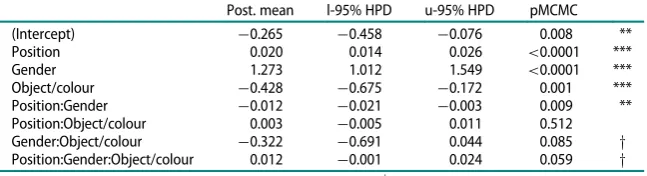
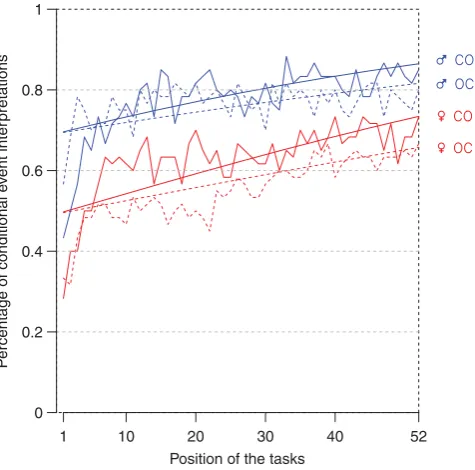
Table 4presents the results of the logistic regression analysis. Conditional event interpretations were encoded byyes=1and no=0 so that the inter-cept of¡0.265 logits corresponds to a“ground level” of 43.4% conditional event interpretations at the theoretical (!) position zero at the beginning of the sessions. Thepositioneffect adds cumulatively 0.020 logits at each of the 52 task positions. This contributes¡0.265 + 52£0.020 = 0.775 logits or 68.5% to the level at the end of the sessions.Figure 5shows the observed rel-ative frequencies of the conditional event interpretations together with the predictions obtained by thepredictfunction of MCMCglmm.
It is obvious that in the course of the sessions, the frequency of conditional event interpretations increased. Without any feedback, in a self-correcting process, the participants“learnt”to interpret the if–then sentences as condi-tional events. They more and more eliminated other interpretations and con-verged towards the interpretation predicted by the process model.
Female participants were encoded by0and male participants by 1. The
gendereffect adds 1.273 logits for male persons and is a strong effect. Origi-nally, the factorgenderwas included in the experimental design as a control variable. There are many factors which may have led to the observed gender differences, for example, motivational factors or differences induced by the educational system. A cognitive explanatory factor might be that higher fre-quency of conjunctive interpretations by female participants results from a stricter interpretation of conditionals. However, simply evenly dividing partici-pants by gender is not strong enough to support any of these speculations. There are multiple potential confounds. Our methodology is not strong enough to discount the possibility that possibly multiple confounds exist. The results do not allow to claim that genderby itself has an effect. We refrain Table 4.Logistic regression analysis of the conditional event interpretation. All three experiments combined (N= 240). Posterior means and lower and upper bounds of the 95% highest-posterior-density (HPD) intervals in logits of the coefficients. Colons denote interactions.
Post. mean l-95% HPD u-95% HPD pMCMC (Intercept) ¡0.265 ¡0.458 ¡0.076 0.008 ** Position 0.020 0.014 0.026 <0.0001 *** Gender 1.273 1.012 1.549 <0.0001 *** Object/colour ¡0.428 ¡0.675 ¡0.172 0.001 *** Position:Gender ¡0.012 ¡0.021 ¡0.003 0.009 ** Position:Object/colour 0.003 ¡0.005 0.011 0.512 Gender:Object/colour ¡0.322 ¡0.691 0.044 0.085 y Position:Gender:Object/colour 0.012 ¡0.001 0.024 0.059 y
from an attempt to give a psychological interpretation of the statistical results.
Participants in the colour-first group were encoded by0, participants in the object-first group by 1. The negative object/feature effect subtracts 0.428 logits from the level for the object-first order. This means, quite contrary to the original hypothesis of Kleiter (1986), that the conditional event inter-pretation was facilitated by the colour-first order. Originally, we supposed that it is easier to process an entityfirst and only then its features and not the other way round. In the experiment, however, it seems the colour of the objects is easier to identify than the shape of the objects, which in turn sup-ports the conditional event interpretation.
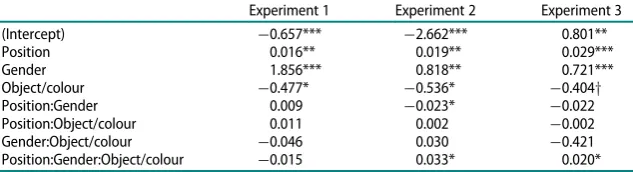
Highly similar results are observed in each of the three experiments.Table 5
shows the posterior means and the significance levels of the three separate analyses. Thepositionand thegendereffects are significant in all three experiments. The object/colour first is significant in the first two experiments and nearly significant in the third one (pMCMC = .0522).
Does the Card Task induce more conditional event responses than the Die Task used by Fugard et al. (2011)? Do the improved methods increase the number of conditional event interpretation? Yes, in the present study with
1 10 20 30 40 52
Position of the tasks 0
0.2 0.4 0.6 0.8 1
P
ercentage of conditional e
v
ent inter
[image:20.442.104.342.52.287.2]pretations
the Card Task, the median was 88% conditional event interpretations per par-ticipant, and in the previous study with the Die Task, the median was 72%.
Pfeifer (2013) argued that conjunctive responses may result from a strict
interpretation of the conditional. Here, the participants“... evaluate thetruth
(and not theprobability) of a conditional. Both, the conditional eventC|Aand the conjunctionA^C are trueifA andC are true. However, both are strictly speakingnot trueif:A(thoughC|A may be trueif:A). Thus, if the participants read the instruction such that the experimenter wants to know in which cases the conditional is strictly speaking true, then the task cannot differentiate between the conjunction and the conditional event interpretation”.Pfeifer (2013) considers also the possibility that conjunctive responses result from matching. The process model proposed in the present paper explains con-junctive responses in a very similar way as proposed by Evans and Over (2004), namely by incomplete processing. Jubin and Barrouillet (2017) showed that framing the tasks in the context of the probability of the six sides of a die may in part explain conjunctive responses. The reduced frequency of conjunctive responses in the present experiments (referring to 10 different cards) as compared to our previous study (referring to the six sides of a die) (Fugard et al.,2011) may in part be explained by this proposal.
To summarise. The conditional event interpretation was the prevailing interpretation of the conditional. A minority of the participants gave conjunc-tion interpretaconjunc-tions. There were no other systematic and stable interpreta-tions. This replicates the originalfindings of Evans et al. (2003) and the results of Fugard et al. (2011).
Change point analysis
[image:21.442.65.382.84.170.2]Fugard et al. (2011) observed that a number of participants experience a sud-den insight (Aha-Erlebnis) after which in the course of an experiment, the interpretation shifts from non-conditional to conditional event interpretation. For the present data, we performed the same Bayesian change-point analysis (Tan, Tian, & Ng,2010). We used a uniform prior probability of a change at Table 5.Logistic regression analyses of the conditional event interpretation separately for Experiments 1, 2, and 3, respectively. The numbers are the means of posterior distri-butions of the logistic regression coefficients. Colons denote interactions.
Experiment 1 Experiment 2 Experiment 3 (Intercept) ¡0.657*** ¡2.662*** 0.801**
Position 0.016** 0.019** 0.029***
Gender 1.856*** 0.818** 0.721***
positioni,i= 1,…, 52, that is, withP(i) = 1/52 = .01923. We determined the posterior probability distribution for a change point after task 4 and before task 50 and considered a position with a posterior probability greater than .20 as a change-point. This corresponded to a Bayes factor of about 10 (0.2/ 0.01923 = 10.4). Overall, 44 out of 240 participants (18.3 %) showed a signifi -cant change-point.All participants with a change-point shifted to a conditional event interpretation. These participants had the feeling that the conditional event interpretationfits the understanding of the task.
Response time
The process model predicts longer response times for conditional event than for conjunction interpretations. InFigure 3, the conditional event interpreta-tion requires six steps while the conjuncinterpreta-tion interpretainterpreta-tion requires only the
first three ones. Moreover, we predicted that during the course of the 52 tasks, the participants will employ a more and more stable response strategy that can be used “blindly”. This saves affords of testing and checking the responses before the responses are actually made. It reduces the search for counterexamples and inner dialogues. Based on the game theoretic seman-tics outlined in the Introduction, we predict decreasing response times in the course of the 52 tasks.
For each task, two response times were measured by the computer, one for the X and one for the Y response in the X-out-of-Y assessments. For data evaluation, both times were added.
The statistical analysis was again done with the MCMCglmm package
(Had-field,2010), now with the response time as the dependent variable. We used a saturated model with the factorsposition, gender, and object/col-ouras in the previous logit analysis and included theinterpretationas an additional factor. Theinterpretationfactor had the two levels
con-ditional eventandconjunction;otherinterpretations were treated
as missing and not included.
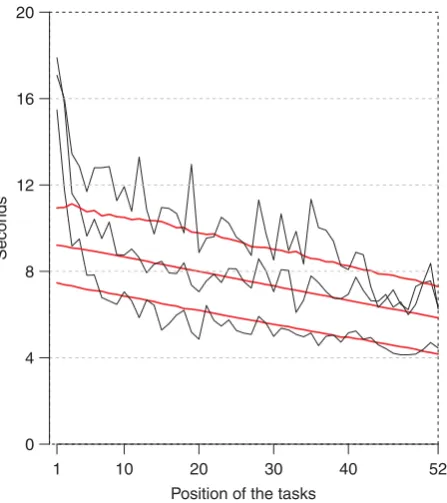
Table 6presents the posterior means and the lower and upper values of the 95% highest-posterior-density (HPD) intervals of the regression coeffi -cients for the significant effects.Figure 6shows the observed and the pre-dicted mean response times for the 52 positions of the tasks. ForFigure 6, the
otherinterpretations were included for the prediction analysis.
The main effectspositionandinterpretation, and the interaction
gender:object/colourfirstare significant with pMCMC<0.001. Simi-lar results were observed in the separate analyses for each of the three experi-ments. In Experiment 1, theintercept, theposition and thegender
was significant; in Experiment 2, two interactions were significant on the 0.05 level. In Experiment 3, the gender:interpretation:object/colour
interaction was significant on the 0.001 level.
[image:23.442.60.383.128.179.2]Two predictions of the process model were supported: (i) conjunction interpretations are faster than conditional event interpretations and (ii) decreasing response times during the experimental sessions.
Table 6.Regression analysis of the response times. All three experiments combined (N= 240). Only the significant effects of a saturated four-factorial analysis involving the factors
position, theinterpretation,genderandobject/colourare reported
in the table. Theinterpretation factorhas two levels only, conditional event interpretation and conjunction; other interpretations are treated as missing data. Poste-rior means and lower and upper bounds of the 95% highest-postePoste-rior-density (HPD) intervals in seconds. The colon denotes the interaction.
Post. mean Low-95% Up-95% HPD pMCMC (Intercept) 7964.792 7597.442 8344.865 0.0001*** Position ¡69.325 ¡82.181 ¡57148 0.0001*** Interpretation 2235.854 1886.106 2577.619 0.0001*** Gender:Object/colour 1205.437 399.972 2001.615 0.002** ***pMCMC0.001, **pMCMC0.01.
1 10 20 30 40 52
Position of the tasks 0
4 8 12 16 20
Seconds
[image:23.442.111.335.312.564.2]Post-experimental performance-ratings
At the end of Experiment 1, the participants rated the confidence of correct responses and the difficulty of the task. Ratings between 1 and 7 were used, 7 meaning high confidence and high difficulty, respectively; the mean confi -dence was 4.107 (sd = 1.754), the mean difficulty was 1.201 (sd = 1.464).
Biserial correlations between the performance ratings and modal responses are shown inTable 7.
Participants predominantly giving conditional event interpretations (modal responses) were more confident that their responses were correct than partic-ipants giving not conditional event interpretations. They rated the tasks as not especially difficult. Participants predominantly giving conjunction inter-pretations tended to be uncertain about the correctness of their assessments. The participant's“theory”of the understanding of conditionals is in line with the theory of the present paper.
2-Back task
Individual differences in reasoning tasks and working memory correlate (Uns-worth,2015). The interpretation of conditionals is a highly relevant ingredient of inferential reasoning. Is there a correlation between the interpretation of conditionals and working memory capacity (WMC)?
The model ofworking memorywas originally introduced by Baddeley and Hitch (1974). In more than 40 years, the model has changed considerably. Unsworth (2015) characterises WMC as a multifaceted capability that is domain-general and independent of the difficulty of the involved tasks. The multifaceted capabilities include the scope of attention, the control of atten-tion, primary and secondary memory, and the protection against interference. WMC is seen as the combination of these functions.
Practically, all models of the human understanding of conditionals predict a relationship with WMC: the theory of mental models predicts that a fully
fleshed-out interpretation of a conditional requires higher WMC than an initial interpretation. The Kamp and Reyle discourse model requires higher WMC for conditionals than for conjunctions. Similar predictions may be derived from the game-theoretic model of Hintikka and Carlson. Finally, the process model shown inFigure 3requires to store the intermediate results and to manage the sequence of the steps in a well-organised way.
Table 7.Rating scales in Experiment 1: point biserial correlations between participants giving most often conditional event interpretations (CE) or giving most often conjunction interpretations (CON), on the one hand, and their confidence ratings of being correct and their difficulty ratings, on the other hand, respectively.
r(CE, confidence) r(CON, confidence) r(CE, difficulty) r(CON, difficulty)
To investigate the relationship between the interpretation of conditionals and WMC, we included in Experiment 1 a procedure to measure WMC. We used a 2-back task (Garcia-Madruga, Gutierrez, Carriedo, Luzon, & Vila,2007; Greenspan & Segal,1984; Kane, Conway, Miura, & Colflesh,2007; Lewandow-sky, Brown, & Thomas,2000; Logan,1994; Oberauer & Wilhelm,2000; Szmalec, Verbruggen, Vandierendonck, & Kemps,2011), where a good performance requires a high degree of attention and control to keep track of the serial order of a stream of digits. It also involves primary memory span and protec-tion against interference.
Method
The 2-back task was run on a computer and controlled by a Python (Van Ros-sum and the Python Software Foundation, 2008) program which was sup-ported by the PyGame library (Shinners,2011). The task was presented on a 1900screen.
The task consisted of a sequence of 144 test trials. On each trial, a digit between 1 and 9 appeared in the middle of the screen. Each trial began with a centredfixation cross displayed for 1000 ms after which it was replaced by a centred numeral for 500 ms;finally, the screen was cleared for the remain-ing 2000 ms, givremain-ing participants a total of 2500 ms to respond. Participants had to decidewhether the currently presented numeral was the same as the numeral seen two steps backin the sequence. They were asked to press a YES or a NO button on a response box. The task included also 1-back and 3-back lure trials where the currently presented numeral matched the numeral one step or three steps back in the sequence. In total, there were 18 2-back tar-get trials, 9 1-back lure trials and 9 3-back lure trials. The session began with 10 practice trials with feedback to ensure participants understood the task. Of the 144 digits presented, there were 108 non-target non-lure trials. Response times were measured by the computer.
The responses were also classified as hits, misses, false alarms, correct rejections, silent on foils (no response at a NO-trial within thefixed time win-dow), and silent on target (no response at a YES-trial). All participants of Experiment 1 were administered the 2-back task after den Card Task.
Results
.004, intercept 3.285, posterior mean =¡1.208, 95% highest-posterior-den-sity (HPD) interval [¡2.041,¡0.419]).
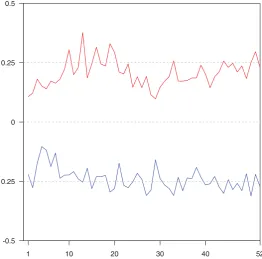
Figure 7shows the 52 biserial correlations between the conditional event interpretation and (i) the number of correct rejections and (ii) the number of lure-3 responses in the 2-back task. Although most absolute values are low (below .3), the coefficients are eitherallpositive (correct rejections) orall neg-ative (lure-3). Despite the involved variables are not independent, this sup-ports the hypothesis of a relationship between WMC and the interpretation of conditionals. We performed the same analysis for the conjunction interpre-tations. For the conjunction, the values are distributed approximately sym-metrically around a mean of zero.
The participants have some knowledge how good they were in the 2-back task. In the rating scales administered after the 2-back task,confidence of being correctcorrelates with the hit rate (.31) and negatively with the false alarm (¡.27). The confidence rating in the 2-back task correlates with the rating for difficulty (¡.51). We did not observe a significant relationship between the response times in the 2-back task and the Card Task.
1 10 20 30 40 52
-0.5 0.25 0 0.25 0.5
Discussion
The results show a relationship– although a weak one–between the inter-pretation of conditionals and working memory. The n-back task measures in thefirst line control processes of the working memory (Kane et al.,2007). The lure-3 score and the score for the correct rejections are not indicators of the capacity of working memory in the sense of buffer size. Kane et al. (2007) have argued, for example, that the n-back task and the span of working mem-ory correlate only weakly. A low lure-3 score is an indicator that a participant is able to block competing but inappropriate content. Low lure-3 and high correct rejection scores show efficient protection against interference and distractions.
The process model inFigure 3requires a stepwise processing: the repre-sentation of the antecedent, the reprerepre-sentation of the pair (antecedent, con-sequent), going back to the antecedent, counting and relating the intermediate results in the X-out-of-Y assessment, etc. Keeping track of this sequence presupposes the multifaceted capabilities of working memory – working memory not in the sense of a buffer but in the sense of the interfer-ence model of Oberauer, Lewandowsky, Farrell, Jarrold, and Greaves (2012). Moreover, in their interference model, a lure-3 response in the 2-back task may result from a mismanagement of setting relative position markers in a serial stream of items. This does also not involve buffer size or decay of mem-ory traces but the assignment and removal of markers to items. This explains as the“common cause”the correlation between the lure-3 score and the con-ditional event interpretation.
Probabilistic modus ponens task
The modus ponens
FromfH;H!EginferE
is the most important inference rule in logic. It has often been studied in human reasoning and has been found to be endorsed by practically all peo-ple. We give the major premiseH! Ea conditional event interpretation so that its uncertainty is expressed by a conditional probability. The probabilistic version of the modus ponens is then given by Pfeifer and Kleiter (2005b), Pfei-fer and Kleiter (2009)
FromfP Hð Þ ¼a;P Eð jHÞ ¼bg inferP Eð Þ2½ab;1aþab: (6)
The lower and upper probabilities of the conclusion may be derived from the theorem of total probability,P Eð Þ ¼P Hð ÞP Eð jHÞ þP H P E jH, whereP E jH
is not given and may thus have any value between 0 and 1.
In Experiment 2, we included a probabilistic modus ponens in whichP(H) is imprecise. Most experimental inference tasks in the probabilistic approach to human reasoning involve precise (point) probabilities of the premises. In real life, however, the uncertainty of the premises is usually imprecise. Imprecision may be modelled mathematically by interval probabilities or by second order probability distributions. For an example of the application of second-order distributions, see the analysis of the pseudodiagnosticity task of Michael Doh-erty in Tweney, DohDoh-erty, and Kleiter (2010) and Kleiter (2015).
Method
To each of the 100 participants of Experiment 2, a series of 18 probabilistic modus ponens tasks was administered. The presentation of each task was computer controlled by a program written in Python (Van Rossum and the Python Software Foundation, 2008) and supported by the PyGame library (Shinners,2011). Each of the 18 tasks was presented on a 1900screen. The text and the schematic pictures of the cards were nicely positioned on the screen. The task was administered after the Card Task.
Here is a stack of 20 cards. 12 cards are red, 8 are blue. (A series of 12 red and 8 blue rectangles was shown in one row). You shuffle the cards carefully. Now you take thefirst 10 cards (empty white cards were shown) one by one and do the following:
If the card is red, then you draw aflower on it.
Now you put the 10 cards back into the original stack and shuffle the 20 cards again carefully. You draw one card randomly. How sure are you that the card shows aflower (approximately is sufficient)?
At the bottom of the display, response buttons from 0% to 100% in steps of 5 % were shown. The response was selected by a mouse click on one of the 21 buttons.
For 26 participants,five tasks were presented two times. We discarded the response to the second presentation.
Assuming identical and independent sampling and assuming that no
flower is drawn on a blue card, the expected number of red cards in a sample ofw white cards isE(r) =w ¢r/n. The expected number of cards showing a
flower in the stack ofncards is thus (w¢r/n)/n=w¢r/n2. In the example, we have P(r) = 12/20 = 3/5, the expected number of red cards among the 10 white cards is 10¢3/5 = 6, and the probability to draw aflower from the stack of 20 cards is 6/20 = .30. This is the“normative” value to which the partici-pants’responses are compared. Note that because P E jH¼0, Equation (6) simplifies. The solution becomes a point value. A more sophisticated analysis would work with a mixture of binomial distributions and thus invoke the imprecision involved in the task.
Results
For each of the 18 tasks, the (signed) difference between the actual response minus the normative value was determined and used as the dependent vari-able in a Gaussian linear random effects model. The MCMCglmm analysis showed that the responses of the participants with modal conditional event interpretations are closer to the normative values than the responses of the participants with other modal responses (means 2.47 versus 3.08, pMCMC .0001). The main gender effect showed that overall female participants were closer to the normative values (mean 2.66 versus 2.82, pMCMC .0001). In addition, the interaction term gender £ modal response shows that females with conditional event interpretations are close to the normative val-ues (mean 2.02, i.e., about 10% difference) and females with other interpreta-tions (most of them conjunction) are distant (mean 3.30).
The relationship between the conditional event interpretation and the probabilistic modus ponens demonstrates the central role of the interpreta-tion of condiinterpreta-tionals in a complex reasoning task.
Bookbag and poker chip task
conditional event interpretations are expected to be closer to normative updating than participants with conjunction interpretations.
Method
Usually, probabilistic inference tasks are paper-and-pencil tasks or adminis-tered via a computer. The tasks are explained by vignettes and the partici-pants are asked to imagine some hypothetical situation. We chose a more scenic urn model, avoided the computer, paper and pencils, and took real urns, chips, and balls.
The task consisted of two parts. In part I, the participants saw a box that contained four chips; one chip was marked with the letter A, two chips were marked with the letter B, and one was marked with the letter C. The partici-pant drew one chip blindly from the box and gave it to the experimenter. The “base rates”of drawing the letters A, B, or C were thus .25, .5, and .25, respec-tively. The letter on the chip drawn in part I determined part II.
In part II, there were three cups, the A, B, and the C cup. Cup A contained 2 red and 3 blue balls, cup B contained 4 red and 1 blue ball, and cup C con-tained 5 red and no blue ball. The experimenter selected the cup correspond-ing to the letter on the chip drawn by the participant in part I. The participant could not see the number of red or blue chips in the cup. The experimenter placed the cup in a larger urn-like box so that the participant could easily draw balls from the cup, but could not see the colour of the balls. The experi-menter asked the participant
“What colour will the first ball be that you draw from the cup?”(red or blue)
“How sure are you? Give a percentage number between 0 and 100”.
The participant drew a ball, checked its colour, and put the ball back into the cup. This was repeated ten times, where“first ball”in the question was replaced by“next ball”. Each time the participant predicted the colour of the next ball and told the experimenter a percentage number between 0 and 100. Five tasks were administered to each participant. There were thus 50 assessments from each participant, 10 assessments for each of thefive tasks. Thefive bookbag and poker chip tasks were administered after the Card Task. The probability that the next ball will be red,ri+1,i= 1,…, 10, given that the lastnidraws resulted infi(r) red balls is obtained from the product of the prob-ability of urnj,j= 1, 2, 3, times the likelihood of drawing a red ball from urnj.
P rðiþ1Þ ¼
X3
k¼1
P ujjni;fið Þr
P rjuj
: (7)
Bayes’theorem
P ujjni;fið Þr
¼ P uj P fið Þjr uj
P3
k¼1P uð Þi P fið Þjr uj
: (8)
The likelihoods are the binomials
P uj ¼
ni
fið Þr
pfið Þr
j 1p
fið Þr
j
: (9)
The probability of drawing a red ball from urnA,B, andCare p1= 2/5 = .4, p2= 4/5 = .8, andp3= 5/5 = 1, respectively.
Results
Each participant had a different history of randomly drawn balls from the urns. So we evaluated for each participant trial by trial the normative proba-bilities applying Equation (9). We took the (signed) difference“rating minus normative value”as the dependent variable.
The MCMCglmm analysis showed a strong position effect of the 10 trials (posterior mean 2.751, pMCMC .0001). At the beginning, the predictive probabilities were too low, toward the end they were too high. There was a significant interactiongender:conditional event interpretation.
Of the participants with predominately conditional event interpretations, males gave higher predictive probability estimates than females (posterior mean 2.329 versus -2.685, pMCMC.001). Especially, toward the end of the 10 trials, male participants were overconfident. For participants who gave pre-dominantly conjunction or other interpretations, there were no differences between female and male participants.
Discussion
The results demonstrate that the interpretation of conditionals is relevant for the performance of a typical judgement under uncertainty task and vice versa. Participants with different interpretations of conditionals in the Card Task differ in their probability estimates in the bookbag and poker chip task. Updating one's beliefs is closely related to the interpretation of conditionals. Bayes theorem involves (i) theremovalof possible but not observed evidence and (ii) therestandardisationof the prior probabilities. In our process model (compare step e inFigure 3), Bayes theorem would replace thehypothetical
by afactual mark. The restandardisation is already represented inFigure 3by the projection of X on Y.
If Program B is adopted, there is 1/3 probability that 600 people will be saved and 2/3 probability that no people will be saved”. By default, the readers are assumed to interpret the uncertainty of the if–then sentence as a conditional probability.
General discussion
In three experiments with a total number of 240 participants, the conditional event interpretation is the dominating interpretation of if–then sentences. About 75% of the participants interpret if–then sentences as conditional events. There is, however, a group of about 20% of the participants who inter-pret if–then sentences as conjunctions. We did not observe any other system-atic interpretations, specifically, no material implication or biconditionals.
A stable conditional event interpretation requires the activation of the truth conditions of a conditional event. This can become a routine during working through a sequence of tasks of the same type. The conjunction response does not necessarily imply that the core meaning of the conditional is a conjunction. It may easily be the case that the solution process gets stuck at an intermediate processing step. While building the discourse representa-tion structure, the antecedent is not reprocessed or not assumed to be
veri-fied. This leads to the activation of the truth conditions of a conjunction. Incomplete processing may evoke a sudden shift of the interpretation (Fugard et al.,2011). The binding of the antecedent and the consequent is moderated by the perceived relevance of the antecedent (Skovgaard-Olsen et al.,2016). The remaining 5% of unsystematic interpretations may result from erroneous perceptual scanning or from miscounting.
We see the conditional event interpretation at the core of a process model. This claim is supported by the participants’evaluation of their own responses. Participants with conditional event interpretations were confident that their answers were correct and that they understood the tasks well. The number of conditional event interpretations increased in the course of the experimental sessions. Change-point analyses showed that all changes are from “some” interpretation to a conditional event interpretation, most often from conjunc-tion to condiconjunc-tional event. No one of the 240 participants changed in a differ-ent direction. The Card Task used in the presdiffer-ent experimdiffer-ents improved the methodology of the Die Task used in our previous study (Fugard et al.,2011). The number of conditional event interpretations in the present experiments is higher than in our previous one. The improvements in the methodology led to results closer to the present process model.
The logical core of the human understanding of conditionals is the condi-tional event in the sense of de Finetti (Coletti & Scozzafava,2005; de Finetti,
of conditionals in this theoryfits nicely the suppositional approach of Evans et al. (2003) and Over and Evans (2003). We try to explain the sequential cog-nitive processing of conditionals by a simple discourse representation model. To encode the meaning of a conditional requires at least three steps: (i) repre-senting the antecedent, (ii) extending the representation by the pair (ante-cedent, consequent), and (iii) going back to the antecedent and assuming it to be verified. The conjunction interpretation gets stuck in the second step, takes the pair (antecedent, consequent) as a conjunction and thus neglects to reprocess the antecedent and to see the conjunction on the background of the antecedent. As a consequence in the Card Task, the count of the (object, colour) or (colour, object) cards is not standardised by the count of the ante-cedent cards. Only the cards matching those objects and colours mentioned in the conditional are counted.
We found a weak but reliable correlation between conditional event inter-pretations and working memory, measured by the number of lure-3 responses in the 2-back task. Memory control processes protect against inter-ference and block competing memory material (Oberauer, 2005; Oberauer et al., 2012). These processes organise the various passes in the Kamp and Reyle model and block lures in the n-back task. Working memory is conceived as an efficient attention control system, not as the size of a memory buffer. The experiments reported by Unsworth (2015) investigated the relationship between reasoning tasks and working memory capacity. The reasoning tasks they used, however, were mainly intelligence tests (Raven test, Cattell's cul-ture fair intelligence test), not tasks specifically related to deductive or induc-tive reasoning. Compare also Markovits and Barrouillet (2002), Markovits, Doyon, and Simoneau (2002), and Halford, Andrews, and Wilson (2015).
The conjunction interpretation of a conditional does not loop back to the antecedent (step e in Figure 3). It does not re-standardise the conjunction probability in terms of the probability of the antecedent. The discourse repre-sentation structure involves the same looping back to an already processed entity. Such an “inhibition of return” (IOR) is described in the research on visual attention and refers to the inhibition to attend two times in succession to the same location (Logan,1994).
The game-theoretical semantics suggests the speculation of an inner dia-logue. It suggests a relationship to Johnson-Laird's theory of mental models. The theory proposes a final processing stage in which reasoners test their conclusions by a search for counter-examples. This may well involve a“virtual theater” where different players exchange arguments which attack and defend assumptions or consequences. Especially, the conditional event inter-pretation (Figure 4) requires to hypothetically switch roles and to search for wins or losses.