BIROn - Birkbeck Institutional Research Online
Hattiangadi, A. and Besson, Corine (2014) The open future, bivalence and
assertion. Philosophical Studies 162 (2), pp. 251-271. ISSN 0031-8116.
Downloaded from:
Usage Guidelines:
Please refer to usage guidelines at or alternatively
BIROn
-
B
irkbeck
I
nstitutional
R
esearch
On
line
Enabling open access to Birkbeck’s published research output
The open future, bivalence and assertion
Journal Article
http://eprints.bbk.ac.uk/5184
Version: Accepted (Refereed)
Citation:
© 2013
Springer
Publisher version
______________________________________________________________
All articles available through Birkbeck ePrints are protected by intellectual property law, including copyright law. Any use made of the contents should comply with the relevant law.
______________________________________________________________
Deposit Guide
Contact: [email protected]
Birkbeck ePrints
Birkbeck ePrints
Hattiangadi, A., Besson, C. (2013)
The open future, bivalence and assertion –
The Open Future, Bivalence and Assertion
Anandi Hattiangadi and Corine Besson
[Forthcoming in Philosophical Studies]
Abstract
It is highly intuitive that the future is open and the past is closed—whereas it is unsettled
whether there will be a fourth world war, it is settled that there was a first. Recently, it has
become increasingly popular to claim that the intuitive openness of the future implies that
contingent statements about the future, such as ‘there will be a sea battle tomorrow,’ are
non-bivalent (neither true nor false). In this paper, we argue that the non-bivalence of future
contingents is at odds with our pre-theoretic intuitions about the openness of the future. These
are revealed by our pragmatic judgments concerning the correctness and incorrectness of
assertions of future contingents. We argue that the pragmatic data together with a plausible
account of assertion shows that in many cases we take future contingents to be true (or to be
false), though we take the future to be open in relevant respects. It follows that appeals to
intuition to support the non-bivalence of future contingents is untenable. Intuition favours
bivalence.
1
Introduction
It is highly intuitive that the future is open while the past is closed; that the future is unsettled,
whereas the past is settled. 1 For example, it seems to be unsettled now whether the glaciers in
the Swiss Alps will melt away within a century, whereas it is now settled that dinosaurs once
roamed the earth. It is intuitively unsettled whether there will be a fourth world war, while it
is intuitively settled that there was a first world war. Our intuitions about openness or
unsettledness are typically triggered by a subclass of future contingent statements: namely,
statements about the future that are metaphysically neither necessary nor impossible. Not all
contingent statements about the future trigger intuitions of unsettledness: ‘I will die someday’
is a contingent, future tensed sentence, but the proposition it expresses is intuitively settled.
However, ‘there will be a fourth world war’ and ‘the glaciers in the Swiss Alps will melt
1
away within a century’ are paradigm cases of future contingents that are now intuitively
unsettled. Henceforth, we will restrict our attention to that sub-class of future contingent
propositions that trigger intuitions of unsettledness.
Reflections on the open future have generated considerable debate about the
semantics of future contingents.2 Central to the debate about future contingents is the
question whether future contingents are neither true nor false, and hence constitute exceptions
to the law of bivalence:
Bivalence: Every proposition p is either true or false.
Let us say that ‘Open Future-compatibilism (‘OF-compatibilism’) is the view that the
openness of the future is compatible with the bivalence of future contingents, and that ‘Open
Future-incompatibilism’ (‘OF-incompatibilism’) is the view that the openness of the future is
incompatible with the bivalence of future contingents.3 The OF-incompatibilist maintains that
if the future is open, then future contingents are neither true nor false. More precisely, for a
future contingent proposition, p, and a time, t, the OF-incompatibilist maintains that:
OF-incompatibilism:
If it is unsettled whether p at t, then p is neither true nor false at t.
The OF-compatibilist holds, in contrast, that future contingents are bivalent, and hence that it
can be unsettled whether p at t, and nevertheless true that p at t.
2
The debate originates with Aristotle’s discussion in De Interpretatione, section IX. For a good overview of the recent debate, see Torre 2011.
3
In this paper, we will argue that OF-incompatibilism is at odds with our pre-theoretic
intuitions about the open future. Drawing on the plausible, orthodox account of assertion, we
will show that OF-incompatibilism makes false predictions about our pragmatic judgments
concerning the correctness and incorrectness of assertions of future contingents, while
OF-compatibilism is better able to explain the data. Since our pragmatic judgments reflect our
pre-theoretic semantic intuitions, our results show that only the view that future contingents
are bivalent is compatible with our pre-theoretic judgment that the future is open. Thus, any
account of the openness of the future which fails to preserve the bivalence of future
contingents runs against intuition.
Our paper will be organized as follows. In the next section, we will argue that to
adjudicate between OF-compatibilism and OF-incompatibilism, we need a theoretically
neutral starting point to establish what we intuitively take the openness of the future to
amount to. We claim that such a starting point is provided by our pragmatic judgments
concerning the correctness and incorrectness of assertions of future contingents. In section 3,
we present the data which supports OF-compatibilism over OF-incompatibilism. In section 4,
we offer replies to some objections.
2
Motivations for OF-incompatibilism about Future Contingents
Why might one think that the open future intuition implies that future contingents are
non-bivalent? A familiar line of reasoning seems to support this view. Suppose that Alice asserts,
on Monday:
(1) It will be sunny in London tomorrow.
Now, suppose that Hugo witnesses Alice’s utterance of (1), and considers whether it is true.
(2) It is not settled today whether it will be sunny in London tomorrow.
(3) Alice said that it will be sunny in London tomorrow.
(4) If it is true that it will be sunny in London tomorrow, then it is true today that it
will be sunny in London tomorrow.
(5) If it is true today that it will be sunny in London tomorrow, it is already settled
today that it will be sunny in London tomorrow.
(6) So, what Alice said is not true.
By parity of reasoning, he can also conclude:
(7) What Alice said is not false.
And by (6) and (7) he can further conclude that:
(8) What Alice said is neither true nor false
The open future intuition, that it is not settled today whether it will be sunny in London
tomorrow, occurs in line (2). The conclusion, in line (8), is that what Alice said is neither true
nor false. Given that this is an arbitrary example, it follows that future contingents are
non-bivalent.
Let us examine the premises more closely. Line (3) seems to be undeniable: if Alice
asserts the sentence ‘It will be sunny in London tomorrow’, what she says is that it will be
sunny in London tomorrow. Line (4) seems to be undeniable as well. Even if one thinks that
some propositions are only temporarily true, and that an utterance of ‘it is sunny’ expresses a
proposition that is true at one time and false at another, the proposition expressed by (1) is
that it will be sunny on a particular day in London, and if this proposition is true, it is true
once and for all. Some philosophers might deny (4) on the grounds that propositions cannot
be true or false at times. For instance, they might claim that the proposition that everything is
self-identical, though true, is not true at any particular times, because it would be odd to say
something like ‘the proposition that everything is self-identical was true yesterday’. But, by
the same token, it would be odd to say ‘the proposition that everything is self-identical was
better sense to explain the oddity of these utterances in terms of the vacuity of the temporal
modifier, which is vacuous not because everything is self-identical is not true at any
particular time, but because it is true at all times.
Line (5) is more interesting, because a generalized version of (5) is equivalent to the
OF-incompatibilist’s thesis. The OF-incompatibilist says that if it is unsettled whether p at t,
then it is neither true nor false that p at t. A generalized version of (5) says that if a future
contingent proposition p is true (false) at t, then it is settled whether p at t. Clearly, the
generalized version of (5) is logically equivalent to the OF-incompatibilist’s thesis. This
means that, this line of reasoning assumes that the unsettledness of the future implies the
non-bivalence of future contingents. However, we are looking for an independent reason to think
OF-incompatbilism is correct. So, let us consider a few possible ways in which one might
endorse OF-incompatibilism.
2.1
‘Open’ Means ‘Non-Bivalent’
Some philosophers have suggested that ‘open’ just means ‘non-bivalent’.4 For instance, one
might simply stipulate that to say that the future is open at some time t is to say that there are
some propositions about the future relative to t that are neither true nor false at t.5 This, of
course, would be too quick for present purposes. Merely stipulating that openness entails
non-bivalence does not give us any reason to think that the stipulation captures our
pre-theoretic intuitions. Let us say that the concept open* is such that if the future is open*, future
contingents are non-bivalent. The question is whether open* is our intuitive concept of
openness.6 Moreover, given that OF-compatibilists deny that future contingents are
non-bivalent, to define openness in terms of non-bivalence is question-begging.
2.2
Substantive Accounts of Openness
Another strategy is to appeal to a substantive physical or metaphysical account of time, and
argue that the preferred account implies that future contingents are non-bivalent. Now, this
4
Cf. Diekemper 2004, MacFarlane 2003, and Markosian 1995.
5
This definition is adapted from Markosian 1995. Note, however, that Markosian’s purpose is not to defend non-bivalence on the basis of this stipulative definition, but to raise a difficulty for OF-incompatibilism.
6
strategy might be successful if there are independent grounds for preferring one such account
of time over others. For example, if the Everett interpretation of Quantum Mechanics turns
out to be true, and the best metaphysical basis for the Everett interpretation entails that future
contingents are non-bivalent, we will have good, independent grounds for thinking that future
contingents are non-bivalent.7 However, it is a further question whether any such
theoretically motivated account of time captures the intuition that the future is open. If, as we
will argue, only the view that future contingents are bivalent is compatible with pre-theoretic
intuitions about openness, then a theoretically motivated account of time that entails
non-bivalence is at odds with the intuitive view of the open future. Anyone who subscribes to
OF-incompatibilism is committed to an error theory concerning our pragmatic judgments
concerning assertions of future contingents.
However, some OF-incompatibilists make the further claim that their favoured
substantive metaphysical theory of time also best captures our intuitive, pre-theoretic view
that the future is open. For example, in some moods, MacFarlane suggests that the best way
to capture our pre-theoretic intuitions about openness is given by the metaphysical picture of
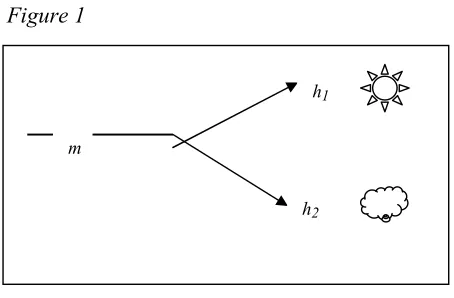
time according to which time is like a rootless tree with multiple branching future histories,
[image:8.612.124.351.445.594.2]which are ontologically on a par (see Figure 1).8
Figure 1
In Figure 1, m is a moment through which both h1 and h2 pass, and the arrowheads indicate
the direction of time. Suppose that m is on Monday, and Alice utters (1) at m, and suppose
7
See Wallace 2010 for discussion.
8
In other moods, like Markosian 1995, MacFarlane suggests that the open future intuition directly entails that future contingents are non-bivalent, subsuming both the open future hypothesis and the denial of bivalence under the ‘intuition of indeterminacy’. See MacFarlane 2003: 322.
h1
h2
that it is sunny on h1 but not on h2. According to this theory, the proposition that it will be
sunny in London tomorrow is neither true nor false at m, because for it to be true at m that it
will be sunny in London tomorrow is for it to be true on all histories that pass through m, and
whereas it is true on h1, it is not true on h2 (MacFarlane 2003, 2008).
To put an alternative view on the table, consider David Lewis’ account of openness,
according to which the asymmetry in openness between the future and the past is understood
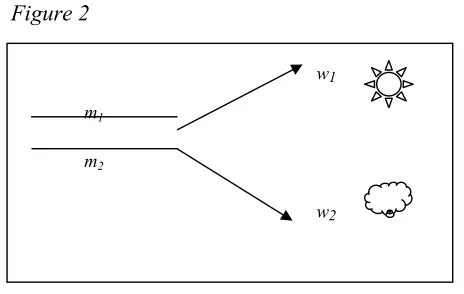
in terms of the asymmetry in counterfactual dependence.9 Lewis’ picture can be represented
[image:9.612.122.354.271.418.2]by Figure 2:
Figure 2
On this picture, w1 and w2 are metaphysically possible worlds, which are duplicates of one
another from the past to the point at which the arrows diverge; w1 contains moment m1 and w2
contains a counterpart moment, m2; at w1 it is sunny in London on the day after Alice’s
utterance, and at w2, it is not. According to Lewis, the multiple futures are alternative ways
the world would have been had the present been different from the way it actually is. The
future is open in the sense that the future counterfactually depends on the present, and the
present on the past, but the past is closed in the sense that the past does not counterfactually
depend on the present. Our intuitions about openness are thus explained in terms of our
readiness to accept the truth of counterfactuals describing how the future would be had the
present been different. For instance, if Hugo says at m1, ‘if the wet weather headed for
Scotland were diverted south, it would not be sunny in London tomorrow’, we would take
him to have said something true. On the standard interpretation, what Hugo says is true
because there is a world, w2, which is just like w1 with respect to the time prior to m1, but at
9
See Lewis 1987.
m1
w1
m2
m2
which it is not sunny. In assessing the truth of this counterfactual, we standardly hold fixed as
many particular facts about the past as is compatible with the counterfactual supposition that
the present is other than it actually is.10 The crucial point is that on Lewis’ view, statements
about the future, such as (1) are bivalent: if Alice occupies w1, then what she says is true, and
if Alice occupies w2, then what she says is false.
How can we decide which of these substantive accounts is better at capturing our
pre-theoretic intuitions? MacFarlane argues that Lewis’ account of openness is unsuccessful
because his view does not capture what he calls the ‘indeterminacy intuition’: that future
contingents are non-bivalent.11 However, this objection to Lewis is question-begging—we do
not yet have an independent reason to think that openness intuitively entails non-bivalence.
MacFarlane also suggests that Lewis’ account does not capture ‘genuine openness’
because Lewis does not accept that we inhabit multiple actualities.12 Similarly, Barnes and
Cameron claim that it is a desideratum for any account of genuine openness to imply that
there are actually now multiple possible ways our future could turn out to be.13 However,
such desiderata are already theoretically loaded; since Lewis does not accept that there are
multiple actualities, and nevertheless purports to capture openness, it is question-begging to
simply characterize the intuitive notion of openness using the metaphysical theory that we
occupy multiple actualities. Moreover, it is difficult to believe that the intuitive concept of
openness, shared by those who are unschooled in philosophy, commits us to a sophisticated
metaphysical doctrine such as the multiple actualities view. Once again, we could
stipulatively introduce the concept open* and insist that the future is open* only if we inhabit
multiple actualities. However, this would give us no reason to think that open* is our intuitive
concept of openness, and it is unclear why OF-compatibilists should be interested in open*
unless it is the intuitive concept of openness.
10
This standard method of interpretation falls apart when we consider backtracking counterfactuals such as ‘had it not been sunny today, it would have been rainy yesterday’, which we do not know how to process unless given further information. Lewis argues that although we are willing to accept backtracking counterfactuals if we are given sufficient information to evaluate them, we are not willing to accept such counterfactuals when we employ our standard analysis. Thus, the asymmetry of openness is preserved on Lewis’ view within ordinary contexts.
11
MacFarlane 2003: 326.
12
MacFarlane 2003: 326.
13
What we need, therefore, is a theoretically neutral starting point, which does not
presuppose a sophisticated metaphysical theory, yet gives us some grip on the pre-theoretic
intuition that the future is open, but the past is closed.
3
Pragmatic Data
Our starting point will be pragmatic data: in particular, our intuitive judgments concerning
the correctness and incorrectness of assertions of the relevant sub-class of future contingent
propositions. This data is theoretically neutral in the sense that it does not presuppose either
OF-incompatibilism or OF-incompatibilism. However, in conjunction with the orthodox
account of assertion, the data reveals that we are intuitively committed to OF-compatibilism.
The upshot is that the OF-incompatibilist will need to opt for a non-standard account of
assertion or find some other way to explain our intuitions away. We present the orthodox
account in this section, and discuss potential rejoinders on behalf of the OF-incompatibilist in
the next section.
According to orthodox accounts of assertion, correct assertion requires at least truth.
Thus a norm of assertion is a truth norm (or a stronger norm which entails a truth norm), such
as the following:
Truth Norm:
You ought to: assert that p only if p is true. 14
This norm of assertion plays an explanatory role in communication: speakers of a language
make the conventional assumption that an assertion of a proposition is correct just in case the
14
proposition asserted is true. So, if we hear an assertion of a proposition we know to be not
true, we will judge the assertion to be incorrect.15 The truth norm is also frequently appealed
to in accounts of what is communicated by utterances. Sometimes, when we judge that an
assertion would be incorrect if interpreted literally, we instead assign a true proposition to the
sentence asserted in order to preserve the correctness of the assertion. For example, suppose
that Becca says:
(9) The glass is full.
Suppose also that there is a tiny little bit of space between the top of the liquid in Becca’s
glass and the top of the glass. It follows that what (9) literally says is false. Nevertheless,
most people will take Becca to have said something true. The reason is that we know that
Becca is a cooperative speaker, aiming to convey information in accordance with the
conventional norms of correct assertion, and that she too knows that it is obviously false that
the glass is literally full. Thus, we work back from the assumption that her assertion is
correct, to the conclusion that she could not have meant that the glass is literally full; she
must have meant that the glass is full enough.
This link between pragmatic and semantic judgments can be exploited to give us
information about our semantic judgments: given the truth norm of assertion, we judge
assertions to be correct only if we take them to be true.
Now, let us return to the incompatibilist’s view. According to the
OF-incompatibilist, at least in those cases in which we intuitively take the future to be open, we
take future contingents to be neither true nor false. If we take future contingents to be neither
true nor false, then we take them to be not true. Assuming the truth norm of assertion (or a
stronger norm which entails it), this view predicts that we will judge assertions of future
contingents to be incorrect, at least in those cases in which we take the future to be unsettled
in relevant respects. This inference is supported by other cases in which we regard assertions
to be incorrect because they express propositions that are neither true nor false, or because
they fail to express propositions at all. For example, consider a case where a demonstrative
15
fails to pick out anything at all. Suppose Maya says ‘that elephant is pink’ but there is nothing
picked out by ‘that elephant’. Most people would regard this as an incorrect assertion,
presumably because it fails to express a proposition.
So, OF-incompatibilism, together with orthodox accounts of assertion, predicts that
we will judge assertions of future contingents to be incorrect. However, most of the time, we
are willing to accept sincere, flat-out assertions of future contingents as correct.16 Consider
the following cases.
First, suppose that Addy is ready to go out for a run, but she is waiting for the
babysitter, who is due to arrive in 10 minutes. Her babysitter has never before been late.
Although, as all mothers know, any number of factors could interfere to cause delay, she has
no positive reason to think that any such interference will occur. Addy says:
(10) I will go running in 10 minutes.17
Second, suppose that Barbara is a Fellow of the Royal Meteorological Society, with a degree
in Environmental Science, who works as a weather presenter for the BBC. Her record for
predicting the weather one day in advance is very good, though of course, she is aware that it
is possible that the weather will change in an unpredictable way. After checking her data
carefully, she goes on the air and asserts:
16
The Of-incompatibilist might point out that we very often hedge our statements about the open future, and prefer not to make flat-out assertions. For instance, we more often say ‘I think that it will be sunny tomorrow’, or ‘it is likely to be sunny tomorrow’ than ‘it will be sunny tomorrow’. Perhaps we hedge because we judge future contingents to be non-bivalent.Though it is true that we often hedge, the fact that we sometimes make flat-out assertions about the open future, and that we sometimes judge these assertions to be correct is sufficient for our purposes. The prevalence of hedging would only support OF-incompatibilism if we were never willing to make flat-out assertions of future contingents, or if we were only willing to make flat-out assertions of future contingents in those cases where we regard the future to be settled (as in ‘I will die someday’). However, the cases that follow are examples of flat-out assertions that we would judge to be correct and yet where we judge the future to be open in relevant respects.
17
(11) It will be sunny in Madrid tomorrow.
Under the circumstances just described, it seems natural to regard the assertions of (10) and
(11) as correct. Yet, we do not think that it is closed or settled that Addy will go running in 10
minutes. Despite judging (10) to be correct, we think that the future is open rather than closed
with respect to Addy’s running. That is, we think that there are alternative ways the future
might be with respect to Addy’s running; even if it is now true that she will go for a run, it is
possible that she won’t. Similarly, though we judge (11) to be correct, we do not think that
the future is closed with respect to the weather in Madrid—everyone knows how sensitive
weather systems are to change. Even if it is now true that it will be sunny in Madrid
tomorrow, it is certainly possible that it will not be sunny, and however much evidence
Barbara may have for the truth of what she says, it is neither fixed nor certain that it will be
sunny in Madrid on the day after the day of her utterance. Yet, we regard Barbara’s assertion
as correct.
If we do judge assertions of these future contingents to be correct, and if we assume
that assertion is constituted by a truth norm, it follows that we take the propositions stated in
assertions of (10) and (11) to be true. But if we also regard the future as unsettled in the
relevant respects, then it follows that we do not in general take the openness of the future to
imply that future contingents are not true. Thus, the OF-incompatibilist makes false
predictions about our intuitive pragmatic judgments.
Of course, there are situations in which we regard assertions of future contingents to
be incorrect. For example, if Alice asserts (1) with no evidence, we are inclined to regard her
assertion as incorrect. Similarly, the following assertions look incorrect, if they are made
(say) on 31st of December 2011:
(12) It will be sunny in London on March 3rd 3014.
(13) There will be a fourth world war.
Do these cases support OF-incompatibilism, or show that the pragmatic data is inconclusive?
might think that the pragmatic data just does not decide either way. However, given the
orthodox view of assertion, OF-incompatibilism also suggests an explanation of why we
regard such assertions as incorrect—because they are neither true nor false.18 But this
explanation of why we regard these assertions as incorrect is not borne out. If this were the
reason why we regard these assertions to be incorrect, then it would be natural to give that
reason when challenging the assertion. Yet, the most natural way to challenge (13) would be
to say one of the following:
(14) Are you sure? There might not be a fourth world war.
(15) You don’t know that there will be a fourth world war.
In contrast, it would be distinctly odd to challenge (13) by saying the following:
(16) It is neither true nor false that there will be a fourth world war.
(16) is just an odd thing to say in English. Only a philosopher would say (16)—indeed, only
an OF-incompatibilist. But if it followed from our judgment that the future is open or
unsettled that future contingents are non-bivalent, or even if non-bivalence was merely
offered as an explanation for those judgments, we would expect (16) to sound more natural.
Moreover, the oddity of (16) cannot be explained by the hypothesis that we do not typically
find it natural to use the ‘neither true nor false’ locution in English, since we would find it
natural to use similar locutions in cases of vagueness, for instance. Indeed, as Ripley has
shown, in the case of vagueness, speakers are often willing to accept outright contradictions,
of the form ‘x is both F and not-F’ as well as disjunctions such as ‘x is neither F nor not-F’. 19
However, these would not sound right in the case of future contingents, either.
Perhaps, one might think, the ‘neither true nor false’ locution sounds odd here, but
that we would find it natural to say that a future contingent is not true, and to say that it is not
18
We discuss alternative accounts of assertion in section 4.
19
false. Similarly, pace Ripley, one might think that it is natural to say ‘”Jones is bald” is not
true’, and to say ‘”Jones is bald” is not false’, but think that it is odd to say ‘”Jones is bald” is
neither true nor false’.20 However, in the present context, this cannot be the correct
explanation of the oddity, because it makes no sense to challenge an assertion of (13) by
saying the following:
(17) It is not false that there will be a fourth world war.
It hardly seems like a challenge to say that an assertion is not false – indeed (17) is
compatible with (13). In contrast, (18) sounds like a more natural challenge:
(18) It is not true that there will be a fourth world war.
However, if one were to challenge an assertion of (13) by asserting (18), one would lay
oneself open to the following challenges:
(19) Are you sure? It might be true that there will be a fourth world war.
(20) You don’t know that it is not true that there will be a fourth world war.
The reason for this seems to be that in asserting (18), the speaker commits herself to
knowing, or at least justifiably believing, that there will not be a fourth world war. Assuming
that our current epistemic situation is insufficient to justify a belief one way or the other, then
the challenge in (18) would be on as shaky epistemic ground as the assertion of (13).
It seems that, assuming an orthodox account of assertion, the OF-incompatibilist
cannot explain the data concerning the correctness and incorrectness of assertions of future
20
contingents, and challenges to them.21 Our view is that the best explanation of this data is
that not only must the norm of assertion entail the truth norm, it must contain an epistemic
component as well. 22 This is strongly suggested by the challenge data. In (14), the challenger
claims that the speaker is not in a position to rule out the alternative epistemic possibility in
which there is no fourth world war, and again in (15) the challenger points to lack of
knowledge or justification on the part of the speaker. Furthermore, the incorrectness of the
challenge in (18) can be explained by the assumption that the speaker of (18) is, by
hypothesis, in the same poor epistemic situation as the speaker of the assertion she is
challenging. This suggests that the correct norm of assertion must be either the knowledge
norm or the justified true belief norm:
Knowledge Norm:
You ought to: assert that p only if you know that p.
Justified True Belief Norm:
You ought to: assert that p only if p is true and you justifiably believe that p.
Both these norms entail the truth norm,23 and both of them can explain the relevant data. In
the case of the correct assertions of (10) and (11), the explanation of our judgment is that we
regard them to be true, and regard the speaker to be in a position to know or at least have a
justified true belief in the proposition asserted. In contrast, in the cases of incorrect assertion,
21
Notice that these objections from challenges just leveled against the truth norm would not work against the factual norm (you ought to (assert ‘p’) only if p). In principle, an OF-incompatibilist could endorse the factual norm (or a stronger norm that entails the factual norm but does not entail the truth norm) and accept excluded middle while rejecting both bivalence and standard disquotation schemas. On this view (1) would be neither true nor false but would still state a determinate fact, and an assertion of (1) would be governed by a factual norm and so would be assertible. This view would avoid the objections concerning the correctness of assertions raised above against OF-incompatibilism. However, if this were the correct view, one would expect it to be natural to challenge assertions of future contingents in the material mode—which it is not. So, for instance, one would expect it to be natural to challenge the assertion of (13) with ‘there will not be a fourth world war’ or ‘there neither will be nor won’t be a fourth world war.’ However, these challenges in the material mode sound just as odd as those in the semantic mode. Thanks to Oystein Linnebø for discussion.
22
Cf. Pérez Otero 2010.
23
such as (12) and (13), we regard the speaker to be in a poor epistemic situation, whether or
not the proposition asserted is true.24
Which of these two norms offers the best account of assertion? On our view, it is the
knowledge norm. Now, one might not feel at ease with a knowledge norm of assertion for
future contingents: one might want to say that although some future contingents are
assertible, because one’s justification for them is strong enough, no future contingent is really
knowable. So, one might think it more fitting to adopt a weaker norm of assertion in terms of
justified true belief. However, the knowledge norm need not be so demanding. For instance,
according to the contextualist (e.g. Cohen 1986, DeRose 1991, Lewis 1996), whether it is
true that S knows that p depends on features of the salient context. In ordinary contexts such
as those described above, a relatively low level of evidence is required for knowledge, or a
small subset of alternative possibilities needs to be ruled out. Hence, the contextualist would
say that Addy and Barbara both know what they assert. In conjunction with the knowledge
norm, it follows that both assertions are correct—which coheres with our pragmatic
judgments. Similarly, according to the subject sensitive invariantist (e.g. Hawthorne 2004,
Stanley 2005), the evidence required for knowledge depends on how high the stakes are: in
low stakes situations, the evidence required for knowledge is relatively low. In conjunction
with such a view of knowledge, the knowledge norm is not too demanding, so it implies that
both Addy and Barbara know what they assert, and hence, it correctly predicts that their
assertions are judged to be correct.
Though both the knowledge norm and the justified true belief norm can deal with the
above cases, there are further examples of assertions of future contingents that the knowledge
norm is better able to explain. For instance, the knowledge norm better explains our intuitions
in lottery cases. Suppose that Paula owns a lottery ticket in a lottery with one million tickets,
and suppose that the winning ticket will be chosen in the future. Given the large number of
tickets in the lottery, there is a high probability that Paula holds a losing ticket. Nevertheless,
we would find the following assertion incorrect:
(21) Paula will not win the lottery.
24
Our pragmatic intuition about this case is better explained by the knowledge norm than the
justified true belief norm. If we assume that justification for (21) is merely probabilistic, and
that (21) is true, the assertion of (21) comes out as correct according to the justified true
belief norm. The knowledge norm, in contrast, deems the assertion of (21) as incorrect,
because the future contingent proposition asserted is not known at the time of assertion,
which conforms better to our judgments.25 Though a full defense of the knowledge norm over
the justified true belief norm is beyond the scope of this paper, future contingent lottery
propositions speak are better explained by the knowledge norm. Hence, we favour the
knowledge norm in this context, since it provides the best overall account of the data.26
Though appeal to an epistemic norm of assertion helps to explain the data, it does not
follow that what it is for the future to be open is for it to be epistemically uncertain or
unknown. After all, we sometimes judge assertions about the past to be incorrect, and thereby
open to challenge, even though we regard the past as settled. For example, in our current
epistemic context, it would be incorrect to assert:
(22) Caesar ate grapes on the day he crossed the Rubicon.
(23) Dinosaurs experienced unusual qualia.
In both of these cases, the intuitive incorrectness can be explained by our poor epistemic
situation, together with an epistemic norm of assertion. Since both (22) and (23) are
intuitively settled, we cannot simply understand the intuition that the past is closed as the
intuition that we are in a better position to know about the past.
These remarks do not amount to an analysis of our intuitive concept of openness.
However, they do shed some light on that concept. They suggest that our intuitive view that
the future is open does not commit us to the view that future contingents are non-bivalent.
25
See Hawthorne 2004 on the knowledge norm and the lottery paradox. See Perez Otero 2010 for further discussion on the knowledge norm in relation to future contingents.
26
Indeed, our pragmatic judgments reveal that we frequently regard contingent statements
concerning the open future to true.27
Moreover, when we do not regard assertions of future contingents to be correct, this is
because, in these cases, we take the speaker to be in a poor epistemic situation with respect to
the assertion in question, not because we take the proposition asserted to be not true. Thus,
assuming a standard style of account of assertion, any substantive account of openness that
preserves bivalence seems to better capture our intuitive concept of openness than any
account that entails bivalence. Indeed, any account of openness that entails
non-bivalence seems to be forced to adopt an error theory about a wide range of pragmatic and
semantic intuitions.
4
Objections and Replies
There are various ways in which the OF-incompatibilist might respond to the foregoing
arguments. In what follows, we consider and reject a number of potential responses.
27
This is why merely preserving bivalence without declaring some propositions as true (and some as false) will not suffice to meet our objection. For instance, Barnes and Cameron (2009 and forthcoming) claim that every proposition is either true or false, but with respect to some propositions, it is indeterminate which truth-value they have. According to them, for every point in time at the actual world, there is a set of possible worlds that represents the way the future of the world might be, consistent with its past up to that point in time. They call this set {Futures} and they treat the worlds in {Futures} as precisifications of the present state of the actual world. They claim that though it is determinate that one of the worlds in {Futures} will be actualized, it is indeterminate which of them will. So, on their view, if Alice asserts (1) today, and if it is sunny in London tomorrow at some worlds in {Futures} but not at others, then what Alice says is not determinately true and not determinately false. However, they maintain that all of the worlds in {Futures} are maximal and classical, so that at each world, every proposition is either true or false. Hence, today, it is determinately true that what Alice says is either true or false, because it is determinately true that one of the worlds in {Futures} will be actualized.
4.1
Alternative Accounts of Assertion
One response might be to reject the orthodox view that assertion is governed by a truth norm,
or a norm that entails the truth norm. For instance, one might think that assertion is governed
by a weaker norm, such as the following:
Belief Norm:
You ought to (assert that p) only if you believe that p is true.
If the sincere belief norm governs assertion, then we can explain the correctness of assertions
(10) and (11) in the relevant contexts: If the speaker believes the proposition asserted to be
true, then the assertions will be correct. And the speaker can believe them to be true, even if
they are neither true nor false.
One difficulty with this response is that a speaker might also believe (12) and (13), yet
these do not seem to be correctly assertible.28 Another is that this response is of no use to
OF-incompatibilists who accept that some assertions of future contingents are correct. Suppose
that Barbara asserts (1) and her assertion is correct. Assuming that in the context, (1)
expresses the proposition that it will be sunny in London on the day after the day of the
utterance, then Barbara must believe that it will be sunny in London on the day following her
utterance. But if Barbara were an OF-incompatibilist, it would be irrational for her to believe
that it will be sunny in London the day following her utterance; for then she would believe a
proposition that she also believed to be not true. But it does not seem to be irrational for
Barbara to believe (1), just because she believes that the future is open.29 This point raises a
general issue for OF-incompatibilism that goes beyond the rejection of the view that assertion
is governed by the sincere belief norm. If we are all intuitive OF-incompatibilists, then it
would be irrational for any of us to believe any future contingents that trigger intuitions of
openness. However, we not only believe some such future contingents, we also believe that it
28
The belief norm is also unacceptable for a variety of independent reasons. For further discussion, see Williamson 2000.
29
is rational to do so. This provides further evidence that our intuitive understanding of the
openness of the future does not commit us to non-bivalence. 30
A similar move that the OF-incompatibilist could make would be to adopt an account
of assertion according to which to make an assertion is to make a certain kind of
commitment.31 MacFarlane puts forward a Brandomian account of assertion along these lines
in his discussion of the assertion of future contingents.32 He says that in making an assertion:
One is committed to producing a justification, that is, giving adequate reasons for
thinking that the sentence is true (relative to its context of utterance and the asserter’s
current context of assessment), whenever the assertion is challenged.33
Applied to our case of Alice’s uttering (1), MacFarlane’s view goes like this. If Alice is
challenged in her assertion of (1), and she is shown conclusively that the future is unsettled
with respect to the weather in London on the day after the day of her utterance, then she
ought to withdraw the assertion. If the challenge is weaker, and she can meet it, then her
assertion can stand.
On the face of it, this might seem like an account of the correctness and incorrectness
of assertions of future contingents that severs the link between pragmatic and semantic
intuitions, and is therefore hospitable to OF-incompatibilism. On this account of assertion,
whether or not an assertion is correct depends on whether it is challenged, the nature of the
challenge, and whether it can be met under the circumstances; crucially, it does not depend
on whether it is true. However, this appearance is misleading: this account of assertion is
actually of no use to an OF-incompatibilist who wishes to explain why we accept some
assertions of future contingents to be correct. The reason is that even on the Brandomian
view, our pragmatic judgements reveal our commitment to a disquotation principle: if we
judge an assertion of sentence S to be correct in a given context, then we also judge that it is
30
The point is put here in terms of outright belief, though Williams raises a similar objection against non-bivalent accounts of future contingents with respect to partial beliefs (see Williams, forthcoming).
31
Brandom 1994.
32
MacFarlane 2003.
33
correct in that context to assert ‘S is true’.34 However, if it is correct to assert ‘S is true’ in a
given context, it cannot also be correct to assert ‘S is not true’ in that context.35
So, given that we do frequently judge assertions of future contingents to be correct, a
commitment based account predicts that we will similarly regard affirmations of truth to
future contingents to be correct, and denials of bivalence to be incorrect. This means that an
assertion of OF-incompatibilim will be intuitively regarded as incorrect. Moreover, if the
disquotation principle is accepted, then our pragmatic judgments can still be exploited to give
evidence of our semantic judgments: assuming a disquotation principle, we judge assertions
to be correct only when we judge them to be true.
Furthermore, on MacFarlane’s account of assertion, what it is to make an assertion is
to make a commitment to provide adequate reasons for believing that the assertion is true. It
follows that an OF-incompatibilist must be insincere when asserting a future contingent
proposition. To see why, suppose that Julia is an OF-incompatibilist, and that p is a future
contingent proposition that is unsettled at t. As an OF-incompatibilist, Julia believes that it is
not true that p at t. If Julia were to assert that p at t, she would thereby be making a
commitment to provide adequate reasons for believing that p is true. Since she does not
believe that p is true, she puts herself in a position similar to a lawyer engaged to defend the
innocence of a client she believes not to be innocent. This is counterintuitive. First, it is
counterintuitive to suppose that we are intuitive OF-incompatibilists such as Julia, who never
believe that future contingent propositions are true. Second, it is counterintuitive to suppose
that in those cases in which we do assert future contingents, we are either being irrational or
insincere. We often make flat out assertions of future contingents, and are prepared to support
our assertions with reasons, and do not, in so doing, exhibit either irrationality or insincerity.
4.2
Weakenings
Another line of response from the OF-incompatibilist might be to say that though a norm that
entails the truth norm governs assertion, when we hear future contingent sentences uttered,
34
See Brandom 1994. Since Brandom works with sentences, he would express the disquotation principle in terms of sentences rather than propositions. Nothing hangs on this here.
35
we tend to reinterpret them to mean something weaker.36 For instance, we hear the assertion
of (10) as expressing (24):
(24) It is likely that I will go running in 10 minutes.
If this is the explanation for why we find assertions of future contingents correct, by parity,
we should naturally interpret Alice’s assertion of (1) as expressing the proposition that:
(25) It is likely that it will be sunny in London tomorrow.
This line of response is promising. If we hear (1) as (25) and (10) as (24), respectively, this
could be because we initially regarded those assertions as literally incorrect, which enables
the OF-incompatibilist to accept the truth norm. This line of reasoning mimics that involved
in the explanation of our intuitive understanding of Becca’s utterance of (9) to mean
something slightly weaker, such as that the glass is full enough. This is because the
assumption that (9) as well as (1) and (10) are obviously literally false generates the
reinterpretation.
This suggestion is not compelling, however. We can see this if we consider indirect
reports. It is standard to test intuitions about what is said by an assertion against judgments of
what would constitute a correct indirect report of what was said. For example, suppose that
Cathy phones from San Diego and says:
(26) It is raining.
Suppose that her call is received in England. In this case, it would be natural to report Cathy’s
assertion indirectly by saying:
36
(27) Cathy said that it is raining in San Diego.
The reason why (27) seems like an accurate report of (26) is that (27) seems to capture what
is said by (26). Now, it is worth noting that this sort of indirect report test has been criticized,
because whereas there is only one literal semantic content of any sentence, there are many
different ways in which to report what is said.37 Be that as it may, a weaker inference can be
made on the basis of indirect speech reports: it seems obvious that if an indirect speech report
seems clearly incorrect, then we can infer that it does not accurately capture what was said by
the initial assertion.
It is only this weaker assumption that we need in order to show that the hypothesis
under consideration is false. If the hypothesis were true, then (10) and (11) would be
correctly reported by (28) and (29):
(28) Addy said that it is likely that she will go running in 10 minutes.
(29) Alice said that it is likely that it will be sunny in London tomorrow.
However, these do not seem to be accurate reports of what was said. In general, to say that it
is likely that p seems to be to say something about the chance or the likelihood that p,
whereas to flat-out assert that p seems to say nothing about likelihoods or chances. Hence, to
report a flat-out assertion that p as saying that it is likely that p would be misleading. This
holds equally in the case of assertions of future contingents. The hypothesis that future
contingents are interpreted as expressing propositions concerning the likelihood of future
events thus fails the weaker indirect report test, because we do not hear flat-out assertions of
future contingents as expressing propositions about likelihood.38
37
Cappelen and LePore 1997.
38
Another good reason to reject this view is that it will not give the correct results in
lottery cases. On the view under consideration, we interpret the flat-out assertion of (21)—
that Paula will not win the lottery—to say that:
(30) It is likely that Paula will not win the lottery.
However, assuming the orthodox account of assertion, an assertion of (30), and therefore (21)
will come out as correct. Yet, we would generally judge an assertion of (21) to be incorrect,
so the view under consideration makes a false prediction in this case.
A further suggestion in the same spirit is that utterances of future contingents are not
assertions of a weaker content, but that they are speech acts other than assertion, and
governed by weaker norms.39 Perhaps there is a sui generis speech act of prediction, which
falls short of assertion. The upshot would be that utterances of future contingents would
never be assertions. Perhaps predictions are governed by a weaker norm, such as the
following:
Prediction Norm:
You ought to (predict that p) only if it is highly likely that p.
This theory can apparently deal with the cases that we discussed. If utterances of future
contingents are governed by the prediction norm rather than the assertion norm, then they
will come out as correct even if they are not true, for likelihood does not imply truth.
Another, similar thought might be that utterances of future contingent sentences are a
kind of pretend or fictional assertion, analogous to fictional belief.40 For example, suppose
that Vikram asserts:
39
Thanks to Dorothy Edgington for suggesting this.
40
(31) Harry Potter goes to Hogwarts School of Witchcraft and Wizardry.
Intuitively, Vikram’s utterance of (31) is correct. However, though we judge his utterance of
(31) to be correct, we do not take (31) to be true, because we do not think that Harry Potter
exists. One way to explain our intuitions here, without abandoning a truth norm of assertion,
is to say that we do not treat (31) as a genuine assertion, but as a quasi-assertion, subject to
different norms. That is, suppose that a proposition is true* just in case it is true at a salient
fictional possible world. Then, one might think that quasi-assertions are governed by
something like the following quasi-assertion norm:
Quasi-Assertion Norm:
You ought to (quasi-assert that p) only if p is true*.
On this view, a quasi-assertion of (31) is correct and true*. In contrast, a quasi-assertion of
(32) is false*:
(32) Harry Potter goes to Eton.
This view seems to capture our intuitions about fictional utterances—though both (31) and
(32) would be either false or truth-valueless if asserted, because Harry Potter does not exist, a
quasi-assertion of (31) could be true*, whereas a quasi-assertion of (32) could be false*,
because (31) is true in the world of Harry Potter, whereas (32) is false in that world. Perhaps
one might think that the same is true of future contingents. That is, perhaps the fact that we
judge utterances of future contingents to be correct is not evidence that we judge them to be
true, because we judge them to be quasi-assertions that are correct only if they are true*. On
this view, when we assess the correctness of quasi-assertions of future contingents we treat
them as a kind of make-believe. Of course, the fictional world in this case could not be made
salient by the writings of a particular author, as in the case of Harry Potter. However, one
likely, and that we assess the truth* of quasi-assertions of future contingents in terms of truth
at the highly likely worlds.
Both the suggestion that utterances of future contingents are predictions and that they
are quasi-assertions attempt to avoid the above problems by treating utterances of future
contingents as a different kind of speech act, governed by a distinct norm from the norm
governing assertion. If utterances of future contingents are not assertions, then perhaps they
are not the sorts of speech act whose correctness depends on whether they are true or false
simpliciter. This allows for judgments of correctness to come apart from judgments of truth.
However, no such account can be correct, because future contingent sentences can be
embedded with present tense constructions, as in the following:
(33) Ana just arrived and she will fix the pipe.
Is (33) an assertion or some other type of speech act? If it is an assertion, then the invention
of an alternative speech act type for future contingents does not help avoid the foregoing
objections. For, there are clearly contexts in which we would judge (33) to be a correct
assertion, yet regard the future to be open with respect to whether Ana fixes the pipe (for
instance, if she forgot her tools, or gets called away for more urgent business, or she chats for
too long and runs out of time).
On the other hand, if we decide that (33) is not an assertion, but a quasi-assertion, or a
prediction, then other difficulties arise. If utterances of future contingents were not assertions
but some other kind of speech act, arguments containing both future contingents and present
tense statements, or containing embedded constructions, would not come out as
straightforwardly valid. For instance, the following argument would not be straightforwardly
valid if utterances of future contingents are not assertions, and therefore, neither true nor
false:
(34) If Ana will fix the pipe, then she is here now.
(35) Ana will fix the pipe.
_______________
The above argument is intuitively valid, but it would not be valid if (35) were not an
assertion. The problem here is similar to the well-known Frege-Geach problem for
meta-ethical expressivists.41 According to the expressivist, an utterance of a normative sentence,
such as ‘murder is wrong’ is not an assertion, but an expression of a non-cognitive attititude,
such as an emotion, an attitude of acceptance, or endorsement. The Frege-Geach problem is
that ‘muder is wrong’ can be embedded, as in ‘if murder is wrong, then getting little brother
to murder is wrong,’ and these sentences can in turn function as premises in intuitively valid
arguments.42 Various solutions have been attempted to the Frege-Geach problem, typically in
terms of consistency within an assumed system of norms or a moral framework.43 Similarly,
one might suggest that arguments containing future contingents are deductively valid if the
truth* of the premises guarantees the truth* of the conclusion. However, this has the unhappy
consequence that the above argument does not permit us to conclude that (36), which is a
present tense statement, is true simpliciter, only that it is true*. Since future contingents can
straightforwardly be embedded, it is implausible to assume that when we utter future tensed
contingent sentences we are not making assertions, but performing some other type of speech
act that is not subject to a truth norm, and is thus not properly assessed as either true or false.
There does not seem to be any satisfactory move which the OF-incompatibilist can
make to explain our pre-theoretic judgments concerning the correctness and incorrectness of
assertions of future contingents: neither weakening the relevant norms of assertion, nor
weakening the contents of those assertions, nor appealing to speech acts different from
assertion nor appealing to multiple concepts of truth helps the OF-incompatibilist to explain
the pragmatic facts. OF-incompatibilism cannot be rescued.
5
Concluding Remarks
The pragmatic data suggests that we sometimes judge assertions of future contingents to be
correct, even though we judge the future to be open in relevant respects. Given the close
connection between our pragmatic judgments and intuitive semantic judgments, the
41
See Geach 1957-8.
42
E.g. If murder is wrong, then getting little brother to murder is wrong; murder is wrong; so, getting little brother to murder is wrong.
43
pragmatic data provides us with strong evidence that we do not intuitively judge future
contingents to be non-bivalent. Hence, the intuitive thought that the future is open but the
past is closed is compatible with the bivalence of future contingents. This places constraints
on accounts of the openness of the future which favours compatibilism over
OF-incompatibilism.
OF-incompatibilists are at a dialectical disadvantage relative to OF-compatibilists. To
take a concrete example, with regard to capturing our semantic intuitions, MacFarlane’s
non-bivalent account of openness is at a dialectical disadvantage relative to Lewis’ non-bivalent
account. MacFarlane’s account of openness implies an error theory: it implies that our
ordinary pragmatic judgments about the correctness of assertions of future contingents are
systematically mistaken. Of-incompatibilists like MacFarlane typically defend their view on
the grounds that it captures our pre-theoretic semantic intuitions. This line of defense of
OF-incompatibilism is untenable.
Acknowledgements
Earlier versions of this paper have been presented at The Open Future workshop in Barcelona
in 2011; the 2011 Mind, World and Action conference in Dubrovnik; The Philosophy of
Language and Mind Conference in Stockholm in 2011; and at the Philosophy departments of
Birkbeck College, Bristol, Glasgow, Nottingham and Oxford. Thanks to the audiences on
these occasions, and especially to Mahrad Almotahari, Alexander Bird, Dorothy Edgington
Oystein Linnebø, and Dag Prawitz for very helpful discussions. Special thanks to Krister
Bykvist, Cian Dorr, Antony Eagle, Max Kölbel, Ofra Magidor, Stephan Torre and
References
Aristotle. De Interpretatione. In (1984) The Complete Works of Aristotle: The Revised Oxford
Translation, Jonathan Barnes (ed.) Oxford: Oxford University Press.
Barnes, Elizabeth. and Cameron, Ross. (2009) ‘The Open Future: Bivalence, Determinism
and Ontology,’ Philosophical Studies 146: 291–309
―. ‘Back to the Open Future,’ forthcoming in Philosophical Perspectives.
Belnap, Nuel. (1992) ‘Branching Space-Time,’ Synthese 92: 385-434.
Belnap, Nuel and Green, Mitchell. (1994) ‘Indeterminism and the Thin Red Line,’ in J.
Tomberlin (ed.) Philosophical Perspectives 8: Logic and Language, Atascadero:
Ridgeview: 365-388.
Brandom, Robert. (1994) Making it Explicit, Cambridge: Cambridge University Press.
Brogaard, Berit.(2008) ‘Sea Battle Semantics,’ The Philosophical Quarterly 58 (231):
326-335.
Cappelen, Hermann. and LePore, Ernie. (1997) ‘On an Alleged Connection between
Semantic Theory and Indirect Quotation,’ Mind and Language 12: 278-296.
Cohen, Stuart. (1986) ‘Knowledge and Context,’ The Journal of Philosophy, 83: 574-583.
DeRose, Keith. (1991) ‘Epistemic Possibilities,’ The Philosophical Review, 100 (4): 581-605.
Diekemper, Joseph. (2004) ‘Temporal Necessity and Logical Fatalism,’ Proceedings of the
Aristotelian Society. 104 (3): 287-294.
Geach, Peter. T. (1957–8) ‘Imperative and Deontic Logic,’ in Analysis, 18: 49–56.
Gibbard, Alan. (2003) Thinking How to Live, Cambridge, MA: Harvard University Press.
Grice, H. Paul. (1989) Studies in the Way of Words, Cambridge, MA: Harvard University
Press.
Hawthorne, John. (2004) Knowledge and Lotteries, Oxford: Oxford University Press.
Kölbel, Max. (2008) ‘Introduction: Motivations for Relativism,’ in Manuel Garcia-Carpintero
and Max Kölbel (eds), Relative Truth, Oxford: Oxford University Press: 1-40.
Lewis, David. (1987) ‘Counterfactual Dependence and Time’s Arrow’, plus ‘postscripts,’ in
his Philosophical Papers, 2: 32-66.
Lewis, David. (1996) ‘Elusive Knowledge,’ Australasian Journal of Philosophy Vol. 74, No.
MacFarlane, John. (2003) ‘Future Contingents and Relative Truth,’ The Philosophical
Quarterly 53: 322-336.
― (2008) ‘Truth in the Garden of Forking Paths,’ in Manuel Garcia-Carpintero and Max
Kölbel (eds), Relative Truth, Oxford: Oxford University Press: 81-102.
Markosian, Ned. (1995) ‘The Open Past,’ Philosophical Studies 79: 95-105.
Peréz Otero, Manuel. (2010) ‘Invariantism versus Relativism about Truth,’ Teorema. Vol
XXIX (3): 145-162.
Prawitz, Dag. (2009) ‘Logical Determinism and the Principle of Bivalence,’ in F. Stoutland
(ed). Philosophy Probings: Essays on von Wright’s Later Work, Birkerød, Denmark:
Automatic Press: 11-35.
Prior, Arthur. (1957) Time and Modality, Oxford: Oxford University Press.
Ripley, David. ‘Contradictions at the Borders,’ forthcoming in Rick Nouwen, Robert van
Rooij, Uli Sauerland & Hans-Christian Schmitz (eds), Vagueness in Communication,
Berlin: Springer (forthcoming).
Ryle, Gilbert. (1953) Dilemmas, Cambridge: Cambridge University Press.
Stanley, Jason. (2005) Knowledge and Practical Interests, Oxford: Clarendon Press.
Torre, Stephan. (2011) ‘The Open Future,’ Philosophy Compass 6 (5):360-373.
von Wright, Georg Henrik. (1979) ‘Time, Truth, and Necessity,’ in C. Diamond and J.
Teichman (eds) Intention and Intentionality. Ithaca: Cornell University Press: 237-250.
Wallace, David. (2010) ‘The Emergent Multiverse: Quantum Theory according to the Everett
Interpretation,’ Oxford: Oxford University Press.
Williams, Robert ‘Aristotelian Indeterminacy and the Open Future,’ Unpublished manuscript.