An Empirical Study of Agile Software Development
Methodologies: A Sri Lankan Perspective
M.M.M.Safwan
Sri Lanka Institute of InformationTechnology
Metro Campus, Colombo 03, Sri Lanka
Thavarajah G.
Sri Lanka Institute of InformationTechnology
Metro Campus, Colombo 03, Sri Lanka
Vijayarajah N.
Sri Lanka Institute of InformationTechnology
Metro Campus, Colombo 03, Sri Lanka
K. Senduran
Sri Lanka Institute of Information Technology Metro Campus, Colombo 03,
Sri Lanka
C.D. Manawadu
Sri Lanka Institute of Information Technology Metro Campus, Colombo 03,
Sri Lanka
ABSTRACT
The challenges with developing software systems led to a switch from traditional software methodologies like Waterfall towards the Agile software methodologies. Agile methodologies are an established process for developing software nowadays and are relatively considered to be quick. These Agile software methodologies have become more and more popular in recent times, and Scrum in particular has been adopted by many companies. The current literature suggests that these Agile methodologies are indeed more effective in project management, particularly in dealing with the complexity of modern software systems and the rapidly changing business environment. There is, however, less evidence on their usage among software practitioners in Sri Lanka. This paper empirically investigates the perceptions of Agile methodologies usage from software practitioners in Sri Lanka. The team presents the practices in Agile perceived to deliver the most benefits. The team aim to provide awareness and knowledge about Agile methodologies to the practitioners in the country. This paper can serve as a reference to the early adopters who intend to use Agile methods in the future.
General Terms
Software Development Methodology; Agile Methodologies
Keywords
Agile project management; Software process; Agile methods; Practices; Methodologies.
1.
INTRODUCTION
The increasingly critical nature of software projects places a greater demand on project management. It has also been observed that the inability to deal with the increasing complexity of a software project increases the likelihood of the project failing [1]. Based on various studies reported in literature [1], there are many reasons commonly cited for failure of software projects. Among these, the following stand out.
Rapid changes in user requirements Lack of user involvement
Unrealistic expectations by developers Poor planning
Ambiguous communication of requirements
As software projects evolved in terms of complexity, so grew the methodologies for managing them. Methodologies like the
Waterfall approach, and the Spiral method were introduced in order to deal with the problems that were identified, but these did not deal well with issues like the rapid delivery to market and the frequent changes required during the development and maintenance cycle.
With the recent introduction of Agile project management methodologies such as Scrum, proponents argue that these problems can be overcome [2], but the author was interested in studying whether, particularly in the Sri Lankan context, a quantifiable improvement has been made with the transition into Agile methodologies. Agile methods provide ways to develop software which place emphasis on people and their creativity [3]. Despite the benefits that Agile can deliver, little work has been published regarding its current usage in Sri Lanka [4]. If the methods are to be used, there is a need to understand how Agile methods are being practiced within this region. How is the practice perceived by the practitioners in Sri Lanka? What challenges and benefits have they experienced when using the methodologies? How they overcome those challenges? Agile methods are not for everyone. In one of the sessions for an invited talk at the XP2011 Conference, titled ‘When Agile is not enough’; the speaker stated: “what works in one culture, will not necessarily work in other cultures”. The team agrees with this statement and intends to investigate the scenario in the country. Several studies stated that addressing cultural differences is important for the success of software development [5, 6]. One study [5] although the paper discussed global software development, it is believed that some cultural aspects discussed in the paper can be related to the usage of Agile methods.
1.1
Research Questions
In this paper, several questions will be addressed:
What do practitioners say about awareness of Agile in the country?
What are the first reason(s) making they started to use Agile methods?
What are the challenges they faced when using Agile?
Despite the challenges, what are Agile Practices perceived to deliver the greatest benefits to them?
1.2
Objectives and Expected Contribution
they are facing, and the benefits they obtained when using the methods. The challenges of using Agile methods can serve as guidelines for software practitioners in Sri Lanka and the nearby region where only limited studies about this field exist. It is hoped that the findings will help to reduce the difficulties encountered when they are trying to introduce Agile methodologies. In addition, this study will help add to the empirical evidence of software engineering knowledge and software processes in terms of Agile methods usage. It is hoped that based on the findings from this study, the usage of the methods will increase and at the same time, add to the awareness of the Agile methodologies in the country.
Agile methods are established methodology that is believed to produce faster results when developing software. Nonetheless, Agile is not a silver bullet replacing traditional methods of software engineering, such as the Waterfall model. However, to get the best out of Agile, it must be adapted to the people and organization of the adopters. While Agile became typical in the development of software in the Western countries (such as Europe, Australia and Northern America), it is not the case in other regions: Southeast Asia region [4] and countries such as Sri Lanka. For them, Agile is new and some have never heard of the method [7].
Furthermore, with the importance of software industries to the country, it is necessary to provide baseline on how to use software processes that can be adapted to frequent change in the business environment.
This paper will present the perception from practitioners in Sri Lanka on the emergence of Agile methodologies. In this paper, their awareness will be considered. Challenges associated with the introduction of Agile methods will be presented, together with solutions suggested by the practitioners. The practices perceived to deliver the most benefits are also presented. As qualitative study is always concerned with validity and reliability of the findings, these issues are discussed before the paper is concluded.
This research paper is structured into two sections. Section 2 will contain the literature review on this topic and the details of the background study that has been conducted. The final section will consist of all the references that have been cited in this paper.
2.
LITERATURE REVIEW
Although there are some papers about the perception from adopters of Agile methods, however, these studies were mainly carried out in Western countries such as Canada, the European region and the United States [8-10]. This chapter describes how Agile software methodologies have emerged over the years in Sri Lanka.
2.1
Agile Software Development
The use of iterative and incremental software development techniques grew during the latter half of the 1990s [11]. At the same time, new software development methodologies began to utilize these techniques, espouse flexible rules of project behavior, and focus on human interactions. By early 2001, the word Agile was selected to describe software development methodologies adhering to these joint principles [12]. The emergence of Agile methodologies, however, can be said to have begun in the mid- 1990s, when software methodologies and techniques such as Extreme Programming (XP), Scrum, eXtreme Testing, Crystal Family of Methodologies, Dynamic Systems Development Method (DSDM), Adaptive Software Development (ASD), and Feature-Driven Development (FDD) began to emerge. Since then, Agile software
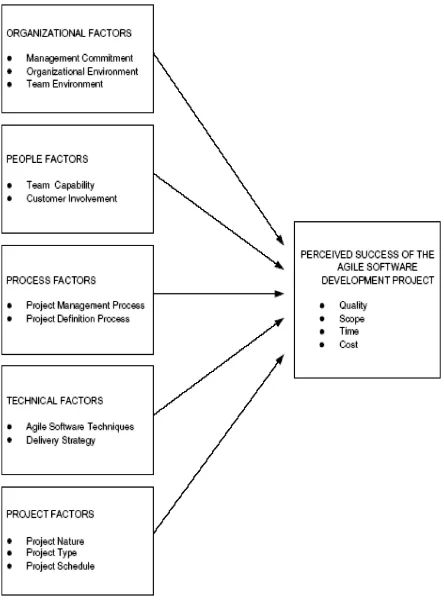
[image:2.595.320.542.214.516.2]development methods have gained popularity and have become increasingly important to a significant number of software development organizations [13, 14]. In a short time, agile development has attracted huge interest from the software industry. A survey in the USA and Europe reveals that 14% of companies are using agile methods, and that 49% of the companies that are aware of agile methods are interested in adopting them [15].The area of Agile software development methodologies has been researched to some extent [16] and has gained a lot of attention mainly because of its potential to improve customer satisfaction, decrease defects rates, and shorten development time along with its capability to assist rapidly changing requirements [17, 18, 19].
Fig 1: Chow and Cao’s Research Model
2.2
A
Model
for
Measuring
the
Effectiveness of Agile Methodologies
Chow and Cao [20] proposed a model for identifying the critical success factors for projects that use Agile methodologies (See Figure 1). They identified the following as key factors which may affect the success or failure of an Agile software project.
Organizational factors, such as management commitment and organizational environment,
People factors, such as team capability and customer involvement
Process factors, such as the project management process and project definition process
Technical factors such as Agile software development techniques and the delivery strategy
2.3
The Importance of Software Industries
and Software Process in Sri Lanka
Software industry is acknowledged worldwide to be the fastest growing sector. Throughout the last decade there was a trend for the software industry to move from advanced high wage countries, towards low waged countries in Asia. According to analysts this trend will continue during the coming decade. During the last decade India made the best use of the above scenario and was able increase software exports considerably, to achieve annual growth rate of over 50%. Though Sri Lanka is lagging far behind, it has the potential to improve the enabling factors and make software industry the main foreign exchange earner of the country within a relatively short period [21]. Realizing the important contribution of the software industry to the economic growth and how it can help the community, Sri Lanka has started focusing on it. This is important in order to transform the country into a developed and technological country.
In order to have smooth operation of software development and successful deployment of the industry in ICT, the needs of software processes are considered to be critical. The problems found from one study [22] show that Sri Lanka is still lacking the usage of software processes. Besides, the problems in terms of delivering quality products have also been identified [21]. In addition, recent investigation has discovered that companies in Sri Lanka do not have a clear methodology that shows how the requirements can be obtained [21].
The need for a good software process is important as it can help practitioners define their requirements. These problems have motivated us to introduce Agile methods in the country. As Agile emphasis on collaboration with customers and having works iteratively and incrementally, it will help to reduce some of the associated problems [21]. It is expected that the problems can be minimized with the application of the methods. To the best of the team member’s knowledge and based on a review of literature, the team found very little information and published studies about Agile methods used in Sri Lanka.
3.
METHODOLOGY
This section provides the road map to achieve the research objectives. The section presents the research design by describing the research approach, target population, sample size, sampling technique, data collection and data analysis methods.
Two methods were employed, initially conducting semi-structured interviews from each company and later collecting the team’s perception via an online survey.
This facilitated the involvement of many team members, allowing the comparison of their opinions. At the same time, through these of open-ended questions, it permitted maintaining a qualitative view on the project environment, without having to conduct interviews with every single team member.
In this study, the team conducted a qualitative semi structured interview to understand the perception of new adopters in Sri Lanka. As software development deals with human factors, a qualitative study therefore helps in understanding the respondents’ behavior, and to identify the unknown and never explored scenarios [22]. Unlike the quantitative approach, a qualitative study will help to describe what is actually happening when Agile methods was implemented [23].
Moreover, the systematic review also included qualitative and quantitative research studies, published up to and including 2013. Only studies written in English were included. The search strategy included electronic databases and hand searches of conference proceedings. The following electronic databases were searched:
ACM Digital Library
IEEE Xplore ISI Web of Science
In addition, the team searched many volumes of the following conference proceedings for research papers:
Agile Universe
Agile Development Conference
3.1
Study Design
Questions in this interview were developed from the findings obtained in the baseline study [7]. The issues identified in the baseline study have been the basic references and consequently created hypotheses investigating the perception of software practitioners when using Agile methods. This is a semi-structure interview and therefore the questions are adapted to the answers given by the participants. The interviews mainly focus on capturing the project specific demographics. These demographics include time and the cost factors. The semi structured interviews facilitated the research to gather answers not only for set of pre-defined questions, but also for some important hidden information. Then a preliminary questionnaire was designed to obtain relevant information for the research.
3.2
Participants
Since this is a qualitative study, the participants are purposely chosen rather than at random. The suggestion behind the qualitative study is to purposefully select participants. The participants chosen are based on the following criteria; software practitioners including developers, testers, system analyst, business analyst and project managers involved in Agile project. Taking benefits from their positions is consistent with the objective of the study. The benefit of this purposive sampling is to allow the researcher understanding the scenario from the right participants. The team conducted interviews with a software architect to collect in depth and in detailed information.
3.3
Data Collection
It was identified that the major software development companies in the island and considered the IT companies providing software development services.
analysis stages. As already mentioned above, the research collected data not only through interviews, but also by providing questionnaires to QA leads, Developers and Testers. The questionnaires were distributed mainly via e-mails and helped the research to obtain information from a large number of personnel.
3.4
Data Analysis
The data were transcribed and they were compared with the notes that were taken during the interview. It was ensured that only the relevant data were transcribed. The results were entered into spread sheet and the calculations were done. Data were presented using pie charts and bar charts with the help of Microsoft Excel. Results were categorized as follows:
The percentage of respondents classified according to their roles.
The percentage of respondents who adopt Agile methodologies in software development process.
The percentages of different Agile methods used by the respondents.
The percentage of reasons for using Agile methods.
The percentage of different problems faced. The percentage of different benefits obtained.
The percentage of respondents who thinks Agile Methodologies are important and vice versa.
The percentage of reasons for considering Agile Methodologies as important and vice versa.
The percentage of areas where Agile methods are expected to play an important role.
4.
RESULTS AND DISCUSSION
This section of the research paper will describe the research outcomes based on gathered information. Information was gathered using interviews and questionnaires. A total of 61 responses were received including the interview.
The information received from questionnaire responses were studied, analyzed and represented in graphical format as follows:
4.1
Sample Categorized by Roles
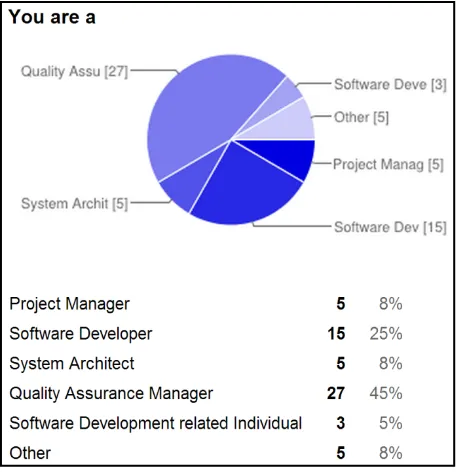
As shown in Fig 2 out of 60 respondents 45% are quality assurance managers, 25% are software developers, 8% are project managers and system architects. It can be depicted that 92% of the respondents are surely involved in software development processes.
[image:4.595.316.544.72.308.2]The balance 8% maybe or may not be involved in software development processes but definitely related to IT and software.
Fig 2: Proportion of respondents in terms of their roles
[image:4.595.312.547.72.530.2]4.2
Agile
Methodologies
Practitioner
Statistics
Fig 3: Proportion of respondents based on usage of agile methodologies
As displayed in Fig 3 68% of the respondents are currently using and involved with Agile methodologies in their developing process. These shows that almost ¾ of the population are adopting Agile methodologies as a working practice. However 32% has responded that Agile methodologies is not being used in their development process which means that there is more than ¼ of the population which has to be motivated to adopt Agile methodologies by highlighting its importance and significance.
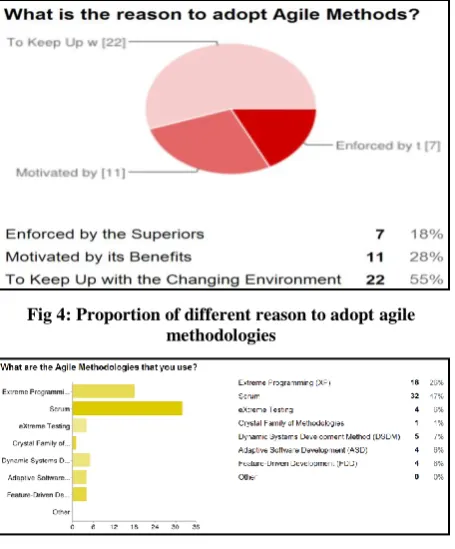
41 out of 60 which are 68% of the respondents were using Agile methodologies and therefore classified as Agile methodology practitioners. These practitioners were further studied by analysing the different reasons which made them adopt Agile methods. It was found that “To keep up with the changing environments” was leading the way at 55% followed by “Motivated by its benefits” at 28%.
Fig 4: Proportion of different reason to adopt agile methodologies
Fig 5: Proportion of different types of agile methodologies used by agile method practitioners
The practitioners were further studied by analysing the different types of Agile methods that they use. It was found that “Scrum” was leading the way at 47% followed by “XP” at 26% and “DSDM” at 7%. “Crystal family of methodologies” was the least used at 1%. However the results seem to be fragmented and Fig 5 shows that Scrum and XP being the most used Agile methods.
4.3
Challenges and Benefits Involved in
Agile Methodologies
Fig 6: Proportion of different types of challenges faced by respondents
[image:5.595.318.544.327.453.2]According to Fig 6 the main issues faced in the adoption of Agile methodologies out of 68% of the respondents are “Costly”, “Insufficient team support” and “Repetition of work” at 45%, 30%, 12% respectively. It can be depicted from this result that more importance should be given to cost management and team building activities.
Fig 7: Proportion of different types of benefits obtained by respondents
The study shows that positive reasons for adoption of Agile methodologies are mainly due to improvement in customer satisfaction which is at 38% according to Fig 7. The other major reasons are clearly represented in the chart above. The “Shortened development time” is the lowest at 18%.
[image:5.595.57.283.454.567.2]4.4
Factors Negatively Affecting the Usage
of Agile Methodologies
Fig 8: Proportion of negative factors contributing to non-agile method practitioners
The reasons for not using Agile methodologies in the development process were studied and therefore the remaining 19 out of 60 which are 32% of the respondents were classified as practitioners. 68% of the non-practitioners stated that they had no idea of Agile methodologies. This shows that majority of the population are unaware of Agile methodologies concept and its use. 11% of the non-practitioners believed that Agile methodologies is of less importance in the software development project and the benefits obtained by using them doesn’t make any difference in the process. This shows that the benefits of using Agile methodologies have not been clearly absorbed by the population. 21% of the reasons indicated in Fig 8 shows that Agile methodologies has not been adopted as a traditional working practice in the organizations like Software Houses. They have been neglected and thus the importance of Agile methodologies and its positive outcomes are over seen. All these factors increase the need of highlighting the importance and benefits of Agile methodologies in a software development project and this research paper exactly does that.
4.5
Non-Practitioners Perception of Agile
Methodologies
Fig 9: Proportion of respondents based on importance of agile methodologies
[image:6.595.55.283.72.183.2]36% of the non-practitioners who perceive Agile methods as important say that they are useful and provides guidance in coding area whereas both analysis and design manipulates up to 17%. Testing seems to be the lowest affected area at 13% according to Fig 10.
Fig 10: Proportion of different areas where agile methods are perceived to be important
The team managed to interview Mrs. Thushari, Software Architect, IT Systems, Sri Lankan Airlines, Katunayake. The information that was extracted from the interview is described below:
Why do you think adopting an Agile method is useful?
Agile defines the software architecture. It helps people in planning. It allows them to learn from small releases and they are able to adjust from market’s feedback.
Explain about the Agile process?
Agile also follows the software development life cycle like requirement gathering, analysis, design, coding and testing but delivers a small release and waits for customer’s feedback. In the whole process satisfaction is the highest priority with faster development.
Are there any particular tools available which can support Agile planning?
Yes there are tools like Rally Software, Version One and XPlanner.
Are there any disadvantages or challenges in Agile?
Yes there are few like inadequate test coverage, code broken accidentally due to frequent builds, early detection of defects, inadequate API testing and performance bottlenecks.
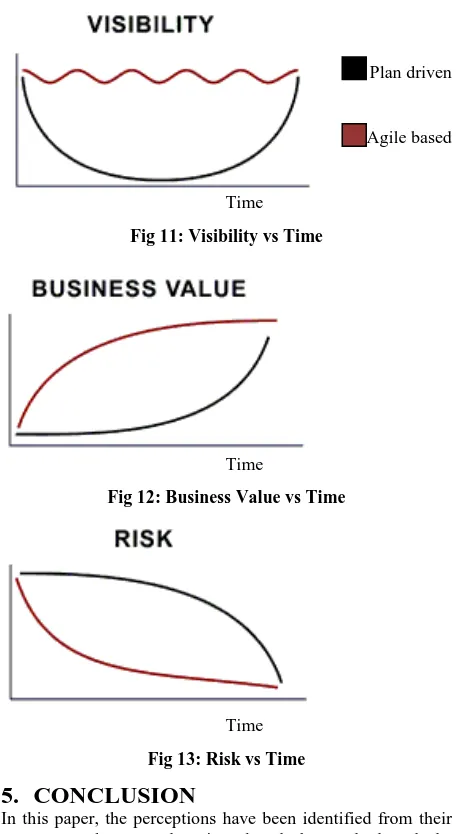
After the interview the team was able to come up with an idea of how plan driven project and agile based project differs as shown in Fig 11, 12 and 13 below:
Plan driven
Agile based
Time
Fig 11: Visibility vs Time
[image:6.595.315.543.74.491.2]Time
Fig 12: Business Value vs Time
Time
Fig 13: Risk vs Time
5.
CONCLUSION
In this paper, the perceptions have been identified from their awareness, the way they introduced the method and the challenges they are facing. The lessons learnt about perceptions are important to serve as guidelines for the adoption of Agile methods in the country.
This study indicates a low perception from Agile users towards the methodologies and that there is difficulty of getting everyone in the team to take responsibilities. The findings also show that people need to be confident when trying to use Agile methods. This is so as they need to see something working and proven success stories from the Agile users. From this study, the challenges are mostly found from the organizations having hierarchical approach. Here the management is expected to set the datelines and control the process, therefore Agile is hard to be accepted. It was found that the challenges from lack of documentation, organizational aspect, involvement, knowledge and culture are all based in or related to people factor where the mindset change is needed to overcome those challenges.
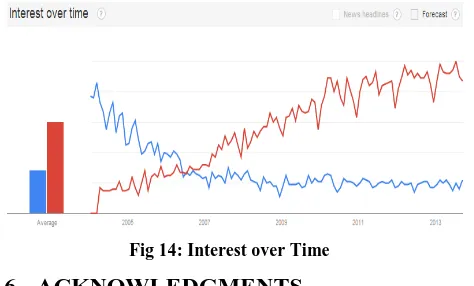
However, recent Google Trend Research show increasing interest of software development companies towards Agile based software development (See Figure 14).
[image:6.595.54.284.274.354.2]Fig 14: Interest over Time
6.
ACKNOWLEDGMENTS
We would like to express our sincere sense of gratitude to our institution - Sri Lanka Institute of Information Technology (SLIIT). We are deeply indebted to our supervisor Mr. Dilhan Manawadu, whose help, stimulating suggestions, knowledge, experience and encouragement helped us in all the times of study and analysis of the project in the pre and post research period. We are also grateful to him since his lectures on Software Quality Assurance helped us to a great extent in the research. Very special thanks to the lecture panel, colleagues of SLIIT, Mrs. Thushari of Sri Lankan Airlines an Zone24x7.
7.
REFERENCES
[1] R. N. Charette, "Why software fails [software failure]," Spectrum, IEEE, vol. 42, no. 9, pp. 42-49, September
2005. [Online]. Available:
http://dx.doi.org/10.1109/MSPEC.2005.1502528
[2] A. Begel and N. Nagappan, "Usage and Perceptions of Agile software development in an Industrial Context: An Exploratory Study", in Empirical Software Engineering and Measurement, 2007. ESEM 2007. First International Symposium on, 2007, pp. 255-264.
[3] A. Cockburn and J. Highsmith, "Agile software development: The people factor," Computer, vol. 34, pp.131-133, Nov 2001.
[4] R. Sison, S. Jarzabek, O. S. Hock, W. Rivepiboon, and N.N. Hai, "Software practices in five ASEAN countries: an exploratory study," in Proceedings of the 28thinternational conference on Software engineering Shanghai, China: ACM, 2006.
[5] V. Casey, "Leveraging or Exploiting Cultural Difference?," IEEE Computer Society, 2009, pp. 8-17.
[6] M. Phongpaibul and B. Boehm, "Improving quality through software process improvement in Thailand: initial analysis." vol. 30: ACM, 2005, pp. 1-6.
[7] A. L. Asnawi, A. M. Gravell, and G. B. Wills, "Empirical Investigation on Agile Methods Usage: Issues Identified from Early Adopters in Malaysia," in Agile Processes in Software Engineering and Extreme Programming, 2011,pp. 192-207.
[8] G. Melnik and F. Maurer, "Perceptions of agile practices: a student survey," in Extreme Programming and Agile Methods - XP/Agile Universe 2002. Second XP Universe and First Agile Universe Conference. Proceedings, Chicago, IL, USA, 2002, pp. 241-250.
[9] B. Bahli and E. S. AbouZeid, "The role of knowledge creation in adopting extreme programming model: An empirical study," in ITI 3rd International Conference on
Information and Communications Technology (ICICT2005), Cairo, EGYPT, 2005, pp. 75-87.
[10] K. Mannaro, M. Melis, and M. Marchesi, "Empirical analysis on the satisfaction of IT employees comparing XP practices with other software development methodologies," in 5th International Conference Extreme Programming and Agile Processes in Software Engineering, Garmisch-Partenkirchen, GERMANY, 2004, pp. 166-17
[11] C. Larman and V. R. Basili, “Iterative and Incremental development: A Brief History”, Computer, vol 36, no. 6, pp. 47-56, June 2003.
[12] A. Cockburn, “Agile software development: The Cooperative Game. Agile development Series”. Cockburn, A. and Highsmith, J., eds, 2nd ed., Boston: Addison-Wesley 2007.
[13] A. Marchenko and P. Abrahamsson, "Scrum in a multi project environment: An ethnographically-inspired case study on the adoption challenges," in Agile, 2008. AGILE '08. Conference, August 2008, pp. 15-26.
[Online]. Available:
http://dx.doi.org/10.1109/Agile.2008.77
[14] B. Boehm, "Get Ready for Agile Methods, with Care," IEEE Computer, pp. 64- 69, January, 2002.
[15] North American and European Enterprise Software and Services Survey, Business Technographics Ed., 2005.
[16] T. Dybå and T. Dingsøyr, "Empirical Studies of Agile software development: A Systematic Review", Information and software Technology, 2008, doi:10.1016/j.infsof.2008.01.006
[17] B. Boehm and R. Turner. (2004) “Balancing agility and discipline: Evaluating and integrating agile and plan-driven methods”, Proceedings of the 26thInternational Conference on Software Engineering, 718-719.61
[18] M. Lindvall, D. Muthig, A. Dagnino, C. Wallin, M. Stupperich, D. Kiefer, J.May, and T. Kahkonen, "Agile software development in Large Organizations", Computer, vol. 37, pp. 26-34, 2004.
[19] C. Mann and F. Maurer, "A case study on the impact of scrum on overtime and customer satisfaction," in ADC '05: Proceedings of the Agile development Conference. Washington, DC, USA: IEEE Computer Society, 2005, pp. 70-79. [Online]. Available:
[20] L Munasinghe, P. L. S. Peter, T. D. S. Perera, "A Growth Prospects for the Software Industry in Sri Lanka and an Appropriate Policy Framework". [Online]. Available:
www.sab.ac.lk/Acade-Activity/susl_journal/vol_3.1/arti_7.doc
[21] G.A.L. Senanyake, "The Effectiveness of Scrum Project Management in Sri Lankan Context". [Online]. Available:
www.ccs.neu.edu/home/rukmal/.../AshaSenanayake_MB A_Thesis.pdf
[22] J. Creswell, Research design: Qualitative, quantitative, and mixed methods approach: Sage Pubns, 2008.