http://dx.doi.org/10.4236/jamp.2014.27064
How to cite this paper: Liu, Z.L. and Zhang, H. (2014) Steffensen-Type Method of Super Third-Order Convergence for Solv- ing Nonlinear Equations. Journal of Applied Mathematics and Physics, 2, 581-586.
http://dx.doi.org/10.4236/jamp.2014.27064
Steffensen
-Type Method of Super
Third-Order C
onvergence for
S
olving
N
onlinear
E
quations
Zhongli Liu*, Hong Zhang
College of Biochemical Engineering, Beijing Union University, Beijing, China Email: *[email protected]
Received 5 March 2014; revised 5 April 2014; accepted 12 April 2014 Copyright © 2014 by authors and Scientific Research Publishing Inc.
This work is licensed under the Creative Commons Attribution International License (CC BY).
http://creativecommons.org/licenses/by/4.0/
Abstract
In this paper, a one-step Steffensen-type method with super-cubic convergence for solving nonli-
near equations is suggested. The convergence order 3.383 is proved theoretically and demon-
strated numerically.This super-cubic convergence is obtained by self-accelerating second-order Steffensen’s method twice with memory, but without any new function evaluations. The proposed method is very efficient and convenient, since it is still a derivative-free two-point method. Its
theoretical results and high computational efficiencyisconfirmed by Numerical examples.
Keywords
Newton’s Method, Steffensen’s Method, Derivative Free, Super-Cubic Convergence,
Nonlinear Equation
1. Introduction
Finding the root of a nonlinear equation
( )
0f x = (1) is a classical problem. It is well-known in scientific computation that Newton’s method (NM, see [1]):
( )
( )
1 , 0,1, 2, ,
n n n
n
f x
x x n
f x
unavailable or is expensive to be obtained, the derivative-free method is necessary. If the derivative f′
( )
xn isreplaced by the divided difference in (2), Steffensen’s method (SM, see [1]) is obtained as follows:
( )
( )
1 , 0,1, 2, ,
,
n
n n
n n
f x
x x n
f x x f x
+ = − + =
(3) NM/SM converges quadratically and requires two function evaluations per iteration. The efficiency index of them is 2=1.414.
Besides H.T. Kung and J.F. Traub conjectured that an iterative method based on m evaluations per iteration without memory would arrive at the optimal convergence of order 1
2m− (see [2]), Traub proposed a self-acce- lerating two-point method of order 2.414 with memory (see [3]):
( )
( )
[
]
1
1
, 1
, ,
n n n
n n n n
n n
f x
x x
f x f x
f x z
β
β +
−
= −
+
= −
(4)
where zn−1=xn−1+βn−1f x
(
n−1)
, and β0 = −sign(
f′( )
x0)
or −1 f x x 0, 0+ f x( )
0 , etc.A lot of self-accelerating Steffensen-type methods were derived in the literature (see [1]-[7]). Steffensen-type methods and their applications in the solution of nonlinear systems and nonlinear differential equations were discussed in [1] [4] [5] [8]. Recently, by a new self-accelerating technique based on the second-order Newtonian interpolatory polynomial N2
( )
x = f x( )
n + f x z[
n, n−1]
(
x−xn)
+ f x z[
n, n−1,xn−1]
(
x−xn)(
x−zn−1)
, J. Džunića and M.S. Petkovića proposed a cubically convergent Steffensen-like method (see [7]):( )
( )
[
] [
] [
]
1
1 1 1 1
, ,
1
,
, , ,
n n n
n n n n n
n n n n n n
f x
x x
f x x f x
f x z f x x f x z
β
β +
− − − −
= −
+
= −
+ −
(5)
In this study, a one-step Steffensen-type method is proposed by doubly-self-accelerating in Section 2, its su-per-cubic convergence is proved in Section 3, and numerical examples are demonstrated in Section 4.
2.
The Method of
Steffensen
-Type
By the first-order Newtonian interpolatory polynomial N1
( )
x = f x( )
n + f x z[
n, n]
(
x−xn)
and( )
n n n n
z =x +β f x , we have f x
( )
=N1( )
x +R x1( )
,where
( )
( )
( )
[
]
(
)(
)
1 1 n, n, n n
R x = f x −N x = f x z x x−x x−z . So, with some µn≈ f x z x
[
n, n,]
,( )
( )
[
]
(
)
(
)(
)
2 n n, n n n n n
N x = f x + f x z x−x +µ x−x x−z (6) should be better than N1
( )
x to approximate f x( )
.Therefore, we suggest
( )
( )
2 1
2
,
n n n
n
N x
x x
N x
+ = − ′
i.e., a two-parameter Steffensen’s method:
( )
[
]
(
)
1 , 0,1, 2, ,
,
n n n
n n n n
f x
x x n
f x z µ x z
where zn =xn+βnf x
( )
n ,{ }
βn and{ }
µn are bounded constant sequences. The error equation of (7) is( )
(
)
( )
( )
2( )
31 1
2
n n n n n n
f a
e f a e O e
f a
β µ β
+ ′′ ′ = + − + ′
. By defining µ =0 0 and
[
]
[
] [
1]
(
)
1 ,
, , 0
,
n n n
n n n n
n n n
f x z
f z x z n f x z
β µ
β −
+
= > recursively as the iteration proceeds without any new evaluation to vanish the asymptotic convergence constant, we establish a self-accelerating Steffensen’s method with super quadratic convergence as follows:
( )
[
]
[
]
(
[
] [
]
)
1
1 1
, 0,1, 2, , 1
, 1 , ,
,
n
n n
n n n n n n
n n n
f x
x x n
f x z f z z f x z
f x z β + − − = − = − + −
(8)
Furthermore, we propose a one-step Steffensen-type method with super cubic convergence by doubly-self- accelerating as follows:
( )
[
]
(
(
[
]
)
)
(
[
] [
]
)
[
] [
] [
]
1
1 1
1 1 1 1
, 1 1 , , ,
1
, , ,
n
n n
n n n n n n n n n
n
n n n n n n
f x
x x
f x z f x z f z z f x z
f x z f x z f x x
β β + − − − − − − = − − + − = − − (9)
3.
Its
Super Third-Order C
onvergence
Lemma 3.1
( )
(
3 1 1)
1
1 z ,
n f c en en
f a
β − ′ + − − where
( )
( )
( )
, ! k k f a ck f a =
′ en=xn−a and .
z
n n
e =z −a
Proof. By Taylor formula, we have
[
] [
] [
]
( )
(
)
( )
(
)
(
)
(
)
( )
(
)
( )
(
)
(
)
(
)
( )
(
) (
)
1 1 1 1
1 1 1 1
1 1 1 1
1 1 1 1
1 1 1 1
2 2 3 3
1 2 1 3 1
1
1 2
, , ,
n n n n n n
n n n n n n
n n n n n n
n n n n n n
z z
n n n n n n n n n n n n
n n z
n n
f x z f x x f x z
f x f x f x f z f z f x
x x x z z x
f x f x f x f z f z f x
e e e e e e
e e c e e c e e
f a
e e
e e c
− − − − − − − − − − − − − − − − − − − − − − − − − + − − − − = + − − − − − − − = + − − − − − + − + − + ′ = − − + +
( )
(
)
(
( )
)
( )
(
)
(
( )
)
( )
(
)
2 3 2 31 3 1
1
2 3
2 3
1 1 2 1 1 3 1 1
1 1
3 1 1
+
1 .
z z
n n n n z
n n
z z z
n n n n n n z
n n z
n n
e e c e e
e e
e e c e e c e e
e e
f a c e e
− − − − − − − − − − − − − − − + − − + − + − + − − ′ − So,
[
] [
] [
]
( )
(
3 1 1)
1 1 1 1
1 1
1 .
, , ,
z
n n n
n n n n n n
f c e e
f x z f x z f x x f a
β − −
− − − −
= − +
′
− −
Theorem 3.2 Let f D: →R be a sufficiently differentiable function with simple root a∈D, D⊂R be an open set, x0 be close enough to a, then (9) achieve the convergence of order 3.383.
Proof. If zn converges to a with order p>1 as:
( )
,z p p
n n n n
e =C e +o e
and if xn converges to a with order r>2 as:
( )
1 ,
r r
n n n n
e+ =D e +o e
Then
(
1 1)
( )
1 1 1( )
1 ,p
z r rp p rp rp n n n n n n n n n
e =C D−e− +o e− =C D−e− +o e−
(
)
( )
2 2( )
21 1 1 1 1 1 1 .
r
r r r r r
n n n n n n n n n
e+ =D D−e− +o e− =D D−e− +o e−
By Taylor formula and Lemma 3.1, we also have
[
]
(
)
(
)
(
)
1
3 1 1 1 1 1 1
1 1
3 1 1 1 1
1 ,
.
z p r r p
n n n n n n n n n n
r p r p
n n n n
e f x a e c e C e D e o e
c C D e o e
β + +
− − − − − − + + + + − − − − = + = − + = − − +
[
]
[
]
(
(
[
]
)
)
(
[
] [
]
)
[
]
(
(
[
]
)
)
(
[
] [
]
)
[
]
[
]
(
(
[
]
)
)
(
[
] [
]
)
[
]
(
(
[
]
)
)
[
]
(
[
]
)
[
]
(
(
[
]
)
)
[
]
1 1 1 1 1 1 1 1 1 ,, 1 1 , , ,
, 1 1 , , , ,
, 1 1 , , ,
, , 1 1 , , , ,
, 1 1 , ,
n n
n n
n n n n n n n n n
n n n n n n n n n n
n
n n n n n n n n n
z
n n n n n n n n n n n
n
n n n n n n n
f x a e
e e
f x z f x z f z z f z x
f x z f x z f z x f z z f x a
e
f x z f x z f z z f z x
f x z a e f x z f z x z f x a
e
f x z f x z f z z
β β β β β β + − − − − − − − − = − − + − + + − − = − + − + + − = − +
(
[
]
)
[
]
(
[
]
)
(
[
]
)
[
[
]
] [
]
[
]
(
(
[
]
)
)
(
[
] [
]
)
[
]
(
)
[
]
(
[
(
] [
[
]
)
] [
)
[
] [
] [
(
] [
]
]
)
1 1 1 1 1 2 2 1 1 2 , ,, , 1 , 1 , , ,
,
, 1 1 , , ,
, , , , , ,
1 ,
, 1 1 , , , ,
1 ,
n n
n
n n n n n n n n n n n n
n n n
n n n n n n n n n
n n n n n n n n
n n n
n n n n n n n n n n n
n n n
f z x
f x a
f x z a f x a e f x z f z x z e
f x z e
f x z f x z f z z f z x
f x z a f x z f x a f z x z
e f x a
f x z f x z f x z f z z f z x
e f x
β β β β β β − − − − − − − − + − + − = − + − − = + − + − =
(
+[
]
)
[
]
[
] [
]
[
]
(
(
[
]
)
)
[
] [
(
] [
]
)
(
)
( ) ( )
( )
(
)
2 1 1 2 1 1 12 2 2 2 2 2 1 2 2 1
3 1 1 2 3 1 1 1 1
, , , , ,
, 1 1 , , , ,
3!
z z
n n n n n n n n
n n n n n n n n n n n
z n
z r p r p
n n n n n n n
f x z a e f x a f z x z e a
f x z f x z f x z f z z f z x
f a
f a e
e c e e c C D e o e
f a β − − − − − + + + + − − − − − − − − + − ′′′ ′ − + = − + = + ′ + .
So, comparing the exponents of en−1 in expressions of
z n
e and en+1 for (9), we obtain the same system of
two equations:
2
1, 2 2 1.
rp r p
r r p
= + +
= + +
From its non-trivial solution r≈3.383 and p≈1.839, we prove that the convergence of (9) is of order 3.383.
4. Numerical
E
xamples
Related one-step methods only using two function evaluations per iteration are showed in the following numeri- cal examples. The proposed method is a derivative-free two-point method with high computational efficiency.
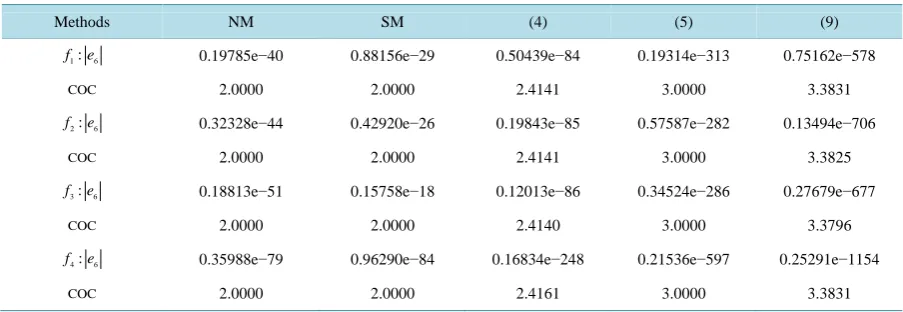
Example 1. The numerical results of NM, SM, (4), (5) and (9) inTable 1 agree with the theoretical analysis. The computational order of convergence is defined by
(
)
(
1 12)
log
COC .
log
n n n n
e e
e e
−
− −
=
Example 2. The numerical results of NM, SM, (4), (5) and (9) are in Table 2 for the following nonlinear functions:
( )
(
2)
1 0.5 e 1 , 2, 0 2.5,
x
f x = − − a= x =
( )
22 e sin 1, 0, 0 0.25,
x
f x = + x− a= x =
( )
22
3 e 1, 1, 0 0.85,
x x
f x = − + + − a= − x = −
( )
4 e arctan 1, 0, 0 0.2.
x
[image:5.595.86.540.319.590.2]f x = − − x− a= x = −
Table 1.
( )
20
ex 3 1, 0, 0.2
f x =x − − − x+ a= x = .
Methods n 1 2 3 4 5 6
NM xn−a 0.53279e−2 0.35561e−5 0.15808e−11 0.31235e−24 0.12195e−49 0.15890e−100
COC 2.25256 2.01691 0.15808e−11 2.00000 2.00000 2.00000
SM xn−a 0.28174e−1 0.51325e−3 0.16476e−6 0.16966e−13 0.17989e−27 0.20226e−55
COC 1.21776 2.04376 2.00830 2.00009 2.00000 2.00000
(4) xn−a 0.28174e−1 0.15996e−4 0.13132e−12 0.43283e−32 0.38442e−79 0.99936−193
COC 1.21776 3.81335 2.49109 2.40945 2.41512 2.41406
(5) xn−a 0.28174e−1 0.16560e−6 0.11521e−21 0.39821e−67 0.16444e−203 0.11580e−612
COC 1.21776 6.14536 2.89776 2.99925 3.00000 3.00000
(9) xn−a 0.28174e−1 0.43010e−7 0.21604e−27 0.23153e−94 0.20021e−321 0.69689e−1090
COC 1.21776 6.83322 3.49004 3.29917 3.39052 3.38434
Table 2. Numerical results for solving f xi
( )
,i=1, 2,3, 4.Methods NM SM (4) (5) (9)
1: 6
f e 0.19785e−40 0.88156e−29 0.50439e−84 0.19314e−313 0.75162e−578
COC 2.0000 2.0000 2.4141 3.0000 3.3831
2: 6
f e 0.32328e−44 0.42920e−26 0.19843e−85 0.57587e−282 0.13494e−706
COC 2.0000 2.0000 2.4141 3.0000 3.3825
3: 6
f e 0.18813e−51 0.15758e−18 0.12013e−86 0.34524e−286 0.27679e−677
COC 2.0000 2.0000 2.4140 3.0000 3.3796
4: 6
f e 0.35988e−79 0.96290e−84 0.16834e−248 0.21536e−597 0.25291e−1154
[image:5.595.87.539.560.716.2]5
.
Conclusion
By theoretical analysis and numerical experiments, we confirm that the proposed method which is a derivative- free two-point method has high computational efficiency. Its convergence order is 3.383 and its efficiency index is 1.839. We can see that the suggested method is suitable to solve nonlinear equations and can also be used for solving boundary-value problems of nonlinear ordinary differential equations.
References
[1] Ortega, J.M. and Rheinboldt, W.G. (1970) Iterative Solution of Nonlinear Equations in Several Variables. Academic Press, New York.
[2] Kung, H.T. and Traub, J.F. (1974) Optimal Order of One-Point and Multipoint Iteration. Journal of the ACM, 21, 634-651. http://dx.doi.org/10.1145/321850.321860
[3] Traub, J.F. (1964) Iterative Methods for the Solution of Equations. Prentice-Hall, Englewood Cliffs.
[4] Zheng, Q., Wang, J., Zhao, P. and Zhang, L. (2009) A Steffensen-Like Method and Its Higher-Order Variants. Applied Mathematics and Computation, 214, 10-16. http://dx.doi.org/10.1016/j.amc.2009.03.053
[5] Zheng, Q., Zhao, P., Zhang, L. and Ma, W. (2010) Variants of Steffensen-Secant Method and Applications. Applied Mathematics and Computation, 216, 3486-3496. http://dx.doi.org/10.1016/j.amc.2010.04.058
[6] Petković, M.S., Ilić, S. and Džunić, J. (2010) Derivative Free Two-Point Methods with and without Memory for Solv- ing Nonlinear Equations. Applied Mathematics and Computation, 217, 1887-1895.
http://dx.doi.org/10.1016/j.amc.2010.06.043
[7] Džunić, J. and Petković, M.S. (2012) A Cubically Convergent Steffensen-Like Method for Solving Nonlinear Equa- tions. Applied Mathematics Letters, 25, 1881-1886.
[8] Alarcón, V., Amat, S., Busquier, S. and López, D.J. (2008) A Steffensen’s Type Method in Banach Spaces with Appli- cations on Boundary-Value Problems. Journal of Computational and Applied Mathematics, 216, 243-250.