Development Of Contextual Teaching And Learning
(CTL) Learning Instruments With Predict, Observe,
Explain (POE) Strategy To Training Critical
Thinking Skills
Muhammad Iqbal Faizin*, Wasis*, Eko Hariyono*
*
Postgraduate Study of Science Education, Postgraduate, State University of Surabaya, Indonesia
DOI: 10.29322/IJSRP.9.09.2019.p93107 http://dx.doi.org/10.29322/IJSRP.9.09.2019.p93107
Abstract- This research aims to: (1) analyze validity instruments consist of Syllabus, Learning Implementation Plan (RPP), Student Worksheet (LKS), handout, and critical thinking skills instrument. (2) Practicality analysis consist of implementation of Learning Implementation Plan (RPP), student’s responses, and obstacles were encountered during teaching and learning process carried out with this learning instruments. (3) Effectiveness analysis consist of critical thinking skills analysis and the item of the geometrical optics test sensitivities The material used in this study is geometrical optics. The type of this research using 4D design (design, define, develop, and dessiminate). Therefore, the research samples are the students of Class VIII students at Alam Insan Mulia Surabaya, East Java, Indonesia, academic year 2018/2019. The validity of the Contextual Teaching And Learning (CTL) learning instruments with Predict, Observe, Explain (POE) strategy developed is valid. The practicality of learning devices as follows: (1) Implementation of the Implementation of Learning Implementation Plan (RPP) developed by 3.9 and the percentage of reliability amounted to 98.23%. The results of observations of the implementation of this RPP indicate that learning that has been implemented can be stated very well and practical. (2) Obstacles found in implementing learning instruments developed as follows: (a) The atmosphere of KBM is quite conducive, but there are still some students do other activities outside the context of learning. (b) Some student’s answers are not by the results of observations and experiment. (c) The unequal ability of students to think critically. (d) The predictions produced by students are not by that the researcher wants. (e) The results of student’s responses with Contextual Teaching And Learning (CTL) with Predict, Observe, Explain (POE) strategies 82% with very strong criteria. (3) The effectiveness of the Contextual Teaching And Learning (CTL) learning instruments with the Predict, Observe, Explain (POE) strategy developed for practice student’s critical thinking skills: (a) Critical thinking skills analysis indicators used: Meeting I (coins in a glass): hypothesis of the shape of an object's shadow if it is associated with several liquid to observe the effect of light refraction, analyze the effect of light refraction on the coin, explain the effect of the refraction of light on coins, and make inferences or conclusions based on observations the right concept. and provide other alternatives. Meeting II (concave-convex mirror on the spoon): the shadow shape hypothesis if the concave mirror distance is changed, analyze observations of the shape of the shadow on the spoon, explain the experimental shape of the shadow on the spoon, make inferences or inferences from shadow forms. There is an increase in TKBK results with an average gain-score the high category that is equal to 0.74. (b) The item of the geometrical optics test sensitivities: The results of the calculation of the sensitivity of items from 4 items in a row are 0.54, 0.70; 0.48; and 0.75 with an average sensitivity value of the questions 0.62. The sensitivity value indicates that the item is sensitive used to measure student’s critical thinking skills with grades the sensitivity index ranges from 0.00 to 1.00 and the items are declared sensitive to the effects of learning if it has a sensitivity ≥ 0.30.
Index Terms- Development of Learning Instruments, Contextual Teaching and Learning (CTL), POE (Predict, Observe, Explain), Critical Thinking Skills
I. INTRODUCTION
concept that embodies, inspires, strengthen, and underlying thinking about how the learning method applied based on certain theories. The expected achievement of implementation this curriculum is students who have the creativity and ability to support their careers going forward [2].
A glimpse of the scientific approach can be seen focusing on student's thinking skills. Students are asked to ask questions, observing objects to prove the results of their thinking, analyzing results their observations, and communicate the results of their discussion. This matter shows that these steps are relevant in learning student’s critical thinking skills. Critical thinking is an ideal goal in education because prepare students for maturity [3]. Prepare learners for adult life does not mean giving to they are something that is ready but includes the students inside the fulfillment of his own development and the direction of his development alone or self-direction. In the process of critical thinking, it takes time enough is available in the analysis to reach conclusions as well the decision to act, this is what will train students to continue develop into someone with better competence. In-Law No.20 of 2003 concerning SISDIKNAS, explained that education is away planned to realize active learning and developing the potential of students to have religious-spiritual power, self control, personality, intelligence, noble character and necessary skills himself, society, nation, and state.
Physics is a systematic study of physical symptoms universe. The study and practice of science involves three main elements namely process, attitude, and product [4]. These three elements expected to be reflected in the learning process of science. Science learning process one of which can be implemented through the experimental method. Through a questionnaire has been distributed to 10 students randomly, it is known that students are still experiencing difficulty in conducting meaningful and systematic experiments, this questionnaire distributed at the Alam Insan Mulia Surabaya School that 3 of 10 students were declared difficulty in determining the experimental hypothesis while 4 students states do not yet understand what a hypothesis is and how systematic the experiment is and another student expressed understanding.
The unevenness of students' understanding of critical thinking skills contained in the distributed questionnaire, encourage researchers to find effective solutions so students can think critically and can build their knowledge to get results more meaningful learning. Critical thinking is capable of giving reasons, thinking reflectively and focused on what to decide what to do or what to believe [5]. To build student knowledge required the teacher's role in following up on the lack of critical thinking skills especially in physics. Students need to be encouraged to construct knowledge in his mind [6]. In line with the statement Schwarz and Gwekwerere, the theory of constructivism also revealed that: "Basically every individual since childhood can construct his knowledge. Knowledge which is constructed by students as subjects, it will become meaningful knowledge [7]. In the learning process with experimental methods, students are allowed to experience themselves or do itself, following a process, observing an object, analyzing, prove and draw your conclusions about an object, state or something process [8]. Students can be taught to construct their thoughts through experimental activities [9]. The same things, POE activities students are faced with the situation and asked to predict what will happen if changes are made towards the situation. When changes take place students are asked to observe carefully the process and results of the change. Furthermore, students are asked to mention and explain the differences between the results they expect it to happen with what happened. Therefore, this research use Contextual Teaching And Learning (CTL) Learning Instruments with Predict, Observe, Explain (POE) Strategy to training critical thinking skills.
II. EXPERIMENTAL METHOD 2.1 General Background of Research
The main purpose of this research to development of Contextual Teaching and Learning (CTL) learning instruments with Predict, Observe, and Explain (POE). This research was conducted in students at Alam Insan Mulia Surabaya, East Java, Indonesia, academic year 2018/2019. Development consist of validity instruments analysis, practicality analysis, and effectiveness analysis.
2.2 Sample of Research
The sample in this research was 10 students at Alam Insan Mulia Surabaya, East Java, Indonesia, academic year 2018/2019.
2.3 Instrument and Procedures
The development of Contextual Teaching and Learning (CTL) learning instruments with Predict, Observe, and Explain (POE) using 4D design (design, define, develop, and dessiminate). Validity instruments analysis consist of Syllabus, Learning Implementation Plan (RPP), Student Worksheet (LKS), handout, and critical thinking skills instrument. Practicality analysis consist of implementation of Learning Implementation Plan (RPP), student’s responses, and obstacles were encountered during teaching and learning process carried out with this learning instruments. Effectiveness analysis consist of critical thinking skills analysis and the item of the geometrical optics test sensitivities The material used in this study is geometrical optics.
2.4 Data Analysis
a. Validity Instruments Analysis
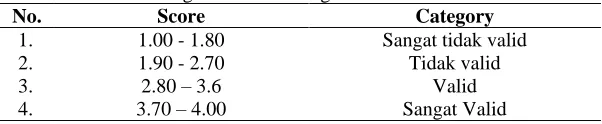
Table 1. Categories of Learning Instruments from Validator
No. Score Category
1. 1.00 - 1.80 Sangat tidak valid
2. 1.90 - 2.70 Tidak valid
3. 2.80 – 3.6 Valid
4. 3.70 – 4.00 Sangat Valid
b. Implementation of Learning Implementation Plan (RPP)
[image:3.612.152.456.190.252.2]The observational data of learning implementation obtained in the form scores in the range 1-4, with category 1 = tidak baik, 2 = kurang baik, 3 = baik, and 4 = sangat baik. Scores for each of the same aspects obtained from all the meetings that have been held, are averaged, then interpreted in the form of scores as follows:
Table 2. Interval Scores and Criteria for Average Implementation Learning Model
No. Score Category
1. 1.00 - 1.80 Sangat tidak valid
2. 1.90 - 2.70 Tidak valid
3. 2.80 – 3.6 Valid
4. 3.70 – 4.00 Sangat Valid
The reliability of the observations sheet of the lesson plan is calculated by the formula following [11].
𝑅 = (1 −𝐴 − 𝐵
𝐴 + 𝐵) 𝑥100% Information:
R: instrument reliability (percentage of agreement) A: higher score from validator
B: lower score from validator c. Student’s Responses Analysis
Data or information about student’s responses to learning obtained by distributing questionnaires to students. Student gives the response to learning by choosing an appropriate statement consists of two categories namely yes and no or called the Guttman scale. Students answer Yes is worth (1) and students answer Not worth (0). Data were analyzed based on the group of respondents who answered “Yes” and the group of respondents who answered “No”. Accordingly mathematically can be written as follows:
𝑃 =Σ𝐾
Σ𝑁𝑥100% Information:
P = percentage of student’s responses
K = Number of students who chose the answer Yes or No
N = Number of students who filled out the questionnaire
The percentage of student responses converted by criteria [12] as following: Figures 0 % - 20 % = Sangat lemah
Figures 21 % - 40 % = Lemah Figures 41 % - 60 % = Cukup Figures 61 % - 80 % = Kuat Figures 81 % - 100 % = Sangat kuat d. Critical Thinking Skills Analysis
The data of student’s critical thinking skills were analyzed through the rubric of critical thinking. The rubric of critical thinking skills used in this study multilevel scale, statement followed by columns which shows the scoring levels with the appropriate scaling scale with predetermined criteria, where a score of 4 if the student’s answers are “sangat benar”; score 3 if the student answers are “benar”; a score of 2 if the student answers are “cukup benar”, score 1 if the student answers are “kurang benar”. Data obtained in this study is quantitative data that is data about critical thinking skills test scores content based on optical topics. Level of student’s critical thinking skills analyzed descriptively quantitative with percentages to describe level of achievement of each indicator of critical thinking skills.
𝑐𝑟𝑖𝑡𝑖𝑐𝑎𝑙 𝑡ℎ𝑖𝑛𝑘𝑖𝑛𝑔 𝑠𝑘𝑖𝑙𝑙𝑠 =𝑠𝑐𝑜𝑟𝑒𝑠 𝑜𝑏𝑡𝑎𝑖𝑛𝑒𝑑 𝑏𝑦 𝑠𝑡𝑢𝑑𝑒𝑛𝑡𝑠 𝑡𝑜𝑡𝑎𝑙 𝑠𝑐𝑜𝑟𝑒𝑠
Table 3. Categories of Critical Thinking Skills
No. Score Category
1. ≤ 25.00 - ≤ 43.75 Sangat kurang kritis 2. ≤ 43.75 - ≤ 62.50 Kurang kritis
3. ≤ 62.50 - ≤ 81.25 Kritis
4. ≤ 81.25 - ≤ 100.00 Sangat kritis
Meanwhile, to find out the change in critical thinking skills score analyzed using the N-Gain equation [13]. 𝑁 𝐺𝑎𝑖𝑛 = 𝑠𝑐𝑜𝑟𝑒𝑝𝑜𝑠𝑠𝑡𝑒𝑠𝑡− 𝑠𝑐𝑜𝑟𝑒𝑝𝑟𝑒𝑡𝑒𝑠𝑡
𝑠𝑐𝑜𝑟𝑒𝑚𝑎𝑥𝑖𝑚𝑎𝑙− 𝑠𝑐𝑜𝑟𝑒𝑝𝑟𝑒𝑡𝑒𝑠𝑡
Table 4. Criteria of Score (N-gain) of Students Before and After Learning
No. Score Category
1. > 0.70 Tinggi
2. 0.30 – 0.70 Sedang
3. < 0.30 Rendah
e. Obstacles in learning process
Constraints during the implementation of teaching and learning activities were analyzed with descriptive qualitative that the observer and researcher give note the obstacles that occur in the implementation of learning as many as two meetings were accompanied by advice from observers.
III. RESULT AND DISCUSSION a. Validity Instruments Analysis
1. Syllabus
The syllabus developed in this study is in the form of a plan on a subject uses KTSP because of the curriculum in force in the place of this research is the KTSP curriculum which includes KD, subject matter, indicators, learning objectives, learning activities, assessment, time allocation, and learning resources. The average value of the results of the syllabus validation has been done based on the assessment of 2 validators. It can be seen that overall, syllabus developed has an average of 3.5 and the percentage reliability of 98.9%. The results of this validation indicate that the syllabus is developed valid so that it can be used in stages implementation.
2. Learning Implementation Plan (RPP)
Validation of Learning Implementation Plan (RPP) is carried out by two experts to examine the feasibility of the lesson plan before being piloted in the activity learning. This study aims to provide responses and input on the lesson plans that have been developed by researchers to be obtained instruments that meet the good category and are subsequently valid for use in learning. The RPP can be used in the data collection process at school because the results of the study by experts can be said to be valid.The overall validator's rating the RPP developed is 3.2 and is reliable with value by 94.57%. The results of this validation indicate that the RPP is developed valid so that it can be used in stages implementation.
3. Student Worksheet (LKS)
The following are the evaluations given by the validator towards the worksheet that has been produced (developed). The overall validator's evaluation of the worksheet developed is of 3.2 and reliable with a value of 96.24%. The results of this validation show that the worksheet developed is valid so that it can be used at implementation.
4. Handout
This study uses the material "Geometry Optics Material" on students class VIII at School of Nature Insan Mulia Surabaya academic year 2019/2020. Material which has been selected is displayed in the form of a handout developed by researchers. The overall validator's rating handout developed is 3.1 and reliable with a value of 96.18%. The results of this validation indicate that the LKS are developed valid so that it can be used in stages implementation.
5. Critical Thinking Skills Instrument
TKBK in this study aims to measure critical thinking skills is based on indicators of critical thinking according developed by researchers. The number of TKBK questions in this study was 4 question item. The 4 items (attachment) include 1 question with indicators analysis, 1 question with evaluation indicators, 1 question with indicators hypothesis/prediction, and 1 problem with the indicator concluded. The average values of the two validators against TKBK instruments are 3.4 and the results of the calculation of reliability TKBK equipment is 96.30%. Based on the review and assessment results the validator, the TKBK device can be said to be valid and can be used in this study
b. Practicality Analysis
1. Implementation of Learning Implementation Plan (RPP)
in 8 phases, namely:
Phase 1: Deliver the objectives and contextualization of learning material leftover (problem orientation) Phase 2: Predict
Phase 3: Observing
Phase 4: Formulate the problem and propose a hypothesis Phase 5: Perform experiments and collect data
Phase 6: Analyze data and formulate conclusions Phase 7: Communicate the results of the experiment Phase 8: Evaluation
In each phase above an explanation of the learning activities is described in the RPP. A whole observing the implementation of learning lesson plans amounting to 3.9 and the percentage of reliability of 98.23%. Observation results of the implementation of this RPP shows that learning that has been implemented can be stated very good and practical.
2. Student’s Responses
The implementation of learning in this study also took data about student responses to the learning process that has been followed. Students are asked to respond this learning by filling out the student response sheet. The average of student’s responses are 82% with strong catagories.
3. Obstacles
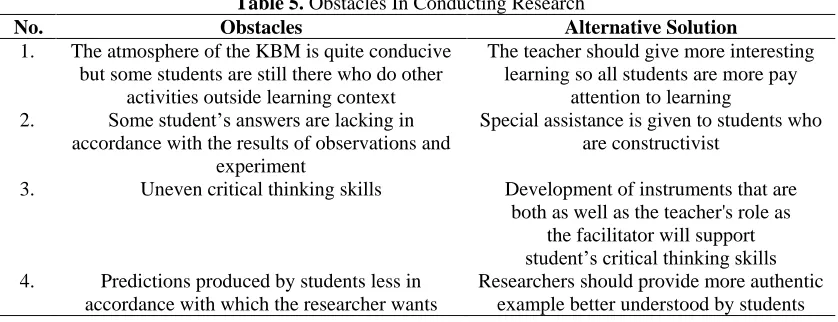
[image:5.612.98.517.276.437.2]During the process of learning activities in this study, of course not regardless of obstacles or obstacles that affect the success to achieve the expected learning goals.
Table 5. Obstacles In Conducting Research
No. Obstacles Alternative Solution
1. The atmosphere of the KBM is quite conducive but some students are still there who do other
activities outside learning context
The teacher should give more interesting learning so all students are more pay
attention to learning 2. Some student’s answers are lacking in
accordance with the results of observations and experiment
Special assistance is given to students who are constructivist
3.
4.
Uneven critical thinking skills
Predictions produced by students less in accordance with which the researcher wants
Development of instruments that are both as well as the teacher's role as
the facilitator will support student’s critical thinking skills Researchers should provide more authentic
example better understood by students
c. Effectiveness analysis
1. Critical Thinking Skills Analysis
Learning instruments developed by researchers must also meet effective element when used in learning activities. Effectiveness of the device this learning is known from TKBK result data. TKBK result data is used to measure student’s critical thinking skills. This treatment is carried out twice namely at the beginning before (pretest) and after learning (posttest) using Contextual Teaching and Learning (CTL) learning with the Predict, Observe, Explain (POE) strategy. The result of this analysis are 0,74 with high N-Gain.
2. The Item of The Geometrical Optics Test sensitivities
The TKBK also determines the sensitivity of the items used. This sensitivity is used to state that the question is appropriate to use in practicing critical thinking skills. Average the item of the geometrical optics test sensitivities have 0,62 and sensitive categories.
IV. CONCLUSION
with several liquid to observe the effect of light refraction, analyze the effect of light refraction on the coin, explain the effect of the refraction of light on coins, and make inferences or conclusions based on observations the right concept. and provide other alternatives. Second meeting (concave-convex mirror on the spoon): the shadow shape hypothesis if the concave mirror distance is changed, analyze observations of the shape of the shadow on the spoon, explain the experimental shape of the shadow on the spoon, make inferences or inferences from shadow forms. There is an increase in TKBK results with an average gain-score the high category that is equal to 0.74. (b) The item of the geometrical optics test sensitivities: The results of the calculation of the sensitivity of items from 4 items in a row are 0.54, 0.70; 0.48; and 0.75 with an average sensitivity value of the questions 0.62. The sensitivity value indicates that the item is sensitive used to measure student’s critical thinking skills with grades the sensitivity index ranges from 0.00 to 1.00 and the items are declared sensitive to the effects of learning if it has a sensitivity ≥ 0.30 [14].
ACKNOWLEDGMENT
Authors wishing to acknowledge assistance or encouragement from supervisor, colleagues and Acknowledgments section immediately following the last numbered section of the paper.
REFERENCES
[1] Subandono A 2007 Pengaruh Life Skill Diklat Kimia Produktif Dan Prestasi Belajar Diklat Kewirausahaan Terhadap Minat Berwirausaha Pada Siswa SMK Kimia Industri Theresiana Semarang [Skripsi] Semarang: Universitas Negeri Semarang
[2] Musfikon H M & Nurdyansyah 2015 Pendekatan Pembelajaran Saintifik Sidoarjo: Nizamila Learning Center (NLC)
[3] Tilaar J & Lody P H A R 2011 Pedagogik Kritis, Perkembangan Substansi dan Perkembangannya di Indonesia Jakarta: Rineka Cipta [4] Ibrahim M 2010 Dasar-Dasar Proses Belajar Mengajar Surabaya: Unesa University Press
[5] Ennis R H 1985 Goals for A Critical Thiking Curriculum Costa A L (Ed) Developing Minds A Resource Book for Teaching Thinking Alexandra Virginia: Assosiation for Supervisions and Curriculum Development (ASCD)
[6] Schwarz C V & Gwekwerere Y N 2006 Using a Guided Inquiry and Modeling Instructional Framework (EIMA) to Support Preservice K-8 Science Teaching Science Education Vol 9, 158 – 186 2007
[7] Mastuang M & M A S 2018 Meningkatkan Keterampilan Proses Sains Dengan Model Inkuiri Terbimbing Pada Siswa Kelas X PMIA 3 DI SMAN 3 Banjarmasin Berkala Ilmiah Pendidikan Fisika 4(3) 228
[8] Sanjaya W 2013 Strategi Pembelajaran Berorientasi Standar Proses Pendidikan Jakarta: Kencana [9] Djamarah S B & Aswan Z 2010 Strategi Belajar Mengajar Jakarta: Rineka Cipta
[10] Lexy J M 2006 Metodologi Penelitian Kualitatif Edisi Revisi Bandung
[11] Riduwan 2012 Skala Pengukuran Variabel-variabel Penelitian Bandung Alfabeta
[12] Borrich A G 1994 Observation Skill for Effective Teaching New York: Mac Millan Publishing Company
[13] Hake R R 1999 Analyzing Change/Gain Scores AREA-D American Education Research Association’s Devision D Measurement and Reasearch Methodology [14] Aiken L R 1997 Psychological Testing and Assesment (Ninth Edition) Boston: Allyn & Bacon
AUTHORS
First Author – Muhammad Iqbal Faizin, M.Pd., Postgraduate Study of Science Education, Postgraduate, State University of Surabaya,
Indonesia, and [email protected]
Second Author – Dr. Wasis, M.Si., Postgraduate Study of Science Education, Postgraduate, State University of Surabaya, Indonesia, and
Third Author – Dr. Eko Hariyono, M.Pd., Postgraduate Study of Science Education, Postgraduate, State University of Surabaya,