Detection of Diethyl 4-Nitrophenyl Phosphate
(Paraoxon) by Modified Polyaniline based
Nanocomposite Graphite Paste Electrode
K.S. Paithankara1, V.B. Deshmukha2, U.N.Shelkea3, S.B.Iyyera4, S.T.More5
1
Department of Physics Research Center, Ahmednagar College Ahmednagar(M.S.) India
2
Institute of Technology, Kuran, Pune (M.S.) India
3
Department of Chemistry, Shri Anand College, Pathardi (M.S.) India
4
Department of Physics, Shri Anand College, Pathardi (M.S.) India
Abstract: New graphite and conducting polyaniline based nanocomposite has been developed as electrochemical biosensor for the amperometric detection of paraoxon(D4-NPP) an organ phosphorous pesticide. The sensor being highly sensitive, selective with a low detection limit was successfully applied for paraoxon determination which occurs in commercial fruit, vegetables samples. An interference free pesticide biosensor has been developed, based on the immobilization of acetyl cholinesterase(AChE) on surface of modified electrodes. Effect of influence of pH and effect of potential on response of biosensor was investigated for optimization the process parameter for good operational stability of sensor. Organized materials were characterized by analytical techniques such as FT-IR, UV-Vis and FE-SEM analyses. The sensor responds for paraoxon in 0.2M phosphate buffer solution (PBS) (pH7) at the range 1x10⁻⁶ to 9x10⁻⁶M and the detection limit were found to be 1x10⁻⁶. About 90% of the enzyme activity is retained for about 40days.
Keywords: Sensors; nanocomposite; FT-IR.
I. INTRODUCTION
In present work the electrochemical cell was assembled in a conventional one compartment three electrode system design, the working electrode was modified paste electrode consist of composition of 70:25 (graphite: mineral oil)and polyaniline, this paste allowed to homogenize for few hours.
The paste was then filled in a teflon tip. A platinum wire was dissected inside the paste, to provide an electrical contact. Instead of platinum wire steel wire also used and sensing action recorded. Smooth and fresh electrode surfaces were obtained by pressing out 0.5mm of paste from the syringe, scraping off the excess and polishing it by butter paper until the surface has a shiny look and polyaniline composite in which the acetyl cholinesterase (AChE)immobilized; the Ag/AgCl used as the reference electrode; and a graphite use as the counter electrode.
Concentration of AChE immobilization on the composite surface carried out by dropping of the buffer solution containing the enzyme on the electrode surface, which further dried at a controlled temperature. No cross-linking agent (gluteraldehyde or di-amide) was necessary as use in earlier work[1-3]. This constitutes a real contribution from the composite surface to the productivity of the biosensor since the cross-linking mediators frequently bond themselves to the active sites of enzymes, thus inhibiting their movement.
II. EXPERIMENTAL
Paraoxon (99%), Acetyl cholinesterase was purchased from Sigma Aldrich, Graphite fine powder extra pure (particle size 240×10 -6
m) obtained from Lobachemie Pvt. Ltd. India, Paraffin liquid heavy or mineral oil (viscosity at 37°C is 64cS) purchased from High
purity lab, Mumbai, India. UV–Visible spectra (UV–Vis) were recorded in air at room temperature in the wavelength range of 200–
800 nm using a Jena specord 210 spectrophotometer.
FT-IR spectra were recorded on aOcean optics HPX-2000 (Fiber coupled) spectrometer in the range of 4000-500 cm-1. FE-SEM carried by JEOL JSM-7500F.
III. RESULTS AND DISCUSSION A. UV–Visible study
The optical absorption spectrum of synthesized PANI and Graphite/PANI/AChE electrode shown in Fig.1(a and b). The spectrum recorded in directly without any solution on i t . All spectra were recorded in the wave lengthrangeof300-800nm.The shoulder is appearing at 491nmforH2SO4 corresponds to the formation of ES (Emeraldine salt) phase irrespective of their organic supporting
electrolyte. It shows very good resemblance with earlier reported work[4-5]. The optical absorption spectrum of synthesized electrode is shown in Fig.1(b).The peak is appearing at310-380 nm forH2SO4and at 480 nm. It shows resemblance with earlier
reported work[6-7].
B. FT-IR study
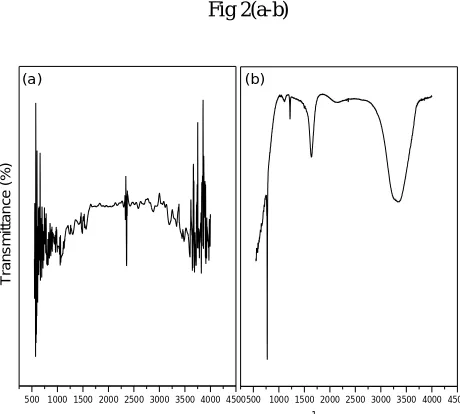
The FT-IR spectrum of freshly synthesized PANI shows in Fig.2(a)peak at 3150-3550 cm-1 corresponds to N-H stretching. The incorporation of the counter anion in the polymer is evidenced by the peaks. Further evidence of the presence of this anion in the polymer electrode is revealed by peaks at 1000-1500 and 1600-1640 cm-1 which may be assigned to SO2 stretch in sulphonates. The
vibration bands are observed at 1728- 1784 cm-1 (C=O), 1527-1548 cm-1 (N-H bending). These bands correspond to the characteristic bands for aniline; it shows very good agreement with earlier reported work [8-9]. Thus, the FT-IR spectral results confirm the presence of PANI. Fig. 2(b) shows FT-IR spectrum of synthesized PANI based electrode. A peak at 3351 cm-1 corresponds to N-H stretching. Electrode is revealed by peaks at 1219 and 1638 cm-1 which shows SO2 stretch in sulphonates.
C. SEM study
Fig. 3(a-b)shows FE-SEM images of surface of modified electrode with and without enzyme at 50 KX.Fig. 3(a) clearly shows porous morphology of electrode surface. This nature helpful for easily immobilization of enzymes for the biosensor application, The physical morphology of the native PANI and graphite embedded surface modified with and without enzyme (AChE) immobilization were characterized by scanning electron microscopy. When the enzyme was covalently immobilized over the surface of the PANI/graphite electrode the porous structure was disappeared and instead bright rectangular shape particles have been seen on the surface of the electrode Fig.3 (b) at the magnification of 50 KX, which may be assigned to enzyme (AChE) molecules. When AChE was immobilized onto the modified electrode, a morphology change in the electrode surface can be easily observed.
3.5Optimization of experimental parameter
D. Effect of potential
The response current increases rapidly with increase in potential, which indicates that the response of the AChE electrode was controlled by the electrochemical methods as shown in Fig. 4. It is well known that the velocity of an electrode reaction is related to the concentration of electro active species, the pH value of solution and applied potential[10-13].Above the potential 0.5V, the response was almost steady, which could be explained by the rate-limiting process of enzyme kinetics, diffusion-control of H2O2
and substrate[14-15]. Considering the decrease in response of the Graphite/PANI/AChE electrode at higher potential, which also has affected the electrochemical response of the enzyme electrode, we preferred to set the potential at 0.5 V for the further studies of Graphite/PANI/Ach Electrode.
D. Current response of Graphite/PANI/AChE electrodes
The change in response current of the active device AChE is the parameter of interest for sensor applications. The response current of the device depends on several factors such as (1) the contact resistance between the metal electrodes and the Graphite/PANI/AChE electrodes (2) the geometric factor of the electrode and (3) the electrode conductivity. The electrode activity is dependent on several factors such as analyte pH, temperature, substrate concentration and enzyme loading.
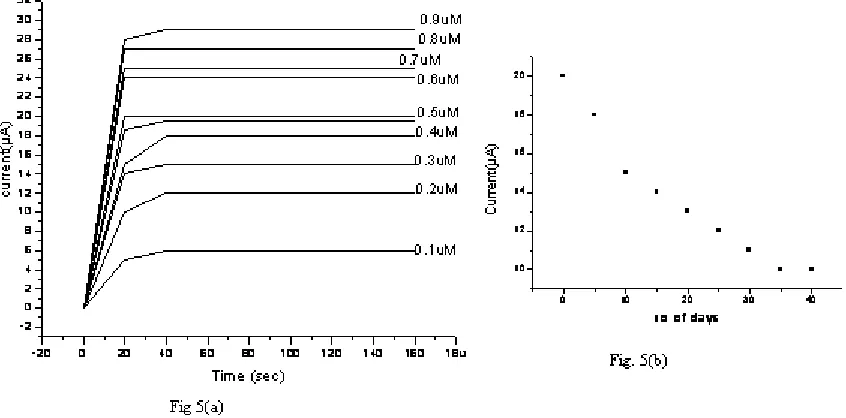
The current-time relationship when the potential of the enzyme electrode was set at 0.5 V is as shown inFig.5(a). It was found that the response current of the enzyme electrode easily reaches to steady state. The relationship between response current and paraoxon concentration in 0.1 M phosphate buffer pH 7 is shown. It was found that, current increases with increasing paraoxon concentration in the range of1x10-6 to 9x10⁻⁶M. In the present case, assuming that the enzyme is uniformly distributed throughout the electrode, the reaction takes place predominantly on the surface of the electrode in the lower concentration. However, the reaction on the surface of the electrode and the diffusion occurring simultaneously at higher concentrations delays the response time. With increasing concentrations of paraoxon, the response current also increased and finally reached to steady state value. The response of
that obtained in the amperometric response studies. Long term stability is one of the most important features required for the satisfactory application of a biosensor as shown in Fig.5(b). In order to evaluate the storage stability, the sensor was tested for 6 weeks of storage in 0.1 M phosphate buffer pH 7 at 25°C. There is a slight decrease in sensitivity of the sensor of about 10% from the initial value, revealing a very good preservation of the bioactivity than other work[16-17].
IV. CONCLUSION
Graphite/PANI/AChE biosensor showed higher sensitivity, dynamic range of detection, good fabrication reproducibility, short response time and acceptable stability toward organ phosphorous pesticide detection. The cost effectiveness and simple method of fabrication of Graphite/PANI/AChE biosensor is an additional advantage as compared with conventional electrodes. The method not only can be used to immobilize enzymes to construct a range of biosensors but also may be extended to develop other biological molecules, such as antibody and DNA for biosensor.
REFERENCES
[1] M.A. Kamyabi, N. Hajari, A.P.F. Turner, A. Tiwari, A high-performance paraxon biosensor using covalently immobilized paraxon oxidase on a poly(2,6-diaminopyridine)/carbon nanotube electrode, Talanta 116 (2013) 801-808.
[2] R. Aguilar, M.M. Dávila, M.P. Elizalde, M. Mattusch, R. Wennrich, Capability of a carbon-polyvinylchloride composite electrode for the detection of dopamine, ascorbic acid and uric acid, Electrochim. Acta 49 (2004) 851–859.
[3] M. Cano, J.L. Ávila, M. Mayén, M.L. Mena, J. Pingarrón, R. Rodrígez-Amaro, A new, third generation, PVC/TTF-TCNQ composite potentiometric biosensor for paraxon determination, J. Electroanal. Chem. 615 (2008) 69–74.
[4] X. Wang, H. Watanabe, S. Uchiyama, Potentiometric L-ascorbic acid biosensors equipped with enzyme micelle membrane, Talanta 74 (2008) 1681–1685. [5] D. K. Bandgar, G. D. Khuspe, R. C. Pawar, C. S. Lee, V. B. Patil Facile and novel route for preparation of a no structured polyaniline (PANI) thin electrodes
Applied Nanoscience 4, (1), (2014)27-36.
[6] S.K. Shukla,AnandBharadvaj, AshutoshTiwari, G.K. Parashar, G.C. Dubey Synthesis and characterization of highly crystalline polyanilineelectrode promising for humid sensor Adv. Mat. Letts. 1(2)(2010)129-134.
[7] Monika, Rajesh Kumar, R.P.Chauhan, R. Kumar, S.K.Chakarvarti Synthesis of conducting polymers and their characterization Indian Journal of Pure & Applied Physics a 48,(2010) 524-526.
[8] J. Vivekanandan, V.Ponnusamy, A. Mahudeswaran and P. S. Vijayanand Synthesis, characterization and conductivity study of polyaniline prepared by chemical oxidative and electrochemical methods Archives of Applied Science Research, 3 (6):1(2011) 47-153.
[9] S. Alegret, F. Céspedes, E. Martínez-Fàbregas, D. Martorell, A. Morales, Carbon-polymer biocomposites for amperometric sensing, Biosens. Bioelectron. 11(1996) 35–44.
[10] M.T. Ramesan Synthesis, characterization, and properties of new conducting polyaniline/copper sulfide nanocomposites Polymer Engineering & Science 54, (2), (2014) 438–445.
[11] Shakeel Ahmed, AmeenaParveen,RaghunandanDashpande, Aashis S. Roy Synthesis, characterization, and DC conductivity of polyaniline-lead oxide composites Chemical Papers, 67( 3), (2013)350-356.
[12] MoumitaKotal, Awalendra K. Thakur, and Anil K. BhowmickPolyaniline–Carbon Nanofiber Composite by a Chemical Grafting Approach and Its Supercapacitor Application ACS Appl. Mater. Interfaces, 5 (17), (2013) 8374–8386.
[13] J.M. Nugent, D. Du, X. Huang, J. Cai, A. Zhang, Comparison of pesticide sensitivity by electrochemical test based on acetylcholinesterase biosensor, Biosens. Bioelectron. 23 (2007) 285–289.
[14] H. Xue, Z. Shen, Y. Li, Amperometric POA-PVS-DBS-GOD electrode. Study of Syn. Met. 124 (2001) 345.
[15] S. Upadhyay, G.R. Rao, M.K. Sharma, B.K. Bhattacharya, V.K. Rao, R. Vijayaragha-van, Biosens.Immobilization of acetylcholine esterase–choline oxidase on a gold–platinum bimetallic nanoparticles modified glassy carbon electrode for the sensitive detection of organophosphate pesticides, carbamates and nerve agents.Bioelectron. 25 (2009) 832.
[16] D. Du, J. Ding, Y. Tao, X. Chen,Application of chemisorption/desorption process of thiocholine for pesticide detection based onacetyl cholinesterase biosensor Sens. Actuators B 134 (2008) 908.
[image:4.612.33.578.248.600.2][17] V.K. Gade, D.J. Shirale, P.D. Gaikwad, P.A. Savale, K.P. Kakde, H.J. Kharat, M.D. Shirsat, Immobilization of GOD on electrochemically synthesized Ppy–PVS composite film by cross-linking via gluteraldehyde for determination of glucose. Reactive & Functional Polymers 66 (2006) 1420–1426.
Figure caption
1) Fig.1 (a-b): UV–Visible study of(a) freshly prepared Polyaniline, (b) Graphite/PANI/AChE. 2) Fig. 2 (a-b): FT-IR studies (a) freshly prepared PANI; (b) PANI based Electrode.
3) Fig. 3 (a-b): (a) Surface of modified electrode without enzyme Mag. 50 KX (Graphite/PANI), (b) Surface of modified electrode with enzyme Mag. 50 KX (Graphite/PANI/AChE).
4) Fig.4. Current–potential curves for the Graphite/PANI/AChE electrode in 0.1 M PBS (pH 7).
Fig 1(a-b) Fig 2(a-b)
2 0 0 3 0 0 4 0 0 5 0 0 6 0 0 7 0 0 8 0 0
( b ) ( a )
A b s o rb a n c e
W a v e l e n g t h ( n m )
5 00 1 000 1500 200 0 250 0 300 0 35 00 40 00 4 500 (a) T ra n s m it ta n c e ( % )
W avenum ber (cm-1)
500 100 0 15 00 20 00 25 00 30 00 3 500 4000 450 0 (b)
Fig. 3 (a-b)
Fig. 4
0.0 0.2 0.4 0.6 0.8 1.0 1.2
[image:5.612.308.538.78.285.2] [image:5.612.88.518.95.720.2]