Model refactoring by Example: A Multi-Objective Search Based
Software Engineering Approach
Adnane Ghannem1*, Marouane Kessentini2, Mohammad Salah Hamdi1 and Ghizlane El Boussaidi3
1 Information Systems Department, Ahmed Bin Mohammed Military College,, Qatar 2 Computer and Information Science Department, University of Michigan, USA 3 Software Engineering and IT Department, École de Technologie Supérieure,, Canada
ABSTRACT
Declarative rules are frequently used in model refactoring in order to detect opportunities in the refactoring and to apply the appropriate ones. However, a high number of rules is required to obtain a complete specification of refactoring opportunities. In some situations, companies have accumulated examples of refactorings from past maintenance experiences. Based on these observations, we consider the model refactoring problem as multi objective problem by suggesting refactorings sequences that should maximize two objectives. The first objective is to maximize both structural and textual similarity between a given model (the model to be refactored) and a set of bad designed models in the base of examples (models that have undergone some refactorings). The second objective is to minimize the structural similarity between a given model and a set of well designed models in the base of examples (models that do not need any refactoring). To this end, we use the Non-dominated Sorting Genetic Algorithm (NSGA-II) to find a set of representative Pareto optimal solutions that present the best trade-off between structural and textual similarities of models. The validation results on eight real world models taken from open-source projects confirm the effectiveness of our approach with more than 80% of average correctness of our refactoring recommendations. In addition, our approach outperforms five other refactoring approaches.
Keywords: softwaremaintenance, model evolution, refactoring by example, NSGA-II, Pareto front;
1.INTRODUCTION
Maintenance process includes the essential tasks that aim to existing software while preserving its integrity [1]. These modifications are incremental and aim to either update some functionality or correct some design flaws and fix some bugs. These software maintenance activities become more complex when the size of the system and the number of requirements increase during the time [2]. Therefore, it is important to provide automated and semi-automated software maintenance tools to improve the quality of software.
Software developers are invited to constantly restructure the software system in order to improve its structure and design. The restructuring process is called refactoring [3]. Fowler [2], defined the refactoring as a cleaning up code process that improves the software structure while preserving its external behavior. The process of refactoring involves several activities [3] including the activities of identifying refactoring opportunities in a given software and determining which refactorings to apply. Many researchers have been working on providing
support for refactoring (e.g., [4], [2], and [5]). Most of them havefocused on refactorings at the source code level (e.g., code smells [6]) and few approaches attacked the refactoring at the model level (e.g., [7], [8] and [9]). However, model-driven engineering (MDE) approach, which is a promising approach to manage software systems’ complexity and specify domain concepts effectively [10] consider the models as primary artifacts in the software systems. . MDE consists of refining and successively transforming abstract models into more concrete models including executable source code. In this context, refactoring is a specific type of model transformation that aims at improving the quality of a given model; for example improving the design of an existing design model by applying a design pattern which can be encoded as a model transformation [11].
The rise of MDE increased the interest and the needs for tools supporting refactoring at the model-level. However, many challenges need to be overcome when building such a tool. Some of these challenges were identified in [8] and they include issues related to assessing model quality, ensuring synchronization and coherence between models (including source code), preserving behavior, etc. Most of the existing refactoring tools offer a semi-automatic support [8] because part of the necessary knowledge for performing the refactoring remains implicit in designers’ heads. Undeniably, recognizing model refactoring opportunities remains a big challenge that is related to the model marking process within MDE contextwhich requires design knowledge and expertise [11]. Furthermore, declarative rules represent a common technique in most of existing work on refactoring in order to detect and correct defects (i.e., refactoring opportunities) and defect types can be very important [12]. Another common issue to most of refactoring approaches is the problem of sequencing and composing refactoring rules that is, in general, related to the control of rules’ applications within a rule-based transformational approach.
To overcome some of these issues, many approaches to refactoring are using a search-based approach where the refactoring is considered as an optimization problem (e.g. [13] [14] [15] [16] [17] and [18]). Search-based refactoring approaches adapted some of the known heuristics methods such as Simulated annealing and Hill_climbing as proposed in [13] and [14], and Genetic Algorithms as proposed in [15]. In previous work [16], we proposed a by example approach that recommends refactorings to correct models. The approach uses single-objective optimization to find the best refactorings sequences which maximize the structural similarity between the model under analysis and a set of model refactoring examples. The structural similarity is computed using a set of metrics. Other optimization goals were considered in search-based refactoring approaches (e.g., reducing the refactoring effort [17], improving the software structure [14]). Harman et al. [18] have proposed a multi-objective approach that uses two software metrics (CBO: coupling between objects, and SDMPC: standard deviation of methods per class) to define two optimization objectives. Most of these approaches relied on the structural information (i.e., a combination of software metrics) to formulate their fitness functions and do not consider the design consistency in the optimization process. However, to suggest meaningful refactorings and to reduce the number of possible refactorings, both quality and consistency of the model to be refactored should be considered.
3 takes as input an initial model to refactor, a base of examples of models and their subsequent refactorings, and a list of structural metrics and textual measures. It generates as output a solution as a sequence of refactorings that should be applied to the initial model. The process of generating this solution can be seen as the mechanism that finds a sequence of refactoring operations that represent the best trade-off between the two criteria of structural and textual similarities between the model to refactor and good/bad design examples.
The intuition behind this work is that we can use data collected from previous releases or projects within the same organization. The “good” and “bad” examples are defined based on the developers’ design and programming practices. In our experiments, we showed that open source systems could represent a very good starting point but to get optimal results it is always better that the developers/users provide a good and bad set of examples from their previous projects to get optimal results. These examples could be found, for example, in the review reports where some bad examples in terms of quality are described. Another option is to use a set of quality metrics to define what is considered as good or bad by the developers to extract a set of examples. The approach could be considered as a data-mining technique since it is based on the exploration of design examples to identify relevant refactorings for a new context (project). We believe that one of the main key limits is related to the automated adaptation of refactorings applied in a similar context to a new one. In some situations, a user interaction is required and not all the refactorings that are recommended can be applied. However, the problem is a bit easier at the model level comparing to the code level. In our approach, we do not try to extract association rules like classical data mining techniques. However, the multi-objective approach try to adapt the refactoring solution as much as possible to an existing example while considering the applicability of the refactorings. Thus, we do not generate “templates” from the refactoring examples then apply them but our goal is to “optimize” as much as possible the similarity between the examples and the identified model fragment to be refactored.
The main contributions of the paper can be summarised as follows:
• We introduce a novel multi-objective refactoring approach based on the use of examples. We take into consideration the design consistency when comparing between the model to be refactored and existing model examples to suggest refactoring solutions.
• We report the result of an empirical study of NSGA-II technique applied to eight open source systems. We compare our approach to a mono objective approach (MONO), MOREX[16], random search, multi-objective particle swarm optimization (MOPSO)[19], a genetic programming approach GP[20], and our previous work that is not based on the use of good design examples [19]. The results provide evidence to support the claim that our proposal enables the generation of refactoring solutions with a high precision.
The goal of our experimentation is to find out whether our approach could propose meaningful sequences of refactorings to correct design defects within models (e.g., class diagrams). Indeed, our approach addresses two research questions:
• RQ1: To what extent can the proposed approach generate correct sequences of refactorings? • RQ2: To what extent can the design consistency aspect improve the efficiency of our proposal to
generate meaningful refactoring solutions?
To answer RQ1, we assessed the precision and recall of our approach that was applied on eight open source projects that we had several versions and refactorings they had undergone. To answer RQ2, we compared our results to those produced by our previous work called MOREX [16], MOREX [16], GP [20], MOPSO [19] and NSGA-II without the use of good design examples [19].
describes the supporting tools and experimental settings and presents results and discussion. Related works are discussed in section 4 and we conclude and outline some future directions to our work in section 5.
2.Model Refactoring using multi Objective optimization
2.1.Approach Overview
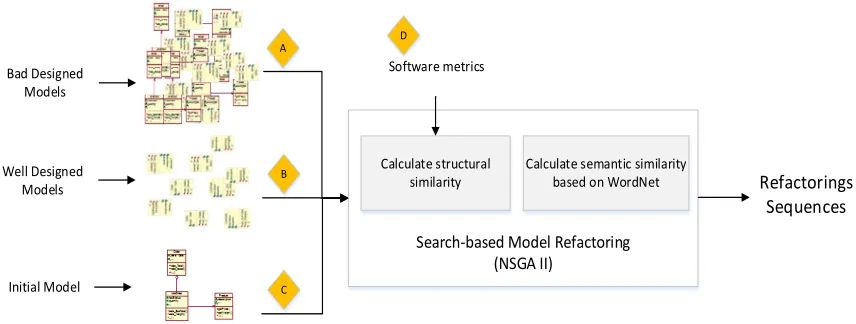
The proposed approach exploits examples of model refactorings and an evolutionary algorithm (NSGA- II [21]) to automatically suggest (to the user) sequences of refactorings that can be applied on a given model. The user is responsible for applying these refactorings. For example, for a rename refactoring, our approach does not decide for the new name but it suggests to apply the mentioned refactoring operation and we give hand to the user to choose the right name based on his experience. The general structure of our approach is introduced in Fig. 1. It takes as input a set of bad designed models (label A) (i.e., existing models and their related refactorings), a set of well designed models that do not need refactoirngs (label B), an initial model (label C) and takes as controlling parameters a set of software metrics (label D). The approach generates as output a sequence of refactorings that can be applied to the initial model. The goal of our approach is to recommend the refactorings that make the design similar to good ones in terms of quality thus we implicitly considered the fact that the refactorings have to improve the quality by meeting quality values similar the ones of the good design. The process of generating a sequence of refactorings (Fig. 1) can be seen as the mechanism that finds the best way to select and combine refactoring operations among the ones in the base of examples, in such a way to: 1) maximize the structural and the textual similarities between entities to be refactored in the initial model and entities of the models (bad designed models) and 2) minimize the structural similarity between entities to be refactored in the initial model and entities of the models (well designed systems). The structural similarity between two entities (e.g., classes) is computed using software metrics of these entities while their textual similarity is computed using textual measures based on WordNet [22].
Search-based Model Refactoring (NSGA II)
Initial Model
A
B
D
Refactorings Sequences
Bad Designed Models
Calculate semantic similarity based on WordNet Calculate structural
similarity Well Designed
Models
C
[image:4.539.44.472.362.524.2]Software metrics
Fig. 1 Multi-objective model refactoring using examples
In the proposed approach, a subset of the 72 refactorings defined in [2], that can be applied to UML class diagrams, was considered. In fact, some of the refactorings in [2] may be applied on design models (e.g.
Rename_Method, Move_Method, Move_Attribute, Extract_Class etc.) while others cannot be (e.g.
Inline_Method, Extract_Method, , Replace_Temp_With_Query etc. ). Table 1 shows the list of twelve
5 diagram level; and 2) they can be linked to a set of metrics (i.e., metrics which are impacted when applying these refactorings).
Table 1. Considered Refactorings in our approach
Refactoring Description
Extract class Consists of creating a new class and moving the relevant fields and methods fro
the old class into the new class
Rename method Consists of renaming method with a name that reveals its purpose in order to giv
more comprehensiveness to the model design.
Push down Method Consists of moving method from a super-class to a specific subclass because
makes sense only there.
Push down Attribute Consists of moving attribute from super class to a specific subclass because it makes sense only there.
Rename parameter Consists of renaming parameter within the method parameter list.
Add parameter Consists of adding a new parameter to the method parameter list.
Move Attribute Consist of moving attribute from a source class to the class destination when it more used by the second one than the class on which it is defined.
Move method Consists of moving method from a class to another one when it is using or used b
more features of the destination class than the class on which it is defined.
Pull up method Consists of moving method from some class(es) to the immediate super-class
in order to eliminate duplicate methods among sibling classes, and hence reduce code duplication in general.
Pull up Attribute Consists of moving attribute from some class(es) to the immediate super-class order to eliminate duplicate field declarations in sibling classes.
Extract interface Consists of creating interface class when many classes use the same subset of class’s interface, or two classes have part of their interfaces in common.
Replace inheritance with delegation
Consists of changing the inheritance relation by a delegation when the subcla uses only part of a super classes interface or does not want to inherit data.
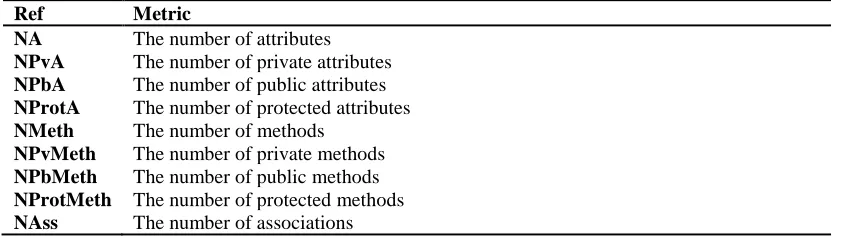
Table 2 shows the list of sixteen metrics used in our approach and that could be applied to class diagrams (e.g. NA, NMeth, NDep, etc.). These metrics include the eleven metrics defined in [23] to which we have added a set of simple metrics (e.g., NPvMeth, NPbMeth). All these metrics are related to the class entity which is the main entity in a class diagram. These metrics are used to compute the structural similarities between classes from the initial model and those in the base of examples. We believe that the textual similarity measure, described in the next section, consider the consistency between the elements.
Table 2. Considered metrics in our approach
Ref Metric
NA The number of attributes
NPvA The number of private attributes
NPbA The number of public attributes
NProtA The number of protected attributes
NMeth The number of methods
NPvMeth The number of private methods
NPbMeth The number of public methods
NProtMeth The number of protected methods
[image:5.539.50.473.511.630.2]NAgg The number of aggregations
NDep The number of dependencies
NGen The number of generalizations
NAggH The number of aggregations hierarchies
NGenH The number of generalization hierarchies
DIT «Deep Inheritance Tree»: the longest path from the class to the root of the hierarchy HAgg «Hierarchy Aggregation»: the longest path from the class to the leaves.
To compute the textual similarity between two classes, we use the Rita toolkit [22]. To find the best compromise between the two objectives (structural and textual measures), we adapted the NSGA-II [21]. The next section describes the algorithm and its adaptation to the refactoring problem..
2.2.NSGA-II for model refactoring
NSGA overview
NSGA-II is an evolutionary algorithm based on the non-dominated sorting in order to solve multi-objective optimization problems [21]. It was designed to accept an exhaustive list of candidate solutions, which creates a large search space. The main idea of the NSGA-II consists of finding a representative set of Pareto optimal solutions, called non-dominated solutions. A solution called non-dominated when no other solution can improve some optimization objective without degrading another. Given a set of objectives 𝑓𝑓𝑖𝑖, i∈ 1, …𝑛𝑛, to maximize, a solution x is said to Pareto dominate another solution x’ if and only if: ∀𝑖𝑖,𝑓𝑓𝑖𝑖(𝑥𝑥′) ≤ 𝑓𝑓𝑖𝑖(𝑥𝑥) 𝑎𝑎𝑛𝑛𝑎𝑎∃𝑗𝑗| 𝑓𝑓𝑗𝑗(𝑥𝑥′) <
𝑓𝑓𝑗𝑗(𝑥𝑥)
Three main steps characterize the NSGA-II algorithm:
• Create randomly the initial population P0 of individuals encoded using a specific representation. • Create a child population C0 generated from the population of parents P0 using genetic operators such
as crossover and mutation.
• Merge both populations and select a subset of individuals, based on the dominance principle to create the next generation.
This process is repeated until reaching the last iteration according to stopping criteria.
NSGA-II adaptation
7 section explains and illustrates the Individuals’ representation.
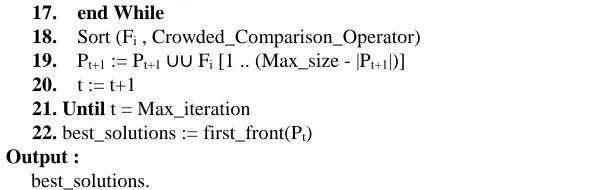
Once, a population of refactoring solutions is generated, the main NSGA-II loop (Lines 4-21) consists of evolving a population of candidate solutions toward the best sequence of refactoring, i.e., an individual that maximises as much as possible both the textual and the structural similarities between the classes CIM and CBE that were matched within the individual’s blocks. In addition, CIM is compared to all the good examples to identify the closest class CGE using the structural similarity measure. An offspring population Ct is generated from a parent population Pt using genetic operators (selection, crossover and mutation) (Line 5) throughout each iteration t. After that, Ct and Pt will be merged together to create a global population Gt. Then, each individual
Iin the population Gt is evaluated using our two fitness functions.
After calculating these functions, a list of non-dominated fronts F (F1, F2, ...) is returned by sorting all the solutions, where F1 represents the set of non-dominated solutions, F2 represents s the set of solutions dominated only by solutions in F1, etc (line 11). Then, we build the next population Pt+1 from the set of non-dominated fronts starting from front F1 to Fi(lines 14-17). In general, the number of solutions in all sets from front F1 to
Fi is larger than the Max_size. To choose exactly Max_size solutions, we sort the solutions of the front Fi using the crowded-comparison operator (<n) defined in [21] (line 18). Then, we select the best solutions needed until we reach the Max-size (line 19). The crowded-comparison operator (<n) is based on non-domination ranking and the crowding distance described in [21]. Finally, the loop terminates (line 21) announcing by that the achievement of termination criterion (i.e. maximum iteration number). The result of the algorithm is the set of best solutions, i.e., those in the Pareto front of the last iteration (line 22). In the next sub-sections, we give more details concerning the representation of solutions, genetic operators, and the fitness functions.
Algorithm 1. High level pseudo-code for NSGA-II adaptation to our problem
Algorithm : NSGA-II Search-based Model refactoring
Input
Set of bad designed models with refactorings Set of well designed models
Initial model
Set of software metrics Process:
1. I := set (CIM, CBE, CPE, A set of applicable refactorings) 2. P0 := set_of(I)
3. t := 0 4. Repeat
5. Ct := apply_Genetic_Operators(Pt) 6. Gt := Pt∪Ct
7. Forall I ∈ Gt
8. SimilarityBE (I) := calculate _Similarity(CIM, CBE) 9. SimilarityGE(I) := calculate _Similarity(CIM, CGE) 10. end For
11. F := fast_Non_Dominated_Sort (Gt) // F = (F1, F2, …) 12. Pt+1 :=∅
13. i := 1
14. While |Pt+1| + |Fi|<Max_size 15. Pt+1 := Pt+1 ∪ Fi
17. end While
18. Sort (Fi , Crowded_Comparison_Operator) 19. Pt+1 := Pt+1 ∪∪ Fi [1 .. (Max_size - |Pt+1|)] 20. t := t+1
21. Until t = Max_iteration 22. best_solutions := first_front(Pt) Output :
best_solutions.
Individual representation
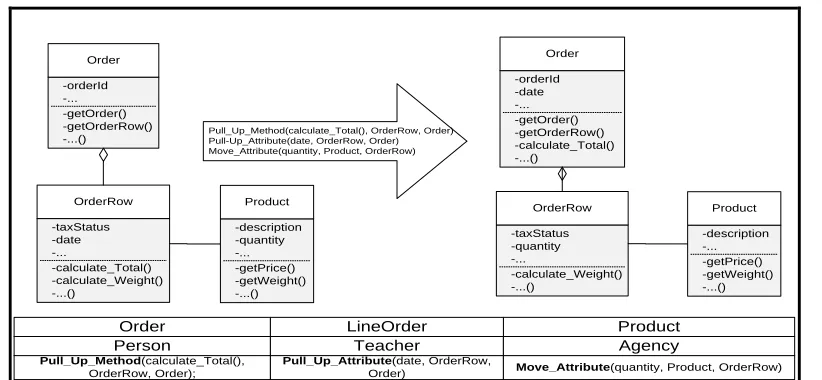
To apply NSGA-II, we represent a candidate solution (i.e., an individual) as a set of blocks. A block is a triplet of (CIM, CBE, Applicable refactorings to CIM), where CIM is a class chosen from the initial model, CBE is a class chosen from the base of examples that was matched to CIM, and finally the list of refactorins which is a subset of the refactorings that were applied to CBE (in its subsequent versions and that can be applied to CIM )of where A is an artifact (software element) chosen from the software system (system being analyzed) and R is a requirement chosen from the set of requirements at hand. Fig. 2Error! Reference source
not found. shows an example of an individual (solution). The refactorings selection process adopted within a block considers some constraints in order to avoid conflicts and inconsistencies. For example, if we the CIM
class does not have any attribute or method and the CBE class requires a Move_attribute or Add_Parameter
refactoring operation, then we discard these refactoring operations since we cannot apply them to the CIM
class.
CIM
[image:8.539.105.405.59.154.2]Applicable refactorings to CIM
CBE
Fig. 2 Block representation
9
Order LineOrder Product
Pull_Up_Method(calculate_Total(), OrderRow, Order);
Pull_Up_Attribute(date, OrderRow,
Order) Move_Attribute(quantity, Product, OrderRow)
Pull_Up_Method(calculate_Total(), OrderRow, Order) Pull-Up_Attribute(date, OrderRow, Order) Move_Attribute(quantity, Product, OrderRow)
Person Teacher Agency
[image:9.539.56.467.55.245.2]Order -orderId -... -getOrder() -getOrderRow() -...() OrderRow -taxStatus -date -... -calculate_Total() -calculate_Weight() -...() Product -description -quantity -... -getPrice() -getWeight() -...() Order -orderId -date -... -getOrder() -getOrderRow() -calculate_Total() -...() OrderRow -taxStatus -quantity -... -calculate_Weight() -...() Product -description -... -getPrice() -getWeight() -...()
Fig. 3 Individual representation
The generation of the initial population require a maximum individual size as parameter. This parameter can be chosen randomly or specified the user. In our implementation, we adopted the first choice in order to obtain individuals with different sizes. After that, we assign randomly for each individual: (1) A set of CIM,(2) their matched CBE’s , and (3) the sub-set of refactorings that we can possibly apply on the CIM among the refactorings proposed from CBE.
Selection and Genetic Operators
a. Selection
There are many methods how to select the best individuals that will participate in the next generation (e.g., roulette wheel selection, Boltzman selection, tournament selection, rank selection, steady state selection, etc.). NSGA-II uses binary tournament selection [21] to derive a child population Qt (i.e., the set of individuals that will undergo the crossover and mutation operators) from a parent population Pt. The binary tournament selection involves running several "tournaments". Each tournament involves two randomly selected individuals from the population. This will give all individuals of the population the chance to be selected and preserves diversity.
b. Crossover
Product
Move_Attribute(quantity, Product, OrderRow) Agency P’1:
P’2:
School Pilot
Add_parameter(version : String) Move_Attribute(typePlane, Pilot, Plane) Course Student
Order OrderRow
Pull_Up_Method(calculate_Total(), OrderRow, Order);
Pull_Up_Attribute(date, OrderRow, Order) Person Teacher
Cross Point
Product
Move_Attribute(quantity, Product, OrderRow) Agency P1: P2: Order OrderRow Pull_Up_Method(calculate_Total(), OrderRow, Order);
Pull_Up_Attribute(date, OrderRow, Order) Person Teacher
School Pilot
[image:10.539.55.456.59.189.2]Add_parameter(version : String) Move_Attribute(typePlane, Pilot, Plane) Course Student
Fig. 4 Crossover operator
c. Mutation
The mutation operator consists of randomly changing one or more components of the list representing an individual (solution). Given a selected individual, the mutation operator first randomly selects one or more block of the sequence corresponding to the individual, then the CBE of each block will be replaced by another one chosen randomly from the base of examples. Fig. 5 illustrates the effect of a mutation operation. The CBE (Teacher and its refactorings list) of the second block is replaced by the CBE Student and its refactorings taking into consideration the constraints mentioned before.
Order OrderRow Product
Pull_Up_Method(calculate_Total(),
OrderRow, Order); Move_Attribute(quantity, Product, OrderRow) Person Teacher Agency
Order OrderRow Product
Pull_Up_Method(calculate_Total(), OrderRow, Order);
Move_Attribute(quantity, Product, OrderRow)
Person Student Agency
Rename_Attribute(qty, Quantity) Pull_Up_Attribute(date, OrderRow,
Order)
Fig. 5 Mutation operator
For all the above change operators, we used a repair operator that eliminates redundant or conflicting or infeasible refactorings. The repair operator can either delete or randomly change these dimensions with new refactoring types or change the controlling parameter of these refactorings. Of course, these issues are also penalized by the fitness function when the solution becomes infeasible and it will increase the distance with design examples.
Multi-criteria evaluation of individuals
[image:10.539.71.447.350.436.2]11
a. Structural criterion
The structural criterion is evaluated using the fitness function denoted by Structural_Similarity by formula 1 and 2.
𝑆𝑆𝑆𝑆𝑆𝑆𝑆𝑆𝑆𝑆𝑆𝑆𝑆𝑆𝑆𝑆𝑎𝑎𝑆𝑆_𝑆𝑆𝑆𝑆𝑆𝑆𝑆𝑆𝑆𝑆𝑎𝑎𝑆𝑆𝑆𝑆𝑆𝑆𝑆𝑆 (𝐶𝐶𝐶𝐶𝐶𝐶,𝐶𝐶𝐶𝐶𝐶𝐶) = 𝑚𝑚1∑𝑚𝑚𝑖𝑖=1𝑆𝑆𝑆𝑆𝑆𝑆(𝐶𝐶𝐶𝐶𝐶𝐶𝑖𝑖,𝐶𝐶𝐶𝐶𝐶𝐶𝑖𝑖) (1)
𝑆𝑆𝑆𝑆𝑆𝑆 (𝐶𝐶𝐶𝐶𝐶𝐶𝑖𝑖,𝐶𝐶𝐶𝐶𝐶𝐶𝑖𝑖) =
⎩ ⎪ ⎪ ⎨ ⎪ ⎪
⎧ 1 𝑆𝑆𝑓𝑓𝐶𝐶𝐶𝐶𝐶𝐶𝑖𝑖= 𝐶𝐶𝐶𝐶𝐶𝐶𝑖𝑖
0 𝑆𝑆𝑓𝑓 (𝐶𝐶𝐶𝐶𝐶𝐶𝑖𝑖= 0 𝑎𝑎𝑛𝑛𝑎𝑎 𝐶𝐶𝐶𝐶𝐶𝐶𝑖𝑖≠0 ) 𝑜𝑜𝑆𝑆 (𝐶𝐶𝐶𝐶𝐶𝐶𝑖𝑖≠0 𝑎𝑎𝑛𝑛𝑎𝑎𝐶𝐶𝐶𝐶𝐶𝐶𝑖𝑖= 0)
𝐶𝐶𝐶𝐶𝐶𝐶𝑖𝑖
𝐶𝐶𝐶𝐶𝐶𝐶𝑖𝑖 𝑆𝑆𝑓𝑓𝐶𝐶𝐶𝐶𝐶𝐶𝑖𝑖< 𝐶𝐶𝐶𝐶𝐶𝐶𝑖𝑖
𝐶𝐶𝐶𝐶𝐶𝐶𝑖𝑖
𝐶𝐶𝐶𝐶𝐶𝐶𝑖𝑖 𝑆𝑆𝑓𝑓𝐶𝐶𝐶𝐶𝐶𝐶𝑖𝑖< 𝐶𝐶𝐶𝐶𝐶𝐶𝑖𝑖
(2)
Where m represents the number of metrics. CIMi, CBEi represent the ith metric value of the CIM and ith metric value of the CBE respectively. Thus, we define the structural fitness function of a solution, normalized in the range [0, 1], as:
𝑓𝑓𝑆𝑆𝑆𝑆𝑆𝑆𝑆𝑆𝑆𝑆𝑆𝑆𝑆𝑆𝑆𝑆𝑆𝑆𝑆𝑆= 1𝑛𝑛∑𝑛𝑛𝑗𝑗=1𝑆𝑆𝑆𝑆𝑆𝑆𝑆𝑆𝑆𝑆𝑆𝑆𝑆𝑆𝑆𝑆𝑎𝑎𝑆𝑆_𝑆𝑆𝑆𝑆𝑆𝑆𝑆𝑆𝑆𝑆𝑎𝑎𝑆𝑆𝑆𝑆𝑆𝑆𝑆𝑆(𝐶𝐶𝐶𝐶𝐶𝐶𝐶𝐶𝑗𝑗,𝐶𝐶𝐶𝐶𝐶𝐶𝐶𝐶𝑗𝑗) (3)
[image:11.539.93.426.431.465.2]Where n represents the individual size (number of blocks), CMIBj and CBEBj represent the classes in the first two parts of the jth block of the individual. To illustrate how the structural fitness function is computed, we consider a system containing two classes as shown in Table 3 and a base of examples containing two classes shown in Table 4. In this example, we use six metrics and these metrics are given for each class in the model in Table 3 and each class of the base of examples in Table 4.
Table 3. Classes from the initial model and their metrics values
CIM NPvA NPbA NPbMeth NPvMeth NAss NGen
Plane 4 1 3 1 1 1
[image:11.539.98.418.494.527.2]Product 2 2 6 0 1 0
Table 4. Classes from the base of examples and their metrics values
CBE NPvA NPbA NPbMeth NPvMeth NAss NGen
Student 2 1 3 0 3 0
Car 5 1 4 0 1 0
Here present two individuals I1 and I2 respectively composed by two blocks (Plane/Student and
Product/Car) and one block (Product/Student). We consider the example of these two solutions (individuals).
The fitness function calculated on these solutions has the value:
𝒇𝒇𝑺𝑺𝑺𝑺𝑺𝑺𝑺𝑺𝑺𝑺𝑺𝑺𝑺𝑺𝑺𝑺𝑺𝑺𝑺𝑺𝑰𝑰𝟏𝟏=
1 2�
1 6��
2
4+ 1 + 1 + 0 +
1
3+ 0�+ � 2 5+
1 2+
4
𝒇𝒇𝑺𝑺𝑺𝑺𝑺𝑺𝑺𝑺𝑺𝑺𝑺𝑺𝑺𝑺𝑺𝑺𝑺𝑺𝑺𝑺𝑰𝑰𝟐𝟐=�
1
6��
2 2 +
1 2 +
3 6 + 0 +
1
3 + 0���= 0,39
In this case, the evaluation process will choose the individual having the maximum value of fitness function, then I1 will be chosen as best individual.
b. Design consistency criterion
To formulate the textual similarity fitness function, we used Rita toolkit [22] which enables to compute the degree of likeness between two concepts based on their meaning. Specifically, we used this tool to calculate the textual similarity distance between two classes using their names. Thus, the textual similarity between two classes Class1 and Class2, denoted as Textual_Similarity(Class1, Class2), corresponds to the textual similarity distance between Class1’ s name and Class2’ s name. The idea behind consist of breaking down the two class names, if the class name is a complex name, into different words. To this end, we used predefined functions in Rita toolkit that allow us the extraction of nouns, verbs, adverbs, etc. Then, we calculate the distance between different obtained combinations. Finally, the design consistency fitness function of a solution corresponds to the average of distances of all the blocks of the solution as shown by the formula 4.
𝑓𝑓𝑆𝑆𝑆𝑆𝑚𝑚𝑆𝑆𝑛𝑛𝑆𝑆𝑖𝑖𝑆𝑆= 1
𝑛𝑛∑𝑛𝑛𝑗𝑗=1𝑆𝑆𝑆𝑆𝑆𝑆𝑎𝑎𝑛𝑛𝑆𝑆𝑆𝑆𝑆𝑆_𝑆𝑆𝑆𝑆𝑆𝑆𝑆𝑆𝑆𝑆𝑎𝑎𝑆𝑆𝑆𝑆𝑆𝑆𝑆𝑆(𝐶𝐶𝐶𝐶𝐶𝐶𝐶𝐶𝑗𝑗,𝐶𝐶𝐶𝐶𝐶𝐶𝐶𝐶𝑗𝑗) (4)
Where n is the number of blocks in the solution and CMIBj and CBEBj are the classes composing the first two parts of the jth block of the solution. We considered the textual (semantic) similarity when the model is compared with the bad designed models since we adapted the refactorings applied to that bad designed model to our context. Thus, the semantic (textual) similarity is important along with the structural one. However, the disimilarity with the well-designed model is used as a helper objective just to identify refactoring opportunities but not to the correction of these identified defects.
The structural function is used by both fitness functions and the semantic function is just used by part the first fitness function that calculates the similarity between the model to refactor and bad examples (average of structural and textual similarities).
3.Experimentations with the approach
This section describes the evaluation steps of our approach. It starts by presenting our supporting tools. Then, we define our research questions. Finally, we describe our experimental settings and we present and discuss the results of the experimentations.
3.1.Supporting Tools
13 tool called Rita toolkit [22] to calculate the textual similarity.. Behind
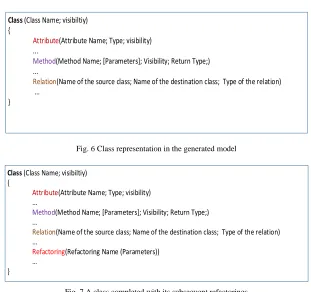
Class (Class Name; visibiltiy) {
Attribute(Attribute Name; Type; visibility)
...
Method(Method Name; [Parameters]; Visibility; Return Type;) ...
Relation(Name of the source class; Name of the destination class; Type of the relation) ...
}
Fig. 6Class representation in the generated model Class (Class Name; visibiltiy)
{
Attribute(Attribute Name; Type; visibility)
...
Method(Method Name; [Parameters]; Visibility; Return Type;) ...
Relation(Name of the source class; Name of the destination class; Type of the relation) ...
Refactoring(Refactoring Name (Parameters))
… }
Fig. 7 A class completed with its subsequent refactorings
[image:13.539.102.413.70.362.2]Fig. 8. Model Refactoring Plugin
3.2.Experimental Setup
Several tests are done in order to set the NSGA-II parameters. The stopping criterion was set to 1000 iterations, the Max_size of the population to 30, the crossover probability to 0.9 and the mutation probability to 0.4. These values were obtained by trial and error. In our case, we selected a high mutation rate because it allows the continuous diversification of the population, which discourages premature convergence to occur. A standard desktop computer (i7 CPU running at 3 GHz with 8GB of RAM) was used to run the NSGA-II algorithm. The run-time of our algorithm with a 1000 iterations (stopping criteria) was less than 4 min, which indicates the scalability of our approach from the performance standpoint. However, the run-time depends on the number of refactorings and the size of the models in the base of examples.
We analyzed eight open-source Java projects to answer the research questions reported above:
• Ant (v1.8.4): A Java library that is mainly used for building Java applications. Ant provides support to compile, assemble, test and run Java applications.
• GanttProject (v2.0.10): A Java project that supports project management and scheduling. • JabRef (v2.7): A graphical application for managing bibliographical databases.
15
• JRDF (v0.5.6.2): A Java library for parsing, storing and manipulating RDF (Resource Description Framework).
• Xerces (v2.7): A set of parsers compatible with Extensible Markup Language (XML). • Xom (v1.2.8): A new XML object model.
[image:15.539.74.442.230.316.2]The choice of these open source projects is based on the fact that they are medium-sized open-source projects and most of them were analyzed in related work (e.g., [24], [25], [26] and [17]). Most of these open source projects have been actively developed over the past 10 years. Table 5 provides some relevant information about these projects. Table 7 describes the number of good and bad examples and their sizes extracted from Ant 1.8.4, GanttProject 2.0.10, JHotDraw 5.2, Xerces 2.7. Most of the examples are selected based on the previous studies that analyzed these systems [50, 51, 52].
Table 5. Case study settings
Model Classes Methods Attributes Expected refactorings
Ant 1.8.4 824 2090 1048 139
GanttProject 2.0.10 479 960 495 91
JabRef 2.7 594 253 237 32
JGraphx 1.10.4.0 191 1284 420 96
JHotDraw 5.2 160 519 141 71
JRDF v0.5.6.2 734 19 10 41
Xerces 2.7 625 2113 1408 182
Xom 1.2.8 252 186 31 36
Table 7. Statistics about the extracted sets of bad and good design examples
Model #Bad Examples
(min#classes, max#classes)
#Good Examples (min#classes, max#classes)
Ant 1.8.4 72(8, 23) 42(7, 29)
GanttProject 2.0.10
49(6, 21) 28 (6, 22)
JHotDraw 5.2 34(9, 19) 19(8, 24)
Xerces 2.7 38 (6, 14) 34 (7, 19)
3.3.Measures of precision and recall
To answer our research questions, we used two measures: Precision and Recall. These measures stem originally from the area of information retrieval (IR). Precision is given by Equation (5). It is equal to the ratio of the “Number of correct refactorings detected” to the “Total number of refactorings detected”. A. Recall is given by Equation (6). It is equal to the ratio of the “Number of correct refactorings detected” to the “Number of correct refactorings”. Both values may range from 0% to 100%, whereas a higher value is better than a lower one. We consider that the threshold for the correctness of recommended refactorings is 85%.”
[image:15.539.62.455.337.413.2]𝑅𝑅𝑅𝑅2𝑅𝑅= 𝑁𝑁𝑆𝑆𝑚𝑚𝑁𝑁𝑆𝑆𝑆𝑆𝑁𝑁𝑆𝑆𝑚𝑚𝑁𝑁𝑆𝑆𝑆𝑆𝑜𝑜𝑜𝑜𝑆𝑆𝑜𝑜𝑆𝑆𝑆𝑆𝑆𝑆𝑆𝑆𝑆𝑆𝑜𝑜𝑜𝑜𝑆𝑆𝑜𝑜𝑆𝑆𝑆𝑆𝑆𝑆𝑆𝑆𝑆𝑆refactoringsrefactoringsdetected (6)
3.4.RTRP and RT2R were determined for each system based on the traceability matrix that is linking each
artifact to the corresponding requirement (correct artifacts). This matrix is known for the systems (projects) used in the evaluation.Results and discussion
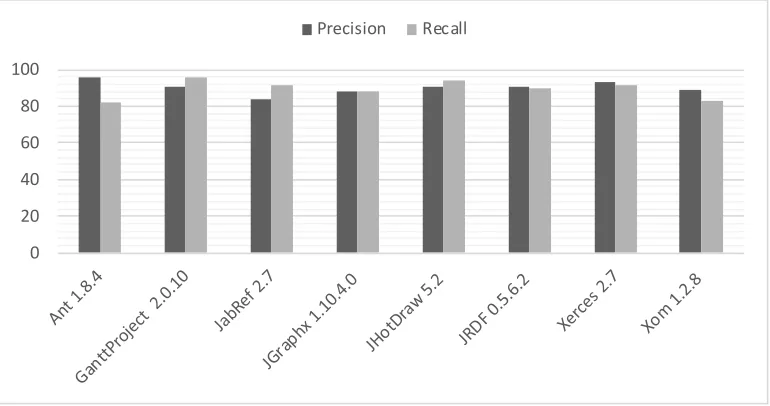
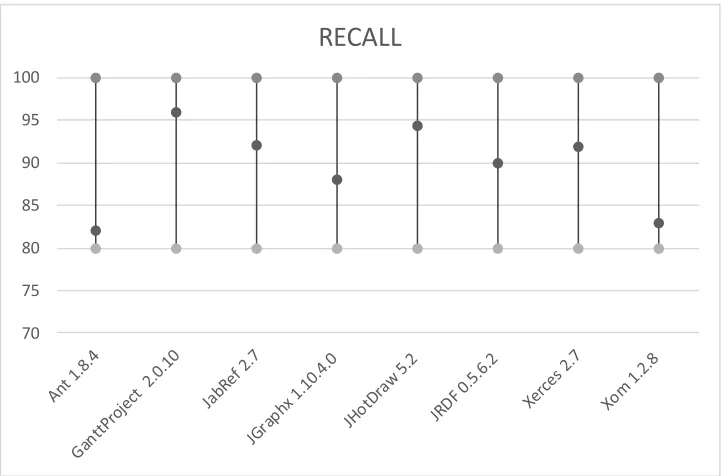
Our results are presented based on two indicators: precision and recall. For our validation, we conducted multiple executions (40 executions) of our approach on the all considered projects. Fig. 9 illustrates the average of precision and recall values for each open source project over the 40 executions. Fig. 10 illustrates the box plots of the precision scores of our algorithm on the different projects based on 40 executions. Similarly, Fig. 11 illustrates the box plots of the precision scores of our algorithm on the different projects based on 40 executions.
0 20 40 60 80 100
[image:16.539.67.452.246.449.2]Precision Recall
Fig. 9. Average of precision and recall over 40 execution of our approach on all projects
17
70 75 80 85 90 95 100
[image:17.539.76.442.60.303.2]PRECISION
Fig. 10 The minimum, maximum and average of the precision scores of our algorithm on the different projects based on 40 executions.
70 75 80 85 90 95 100
RECALL
Fig. 11. The minimum, maximum and average of the recall scores of our algorithm on the different projects based on 40 executions.
[image:17.539.78.439.336.574.2]called the Pareto-front. In our context, NSGA-II converges to Pareto-optimal solutions that are considered as good trade-off between structural and textual similarities. Fig. 12 display the Pareto-front for NSGA-II obtained on the considered open source projects. In these figures, each point is a solution with the structural similarity score represented in x-axis, the textual similarity score in the y-axis. The best solutions exist in the corner representing the Pareto-front that maximizes the values of the textual and the structural similarities.
(a) (b)
(c) (d)
19
[image:19.539.42.481.68.225.2](g) (h)
Fig. 12. Pareto front for NSGA-II obtained on eight open source systems: (a) GanttProject (b) JHotDraw (c) Xercess (d) Xom (e) JabRef (f) JRDF (g) JGraphx (h) Ant
To answer the second research question, RQ2, we compared our NSGA-II adaptation to the current, state-of-the-art refactoring approaches widely used multi-objective algorithm, MOPSO, using the same adapted fitness function, NSGA-II without the use of good design examples (NSGA-II BE) [19], to a mono objective approach (MONO) using genetic algorithm, to our previous work (MOREX: MOdel Refacttoring by EXamples) [16], to a genetic programming (GP) based approach [23] and to a random search approach. In MONO, we defined the fitness function as combination of both structural and textual fitness functions. The MOPSO used in this paper is the Non-dominated Sorting PSO (NSPSO) proposed by Li [19]. In a random search, the change operators (crossover and mutations) are not used, and populations are generated randomly and evaluated using the two fitness functions. To better evaluate the relevance of considering well designed model fragment examples, we compared our NSGA-II adaptation to our previous work based also on NSGA-II but without the use of good examples (called NSGA-II BE) [19]. In MOREX [16], we used a single-objective genetic algorithm to propose refactorings; i.e., we considered only one fitness function based on the structural similarity which is a combination of software metrics. In GP [20], the authors proposed an approach to generate detection rules based on quality metrics by using GP.
Fig. 13. Comparison between NSGA-II, MONO, MOREX [16], GP [20], MOPSO [19], NSGA-II BE [19] and Random search in terms of precision
Fig. 14. Comparison between NSGA-II, MONO, MOREX [16], GP [20], MOPSO [19], NSGA-II BE [19] and Random search in terms of recall
[image:20.539.41.476.313.532.2]21 our experiment. In our context, a p-value that is less than or equal to α (=0.05) means that the distributions of the results of the five algorithms are different in a statistically significant way. In fact, we computed the p-values of MONO, MOREX, GP and MOPSO results compared with NSGA-II. In this way, we could decide whether the outperformance of our approach over the MONO, MOREX [16], [29]GP, NSGA-II BE [19] and MOPSO approach is statistically significant. Table 8 and Table 9 display the precision and recall median values of NSGA-II, MONO, MOREX, GP, NSGA-II BE [19] and MOPSO for the 8 open source projects respectively. For example, for Ant project, the p-value for the precision median results of MONO compared with NSGA-II is 0,0103 while the value of the recall median results of MONO compared with NSGA-II is 0,0113. The p-value for the precision median results of MOREX compared with NSGA-II is 0,0224 while the p-p-value of the recall median results of MOREX compared with NSGA-II is 0.0213. The p-value for the precision median GP compared with II is 0.0112 while the p-value of the recall median results of GP compared with NSGA-II is 0.0142. In addition, the p-value for the precision median results of MOPSO compared with NSGA-NSGA-II is 0.0098 while the p-value of the recall median results of MOPSO compared with NSGA-II is 0.0087. Accordingly, we infer that the precision and recall median values of our algorithm are statistically different from the MONO, MOREX, GP, NSGA-II BE [19] and the MOPSO ones on each of the systems based on the fact that these p-values are less than α (= 0.05). We consequently conclude that our approach is more effective than these four approaches and specifically it is more effective than an approach based only on the structural similarity without taking into account the context of the entities of analyzed models (i.e., MOREX). This observation allows us to positively answer our second research question RQ2.
Table 8. Precision median values of NSGA-II, MONO, MOREX [16], GP [20], NSGA-II BE [19] and MOPSO [19] over 40 independent simulation runs
Model
Precision (%) P-value (<= 0.05)
NSGA-II
NSGA-II BE [19]
MONO MOREX GP MOPSO NSGA-II vs MONO
NSGA-II vs [19]
NSGA-II vs MOREX
NSGA-II vs GP
NSGA-II vs MOPSO
Ant 95 92 91 93 94 79 0.0103 0.0147 0.0224 0.0112 0.0098
Gantt 90 84 83 84 80 75 0.0015 0.0014 0.0158 0.0101 0.0012
JabRef 84 80 79 78 77 73 0.0101 0.0111 0.0124 0.0077 0.0045
JGraphx 86 80 75 77 73 70 0.0017 0.0047 0.0212 0.0111 0.0014
JHotDraw 90 84 82 85 84 80 0.0078 0.0019 0.0222 0.0056 0.0075
JRDF 90 87 86 88 84 82 0.0028 0.0027 0.0189 0.0045 0.0084
Xerces 92 88 87 89 86 83 0.0102 0.0043 0.0211 0.0059 0.0047
Table 9. Recall median values of NSGA-II, MONO, MOREX [16], GP [20], NSGA-II BE [19] and MOPSO [19] over 40 independent simulation runs
Model
Recall (%) P-value (<= 0.05)
NSGA-II
NSGA-II BE [19]
MONO MOREX GP MOPSO NSGA-II vs MONO
NSGA-II vs [19]
NSGA-II vs MOREX
NSGA-II vs GP
NSGA-II vs MOPSO
Ant 81 79 73 78 77 80 0.0113 0.0026 0.0213 0.0142 0.0087
Gantt 94 88 86 88 86 81 0.0011 0.0134 0.0211 0.0091 0.0071
JabRef 91 90 88 90 90 78 0.0009 0.0087 0.0016 0.0075 0.0061
JGraphx 87 83 83 84 83 79 0.0102 0.0231 0.0058 0.0097 0.0004
JHotDraw 94 87 85 90 82 75 0.0067 0.0057 0.0211 0.0113 0.0007
JRDF 89 84 86 86 88 83 0.0087 0.0011 0.0198 0.0117 0.0076
Xerces 91 84 84 85 78 74 0.0101 0.0340 0.0029 0.0131 0.0044
Xom 82 79 77 77 75 69 0.0105 0.0014 0.0158 0.0141 0.0059
The proposed approach is different than a classical data mining technique or a manual inspection of the history to identify similar refactoring patterns. First, the proposed approach does not find similarities between refactorings but the current model design is compared to examples of bad and good design models then the applied refactorings to that similar bad design model are adapted to the current context. It will be difficult for a developer to identify similarities between model fragments based on the history of changes, especially when the number of changes are high. Second, our multi-objective approach does not require to use examples from previous releases of the project to evaluate. The experiments show that examples from open source systems could be a very good starting point for developers in practice/industry to use our technique. Finally, our approach generates a set of Pareto front solutions and not a single solution which is the case of machine learning and data mining algorithms. Thus, the developer can select a solution based on his preferences and not limited to one set of recommended refactorings.
23
Fig. 15. Comparison between NSGA-II, MONO, MOREX [16], GP [20], NSGA-II BE [19], MOPSO [19] and Random search in terms of average execution time on the different systems
Fig. 16. The average distribution of refactoring types in the best solutions recommended by our approach on the different models
4.Threats to validity
[image:23.539.126.411.260.515.2]In general, we do not need a large number of examples to obtain good results which confirm the reliability of the proposed approach. We showed, in our experiment, that some open source projects used out of the box could produce good refactoring results for the systems under analysis. However, we agree that, sometimes, within specific contexts it is difficult to define and find refactorings’ opportunities. Applications from different domains may have dissimilar design practices and developers may have different opinions on how to define a good and bad design example. In fact, the quality of our results heavily depends on the examples introduced as inputs. In an industrial setting, we could expect a company to start with some few open source projects, and gradually migrate its set of refactoring examples to include context-specific data. In fact, the definition of “good” and “bad” examples are left to the developers based on their preferences and best/bad design practices. A possible use of previous releases of evolved models could be a good strategy to adapt in order to define a set of bad and good design fragments. This might be essential if we consider that different languages and software infrastructures have different best/worst practices. Another threat is related to the used textual measures. Sometimes two classes have similar names but they are semantically equivalent. Also, two classes might have different names, but be semantically similar.
5.Related Work
In this section, we classified a relevant existing works that tackled the automation of refactoring activities using search-based techniques’ into two main groups: single-objective and multi-objective optimization approaches.
In the first group, most of existing works defined their fitness function based on software metrics in order to find the best sequence of refactorings (e.g. [14] [30] [31] [20] [57] [58] [59] [60] [61] [62] [63] [64] [65] and [32]). A comparative study of four heuristic techniques applied to the refactoring problem was presented by O’Keeffe et al. [30] using a fitness function that combine 11 metrics to evaluate the quality improvements. They experiment the four techiques on five open-source systems. They find that hill-climbing outperforms the other three algorithms. Another single–objective optimization was proposed by Seng et al. [14] using on the genetic algorithm (GA) in order to suggest a list of refactorings. The single fitness function used in this proposal aims to maximize a weighted sum of a set of metrics to improve the class structure of a software system. These metrics are mainly related to the coupling, cohesion, complexity and stability. The authors have defined some refactorings’ preconditionsable to preserve the behaviour but not the semantics domain of the software program. However, authors have validated their proposal only on the move method refactoring. The refactoring schedule problem was considered by Qayum et al. [31] as a graph transformation problem expressings as a search for an optimal path. To do that, they used Ant colony optimization in the graph where nodes and edges represent respectively refactoring candidates and dependencies between them. However, the domain semantics of the software system and its runtime behavior was not considered. Last but not least, Kessentini et al. [20] have proposed a single-objective optimization approache using GA to find the best sequence of refactoring operations at code level aiming to to improve its quality by minimizing the design defects’ number detected in the source code.
25 semantic errors. Ó Cinnéide et al. [34] have d investigated, via an empirical study, about the assessment of some structural software metrics and their relationships between them. based on a variety of search techniques (Pareto-optimal search, semi-random search). In conclsion, vast majority of existing work on search-based software engineering approaches focused only on the program structure improvements based on a set of software metrics in both single and multi-objectives approaches. Thaina et al. [53] proposed a recent systematic literature review on search based refactoring.
Interactive techniques have been generally introduced in the literature of Search-Based Software Engineering and especially in the area of software modularization. Hall et al. [54] treated software modularization as a constraint satisfaction problem. The idea of this work is to provide a baseline distribution of software elements using good design principles (e.g. minimal coupling and maximal cohesion) that will be refined by a set of corrections introduced interactively by the designer. The approach, called SUMO (Supervised Re-modularization), consists of iteratively feeding domain knowledge into the remodularization process. The process is performed by the designer in terms of constraints that can be introduced to refine the current modularizations. Initially, the system begins with generating a module dependency graph from an input system. This dependency is based on the correlation between software elements (coupling between methods, shared attributes etc.). Possible modularizations are then generated from the graph using multiple simulated authoritative decompositions. Then, using a clustering technique called Bunch, an initial set of clusters is generated that serves as an input to SUMO.
Bavota et al. [55] presented the adoption of single objective interactive genetic algorithms in software re-modularization process. The main idea is to incorporate the user in the evaluation of the generated remodularizations. Interactive Genetic Algorithms (IGAs) extend the classic Genetic Algorithms (GAs) by partially or entirely involving the user in the determination of the solution’s fitness function. The basic idea of the Interactive GA (IGA) is to periodically add a constraint to the GA such that some specific components shall be put in a given cluster among those created so far. Initially, the IGA evolves similarly to the non-interactive GA. After a user-defined set of iterations, the individual with the highest fitness value is selected from the population set (in the case of single-objective GA) or from the first front (in the case of multi-objective GA) and presented to the user. After analyzing the current modularization, the user provides feedback in terms of constraints dictating for example, that a specific element needs to be in the same cluster as another one. Overall, the above existing studies of interactive remodularization are limited to few types of refactoring such as moving classes between packages and splitting packages. Furthermore, the interaction mechanism is based on the manual evaluation of proposed remodularization solutions which could be a time-consuming process. A recent study [56] extended our previous work [57] to propose an interactive search based approach for refactoring recommendations. The developers have to specify a desired design at the architecture level then the proposed approach try to find the relevant refactorings that can generate a similar design to the expected one.
Some other studieshave tackled the refactoring opportunities detection at model level using code smells defined as bad design choices which could negatively impact some code qualities such as maintainability, changeability and comprehensibility [39]. . Indeed, during the evolution of the system, code-smells can emerge and then represent patterns of software design. These patterns can be a sasource of problems in the further development and maintenance of the system. Fowler et al [2] identified and defined 22 Code Smells aiming to indicate software refactoring opportunities and ‘give you indications that there is trouble that can be solved by a refactoring’. Zhang et al. [40] investigated about code-smells that need more attention than any other Van Emden and Moonen [41] and Mantyla [42] proposed two approaches that aim to detect and analyse code smells for java programs. Previous empirical studies have analysed the impact of code-smells on different software maintainability factors including defects [43] and effort [44]. In fact, software metrics (quality indicators) are sometimes difficult to interpret and suggest some actions (refactoring) as noted by Anda et al. [45] and Marinescu et al. [46].
6.Conclusion
We presented a by example search-based approach that exploits both structural and design consistency information to improve the automation of suggesting refactoring. It takes as input a model to be refactored, a base of examples of models and their subsequent refactorings, and a list of metrics and textual measures calculated on both the initial model and the models in the base of examples. The output is a solution to the refactoring problem. A solution is a sequence of refactoring operations that should be applied to the initial model and that displays the best compromise between the two criteria: structural and textual similarities. In contrast to existing work on refactorings, the design consistency is a major concern in our paper.
Our experimentation shows that our technique outperforms state-of-the-art techniques where single-objective and multi-single-objective is used. We evaluated our approach on real-world models and the obtained results indicate that the proposed refactorings are comparable to those expected.. We also tested the stability of our approach by performing multiple executions on the projects at hand and checking the it’s the stability of precision and recall values over the multiple executions. These results allowed us to conclude that the proposed approach is more efficient and promising than approaches that do not consider the design consistency in their optimization objectives.
In the future, we plan to extend our base of examples to include more refactoring operations. We also plan to analyse the domain-specific impact on the obtained results.
Acknowledgment
This work was made possible by NPRP grant # [7-662-2-247] from Qatar Research Fund (a member of Qatar Foundation). The findings achieved herein are solely the responsibility of the authors.
References
1. ISO/IEC, International Standard - ISO/IEC 14764 IEEE Std 14764-2006 Software Engineering; Software Life Cycle Processes &; Maintenance. ISO/IEC 14764:2006 (E) IEEE Std 14764-2006 Revision of IEEE Std 1219-1998), 2006: p. 01-46.
2. Fowler M., Refactoring: Improving the Design of Existing Code, . 1999, Boston, MA, USA: Addison-Wesley.
27 4. Opdyke, F.W., Refactoring : A Program Restructuring Aid in Designing Object-Oriented Application
Frameworks. 1992, University of Illinois at Urbana-Champaign.
5. Moha, N., DECOR : Détection et correction des défauts dans les systèmes orientés objet. 2008, Université de Montréal & Université des Sciences et Technologies de Lille: Montréal. p. 157-179.
6. Du Bois, B., S. Demeyer, and J. Verelst. Refactoring-Improving Coupling and Cohesion of Existing Code. in Proceedings of the 11th Working Conference on Reverse Engineering (WCRE). 2004. Delft University of Technology, Netherlands: IEEE Computer Society.
7. El-Boussaidi, G. and H. Mili, Understanding design patterns — what is the problem? Software: Practice and Experience, 2011. 42: p. 1495-1529.
8. Mens, T., G. Taentzer, and M. Dirk. Challenges in Model Refactoring. in Proceedings of the 1st Workshop on Refactoring Tools (WRT). 2007. University of Berlin, Germany.
9. Zhang, J., Y. Lin, and J. Gray, Generic and Domain-Specific Model Refactoring using a Model Transformation Engine. Model-driven Software Development – Research and Practice in Software Engineering, 2005. 2: p. 199-217.
10.Douglas, C.S., Guest Editor's Introduction: Model-Driven Engineering. IEEE Computer, 2006. 39(2): p. 41-47.
11.El-Boussaidi, G. and H. Mili, Detecting Patterns of Poor Design Solutions Using Constraint Propagation, in Proceedings of the 11th international conference on Model Driven Engineering Languages and Systems. 2008, Springer-Verlag: Toulouse, France. p. 189-203.
12.Kessentini, M., et al. Search-based design defects detection by example. in Proceedings of the 14th international conference on Fundamental approaches to software engineering: part of the joint European conferences on theory and practice of software. 2011. Saarbrücken, Germany: Springer-Verlag.
13.O'Keeffe, M. and M. O'Cinneide. Search-based software maintenance. in Proceedings of the 10th European Conference on Software Maintenance and Reengineering (CSMR). 2006. Bari, Italy.
14.Seng, O., J. Stammel, and D. Burkhart. Search-based determination of refactorings for improving the class structure of object-oriented systems. in Proceedings of the 8th annual conference on Genetic and evolutionary computation. 2006. Seattle, Washington, USA: ACM.
15.Kessentini, M., H. Sahraoui, and M. Boukadoum. Model Transformation as an Optimization Problem. in Proceedings of the 11th international conference on Model Driven Engineering Languages and Systems. 2008. Toulouse, France: Springer-Verlag.
16.Ghannem, A., G. El-Boussaidi, and M. Kessentini, Model refactoring using examples: a search-based approach. Journal of Software: Evolution and Process, 2014. 26: p. 692-713.
17.Ouni, A., et al., Maintainability defects detection and correction: a multi-objective approach. Journal of Automated Software Engineering, 2013. 20(1): p. 47-79.
18.Harman, M. and L. Tratt, Pareto optimal search based refactoring at the design level, in Proceedings of the 9th annual conference on Genetic and evolutionary computation (GECCO). 2007, ACM: London, England, UK. p. 1106-1113.
19.Ghannem, A., G. ElBoussaidi, and M. Kessentini. Example-Based Model refactoring Using Multi-Objective Optimization. in North American Search Based Software Engineering Symposium. 2015, pp104-127, Michigan, Detroit, USA.
20.Deb, K., et al., A fast and elitist multiobjective genetic algorithm: NSGA-II. IEEE Transactions on Evolutionary Computation, 2002. 6(2): p. 182-197.
21.Li, X., A Non-dominated Sorting Particle Swarm Optimizer for Multiobjective Optimization, in Genetic and Evolutionary Computation — GECCO 2003, E. Cantú-Paz, et al., Editors. 2003, Springer Berlin Heidelberg. p. 37-48.
23.Howe, C.D., RiTa: creativity support for computational literature, in Proceedings of the 7th ACM conference on Creativity and cognition. 2009, ACM: Berkeley, CA, USA. p. 205-210.
24.Genero, M., M. Piattini, and C. Calero. Empirical validation of class diagram metrics. in Proceedings of the International Symposium in Empirical Software Engineering (ISESE). 2002. Nara, Japan.
25.Kim, M., et al., Ref-Finder: a refactoring reconstruction tool based on logic query templates, in Proceedings of the 18th ACM SIGSOFT international symposium on Foundations of software engineering. 2010, ACM: Santa Fe, New Mexico, USA. p. 371-372.
26.Moha, N., et al., DECOR: A Method for the Specification and Detection of Code and Design Smells. IEEE Transactions Software Engineering, 2010. 36(1): p. 20-36.
27.Ghannem, A., M. Kessentini, and G. El-Boussaidi. Detecting Model Refactoring Opportunities Using Heuristic Search. in Proceedings of the 2011 Conference of the Center for Advanced Studies on Collaborative Research (CASCON). 2011. IBM Corp., Riverton, NJ, USA: Marin Litoiu, Eleni Stroulia, and Stephen MacKay (Eds.).
28.Rachmawati, L. and D. Srinivasan, Multiobjective Evolutionary Algorithm With Controllable Focus on the Knees of the Pareto Front. Evolutionary Computation, IEEE Transactions on, 2009. 13(4): p. 810-824. 29.Wilcoxon, F., Individual Comparisons by Ranking Methods, in Breakthroughs in Statistics, S. Kotz and N.
Johnson, Editors. 1992, Springer New York. p. 196-202.
30.Ghannem, A., G. El Boussaidi, and M. Kessentini, Model refactoring using examples: a search-based approach. Journal of Software: Evolution and Process, 2014. 26(7): p. 692-713.
31.O'Keeffe, M., O' Cinnéide, M., Search-based refactoring: an empirical study. Journal of Software : Maintenance and Evolution (JSME), 2008. 20(5): p. 345-364.
32.Qayum, F. and R. Heckel. Local Search-Based Refactoring as Graph Transformation. in Proceddings of the 1st International Symposium on Search Based Software Engineering (SSBSE). 2009. Cumberland Lodge, Windsor, UK: Springer Berlin Heidelberg.
33.Ghannem, A., G. El-Boussaidi, and M. Kessentini. Model Refactoring Using Interactive Genetic Algorithm. in Proceedings of the 5th Symposium on Search Based Software Engineering (SSBSE). 2013. Springer Berlin Heidelberg.
34.O' Cinnéide, M., et al. Experimental assessment of software metrics using automated refactoring. in Proceedings of the ACM-IEEE international symposium on Empirical software engineering and measurement. 2012. Lund, Sweden: ACM.
35.Ouni, A., et al. Search-based refactoring: Towards semantics preservation. in Software Maintenance (ICSM), 2012 28th IEEE International Conference on. 2012.
36.Ragnhild, V.D.S., V. Jonckers, and T. Mens, A formal approach to model refactoring and model refinement. Software and Systems Modeling (SoSyM), 2007. 6(2): p. 139-162.
37.Van Kempen, M., et al. Towards proving preservation of behaviour of refactoring of UML models. in Proceedings of the 2005 annual research conference of the South African institute of computer scientists and information technologists on IT research in developing countries (SAICSIT). 2005. South African Institute for Computer Scientists and Information Technologists, Republic of South Africa.
38.Mens, T., G. Taentzer, and O. Runge, Analysing refactoring dependencies using graph transformation. Software and Systems Modeling, 2007. 6(3): p. 269-285.
39.Biermann, E. EMF model transformation based on graph transformation: formal foundation and tool environment. in Proceedings of the 5th International Conference on Graph Transformations (ICGT). 2010. Enschede, The Netherlands: Springer-Verlag.
40.Brito e Abreu, F. and W. Melo. Evaluating the impact of object-oriented design on software quality. in Proceedings of the 3rd International Software Metrics Symposium, 1996.
41.Brown, J.W., et al., AntiPatterns: Refactoring Software, Architectures, and Projects in Crisis. WILEY ed. 1998. 336.
29 43.Van Emden, E. and L. Moonen. Java quality assurance by detecting code smells. In Proceedings of the Ninth
Working Conference on Reverse Engineering. 2002.
44.M, M.V. and C. Lassenius, Subjective evaluation of software evolvability using code smells: An empirical study. Empirical Software Engineering, 2006. 11(3): p. 395-431.
45.Monden, A., et al. Software quality analysis by code clones in industrial legacy software. In the Proceedings of the Eighth IEEE Symposium on Software Metrics. 2002.
46.Deligiannis, I., et al., An empirical investigation of an object-oriented design heuristic for maintainability. Journal of Systems and Software, 2003. 65(2): p. 127-139.
47.Anda, B. Assessing Software System Maintainability using Structural Measures and Expert Assessments. in Software Maintenance, 2007. ICSM 2007. IEEE International Conference on. 2007.
48.Rapu, D., et al. Using history information to improve design flaws detection. in Software Maintenance and Reengineering, 2004. CSMR 2004. Proceedings. Eighth European Conference on. 2004.
49.Yamashita, A. and L. Moonen. Do code smells reflect important maintainability aspects? In 28th IEEE International Conference on Software Maintenance (ICSM). 2012.
50.Marouane Kessentini, Stéphane Vaucher, Houari A. Sahraoui: Deviance from perfection is a better criterion than closeness to evil when identifying risky code. ASE 2010: 113-122
51.Marouane Kessentini, Wael Kessentini, Houari A. Sahraoui, Mounir Boukadoum, Ali Ouni: Design Defects Detection and Correction by Example. ICPC 2011: 81-90
52.Usman MansoorMarouane KessentiniEmail authorManuel WimmerKalyanmoy Deb, Multi-view
refactoring of class and activity diagrams using a multi-objective evolutionary algorithm, Software Quality Journal, pp 1–29, to appear.
53.Thainá Mariani and Silvia Regina Vergilio. 2017. A systematic review on search-based refactoring. Inf. Softw. Technol. 83, C (March 2017), 14-34. DOI: https://doi.org/10.1016/j.infsof.2016.11.009
54.Hall, M., Walkinshaw, N., and McMinn, P.: ‘Supervised Software Modularization. 28th IEEE International Conference on Software Maintenance. pp. 23-30.’ (2012. 2012)
55.Bavota, G., and Carnevale, F.: ‘Putting the developer in a loop:an interactive GA for Software Re-modularization. Search based software engineering, Lecture notes in computer science volume 7515. pp 75-89’ (2012. 2012)
56.Lin, Y., Peng, X., Cai, Y., Dig, D., Zheng, D., and Zhao, W.: ‘Interactive and Guided Architectural Refactoring with Search-Based Recommendation’, International Symposium on the Foundations of Software Engineering (FSE 2016), Accepted, 2016
57.Mkaouer, M.W., Kessentini, M., Bechikh, S., Deb, K., and Ó Cinnéide, M.: ‘Recommendation system for software refactoring using innovization and interactive dynamic optimization’. ASE 2014 pp. 331-336 58.Kalboussi S, Bechikh S, Kessentini M, Said LB. Preference-based many-objective evolutionary testing
generates harder test cases for autonomous agents. In International Symposium on Search Based Software Engineering 2013 Aug 24 (pp. 245-250). Springer, Berlin, Heidelberg.
59.Ouni, Ali, Marouane Kessentini, and Houari Sahraoui. "Search-based refactoring using recorded code changes." In Software Maintenance and Reengineering (CSMR), 2013 17th European Conference on, pp. 221-230. IEEE, 2013.
60.Bechikh, Slim, Marouane Kessentini, Lamjed Ben Said, and Khaled Ghédira. "Chapter four-preference incorporation in evolutionary multiobjective optimization: A survey of the state-of-the-art." Advances in Computers 98 (2015): 141-207.
61.Boussaa, Mohamed, Wael Kessentini, Marouane Kessentini, Slim Bechikh, and Soukeina Ben Chikha. "Competitive coevolutionary code-smells detection." In International Symposium on Search Based Software Engineering, pp. 50-65. Springer, Berlin, Heidelberg, 2013.
63.Kessentini, Marouane, Arbi Bouchoucha, Houari Sahraoui, and Mounir Boukadoum. "Example-based sequence diagrams to colored petri nets transformation using heuristic Search." Modelling Foundations and Applications (2010): 156-172.
64.Kessentini, Marouane, Philip Langer, and Manuel Wimmer. "Searching models, modeling search: On the synergies of SBSE and MDE." In Proceedings of the 1st International Workshop on Combining Modelling and Search-Based Software Engineering, pp. 51-54. IEEE Press, 2013.