R E S E A R C H
Open Access
Half convex functions
Zlatko Pavi´c
**Correspondence:
Mechanical Engineering Faculty in Slavonski Brod, University of Osijek, Trg Ivane Brli´c Mažurani´c 2, Slavonski Brod, 35000, Croatia
Abstract
The paper provides the characteristic properties of half convex functions. The analytic and geometric image of half convex functions is presented using convex
combinations and support lines. The results relating to convex combinations are applied to quasi-arithmetic means.
MSC: 26A51; 26D15
Keywords: convex combination center; half convex function; Jensen’s inequality; quasi-arithmetic mean
1 Introduction
Through the paper we will use an intervalI⊆Rwith the non-empty interior I. Two subintervals ofIspecified by the pointc∈Iwill be denoted by
Ix≥c={x∈I:x≥c} and Ix≤c={x∈I:x≤c}.
We say that a functionf :I→Ris right convex if it is convex onIx≥cfor some point
c∈I. A left convex function is similarly defined on the intervalIx≤c. A function is half convex if it is right or left convex.
A combination
c=
n
i=
pixi (.)
of pointsxiand real coefficientspiis affine if the coefficient sum
n
i=pi= . The above
combination is convex if all coefficientspiare non-negative and the coefficient sum is equal
to . The pointcitself is called the combination center, and it is important for mathematical inequalities.
Every affine functionf :R→Rsatisfies the equality
f
n
i= pixi
=
n
i=
pif(xi) (.)
for all affine combinations fromR. Every convex functionf :I→Rsatisfies the Jensen inequality
f
n
i= pixi
≤
n
i=
pif(xi) (.)
for all convex combinations fromI.
Ifa,b∈Rare different numbers, saya<b, then every numberx∈Rcan be uniquely presented as the affine combination
x=b–x b–aa+
x–a
b–ab. (.)
The above binomial combination ofaandbis convex if, and only if, the numberxbelongs to the interval [a,b]. Given the functionf :R→R, letf{aline,b}:R→Rbe the function of the line passing through the points (a,f(a)) and (b,f(b)) of the graph off. Using the affinity of fline
{a,b}, we get the equation
f{aline,b}(x) = b–x b–af(a) +
x–a
b–af(b). (.)
Assuming thatf is convex, we get the inequality
f(x)≤f{aline,b}(x) ifx∈[a,b], (.)
and the reverse inequality
f(x)≥f{aline,b}(x) ifx∈/(a,b). (.)
A general overview of convexity, convex functions, and applications can be found in [], and many details of this branch are in []. The different forms of the famous Jensen’s inequality (discrete form in [] and integral form in []) can be found in [] and []. Global bounds for Jensen’s functional were investigated in [].
2 Recent results
The following results on half convex functions have been presented in [].
WRCF-Theorem(Weighted right convex function theorem) Let f(x)be a function de-fined onIand convex for x≥c∈I,and let p, . . . ,pnbe positive real numbers such that
p=min{p, . . . ,pn}, p+· · ·+pn= .
The inequality
f
n
i= pixi
≤
n
i= pif(xi)
holds for all x, . . . ,xn∈Isatisfying
n
i=pixi≥c if and only if the inequality
fpx+ ( –p)y≤pf(x) + ( –p)f(y)
holds for all x,y∈Isuch that x≤c≤y and px+ ( –p)y=c.
WHCF-Theorem(Weighted half convex function theorem) Let f(x)be a function defined onIand convex for x≥c or x≤c,where c∈I,and let p, . . . ,pnbe positive real numbers
such that
p=min{p, . . . ,pn}, p+· · ·+pn= .
The inequality
f
n
i= pixi
≤
n
i= pif(xi)
holds for all x, . . . ,xn∈Isatisfying n
i=pixi=c if and only if the inequality
fpx+ ( –p)y≤pf(x) + ( –p)f(y)
holds for all x,y∈Isuch that px+ ( –p)y=c.
3 Main results
3.1 Half convexity with convex combinations
The main result is Lemma ., which extends the right convexity of WRCF-Theorem to all convex combinations, without pre-selected coefficientsp, . . . ,pnand without
empha-sizing the coefficient p=min{p, . . . ,pn}. Therefore, Jensen’s inequality for right convex
functions follows (using as usual non-negative coefficients in convex combinations).
Lemma . Let f :I→Rbe a function that is convex onIx≥cfor some point c∈I.Then
the inequality
f
n
i= pixi
≤
n
i=
pif(xi) (.)
holds for all convex combinations fromIsatisfyingni=pixi≥c if,and only if,the
inequal-ity
f(px+qy)≤pf(x) +qf(y) (.)
holds for all binomial convex combinations fromIsatisfying px+qy=c.
Proof Let us prove the sufficiency using the induction on the integern≥.
The base of induction. Take a binomial convex combination fromIsatisfyingpx+qy≥c withx≤yand <p< . Ifx≥c, we apply the Jensen inequality to get the inequality in equation (.) forn= . Ifx<c, we havex<c≤px+qy<y. Sincepx+qylies betweenc andy, we have some convex combinationpc+qy=px+qywithp> . Then the affine combination
c= p p
x+q–q p
is convex sinceclies betweenxandy, and hence
f(c)≤ p p
f(x) +q–q p
f(y) (.)
by assumption in equation (.). Using the convexity off onIx≥cand the above inequality,
it follows that
f(px+qy) =f(pc+qy)≤pf(c) +qf(y)≤pf(x) +qf(y). (.)
The step of induction. Suppose that the inequality in equation (.) is true for all corre-spondingn-membered convex combinations withn≥. Take an (n+ )-membered con-vex combination fromIsatisfyingni=+pixi≥cwithx=min{x, . . . ,xn}and <p< . If x≥c, we can use the Jensen inequality to get the inequality in equation (.) forn+ . If x<c, relying on the representation
n+
i=
pixi=px+ ( –p)
n+
i= pi
–p
xi, (.)
we can apply the induction base with the pointsx=xandy=ni=+pi/( –p)xi, and the
coefficientsp=pandq= –p. Using the inequality in equation (.) and the induction premise
f(y) =f
n+
i= pi
–p xi ≤ n+ i= pi
–p
f(xi), (.)
we get the inequality in equation (.) for the observed (n+ )-membered combination.
Remark . The formula in equation (.) for the casex<cin the proof of Lemma . can be derived with exactly calculated convex combination coefficients. If d=px+qy, then we have the orderx<c≤d<y. Using the presentation formula in equation (.), we determine the convex combinations
d=y–d y–cc+
d–c
y–cy, c= y–c y–xx+
c–x y–xy.
Applying the right convex functionf, it follows that
f(px+qy) =f(d)≤y–d y–cf(c) +
d–c y–cf(y)
≤ y–d y–c
y–c y–xf(x) +
c–x y–xf(y) +
d–c y–cf(y)
= y–d y–xf(x) +
d–x
y–xf(y) =pf(x) +qf(y)
since
d=y–d y–xx+
Following Lemma . we can state a similar lemma for left convex functions. So, if a functionf(x) is convex onIx≥c, and if the intervalI is symmetric respecting the point
c, then the functiong(x) =f(c–x) is convex onIx≤c. The functiong verifies the same
inequalities as the functionf in Lemma ., wherein the conditionni=pi(c–xi)≥c
becomesni=pixi≤c.
Connecting the lemmas on right and left convex functions, we have the following result for half convex functions.
Theorem . Let f :I→Rbe a function that is convex onIx≥c orIx≤cfor some point
c∈I.Then the inequality
f
n
i= pixi
≤
n
i=
pif(xi) (.)
holds for all convex combinations fromIsatisfyingni=pixi=c if,and only if,the
inequal-ity
f(px+qy)≤pf(x) +qf(y) (.)
holds for all binomial convex combinations fromIsatisfying px+qy=c.
If f is concave onIx≥corIx≤cfor some point c∈I,then the reverse inequalities are valid in equations(.)and(.).
3.2 Half convexity with support lines
The main result is Lemma . complementing a geometric image of a right convex func-tion satisfying Jensen’s inequality for all binomial convex combinafunc-tions with the center at the convexity edge-pointc. The graph of such a function is located above the right tangent line atc.
Regardless of convexity, we start with a trivial lemma which can be taken as Jensen’s inequality for functions supported with the line passing through a point of its graph.
Lemma . Let f :I→Rbe a function,and let C(c,f(c))be a point of the graph of f with c∈I.
If there exists a line that passes through the point C below the graph of f,then the function f satisfies the inequality
f
n
i= pixi
≤
n
i=
pif(xi) (.)
for all convex combinations fromIsatisfyingni=pixi=c.
If there exists a line that passes through the point C above the graph of f,then the reverse inequality is valid in equation(.).
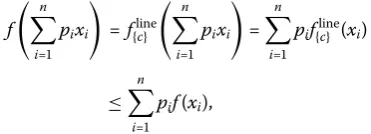
Proof Letfline
{c} be the function of the line passing through the pointC. Assume the case
Figure 1 Function supported by the line.
the affinity offline
{c} , it follows that
f
n
i= pixi
=f{c}line
n
i= pixi
=
n
i=
pif{c}line(xi)
≤
n
i= pif(xi),
concluding the proof in the case that the line is below the curve.
The functionf with the line passing through the pointCbelow its graph is shown in Figure . In what follows,f will be convex to the right or left ofc, and the right or left tangent line will be used as the support line atc.
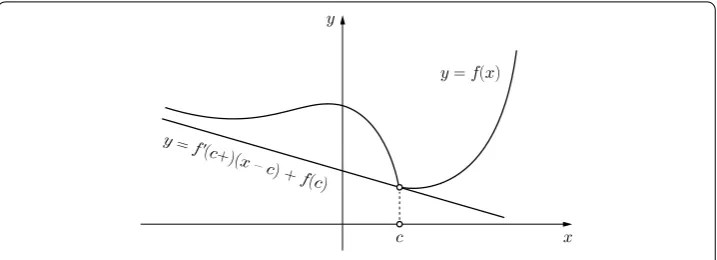
Iff is convex onIx≥c, then the slope (f(x) –f(c))/(x–c) approaches the real number kr=f(c+) or to the negative infinity –∞asxapproachesc+.
Lemma . Let f :I→Rbe a function that is convex onIx≥cfor some point c∈I.Let
kr∈Rbe the slope of the right tangent line of the function f at the point c.
Then the inequality
f(px+qy)≤pf(x) +qf(y) (.)
holds for all binomial convex combinations fromIsatisfying px+qy=c if,and only if,the right tangent line inequality
f(x)≥kr(x–c) +f(c) (.)
holds for all points x∈I.
Proof The proof of necessity. Since the tangent line of a convex function is the support line, it is sufficient to prove the inequality in equation (.) for allxinIwhich are less thanc. Take any suchx. Then thec-centered convex combinationspx+qy=cfromI include onlyy>c. The inequality in equation (.) with these combinations can be adapted to the form
f(x) –f(c) x–c ≤
[image:6.595.134.320.262.329.2]Figure 2 Right convex function supported by the right tangent line.
Lettingygo tocandpto so thatxstays the same, it follows that
f(x) –f(c) x–c ≤y→clim+
f(y) –f(c) y–c =f
(c+) =k r.
Multiplying the above inequality withx–c< , we get the inequality in equation (.). The proof of sufficiency. Using the convex functiong:I→Rdefined by
g(x) =
kr(x–c) +f(c) forx≤c,
f(x) forx≥c,
we see that the inequality
f(px+qy) =g(px+qy)≤pg(x) +qg(y)≤pf(x) +qf(y)
holds for all binomial convex combinations fromIsatisfyingpx+qy=c.
The graph of the right convex functionf with the right tangent line at the pointcis presented in Figure .
Based on Lemma . and its analogy for left convex functions, and also on Theorem ., we have the following characterization of half convex and half concave functions.
Theorem . Let f :I→Rbe a function that is convex onIx≥c orIx≤cfor some point c∈I.If f is right(resp.left)convex,let k
r∈R(resp.kl)be the slope of the right(resp.left)
tangent line at c.
Then the following three conditions are equivalent:
() The inequality
f
n
i= pixi
≤
n
i= pif(xi)
holds for all convex combinations fromIsatisfyingni=pixi=c. () The inequality
f(px+qy)≤pf(x) +qf(y)
() The tangent line inequality
f(x)≥k(x–c) +f(c)
withk=krork=klholds for all pointsx∈I.
If f is concave onIx≥corIx≤cfor some point c∈I,then the reverse inequalities are valid
in(), (),and().
4 Application to quasi-arithmetic means
In the applications of convexity to quasi-arithmetic means, we use strictly monotone con-tinuous functionsϕ,ψ:I→Rsuch thatψ isϕ-convex, that is, the functionf =ψ◦ϕ– is convex (according to the terminology in [, Definition .]). A similar notation is used for concavity.
A concept of quasi-arithmetic mean refers to convex combinations and strictly mono-tone continuous functions. The ϕ-quasi-arithmetic mean of the convex combination
n
i=pixifromIis the point
Mϕ(xi;pi) =ϕ–
n
i= piϕ(xi)
(.)
which belongs toI, because the convex combinationni=piϕ(xi) belongs toϕ(I). Ifϕis
the identity function onI, then its quasi-arithmetic mean is just the convex combination
n
i=pixi.
Right convexity and concavity for quasi-arithmetic means can be obtained using Lem-ma ..
Corollary . Letϕ,ψ:I→Rbe strictly monotone continuous functions,andJ =ϕ(I) be theϕ-image of the intervalI.
Ifψ is eitherϕ-convex onJz≥dfor some point d=ϕ(c)∈J and increasing onI or
ϕ-concave onJz≥dand decreasing onI,then the inequality
Mϕ(xi;pi)≤Mψ(xi;pi) (.)
holds for all convex combinations from J satisfyingni=piϕ(xi)≥d if,and only if,the
inequality
Mϕ(x,y;p,q)≤Mψ(x,y;p,q) (.)
holds for all binomial convex combinations fromJ satisfying pϕ(x) +qϕ(y) =d.
Ifψ is eitherϕ-convex onJz≥ϕ(c)for some point d=ϕ(c)∈Jand decreasing onIor ϕ-concave onJz≥dand increasing onI,then the reverse inequalities are valid in equations (.)and(.).
Proof We prove the case that the functionψisϕ-convex on the intervalJz≥dand
In the first step, applying Lemma . to the functionf :J →R, convex on the interval Jz≥d, we get the equivalence: the inequality
f
n
i= piϕ(xi)
≤
n
i= pif
ϕ(xi)
holds for all convex combinations fromJ satisfyingni=piϕ(xi)≥dif, and only if, the
inequality
fpϕ(x) +qϕ(y)≤pfϕ(x)+qfϕ(y)
holds for all binomial convex combinations fromJ satisfyingpϕ(x) +qϕ(y) =d.
In the second step, assigning the increasing functionψ–to the above inequalities, the equivalence follows. The inequality
Mϕ(xi;pi) =ϕ–
n
i= piϕ(xi)
≤ψ–
n
i= piψ(xi)
=Mψ(xi;pi)
holds for all convex combinations fromJ satisfyingni=piϕ(xi)≥dif, and only if, the
inequality
Mϕ(x,y;p,q) =ϕ–
pϕ(x) +qϕ(y)≤ψ–pϕ(x) +qϕ(y)=Mψ(x,y;p,q)
holds for all binomial convex combinations fromJ satisfyingpϕ(x) +qϕ(y) =d.
Combining ‘right’ and ‘left’ similarly as in Theorem ., we get the following character-ization of half convexity and concavity for quasi-arithmetic means.
Corollary . Letϕ,ψ:I→Rbe strictly monotone continuous functions,and letJ = ϕ(I)be theϕ-image of the intervalI.
Ifψis eitherϕ-convex onJz≥dorJz≤dfor some point d=ϕ(c)∈Jand increasing onI
orϕ-concave onJz≥dorJz≤dand decreasing onI,then the inequality
Mϕ(xi;pi)≤Mψ(xi;pi) (.)
holds for all convex combinations from J satisfyingni=piϕ(xi) =d if, and only if,the
inequality
Mϕ(x,y;p,q)≤Mψ(x,y;p,q) (.)
holds for all binomial convex combinations fromJ satisfying pϕ(x) +qϕ(y) =d.
Ifψis eitherϕ-convex onJz≥ϕ(c)orJz≤dfor some point d=ϕ(c)∈Jand decreasing on Iorϕ-concave onJz≥dorJz≤dand increasing onI,then the reverse inequalities are valid in equations(.)and(.).
refinements were studied in []. A simple transformation for deriving new means was in-troduced in [].
In further research of half convexity it would be useful to include the functions of several variables. Their geometric characterization using support surfaces would be especially interesting.
Competing interests
The author declares that they have no competing interests.
Received: 5 September 2013 Accepted: 17 December 2013 Published:09 Jan 2014
References
1. Niculescu, CP, Persson, LE: Convex Functions and Their Applications. CMS Books in Mathematics. Springer, New York (2006)
2. Peˇcari´c, JE, Proschan, F, Tong, YL: Convex Functions, Partial Orderings, and Statistical Applications. Academic Press, New York (1992)
3. Jensen, JLWV: Om konvekse Funktioner og Uligheder mellem Middelværdier. Nyt Tidss. Mat. B16, 49-68 (1905) 4. Jensen, JLWV: Sur les fonctions convexes et les inégalités entre les valeurs moyennes. Acta Math.30, 175-193 (1906) 5. Pavi´c, Z, Peˇcari´c, J, Peri´c, I: Integral, discrete and functional variants of Jensen’s inequality. J. Math. Inequal.5, 253-264
(2011)
6. Mi´ci´c, J, Pavi´c, Z, Peˇcari´c, J: The inequalities for quasiarithmetic means. Abstr. Appl. Anal.2012, Article ID 203145 (2012)
7. Sándor, J: On global bounds for generalized Jensen’s inequality. Ann. Funct. Anal.4, 18-24 (2013)
8. Cirtoaje, V, Baiesu, A: An extension of Jensen’s discrete inequality to half convex functions. J. Inequal. Appl.2011, Article ID 101 (2011)
9. Bullen, PS, Mitrinovi´c, DS, Vasi´c, PM: Means and Their Inequalities. Reidel, Dordrecht (1988)
10. Raïssouli, M, Sándor, J: On a method of construction of new means with applications. J. Inequal. Appl.2013, Article ID 89 (2013)
10.1186/1029-242X-2014-13