R E S E A R C H
Open Access
Properties of convergence of a class of
iterative processes generated by sequences
of self-mappings with applications to
switched dynamic systems
Manuel De la Sen
1*and Asier Ibeas
2*Correspondence:
[email protected] 1Institute of Research and
Development of Processes, University of the Basque Country, Campus of Leioa (Bizkaia), Barrio Sarriena, P.O. Box 644, Bilbao, 48940, Spain
Full list of author information is available at the end of the article
Abstract
This article investigates the convergence properties of iterative processes involving sequences of self-mappings of metric or Banach spaces. Such sequences are built from a set of primary self-mappings which are either expansive or non-expansive self-mappings and some of the non-expansive ones can be contractive including the case of strict contractions. The sequences are built subject to switching laws which select each active self-mapping on a certain activation interval in such a way that essential properties of boundedness and convergence of distances and iterated sequences are guaranteed. Applications to the important problem of stability of dynamic switched systems are also given.
Keywords: expansive; non-expansive; contractive and strictly contractive self-mappings; switched dynamic systems; convergence; fixed point; stability
1 Introduction
The problems of boundedness and convergence of sequences of iterative schemes are very important in numerical analysis and the numerical implementation of discrete schemes. See [–] and references therein. In particular, [] describes in detail and with rigor the as-sociated problems linked to the theory of fixed points in various types of spaces like metric spaces, complete and compact metric spaces and Banach spaces. This book also contains, discusses and compares results of a number of relevant background references on the sub-ject. In other papers, related problems are focused from a computational point of view in-cluding the acceleration of convergence using modified numerical methods like Aitken’s delta-squared methods or Steffensen’s method, [–]. On the other hand, there is also a rich background in theory and applications of fixed point theory related to non-expansive, contractive, weakly contractive and strictly contractive mappings as well as related to their counterparts in the framework of common fixed points and coincidence points for several mappings and in the framework of multivalued functions. A (non-exhaustive) list of recent related references is given including new results and a discussion of previous background ones. See, for instance, [, –], and references therein. Many efforts are also devoted to the formulation of extensions of the above problems to the study of existence and unique-ness of best proximity points in cyclic self-mappings, [, , , –], to that of proximal
contractions, [, ] and to the characterization of approximate fixed and coincidence points, [, ]. Direct applications of fixed point theory to the study of the stability of dy-namic systems including the property of ultimate boundedness for the trajectory solutions having mixed non-expansive and expansive properties through time or being subject to impulsive controls have been given in [] and [, ]. Some recent studies of best prox-imity points of weak φ-contractions in ordered metric spaces have been performed in []. On the other hand, the existence of best proximity points for -cyclic operators in uniformly convex Banach spaces is investigated in []. Finally, in [], it has been proved that some previous fixed point results and some recently announced best proximity results are equivalent.
This paper is focused on the study of boundedness and convergence of sequences of dis-tances and iterated points and the characterization of fixed points of a class of composite self-maps in metric spaces. Such maps are built with combinations of sets of elementary self-maps which can be expansive or non-expansive and the last ones can be contractive (including the case of strict contractions). The composite maps are defined by switching rules which select some self-map (the ‘active’ self-map) on a certain interval of definition of the running index of the sequence of iterates being built. The above mentioned proper-ties concerning the sequences of iterates being generated from the given initial points are investigated under particular constraints for the switching rule. Note, on the other hand, that the properties of controllability and stability of differential-difference and the various kinds of dynamic systems are of a wide interest in theory and applications [, –]. See, for instance, related problems associated with continuous-time, discrete-time, dig-ital, and hybrid systems and those involving delayed dynamics [–] and [, –, –], sampled-data systems under constant, non-uniform, and/or multirate sampling and switched systems [, , , ]. In this context, this paper also includes an appli-cation of the developed theoretical framework to the stability of (in general) nonlinear switched dynamic systems. The composite self-map generating the trajectory solution se-quence from initial conditions is defined with sets of elementary self-maps being associ-ated with distinct active parameterizations which are switched through time by switching rules which guarantee the fulfilment of the suitable properties.
2 Problem statement and main results
Consider a sequence{Tσ(n)}of self-mappings fromXtoXwhere (X,d) is a metric space
endowed with a metricd:X×X→R+and an iterative process
xn+=Tσ(n)xn, x∈X,∀n∈Z+. (.)
The subsequent nomenclature is used:
() The functionσ:Z+→ ¯q⊆Z+is the so-called switching law whereq¯={, , . . . ,q}
ifq∈Z+is finite andq¯≡Z+, otherwise,i.e. q=card(q¯) =χ(i.e.the infinity cardinal of a
countable set).
() q is the set of distinct parameterizations of the sequence ST ={Tσ(n)} of
self-mappings onXin the sense that such a sequence contains a finite or infinite setST∗=
{T,T, . . . ,Tq}of distinct self-mappings.
are not strict contractions, non-expansive self-mappings which are not contractive, and a class of expansive self-mappings which fulfil a specific expanding condition according to
d(Tix,Tiy)≤Kid(x,y), ∀x,y∈XwithKi∈(, ) ifi∈qsc,
d(Tix,Tiy) <d(x,y) =Kid(x,y), ∀x,y(=x)∈XwithKi= ifi∈qc, d(Tix,Tiy) =Kid(x,y) =d(x,y), ∀x,y∈XwithKi= ifi∈qne,
Kid(x,y)≤d(Tix,Tiy)≤Kid(x,y),
∀x,y∈XwithKi,Ki(>Ki)∈(,∞) ifi∈qe.
(.)
Note thatqc=qsc∪qcindexes the whole set of contractive self-mappings in the setST∗. () The composite mappingST:Z+×Z+×X→X,∀n∈Z+defined by
ˆ
T(n,n+m) =Tσ(n+m–)Tˆ(n,n+m– )
=Tσ(n+m–)Tσ(n+m–)· · ·Tσ(n), ∀n∈Z+,∀m∈Z+; (.)
in particular,
ˆ
Tn=Tˆ(,n) =Tσ(n)Tˆn–=Tσ(n)Tσ(n–)· · ·Tσ() (.)
withσ(n)∈ ¯q, defines the sequence of iterations{xn}defined by
xn+=Tˆ(m,n+ )xm=Tˆσˆ(n,m+)=Tσ(n)xn=Tˆnx, ∀x∈X,∀m,n(≥m)∈Z+, (.)
whereσˆ(n,m+ ) ={σ(n),σ(n+ ), . . . ,σ(m)}is the sequence of configurations fromnto
m+ defined by the switching lawσ:Z+→ ¯q⊆Z+. One gets from recursion with (.)
d(Tˆnx,Tˆn–x)≤K(,n)d(x,Tσ()x)
=K(,n)d(x,Tσ()x), ∀x∈X,∀n∈Z+ (.)
ifσ(j) /∈qc,∀j∈ ¯n∪ {}, and
d(Tˆn+x,Tˆnx)≤K(,n)Kc(,n)d(x,Tσ()x)
<K(,n)d(x,Tσ()x), ∀x∈X, (.)
if there is somej∈ ¯n∪ {}such thatσ(j)∈qc, where
K(,n) = n–
j=
[Kσ(j)],
Kc(,n) = n–
j(∈σc)=
d(Tσ(j+)xj+,Tσ(j+)xj) d(Tσ(j)xj,Tσ(j+)xj+)
(< ), ∀n∈Z+.
(.)
Example . Consider the simple scalar discrete equation (.) withxn+=Tσ(n)xn=anxn withx∈R,∀n∈Z+under the Euclidean metric. The sequence{Tσ(n)=an}is such that Tσ(n)∈ {T,T,T},∀n∈Z+, whereT={z∈R:z≤α},T={}, andT={z∈R:z≥β}
for some given real constants – <α< andβ> . It is clear that the self-mappingTon
Ris a strict contraction with a contractive constantK=|α|< , the self-mappingTon
Ris non-expansive with constantK= , and the self-mappingTonRis expansive with
constantsK= andK=β> . Note that the set of fixed points ofTireduces to{}, that is,Fix(Ti) ={}fori∈ ¯q{}is the unique fixed, and equilibrium, point ofTandTwhile
Fix(T) =Rwith the wholeRbeing an equilibrium set ofT. Note also that{}is a stable
equilibrium point ofT, while it is an unstable equilibrium point ofT.
The switching law isσ:Z+→ ¯q={, , } ⊆Z+. Ifσ(n) =i(∈ ¯q),∀n∈[n,n)∩Z+, it is
said that theith configuration of (.) is active in the interval [n,n). Ifσ(n) =j(∈ ¯q)=i,
then it is said thatnis a switching sample of (.) since the active configuration becomes
modified with such a sample.
Lemma . Consider the iterative process (.) built with a sequence {Tσ(n)} of
self-mappings from X to X such that (X,d)is a metric space.Assume a given switching law σ :Z+→ ¯q⊆Z+ such that there are a strictly increasing testing sequence of integers
S =S(σ) ={nk}, which may be non-unique, with n= , and an associate sequence of
positive real numbers Sρ=Sρ(S) ={ρk}verifying nk+–nk≤μ< +∞and K(nk,nk+) =
nk+–
j=nk [Kσ(j)]≤ρk,∀k∈Z+,whereμ=μ(S).Then the metric has the following proper-ties:
(i) Ifρk < , ∀k ∈Z+ then d(xn+,xn)→ as n→ ∞, ∀x∈X, and d(xnk+,xnk)≤
(μi=–Mi
)ρkd(xnk,xnk–)∀k∈Z+,∀x∈X,d(xnk,xnk+)→as k→ ∞and d(xn,xn+)→
as n→ ∞,∀x∈X,where M=maxi∈¯q(Ki).
(ii)If the switching lawσ:Z+→ ¯q⊆Z+is such thatρk≤ρ/(μi=Mi),∀k∈Z+,for
some given real constantρ∈(, )then all the sequence of composite self-mappings defined byTˆ(nk,nk+) =Tσ(nk+–)· · · ˆTσ(nk)on X are strict contractions of contractive constantρ.
(iii)Ifρk> ,∀k∈Z+then d(xn+,xn)→+∞as n→ ∞for any given x∈/ Fix(Tσ())
in X.
(iv)Assume thatρk≤ ¯ρ< ,∀k∈Z+for nk∈S andρk∈Sρ,∀k∈Z+and the existence
of the limitslimk→∞(nk+–nk) =μ∗≤μ< +∞andTˆ(nk,nk+)→ ˆT∗(,μ∗)uniformly in X
as k→ ∞,that is,limk→∞sup ˆT(nk,nk+)x–Tˆ∗(,μ∗)x= ,∀x∈X,whereμ∗=μ∗(S).
Then the self-mappingTˆ∗(,μ∗)on X is a strict contraction and,for any given N∈Z+,
there is a real constantδ=δ(N)such that{δ(N)} →such that one has for all k,N∈Z+
d(xk+N+,xk+N)≤ ¯ρkd(xn,xn) +
–ρ¯k
–ρ¯ i∈maxZ+
(δni), (.)
lim
k,N→∞d(xnk+N+,xnk+N) = . (.)
Proof Note thatn= so that for anynk∈Sandk∈Z+
d(xnk++,xnk+)≤K(nk,nk+)d(xnk,xnk+)≤ρkd(xnk,xnk+), ∀k∈Z+
≤ · · · ≤
k
i=
[ρi]
d(xnk++j+,xnk++j)≤
n
k++j
i=nk+
[Kσ(i)]
k
i=
[ρi]
d(Tσ()x,x)
≤M(nk,j)
k
i=
[ρi]
d(Tσ()x,x)
≤M
k
i=
[ρi]
d(Tσ()x,x) <M
k
i=
[ρi]
d(Tσ()x,x),
∀k∈Z+,∀j∈nk–nk+– ∪ {} (.)
(the last inequalities of (.)-(.) standing if and only if the respective left-hand-sides are nonzero) for some set of real bounded sequences{M(nk,j)},j∈nk+–nk+which
sat-isfy M(nk,j)≤M=Mmax(,Mμ–) < +∞for some M∈R+ andj∈nk+–nk+, since
maxk∈Z+(nk+–nk)≤μ< +∞,∀k∈Z+andKi∈(,∞),∀i∈ ¯q. There isk∈Z+such
that (ki=[ρi]) < /M, sinceρi< ,∀i∈Z+, then one gets from (.)
d(xnk++j+,xnk++j) <d(Tσ()x,x), ∀k(≥k)∈Z+. (.)
Also, sinceρk< ,∀k∈Z+, one gets from (.)-(.)
lim
k→∞d(xnk+j+,xnk+j) = , ∀j∈nk+–nk– ∪ {}. (.)
Since (.) involves any limit distance in-between any two adjacent elements of the so-lution sequence{xn}of (.) for any givenx∈X, one getslimn→∞d(xn+,xn) = . On the other hand, one gets from (.) and the triangle inequality
d(xnk+,xnk)≤
nk+–nk– i=
d(xnk+i,xnk+i+)≤ρk μ–
i=
Mi
d(xnk,xnk+), ∀k∈Z+ (.)
so thatd(xnk+,xnk)≤(
μ–
i=Mi)ρkd(xnk,xnk–),∀k∈Z+andd(xnk,xnk+)→ ask→ ∞
from the triangle inequality,d(xn,xn+)→ asn→ ∞andmaxk∈Z+(nk+–nk)≤μ< +∞.
Hence, property (i) follows. Property (ii) is proven by noting that ifρk≤ρ/(μi=–Mi),
∀k∈Z+, for some realρ∈(, ) then
d(xnk+,xnk)≤ρd(xnk,xnk–)≤ρ
d(x
nk–,xnk–)≤ · · · ≤ρ
kd(x
n,xn). (.)
Property (iii) is proven from the fact that expansive mappings of the switching law fulfil
d(x,y) <Kid(x,y)≤d(Tix,Tiy), ∀x,y∈XwithKi> ifi∈qe
and it follows from the assumptions that there is an infinite sequenceS={nk}such that Tσ(nk)onXare non-expansive self-mappings. Thend(xnk+,xnk++)≥(
k
i=[ρi])d(Tσ()x,
x),∀k∈Z+so thatlimk→∞d(xnk+,xnk++) = +∞ifx∈/Fix(Tσ()). Thus,limk→∞d(xnk++j,
xnk++j+) = +∞for allj= , , . . . ,nk+–nk+– sincenk+–nk+≤μ. Otherwise, it would
property (iii) follows. To prove property (iv), note thatδnk =d(Tˆ(nk–,nk)x,Tˆ(nk,nk+)x)
leads toδnk → ask→ ∞, so that{δnk}is bounded since (nk+–nk)→μ
∗ask→ ∞
and Tˆ(nk,nk+)→ ˆT∗(,μ∗) uniformly in X as k → ∞. Then ρk ≤ ¯ρ < , ∀k∈ Z+
for nk∈S and ρk∈Sρ, ∀k∈Z+ and the existence of the limitslimk→∞(nk+ –nk) = μ∗ ≤μ < +∞, limk→∞ρk =ρ∗ ≤ ¯ρ < and Tˆ(nk,nk+)→ ˆT∗(,μ∗) uniformly in X
as k → ∞ imply that Tˆ∗(,μ∗) is a strict contraction on X and, furthermore, since [d(Tˆ(nk–,nk)xnk,Tˆ(nk,nk+)xnk) –d(Tˆ(,μ∗)xnk,Tˆ(,μ∗)xnk)]→ ask→ ∞, one gets
d(xnk+,xnk) =d ˆ
T(nk,nk+)xnk,Tˆ(nk–,nk)xnk–
≤dTˆ(nk–,nk)xnk–,Tˆ(nk–,nk)xnk
+dTˆ(nk–,nk)xnk,Tˆ(nk,nk+)xnk
≤K(nk–,nk)d(xnk–,xnk) +δnk
≤
k
i=
[ρi]
d(xn,xn) +
k
i=
k
j=i+
[ρi]δni
≤ ¯ρkd(xn,xn) +
–ρ¯k –ρ¯ i∈maxZ+
(δni) (.)
and then (.) holds. Also, (.) follows from (.), sincelimN→∞maxi(≥N)∈Z+(δni) =
for any givenx∈Xandρ¯nk+N–nN→ ask,N→ ∞, and then
≤lim sup
k→∞d(xnk+,xnk+)
≤lim sup
k→∞
d(xnk+,xnk+) –ρ¯
μ∗d(x
nk,xnk+) –
–ρ¯μ∗
–ρ¯ i∈maxZ+
(δni)
≤lim sup
k→∞
d(xnk+,xnk+) –K
,μ∗d(xnk,xnk+) –
–ρ¯μ∗
–ρ¯ maxi∈Z+
(δni)
≤ (.)
so thatlimk→∞d(xnk+,xnk+) exists and then, sincelimk→∞(nk+–nk) =μ∗≤μ< +∞and ˆ
T(nk,nk+)→ ˆT∗(,μ∗) uniformly inXask→ ∞and (.)-(.) hold, one gets for any
nonnegative integerj≤μ∗
lim
k→∞d
xnk,Tˆ(nk,nk+)xnk
= lim
k→∞d
xnk,Tˆ
∗,μ∗x nk
= lim
k→∞d
xnk+j,Tˆ(nk+j,nk+j+)xnk
= lim
k→∞d
xnk+j,Tˆ
∗,μ∗x nk+j
= lim
k→∞d
xnk+μ∗+j,Tˆ
∗,μ∗x nk+j
= (.)
and property (iv) has been proven.
Remark . Note that the testing sequence S ={nk} of the given switching law in Lemma . is not necessarily associated with a set of strict contractions although the com-positeK(nk,nk+), fornk∈S, defines a composite strict contraction of non-necessarily strictly contractive self-mappings. The composite sequencesK(n,nk) forn∈[nk+ ,nk+),
since the only requirement is that it be strictly increasing with a maximum prescribed, but arbitrary, separation in-between any two adjacent elements of such a sequence.
Remark . Lemma . can be fulfilled, in general, by non-unique sequences S={nk} of a given switching law in Lemma . as well as non-unique associated{ρk},μandμ∗. A typical case occurs when the switching law consists of strict contractions or converges to a sequence of strict contractions. Those ones can be grouped individually in the limit
ˆ
T∗(,μ∗) or this one may be a composite self-mapping of strict limit contractions so that the next result follows.
Theorem . Assume an iterative procedure (.) built from a given switching law σ :Z+→ ¯q⊆Z+. If the self-mappingTˆ∗(,μ∗) on X is a strict contraction such that
ˆ
T(nk,nk+)→ ˆT∗(,μ∗)uniformly in X as k→ ∞with the strictly increasing testing
se-quence S={nk}being subject tomaxk∈Z+(nk+–nk)≤μ< +∞andlimk→∞(nk+–nk) = μ∗≤μ.Then the following properties hold:
(i)There is a(in general,non-unique)decomposition of the compositeTˆ∗(,μ∗) :X→X in a maximum number of p∈[,μ∗]strict contractionsTˆi∗(μ¯∗i–,μ¯∗i) :X→X,∀i∈ ¯p,with μ∗=μ¯∗= for the testing sequence S={nk},such thatμ∗=μ¯∗=
p
i=μ∗i so that
ˆ
T∗,μ∗=Tˆ∗,μ¯∗=Tˆp∗μ¯∗p–,μ¯∗p· ˆTp∗–μ¯∗p–,μ¯∗p–·. . .· ˆT∗,μ¯∗, (.)
whereμ¯∗i =ij=μ∗i,∀i∈ ¯p.
(ii)The decomposition(.)in a maximum number of strict contractions is unique if and only if the positive integer numbersμ∗i,∀i∈ ¯p such thatμ∗=pi=μ∗i are unique.In particular,the decomposition(.)is unique ifμ∗i = ,∀i∈ ¯p.
(iii)Assume that,furthermore, (Tσ(kn+j)–Tσ((k+)n+j))→uniformly in X as n→ ∞for
some k(≥μ∗)∈Z+,∀j∈k– ∪ {}so that{σ(kn+j)} → {σj∗}and{Kσ(kn+j)} → {Kj∗},∀j∈
¯
μ∗.Then the decomposition(.)is unique in a maximum number of strict contractions if and only if
μ∗i = min
z≥μ∗ i–
z∈Z+:
Kz∗<z– j=[Kj∗]
∧
μ∗
j=z
Kj∗<
, (.a)
μ∗p= min
z≥μ∗p–
z∈Z+:Kz∗< z–
j=[Kj∗]
, (.b)
∀i∈p– sinceμ∗=μ¯∗= ,where p= (maxz∈Z+:μ∗=
z
i=μ∗i).Thenμ∗= p
i=μ∗i with μ∗i(≤μ∗)∈Z+,∀i∈ ¯p being unique as well.
Proof Since the switching lawσ:Z+→ ¯q⊆Z+is given, any strictly increasing sequence
S={nk}satisfying the constraintsmaxk∈Z+(nk+–nk)≤μ< +∞,limk→∞(nk+–nk) =μ∗≤
μandTˆ(nk,nk+)→ ˆT∗(,μ∗) uniformly inXask→ ∞fornk,nk+∈S, withμ=μ(S)
andμ∗ =μ∗(S) being finite, imply that the composite-self-mapping Tˆ∗(,μ∗) :X→X
is a composite self-mapping of at least one and at mostμ∗ strict contractions. So, the maximum numberpof strict limit contractionsp∈[,μ∗] in the compositeTˆ∗(,μ∗) for the sequence{Tnk}fornk∈Sfor a given sequenceSexists and satisfies (.). Property (i)
thatμ∗=pi=μi∗andTˆi∗(μ¯∗i–,μ¯∗i) :X→X,∀i∈ ¯pare strict contractions. In particular, the decomposition (.) is trivially unique ifμ∗i = ;∀i∈ ¯pso thatp=μ∗. Property (ii) has been proven.
The proof of property (iii) is split into two parts as follows:
-p= andμ∗ =μ¯∗ =μ∗. Since (.a)-(.b) hold,μ∗ ∈Z+, subject to ≤μ∗ ≤μ∗
exists so thatTˆ(,μ∗) is a unique strict contraction onX. Thus, either (.b) holds with ≤μ∗ =μ∗ and the sufficiency part of the property is already proven forp= with a strict contractionTˆ(,μ∗) =Tˆ(,μ∗) onXforp= orp> and (.a) holds for some integer i≥. Necessity follows since if p= andTˆ(,μ∗) is a strict contraction then
ˆ
T(,μ∗) =Tˆ(,μ∗) forμ∗=μ∗. Uniqueness is trivial since there is a single self-mapping in the decomposition of the composite self-mappingTˆ(,μ∗) onX.
-p≥. The proof of sufficiency is proven by complete induction. Assume that (.a)-(.b) hold so that μ∗ ∈Z+, subject to ≤μ∗≤μ∗, has to exist so thatTˆ(,μ∗) is a
unique strict contraction onXsinceμ∗∈Z+exists such thatTˆ(,μ∗) exists, being a strict
contraction on X. Set μ¯∗=μ∗ = and note thatμ∗j =μ¯∗j –μ¯∗j– and μ¯∗j =μj+μ¯∗j–=
μj+
j–
i=μi,∀j∈ ¯p, so thatTˆ(μ¯∗j–,μ¯∗j), thenμ∗j =μ¯∗j –μ¯∗j–is a unique strict
contrac-tion on Xfor allj(≤i– )∈Z+ and somei(≤p)∈Z+ such that the set of positive
in-tegers {μ∗,μ∗, . . . ,μ∗i–}, subject toμ¯∗i–=ji–=μ∗j <μ∗, is unique. Then the composite
ˆ
T(,μ¯∗i–) =Tˆ(μ¯∗i–,μ¯∗i–)·. . .· ˆT(,μ∗) is a unique strict contraction, withμ¯∗i =ij=μ∗i,
∀i∈ ¯p, and the positive integer μ∗i is unique so that the set {μ∗,μ∗, . . . ,μ∗i}, subject to
i
j=μ∗j <μ∗, is also unique andTˆ(,μ∗j), for allj(≤i)∈Z+andi(≤p)∈Z+, and then the
compositeTˆ(,μ¯∗i) =Tˆ(,μ∗i)·. . .· ˆT(,μ∗) are unique and strictly contractive onX. The proof follows by complete induction,∀i∈ ¯pwith the existence of a unique positive integer
p=p(μ∗) = (maxz∈Z+:μ∗=
z
i=μ∗i). Thenμ∗= p
i=μ∗i withμ∗i(≤μ∗)∈Z+,∀i∈ ¯p
being unique. Necessity follows since if (.) holds and (.) fails for somei(≥)∈ ¯pfor a givenp≥ then the factorization of the composite self-mappingTˆ(,μ∗) onX, subject toμ∗=pi=μ∗i, does not consist of strict contractions. Property (iii) has been proven. A particular case of the decomposition of the composite self-mapping (.) is when such a decomposition becomes invariant and equal to
ˆ
T∗,μ∗=Tˆp∗,μ∗p· ˆTp∗–,μ∗p–·. . .· ˆT∗,μ∗
under the invariance identitiesTˆi∗(,μi∗) =Tˆi∗(μ¯∗i–,μ¯∗i), implied by the identitiesμi=μ¯∗i–
¯
μ∗i–,∀i∈ ¯p. If the collection of all the sequencesSˆ=Sˆ(σ) ={S={nk}}for givenx∈X
andσ :Z+→ ¯q⊆Z+is considered under the given convergence hypotheses, it follows
easily from the above reasoning that there is also a maximum number pˆ of strict limit contractionspˆ∈[,μˆ∗], where
ˆ
μ∗=maxμ∗(S) :S∈ ˆS=max
S∈ˆS
lim
k→∞(nk+–nk) :nk,nk+∈S
=max
S∈ˆS
μ∗(S) (.)
of the (in general, non-unique) decomposition:
ˆ
(.) is unique if the testingSconverges to a finite subsequence of strict contractions so thatμ∗=pi=μ∗i wherepis the maximum number of strict contractions of the decom-position (.) and the numbersμ∗i,∀i∈ ¯pare unique. Uniqueness holds in the case that
p=μ∗andμ∗i = ,∀i∈ ¯p.
Note that the assumption (Tσ(kn+j)–Tσ((k+)n+j))→ uniformly inXasn→ ∞for some
k(≥μ∗)∈Z+,∀j∈k– ∪ {}in Theorem .(iii) implies that{Tσ(kn+j)} →Tj∗=Tˆj∗(, ),
∀j∈k– ∪{}. Note also thatk≥μ∗is a consequence of the fact that (.) is a decompo-sition of strict contraction while some of the limit self-mappings onXreached as a result of the uniform convergence constraint{Tσ(kn+j)} →Tj∗=Tˆj∗(, ),∀j∈k– ∪ {}can be expansive.
Theorem . Consider the iterative process(.)under the assumptions of Lemma..
Then the following properties hold:
(i)If Lemma.(ii)holds then{xnk}and{xnk,xnk+},with nk∈S,∀k∈Z+,are Cauchy sequences,so bounded,and then convergent in X if,in addition, (X,d)is complete.
(ii)If Lemma.(iii)holds withρ∗≤ρ/(μi=–Mi),∀k∈Z+,for some realρ∈(, )then
property(i)holds.
(iii) If both Lemma.(ii)and Theorem .(i)hold then{xn k+
j
i=μ∗i} are Cauchy se-quences,so bounded, and then convergent in X if,in addition, (X,d)is complete for all j∈ ¯p∪ {}and nk∈S,∀k∈Z+and∀S∈ ˆS,whereSˆ=Sˆ(σ) ={S={nk}}.
(iv) Assume that(X,d)is a compact metric space and that Lemma.(ii)and Theo-rem.(i)both hold.ThenFixTˆ(,μ∗) ={z}for some z∈X andTˆ(,μ∗) :X→X is a strict Picard self-mapping and{xnk+μ¯j∗} →z for any initial x∈X,whereμ¯
∗ j =
j
i=μ∗i,∀j∈ ¯p.If qc=∅then the above result holds if(X,d)is a complete metric space.
Proof If Lemma .(i) holds then{xnk}is a Cauchy sequence from (.), then bounded
and, in addition, convergent inXif (X,d) is complete. The properties are extendable to
{xnk,xnk+} from (.). Thus, property (ii) has been proven. Property (ii) follows from
property (i) sinceρk→ρ∗∈(, ) ask→ ∞andρ∗≤ρ/(μi=–Mi),∀k∈Z+, for some
realρ,ρ∗∈(, ) then for any givenε∈R+there arek¯=k¯(ε)∈Z+andk¯∗=k¯∗(ε)(≥ ¯k)∈
Z+such that fork(>k¯)∈Z+ρk≤ρ/(
μ–
i=Mi),∀k≥ ¯kandρk≤ρ∗/(
μ–
i=Mi),∀k≥ ¯k∗.
To prove property (iii), note that if, in addition, Theorem .(i) holds then{xn
k++ji=μ∗i – x
nk+ji=μ∗i} →
sinceTˆ∗(,μ∗) =Tˆ∗(,μ¯∗) =Tˆp∗(μ¯∗p–,μ¯∗p)· ˆTp∗–(μ¯∗p–,μ¯p∗–)·. . .· ˆT∗(,μ¯∗) are strict contractions from (.),∀j∈ ¯pand{xnk}is a Cauchy sequence from property (i)
since by definingμ¯∗j =ji=μ∗i,ρ¯∗j =K(,μ¯∗j) < ,∀j∈ ¯p, one gets
d(xnk++μ¯∗j,xnk+μ¯∗j)≤d(xnk,xnk+μ¯∗j) +d(xnk,xnk+) +d(xnk+,xnk++μ¯∗j)
≤d(xnk,xnk+) +
–ρ¯j∗max
d(xnk,xnk+),d(xnk+,xnk++)
, (.)
∀j∈ ¯p,∀k∈Z+, and, from property (i), one gets
lim
lim
k→∞d ˆ
Tnk++μ¯j∗,nk+μ¯∗j
xnk+μ¯∗j,xnk+μ¯∗j =d lim k→∞ ˆ
Tnk++μ¯j∗,nk+μ¯∗j
xnk+μ¯∗j
, lim
k→∞xnk+μ¯∗j =d lim k→∞ ˆ
Tnk++μ¯j∗,nk+μ¯∗j
xnk+μ¯∗j
, lim
k→∞ ˆ
T,μ¯∗jxnk
=dlim
k→∞ ˆ
Tμ¯∗j,μ¯∗j +μ∗Tˆ,μ¯∗jxnk
, lim
k→∞ ˆ
T,μ¯∗jxnk
=d
ˆ
Tμ¯∗j,μ¯∗j +μ∗Tˆ,μ¯∗jlim
k→∞xnk,Tˆ
,μ¯∗j lim
k→∞xnk
=dTˆμ¯∗j,μ¯j∗+μ∗Tˆ,μ¯∗jz,Tˆ,μ¯∗jz= , ∀j∈ ¯p (.)
since{xnk} →zfrom property (i) and the interchange of the limit and the distance function
from the Lipschitz-continuity of the contraction self-mappingsTˆ(,μ¯∗j) andTˆ(μ¯∗j,μ¯∗j +
μ∗)Tˆ(,μ¯∗j) on∀j∈ ¯p. Then{xnk+μ¯∗j} →zj=Tˆ(,μ¯ ∗
j)zand{xnk++μ¯∗j} →zj=Tˆ(μ¯ ∗ j,μ¯∗j + μ∗)Tˆ(,μ¯∗j)z are Cauchy sequences,∀j∈ ¯p, and then bounded. If, in addition, (X,d) is
complete thenzj∈X,∀j∈ ¯p. Property (iii) has been proven for a sequenceS={nk}. The proof forSˆ={{nk}}is similar. On the other hand, one gets from (.)
dTˆ,μ∗zj,zj
= , ∀j∈ ¯p (.)
thenTˆ(,μ∗)zj=zjso thatzj∈FixTˆ(,μ∗),∀j∈ ¯p. SinceTˆ(,μ∗) :X→Xis a strict con-traction from Lemma .(ii), it has a unique fixed point from Banach concon-traction principle since (X,d) is a compact metric space (i.e.totally bounded and complete, equivalently, if it very family of closed subsets ofXwith finite intersection property has a nonempty in-tersection). Thenzj=z∈FixTˆ(,μ∗) ={z},∀j∈ ¯pandTˆ(,μ∗)z=zfor somez∈X. As a result,{xnk+μ¯∗j} →zfor any initial conditionx∈X,∀j∈ ¯p. If there is no contractive
self-mapping onXnot being a strict contraction in the switching law, the above holds if (X,d)
is just a complete metric space.
Note that Theorem .(iv) holds even ifTˆi∗(μ¯∗i–,μ¯∗i) :X→Xfor somei∈ ¯pis not con-tractive. However, the composite self-mapping Tˆ(,μ∗) :X→X is a strict Picard self-mapping and{xnk+μ¯j∗} →z,∀j∈ ¯p, []. The error estimates and convergence rate are
char-acterized in the subsequent result.
Theorem . Assume that(X,d)is a compact(complete if qc=∅)metric space and that Lemma.(ii)and Theorem.(i)jointly hold.Then the following respective a priori and a posteriori error estimates and convergence rate hold for the iterative process(.)for any x∈X ifFixTˆ(,μ∗) ={z}:
d(xn,z)≤
Kρ∗n
–ρ∗+o
|εn|
d(x,x), (.)
d(xn,z)≤
Kρ∗
–ρ∗+o
|εn|
d(xn–,xn), (.)
d(xn,z)≤
Kρ∗n+o|εn|
∀n≥n for any given ε∈(, –ρ∗)∩R+, some real convergent sequence {εn} →, with|εn| ≤ε, ∀n≥n,and some n=n(ε)∈Z+ and K(≥) =K(ε)∈R+,whereρk≤ ρ/(μi=Mi
)converges{ρk} →ρ∗∈(, ).
Proof Given anyε∈(, –ρ∗)∩R+, and since{ρnk} →ρ
∗from Lemma .(ii), there are
ni=ni(ε)∈Z+(i= , , ) andKa(≥) =Ka(ε)∈R+andKb(≥) =Kb(ε)∈R+such that
ρnk=ρ∗+εnk≤ρ∗+εwith|εnk| ≤ε,∀nk≥n(since{εnk} →) and d(xn,xn+)≤Kaρ∗
n
d(x,x), d(xn,z)≤Kbρ∗ n
d(x,z), (.)
wherez∈Xis the unique element in the setFixTˆ(,μ∗), sincenandnare finite and
min(Ka,Kb)≥, one gets for the testing sequenceS=S(σ) ={nk}of a solution of the iter-ative scheme (.)
maxd(xn,xn+),d(xnk–,xnk),d(xnk–,z)
≤max(Ka,Kb)max
ρ∗nd(x,x),d(xnk–,xnk),ρ ∗n
d(xnk–,z)
, (.)
∀n≥nsince{xnk} →z(∈X) from Theorem .(i) and Theorem .(iv) which holds
since Lemma .(ii) and Theorem .(i) hold and (X,d) is a compact (it suffices it be complete if qc=∅) metric space. Then one gets by takingK=max(Ka,Kb) andn=
max(n,n,n):
d(xnk,z)≤
ρ∗nk–n+o(|εnk|)
–ρ∗–ε
d(xn,xn)≤Ka
ρ∗nk+ρ∗no(|εnk|)
–ρ∗–ε
d(x,x)
≤
Kaρ∗nk –ρ∗–ε+o
|εnk|
d(x,x)≤
Kρ∗nk
–ρ∗ +o
|εnk|
d(x,x), (.)
d(xnk,z)≤
Kρ∗nk
–ρ∗ +o
|εnk|
d(x,z)≤
ρ∗
–ρ∗–ε+o
|εnk|
d(xnk–,xnk)
≤
Kρ∗
–ρ∗ +o
|εnk|
d(xnk–,xnk), (.)
d(xnk,z)≤
ρ∗nk–n+ρ∗no(|εnk|)
–ρ∗–ε
d(xn,z)≤
Kbρ∗nk –ρ∗–ε+o
|εnk|
d(x,z)
≤
Kρ∗nk
–ρ∗ +o
|εnk|
d(x,z), (.)
since –ρ∗–ε <
–ρ∗,
Kaρ∗no(|εnk|)
–ρ∗–ε =o(|εnk|) and Kbρ∗
n
o(|εnk|)
–ρ∗–ε =o(|εnk|). Now, denote in
(.) the Lipschitz constants of the limit self-mappings onXwhich define the composite limit self-mappingTˆ∗(,μ∗) onXbyKj∗=Kj(,μ∗j),∀j∈ ¯p. Now, note from (.) and the triangle inequality that the sequence{xn}, which contains the testing subsequence{xnk},
satisfies for anyj∈nk+–nk– ,∀k(≥n)∈Z+:
d(xnk+j,z)≤d(xnk,z) + j
i=
d(xnk+i,xnk+i–)
+K(nk,nk+ )K(nk+ ,nk+ )· · ·Kj(nk+j– ,nk+j)
d(xnk,z)
≤ +K∗+K∗K∗+· · ·+K∗K∗K∗· · ·Kj∗+K(nk,nk+ ) –K∗
+K(nk,nk+ )K(nk+ ,nk+ ) –K∗K∗
+· · ·
+K(nk,nk+ )K(nk+ ,nk+ )· · ·Kj(nk+j– ,nk+j) –K∗K∗K∗· · ·Kj∗
×ρ∗(nk+j–n)
Kρ∗n
–ρ∗ +o(εn)
+o|εnk|
–o|εn|
d(x,x)
≤ +p
max
≤j≤p
Kj∗,Kj∗p+max
≤j≤p
K(nk,nk+j) – j
i=
Ki∗
+· · ·
+K(nk,nk+ )K(nk+ ,nk+ )· · ·Kj(nk+j– ,nk+j) –K∗K∗K∗· · ·Kj∗ρ∗(nk+j–n)
×
Kρ∗n
–ρ∗ +o
|εn|
+o|εnk|
–o|εn|
d(x,x)
≤M(nk)
Kρ∗n
–ρ∗ +o
|εn|
d(x,x)
+M(nk)o
|εnk|
–o|εn|d(x,x) (.)
for anyj∈nk+–nk– , whereεj=ρj–ρ∗withρ∗∈(, ),∀j∈Z+, and
M(nk) = max
≤j≤p
+p
max
≤j≤p
Kj∗,Kj∗p+max
≤j≤p
K(nk,nk+j) – j
i=
Ki∗
+· · ·
+K(nk,nk+ )K(nk+ ,nk+ )· · ·Kj(nk+j– ,nk+j) –K∗K∗K∗· · ·Kj∗
< +∞ (.)
and one gets from (.) for any integern=nk+j,∀j∈nk+–nk– ,∀k∈Z+withK=
Ksupk≥nM(nk) =max(Ka,Kb)supk≥nM(nk) that thea priorierror estimate satisfies
d(xn,z)≤
KM(nk)ρ∗ n
–ρ∗
+o|εn|+|εnk|
d(x,x), ∀n∈[nk,nk+),
∀k∈Z+ (.)
and, since {εnk : (nk≥n∧k∈Z+)}and{εn:n≥n} subject to{εnk : (nk≥n∧k∈
Z+)} ⊆ {εn:n≥n}, with both sequences converging to zero,
d(xn,z)≤
Kρ∗n
–ρ∗
+o|εn|
d(x,x), ∀n∈[nk,nk+),∀k∈Z+ (.)
and (d(xn,z)/d(x,x))→ asn→ ∞at exponential rate so that (.) is proven. Closely
A discussion of cases of interest concerning the above result follows.
Remark . () Theorem . refers to the case when { ˆT(nk,nk+)} → ˆT∗(,μ∗) with
ˆ
T∗(,μ∗) being a composite strictly contractive self-mapping onXof the form (.),i.e.
possessingp(non-necessarily strictly contractive) fixed configurations which are the limit of the switching lawσ:Z+→ ¯q⊆Z+.Tˆ∗(,μ∗) is a strict Picard self-mapping onXas a
result. Also,{ ˆT(n+ , )x} →z, satisfying (.)-(.), and{ ˆT∗
n
(,μ∗)x} →z,
satisfy-ing (.)-(.) withK= ando(|εn|) being replaced with , for any givenx∈X, where
FixTˆ∗(,μ∗) ={z}.
() A particular case of interest of Theorem . is that when Tˆ∗(,μ∗) =Tˆ∗(, ) =
ˆ
Tj∗(, ) =Tj∗, so that {Tσ(n)} →Tj∗, withμ∗= and some j∈ ¯q (one of the configura-tions of the switching law) so that the limit self-mapping Tj∗ onX is a strict contrac-tion, and then a strict Picard self-mapping, and the switching lawσ :Z+→ ¯q⊆Z+ is
such that{Tσ(n)} →Tj∗uniformly inX. Since the testing switching{nk}has the property
limk→∞(nk+–nk) = ,limk→∞M(nk) =limn→∞M(n) = so that an admissible choice of K=max(Ka,Kb) can be made in (.)-(.). The interpretation of the presence of the real constantK= in the error estimates and convergence rate is due to the fact that the sequence of composite self-mappings{ ˆT(,n)}governed by the switching law to build the iterative schemexn+=Tnxn=Tˆ(n+ , )xfor any givenx∈Xis not of the form{T∗
n j }, while{Tσ(n)}converges to a uniform limit strictly contractiveTj∗onXwith a unique fixed pointzj∈Xsubject tolimk→∞(nk+–nk) = and{ ˆT(n+ , )x} →zjand{T∗
n
j x} →zjfor any givenx∈Xaccording to (.)-(.) with the replacementz→zj.
() Particular cases of interest of Remark .()-() are when fixed pointsz= , respec-tively,zj= (which are also, in particular, globally asymptotically stable equilibrium points if the iterative scheme refers to a dynamic system). Thus, the iterative scheme converges exponentially fast to zero. If the formalism is concerned with a Banach space (X, · ) endowed with the norm · , withXbeing a linear space, we can use as metric the norm-induced metric so that (.)-(.) become
xn ≤
Kρ∗n
–ρ∗+o
|εn|
x–x ≤
KTσ()– ρ∗
n
–ρ∗ +o
|εn|
x, (.)
xn ≤
Kρ∗
–ρ∗+o
|εn|
xn–xn–
≤
K ˆT(n, ) –Tˆ(n– , )ρ∗
–ρ∗ +o
|εn|
x, (.)
xn ≤
Kρ∗n+o|εn|
x, (.)
∀n≥n. If a fixed point ofz= then (.)-(.) hold in closed forms under the
replace-mentsxn → xn–z,∀n≥nandx → x–z.
() Note that in the case thatρ∗= , the limit self-mappingTˆ(,μ∗) is only guaranteed to be non-expansive. Then (.) and (.) do not hold. However, one gets from Theo-rem . and (.), with the replacementsxn → xn–z,∀n≥nandx → x–z,
xn–z ≤
K+o|εn|
provided that the non-expansive self-mapping Tˆ∗(,μ∗) onX has a fixed point z∈X. Then one has|lim supn→∞xn–z| ≤lim supn→∞xn–z ≤Kx–z+zso that
lim supn→∞xn ≤Kx+ ( +K)zand{xn}is bounded for any initialx∈Xalthough
convergence to the fixed point is not guaranteed. This is a well-known result from fixed point theory for non-expansive self-mappings and a well-known (non-asymptotic) global stability result in related problems of stability of dynamic systems which can have a global attractor which can be either a fixed point, which is also an equilibrium point which is not asymptotically stable, or a stable limit cycle. Ifz= then the above result takes the simpler formlim supn→∞xn ≤Kx.
Remark . The given convergence properties to fixed points also hold if{ ˆT(nk,nk+)} →
ˆ
T(,μ∗) point-wisely in X and Tˆ(,μ∗) is a strict contraction on X. Assume that
{ ˆT(nk,nk+)} → ˆT(,μ∗) with{ ˆT(nk,nk+)xnk} →xand{ ˆT(,μ∗)x} →zso that
d(x,z)≤dx,Tˆ(nk,nk+)xnk
+dTˆ(nk,nk+)xnk,Tˆ
,μ∗xnk
+dTˆ,μ∗xnk,z
+dTˆ,μ∗z,z
≤dx,Tˆ(nk,nk+)x
+Tˆ(nk,nk+)xnk,Tˆ(nk,nk+)x
+dTˆ(nk,nk+)xnk,Tˆ
,μ∗xnk
+dTˆ,μ∗xnk,z
+dTˆ,μ∗z,z, ∀k∈Z+. (.)
Then {d(Tˆ(nk,nk+)xnk,Tˆ(,μ ∗)x
nk)} → from point-wise convergence, {d(Tˆ(,μ ∗)x
nk, z)} →, sincezis a fixed point ofTˆ(,μ∗),{d(x,Tˆ(nk,nk+)x)} →xand{d(Tˆ(nk,nk+)xnk,
ˆ
T(nk,nk+)x)} →x. Taking the limit ask→ ∞in (.) yieldsx=z.
Example . Retaking the simple Example ., the following conclusions arise. Assume that{Tσ(n)} → ˆT(,μ∗) = (TTT)ωTg which is a composite self-mapping composed of
three, in general, composite self-mappings, subject to nonzero integersω> andg>ω– withαβ< . In this case, there is a limit self-mappingTˆ(,μ∗) which is a strict contraction and then a strict Picard mapping and has a unique fixed point{}to which any iteration built with (.) for any initial real condition converges. However, the decomposition in a maximum number of strict contractions is not unique since ≤g≤gcan be chosen
arbitrarily in the subsequent decomposition by taking into account thatTi:X→X,i= , , , commute:
ˆ
T,μ∗= (TTT)ω–·
TTTg+–
ω
=Tˆ
,μ∗· ˆT
μ∗,μ∗+μ∗
=TTTg+–
ω
·(TTT)ω–=Tˆ
,μ∗· ˆT
μ∗,μ∗+μ∗
=TTTg
·(TT)ω–=Tˆ
,μ∗· ˆT
μ∗,μ∗+μ∗ (.) withω∗= ω+g,μ∗=ω∗–μ∗ andμ∗= (ω– )=μ∗=g+ –ω<g+ . But ifg= ω– thenμ∗=g+ =μ∗ <g+ (sinceω> ) ifg= ω– .
3 Numerical examples
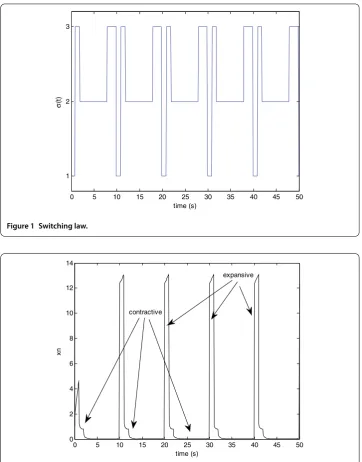
time-Figure 1 Switching law.
Figure 2 Solution trajectory for the switching rule depicted in Figure 1.
invariant nonlinear switched system while the second one deals with a linear time-varying switched system.
3.1 Scalar nonlinear switched system
Consider the nonlinear discrete-time dynamic system given by (.) withσ(t)∈ {, , } andT(xn) =xn+ xn,T(xn) = .xne–xn andT(xn) = .tanh(xn). Note thatT(xn) is a mixed type operator, being contractive for largexnwhile expansive for small values ofxn (it is also non-strictly contractive in [,∞)),T(xn) is strictly contractive withK= .
andT(xn) is expansive withK= .. The stability of the nonlinear switched system (.)
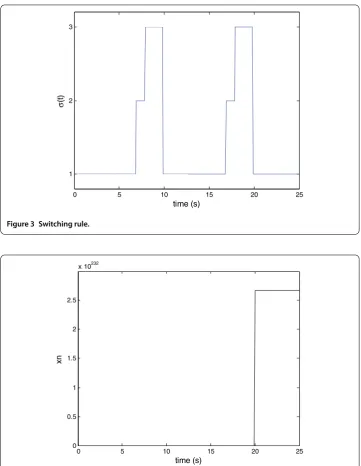
[image:15.595.117.480.79.542.2]Figure 3 Switching rule.
Figure 4 Solution trajectory for the switching rule depicted in Figure 3.
The contractive and expansive phases generated by the switching rule can be clearly ap-preciated in Figure . In this way, when the contractive operator,T(xn), is activated by the switching rule, the solution trajectory converges to zero while when the non-contractive operators are activated, the solution enlarges. Nevertheless, the combination of these op-erators according to the switching rule provides a globally stable system, with a bounded trajectory at all time. On the other hand, if the switching rule is given by Figure , the solution trajectory is displayed in Figure .
dif-ferent switching rules? The results stated in Section can be used to solve this question as the following example shows.
3.2 Linear time-varying switched dynamic system
This example shows how the previously presented theoretical results can be applied to study the asymptotic stability of time-varying dynamical systems by means of their dis-cretization. This problem is of great importance in practice since many control systems are currently designed in a discrete-time set-up which leads to iterative schemes of the form (.) despite the system being originally in continuous-time. Therefore, the results introduced above might be used in a highly practical context. For this purpose, a linear time-varying switched dynamical system will be considered. These types of systems are described by a number of different parameterizations which are themselves time-varying. The switching rule selects the active parameterization during each time interval, as dis-cussed in Section . The stability of time-varying systems is far from being trivial and offers a variety of behaviors different from those of linear time-invariant ones. For instance, a lin-ear time-varying system may possess constant stable eigenvalues (i.e.constant eigenvalues with negative real part) and, nevertheless, to be asymptotically unstable in the Lyapunov sense, []. The tools provided by fixed point theory are useful in this situation where other techniques become intricate. Therefore, consider a linear time-varying system of the form
˙
x(t) =Aσ(t)(t)x(t), (.)
whereσ(t)∈ {, , }and the dynamics matrices are given by
Aσ(t)(t) =
cost –sint
sint cost
, Bσ(t)
cost sint
–sint cost
, (.)
B=
– –
–
, B=
–
–
, B=
–
–
.
It is easy to verify that matrices (.) are in the formAσ(t)=etBσ(t)e–t, [], with=
–
. In this way, the solution of (.) is given by
x(t) =ete(–+Bσ(ti))tx(t
i) (.)
[], withσ(t–
i)=σ(t+i)≡σ(ti) andσ(t) =σ(ti) fort∈[ti,ti+),∀i∈Z+. The eigenvalues
ofare±jimplying that the stability of (.) is directly influenced by that of the matrices (–+Bσ(t)). Thus, we have
spec(–+B) ={– –j
√
, – +j√},
spec(–+B) ={–, –},
spec(–+B) ={–, }.
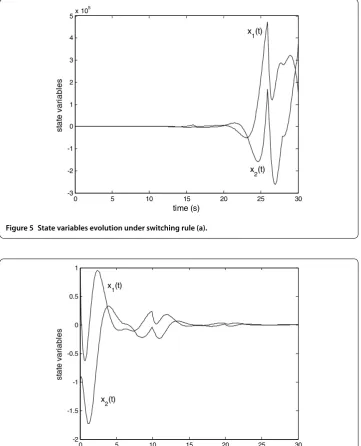
Figure 5 State variables evolution under switching rule (a).
Figure 6 State variables evolution under switching rule (b).
laws under which the switched system is asymptotically stable while for others it may be unstable. To verify the stability of (.) under different switching laws, we will discretize the system so as to generate an iterative scheme of the form (.). Thus, from (.) if the sampling period is denoted byhandx(nh) =xn, we have after a little bit of algebra:
xn+=enhehe(–+Bσ(nh))he–nhxn,
which fits into the iterative structure (.) with operatorsTσ(n)=enhehe(–+Bσ(nh))he–nh.
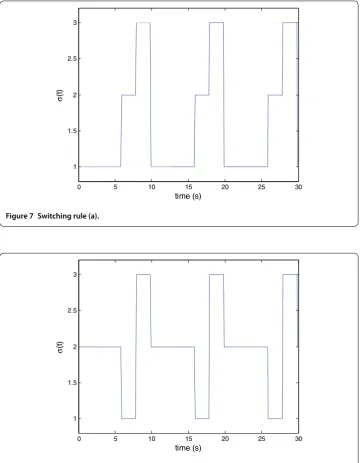
[image:18.595.118.480.84.531.2]Figure 7 Switching rule (a).
Figure 8 Switching rule (b).
Therefore, the dynamics of the system is essentially controlled bye(–+B)h,e(–+B)h, and
e(–+B)haccording to the switching rule (i.e.there are only three different acting opera-tors). For simulation purposes considerh= . seconds. Equations (.) are fulfilled for these operators withK= .,K= . andK= corresponding to the expansive,