doi:10.1155/2012/943621
Research Article
A Regularization of the Backward
Problem for Nonlinear Parabolic Equation with
Time-Dependent Coefficient
Pham Hoang Quan,
1Le Minh Triet,
1and Dang Duc Trong
21Department of Mathematics and Applications, Sai Gon University, 273 An Duong Vuong,
District 5, Ho Chi Minh City, Vietnam
2Department of Mathematics, University of Natural Science, Vietnam National University,
227 Nguyen Van Cu, District 5, Ho Chi Minh City, Vietnam
Correspondence should be addressed to Le Minh Triet,[email protected]
Received 31 March 2012; Revised 21 June 2012; Accepted 11 August 2012
Academic Editor: Theodore E. Simos
Copyrightq2012 Pham Hoang Quan et al. This is an open access article distributed under the Creative Commons Attribution License, which permits unrestricted use, distribution, and reproduction in any medium, provided the original work is properly cited.
We study the backward problem with time-dependent coefficient which is a severely ill-posed problem. We regularize this problem by combining boundary value method and quasi-reversibility method and then obtain sharp error estimate between the exact solution and the regu-larized solution. A numerical experiment is given in order to illustrate our results.
1. Introduction
We consider the inverse time problem for the nonlinear parabolic equation
utx, t−atuxxx, t fx, t, ux, t, x, t∈0, π×0, T, 1.1
u0, t uπ, t 0, t∈0, T, 1.2
ux, T gx, x∈0, π, 1.3
whereatis thermal conductivity function of1.1such that there existp,q >0 satisfying
0< p≤at≤q, 1.4
In other words, from the temperature distribution at a particular timetTfinal data, we want to retrieve the temperature distribution at any earlier timet < T. This problem is called the backward heat problemBHP, or final-value problem. As known, this problem is severely ill-posed in Hadamard’s sense; that is, solutions do not always exist, and when they exist, they do not depend continuously on the given data. In practice, datumgis based on physicalmeasurements. Hence, there will be measurement errors, and we would actually have datum functiongδsuch thatgδ−gL20,π ≤ δ. Thus, form small error contaminating
physical measurements, the solutions corresponding to datum functiongδhave large errors.
This makes it difficult to make numerical calculations with perturbed data.
In our knowledge, there have been many papers on the linear homogeneous case of the backward problem, but there are a few papers on the nonhomogeneous case and the nonlin-ear case such as1–6; especially, the nonlinear case with time-dependent thermal conductiv-ity coefficient is very scarce. Moreover, the thermal conductivity is the property of a material’s ability to conduct heat. Therefore, the thermal conductivity is not a constant in some cases. In this paper, we extend the resultin7for the case of the time-dependent thermal conduc-tivityat. In future, we will research the BHP problem for the case of the time- and space-dependent thermal conductivityax, t.
In 8, the authors used the quasi-reversibility method to regularize a 1D linear nonhomogeneous backward problem. Very recently, in9, the methods of integral equations and of Fourier transform have been used to solve a 1D problem in an unbounded region. In recent articles considering the nonlinear backward heat problem, we refer the reader to10. In11, the authors used the quasi-boundary value method to regularize the latter problem. However, in11, the authors showed that the error between the regularized solution and the exact solution is
uδ·, t−u·, t ≤Ktδt/T, 0< t < T. 1.5
It is easy to see that the convergence of the error estimate between the regularized solution and the exact solution is very slow whentis in a neighborhood of zero. For this reason, the error estimate in initial time is given by
uδ·, t−u·, t ≤K
1 ln1/δ
1/4
. 1.6
We can easily find that the exact solution of1.1–1.3satisfies
ux, t
∞
k1
uktsinkx, 1.7
where
ukt ek
2λT−λt
gk−
T
t
ek2λs−λtfkusds, 1.8
fkus
2
π
π
0
gk
2
π
π
0
gxsinkxdx, 1.10
λt
t
0
asds. 1.11
In this paper, we will approximate1.1–1.3by using the regularization problem:
uδtx, t−atuδxxx, t
∞
k1
e−k2λT
αkδ e−k2λT
fkuδtsinkx,
uδ0, t uδπ, t 0,
uδx, T
∞
k1
e−k2λT
αkδ e−k2λT
gksinkx,
1.12
where αkδ δk2. Actually, in 12, we also considered the problem 1.1–1.3 for the
homogeneous case f 0 inR. Hence, we want to extend for the nonlinear casefx, t, u
in bounded region0, π, and this is the biggest different point in this paper.
The remainder of this paper is organized as follows. InSection 2, we shall regularize the ill-posed problem1.1–1.3and give the error estimate between the regularized solution and the exact solution. Then, inSection 3, a numerical example is given.
2. Regularization and Error Estimates
For clarity of notation, we denote the solution of1.1–1.3byux, tand the solution of the regularized problem1.12byuδx, t. Throughout this paper, we denoteλ1 max{1, λT},
and,δbe a positive number such that 0< δ < λT. Hereafter, we have a number of inequali-ties in order to evaluate error estimates.
Lemma 2.1. Letatbe a function satisfying1.4,αkδ δk2,Bδ δlnλT/δ−1 andλt
be as in1.11. Then fork >0 and 0≤t≤s≤T, one gets
iek2λs−λt−λT
/αkδ e−k
2λT
≤ λ1δlnλT/δλt−λs/λT
λ1Bδλs−λt/λT,
iie−k2λt
/αkδ e−k2λT
≤λ1δlnλT/δλt−λT/λTλ1BδλT−λt/λT.
Proof ofLemma 2.1. The proof ofLemma 2.1can be found in12.
Theorem 2.2. Let g ∈ L20, π and f ∈ L∞0, π×0, T×R such that there existsL > 0
independent ofx, t, u, vsatisfying
Then problem1.12has a unique weak solution uδ ∈W C0, T; L20, πsatisfying the
fol-lowing equality:
uδx, t
∞
k1
e−k2λt
αkδ e−k2λT
gk−
T
t
ek2λs−λt−λT
αkδ e−k2λT
fkuδsds
sinkx, 2.2
where
gk
2
π
π
0
gxsinkxdx,
fkuδs 2
π
π
0
fx, s, uδsinkxdx.
2.3
Proof ofTheorem 2.2. Step 1. The existence and the uniqueness of the solution of the problem
2.2. Put
Fux, t
∞
k1
Pkt−Kkutsinkx, 2.4
where
Pkt
e−k2λt
αkδ e−k2λT
gk,
Kkut
T
t
ek2λs−λt−λT
αkδ e−k2λT
fkusds.
2.5
We claim that, for everyu, v∈C0, T; L20, π,k≥1, we have
Fku·, t−Fkv·, t 2≤ T−tk
k! Bδ
2kq/pCλ2k
1 L2ku−v2C0,T;L20,π, 2.6
whereCmax{1, T}and · C0,T;L20,πis supremum norm inC0, T; L20, π. We shall
prove this inequality by induction. Fork1, we have
Fu·, t−Fv·, t2
π
2
∞
k1
π 2 ∞ k1 T t
ek2λs−λt−λT
αkδ e−k2λT
fkus−fkvs
ds 2 ≤ π 2 ∞ k1 ⎡ ⎣T
t
ek2λs−λt−λT
αkδ e−k2λT
2
ds
T
t
fkus−fkvs
2
ds
⎤ ⎦.
2.7
FromLemma 2.1, we get
Fu·, t−Fv·, t2
≤ π 2 ∞ k1 ⎡ ⎣T
t λ1 δln
λT
δ
λt−λs/λT2
ds
T
t
fkus−fkvs
2 ds ⎤ ⎦. 2.8 It follows
Fu·, t−Fv·, t2
≤ π 2 ∞ k1 T t
λ21Bδ2λs−λt/λTds
T
t
fkus−fkvs
2 ds ≤ π 2 ∞ k1 T t
λ21Bδ2qs−pt/pTds
T
t
fkus−fkvs
2 ds ≤ π 2 ∞ k1 T t
λ21Bδ2q/pds
T
t
fkus−fkvs
2
ds
λ21B2δq/pT−t
T
t
π
0
fx, s, ux, s−fx, s, vx, s2dx ds.
2.9
Therefore, we have
Fu·, t−Fv·, t2
≤λ2 1L2B
2q/p
δ T−t
T
t
π
0
ux, s−vx, s2dx ds
≤T−tBδ2q/pCλ21L2u−v2C0,T;L20,π,
2.10
Thus,2.6holds fork 1. Supposing that2.6holds fork n, we shall prove that 2.6holds forkn1. In fact, we get
Fn1u·, t−Fn1v·, t 2
π
2
∞
k1
KkFnut−KkFnvt2
π
2
∞
k1
T
t
ek2λs−λt−λT
αkδ e−k2λT
fkFnus−fkFnvs
ds
2
.
2.11
Hence, we obtain
Fn1ux, t−Fn1vx, t 2
≤ π
2Bδ
2q/pλ2 1T−t
T
t
∞
k1
fkFnus−fkFnvs
2
ds
Bδ2q/pλ21T−t
T
t
f·, s, Fnu·, s−f
k·, s, Fnv·, s 2ds
≤Bδ2q/pλ21T−tL2 T
t
Fnu·, s−Fnv·, s2ds.
2.12
Thus, we have
Fn1ux, t−Fn1vx, t 2
≤Bδ2q/pλ21T−tL2 T
t
L2nBδ2nq/pλ21n
T−sn
n! C
nu−v2
C0,T;L20,πds
≤CnBδ2n1q/pλ21n2T−tL2n2u−v2C0,T;L20,π
T
t
T−sn
n! ds
≤ T −tn1
n1! C
n1B
δ2n1q/pλ12n2T−tL2n2u−v2C0,T;L20,π.
2.13
Therefore, by the induction principle, we have
Fkux, t−Fkvx, t ≤ T√−tk/2
k! Bδ
kq/pCk/2λk
1Lku−vC0,T;L20,π, 2.14
We considerF :C0, T; L20, π → C0, T; L20, π. Since
T−tk/2
√
k! Bδ
kq/pλk
1Ck/2Lk−→0, 2.15
whenk → ∞,there exists a positive integer numberk0such that
T−tk0/2
k0!
Bδk0q/pλk10Ck0/2Lk0<1, 2.16
andFk0 is a contraction. It follows that the equationFk0u uhas a unique solutionu
δ ∈
C0, T; L20, π.We claim thatFu
δ uδ. In fact, one has FFk0uδ Fuδ. Hence,
Fk0Fu
δ Fuδ. By the uniqueness of the fixed point ofFk0, one hasFuδ uδ; that is,
the equationFu uhas a unique solutionuδ∈C0, T; L20, π.
Step 2. Ifuδ∈Wsatisfies2.2, thenuδis the solution of the problem1.12. For 0≤t≤T, we
have
uδx, t
∞
k1
e−k2λt
αkδ e−k2λT
gk−
T
t
ek2λs−λt−λT
αkδ e−k2λT
fkuδsds
sinkx. 2.17
We can verify directly that uδ ∈ C0, T;L20, π ∩ L20, T;H010, π ∩
C10, T;H1
00, π. In fact,uδ∈C∞0, T;H010, π. Moreover, one has
uδtx, t
∞
k1
−k2at
e−k2λt
gk−
T
t ek
2λs−λt−λT
fkuδsds
αkδ e−k2λT
sinkx
∞
k1
e−k2λT
αkδ e−k2λT
fkuδtsinkx
−atuδxxx, t
∞
k1
e−k2λT
αkδ e−k2λT
fkuδtsinkx,
uδx, T
∞
k1
e−k2λT
αkδ e−k2λT
gksinkx.
2.18
Hence,uδis the solution of1.12.
Step 3. The problem 1.12 has at most one solution uδ ∈ C0, T; L20, π ∩
L20, T; H1
00, π∩C10, T; H010, π. In fact, letuδandvδbe two solutions of1.12such
thatuδ, vδ∈W. Puttingwδx, t uδx, t−vδx, t, thenwδsatisfies
wδt−wδxx
∞
k1
e−k2λT
αkδ e−k2λT
fkuδt−fkvδt
It follows that
wδt−wδxx2≤
1
δ2
∞
k1
fkuδt−fkvδt
2
≤ 1
δ2 f·, t, uδ·, t−f·, t, vδ·, t
2
≤ L2
δ2uδ·, t−vδ·, t
2
L2
δ2wδ·, t
2.
2.20
By using the result in Lees and Protter13, we getwδ·, t 0. This completes the
proof of Step 3.
Finally, by combining three steps, we complete the proof ofTheorem 2.2.
Theorem 2.3stability of the modified method. Let f be as inTheorem 2.2,αkδ δk2, gand let
gδinL20, πsatisfygδ−g ≤δ. If one supposes thatuδandvδdefined by2.2are corresponding
to the final valuesgandgδinL20, π, respectively, then one obtains
uδ·, t−vδ·, t ≤
√
2λ1eL
2λ2
1TT−tδλt/λT
ln
λT
δ
λt−λT/λT
. 2.21
Proof ofTheorem 2.3. Using the inequalityab2 ≤ 2a2 b2 andLemma 2.1, we get the
estimate
uδ·, t−vδ·, t2
≤π
∞
k1
e−k2λt
αkδ e−k2λT
gk−gk,δ
2
π
∞
k1
T
t
ek2λs−λt−λT
αkδ e−k2λT
fkuδs−fkvδs
ds
2
≤π
∞
k1
e−k2λt
αkδ e−k2λT
gk−gk,δ
2
πT−t
∞
k1 T
t
ek2λs−λt−λT
αkδ e−k2λT
fkuδs−fkvδs
2
ds.
Thus, we get
uδ·, t−vδ·, t2
≤πλ21Bδ2λT−λt/λT
∞
k1
gk−gk,δ2
πT−t
∞
k1 T
t
λ21Bδ2λs−λt/λTfkuδs−fkvδs2ds.
2.23
Hence, we obtain
uδ·, t−vδ·, t2
≤πλ21Bδ2λT−λt/λT
∞
k1
gk−gk,δ2
λ21πTBδ2λT−λt/λT
∞
k1 T
t
Bδ2λs−λT/λTfkuδs−fkvδs2ds
≤πλ21Bδ2λT−λt/λT
∞
k1
gk−gk,δ2
λ2
1πTBδ2λT−λt/λT
T
t
Bδ2λs−λT/λT
∞
k1
fkuδs−fkvδs2ds.
2.24
Thus, we get
Bδ2λt−λT/λTuδ·, t−vδ·, t2
≤2λ21 g−gδ 2
2λ21T
T
t
Bδ2λs−λT/λT f·, s, uδ·, s−f·, s, vδ·, s 2
≤2λ21 g−gδ 2
2L2λ21T
T
t
Bδ2λs−λT/λTuδ·, s−vδ·, s2.
2.25
By using Gronwall’s inequality, we have
Bδ2λt−λT/λTuδ·, t−vδ·, t2 ≤2λ21e2L
2λ2
It follows
uδ·, t−vδ·, t ≤
√
2λ1eL
2λ2
1TT−tBδλT−λt/λT gδ−g
≤√2λ1eL
2λ2
1TT−tδλt/λT
ln
λT
δ
λt−λT/λT
.
2.27
This completes the proof ofTheorem 2.3.
Theorem 2.4. Let u be the exact solution of problem1.1–1.3such that
Qt 3λ21e3L2Tλ21T−tuxx·,02<∞,
Mt 6Tλ21e3L2Tλ21T−t
T
0 π
0 ∞
k1
k2ek2λsusx, s−asuxxx, s
2
dx ds <∞,
2.28
for allt∈0, T. Lettingαkδ δk2andvδ·, tgiven by2.2corresponding to the perturbed data
gδ, then one has for everyt∈0, T
u·, t−vδ·, t ≤Ctδλt/λT
ln
λT
δ
λt−λT/λT
, 2.29
whereCt √2λ1eL
2λ2
1TT−tQt Mt.
Proof ofTheorem 2.4. From1.1, we construct the regularized solution corresponding to the
exact data and the perturbed data
uδx, t
∞
k1
uk,δtsinkx, 2.30
vδx, t
∞
k1
vk,δtsinkx, 2.31
where
uk,δt
e−k2λt
αkδ e−k2λT
gk−
T
t
ek2λs−λt−λT
αkδ e−k2λT
fkuδsds, 2.32
vk,δt
e−k2λt
αkδ e−k2λT
gk,δ−
T
t
ek2λs−λt−λT
αkδ e−k2λT
Since1.8and2.32, we get
|ukt−uk,δt|
αkδe−k
2λt
αkδ e−k2λT
ek2λT
gk−
T
t
αkδek
2λs−λt−λT
αkδ e−k2λT
ek2λTfkusds
T
t
ek2λs−λt−λT
αkδ e−k2λT
fkuδs−fkus
ds . 2.34
Fromαkδ δk2, we get
|ukt−uk,δt|
≤ δe−k
2λt
δk2e−k2λTk
2ek2λT
gk−
T
t
δek2λs−λt−λT
δk2e−k2λT k
2ek2λT
fkusds
T t
ek2λs−λt−λT
δk2e−k2λT
fkuδs−fkus
ds
≤ δe−k
2λt
δk2e−k2λT
k2ek
2λT
gk−k2
T
0
ek2λsfkusds
δe−k
2λt
δk2e−k2λT
T 0
k2ek2λsfkusds
T
t
ek2λs−λt−λT
δk2e−k2λT
fkuδs−fkus
ds . 2.35
By applying the inequalityabc2≤3a2b2c2, we get
u·, t−uδ·, t2
π
2
∞
k1
|uk,δt−ukt|2
≤ 3π
2 ∞ k1
δe−k2λt
δk2e−k2λT
2
k2ek
2λT
gk−k2
T
0
ek2λsfkusds
2 3π 2 ∞ k1
δe−k2λt
δk2e−k2λT
2T
0
k2ek2λsfkusds
2 3π 2 ∞ k1 T t
ek2λs−λt−λT
δk2e−k2λT
fkuδs−fkus
ds
2
.
UsingLemma 2.1, we obtain
u·, t−uδ·, t2
≤ 3π
2 λ
2
1L1t L2t L3t,
3π 2 λ
2
1δ2λt/λT
ln
λT
δ
2λt−λT/λT∞
k1
k2uk0
2
3π 2 λ
2
1δ2λt/λT
ln
λT
δ
2λt−λT/λT∞
k1
T
0
k2ek2λs
fkusds
2
3π 2 λ
2
1Tδ2λt/λT
ln
λT
δ
2λt−λT/λT
×
T
t
δ−2λs/λT
ln
λT
δ
2λT−λs/λT∞
k1
fkuδs−fkus2ds,
2.37
where
L1t δ2λt/λT
ln
λT
δ
2λt−λT/λT∞
k1
k2uk0
2
,
L2t δ2λt/λT
ln
λT
δ
2λt−λT/λT∞
k1
T
0
k2ek2λsfkusds
2
,
L3t Tδ2λt/λT
ln
λT
δ
2λt−λT/λT
×
T
t
δ−2λs/λT
ln
λT
δ
2λT−λs/λT∞
k1
fkuδs−fkus2
ds.
2.38
Hence, we get the following estimates
3π
2 λ
2
1L1t≤ 3λ12δ2λt/λT
ln
λT
δ
2λt−λT/λT
uxx·,02 ,
3π
2 λ
2 1L2t≤
3π
2 Tλ
2
1δ2λt/λT
ln
λT
δ
2λt−λT/λTT
0 ∞
k1
k4e2k2λsfk2usds,
3π
2 λ
2
1L3t≤ 3L2λ21Tδ2λt/λT
ln
λT
δ
2λt−λT/λT
×
T
t
δ−2λs/λT
ln
λT
δ
2λT−λs/λT
u·, s−uδ·, s2ds.
From the estimate2.39, we get
u·, t−uδ·, t2
≤3λ21δ2λt/λT
ln
λT
δ
2λt−λT/λT
×
uxx·,02π
2T
T
0 ∞
k1
k4e2k2λsfk2usds
3L2Tλ21δ2λt/λT
ln
λT
δ
2λt−λT/λT
×
T
t
δ−2λs/λT
ln
λT
δ
2λT−2λs/λT
u·, s−uδ·, s 2ds.
2.40
Hence, we have
δ−2λt/λT
ln
λT
δ
2λT−λt/λT
u·, t−uδ·, t2
≤3λ21
uxx·,02
π
2T
T
0 ∞
k1
k4e2k2λsfk2usds
3L2Tλ21
T
t
δ−2λs/λT
ln
λT
δ
2λT−2λs/λT
u·, s−uδ·, s 2ds.
2.41
Applying Gronwall’s inequality, we obtain
δ−2λt/λT
ln
λT
δ
2λT−2λt/λT
u·, t−uδ·, t2
≤3λ21e3L2Tλ21T−t
uxx·,02
π
2T
T
0 ∞
k1
k4e2k2λsfk2usds
.
2.42
Hence, we get
δ−2λt/λT
ln
λT
δ
2λT−2λt/λT
u·, t−uδ·, t2
≤3λ2 1e3L
2Tλ2 1T−t
uxx·,02
π
2T
T
0 ∞
k1
k4e2k2λs
fkus
3λ21e3L2Tλ21T−t
uxx·,02 2
πT
T
0 ∞
k1
k4e2k2λs
π
0
fx, s, ux, ssinkxdx
2
ds
≤3λ2 1e3L
2Tλ2 1T−t
uxx·,022T
T
0 ∞
k1
k4e2k2λsπ
0
fx, s, ux, s2dx
ds
.
2.43
From1.1, we have
δ−2λt/λT
ln
λT
δ
2λT−2λt/λT
u·, t−uδ·, t2
≤3λ21e3L2Tλ21T−t
uxx·,022T
T
0 ∞
k1
k4e2k2λs
π
0
fx, s, ux, s2dx
ds
≤3λ21e3L2Tλ21T−t
×
uxx·,022T
T
0 π
0 ∞
k1
k2ek2λsusx, s−asuxxx, s
2
dx ds
Qt Mt,
2.44
where
Qt 3λ21e3L2Tλ21T−tuxx·,02,
Mt 6Tλ21e3L2Tλ21T−t
T
0 π
0 ∞
k1
k2ek2λsusx, s−asuxxx, s
2
dx ds.
2.45
Therefore, we get the estimate
u·, t−uδ·, t ≤
Qt Mtδλt/λT
ln
λT
δ
λt−λT/λT
. 2.46
Letvδbe the solution of1.12corresponding to the perturbed datagδ, and letuδbe
the solution of1.12corresponding to the exact datag. FromTheorem 2.3and2.46, we can get
vδ·, t −u·, t ≤ vδ·, t−uδ·, tuδ·, t−u·, t
≤√2λ1eL
2λ2
1TT−tδλt/λT
ln
λT
δ
Qt Mtδλt/λT
ln
λT
δ
λt−λT/λT
Ctδλt/λT
ln
λT
δ
λt−λT/λT
,
2.47
whereCt √2λ1eL
2λ2
1TT−tQt Mt.
This completes the proof ofTheorem 2.4.
3. Numerical Experiment
Consider the nonlinear parabolic equation with time-dependent coefficient:
utx, t−atuxxx, t fx, t, ux, t, x, t∈0, π×0,1,
u0, t uπ, t 0, t∈0,1,
ux, T gx, x∈0, π,
3.1
where
at 2t1,
fx, t, ux, t u4etsinxcosx2t1,
gx esinxcosx.
3.2
The exact solution of the equation is
ux, t etsinxcosx. 3.3
Lettingt0, from3.3, we have
ux,0 sinxcosx. 3.4
Consider the measured data
gδx
1 δ
g
gx
1 δ
1.7034
gx. 3.5
Then we have
Table 1
δ vδin·,0−u·,02
δ110−1 3.763414e−001
δ210−2 3.735245e−001
δ310−3 3.475127e−001
δ410−4 2.048545e−001
δ510−5 4.012725e−002
δ610−10 4.491189e−007
δ710−20 2.638466e−013
δ810−50 2.179771e−013
From2.31and3.5, we have the regularized solution for the caset0 in the form of iteration
vδnω,0
∞
k1
vδ,knx,0sinkx, 3.7
where
vδ,knx,0 1
αkδ exp{−2k2}
gδ,k−
1
t
expk2s2s−2
αkδ exp{−2k2}
fkvδn−1sds,
gδ,k 2
π
π
0
gδxsinkxdx,
vδ1x,0 1δsinxcosx,
αkδ δk2.
3.8
We considerδ110−1,δ210−2,δ3 10−3,δ410−4,δ510−5,δ610−10,δ710−20,
δ810−50, andn10. Now, we getTable 1for the caset0.
We have inFigure 1the graphs of the regularized solutionvδin·, t,i 1,2,3 and
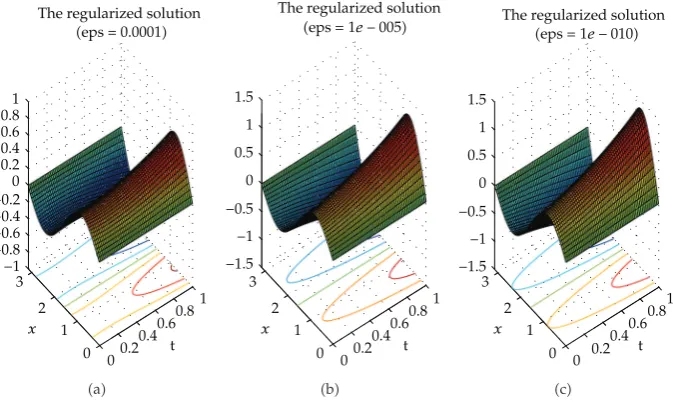
n10.
We have inFigure 2the graphs of the regularized solutionvδin·, t,i 4,5,6 and
n10.
We have in Figure 3 the graphs of the exact solution u·, t and of the regularized solutionvδin·, t,i7,8 andn10.
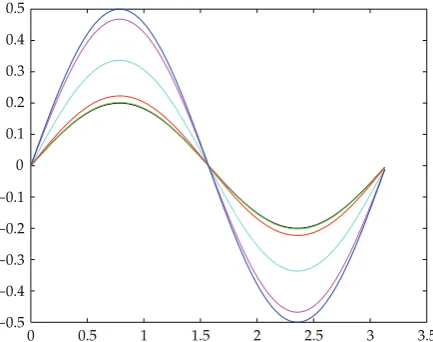
Now, Figure 4 can represent visually the exact solution and regularized solutions corresponding toδi,i1, . . . ,8 at initially timet0.
Notice that, inFigure 4, the curve number 0 expressing the exact solution is indistinguishable from the curve numberiexpressing the regularized solution corresponding toδi,i6,7,8.
Remark 3.1. From1.7and3.5, we obtain the exact solution corresponding to the measured
datagδx:
wx, t
∞
k1
0 0.2 0.40.6 0.81 0 1 2 3
−0.2
−0.15
−0.1
−0.05
0 0.05 0.1 0.15 0.2 t x
The regularized solution
(eps=0.1)
a 0 0.2 0.40.6 0.81 0 1 2 3
−0.2
−0.15
−0.1
−0.05
0 0.05 0.1 0.15 0.2 t x
The regularized solution
(eps=0.01)
b
−0.25
−0.2
−0.15
−0.1
−0.05
0 0.05 0.1 0.15 0.2 0.25 0 0.2 0.40.6 0.81 0 1 2 3 t x
The regularized solution
(eps=0.001)
[image:17.600.126.477.99.296.2]c
Figure 1: The regularized solutions corresponding toδi,i1,2,3.
−1
−0.8
−0.6
−0.4
−0.2
0 0.2 0.4 0.6 0.8 1 t x 00.2 0.40.6 0.81 0 1 2 3
The regularized solution
(eps=0.0001)
a
0
−1.5
−1
−0.5
0.5 1 1.5
The regularized solution
(eps=1e−005)
t x 00.2 0.40.6 0.81 0 1 2 3 b 0
−1.5
−1
−0.5
0.5 1 1.5
The regularized solution
(eps=1e−010)
t x 0 0.2 0.40.6 0.81 0 1 2 3 c
Figure 2: The regularized solutions corresponding toδi,i4,5,6.
where
wkt ek
2λT−λt
gδ,k−
T
t
ek2λs−λtfkwsds,
fkws
2
π
π
0
fx, s, wx, ssinkxdx,
gδ,k
2
π
π
0
gδxsinkxdx.
[image:17.600.133.470.335.536.2]0
−1.5 −1 −0.5 0.5 1 1.5
t x
00.2 0.40.6
0.81
0 1 2 3
The regularized solution
(eps=1e−020)
a
0
−1.5
−1
−0.5
0.5 1 1.5
t
x
00.2
0.40.6
0.81
0 1 2 3
The regularized solution
(eps=1e−050)
b
0
−1.5
−1
−0.5
0.5 1 1.5
t
x
00.2
0.40.6
0.81
0 1 2 3
The exact solution
[image:18.600.133.468.110.309.2]c
Figure 3: The regularized solutions correspondingδi,i7,8 and the exact solution.
0 0.5 1 1.5 2 2.5 3 3.5
−0.5
−0.4
−0.3
−0.2
−0.1
0 0.1 0.2 0.3 0.4 0.5
Figure 4: The exact solution and the regularized solutions corresponding toδi,i1, . . . ,8 at initial time
t0.
Now, we cannot calculate the formula3.9exactlywe need to findfkwswhile
we have not knownw yet. FromTheorem 2.2, we use the iteration for3.9at initial time
t0 as follows:
wnω,0
∞
k1
[image:18.600.191.408.367.538.2]Table 2
δ wδi5·,0−u·,02
δ110−1 1.1856e031
δ210−2 1.0e031
δ310−3 1.0e031
δ410−4 1.0e031
δ510−5 1.0e031
δ610−10 1.0e031
δ710−20 1.0e031
δ810−50 1.0e031
where
wknx,0 exp
2k2gδ,k−
1
0
expk2s2sfkwn−1sds,
gδ,k
2
π
π
0
gδxsinkxdx,
w1x,0 1δsinxcosx.
3.12
Then we get the error in theTable 2.
We can see that the errorwδi5·,0−u·,02is very large. Therefore, the problem is
ill-posed and a regularization is necessary.
Acknowledgment
All authors were supported by the National Foundation for Science and Technology DevelopmentNAFOSTED.
References
1 Z. Qian, C.-L. Fu, and R. Shi, “A modified method for a backward heat conduction problem,” Applied
Mathematics and Computation, vol. 185, no. 1, pp. 564–573, 2007.
2 R. E. Ewing, “The approximation of certain parabolic equations backward in time by Sobolev equations,” SIAM Journal on Mathematical Analysis, vol. 6, pp. 283–294, 1975.
3 X.-L. Feng, Z. Qian, and C.-L. Fu, “Numerical approximation of solution of nonhomogeneous back-ward heat conduction problem in bounded region,” Mathematics and Computers in Simulation, vol. 79, no. 2, pp. 177–188, 2008.
4 C.-L. Fu, X.-T. Xiong, and Z. Qian, “Fourier regularization for a backward heat equation,” Journal of
Mathematical Analysis and Applications, vol. 331, no. 1, pp. 472–480, 2007.
5 D. N. H`ao, “A mollification method for ill-posed problems,” Numerische Mathematik, vol. 68, no. 4, pp. 469–506, 1994.
6 A. Hasanov and J. L. Mueller, “A numerical method for backward parabolic problems with non-selfadjoint elliptic operators,” Applied Numerical Mathematics, vol. 37, no. 1-2, pp. 55–78, 2001. 7 D. D. Trong, P. H. Quan, and N. H. Tuan, “A quasi-boundary value method for regularizing nonlinear
ill-posed problems,” Electronic Journal of Differential Equations, vol. 2009, no. 109, pp. 1–16, 2009.
9 I. V. Mel’nikova and A. I. Filinkov, The Cauchy Problem. Three Approaches, vol. 120 of Monograph and
Surveys in Pure and Applied Mathematics, Chapman & Hall, London, UK, 2001.
10 D. D. Trong and N. H. Tuan, “A nonhomogeneous backward heat problem: regularization and error estimates,” Electronic Journal of Differential Equations, vol. 2008, no. 33, pp. 1–14, 2008.
11 D. D. Trong, P. H. Quan, T. V. Khanh, and N. H. Tuan, “A nonlinear case of the 1-D backward heat problem: regularization and error estimate,” Zeitschrift f ¨ur Analysis und ihre Anwendungen, vol. 26, no. 2, pp. 231–245, 2007.
12 P. H. Quan, D. D. Trong, L. M. Triet, and N. H. Tuan, “A modified quasi-boundary value method for regularizing of a backward problem with time-dependent coefficient,” Inverse Problems in Science and
Engineering, vol. 19, no. 3, pp. 409–423, 2011.
Submit your manuscripts at
http://www.hindawi.com
Hindawi Publishing Corporation
http://www.hindawi.com Volume 2014
Mathematics
Journal ofHindawi Publishing Corporation http://www.hindawi.com
Differential Equations
International Journal of
Volume 2014
Applied MathematicsJournal of
Hindawi Publishing Corporation
http://www.hindawi.com Volume 2014
Hindawi Publishing Corporation
http://www.hindawi.com Volume 2014
Mathematical PhysicsAdvances in
Complex Analysis
Journal ofHindawi Publishing Corporation
http://www.hindawi.com Volume 2014
Optimization
Journal ofHindawi Publishing Corporation
http://www.hindawi.com Volume 2014
Combinatorics
Hindawi Publishing Corporation
http://www.hindawi.com Volume 2014 International Journal of
Journal of
Hindawi Publishing Corporation
http://www.hindawi.com Volume 2014
Function Spaces
Abstract and Applied Analysis
Hindawi Publishing Corporation
http://www.hindawi.com Volume 2014
International Journal of Mathematics and Mathematical Sciences
Hindawi Publishing Corporation http://www.hindawi.com Volume 2014
The Scientific
World Journal
Hindawi Publishing Corporationhttp://www.hindawi.com Volume 2014
Discrete Dynamics in Nature and Society
Hindawi Publishing Corporation
http://www.hindawi.com Volume 2014
Discrete Mathematics
Journal ofHindawi Publishing Corporation
http://www.hindawi.com Volume 2014
Hindawi Publishing Corporation
http://www.hindawi.com Volume 2014