ISSN: 1992-8645 www.jatit.org E-ISSN: 1817-3195
NUMERICAL ANALYSIS STABILITY OF RETAINING
WALL WITH RELIEVING PLATE
1JIEQUN LIU, 2LUWANG CHEN
1Engineer, Department of Computer Science and Technology, Key Lab of Network and Intelligent
Information Processing, Hefei University, Hefei, China.
2
Assoc. Prof., School of Resource and Environmental Engineering, Hefei University of Technology, Hefei,
China.
E-mail: [email protected], [email protected]
ABSTRACT
Based on shear strength reduction finite element method, stability of retaining wall with relieving plate has been analyzed. Due to the structure character of retaining wall with relieving plate, it can be found that fracture surface could hardly cross the triangle area of between lower wall and soleplate, between upper wall and relieving plate, so the second fractured surface occurred at there, which is essentially different with the second fractured surface of planar retaining wall. There is a reasonable value interval of width of relieving plate, in which the stability of retaining wall increased with width of relieving plate increased. There is no influence on shape of the first fractured surface by different location of relieving plate, except the second fractured surface. The soil to be failure is between the first fractured surface and the second fractured surface, in which more soil contained, the earth pressure on retaining wall increased, the stability of retaining wall decreased. The stability of retaining wall could be decreased by inclination of filling, for the principal stress deflected and retaining wall extruded by much soil when filling inclined. It is suggested to fill the retaining wall by the soil with low weight, big cohesive strength and big internal friction angle.
Keywords: Retaining Wall, Relieving Plate, Fractured Surface, Stability, Finite Element Methods
1. INTRODUCTION
Retaining wall with relieving plate is a new structure of retaining wall, with the characters of high stability, little masonry quantities and convenience of construction, being suitable for area with big ground bearing capacity and height of retaining wall at 6 m to 12 m[1]. Relieving plate is an important component of this type of retaining wall, which making the weight of retaining wall increased by bearing backfill, reducing the lateral earth pressure of retaining wall, and enhancing the overturning stability and slipping stability of retaining wall[2, 3].
Since 1958 the retaining wall with relieving plate has been successfully used in dock wall engineering, it has been expanded used in road and railway engineering, coastal engineering and small slope engineering. Such as right bank wall of Bai-He-Qiao power station at Bailong river in Gansu province of China, the maximal height of retaining wall is 16.4 m, and the foundation of retaining wall is composed by unconsolidated sand and gravel
with high hydraulic permeability. Retaining wall with relieving plate has been used in this engineering, which reducing the excavation quantities, accelerating the construction progress, and reserving the undisturbed soil ditch behind retaining wall, achieving obvious technological and economic effects[4]. Another example, shoulder of roadbed at IDK103+685~ IDK103+816 of Hou-Yue railway, which has been changed the design from gravity retaining wall to retaining wall with relieving plate, getting the benefit of reducing the excavation quantities of 30.8%, diminishing the engineering cost of 11.4%, reducing the days of construction period of 8.1%[5].
Although retaining wall with relieving plate has been already used in engineering, the mechanism and calculation method is still immaturity, and there is no code or criterion to guide the calculation of the stability of retaining wall with relieving plate. In a certain degree, stability against sliding, overturning stability, strength of wall section and ground bearing capacity should be checked in design of retaining wall[1], which need the value of earth pressure. It can be used Rankine’s theory or Coulomb’s theory to calculate the value of earth pressure. While there are lots of assumptions in Rankine’s theory or Coulomb’s theory, which is not consistent with reality sometimes, bringing observable errors to value of earth pressure. Expressly, the value of earth pressure has big discreteness with multivariate structure of retaining wall and complex geological conditions. With the development of finite element method (FEM), it is an effective approach to study stability of retaining wall with FEM.
Therefore, based on shear strength reduction of FEM, stability of retaining wall with relieving plate has been systematic analyzed in this article, the influence of length of relieving plate, location of relieving plate, slope angle of filling and parameters of filling on stability of retaining wall have been discussed, which aimed to give some advice on design and application of retaining wall with relieving plate.
2. MODEL OF FEM
The retaining wall is composed by upside wall, lower wall and relieving plate, constructed by concrete, and the strength grade of concrete is no less than C20, the diameter of bar is no less than 12
mm, the designed serviceable life of retaining wall is 60 years.
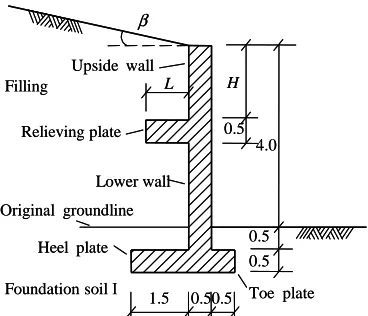
Now a typical model of retaining wall with relieving plate is to be analyzed, the thickness of upside wall, lower wall, relieving plate and soleplate are 0.5 m, the breadth of toe plate is 0.5 m, and the breadth of heel plate is 1.5 m, the height of filling is 4.0 m, the embedded depth of foundation is 1.0 m, as showed in Fig. 1, where
β
is the slope angle of filling, L(m) is the length of relieving plate,H
(m) is the distance between top of retaining wall and relieving plate.5 . 0 5 . 0
5 . 0
5 . 0 5 . 0
5 . 1
0 . 4
L H
β
Filling
groundline
Original
Ι
soil Foundation
plate Relieving
wall Upside
Lower wall
plate Heel
plate Toe 5 . 0 5 . 0
5 . 0
5 . 0 5 . 0
5 . 1
0 . 4
L H
β
Filling
groundline
Original
Ι
soil Foundation
plate Relieving
wall Upside
Lower wall
plate Heel
[image:2.612.326.510.268.426.2]plate Toe
Figure 1. Model of the Retaining Wall (Unit: m)
This problem can be considered as plane strain model, foundation and filling could be simulated with Mohr-Coulomb failure criterion, and the retaining wall, constructed with steel concrete with high strength, could be simulated by linear elastic model. The parameters of each layer are showed in table 1.
Table 1. Parameters Of Each Layer
The friction between retaining wall and soil could be simulated with interface element by parameter Rinter. Rinter=1.0 indicated that there is no
glide between retaining wall and soil. The real value of Rinter could be measured by tests, but need
much source and fee. In fact, the specific value of every parameter of retaining wall could be
impacted by the exact value of Rinter from 0 to 1.0,
but the regularity of every parameter remain the same with different value of Rinter. Therefore, it is
assumed that there is no glide between retaining wall and soil with Rinter=1.0 in this article.
Soil layers Gravity /kN.m-3
Cohesive strength c/kPa
Internal friction angle φ/(0)
Deformation Modulus E0/MPa
Poisson’ s ratio
Filling 18.2 7.3 20.7 6.5 0.30
Foundation soil 19.3 11.5 24.8 9.3 0.28
Foundation soil 19.7 28.5 26.9 9.8 0.30
[image:2.612.92.525.562.642.2]ISSN: 1992-8645 www.jatit.org E-ISSN: 1817-3195
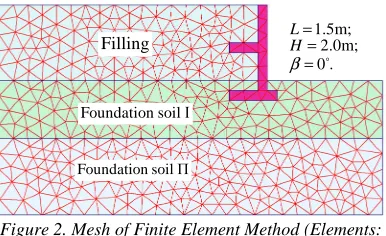
The domain of FEM model should be large enough to eliminate the influence of boundary. Thus, the area of FEM model including 7 m thickness of foundation, 14 m breadth of filling and 6 m breadth of foundation behind retaining wall. The vertical settlement and lateral displacement fixed at bottom of model, and lateral displacement fixed at both sides of model. The mesh of FEM is divided by 15 nodes triangle elements, as showed in Fig. 2.
Filling
. 0
2.0m; m; 5 . 1
o
== = β
H L
Ι
soil Foundation
Π soil Foundation
Filling
. 0
2.0m; m; 5 . 1
o
== = β
H L
Ι
soil Foundation
[image:3.612.99.292.236.354.2]Π soil Foundation
Figure 2. Mesh of Finite Element Method (Elements: 840)
In a general way, the retaining wall is constructed before filling. So, it can be treat that the deformation and consolidation of foundation of retaining wall finished at the phase of filling, which simulated by activating the element of filling.
The stability of retaining wall is to be studied with shear strength reduction of FEM[7-9], that is, the intensive parameters
c
、φ
of each layers soilshould be reduced by coefficient
F
trialsimultaneously:
trial r
F
c
c
=
,
=
trial r
tan
arctan
F
φ
φ
(1)Where
c
r ,φ
r is reduced cohesive strength and internal friction angle respectively. The model analyzed by FEM with reduced parameters, if the retaining wall arriving limiting equilibrium state judged by some criterion[10], the safety factor ofretaining wall equal the value of coefficient
F
trial.Otherwise, the model should be recalculated with new reduced parameters until retaining wall arriving limiting equilibrium state. Lots of researches indicated that it is reliably and feasibly to analyze stability of retaining wall with shear strength reduction of FEM[11, 12].
3. RESULT OF FEM CALCULATION
3.1 Influence of Width of Relieving Plate on
Stability of Retaining Wall
The relationship between width of retaining wall relieving plate and position of fractured surface are showed in Fig. 3. It is obviously that there are two fractured surfaces (the first fractured surface and the second fractured surface) in the filling behind wall, clinging to the bottom of soleplate and cross the soil near toe of wall.
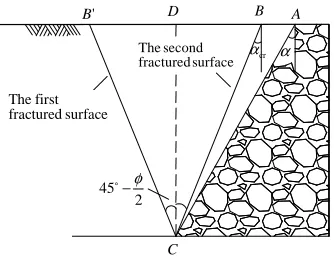
In engineering, retaining wall with the second fractured surface could be called planar retaining wall. The condition of emerging the second fractured surface connected with the slope angle of wall
α
, friction angle between soil and wallδ
, internal friction angle of soilφ
and slope angle of fillingβ
. In a certain degree, the second fractured surface would be emerged when the slope angle of wallα
bigger than the critical slope angle of wallcr
α
(i.e.α
>
α
cr). The critical slope angle of wallcr
α
could be calculated as[13]:
−
+
−
=
φ
β
β
φ
α
sin
sin
arcsin
2
1
2
2
45
cro (2)
When with horizontal filling surface
β
=
0
o, itcan be got
2
45
crφ
α
=
o−
from equation (2), thecorresponding fractured surface showed in Fig. 4.
. 0
m; 0 . 0
o
= =
β
Lsurface fractured
first The
surface fractured
second The
(a) L=0.0 m
. 0
2.0m; m; 5 . 0
o
== =
β
H L
surface fractured
first The
surface fractured
second The
. 0
2.0m;.0m; 1
o
==
= β
H L
surface fractured
first The
surface fracturedsecond The
(c) L=1.0 m
. 0
2.0m; m; 5 . 1
o
==
= β
H L
surface fractured
first The
surface fractured
second The
(d) L=1.5 m
. 0
2.0m; m; 0 . 2
o
==
=
β H L
surface fractured
first The
surface fracturedsecond The
(e) L=2.0 m
. 0
2.0m; m; 5 . 2
o
== = β
H L
. 0
2.0m; m; 5 . 2
o
== = β
H L
[image:4.612.105.274.74.464.2](f) L=2.5 m
Figure 3. Relationship Between Width of Retaining Wall Relieving Plate with Position of Fractured Surface
C D
'
B B A
cr
α α
2 45o−φ 第一滑裂面
surface fractured
first The
surface fractured
second The
Figure 4. Position of Fractured Surface of Planar Retaining Wall
Is that the second fractured surface in Fig. 3 the same as the second fractured surface in Fig. 4? Article [12] holds the attitude that they are the same. In fact, due to the character of structure of retaining wall with relieving plate, the soil in the triangle zone between upside wall and relieving
plate, between lower wall and heel plate, as showed in Fig. 5, likely be “protected” by space, is too lower to be failure by shear. The volume of “protected” soil increased when width of heel plate or relieving plate increased. That is, the second fractured surface of retaining wall with relieving plate is the boundary of “protected” and “unprotected” soil. While the typical failure surface of gravity retaining wall, as showed in Fig. 6, is the sliding surface between filling and retaining wall. The result of FEM indicated that the second fractured surface of retaining wall with relieving plate emerged even at short width of relieving plate, such as L=0.5 m. Therefore, the second fractured surface of retaining wall with relieving plate is not the same of that of gravity retaining wall, which is
not controlled by equation (2) and
α
>
α
cr.soil
protected" " The
surface fractured
[image:4.612.339.496.320.446.2]second The
[image:4.612.348.524.497.586.2]Figure 5. Part of Filling Apart From Fractured Surface in Retaining Wall with Relieving Plate
Figure 6. Typical Fractured Surface of Gravity Retaining Wall
[image:4.612.112.279.503.633.2]ISSN: 1992-8645 www.jatit.org E-ISSN: 1817-3195
superposed, that is to say, only one fractured surface emerged.
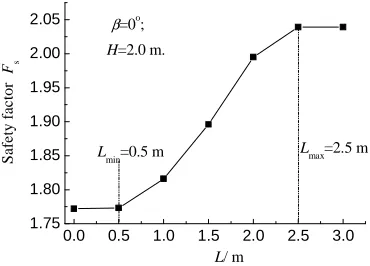
The relationship between safety factor of retaining wall and width of relieving plate with the condition of β=00, H=2.0 m is showed in Fig. 7. It can be found that when L=0.5 m, the width of relieving plate is too short to enhance the safety factor of retaining wall. When L=3.0 m, the width of relieving plate is too large to enhance the safety factor of retaining wall. That is to say, there is a reasonable interval value of width of relieving plate, which could enhance stability of retaining wall effectively. In the example of this article, the reasonable interval value of width of relieving plate is [0.5 m, 2.5 m]. In the reasonable interval value of width of relieving plate, stability of retaining wall increased with width of relieving plate increased. In a certain degree, it is difficult to construct retaining wall with large width of relieving plate. Therefore, it needs to choose a reasonable value of width of relieving plate according the requirement of real engineering.
0.0 0.5 1.0 1.5 2.0 2.5 3.0
1.75 1.80 1.85 1.90 1.95 2.00 2.05
Lmax=2.5 m
Lmin=0.5 m
H=2.0 m. L/ m S af e ty f ac to r Fs
[image:5.612.329.509.84.633.2]β=0o;
Figure 7. Relationship Between Safety Factor of Retaining Wall and Width of Relieving Plate
3.2 Influence of Location of Relieving Plate on
Stability of Retaining Wall
The influence of position of relieving plate on shape of fractured surface with the condition of β=00, L=1.5 m is showed in Fig. 8, corresponding safety factor is showed in Fig. 9. It can be found that the location of relieving plate has no influence on shape and position of the first fractured surface, but have obviously influence on the second fractured surface. When the location of relieving plate becomes nearer bottom of retaining wall (big value of H), distance between relieving plate and soleplate decreased, and failure surface could hardly across the soil between relieving plate and soleplate. . 0 m; 5 . 0 m; 5 . 1 o == = β H L . 0 m; 5 . 0 m; 5 . 1 o == = β H L
(a) H=0.5 m
. 0 m; 0 . 1 m; 5 . 1 o == = βH L . 0 m; 0 . 1 m; 5 . 1 o == = βH L
(b) H=1.0 m
. 0 m; 5 . 1 m; 5 . 1 o == =
β
H L . 0 m; 5 . 1 m; 5 . 1 o == =β
H L(c) H=1.5 m
. 0 m; 0 . 2 m; 5 . 1 o == = β H L . 0 m; 0 . 2 m; 5 . 1 o == = β H L
(d) H=2.0 m
. 0 m; 5 . 2 m; 5 . 1 o == =
β
H L . 0 m; 5 . 2 m; 5 . 1 o == =β
H L(e) H=2.5 m
. 0 m; 0 . 3 m; 5 . 1 o == = β H L . 0 m; 0 . 3 m; 5 . 1 o == = β H L
(f) H=3.0 m
[image:5.612.103.288.381.514.2]0.5 1.0 1.5 2.0 2.5 3.0 1.84
1.86 1.88 1.90 1.92 1.94 (F
s)max
L=1.5 m.
H/ m
S
af
et
y
f
ac
to
r
Fs
[image:6.612.98.518.65.444.2]β=0o;
Figure 9. Relationship Between Safety Factor of Retaining Wall and Position of Relieving Plate
0 2 4 6 8 10 12 14 16
1.5 1.6 1.7 1.8 1.9 2.0
H=1.5 m. L=1.5 m;
β / (0)
S
a
fe
ty
f
ac
to
r
Fs
Figure 10. Relationship Between Safety Factor of Retaining Wall and Inclination of Filling
3.3 Influence of Slope Angle of Filling on
Stability of Retaining Wall
The relationship between safety factor of retaining wall and slope angle of filling with the condition of L=1.5 m, H=1.5 m is showed in Fig. 10, it can be found that stability of retaining wall decreased with slope angle of filling increased.
The relationship between slope angle of filling and position of fractured surface of retaining wall is showed in Fig. 11. It is obviously that the slope angle of filling has no influence on the second fractured surface except the first fractured surface. When the slope angle of filling increased, more and more soil involved in the failure surface, the length of the first fractured surface increased, and stability of retaining wall decreased, likely bedding slip. This character also can be proved by total incremental displacement of filling as showed in Fig. 12. The direction of total incremental displacement of filling is approximately parallel with the first fractured surface and point to retaining wall. The direction of primary stress deflexed with inclined filling, which make more and more soil parallel with the first fractured surface and point to retaining wall, so the stability of retaining wall decreased. Therefore, in order to enhance the stability of retaining wall, filling with
horizontal surface is suggested to be used in engineering.
. 5
m; 5 . 1 m; 5 . 1
o
==
=
βH
L
surface fractured
first The
surface fractured
second The
(a) β=50
. 0 1
m; 5 . 1
m; 5 . 1
o
==
= β
H L
surface fractured
first The
surface fracturedsecond The
(b) β=100
. 5 1
m; 5 . 1
m; 5 . 1
o
==
= β H L
surface fractured
first The
surface fractured
second The
[image:6.612.295.509.75.441.2](c) β=150
Figure 11. Relationship Between Inclination of Filling and Position of Fractured Surface of Retaining Wall
. 0
m; 5 . 1
m; 5 . 1
o
==
= β
H L
. 0
m; 5 . 1
m; 5 . 1
o
==
= β
H L
(a) β=00
. 0 1
m; 5 . 1
m; 5 . 1
o
==
= β
H L
. 0 1
m; 5 . 1
m; 5 . 1
o
==
= β
H L
(b) β=100
[image:6.612.117.272.242.364.2] [image:6.612.316.522.475.670.2]ISSN: 1992-8645 www.jatit.org E-ISSN: 1817-3195
3.4 Sensitivity Analysis of Parameters of Filling
and Foundation
In a certain degree, it is economically to use local materials to fill the retaining wall, such as in mountainous area block stone and reduced stone is to be used, while in plain country clay and sand is to be used. That is, there is big difference in the parameters of different filling, so it is worth to study the sensitivity of parameters of filling and foundation on stability of retaining wall.
The influence of gravity, cohesive strength and inner friction angle of filling on stability of retaining wall are showed in Fig. 13~ Fig. 15. It can be found the stability of retaining wall decreased with gravity of filling increased, which increased with cohesive strength and inner friction angle of filling increased. Therefore, it is suggested to use the filling with small gravity and big cohesive strength and inner friction angle in retaining wall engineering.
17.5 18.0 18.5 19.0 19.5 20.0 20.5 1.80
1.82 1.84 1.86 1.88 1.90 1.92 1.94 1.96 1.98
L=1.5 m; H=1.5 m.
γ /(kN/m3)
S
a
fe
ty
fa
c
tor
Fs
[image:7.612.322.526.76.226.2]β=0o;
Figure 13. Influence of Gravity of Filling on Stability of Retaining Wall
6 7 8 9 10 11 12
1.85 1.90 1.95 2.00 2.05 2.10
L=1.5 m; H=1.5 m.
c / kPa
S
a
fe
ty
f
ac
to
r
Fs
[image:7.612.102.291.361.494.2]β=0o;
Figure 14. Influence of Cohesive Strength of Filling on Stability of Retaining Wall
14 16 18 20 22 24
1.83 1.86 1.89 1.92 1.95 1.98
L=1.5 m; H=1.5 m.
φ / (0
)
S
a
fe
ty
f
ac
to
r
Fs
β=0o;
Figure 15. Influence of Internal Friction Angle of Filling on Stability of Retaining Wall
Sometimes, expanded polystyrene Sheet (EPS), a material with high strength and very little gravity, could be used to fill retaining wall. The gravity of EPS is 0.2~0.3kN/m3, and the lateral pressure coefficient of EPS is about K = 0.1, which decreased the earth pressure on retaining wall greatly. Without special machine, it is very quickly and conveniently to fill the retaining wall at complex area. It is suggested to use EPS at the area of complicated geology, stability of retaining wall hard to control, difficult to construct with traditional method, special terrain, and so on[14,15].
4. CONCLUSIONS
(1) Due to the character of structure of retaining wall with relieving plate, the soil in the triangle zone between upside wall and relieving plate, between lower wall and heel plate, likely be “protected” by space, is too lower to be failure by shear. The second fractured surface of retaining wall with relieving plate is the boundary of “protected” and “unprotected” soil, which essentially different with planar retaining wall.
(2) There is a reasonable interval value of width of relieving plate, which could enhance stability of retaining wall effectively. It is difficult to construct retaining wall with large width of relieving plate. Therefore, it needs to choose a reasonable value of width of relieving plate according the requirement of real engineering.
[image:7.612.105.284.518.662.2]retaining wall, and the stability of retaining wall decreased.
(4) When the slope angle of filling increased, more and more soil involved in the failure surface, the length of the first fractured surface increased, and stability of retaining wall decreased, likely bedding slip. In order to enhance the stability of retaining wall, filling with horizontal surface is suggested to be used in engineering.
(5) The stability of retaining wall decreased with gravity of filling increased, while increased with cohesive strength and inner friction angle of filling increased. It is suggested to use the filling with small gravity and big cohesive strength and inner friction angle in retaining wall engineering.
ACKNOWLEDGEMENTS
This work was financially supported by Anhui Provincial Natural Science Foundation (No. 1208085QE89).
REFRENCES:
[1] The Second Reconnaissance and Design Research Institute of Railroad, “Code for design on retaining structures of railway subgrade (TB10025-2006)”, China Tiedao
Press, 2006.
[2] LI Hai-guang, “Design of new structure of retaining wall and its application”, Beijing,
China Communications Press, 2004, pp. 5-48.
[3] LIU Chang-qing, TAO Zhi-ping, PENG YIN-zong, “Centrifugao model test of retaining wall with short relieving plate on sand backfill”, Journal of Southwest Jiaotong
University, Vol. 31, No.1, 1996, pp. 81-85.
[4] ZHANG Wen-qing, “Design and application of retaining wall with relieving plate in hydraulic engineering”, Gansu Water Resources and Hydropower Technology, No.1,
1996, pp.30-32.
[5] SHI Da-zhen, “Experimental investigation of retaining wall with short relieving plate at side of the road and its application”, Anhui
Architecture, Vol. 86, No.2, 1996, pp. 34-42.
[6] HU Rong-hua, QI Ming-zhu, YU Hai-zhong, “Practical design of retaining wall with relieving plate”, Railway Engineering, No.11, 2010, pp. 87~90.
[7] Dawson E M, Roth W H, Drescher A, “Slope stability analysis by strength reduction”,
Geotechnique, Vol. 49, No.6, 1999, pp.
835-840.
[8] Manzari M T, Nour M A, “Significance of soil dilatancy in slope stability analysis”, Journal
of Geotechnical and Geoenvironmental Engineering, ASCE, Vol. 126, No.1, 2000, pp.
75-80.
[9] WAN Shao-shi, NIAN Ting-kai1, JIANG Jing-cai, “Discussion on several issues in slope stability analysis based on shear strength reduction finite element methods (SSR-FEM)”,
Rock and Soil Mechanics, Vol. 31, No.7, 2010,
pp. 2283-2288.
[10] LIU Jin-long, LUAN Mao-tian, ZHAO Shao-fei, “Discussion on criteria for evaluating stability of slope in elastioplastic FEM based on shear strength reduction technique”, Rock
and Soil Mechanics, Vol. 26, No.8, 2005, pp.
1345-1348.
[11] LIANG Xue-wen, LIU Qian, “Finite element analysis of the cantilever retain wall”, Journal
of Huazhong University of Science and Technology, Vol. 20, No.2, 2003, pp. 99–102.
[12] DAI Zi-hang, LIN Zhi-yong, ZHENG Ye-ping, “Finite element method for computations of active earth pressures acting on L-shaped retaining walls with reduced friction coefficients of base bottoms”, Chinese Journal
of Geotechnical Engineering, Vol. 31, No. 4,
2009, pp. 508–514.
[13] CHEN Zhong-yi, ZHOU Jing-xing, WANGHong-jin, “Soil mechanics”, Beijing, Tsinghua University Press, 1994, pp. 219-221.
[14] LI Jing, MIAO Lin-chang, ZHONG Jian-chi, “Deformation and damping characteristics of EPS beads-mixed lightweight soil under repeated load-unloading”, Rock and Soil
Mechanics, Vol. 31, No.6, 2010, pp.
1769-1775.
[15] GU An-quan, LV Zhen-feng, JIANG Feng-lin, “Load reduction tests and design methods for culverts with high fill soil using EPS slabs”,
Chinese Journal of Geotechnical Engineering,