ISSN: 1992-8645 www.jatit.org E-ISSN: 1817-3195
108
INTELLIGENT DECISION SUPPORT SYSTEMS (IDSS) FOR
MULTI-OBJECTIVE OPTIMIZATION PROBLEMS AT SEA
SECURITY INDONESIA
1
MASROERI 1,
Institut Teknologi Sepuluh Nopember, Department of Marine, Surabaya E-mail: [email protected]
ABSTRACT
Indonesian maritime security issues is a complex problem therefore included in the multi-objective problems, it is necessary for the proper method to overcome these problems, one of them by developing intelligent decision support system using methods Non dominated Sorting Genetic Algorithms II (NSGA II) and Fuzzy C Means (FCM). NSGA-II method will produce a set of optimal solution candidates, while the FCM method serves to minimize the set of optimal solutions. His study aims to maximize the achievements of the coverage area and minimize operational costs by considering the type of vessel, speed, range radar,
endurance. Optimization results using NSGA-II with the following parameters: population = 20, generation = 100, crossover probability = 75% and = 90% probability of mutations produced as many as 125 candidates for the optimal solution. Furthermore, the solution is in the cluster to minimize the prospective solutions based on a predetermined point cluster into four, resulting in four candidates for the best solution, that is: [1] Co = Rp. 4.741.205.798 and Ca = 1.915.083 Mil2; [2] Co = Rp. 3.997.582.228 and Ca = 1.560.672 Mil2; [3] Co = Rp. 4.802.314.832 and Ca = 1.962.895 Mil2; [4] Co = Rp. 4.939.637.487 and Ca = 1.982.564 Mil2. Results of Intelligent Decision Support System with consideration of increasing security in sea area of Indonesia and optimize the budget that has been set by the Government, the recommended solution is the solution to the cluster of four with a combined value of patrol boats [647755475625136306153116502] Cost = Rp. 4.939.637.487, Coverage = 1.982.564 Mil2 and distance = 0.006724.
Keywords:IDSS, Multi-Objective Optimization Problems, NSGA-II, FCM
1.
INTRODUCTION
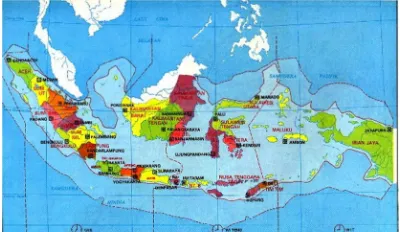
[image:1.612.95.295.593.709.2]Negara kesatuan Republik Indonesia (NKRI) is an archipelago of 17.504 islands and has a 81.290 kilometer long beach (Dishidros TNI-AL, 2003). As an island nation with 80% of marine areas and 20% of the land area, the percentage of the greatest threats to the sovereignty of Indonesia is in the sea area. This percentage becomes higher threat because of the geographical position of Indonesia are in the world trade traffic.
Figure 1. Map Indonesian archipelagic sea lanes (ALKI) (Source: google maps)
The high number of crimes and violations that occurred in Indonesian waters showed that the Indonesian sea is not safe. Violations were caught during the year 2005 - 2012 has increased. Supposed to be the quality and quantity of the Navy was able to secure Indonesian waters from various threats of illegal logging, illegal fishing, illegal minning and violations of the border region. This is due to several factors, that is:
[1]. Delimitation of the sea area of Indonesia is not yet clear;
[2]. Indonesian sea connected with Indonesian archipelagic sea lanes (ALKI I and II); [3]. Weak coordination among government
agencies that handle marine border security Indonesia;
[4]. The vast area of Indonesian waters are to be secured;
[5]. The limited number of Patrol Boats Republic of Indonesia (KRI);
ISSN: 1992-8645 www.jatit.org E-ISSN: 1817-3195
109 [7]. Less precisely the Navy's decision in
determining the operational management of Indonesia's marine security;
[8]. he limited ability of a commander to resolve some of Indonesia's marine security issues quickly and accurately. Based on the above factors the Government is seen to be more careful, quick and precise to decide what strategy will be taken in the Indonesian marine security operations.
The decision is the process of choosing, that is a choice of two or more possibilities. Decision making is the process of choosing an alternative way of acting with an efficient method according to the situation. For that a commander of the Navy must be able to provide some alternative decision regarding the assignment and placement of Indonesian warship (KRI) in the area of operation so as to increase the intensity of Indonesian maritime security while considering operational costs prepared by the State. Therefore, the Indonesian maritime security issues not only in the form of single objective problem but has become a model of multi-objective problem.
For that we need a method to solve these problems, using the best methods of finding solutions. It is known for Multiobjective Optimization Problems (MOP), based on some previous studies that MOP included in Metaheuristic issues that have been extensively researched and developed by the researchers (Talbi, 2009) (Luke, 2012). So Multiobjective Optimization Problem is a problem that involves more than one objective function to be minimized or dimaksimasi. The answer will be obtained from these problems is a collection of solutions that describes best tradeoff among competing objective functions (Deb, 2001). The best solution in Multiobjective Optimization Problem is determined by the dominance / dominace test.
This study focused on solving the problems of Indonesia's marine security by means of simulating the placement of the Navy patrol boats to the respective bases. The purpose of this research is to develop an intelligent decision support system application by optimizing database available, the methods used to construct the intelligent decision support system is Nondominated Sorting Genetic Algorithm (NSGA) and Fuzzy C-Means (FCM). The simulation results NSGA generate many combinations of solutions Navy patrol boat optimum form of optimal Pareto set.
Therefore, it still needed further processing to minimize the many solutions that use clustering methods to reduce the Pareto optimal set into a number of more specific decisions so that decision-makers will be easier to determine the best decision of several alternative decisions.
2. RESEARCH METHODS
2.1. Intelligent Decision Support Systems (IDSS) Intelligent Decision Support System (IDSS) is a development of the method of Decision Support System (DSS) and Artificial Intelligent (AI). This method was developed to help decision makers at various stages of decision-making by integrating modeling and human knowledge.
IDSS is a tool to help the decision-making process in which the uncertainty of the solution becomes a complex problem in which the decision must be made using human judgment and preference (Hozairi, 2011). IDSS as the concept of implied, are used to support decision-making and is not meant to replace the task of decision-makers. In addition, the IDSS work under the assumption that the decision makers are more familiar with the problem to be solved. In this case, the IDSS provides full control to the user regarding information acquisition, evaluation and make a final decision. IDSS is an interactive system, flexible, adaptable and is specifically developed to support the management of unstructured problem solving to improve decision-making. A more cognitive than the IDSS technology systems, The fundamental difference is that the basic characteristics of intelligence can not be captured in a mechanistic (Malhotra et al, 2003). Most researchers agree that the aim of DSS is to support management solution and enables the processing of unstructured knowledge with better communication skills (Qian et al, 2004;. Quintero et al, 2005).
2.2. The Principle of Multi Objective Optimization
Indonesian maritime security issues is a complex issue because it deals with the placement of some of the Navy patrol boats at each base in each sector. So that marine safety problems Indonesia is a multi-objective problem. Problems multi objective is to minimize the operational costs of the Navy patrol boats and improve the achievement of coverage of the Navy patrol boats.
ISSN: 1992-8645 www.jatit.org E-ISSN: 1817-3195
110 mathematics usually indicates a conflict between the objective function. Therefor, optimization is used to find a solution that will provide value to optimize all functions that goal can be fully accepted by the decision maker.
So Multiobjective Optimization Problems is a problem that involves more than one objective function to be minimized or in the maximization. The answer will be obtained from these problems is a collection of solutions that illustrate best tradeoff among competing objective functions (Deb, 2001).
The general form of the mathematical model of this function is:
Min/Max fm(x) m= 1,2,……m
Subject to:
gi (x) ≥ j = 1,2,……,j
hi (x) = 0 k = 1,2,……,k
i = 1,2,…..n; l = lower bound; u = upper bound
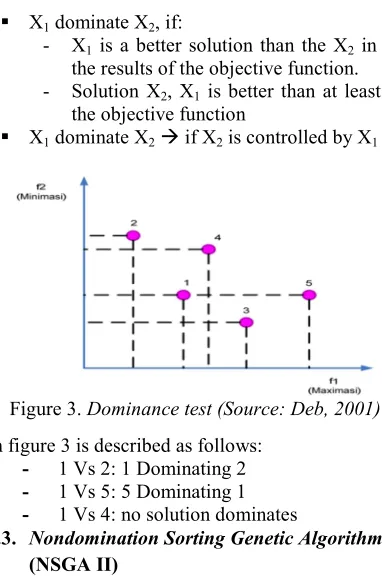
In the single-objective, optimization problem, the best solution is easily determined by comparing the value of the objective function. While the problem of multi-objective optimization, the best solution is determined by dominance. Dominace test the intention is as follows:
X1 dominate X2, if:
- X1 is a better solution than the X2 in all
the results of the objective function. - Solution X2, X1 is better than at least in
the objective function
[image:3.612.97.288.416.705.2]X1 dominate X2 if X2 is controlled by X1
Figure 3. Dominance test (Source: Deb, 2001)
In figure 3 is described as follows:
- 1 Vs 2: 1 Dominating 2
- 1 Vs 5: 5 Dominating 1
- 1 Vs 4: no solution dominates
2.3. Nondomination Sorting Genetic Algorithm II (NSGA II)
One type of Multi Objective Genetic Algorithm
(MOGA) is a non-dominated Sorting Genetic
Algorithm (NSGA) developed by N. Kalyanmoy Srinivas and Deb [8] which is a modification of the ranking procedure. NSGA II algorithm based on multiple layers of classification of individuals. Before the selection is displayed, the population in the rankings on the basis of non-domination. Non dominated all individuals classified into one category.
In order to maintain the diversity of the population, This classified individually divided by the value of
dummy fitness. Then a group of individuals classified is ignored and another layer of individual non-dominated considered. The process will continues until all individuals in the population classified. Since the individual on the first front
have the maximum fitness value, they always get a copy which is more than the remaining population. This allows for a better search on the area Pareto Front and produce convergence of the population towards the area.
2.4. Fuzzy C – Means
Fuzzy clustering is one technique for determining the optimal cluster in a vector space based on the normal form for the Euclidean distance between the vectors. Fuzzy clustering very useful for modeling fuzzy especially in identifying rules
fuzzy. Methodclustering grouping of data and its parameters in groups - groups according to the tendency of the nature of each of these data (similarity properties).
Famous fuzzy clustering algorithm is Fuzzy C-Means (FCM) which was introduced by Jim Bezdek. he Introduced the idea of fuzzyfication
parameter (m) in the range [1, n] the which determines the degree of all of the cluster's fuzzy. When the cluster m = 1, the effect is a crisp
clustering of some point, but when m> 1 degree to the fuzzy-an in between points on the decision space to be increased.
If X={x1,x2,…,xn} where xi ∈Rn is a set of data
features and objectives of the FCM algorithms is to minimize the cost function FCM the formulated as followed:
V={v1,v2,…,vc} is the center of the cluster.
U=(µij)NxC is a fuzzy partition matrix where each
member μij shows the degree of membership
between data vectors xi and cluster j. The value of
ISSN: 1992-8645 www.jatit.org E-ISSN: 1817-3195
111 FCM Clustering involves two processes, namely counting center cluster and assignment of points to the center by using a form of the Euclidean
distance. This process is repeated until the center
cluster has stabilized. FCM executing a direct constraint on the fuzzy membership function connected with each point as follows:
The purpose of the FCM algorithm is the assignment of data points into clusters with varying degrees of membership. The membership reflects the degree to which point more representative of one of the other cluster.
Eksponen m ∈ [1, ∞] is a weighting factor that determines all of the cluster's fuzzy. The use of distance most frequently used is the Euclidian dij =
|| xi–vj ||. Minimization of the cost function J (U, V)
is a non-linear optimization problems can be minimized by following iterative algorithm:
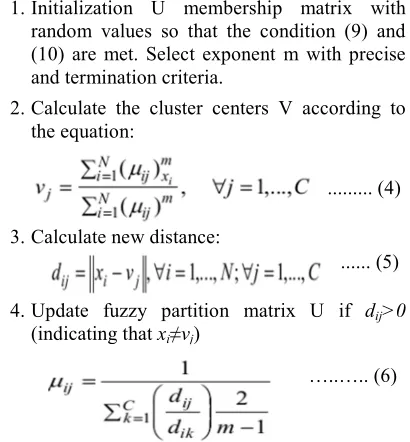
1.Initialization U membership matrix with random values so that the condition (9) and (10) are met. Select exponent m with precise and termination criteria.
2.Calculate the cluster centers V according to the equation:
3.Calculate new distance:
4.Update fuzzy partition matrix U if dij>0
(indicating that xi≠vj)
5.If the termination criteria have been met, stop and if others go to step 2.
2.5. Operational Cost Navy
The operational costs of the Navy patrol boats is a collection of some of the costs involved in a single operation for the Indonesian maritime security. These costs include some things, That is:
a. Logistics Cost Navy (BLK):
-Fuel Oil (BBBM) (Rp/ltr)
-Lubricating Oil (BMP) (Rp/ltr)
- Fresh Water (BAT) (Rp/ltr)
So the formula for calculating the cost of logistics ships as follows:
BLK = ∑ BBBM + ∑ BMP + ∑ BAT (Rp) ………. (7)
b. Personnel cost (BOP): - Sailing allowances personnel (BTL) (Rp/day) - Meal allowances personnel (BUMO) (Rp/day) - Leaders allowances personnel (BTP) (Rp/day) So the formula for calculating the operational costs of personnel as follows: BOP = ∑ BTL + ∑ BUMO + ∑ BTP (Rp) ………. (8)
[image:4.612.96.301.369.590.2]So to minimize operational costs and personnel navy obtained by the following formula: Co … … Co ∑ ∑ ! … . 2.6. Coverage Area Navy Navy patrol boats that move from one point to another during his endurance has several variables, namely: radar capability and speed. Coverage area of the Navy patrol boats is the ability of a vessel to conduct security operations in accordance with the sailing capabilities. For the calculation of broad range and coverage area of the patrol boat cruising distance as figure 3. Figure 4. Coverage area range Based on Figure 3 there are some similarities as follows: Skri = Navy speed x 24 Hours (Mil) - Skri= ∑Vkri * 24 Hours (Mil) - dkri = Radar range (Mil) - L1kri = Wide Rectangle L1kri = Skri*dkri (Mil2) - L2kri = Area of a circle L2kri = π*r2 (Mil2) ….. (9)
…... (2)
………... (3)
... (4)
... (5)
ISSN: 1992-8645 www.jatit.org E-ISSN: 1817-3195
112
Coverage Area wide range navy is a rectangular area (L1) plus the area of a circle (L2) and multiplied by the probability of detection radar.
Coverage Area Range (CA):
CAkri = ∑(L1+L2) * Probability radar (Mil2)
CAkri = ∑(L1kri+L2)*0.9 (Mil 2
) ……… (10) So to maximize the achievement of the coverage area of the Navy patrol boats with the following formula:
Ca $ … $%
Ca ∑ L1() L2 ∗ 0.9 ./… $%
Ca ∑ 0() ∗ 24 2$3 4() ∑5 ∗ 6/
∗ 0.9 ./… $%
2.7.Constraint Functions
- Class PARCHIM = All sector
- Class FPB and PC ≠ sector IV and VII - Operational cost ≤ Rp. 5.000.000.000 - Coverage Area ≥ 1.868.000 Mil2 - Used of Navy ≤ 27 Kapal
So to get a combination of the Navy patrol boats are optimal in each sector, constraint functions used are fitness value of genetic algorithms operator:
- Cost (Co):
- Coverage Area (Ca)
3. RESULT AND DISCUSSION
In Figure 4 shows the determination of design combinations, where at the beginning of the scenario of a commander will choose commissioned navy in accordance with the classification to each base represented by sector.
The selected scenario will be influenced by several factors: vessel specifications (speed, endurance radar capability, weaponry, the number of personnel), geographical conditions bases (level of vulnerability, wind velocity, an area, support facilities, etc).
The government demands is how to improve the achievement of the coverage area of the navy so the condition of Indonesia's marine area is guaranteed security. but what about the cost to a minimum by looking at the terms set by the Government budget. This problem will be solved by using NSGA-II to select optimal solutions of some combination of ships assigned to the 7 (seven) sectors of the fleet in the eastern region of Indonesia.
Fiqure 5. Model IDSS For Maritime Security
The first stage of the optimization assignment Navy patrol boats to every sector of operation, by using the algorithm NSGA-II obtained many optimal combination in accordance with the value of fitness is to maximize coverage area and minimize operational costs.
Fiqure 6. Results Of The Optimization NSGA-II
(Pc < 50%, Pm = 10%, 20 Generation)
Results of a multi-objective optimization stage produced an optimal solution that is pretty much the constraint as follows:
- Coverage Area ≥ 1.688.765 Mil2
- Operational Cost ≤ Rp. 5.000.000.000 ……… (11)
ISSN: 1992-8645 www.jatit.org E-ISSN: 1817-3195
113 Based on the results of running the model NSGA-II with 20 generations showed 125 solution with various models of optimal combination of navy. Based on Figure 6 on the first line, describes the composition of 27 navy seven sectors.
Fiqure 7. Solution NSGA-II In The First Row
Based on the figure 6, the composition of the navy in some sectors can be explained in table 1.
Table1. Composition Of The Navy In Some Sectors
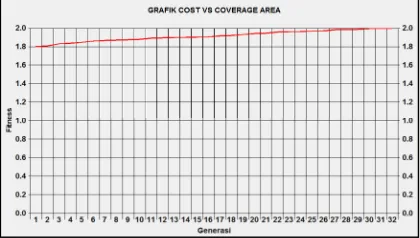
[image:6.612.93.302.236.338.2]Model multi-objective optimization problem, the data input for the NSGA-II using a population of 20 and many 20 generations. Results of multi-objective optimization problem shown in Figure 7. There is an optimal solution produced as many as 125 solution.
Figure 8. Results Of Optimization With NSGA-II
At the next stage will be stage clustering, FCM would be to cluster the optimal solution of the NSGA-II into any decisions. Stage clustering using FCM will reduce the solution became several decisions alone. Input parameters used FCM
clustering is determined from the beginning as follows:
Number of cluster (c) = 4; Rank (w) = 2; Maximum iteration (MaxIter) = 100; Error smallest (ζ ) = 10-12 Initial objective function (Po) = 0;
Initial iteration (t) = 1;
[image:6.612.315.525.249.369.2]FCM basic concepts, the first time is to determine the center of the cluster, which will mark the average location for each cluster. In the initial condition, the center of the cluster is still not accurate. Each data point has a degree of membership for each cluster. By improving the center of the cluster and the degree of membership of each data point repeatedly, it will be seen that the center cluster will move towards the right location. This iteration is based on minimization of the objective function that describes the distance from the given data point to the cluster center weighted by the degree of membership of the data points.
Figure 9. Results Cluster With FCM
Output of FCM is not fuzzy inference system, but a row of center cluster and some degree of membership for each of data points. The information can be Obtained from the four clusters
are grouped into four classes as follows:
Class1 : Medium cost & medium coverage Class 2 : Low cost & low coverage
Class 3 : High cost & medium coverage Class 4 : High cost & high coverage
Four class cluster point of the final scores obtained by the closest distance to the point cluster. In detail can be seen in table 2.
Table 2. Solution 4 Classes Based On The Shortest Distance
[image:6.612.91.301.422.541.2]ISSN: 1992-8645 www.jatit.org E-ISSN: 1817-3195
[image:7.612.91.299.73.209.2]114
Figure 10. Graph Distances Between Classes
Figure 9 is explained that the IDSS provides convenience for the commander of the TNI AL some decisions, namely:
If the commander wants moderate operating costs and achieving coverage were then combined in a class-1 ship should be chosen; If you want low operational costs and the achievement of low coverage, the combination of class-2 ship should be chosen;
If you want high operating costs and achieving coverage were then combined in a class-3 ships to be selected;
If you want high operating costs and achieving high leverage, the combination vessel in the 4th grade should be selected.
Every cluster has its disadvantages and advantages that the commander of the Navy will be easier to determine the most ideal decision.
Results of the above cluster process to produce 4 pieces of solutions that is central cluster of each cluster, as shown in Figure 9. The resulting distance between grades 1 to 4 are:
Class 1 = 0.064503, Class 2 = 0.594481, Class 3 = 0.546994, Class 4 = 0.006724.
[image:7.612.92.302.643.710.2]Based on the above, the application range IDSS will sort some of these decisions a priority decision. After posting by the IDSS system solutions presented recommendations to the commander of the Navy as table 3.
Table 3. IDSS Solution For Assignment Combination Navy In Indonesian
Solution decisions total 4 pieces above were taken from the value of the smallest Euclidian. This means that the value of the smallest distance from the center of decision solutions centroid has represented the best combination of several other combinations. Solution of IDSS suggest selection decisions on class 4 with operational costs Rp. 4.939.637.487 and achievements covarega 1,982,564 Mil2 area.
4. CONCLUSION
Methods NSGA-II is able to provide 125 prospective solution for the combination of the placement of the Navy patrol boat in the respective sectors.
FCM method is used to minimize the collection of solutions provided by NSGA-II by dot clusters that have been determined to be four, that is: [1] Cost medium and Coverage medium, [2] Low Cost and Low Coverage, [3] The High Cost and Coverage medium, [4] Cost high and Coverage high. IDSS has been able to provide a choice of solutions based approach to maritime security Indonesia, So the decision was elected priorities, namely: [1] Class 4 = 0.006724, [2] Class 1 = 0.064503, [3] Class 3 = 0.546994 and [4] Class 2 = (0.594481).
IDSS Solution for a combination of patrol boats selecting clusters to 4 (high Cost and Coverage high).
The combination of the selected navy is [647755475625136306153116502] by resting boats 17 and 26 and commissioned the entire navy to each sector.
Achievement coverage area of 1,982,564 Mil2 navy and implications for the cost needed to secure the eastern region of the sea Indonesia Rp. 4.939.637.487.
From the achievements of area coverage decision is able to enhance maritime security Indonesia for 6:13% ≈ 94 895 Mil2 and cost savings in terms of maritime security budget is able to save by 1.21% ≈ Rp. 60,362,513.
REFERENCES
ISSN: 1992-8645 www.jatit.org E-ISSN: 1817-3195
115 [2]. Deb, N. a. (2009). Multiobjective
Optimization Using Nondominated Sorting in Genetic Algorithms. Evolutionary Computation, 2 (3), 221-248.
[3]. Hozairi, K. B. (2011a). Border Area Development Security Strategy Indonesia Sea-Based Expert Systems. Sitia (pp. 30-36). Surabaya: Electrical Engineering - ITS.
[4]. Hozairi, K. B. (2011b). Application of Expert System for the Development of Regional Sea Border Security Strategy Indonesia. SNATI (pp. 70-76). Yogyakarta: Teknik Informatika - UII.
[5]. Hozairi, K. B. (2013). Implementation Of Nondominated Sorting Genetic Algorithm-II (NSGA-II) For Multiobjective Optimization Problems On Distribution Of Indonesian Navy Warship. Journal Of Theoretical and Applied Information Technology, 53(1), 1-8. [6]. I.G.P. Asto Buditjahjanto, D. (2009). Game
Business Using Intelligent Agent Based Fuzzy C-Means to Support Decision. Journal
of Research and Development
Telecommunications. Bandung.
[7]. IDSPS. (2009). Management and Homeland Security Border Region. Jakarta: Intitute For Defence, Security and Peace Studies.
[8]. Khoirudin, A. A. (2007). Determine the Final Value Class With Fuzzy C-Means. Seminar Nasional Sistem and Informatika. Bali. [9]. Klayanmoy Deb, A. P. (2000). A Fast and
Elitist Multi-Objective Genetic Algorithm: NSGA-II, KanGal Report Number 200001.
Kanpur, India: Indian Institute of Technology. [10]. Kusumadewi, S. (2007). Classification Nutrition Food Ingredients Using Fuzzy C-Means. Seminar Nasional Aplikasi Teknologi Informasi (SNATI). Yogyakarta.
[11]. Luthfi, E. T. (2007). Fuzzy C-Means Clustering Data To (Case Study: Data Performance Teaching Lecturer). Seminar Nasional Teknologi (SNT). Yogyakarta. [12]. M. Rajkumar, K. M. (2013). Combined
Economic and Emission Dispatch with Valve-point loading of Thermal Generators using Modified NSGA-II. J Electr Eng Technol .