THE ANTECEDANTS OF BROADBAND INTERNET
ADOPTION AND CONTINUANCE USAGE IN MALAYSIAN
HOUSEHOLD CONTEXT
1SARAVANAN NATHAN LURUDUSAMY,2T. RAMAYAHa, b
1School of Management, Universiti Sains Malaysia, Penang, Malaysia 2aSchool of Management, Universiti Sains Malaysia, Penang, Malaysia
2bUTM International Business School (UTM-IBS), Universiti Teknologi Malaysia, Kuala Lumpur
ABSTRACT
The Internet is simply a series of worldwide computer networks linked together, communicating almost instantly by using various access technologies. It is playing a major role in many areas of our lives, such as communication, entertainment and information which is supported by newer innovations and technology evolvement. While the broadband Internet penetration rate is encouraging in many countries, its adoption is still a notable issue in Malaysia. Therefore this research is focused on identification of two relevant research streams covering broadband Internet, which are adoption and continuance of usage (after initial adoption) in Malaysia. The theoretical framework which is utilized in this study is an integrated model of Unified Theory of Acceptance and Use of Technology (UTAUT) and IS- Continuance Model which has been further extended by integrating another 2 Independent Variables, namely Perceived Innovativeness and Perceived Playfulness. This study is trying to determine the relationship among the independent variables that influences the adoption and continuance usage of Broadband Internet technology among Malaysian individuals. Survey was used as the research instrument and the unit of analysis are existing broadband Internet subscribers in Malaysia. Data obtained from the survey was analyzed using Partial Least Square (PLS-SEM) and indicate that intention to adopt broadband have a significant positive influence on initial usage, Intention to continue using broadband have a significant positive influence on actual usage continuance and Initial broadband usage have a significant positive influence on usage continuance of broadband. This paper is concluded by some recommendations, limitations and directions for future study.
Keywords: Internet Broadband, Technology Adoption, UTAUT, Continuance Usage Of Technology
1 INTRODUCTION
During the industrial revolution, dependency was on motors that use muscle power but in the new Information Age, the challenge is in learning to utilize brainpower by putting the power of computation and to provide information services on a global basis. Ecologically, important technological developments have created a global environment that is drawing the people of the world closer and closer together. The Internet, as an integrating force, has enabled the technology of communications and computing to provide instant connectivity and global information services to all its users that allows consumers to generate and exchange, share and manipulate information in an uncountable number of ways.
Internet is simply a series of worldwide computer networks linked together,
communicating almost instantly with each other via telephone lines or satellite linkup and can be accessed using various access technologies namely wired technology and wireless technology [11]. Moving on from here, Broadband Internet is a term that describes the Internet as a function of high speed data connections and large bandwidth. The Federation of Communication Commission (FCC), which is an independent agency of the United States government, defines broadband service as data transmission speeds exceeding 200 kilobits per second (Kbps) in at least one direction, either downstream or upstream. Briefly, high capacity bandwidth allows greater amount of information to be transmitted which is the essence of all applications and communications.
aspirations of turning Malaysia into a Communications and Multimedia Global Hub, a secretariat has been formed to roll out the National Broadband Plan (NBP) to where the fundamental strategies to accomplish such a vision is to put in place an efficient broadband network and ensure sufficient subscription to Internet service among Malaysian households. On the other hand, the shift to the knowledge economy is part of a wider plan to achieve the objective of the nation’s Vision 2020, which is a 30-year plan to “push” Malaysia to achieve a level at par with industrial nations in terms of economic performance and technological capability. It is envisaged that Malaysia is moving towards a new era of advanced information, communications and multimedia services with Internet as the key enabler, and as it is anticipated that the future of Internet depends on the adoption of broadband technology among existing Internet users.
2 MALAYSIAN HOUSEHOLD’S
BROADBAND INTERNET USAGE SCENARIO
There are many tangible benefits of broadband Internet at various levels that’s impacting an individual. A good broadband connection to a home means there's a greater capacity to send and receive data, that allows faster Internet access to support faster and more efficient file downloads. Home networking that allows sharing of broadband connection among multiple PC and devices by wireless connectivity. These resources enables the employment, education, leisure and entertainment possibilities are open to all the family.
Primarily, the deployment of broadband technology improves productivity by facilitating the adoption of more efficient consumer to business processes. For many people who work in offices the commute to work can be a chore. More and more companies are now embracing the flexibility of allowing staff to work from home. High speed connectivity allows links to internal computer and telephone networks, virtually providing all the office facilities at home. With increasing fuel costs and companies aware of their Carbon Footprint, this is an
attractive alternative. People with children or other care commitments may be able to use faster broadband to restructure their working days. This may benefit both them and their employers. Second, extensive deployment of broadband accelerates innovation by introducing new consumer applications and services such as new forms of commerce and financial intermediation. Third, broadband leads to a more efficient functional deployment by maximizing their reach to resources, access to raw materials, and consumers. With its transformative power as an enabler for economic and social growth, broadband Internet makes it as an essential tool for empowering people, creating an environment that nurtures the technological and service innovation, and triggering positive change in the communications method in the society as well as in business transactions as a whole.
While the benefits of broadband-enabled future are manifest, the broadband revolution has raised up issues and challenges as explained at forthcoming section
.
Firstly, the adoption of broadband Internet is a notable issue in Malaysia as despite the provision of broadband access at affordable prices, the demand for broadband has not increased as expected and the deployment and adoption of broadband is still in its infancy in Malaysia. It is predicted that by 2015, there will be 17.4 million Internet users in Malaysia. Out of this, only 9.3 million will be broadband users. Looking back at the past scenario when this research has been embarked in 2011, out of 16.9 million Internet users, only 5.1 are broadband users. Based on the statistics by [12], though as of 2013, the current Malaysian household Broadband penetration rate is about 66.7%, there is still considerable potential in broadband adoption among Malaysian individuals as the nation’s broadband penetration rate is very low achievement compared to other countries around the globe[17]. This problem of slow broadband adoption has been taken seriously by the Malaysian government as they are continuously revising their policy and changing the target. This disappointing state of affairs has prompted the government of Malaysia to revise the previous target of 75% household Broadband adoption to only 50% by the year 2010.the issues of broadband in the areas of consumer’s adoption and the impact on the post adoption. Studies conducted on broadband adoption also highlight the need to understand adoption of broadband at consumer level. Research has demonstrated that it costs about 6 times as much to recruit new subscriber as to maintain an old one, in paid membership context, particularly in telecommunication applications, such as Broadband Internet. It is prominent that previous research on Broadband Internet has mainly focused on the supply side such as pricing, promoting infrastructure, building, and establishing right policies, ignoring the importance of the demand side issues such as looking more deeply into the use, and factors impacting individual uptake [4].
Hence, the current study tries to identify the key drivers of Broadband Internet continuance (after initial adoption) among Malaysian individuals in a wholesome perspective.
3 THEORETICAL FRAMEWORK
DEVELOPMENT
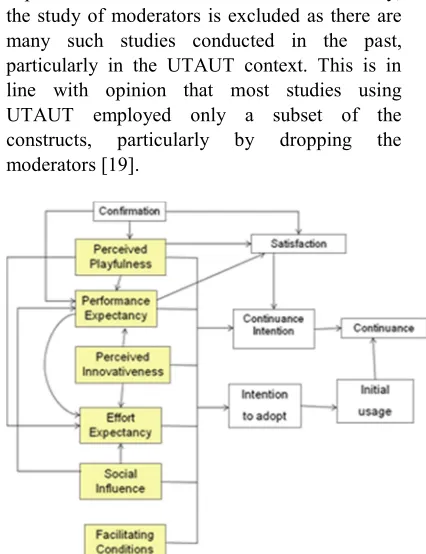
The proposed framework of this study integrates Unified Theory of Technology Acceptance and Use of Technology (UTAUT) and IS Continuance Model which is from Expectation Confirmation model (ECM) principles, with inclusion of Perceived Innovativeness and Perceived Playfulness variables to study the adoption intention and continuance intention. With this integration, the effect that actual usage has on actual continuance of broadband is also being investigated. According to the UTAUT, intention to use the information technology (IT) can be determined by four antecedents: performance expectancy, effort expectancy and social influence and facilitating conditions, as a consequence, intention to use is to exert influence on actual behavior toward technology adoption with facilitating conditions [20].
Performance expectancy is defined as the degree to which an individual believes that using the system will help him or her to attain gains in job performance. In this study, Performance Expectancy reflects the perceived utility associated with adopting broadband Internet. The broadband service can improve
users’ living and working performance efficiency. When users form positive expectation towards broadband Internet, they may continue their usage based on previous research
Effort expectancy is defined as the degree of ease associated with the use of the system. Effort Expectancy reflects the perceived difficulty of using Broadband Internet. The constrains of Internet Broadband such as viewing in small computer screen and inconvenient user prompt and commands may result in difficulty for users to get what they want by using an IS technology, such as Internet Broadband. If users need to invest great effort on learning to use or skillfully using the Broadband, they might not feel satisfied. This reveals that Effort Expectancy will affect user satisfaction.
Social influence is defined as the degree to which an individual perceives that important others believe he or she should use the new system. In terms of consumer oriented service, relevant references such as adopter’s friends, family, colleagues/peers may all influence the adoption decision. It is expected that households with broadband connections are likely to influence their relatives and friends by informing them of, and of demonstrating to them the benefits and convenience offered by broadband.
Facilitating conditions are defined as the degree to which an individual believes that an organizational and technical infrastructure exists to support use of the system. Besides user intention, the user also needs to possess relevant knowledge of broadband system. For non-professionals or new users, they definitely need professional assistance and guidance, or relative training course, when they do not know how to operate it in their residential. If there were such benefiting resource and environment available, their user intention will be enhanced. A study found that when the users consider they have enough usage capacity and assistance resource, they will show more positive acceptance of information technology [20].
changes in attitudes and beliefs over time. If this is accomplished, the UTAUT will truly be a unifying theory and this research is performed towards that accomplishment. Based on this suggestion, UTAUT model has been integrated with ECM, which is an extension of CDT, in order to study on the adoption of broadband Internet and its usage continuance among individuals.
It is noted from previous researches that understanding the role of perceived playfulness over time is an important avenue of research to pursue. In experienced users base the perception of their playfulness on relatively superficial information, so it is difficult for them to evaluate and identify fun from using the broadband, which offers a high speed transmission facility to support the advanced applications such as online games and media downloads. If an individual ‘‘feels good’’ about an activity it is intrinsically motivating, and he/she is more likely to engage in it. Perceived playfulness explained significant variance in usage intentions. Playfulness was highly correlated with voluntary use and similar findings revealed that perceived playfulness was positively related to microcomputer usage [10].
Meanwhile, according to [21], individuals who are high in Personal Innovativeness are more likely to be risk-seeking and may demonstrate more confidence in their capacity to adopt or use an innovation such as broadband Internet technology. Adopters’ innovativeness significantly affects their perceptions and behavior towards the innovation, especially in the area of technology adoption. Users with high personal innovativeness in information technology tend to have positive beliefs in using a technology such as Broadband Internet and are likely to have more satisfaction from using the technology.
According to [4], adoption of an IS technology is just the first step toward overall technology success. An IS implementation can truly be considered as “a success” when a significant number of users have moved beyond initial adoption and used the information systems on a continued basis. Simply studying the decision to adopt a technology is not enough, since it is followed by a process of deeper evaluation through use that may or may not
[image:4.612.321.534.129.406.2]result in continuance. The gap between expectations before adoption and evaluation after experience influences this decision. In this study, the study of moderators is excluded as there are many such studies conducted in the past, particularly in the UTAUT context. This is in line with opinion that most studies using UTAUT employed only a subset of the constructs, particularly by dropping the moderators [19].
Figure 1: Proposed Research Framework.
In addition, user beliefs and attitudes change over time, users’ initial intention and continuance intention will be different. Whether there is correlation or influence between the two intentions, and what kind of relationship exists between different intentions with final users’ satisfaction, are considered in this model as reflected in Figure 1.
4 DATA COLLECTION METHOD
This research is a cross sectional study and it assumes that user’s intention to adopt to broadband and continuance of usage remain constant, since it has been almost a decade since broadband Internet technology has been introduced in Malaysia.
approaches are available within the category of quantitative positivist research, the survey is the only appropriate research approach that can be employed to conduct such research (i.e., that requires hypotheses testing and validation of the conceptual model) in a social setting, in this instance the individuals.
The purpose of the survey is to determine items or factors that are affecting adoption and usage continuance behaviors of broadband Internet and then in subsequent stages the important factors are modified to measure usage satisfaction and its confirmation. A number of appropriate items are collected and modified to be in accordance to the definition of Performance Expectancy, Effort Expectancy, Social Influence, Facilitating Conditions, Perceived Playfulness and Perceived Innovativeness, Satisfaction, Confirmation, Intention, Actual Usage and Continuance of Usage. This is done by reviewing some of the relevant questionnaire used in previous information science and technology continuance studies.
This survey was conducted among broadband Internet users across Malaysia through online questionnaire and personal hand delivery of the survey forms, based on the list which was obtained from a Malaysian Internet Service Provider (ISP). This list contains name of subscriber, complete address, contact number and years of broadband Internet subscription. An examination of the literature is conducted to ascertain the research approaches employed in the area of technology adoption and diffusion. Various journals and online search is conducted to understand the theories in technology adoption studies. This is done by reviewing some of the relevant questionnaire used in previous information science continuance studies.
Prior to dissemination of the final questionnaire, a pre-test was conducted to determine the response rate and learn of any discrepancies within the questions, which included determining whether the format of the questionnaire and questions are suitable. Additionally, the duration that completion of the questionnaire would require is also established. The pilot questionnaire will be delivered via the postal service to a total of 20 randomly selected participants from broadband Internet subscriber list obtained from a local telecommunication firm.
Based upon the received feedback, changes was made to the final design of the questionnaire, and a final questionnaire was developed. The final questionnaire is sent using email notification on the online questionnaire which is available on the Internet. A cover letter and the Internet online website link is sent to the email addresses of broadband subscribers based on the list of broadband Internet subscribers in Malaysia obtained from ISP. The collected data is analyzed using Statistical Package for Social Science (SPSS) and Smart- Partial Lease Square (Smart PLS) software.
The respondents are required to choose to what extent he/ she agreed or disagreed with each of the statement, with 1 being extremely disagree and 7 being extremely agree. These questions are divided into two broad categories, where part A consists of 11 multiple choice questions addressing the social attributes (demographic variables) including age, gender, education, years of broadband Internet subscription and income; and part B that comprises 12 Likert scale (1-7) questions that are designed to address the issues related to the factors of broadband Internet adoption and continuance; following number of items measured for each of the 44 constructs.
Questionnaires were printed in hardcopy and distributed to broadband Internet subscribers. At the same time, questionnaires were made available in the Internet and were emailed to some of the subscribers to answer the web survey via providing the link in the cover email. The number of responses obtained from web survey is 89 and the number of responses obtained from personal interview is 367. This totals up 456 as the total responses. Out of the total 456, only 450 are usable since 6 cases were either did answer the questionnaire partially or most of the fields were left blank. Missing values were checked and treated using the Estimation Maximation (EM), which is a method that assumes a distribution for the partially missing data and bases the inferences on the likelihood under the. Missing values were then imputed based on the expectation maximization estimates of the parameter.
5 RESULTS
are the children of the registered broadband subscriber, with the age group obviously comes from the range of 17 to 24 years old, and dominated by female as respondents. Majority of the respondents are with tertiary education that consists of Degree and above qualifications. On the type of broadband Internet access, nearly 40% of the respondents have fixed line Internet access, about 25% have mobile Internet access and about 34 % have both types of Internet access at their home, with majority of the respondents subscribing the respective services of more than 3 years. Social communication such as Facebook, online chat and email have been the mainstream reason to use broadband Internet, followed by entertainment such as online games, YouTube streaming and songs downloading. About 70% participants are using broadband Internet for their research reason and nearly half of the respondents use the technology for prominent reasons such as telecommuting (work from home), e-commerce and sharing of digital files on the Internet.
5.1 Common Method Variance
Due to the fact that data was collected from respondents within a short period of time which is within duration of one to two months, the common method bias may present a problem. This potential problem can be tested and detected by Harman’s single factor test. Common method variance exists in the data if a single factor emerged from a factor analysis of all survey items and if one general factor accounting for most of the common variance existing in the data. An un-rotated factor analysis using the Eigen-value greater than one criterion revealed that 7 distinct factors accounted for 71.52% of the variance. The first factor captured 45.74% of the variance in the data. Since this percentage is less than 50%, it is apparent that single factor did not emerge and the first factor did not account for most of the variance. Therefore, this study concludes that common method variance was not a major concern in this study.
5.2 Construct Validity And Reliability The constructs validity can be defined as the extent to which a set of measured variable are actually measuring what it is supposed to measure based on the grounded theoretical measure [6]. Constructs validity can be measured through convergent and discriminant validity whereas convergent validity refers to the degree which multiple items used in the research to
measure the same concept are in agreement. Thus, convergent validity is being conducted in this research, where validity of measures used are examined through the value of average variance extracted (AVE). [6] recommends that an AVE value of 0.5 and higher should be achieved to prove that the latent variable explains more than half of its indicators’ variances. The AVE for all the 12 variables to be in the range of 0.645 and 0.913 which is well above the recommended cut-off value.
5.3 Discriminant Validity
Discriminant validity can be defined as a situation when two or more distinctively different concepts are not correlated to one another [16].The two methods that have been put forward to determine the construct’s discriminant validity are the cross loadings and Fornell-Larcker criterion.
In the cross loadings method, firstly, the loadings and cross loadings were examined by running the PLS –Algorithm analysis, Discriminant validity was ascertained when an indicators’ loading pertaining to its associated latent construct was higher than all the remaining constructs. Therefore, cross loading in indicators with very low loadings of less than 0.6 should always be eliminated from further consideration. Next, once these items had been deleted, the PLS –algorithm analysis was re-run again and all the indicators loadings values exceeded the cut-off point of 0.4 as suggested by [5]. Besides that, as anticipated, all of the indicators loaded onto their underlying constructs showed that no cross loadings were found among indicators.
In addition, reflective measurement models’ discriminant validity can also be established through Fornell-Larcker criterion. According to this criterion, the squared root of AVE for each latent construct should be higher than the correlations of any other latent construct which is evidently higher than the correlation for each construct indicating adequate discriminant validity for the constructs proposed in this research.
5.4 Reliability Analysis
according to their reliability during model estimation [5]. Composite reliability should be higher than 0.7 and in this research, all the composite reliability exceeded the cut-off value. As such, it can be concluded that the measurement are reliable.
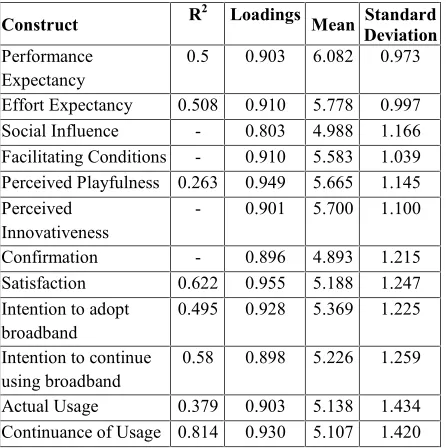
Table 1: Descriptive Analysis
Construct R2 Loadings Mean StandardDeviation
Performance
Expectancy 0.5 0.903 6.082 0.973
Effort Expectancy 0.508 0.910 5.778 0.997 Social Influence - 0.803 4.988 1.166 Facilitating Conditions - 0.910 5.583 1.039 Perceived Playfulness 0.263 0.949 5.665 1.145 Perceived
Innovativeness - 0.901 5.700 1.100
Confirmation - 0.896 4.893 1.215
Satisfaction 0.622 0.955 5.188 1.247 Intention to adopt
broadband 0.495 0.928 5.369 1.225
Intention to continue
using broadband 0.58 0.898 5.226 1.259 Actual Usage 0.379 0.903 5.138 1.434 Continuance of Usage 0.814 0.930 5.107 1.420
Based on descriptive statistic, generally, all the variables recorded mean values of above the midpoint 3.5. Performance Expectancy scored the highest with a mean value of 6.082 while Confirmation showed the lowest mean value at 4.893. The dispersion values reported through standard deviation indicated that the dispersion values were between 0.973 and 1.434, where the lowest value is on Actual Usage and highest value on Performance Expectancy respectively. Table 1 reflects the results obtained from the descriptive analysis
6 DISCUSSION
Findings derived from the analysis of the structural model are briefly discussed in correspondence to the main research questions raised in this study.
6.1 Intention To Adopt Broadband Internet Technology
The relationship between the broadband Internet adoption intention among Malaysian individuals with Performance Expectancy, Effort
Expectancy, Social Influence, Facilitating Conditions, Perceived Innovativeness and Perceived Playfulness were examined. The results showed that Performance Expectancy, Facilitating Conditions and Perceived Playfulness were found to have a significant positive relationship with broadband Internet adoption intention. However, a puzzling finding was that no significant relationships were found between Effort Expectancy, Social Influence, Perceived Innovativeness and intention to adopt broadband Internet.
On Performance Expectancy, the usage of broadband Internet technology is very useful for the life and work efficiency as many household users depend on the Internet to do teleworking with faster information acquisition that would enhance their effectiveness on the task they perform at home. The respondents condone to the fact that a specific person such as helpdesk agent or field technician are available for assistance each time they face broadband difficulties while using the technology. Therefore, it is apparent that Broadband Internet users in Malaysia have the necessary resources to use the technology such as technical knowledge and capability to pay the monthly subscription charges, thus establishes a positive relationship between Facilitating Conditions and intention to use the broadband Internet technology.
Perceived playfulness is influential in the adoption intention of broadband Internet since this technology is seemed to be incompatible with other Internet technology usages such as dialup or wireless or LAN usage at the office environment. This is mainly due to the fact that many home based users would like to use the technology at home for both their job as well as entertainment reasons. Certain company’s network connection which is made via the managed security control that enable them to telework from home, is seem to be ineffective in use as the connection still behaves as private environment for corporate applications and thus, strictly confining the user to perform official and formal task only.
broadband Internet technology is insignificant. This is the level where the time and effort needed to learn about and to use a technology has become very minimal for seasoned users. As for Social Influence, in the context of Internet users, Malaysian household have the option either to adopt to broadband Internet or not, therefore usage of this technology is an option and not compulsory. Hence, it explains why this relationship is not supported in this study as supported by another study [14] in the area of Information system adoption.
Findings revealed states individuals who are high in Personal Innovativeness are expected to be risk-seeking, have higher forbearance to risk and are probable to embrace the innovation [21]. However, in this study, personal innovativeness is not supported as an influence for broadband Internet adoption due to the fact that many Malaysians may not interested in seeking and using innovative products to enrich their lifestyle. They are probably less risk taking, and are satisfied as long as their Internet application works well even with conventional method or an outdated technology.
6.2 Intention To Continue Using Broadband Internet Technology
The relationship between the broadband Internet continuance intention among Malaysian individuals with Performance Expectancy, Effort Expectancy, Social Influence, Facilitating Conditions, Perceived Innovativeness and Perceived Playfulness were examined. The results showed that Performance Expectancy, Social Influence, Facilitating Conditions and Perceived Playfulness were found to have a significant positive relationship with broadband Internet adoption intention.
A possible explanation is that the roles of Performance Expectancy in explaining continuance intention of broadband Internet is probably due to the capabilities of the technology in achieving the specified goals of the users with effectiveness, efficiency and satisfaction in a specified context of use. This is possible due to the emergence of many Internet application that makes some betterment in the Quality of Life of the users in using this technology. Developments such as software to ease out teleworking among office workers, facilitating web conferencing via Internet, access to single sign on (SSO) portals
will definitely add value to the technology to maintain users to continue using the broadband Internet technology. The usage purpose of broadband Internet encompasses of work-oriented, pleasure, enjoyment activities. As an example, broadband Internet technology can benefit users with self-fulfilling standards as they relate to recreational activities such as online games, movie clips and electronic books. Hence, perceived playfulness is prominent in this relationship that it positively affects the continuance intention of broadband Internet technology.
This study also found that there is positive effect between Facilitating Conditions and intention to continue using broadband Internet technology. This dimension also means that users have the resources and necessary knowledge to use Broadband Internet. Users have borne the costs of using Broadband Internet, such as initial set-up fees for the equipment’s, internal wiring, electrical points and committed monthly subscription fees. In addition, they need to be equipped with necessary knowledge to operate the technology based on the network infrastructure nature, which represents as an emerging technology. If users do not own these resources and knowledge, they may not continue their usage of broadband Internet. Since all the resources and knowledge are already in place, with the correct technical helpdesk to assist them during any fault, customer will continue to use the broadband Internet technology.
There seem to be negative relationship between Effort Expectancy and intention to continue using broadband Internet. The explanation to this is that many technology users such as broadband Internet users probably need to learn though the process to use the technology constantly. This is due to the technology’s nature that is always developing with new interface designs and system upgrades. Therefore, as suggested in other studies, as users become more comfortable with a system, the influence of perceived ease of use diminishes [7], [15].
Another pertinent finding of this research is that Personal Innovativeness has no significant influence on broadband Internet continuance intention. Reckoning that an individual’s innovativeness is an insistent attribute, people who formerly adopt an innovation are typically those with high degree of innovative nature. This is contradicting to previous researches, existing users with greater level of innovativeness will foresee the tangible benefits and would embrace the innovation [13], [18].
6.3 Broadband Internet
Adoption/Continuance Intention And Actual Usage/Continuance
The relationship between Internet broadband adoption intentions with actual usage was examined and the relationship between Internet broadband continuance intentions with actual continuance was examined. It was discovered that both these this relationships are significantly positive.
The stronger an individual believes in intending to adopt to broadband Internet technology, the greater will be its adoption. Therefore, incumbent telecommunication companies and policy holders must work hand in hand to ensure awareness of broadband Internet connectivity is made known to the entire household. Many campaigns and roadshows can be done to induce the usage intention among Malaysian household users.
On the other hand, there is a positive relationship between broadband Internet continuance intention and actual continuance of broadband Internet. In the current study, the role of behavioral intentions in predicting actual behavior is examined and it is hypothesized that behavioral continuance intentions positively
influence continuance of broadband Internet usage.
6.4 Initial Usages Of Broadband Internet And The Broadband Internet Actual Continuance
The relationship between Internet broadband initial usages with continuance intention was examined. It was discovered that this relationship had a significant positive impact too. This suggests that once the users adopt the system, they have a higher tendency for continuously use of the technology [3], [9], [22]. Therefore ISP’s and other telecommunication practitioners should deign a plan that encourages usage in the adoption stage and should realize that initial usage determines the broadband Internet actual continuance as a collaborative effort.
6.5 Satisfaction And Broadband Internet Continuance
The relationship between satisfaction and broadband Internet continuance intention was examined. Consistent with previous researches conducted in technology adoption [2], this study found that satisfaction was found to be a strong predictor of the continuance intention of broadband Internet [8]. This is probably due to trust and switching barrier factors. Users who are satisfied with their Internet usage might face many problems such as disruption in their online habits of they change the service technology to another.
On the other hand, the usual contents that the user might be using might have an effect in case they change to another Internet technology. For instance, the concept of always “on” mode of the device in broadband Internet technology might have made the user to be comfortable in using the technology s compared to some other Internet technology that requires a user to input the security passcodes each time the user wants to access to the Internet. Apart from this, a user might also feel irritated at the usage experience shown by different Internet technology compared to the existing technology at which the user is satisfied [9].
7 RESEARCH CONTRIBUTION
management field. Firstly, this research extends the individual UTAUT and IS Continuance Model explanation by integrating both of them together with two other variables, namely Personal Innovativeness and Perceived Playfulness. These theories assert that, to influence adoption and continuance of usage of the broadband Internet, there need to be commitment from telecommunication companies, policy implementers and application developers as well as Internet users themselves. There seem not many researches that actually integrates these theories simultaneously by examining broadband adoption and continuance use in the same study.
Though the lens of these theories, this research exploited how UTAUT and ECM has been glued together to increase the adoption rate of broadband Internet and ensure existing subscribers are sticky to this technology. In this sense, this study overcomes the shortcoming by successfully incorporating all the different theories and extra two variables to enable a comprehensive view of what are the factors that need to be emphasized to ensure substantial adoption of broadband Internet.
8 CONCLUSION
This research also asserts that intention to continue and actual usage will influence actual continuance of usage of broadband Internet technology among existing subscribers. This is postulation links of intention to adopt broadband Internet and intention to continue using broadband Internet that influences the actual usage of the technology. In addition, this study examined the relationships between confirmation and satisfaction of broadband Internet usage in household context. It can be concluded that as a collaborative effort, service providers such as ISP, government agencies, telecommunication practitioners and application developers need to work hand in hand to support the adoption growth of broadband Internet and also in ensuring these subscribers are loyal and continue to use the technology in the future.
Therefore, it is important for telecommunication practitioners to understand and be aware of the importance and implications of policy and regulations that they implement, such as setting up broadband infrastructure and rollout plan to ensure coverage is provided to the
Malaysian household nationwide. Hence, it is also pertinent for application developers and home based online business to keep themselves updated with the latest information regarding technology, newer products, systems and process with regards to their usage requirements. The notion of assuming that the broadband Internet will be sustaining in the long run that were once thought of as sufficient have been overshadowed by the need to offer more value added services together with the existing subscription gets more and more aggressive due to competitive in the global arena. For this reason, telecommunication practitioners and ISPs are currently striving hard to improve their network coverage and ensure connectivity is available to the nation. This study is truly an eye-opener for the broadband industry players as well as to the application developers in providing a useful guidelines that are listed for them as and when they intend to expand and provide higher quality broadband services as a platform and developing more appropriate applications to ride on the technology.
In a nutshell, this study stands as a reminder that Performance Expectancy, Perceived Playfulness and Facilitating Conditions are common fundamental ingredients that can facilitate the broadband Internet adoption growth and sustain existing users in continue using the technology. At the same time, this study found that there is no evidence on Effort Expectancy and Perceived Innovativeness exerting an influence on both adoption and usage continuance of broadband Internet technology among household users. Nevertheless, this result could merit further exploration as to why this phenomenon occurred.
REFERENCES
[1] Brevik, E. (2005). User Acceptance of Technology and Success in IS Implementation. In M. Khosrow-Pour,
Managing Modern Organizations through
Information Technology, (pp. 172-175).
Hershey, PA: Idea Group Publishing.
[2] Chen, M., & Xianjun Qi, X. (2015). Members’ satisfaction and continuance intention: a sociotechnical perspective.
Industrial Management Data Systems, 115 (6),1132-1150.
Industrial Management Data Systems, 115 (4),646-660.
[4] Gholami R., Koh E., and Lim J. (2010). A Survey on the Post-Adoption of Broadband Internet, Information Resource Management Journal, 23(1), 3.
[5] Hair, J.F., Ringle, C.M., & Sarstedt, M. (2011). "PLS-SEM: Indeed a Silver Bullet."
Journal of Marketing Theory and Practice, 19 (2), 139-151.
[6] Hair, J.F., Ringle, C.M., & Sarstedt, M. (2011a). PLS-SEM: indeed a silver bullet.
Journal of Marketing Theory and Practice,
19 (2),139–151.
[7] Islam, A.K.M.N., & Azad, N. (2015). Satisfaction and continuance with a learning management system. The International Journal of Information and Learning Technology, 32 (2),109 – 123.
[8] Jin, X.L., Zhou, Z.Y., Lee, M.K.O. & Cheung, C.M.K. (2013). International Journal of Information Management, 33(3),
93-104.
[9] Liou, D.K., Hsu, L.C., & Chih, W.H. (2015). Understanding broadband television users’ continuance intention to use, Industrial Management Data Systems, 115 (2), 210-234.
[10]Lin, C.S., Wu, S., & Tsai, R.J. (2005). Integrating perceived playfulness into expectation-confirmation model for web portal context. Information & Management,
42, 683–693.
[11]Lurudusamy, S. N., & Ramayah, T. (2009). Broadband Solutions for the Last Mile to Malaysian Residential Customers.
Encyclopaedia of Multimedia Technology and Networking (2nd ed.).Milan, Italy: IGI Publishing.
[12]MCMC. (2013). Fibering up Malaysia. ITU Asia Pacific Regional Development Forum. Phnom Penh, Kingdom of Cambodia: ITU. [13]Min, L., Dong, Z.Y., & Chen, X. (2012).
Factors influencing consumption experience of mobile commerce: A study from experiential view. Internet Research, 22 (2),
120-141.
[14]Moghavvemi, S., & Salleh, N. A. M. (2014). Effect of precipitating events on information system adoption and use behaviour. Journal of Enterprise Information Management, 27 (5),599 - 622
[15]Mohamed, N., Hussein, R., Zamzuri, N.H.A., & Haghshenas, H. (2014). Insights into individual’s online shopping continuance
intention. Industrial Management & Data Systems, 114 (9),1453 - 1476
[16]Sekaran, U. & Bougie, R. (2011). Research Methods for business: A skill building approach.5th(ed.). New Delhi: John Wiley &
Sons
[7]Selamat, M. H., Hisyam, Dwivedi, Y. K., Abd, W., Muhammad, S., Mat, S., Mohd, A., Williams, M. D., & Lal, B. (2008). Factors Affecting Malaysian Accountants' Broadband Adoption and Use Behavior. AMCIS 2008 Proceedings.
[18]Thakur, R., & Srivastava, M. (2014). Adoption readiness, personal innovativeness, perceived risk and usage intention across customer groups for mobile payment services in India.Internet Research, 24(3),369-392. [19]Venkatesh, V., Thong, J. Y. L., & Xu, X.
(2012). Consumer Acceptance and Use of Information Technology. MIS Quarterly,36, 1- 22.
[20]Venkatesh, V., Morris, M.G., Davis, G.B., & Davis, F.D. (2003). User acceptance of information technology: Toward a unified view.MIS Quarterly, 27(3), 425-478. [21]Yang, S., Lu, Y., Gupta, S. and Cao, Y.
(2012). Does context matter? The impact of use context on mobile internet adoption.
International Journal of Human-Computer Interaction, 28(8),530-541.