ISSN: 1992-8645 www.jatit.org E-ISSN: 1817-3195
ANALYSIS AND OPTIMIZATION OF VENTILATION MODE
OF SMOKE CONTROL SYSTEM IN SUBWAY STATION
FIRES
1RU ZHOU, 2WEI ZHANG 1
College of Urban Construction and Safety Engineering, Nanjing University of Technology, Nanjing 210009, Jiangsu, China
273677 PLA troops, Nanjing 210016, Jiangsu, China
ABSTRACT
In the subway station fires, the most immediate threat to passengers’ life is not the direct exposure to fire, but the smoke inhalation because it contains hot air and toxic gases. Theoretical analysis and CFD simulations are applied to analyze the various possible ventilation model and obtain the optimization of ventilation mode in the subway station fires. According to the structure characters of the subway station and the mechanics analysis of smoke flowing, the air curtain is put forward to control the smoke diffusion according to the streamline and flux principle. The computational mathematical model of the air curtain is derived theoretically. The results indicate that more than 6 minutes for safe evacuation can be guaranteed by air curtain. The quantity of fresh air that the air curtain needs has been only 2/5 of which the traditional method, which effectively prevent the fire expand and control the smoke diffusion.
Keywords: Subway Station Fire, Smoke Control Model, Air Curtain
1. INTRODUCTION
There are many Subway fires in the past two decades when the subway has become a major transportation scheme in metropolitan areas. Four serious accidents were listed: (1) the fire at Paris caused 84 deaths in 1903, (2) the fire at King’s Cross subway station happened in 1987 and caused one death and 47 serious injuries, (3) the fire at Baku in Azerbaijan was more horrible, the hot gas and toxic smoke killed 337 people and 227 seriously injured, (4) the subway fire in Korea caused 138 deaths and 99 people disappear[1]. From the computational fluid dynamics (CFD) simulation results of the King’s Cross fire, it was found that smoke diffusion in the complicated station could hardly be predicted and the smoke control is crucial in a fire emergency; more precisely, for example, buoyant smoke may move rapidly through the stairwells, blocking the passages through which passengers are supposed to evacuate [2]. So it is obviously known that, in the fires of subway station, the most immediate threat to passengers’ life is not the direct exposure to fire, but the smoke inhalation because it contains hot air and toxic gases. And the key to evacuate easily is how to control the smoke diffusing in a subway station fire.
However, in underground facilities such as a subway station, it is dangerous for passengers to evacuate toward the ground floor because smoke also flows upward to the ground. A number of studies have been reported on fires in underground facilities[3,4,5]; however, few systematic studies have been conducted on air curtain in subway stations. So the objective of the present paper is to investigate the effectiveness of air curtain, which is opposite to the buoyant smoke flow, by computing the behavior of smoke.
ISSN: 1992-8645 www.jatit.org E-ISSN: 1817-3195
not influence filed of vision, therefore, adopting air curtain in stairhead for replacing the traditional smoke prevention model for smoke prevention was put forward in this paper, in order to assure safety evacuation.
2. PHYSICAL MODEL OF SUBWAY STATION
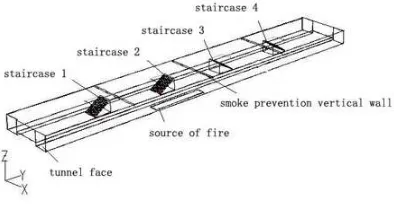
[image:2.612.95.292.316.418.2]The usual subway station is divided into upper layer and lower layer generally, the upper layer is concourse layer, while the lower layer is platform layer. The only passage for people to evacuate from platform layer is the stairhead connecting the platform layer and the concourse layer. There are two tunnel faces ahead to tunnel at left and right. The physical model was showed as Figure 1.
Figure 1: Physical Model Of Platform Layer
3. SMOKE FLOW ANALYSIS OF ESCAPE STAIRHEAD OF SUBWAY STATION
3.1. Pressure Analysis Of Escape Stairhead Of Subway Station
In the mode of flow, there was hardly any difference between smoke and air, they were just different in the quantity of oxygen and carbon dioxide, but this kind of difference did not influence physical characteristics of gas gravely. The characteristics of smoke particle and air were different remarkably, but even though the concentration of smoke reached the degree that reduces the visibility almost to zero, it was not able to change the whole flowing mode. Generally speaking, the major factor resulting in smoke flowing was: when fire happens, the gas expansion and the heat pressure effect resulting from temperature rising.
3.1.1. Gas expansion
Generally, smoke was about 3% heavier than air in the same temperature. Clotted drop contained in smoke sedimentation or absorbs to the wall, after its isolation from smoke, the volume weight of smoke
could be close to the air’s, and could be seen as ideal gas approximately. So after being heated the volume expansion of smoke was showed by ideal gas function:
0[1 ( 0)]
s s
V =V +β t −t (1)
Where Vs is the volume of smoke when the temperature is ts, m3; V0 is the volume of smoke when the temperature is t0, m
3
; ts is the temperature of smoke, ; t℃ 0 is normal temperature in the station,
;
℃ β is the coefficient of smoke’s volume expansion, β=1/273, 1/ . ℃
When the combustion reached shotpoint, the temperature was about 800 , it could be seen from℃ formula (1) that the volume of smoke just increases three times, therefore, beside fire, the major factor of smoke flowing was the heat expansion of smoke. When the smoke was flowing, the smoke flowing from the face of ceiling fell down gradually, the reason was that smoke loses buoyancy force gradually after it contacted ceiling and was cooled. Because subway station was a more ringent sealed-off system, the pressure difference results from smoke expansion produced by combustion is dinky. So the heat expansion of smoke was not the major factor that made smoke diffuse in evacuation path.
3.1.2. Heat pressure effect
The characteristic of heat pressure effect was that, when the temperature outside was lower than it inside, there was a upcurrent. This phenomenon was called heat pressure effect. It was the air flow caused by the difference of heat pressure which was caused by the change of air density results from the difference of temperature.
The differential pressure was:
1 ( n w)( 0 )
p g ρ ρ h h
∆ = − − (2)
Where ρw and tw are the outside air density and temperature, respectively; ρn is the air inside density when the temperature is tn, kg/m3; h is the height from bottom to the calculation height, m; h0 is the height from bottom to the neutral plane, m.
3.1.3. Synthesis effect
It could be seen from the analysis above that the chief factor which caused the smoke to flow and diffusion was the heat pressure effect, while the smoke heat expansion was the secondary factor causing smoke diffusion[7].
(
)(
)
1 k1 n w 0
p g ρ ρ h h
ISSN: 1992-8645 www.jatit.org E-ISSN: 1817-3195
Where k1 is the effect coefficient of the smoke heat expansion to heat pressure, k1=1.05.
3.2. Analysis Of Smoke Flow Field 3.2.1. Smoke flow
According to the principle of hydromechanics, the flow generated from differential pressure was:
∆ = ⋅ ⋅p ρ ξ v2/ 2 (4)
Where ξ is coefficient of resistance; v is air flow velocity at the evacuation stairhead, m/s.
Substitute formula (3) into formula (4), it gets:
1
1 0 2
2 ( )( )
[ n w ]
n
k g h h
v ρ ρ
ρ ζ
− −
= (5)
3.2.2. Stream function of smoke flow
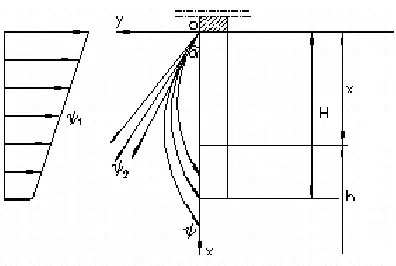
[image:3.612.93.291.446.579.2]Now taking the cross direction of evacuation stairhead as x axis, taking the vertical direction of evacuation stairhead as y axis, and taking the top part of evacuation stairhead as point o, system of axes was established. Under the effect of differential pressure, the flow through the evacuation stairhead was regarded as one-dimensional flow, namely: v=vy, and h=H−x. As it shown in Figure 2, according to the definition of stream function, the stream function generated from differential pressure was:
Figure 2: Flow Field Map Of Design Of Stairhead
1 0
1/ 2
1 0
0
2 ( )( )
x y x n w n v dx
k g h H x
dx ψ ρ ρ ρ ζ = − − + =
∫
∫
(6)3.2.3. Stream function of smoke prevention air curtain
Considering the setting, maintenance, beautiful seeing, application and reliability, it was suitable to
use upwind air curtain, and according to the plane jet stream blowed-out aslant deduced in reference 3, the stream function of its basic segment was:
(
)
1 2 2 0 2 0 3 cos 2 cos ab xv th y x tg
ax α ψ α ε = − ⋅
(7) Where v0 is exit velocity of jet stream, m/s; b0 is width of wind gap, m; a is coefficient of turbulence current, a=0.11-0.12[8]; α is the separation angle of jet stream axis with axis x; th( ) is hyperbolic tangential function.
3.2.4 Stream function of stairhead
Here the air was considered as incompressible fluid, the plane jet stream can be considered as potential flow approximately. According to the principle of superimposition of flow field, the stream function after the two air stream superimposing was:
(
)
1 2 1 2 2 0 0 0 3 cos 2 cos x y ab xv dx v th y x tg
ax
α α
α Ψ = Ψ +Ψ
= + − ⋅
∫
(8)Furthermore: ∂ψ⁄∂x∂y=∂ψ⁄∂y∂x (leave the course of mathematical testification out), shows that this stream function was existent, the designed flow field was:
y=0 When x=0; y=0 When x=H.
4. DESIGN COMPUTATIONAL MATHEMATICAL MODEL OF SMOKE PREVENTION AIR CURTAIN
Substituting the boundary condition into stream function formula (8):
When x=0, y=0, the streamline was:
0 0
ψ = (9) When x=H, y=0, the streamline was:
0 0
0 1
3 2 sin cos
2 cos H H v dxy
ab H v th a ψ α α α =∫ − (10)
ISSN: 1992-8645 www.jatit.org E-ISSN: 1817-3195
H 0 1 2 0 0 0
L B( - )
3 sin cos
2 cos
H y
ab H
B v dx v B th
a
α α
α
= Ψ Ψ
= −
∫
(11)Where H is height of platform layer, m; B is
width of evacuation stairhead, m.
The front part of formula (11) was the flux of air or smoke got across the evacuation stairhead in the effect of differential pressure with no air curtain, namely:
(
)(
)
12 0
0
2 P
H n w n
L
g h h x
B ρ ρ dx
ρ ξ − − + = ⋅
∫
(12)Because the flux of air curtain was:
L0 =Bb v0 0 (13)
Taking:
1 2
3 sin cos
2 cos a e th a α α α =
(14)
Substituting formula (12), (13) and (14) into formula (11): 1 2 0 0 P H
L L L e
b
= − ⋅ ⋅
(15)
Because the air curtain at the stairhead was used for smoke prevention, smoke was not allowed to flow into the front room, so it was required L=0, therefore: 1 2 0 0 0 P H
L L e
b
− ⋅ ⋅ =
(16)
According to the research[9], the optimal jet angle α =30°, and the optimal specific flux L0/LP=0.6, substituting these into formula (22):
1 2
0 1 0
0.6 P
L b
L e H
= =
(17)
Solving it and getting: 2
0 0.36
b = e H (18) Substituting formula (14) and α=30° into formula (18) , and taking a=0.115:
b0 =0.03577H (19)
We can solve according to the formula (12) , (13) , (17) and (18) , and get:
0
0
0.6 LP v
Bb
= (20)
Formula (19) and (20) were the final formulas to calculate the smoke prevention air curtain at the evacuation stairhead.
5. CASE SIMULATION
5.1. Air Curtain Model
[image:4.612.326.509.215.339.2]The thickness of the air curtain was 40mm, the angle of jet flow was 300 and the velocity of jet flow was 10m/s according to the formula (19) and (20). Both sides of stair rails were sealed completely by the smoke screens, which was shown in Fig.3.
Figure 3: Location of smoke-prevention air curtain
5.2. Cfd Mathematical Model And Boundary Conditions
5.2.1. Mathematical model
The CFD approach was employed to investigate the flow field of subway station fire. Reliable results can be obtained only when some reliable assumptions were made[10]: (1) the smoke flow in the subway station should be three-dimensional, (2) the k-εturbulence model was used to simulate the flow, (3) the fire can be taken as a source of heat and smoke (accounted by CO2) in which no combustion is considered. And the governing equations for the conservation of mass, energy and turbulence kinetic energy dissipation that were used in the field model can be expressed in the following general format:
( ) div( u ) div( grad ) s
t ρϕ ρ ϕ ϕ ϕ
∂ + = Γ +
∂ (21)
Where t is the time, ρ is the fluid density, u is the diffusion velocity, φ is the dependent variables, Γ is the diffusion coefficient of smoke, and SΦ is the source term.
ISSN: 1992-8645 www.jatit.org E-ISSN: 1817-3195
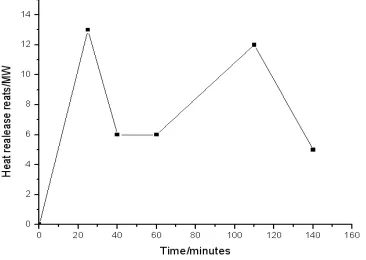
[image:5.612.320.518.78.236.2]initiatory 25mins and reached the peak of 13MW, namely, qs =kt , k= 8.67kW/s. It was fully combusted and the product was accounted as CO2, namely, Ws=9.03×10⁻⁴t.The uniform grid was employed and the number of grids varied according to the structure. A finer grid was prescribed for the complicated structure, such as fire, stairs, and so on. Totally, there were more than 364,000 grids in the domain. For each computation, stability and accuracy of the number were checked by changing the number of iterations. Normally, a 10-time iteration or higher was needed to obtain a converged solution. About 36 hours was taken to run through a case on a PC with Pentium 4 3.0GHz CPU and 4 GB RAM.
Figure 4: Heat-Released Rate Of Fire Source
5.2.2. Boundary conditions
The four tunnel fronts were considered as the pressure outlets and the four stairheads were considered as velocity inlets with 1.5m/s air flowing through. The pressure was the local atmosphere pressure and the temperature was 300K. According to the subway design criteria, no less than 1m3/(min.m2) of the exhausting volume can be supplied. So the volume of exhausting fans was 10.3m3/s in every smoke-preventing subarea which can meet the demand.
5.3. ANALYSIS OF SIMULATION RESULTS
5.3.1. Traditional Control Mode
The center plane section was selected as the observing face. The results were as follows.
a t=60s
b t=150s
c t=360s
Figure 5: Smoke Concentration Distribution Of The Subway Station
As shown in Fig.5, after the station got fire for 60 seconds, smoke spread to the 2nd stair. Smoke was blocked off here as a result of the smoke screens on the top of the stair head, but there was small amount of smoke at the stair head. Smoke passed smoke screen which was above lateral banister to the stair head and continual spread to the station hall layer, threatened the upper layer’s safety. The smoke spread to the 1st and 3rd stairs but kept off in front of the 1st and 3rd stair heads as a result of smoke screens when the fire lasted for 150 seconds. Meanwhile, the 2nd stair head was completely full of smoke, there was not any smoke at the 4th stair head. The whole station hall layer was full of smoke, which was harm to the people.
[image:5.612.97.280.289.419.2]5.3.2. New control mode with air curtain
Figure 6: The Vector Graph Of Velocity Field At Stairs(40s)
Figure 7: The Vector Graph Of Velocity Field At Stairs(200s)
[image:5.612.319.516.430.620.2]ISSN: 1992-8645 www.jatit.org E-ISSN: 1817-3195
the air curtain jet flow and the downward airflow from the stairhead flows onwards at a new compound speed.
a t=60s
b t=150s
[image:6.612.98.289.141.300.2]c t=360s
Figure 8: Smoke Concentration Distribution Of The Subway Station
As shown in Fig.8, the smoke appeared near 2nd stair when the fire lasts for 60s, but smoke deviated from the stair as a result of the airflow of smoke-preventing air curtain. The smoke continuously accumulated and pressured continuously increases as time goes by, smoke gradually approached to 2nd stair. And the smoke appears near 1st when the fire lasted for 150s and no smoke in the vicinity of the stair4 even at 360s. As shown in the Fig.6, the smoke cannot break through the air curtain and spread to the mezzanine in the whole simulation course. The smoke-prevention air curtain at the stair head could ensure more than 6 minutes for personal evacuating safely.
To prevent the smoke spreading to the stairhead, by the traditional method, fresh air should be imported into the platform layer from every stairhead at the speed of 45 m3/s at least. The smoke diffusion could be controlled effectively by this way, but a great deal of fresh air spread into the fire field and enhanced the intensity of fire. By using air curtain, when the airflow came to be steady, about 18 m3/s fresh air should be imported into the platform layer from every stairhead. The quantity of fresh air that the air curtain needed was only 2/5 of which the traditional method needs, and it could reduce the disadvantageous effect on the fire field.
6. CONCLUSIONS
(1) In this paper, the smoke prevention air curtain had been put forward to control the smoke diffusion
according to the streamline and flux principle. The computational mathematical model of the smoke prevention air curtain had been derived theoretically.
(2) The air curtain has been used at the stairhead of the subway station to control the smoke and ensure the life safety, according to the structural character and the requirement of personnel safe evacuation. By the field simulation on the subway fire, it was known that the smoke prevention air curtain at the stairhead can ensure more than 6 minutes for people to evacuate safely, when a train catched fire in the platform layer.
(3) The needed quantity of fresh air has been reduced by using air curtain. The computation results has indicated that the quantity of fresh air that the air curtain needs was only 2/5 of which the traditional method needed, which reduces the disadvantageous effect on the fire field.
(4) To improve the security of subway station, the prevention air curtain could be combined with exhaust smoke in the platform layer to control smoke diffusion.
ACKNOWLEDGMENTS
The authors wish to thank the helpful comments and suggestions from the teachers and colleagues in Jiangsu Key Laboratory of Urban and Industrial Safety. This work is supported by the China Postdoctoral Science Foundation funded project (2012M511742) and Natural Science Fundamental Research Project of Jiangsu Colleges and Universities (11KJB620002)).
REFERENCES:
[1] Falin Chen and Shinchang Guo, “Smoke control of fires in subway station”, Theoretical and Computational Fluid Dynamics, Vol.6, No.1, 2003, pp. 349-368
[2] Jun Yuan and Yi Sun, “Preliminary discussion on the fire design of the subway”, Fire Science and Technology, Vol.22, No.4, 2003, pp.302-308
[3] L.H Cheng, T.H Ueng, C.W Liu, “Simulation of ventilation and fire in the underground facilities”, Fire Safety Journal, Vol.36, No.6, 2001, pp.597-619
ISSN: 1992-8645 www.jatit.org E-ISSN: 1817-3195
[5] Ru Zhou, Jiapeng He, Juan Xie, “Analysis of Smoke Dynamic Field in Subway Station Fire”, Progress in Safety Science and Technology, Science Press, September 15-18, 2006, pp.823-8827
[6] A.B Sadygov, “Way to simulate the airflows' motion in subway constructions during fires”, Surface Engineering and Applied Electrochemistry, Vol.48, No.2, 2012 , pp. 187-191
[7] R.J Seong, H.S Ryou, W.H Park, “CFD simulation and assessment of life safety in a subway train fire”, Tunnelling and Underground Space Technology, Vol.24, No.4, 2009, pp. 447-453
[8] R.J Seong, H.S Ryou, S.W Yoon, “The effect of PSD on life safety in subway station fire”, Journal of Mechanical Science and Technology, Vol.24, No.4, 2010, pp. 937-942
[9] K.C Chung, J.L Siao, “Smoke management test in a subway tunnel”, Journal of Applied Fire Science, Vol.20, No.3, 2010 , pp.211-224 [10] Wenzhong Wu and Shijun You, “Wave motion