U P D A T E
Open Access
Statistical analysis plan of a randomized
controlled trial to compare a restrictive
strategy to usual care for the effectiveness
of cholecystectomy (SECURE trial)
Sarah Z. Wennmacker
1, Aafke H. van Dijk
2, Joost P. H. Drenth
3, Sandra C. Donkervoort
4, Djamila Boerma
5,
Gert P. Westert
6, Cornelis J. H. M. van Laarhoven
1, Marja A. Boermeester
2, Marcel G. W. Dijkgraaf
7and
Philip R. de Reuver
1*Abstract
Background:Cholecystectomy is the preferred treatment for symptomatic cholecystolithiasis. However, persistent pain after cholecystectomy for symptomatic cholecystolithiasis is reported in up to 40% of patients. The aim of the SECURE trial is to compare the effectiveness of usual care with a restrictive strategy using a standardized work-up with stepwise selection for cholecystectomy in patients with gallstones and abdominal complaints. The SECURE trial is designed as a multicenter, randomized, parallel-arm, non-inferiority trial in patients with abdominal symptoms and ultrasound-proven gallstones or sludge. Randomization was performed to either usual care (standard practice, according to the physician’s knowledge and experience, and physician’s and patient’s preference) or a restrictive standardized strategy: treated with interval evaluation and stepwise selection for laparoscopic cholecystectomy based on fulfilment of pre-specified criteria. This article presents in detail the statistical analysis plan (SAP) of this trial and was submitted before outcomes were available to the investigators.
Results:The primary end point of this trial is defined as the proportion of patients being pain-free at 12 months’ follow-up. Pain will be assessed with the Izbicki Pain Score. Secondary endpoints will be the proportion of patients with complications due to gallstones or cholecystectomy, quality of life, the association between the patients’ symptoms and treatment, work performance, and cost-effectiveness.
Discussion:The data from the SECURE trial will provide evidence whether or not a restrictive strategy in patients with symptomatic cholecystolithiasis is associated with similar patient reported outcomes and a reduction in the number of cholecystectomies compared to usual care. The data from this trial will be analyzed according to this pre-specified SAP.
Trial registration:The Netherlands National Trial RegisterNTR4022. Registered on 5 June 2013.
Keywords:Cholecystectomy, Symptomatic gallstones, Abdominal pain, Cost-effectiveness
* Correspondence:[email protected]
1Department of Surgery, Radboud University Medical Centre, P.O. Box 9101,
6500 HB Nijmegen, The Netherlands
Full list of author information is available at the end of the article
Introduction
Despite the high number of cholecystectomies for symp-tomatic cholecystolithiasis performed worldwide, this ap-proach appears to be ineffective as up to 40% of patients will continue to have (persistent) abdominal pain [1, 2]. The SECURE trial is designed to examine the effectiveness of usual care versus restrictive strategy in patients with symptomatic gallstones. The trial protocol was previously published [3] and present article is the proposed statistical analysis plan (SAP). The SAP was written by the investiga-tors before any of the outcomes were available.
Summary study protocol
The SECURE trial (Scrutinizing (in)efficient use of chole-cystectomy: a randomized trial concerning variation in prac-tice) is designed as a multi-centre, randomized, parallel-arm, non-inferiority study in 1038 subjects with abdominal symptoms and ultrasound-proven gallstones or sludge.
All patients between the age of 18 and 95 who are re-ferred to a surgical outpatient clinic for treatment of ultrasound-proven gallstones or sludge, and abdominal complaints are suitable for inclusion. Exclusion criteria are (a) a history of complicated cholelithiasis; (b) an indi-cation for primary open cholecystectomy; (c) a history of current malignancy; (d) an expected short life span of less than 12 months; (e) an American Society of Anaesthesiol-ogists physical status classification (ASA) of III and IV; (f) known liver cirrhosis; (g) cognitive disorders that predis-pose unreliable questionnaire responses; (h) insufficient knowledge of the Dutch language and (i) pregnancy.
After inclusion, patients will be randomized to either usual care or to the restrictive strategy. Patients assigned to the usual care group will receive the standard care given at the participating centres. Treatment decisions (i.e. cholecystectomy or conservative treatment) will be based on the physician’s knowledge, preference and experience, and on the patients’preferred choice of treatment. The re-strictive strategy includes a stepwise selection for surgery, using a triage instrument for symptomatic cholecysto-lithiasis. In this restrictive strategy, patients are selected for cholecystectomy on fulfilment of pre-specified criteria of the triage instrument: biliary colic defined by the Rome criteria, pain radiating to the back and a positive pain re-sponse to simple analgesics. Patients not fulfilling the pre-specified criteria are selected for conservative treat-ment and further work-up of alternative diagnoses for the abdominal complaints. Patients will be evaluated at the outpatient clinic every 3 months. Patients in the restrictive strategy with conservative treatment can be indicated for cholecystectomy at such an evaluation if the symptoms develop and match the pre-specified criteria, or if all other causes for abdominal pain are excluded.
The primary outcome is defined as the proportion of pa-tients being pain-free at 12 months’follow-up (irrespective
of treatment). Pain and pain medication use will be assessed with the Izbicki Pain Score (IPS). Non-inferiority of the restrictive strategy to the usual care will be assessed, with a non-inferiority margin of 5% (i.e. significance level). Secondary endpoints include number of cholecystecto-mies, time to pain-free, complications due to gallstones or cholecystectomy, patient-reported satisfaction on treat-ment outcome, alternative diagnostics and treattreat-ment, pa-tients’ health status over time, working disability, the association between the patients’ symptoms and treat-ment, practice variation, and cost-effectiveness. Safety out-comes are complications of treatment, and serious adverse events (SAEs).
A total of 1038 evaluable patients should be included in this study. For power analysis, we assumed that the percentage of pain-free patients after 12 months in the restrictive strategy would be at least equal to the usual care, and that in the usual care a maximum of 80% of patients would be pain-free after 12 months. Restrictive strategy would be considered non-inferior if at least 75% of patients are pain-free. Possible contamination of the usual care by the restrictive strategy might increase the percentage of patients being pain-free (e.g. by 1%), and the non-inferiority boundary should increase equally. Therefore, with a one-sided Z-test, power of 80% and significance level of 5%, 1038 evaluable patients (519 per arm) need to be included. In absence of contamination this would result in a power of 89%. On 26 April 2017, all patients will be included and the completed follow-up is expected in May 2018. The power analysis and other study procedures are further detailed in the previously published trial protocol [3].
Protocol developments
The SECURE trial is registered at the Netherlands National Trial Register (NTR4022) on 5 June 2013. The Institutional Review Board of the Academic Medical Centre, Amsterdam, approved the protocol on 7 August 2013, and 24 participating centres were added in the course of the study, located throughout The Netherlands.
Statistical analysis plan
General principles
The analyses will be performed after last patient out, after monitoring and cleaning of data gathered from all pa-tients, and after acceptance of this SAP for publication. Analyses will be performed by the investigators and bio-statistician of the SECURE study group, using the latest version of SPSS statistics (IBM Corp., Armonk, NY, USA).
Patient flow diagram
Intention-to-treat and per protocol population
The main analysis will be performed according the intention-to-treat (ITT) principle. In the ITT analysis all patients are analysed according to their initially assigned study arm at baseline, regardless of adherence to study protocol. Patient who withdrew consent or patients with a protocol violation concerning eligibility are excluded from ITT analysis. Patients with missing baseline infor-mation on the fulfilment of the pre-specified criteria of the triage instrument and patients lost to follow-up (from whom no outcome data are available at any time
point (baseline, 3, 6, 9, and 12 months follow-up)) were
replaced and likewise excluded from ITT analysis. Differ-ences in patient characteristics between patients lost to follow-up and included patients will be assessed. In case of potentially meaningful differences, a worst-case sce-nario will be run, in which all patients lost to follow-up in the usual care are considered pain-free, all patients lost to follow-up in the restrictive strategy are consid-ered not pain-free after 12 months, and all patients lost-to-follow-up are added to the existing ITT analysis group. A full, reproducible account will be provided of what is or is not considered as potentially meaningful.
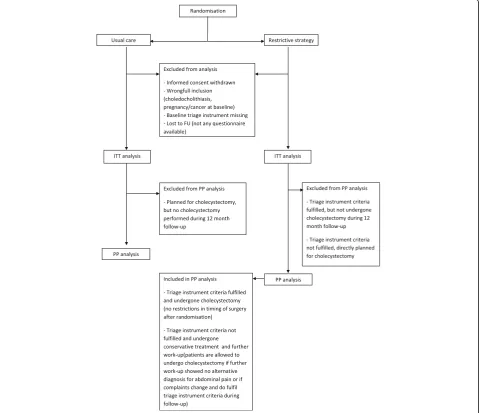
In view of the non-inferiority study design, per proto-col (PP) analysis will also be performed. All subjects from the ITT population without protocol violations and deviations regarding treatment will be included in the PP population (Fig.2).
Protocol violations in eligibility and consent, and deviations in treatment
Protocol violation in eligibility is defined as when a patient was randomized, but did no longer qualify for inclusion criteria or did meet an exclusion criterion (e.g. had cho-ledocholithiasis or cholecystitis, was pregnant, had cancer at baseline). These patients will be excluded from further follow-up and analysis.
Informed consent is obtained from the patients ac-cording to the SECURE trial protocol [3]. Patients who withdrew their consent after randomisation will be ex-cluded from further follow-up and analysis. The number of excluded patients after randomisation will be dis-played in the CONSORT flow diagram (Fig.1).
Patients assigned to the usual care arm (control) re-ceive the standard care given at participating centres, based on physician’s knowledge, experience, and both, physician’s and patient’s preferences. Deviation of the usual care protocol is defined as when a patient is planned for cholecystectomy, but surgery is not per-formed during follow-up (Fig.2).
Patients assigned to the restrictive strategy (interven-tion) are selected for cholecystectomy on fulfilment of the pre-specified criteria of the triage instrument, or se-lected for further work-up if patients did not meet the criteria of the triage instrument. The latter patients could undergo cholecystectomy during follow-up in the trial if abdominal symptoms developed and meet the
[image:3.595.57.541.88.361.2]criteria of the triage instrument at a later time point, or when further work-up shows no alternative diagnosis and gallstones are the only remaining explanation for the symptoms. Deviation of the restrictive strategy protocol is present if (1) patients who meet the criteria of the triage instrument for cholecystectomy do not undergo cholecystectomy, (2) patients who do not meet the criteria of the triage instrument do undergo early cholecystectomy, which does not refer to patients who undergo further work-up that shows no alternative diag-nosis and gallstones are the only remaining explanation for the symptoms (Fig.2).
Patient replacement and missing data
Based on the sample size calculation we need to include a total of 1038 evaluable patient (519 per study arm). Pa-tients are evaluable if they are not excluded due to
protocol violation in eligibility or consent, and if (1) the triage instrument (with pre-specified criteria for chole-cystectomy) at baseline is completed, and (2) primary outcome at 12 months (either directly or through imput-ation) is available. To reach the appropriate sample size and targeted power in the study, patients not fulfilling these evaluability criteria are replaced.
At the interim safety analysis in 2016, uncompleted baseline triage instruments and violations in patients’ eli-gibility and consent were observed. The expected rate of patients lost to follow-up and/or patients with incomplete data was 21%. The additional number of patients that need to be replaced is calculated according the formula 1038 / (1 - proportion non-evaluable patients). Based on this the total sample size was increased from 1038 to 1325 patients. Importantly, no changes were made regarding the primary outcome and secondary outcomes.
[image:4.595.59.542.90.503.2]If outcome data at 12 months’follow-up cannot be ob-tained through patients’questionnaires, the patient will be contacted by telephone to retrieve the primary outcome. Secondary outcome data of these patients and all data on patients that cannot be contacted will be considered miss-ing. Patients from whom no outcome data are availableat
any time point(baseline, 3, 6, 9, and 12 months follow-up)
are considered lost to follow-up and will be excluded from analysis.
Different scenarios for handling missing data will be considered. A definitive choice for method of handling missing data will be made based on the robustness of the analysis results.
First, complete case analysis will be performed in which patients with incomplete data at 12 months’follow-up will be excluded from analysis. Although the non-evaluable patients are replaced, this method could lead to loss of power and biased estimates [4]. Second, single imputation by last observation carried forward (LOCF) will be per-formed, using the results of the last available patients’ questionnaire (9, 6, 3 months’ follow-up or baseline). Third, the nearest neighbour (NN) imputation will be per-formed. The missing value will be replaced by a value ob-tained from related cases in the cohort, either the actual measured value from another patient (1-NN) or the aver-age of measured values from several (k) patients (k-NN) [5]. Lastly, multiple imputation will be performed. The co-efficients of multiple (% of missing data) rounds of imput-ation, based on relevant patient characteristics and outcome predictors, will be used to obtain final estimates of the missing value [6]. The variables selected as predic-tors for imputation contain; sex, age, body mass index (BMI), ASA classification, history of abdominal surgery, study arm, treatment, fulfilment of criteria of the triage in-strument, complications, smoking, alcohol consumption, use of pain medication, not-pain-related abdominal complaints, and the questionnaires of all time points. The imputed values will be primarily estimated within the observed range of the IPS and visual analogue scale (VAS) pain score. In case the observed range is smaller than the total range (IPS 0–100 and VAS pain score 0– 10 respectively), additional estimations within the total range of IPS and VAS pain score will be performed, to identify possible outliers.
The imputation strategy with the smallest confidence in-tervals and with point estimates closest to the complete case analysis results will be reported as the most robust one.
Missing values of baseline characteristics will not be im-puted. When displaying the baseline characteristics, the actual denominator will be stated for dichotomous vari-ables. For continuous variables a footnote to show the number of patients for whom the variable was available will be stated.
Baseline characteristics
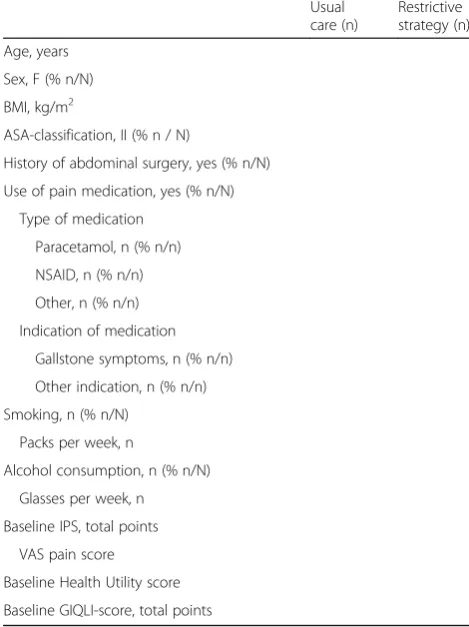
[image:5.595.303.538.393.707.2]The baseline characteristics of the included patients will be reported per randomisation group and shown in a baseline table (Table 1). The following characteristics will be reported: age (years), sex (% F), BMI (kg/m2), ASA-classification (% ASA II), history of abdominal sur-gery (% yes), use of pain medication (% yes), type of medi-cation (% paracetamol, nonsteroidal anti-inflammatory drugs [NSAIDs], other) and indication medication use (% used for gallstone symptoms), smoking (% yes, number of packs/week), alcohol consumption (% yes, number of glasses/week), baseline IPS, baseline VAS pain score, base-line health utility score (derived from the EuroQol 5 dimen-sions (EQ-5D) questionnaire) and baseline Gastrointestinal Quality of Life Index (GIQLI) score. Dichotomous variables will be summarised as proportion of patients with the count divided by the total number of evaluated patients. Continuous variables will be summarised as mean with standard deviation in case of normal distribution and as median with interquartile range in case of non-normal dis-tribution. Testing for normality of data distributions will be based on the Shapiro-Wilks test. For continuous variables a footnote will state the number of evaluated patients.
Table 1Baseline characteristics
Usual care (n)
Restrictive strategy (n)
Age, years
Sex, F (% n/N)
BMI, kg/m2
ASA-classification, II (% n / N)
History of abdominal surgery, yes (% n/N)
Use of pain medication, yes (% n/N)
Type of medication
Paracetamol, n (% n/n)
NSAID, n (% n/n)
Other, n (% n/n)
Indication of medication
Gallstone symptoms, n (% n/n)
Other indication, n (% n/n)
Smoking, n (% n/N)
Packs per week, n
Alcohol consumption, n (% n/N)
Glasses per week, n
Baseline IPS, total points
VAS pain score
Baseline Health Utility score
Baseline GIQLI-score, total points
ASA American Society of Anaesthesiologists physical status classification,BMI
Differences in baseline characteristics between study arms will be reported as preferred by the intended journal. Differ-ences between the study arms will then be analysed using chi-square test, independentttest or Mann-Whitney test if requested by the journal.
Assessment and analysis of primary outcome
The primary endpoint is defined as the proportion of pa-tients being pain-free at 12 months’follow-up. This end-point is derived from the patient-reported IPS. Pain-free is defined as IPS≤10 (with a VAS pain score≤4). Non-inferiority will be established if the lower limit of the one-sided 95% confidence interval for the proportion of patients being pain-free at 12 months following restrictive strategy is within the absolute 5% margin below the pro-portion under usual care. The results of the ITT and the PP analysis should both allow such interpretation.
In a supplementary appendix, the analyses will be re-peated with logistic regression to take into account that randomisation was stratified by center, sex, and body mass index. Non-inferiority will be established if the lower limit of the one-sided 95% confidence for the ad-justed odds ratio of being pain-free at 12 months for pa-tients under restrictive strategy relative to papa-tients under usual care exceeds the critical odds ratio corresponding to the absolute 5% margin below the observed propor-tion under usual care.
Assessment and analysis of secondary outcomes
The assessment and analysis of the secondary outcomes will be discussed separately for each secondary outcome. In all analyses, statistical uncertainties are expressed in 95% two-sided confidence intervals. A pvalue of < 0.05 will indicate statistical significance.
Number of cholecystectomies and number of patients being pain-free after cholecystectomy
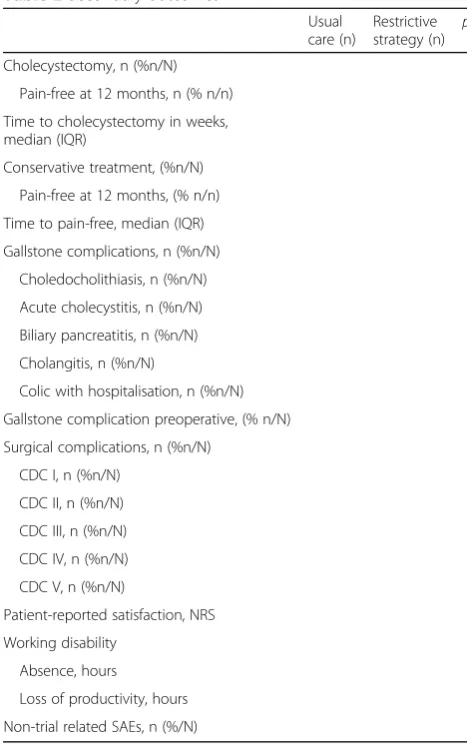
The total number of cholecystectomies performed after 12 months in the two study arms will be reported. Whether a patient underwent surgery is registered by the physician in the CRF and verified by patients’ interview (by phone) and medical records at 12 month follow-up. The proportion of patients being pain-free (defined as for the primary outcome) in this subset of patients following cholecystectomy will also be reported per study arm. The chi-square test will be used to compare the outcomes be-tween the study arms. These outcomes will be shown in a secondary outcome table (Table2).
Time to pain-free
The moment the patient is free of pain, defined as IPS≤ 10 (with a VAS score≤4), can be deducted from the pa-tients questionnaire. The IPS is measured at 3, 6, 9, and 12 months of follow-up. The first follow-up questionnaire
the patient reports an IPS≤10 (with a VAS score≤4) will be considered the time to pain-free, providing that the pa-tient remains pain-free during the remaining follow-up period. Considering the limited number of assessments over time, life tables will be generated for time to pain-free. The median times to being free of pain, the Wilcoxon Gehan statistic and the corresponding p value will be reported in the secondary outcome table (Table2) with a graphical representation presented in a supplementary appendix.
Complications of gallstones and cholecystectomy
[image:6.595.303.537.95.469.2]All complications of gallstones and complications of cholecystectomy will be reported per study arm. Compli-cations should be reported by the physician to the trial co-ordinator at occurrence. Occurrence of complications will be verified with the patient at 3 months and 12 months’ follow-up, and with patient’s medical records at 12 months’ follow-up. Complications of gallstones are defined as oc-currence of choledocholithiasis, acute cholecystitis, biliary Table 2Secondary outcomes
Usual care (n)
Restrictive strategy (n) p
Cholecystectomy, n (%n/N)
Pain-free at 12 months, n (% n/n)
Time to cholecystectomy in weeks, median (IQR)
Conservative treatment, (%n/N)
Pain-free at 12 months, (% n/n)
Time to pain-free, median (IQR)
Gallstone complications, n (%n/N)
Choledocholithiasis, n (%n/N)
Acute cholecystitis, n (%n/N)
Biliary pancreatitis, n (%n/N)
Cholangitis, n (%n/N)
Colic with hospitalisation, n (%n/N)
Gallstone complication preoperative, (% n/N)
Surgical complications, n (%n/N)
CDC I, n (%n/N)
CDC II, n (%n/N)
CDC III, n (%n/N)
CDC IV, n (%n/N)
CDC V, n (%n/N)
Patient-reported satisfaction, NRS
Working disability
Absence, hours
Loss of productivity, hours
Non-trial related SAEs, n (%/N)
pancreatitis, cholangitis, or a biliary colic that required hospitalisation. Although natural history of gallstones in-cludes occurrence of complicated gallstone disease, the number of patients with complicated gallstone disease can differ based on the study arm and is therefore considered as complication in this study. Surgical complications are classified according to the Clavien-Dindo classification (CDC) [7]. Complications will be assessed on patient level (yes/no) and chi-square test will be used to compare the outcomes between the study arms. In the case > 25% of patients have multiple complications, assessment will be performed on complication level (n per patient) using Poisson-regression analysis. These outcomes will be shown in the secondary outcome table (Table2).
Patient-reported satisfaction on treatment outcome At 12 months’follow-up, all patients were asked to ex-press their satisfaction on the treatment outcome (either surgical or conservative) with a numerical rating scale (NRS) between 0 and 10 (0 being the worst and 10 being the best appraisal). The satisfaction on the treatment outcome will be reported, as mean with standard devi-ation if the data are normally distribution, and as median with interquartile range if the data are skewed. The inde-pendent t test or Mann-Whitney test will be used to compare the outcome between study arms. Testing for normality of data distributions will be based on the Shapiro-Wilks test. The outcome will be shown in the secondary outcome table (Table2).
Alternative diagnostics and treatment
At 12 months’ follow-up, information on all diagnostic procedures and treatments related to abdominal pain were obtained, through patients’ interview (by phone) and medical records. For the conservatively treated pa-tients (i.e. who did not undergo cholecystectomy), the proportion of patients that underwent alternative diag-nostic procedures and/or treatments (including diagno-sis) will be reported. The proportion of patients for whom an alternative diagnosis (other than gallstones) for the abdominal pain was determined, and type of diagnoses, will be reported.
Health status scores over time
Changes in disease-specific quality of life and health util-ity over time will be reported. Health status, defined by GIQLI scores, and health utility scores, derived from the EQ-5D-3 L profiles using the standard Dutch health valuation algorithm [8], is available at baseline and 3, 6, 9, and 12 months follow-up. The follow-up data will be assessed by repeated measurement analysis with baseline data as covariate, using a generalized linear mixed model. The results will be displayed per study arm in a graph (Fig.3).
Working disability
Working disability will be assessed using the Short Form Health and Labour Questionnaire (SF-HLQ). Patients filled out this questionnaire at baseline, 3, 6, 9, and 12 months of follow-up, which provides information on absence from paid employment, production loss due to lower efficiency while at work and impediments to paid or unpaid employment. The cumulative number of hours of absence and production loss per study arm will be re-ported, as mean with standard deviation if the data are normally distribution, and as median with interquartile range if the data are skewed. The independent t test or Mann-Whitney test will be used to compare the outcome between study arms. Testing for normality of data distri-butions will be based on the Shapiro-Wilks test. (Table2).
Cost-effectiveness and budget impact analysis
A cost-effectiveness analysis (CEA) with the costs per pain-free patient at 12 months as primary outcome measure will be performed. Additionally, a cost-utility analysis (CUA) will be performed with the costs per quality-adjusted life year (QALY) as outcome. The short-and mid-term affordability of the restrictive strategy in patients with abdominal pain and ultrasound-proven gallstones will be assessed from governmental, provider, and insurer perspectives following a budget impact ana-lysis (BIA) [9]. The cost-effectiveness analyses and BIA will not be included in the primary article on the clinical study results and are not further elaborated here.
[image:7.595.63.539.609.718.2]Practice variation
Practice variation in number of cholecystectomies in the usual care arm will be assessed amongst the participa-tion hospitals. The practice variaparticipa-tion indicator is defined as the number of patients with cholecystectomy on hos-pital level per 100,000 inhabitants in the catchment area of the hospital, and will be adjusted for relevant patient characteristics (i.e. age, sex, BMI). Results on practice variation will not be included in the primary article on the clinical study results and the statistical approach will not be elaborated here.
Additional analysis
The preoperative symptoms of the included patients and fulfilment of the criteria of the triage instrument will be assessed and shown per study arm. The relation between specific patient characteristics or symptoms and (1) being pain-free at 12 months’follow-up and (2) undergoing a cholecystectomy will be explored, to identify additional patient characteristics that are associated with being pain-free at 12 months follow-up and after cholecystec-tomy. The following characteristics and (sets of) symp-toms will be assessed: sex, age, BMI, center (high versus low volume), ASA classification, history of surgery, use of pain medication (and type), baseline VAS pain score, base-line GIQLI score, basebase-line IPS, fulfilment of criteria of tri-age instrument (fulfilment of all criteria and subset of the criteria). The additional analyses will be performed using logistic regression with and without study arm as co-variable. Variables with a p value < 0.1 in univariable analyses will be included in multivariable logistic regres-sion analysis and reported in a supplementary appendix. Subsequently, backward stepwise elimination will be used as further variable selection method. The results will be reported as adjusted odds ratio.
Safety outcomes
Safety outcomes are all SAEs due to complications of gallstones or treatment and non-trial-related SAEs, be-tween inclusion of the patient in the trial and 12 months of follow-up. Complications of gallstones and treatment are already incorporated in Table 2, as secondary out-come. The number of non-trial related SAE’s will be added in Table 2 and types of SAEs will be described. Statistical analysis to compare non-trial-related SAEs be-tween study arms is as described for complications of gallstones and cholecystectomy.
Authorship
The two PhD fellows (AD and SW) of the SECURE study group will share first authorship. The initiating and coordinating investigator (PR) will be second author and principle investigators MB and CvL will share senior authorship as second to last (MB) and last author (CvL).
The other members of the SECURE study group will be co-authors. The local investigators who contributed to study design and data and manuscript discussion, and included at least 50 patients will also be co-authors, pro-vided that there are no author number restrictions at the intended journal. Otherwise the local investigators with the highest inclusion rate and fulfilling the above criteria will be co-author. All other local investigators will be ex-plicitly mentioned in the article as collaborators.
Discussion
The aim of the SECURE trial is to compare the effectiveness and cost-effectiveness of usual care with a restrictive strategy using a pre-operative work-up with stepwise selection for cholecystectomy in patients with gallstones and abdominal complaints. The present article presents the analyses that will be published in the primary manuscript. This SAP was written to prepare for future analyses (before the data are available) and to increase transparency of scientific conduct, thereby allowing others to comment our plans.
This might prevent further increase in cholecystectomy rates reported in the last decades and reduce the geo-graphic variation between and within countries like France, Britain, the Netherlands and the USA [18]. The lack of level 1 evidence for the indication of gallbladder re-moval results in high operation rates and maintains prac-tice variation.
Randomization in the SECURE trial was performed to either standard practice, according to the physician’s knowledge and experience and physician’s and patient’s preference (usual care), or a restrictive strategy: treated with interval evaluation and stepwise selection for laparoscopic cholecystectomy based on fulfilment of pre-specified criteria. A discussed pitfall of this study is the risk of contamination of usual care by the restrictive work-up approach. It is conceivable that specialists trans-fer their usual care to a more restrictive work-up during the trail. To reduce this potential bias the trial was per-formed in more than 20 Dutch hospitals and thereby many different surgeons were involved to avoid manifest and uniform contamination. Potentially remaining con-tamination was accounted for during the sample size cal-culation of the SECURE trial [3].
At interim safety analysis (after complete follow-up of 669 patients) violation of eligibility was noticed in 72 pa-tients (10.8%) due to lack of baseline data on the triage instrument (not recorded by treating physician) and in 31 patients (4.6%) due to later discovered exclusion cri-teria (e.g. pregnancy or cancer). Additionally, 36 patients (5.4%) withdrew consent during follow-up and 6 patients (0.9%) were lost to follow-up. Due to this loss of evalu-able patients the total number of included patients was increased from 1038 to 1325 patients to assure the avail-ability of a total of 1038 evaluable patients for analysis of the primary endpoint.
The results of this trial may optimize the clinical outcome of gallbladder removal and reduce the number of ineffective operations. The Secure trial has the potential to impact daily clinical practice and improve patient outcomes. Sec-ond, a later cost-effectiveness and budget impact analysis of a more restrictive strategy may illustrate the cost reduction for health care providers, insurers, and society.
Abbreviations
ASA:American Society of Anaesthesiologists physical status classification; BIA: Budget impact analysis; BMI: Body mass index; CDC: Claivien-Dindo classification; CEA: Cost-effectiveness analysis; CONSORT: Consolidation Standard of Reporting Trials; CUA: Cost-utility analysis; EQ-5D: EuroQol 5 dimensions; GIQLI: Gastrointestinal Quality of Life Index; IPS: Izbicki Pain Score; ITT: Intention-to-treat; LOCF: Last observation carried forward; NN: Nearest neighbour; NRS: Numerical rating scale; PP: Per protocol; QALY: Quality-adjusted life year; SAE: Serious adverse event; SAP: Statistical analysis plan; SF-HLQ: Short Form Health and Labour Questionnaire; VAS: Visual analogue scale
Acknowledgements
Twenty-four Dutch hospitals participate in de SECURE trial. The authors would like to thank the local investigators for their support in patient inclusion: G. van Acker, O. Buyne, B.C. Dijkhuis, E.H. Eddes, Q.A.J Eijsbouts, J.T.
Heikens, J. Heisterkamp, K.H. in‘t Hof, W.E. Hueting, J.Janssen, P.A. Neijenhuis, V.B. Nieuwenhuijs, H.M. Schaap, P.Steenvoorde, H.B.A.C. Stockmann, B.C. Vrouenraets, E. van der Zaag. The Data Monitoring Committee is formed by M.J. Bruno, C.H.C. de Jong, A.H. Zwinderman. The authors would like to thank them for periodically reviewing the safety data of the SECURE trial.
Funding
The SECURE-trial is funded by the Netherlands Organisation for Health Research and Development (ZonMw; 837002004; https://www.zonmw.nl/nl/ onderzoek-resultaten/doelmatigheidsonderzoek/programmas/project-detail/ doelmatigheidsonderzoek/scrutinizing-inefficient-use-of-cholecystectomy-a-randomized-trial-concerning-variation-in-practi/) and CZ healthcare insurance. The funders had no role in study design, data collection, analysis proposal, or writing this manuscript.
Availability of data and materials Not applicable.
Authors’contributions
SZW, MGD, and PRdR performed conception and design of the work and drafted the manuscript. AHvD, JPHD, GPW, CJHMvL, and MAB were involved in design of the work and critically revised the manuscript for intellectual content. SCD and DB critically revised the manuscript for intellectual content. All authors read and approved the final manuscript.
Ethics approval and consent to participate
The Institutional Review Board of the Academic Medical Centre, Amsterdam, approved the protocol on 7 August 2013 (#2013_129). The local ethics committees and boards of directors of all participating centers endorsed the protocol prior to local execution of the trial.
Consent for publication Not applicable.
Competing interests
The authors declare that they have no competing interests.
Publisher’s Note
Springer Nature remains neutral with regard to jurisdictional claims in published maps and institutional affiliations.
Author details
1Department of Surgery, Radboud University Medical Centre, P.O. Box 9101,
6500 HB Nijmegen, The Netherlands.2Department of Surgery, Academic Medical Centre, Meibergdreef 9, 1105 AZ Amsterdam, The Netherlands.
3Gastroenterology and Hepatology, Radboud University Medical Centre, P.O.
Box 9101, 6500 HB Nijmegen, The Netherlands.4Department of Surgery,
Onze Lieve Vrouwe Gasthuis, Oosterpark 9, 1091 AC Amsterdam, The Netherlands.5Department of Surgery, St. Antonius Hospital, Koekoekslaan 1,
3435 CM Nieuwegein, The Netherlands.6Department of IQ healthcare,
Radboud University Medical Centre, P.O. Box 9101, 6500 HB Nijmegen, The Netherlands.7Clinical Research Unit, Academic Medical Centre, Meibergdreef 9, 1105 AZ Amsterdam, The Netherlands.
Received: 13 December 2017 Accepted: 16 October 2018
References
1. Lamberts MP, Lugtenberg M, Rovers MM, Roukema AJ, Drenth JP, Westert GP, van Laarhoven CJ. Persistent and de novo symptoms after cholecystectomy: a systematic review of cholecystectomy effectiveness. Surg Endosc. 2013;27(3):709–18.
2. Wennmacker S, Lamberts M, Gerritsen J, Roukema JA, Westert G, Drenth J, van Laarhoven C. Consistency of patient-reported outcomes after cholecystectomy and their implications on current surgical practice: a prospective multicenter cohort study. Surg Endosc. 2017;31(1):215–24. 3. de Reuver PR, van Dijk AH, Wennmacker SZ, Lamberts MP, Boerma D, den
4. Schemper M, Smith TL. Efficient evaluation of treatment effects in the presence of missing covariate values. Stat Med. 1990;9(7):777–84. 5. Beretta L, Santaniello A. Nearest neighbor imputation algorithms: a critical
evaluation. BMC Med Inform Decis Mak. 2016;16(Suppl 3):74. 6. Donders AR, van der Heijden GJ, Stijnen T, Moons KG. Review: a gentle
introduction to imputation of missing values. J Clin Epidemiol. 2006;59(10): 1087–91.
7. Dindo D, Demartines N, Clavien PA. Classification of surgical complications: a new proposal with evaluation in a cohort of 6336 patients and results of a survey. Ann Surg. 2004;240(2):205–13.
8. Lamers LM, Stalmeier PF, McDonnell J, Krabbe PF, van Busschbach JJ. Measuring the quality of life in economic evaluations: the Dutch EQ-5D tariff. Ned Tijdschr Geneeskd. 2005;149(28):1574–8.
9. Mauskopf JA, Sullivan SD, Annemans L, Caro J, Mullins CD, Nuijten M, Orlewska E, Watkins J, Trueman P. Principles of good practice for budget impact analysis: report of the ISPOR Task Force on good research practices--budget impact analysis. Value Health. 2007;10(5):336–47.
10. Shaffer EA. Gallstone disease: Epidemiology of gallbladder stone disease. Best Pract Res Clin Gastroenterol. 2006;20(6):981–96.
11. Everhart JE, Ruhl CE. Burden of digestive diseases in the United States Part III: Liver, biliary tract, and pancreas. Gastroenterology. 2009;136(4):1134–44. 12. Number of patients with cholecystitis/cholecystolithiasis DBC-code In: Open
data of Dutch Health Care Authority. 2014.http://www.opendisdata.nl/. Accessed Dec 12 2017.
13. Lammert F, Gurusamy K, Ko CW, Miquel JF, Mendez-Sanchez N, Portincasa P, van Erpecum KJ, van Laarhoven CJ, Wang DQ. Gallstones. Nat Rev Dis Primers. 2016;2:16024.
14. Huntington CR, Cox TC, Blair LJ, Prasad T, Lincourt AE, Heniford BT, Augenstein VA. Nationwide variation in outcomes and cost of laparoscopic procedures. Surg Endosc. 2016;30(3):934–46.
15. Nilsson E, Ros A, Rahmqvist M, Backman K, Carlsson P. Cholecystectomy: costs and health-related quality of life: a comparison of two techniques. Int J Qual Health Care. 2004;16(6):473–82.
16. Keus F, de Vries J, Gooszen HG, van Laarhoven CJ. Assessing factors influencing return back to work after cholecystectomy: a qualitative research. BMC Gastroenterol. 2010;10:12.
17. Wennmacker SZ, Dijkgraaf MGW, Westert GP, Drenth JPH, van Laarhoven C, de Reuver PR. Persistent abdominal pain after laparoscopic cholecystectomy is associated with increased healthcare consumption and sick leave. Surgery. 2018;163(4):661–6.