R E S E A R C H
Open Access
A phase IIa proof-of-concept,
placebo-controlled, randomized, double-blind,
crossover, single-dose clinical trial of a new
class of bronchodilator for acute asthma
Veronica Swystun
1, Francis H. Y. Green
2,3*, John H. Dennis
3, Emmanouil Rampakakis
4, Gurkeet Lalli
3,
Morenike Fadayomi
2,3, Andrea Chiu
2,3, Grishma Shrestha
2, Sharif Galal El Shahat
3, David Evan Nelson
2,
Tamer Y. El Mays
2,3, Cora A. Pieron
3and Richard Leigh
1Abstract
Background:This study evaluates a novel bronchodilator, S1226, for its efficacy in reversing allergen-induced
bronchoconstriction in subjects with mild, allergic asthma. S1226 is a new class of bronchodilator that is an aerosol/vapor/ gas mixture combining pharmacological and biophysical principles for a novel mode of action. It contains a potent bronchodilator gas (carbon dioxide or CO2) and nebulized perflubron (a synthetic surfactant possessing mucolytic
properties). It has demonstrated rapid reversal of allergen-induced bronchoconstriction in an ovine study model.
Methods:This was a phase IIa proof-of-concept, placebo-controlled, randomized, double-blind, crossover single-dose clinical trial to evaluate the safety, tolerability, and efficacy of S1226 (8% CO2) administered by nebulization following an
allergen-induced early asthmatic response in 12 subjects with mild, allergic asthma. Primary safety endpoints were adverse events, vital signs, pulse oximetry, and spirometry. Efficacy endpoints included bronchodilator response (measured as the forced expiratory volume in 1 s or FEV1) over time, the area under the curve of FEV1for the early asthmatic response over
time, and achievement of responder status, defined as a 12% improvement after the allergen challenge.
Results:No significant safety issues were observed. All adverse events were non-serious, mild, and transient. There was a statistically significant decrease in peripheral blood oxygenation levels over time in the placebo group following allergen inhalation, whereas blood oxygenation was maintained at normal levels in the S1226-treated subjects (P= 0.028). This effect was greatest 5 min after start of treatment (P< 0.001). The recovery rate was faster but not significantly so (P= 0.272) for S1226 compared to the placebo at earlier time points (5, 10, and 15 min), as assessed by≥12% reversal of FEV1.The
recovery of FEV1over time was significantly greater (P= 0.04) with S1226 compared to the placebo.
Conclusions:S1226 was safe, tolerated well, and provided bronchodilation and improved blood oxygenation in subjects with mild atopic asthma following allergen-induced bronchoconstriction. Additional studies to optimize the therapeutic response are indicated.
Trial registration:ClinicalTrials.gov,NCT02334553. Registered on 12 November 2014.
Keywords:Novel bronchodilator, Asthma, S1226, Carbon dioxide (CO2), Perflubron, Clinical trial
* Correspondence:[email protected]
2Department of Pathology & Laboratory Medicine, University of Calgary,
Calgary, AB, Canada
3SolAeroMed Inc, 120-4838 Richard Rd SW, Calgary, AB T3E 6L1, Canada
Full list of author information is available at the end of the article
Background
Inhaled bronchodilators, including short-acting beta-2-adrenergic agonists and anticholinergics along with anti-inflammatory medications, are first-line treat-ments for emergency management of acute asthma exacer-bations [1, 2]. Effective bronchodilation is a challenge during exacerbations and having an additional class of bronchodilator in the treatment arsenal would be beneficial. Existing bronchodilator treatments are effective in most cases, but there are several reasons why they can fail during exacerbations. First, in severe exacerbations, particulate medications may be unable to penetrate air-ways obstructed by bronchoconstriction, mucus plugs, and inflammation. Second, patients become less respon-sive to traditional bronchodilators from chronic use, due to tachyphylaxis and tolerance [3–5]. Third, there is a group of patients with asthma refractory to standard therapies [6] and these patients represent an unmet clin-ical need for whom alternative treatment options are re-quired. The challenge is to find an alternative treatment to augment conventional therapy.
This study evaluates a new class of bronchodilator, S1226, which combines pharmacological and biophysical properties. S1226 is an aerosol/vapor/gas mixture con-taining a bronchodilator gas (CO2) and a nebulized syn-thetic surfactant (perflubron) that has mucolytic [7, 8] and anti-inflammatory properties [9–11]. Previous stud-ies have shown that inhalation of 6% CO2over 4–5 min in atopic asthmatics relieved exercise-induced asthma. However, its effects were short-lived [12]. The broncho-dilatory effects of CO2 are complex. They involve pH and epithelial-dependent mechanisms [13] and do not require adrenergic [14] or cholinergic pathways [12]. The combination of CO2 with perflubron in preclinical studies produced a synergistic effect, providing rapid and sustained bronchodilation [13–15]. S1226 showed rapid opening of airways in sheep sensitized and chal-lenged with house dust mites and rats sensitized and challenged with ovalbumin. The effect was fast (<4 s for bronchodilation) and sustained (>20 min) [15].
A phase I clinical trial was completed in 36 healthy volun-teers to assess safety and tolerability of S1226. All adverse events (AEs) were mild and transient and S1226 appeared safe at CO2concentrations of 4%, 8%, and 12% [16].
We now undertook a phase IIa, proof-of-concept, placebo-controlled, randomized, double-blind, crossover single-dose study to demonstrate safety, tolerability, and efficacy of nebulized S1226 (8% CO2) in subjects with mild, atopic asthma. We chose 8% CO2in this first study in asthmatic humans as this level of CO2was effective in animal studies and had no AEs in the phase I clinical trial [16]. An abstract of the study described in this paper was presented as a poster at the American Thor-acic Society meeting in 2016 [17].
Methods
Participants
Adult volunteers, aged 18–40 years, with mild, allergic asthma were screened to confirm the presence of an early asthmatic response (EAR) to inhaled allergen. PC20 methacholine indicates a provocative concentration of inhaled methacholine producing a 20% reduction in forced expiratory volume in 1 s (FEV1). All subjects had had asthma for more than 3 months, and their inclusion was based on a PC20 methacholine of ≤16 mg/mL and an allergen-induced EAR producing a≥20% reduction in FEV1during screening. The full list of inclusion and ex-clusion criteria are listed in Additional file1.
Trial design
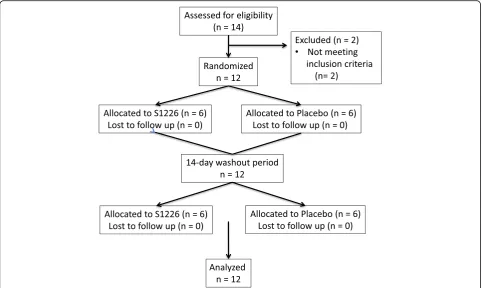
This was a phase IIa, randomized, double-blind, placebo-controlled, crossover study enrolling 12 subjects with asthma. The study design is outlined in Fig.1.
The study consisted of a <30-day screening period, two treatment periods with a minimum 2-week washout in between, and a follow-up visit 1 day later. A detailed sched-ule of assessments during the clinical trial study are shown in Additional file 2. Baseline screening involved routine chemistry, hematology, urinalysis, methacholine inhalation testing (PC20≤16 mg/mL), and allergen skin prick tests. An allergen inhalation challenge to common aero-allergens (cat, horse, and grass pollen) was used to establish the al-lergen concentration required to achieve a 20% fall in FEV1 as previously reported [5,18]. This concentration was used in the subsequent treatment periods with the goal of achieving comparable EARs (20% fall in FEV1) between the two treatment periods. The allergen challenge model has excellent within-subject repeatability and hence, in cross-over studies, a sample size of 12 subjects is sufficient to de-tect an effect on clinically relevant outcome measures with a power of 90% [18].
For this study, a sample size of 16 subjects was estimated to be able to detect a treatment difference of at least a 14% change in FEV1with a 95% confidence interval with a power of over 90% in a two-sided test, assuming that the variability observed would be like the response to S1226 in the sheep allergen challenge model [15]. The sheep model used airway resistance as a model of airway caliber. Under similar as-sumptions, a sample size of 12 subjects was estimated to able to detect a treatment difference of at least 17% change in FEV1with a 95% confidence interval and a power of 90%.
In summary, in this proof-of-concept study, using the animal data and taking the robustness of this model into consideration, our goal was to recruit up to 16 subjects with the expectation of retaining at least 12 subjects to account for any dropouts.
Each treatment period consisted of a methacholine chal-lenge on day 1 to confirm airway hyperresponsiveness (methacholine PC20 within 1 doubling concentration of baseline PC20), an allergen challenge followed by study intervention (S1226 or placebo) on day 2, and spirometry on day 3 to confirm recovery from allergen inhalation. Im-mediately after a 20% fall in FEV1was documented as part of the EAR, a single dose of S1226 (8%) or placebo was administered via nebulization to subjects over 2 min with a Circulaire ® II hybrid nebulizer system (Westmed, Tucson, AZ, USA). Subjects were allowed to stop receiving the interventions at any time.
S1226 (8%) (SolAeroMed, Calgary, AB, Canada) consists of 3 mL of perflubron nebulized with medical grade com-pressed gas (Praxair Canada, Mississauga, ON, Canada) containing 8% CO2, 21% O2, and balanced N2at a flow rate of 9 L/min. The placebo was 3 mL saline (0.9% NaCl) (Smiths Medical ASD Inc. Markham, ON, Canada) with medical grade air (Praxair Canada, Mississauga, ON, Canada) at a flow rate of 9 L/min. The Circulaire nebulizer system incorporates an inflatable reservoir bag, which col-lects nebulized gas during exhalation so that during inhal-ation the subject receives both freshly generated nebulized drug and stored nebulized drug.
The study was double-blind. The treatments were pre-pared and administered by an unblinded research associ-ate, who performed no other procedures in the study.
Personnel conducting testing procedures and collecting study outcomes were blinded to the treatment alloca-tion. Although S1226 (8%) and placebo have different viscosities and densities [16], they had identical visual appearances and the same model of nebulizer was used to administer both compounds. Thereby, the identity of the treatments remained blinded to the study subjects.
The treatment order of placebo and S1226 (8%) for each subject was randomized in a 1:1 ratio in blocks of four, using a computer-generated randomization list. Both study subjects and the clinical personnel involved in collection and monitoring of study data and evaluation of AEs were blinded with respect to the subject’s treatment allocation.
All procedures were conducted in accordance with the standard operating procedures for the Respiratory Clin-ical Trials Centre. Calgary Lab Services completed the clinical laboratory work. The project was monitored by and the statistical analysis was completed by JSS Medical Research Inc., St Laurent, QC, Canada.
The study was conducted at the Respiratory Clinical Trials Centre, University of Calgary, AB, Canada, from January 2015 to April 2016, in accordance with the Declaration of Helsinki (2014). The Conjoint Health Re-search Ethics Board of the University of Calgary ap-proved the study protocol, amendments, and consent form (REB14–1581). Written informed consent was ob-tained from all subjects.
[image:3.595.57.540.88.376.2]Outcome measures
The primary outcome was safety; efficacy was a secondary outcome measure. The incidence of treatment-emergent AEs was monitored, recorded, and graded for severity and assigned attribution.
The safety and tolerability of S1226 (8%) was evaluated based on the following assessments:
The number and proportion of subjects experiencing treatment-emergent AEs
12-lead electrocardiogram at screening and follow-up
Vital signs (heart rate, respiratory rate, and blood pressure) at screening, pre-dose, and at 120 min post-dose
Pulse oximetry at screening, pre-dose, and at 5, 10, 15, 20, 30, 45, 60, and 90 min post-dose and follow-up
Safety biochemistry, hematology, and urinalysis at screening and follow-up
FEV1was measured pre-dose and at 5, 10, 15, 20,
30, 45, 60, and 90 min post-dose, while spirometry (FEV1and forced vital capacity) was conducted at
screening and follow-up
The efficacy of S1226 (8%) was evaluated based on the following endpoints:
Area under curve (AUC) of recovery from the EAR in the first 30 and 90 min following treatment
Responder status, defined as achieving≥12% improvement in FEV1after the allergen challenge
Time to achieve responder status
Maximum percentage reversal of allergen-induced decrease in FEV1in the first 30 and 90 min
follow-ing study treatment administration
Statistical methods
The total number of AEs was summarized for each treat-ment group by seriousness, intensity, relationship to prod-uct, and outcome. AEs were coded using the Medical Dictionary for Regulatory Activities (MedDRA version 18.1) and summarized using the total number of AEs, total number and percentage of subjects who experienced an AE, and number and percentage of subjects who expe-rienced an AE within each preferred term. No inferential statistical analysis of safety data was performed.
The AUC of the EAR reversal following study drug in-halation was calculated using the trapezoidal rule. The AUCs within 30 min and 90 min from study drug inhal-ation were compared between S1226 (8%) and the pla-cebo using a mixed general linear model. The model included subject as a random effect; treatment group, period, and sequence as fixed effects; and FEV1at study drug inhalation as a covariate. A repeated measures ana-lysis of variance (ANOVA) mixed model was used to
compare the FEV1 and AUC over time between S1226 (8%) and placebo. Like the primary analysis, the model included subject as a random effect; treatment group, period, and sequence as fixed effects; and FEV1at study drug inhalation as a covariate.
Achievement of responder status, defined as≥12% rever-sal of FEV1 from study drug inhalation within 30 and 90 min, was compared between S1226 (8%) and the placebo using logistic regression where period and FEV1 at study drug inhalation were entered as terms. Time to achieve re-sponder status was compared between treatment groups using a Cox regression. The model considered treatment group, period, and FEV1at study drug inhalation as covari-ates. In addition, randomization order was included as a co-variate in the mixed models of AUC30, AUC90, FEV1, and AUC over time to evaluate a carryover effect that would favor one treatment vs the other.
Results
A total of 14 subjects were screened, of whom 12 were eli-gible and received both interventions. One subject missed the final follow-up visit but their assessments for the two intervention treatments were included in the results.
Patient characteristics at baseline, including demo-graphic and clinical measurements, are summarized in Table1. The mean (standard deviation, SD) age at baseline for the total cohort was 27.3 (2.4) years. Exactly half of the subjects were female and Caucasian; Asians accounted for 25.0% of subjects. Mean (SD) height, weight, and body mass index (BMI) were 1.7 (0.1) m, 68.5 (17.9) kg, and 23.8 (4.5) kg/m2, respectively.
Safety and tolerability
During the study, 17 AEs were reported, all of which were judged to be mild in severity and transient. Of the 17 AEs, 10 were not related to the investigational products. The majority of these (n= 8) were related to the nebulizer de-vice. Two AEs were possibly related to the placebo and five AEs were probably related to S1226. AEs associated with S1226 were palpitations (1), chest discomfort (1), diz-ziness (2), and anxiety (1), while feeling hot (1) and flush-ing (1) were associated with the placebo. Details of the AEs by severity, relation to drug, outcome, and preferred terms are given in Additional files3and4.
No abnormalities in the electrocardiogram, vital signs (respiratory rate and blood pressure), and biochemistry variables were associated with S1226 or the placebo at screening, pre-dose, or 120 min post-dose.
squares estimates showed that the S1226 group ex-perienced a lower drop in %SpO2 (estimate: -0.627;
P= 0.267) compared to the placebo group (estimate: -2.502; P< 0.001) 5 min post-dose. Furthermore, the placebo group showed higher absolute decreases in
%SpO2 for all time points with the exceptions of the 45-min time point.
AUC and FEV1over time
FEV1over time was significantly greater for S1226 com-pared with the placebo, with the difference becoming apparent as early as 5 min post-treatment (p= 0.043) (Fig.3). There were no statistically significant differences for AUC, although values for FEV1 were numerically higher after S1226 for all time points. The mean (95% confidence interval, CI) adjusted difference in FEV1 AUC (0–30 min) between S1226 and the placebo was 0.406 (−6.146, 6.958;P= 0.893) while the mean (95% Cl) in FEV1AUC (0–90 min) was 1.509 (−18.973, 21.991;P = 0.873). There were no significant carryover effects that would favor one treatment vs the other.
Achievement of responder status
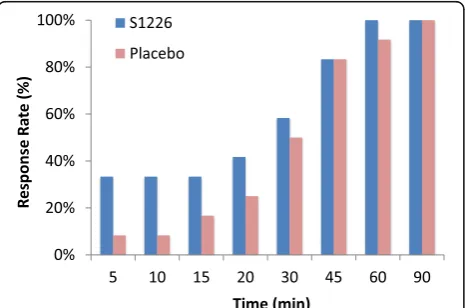
The recovery rate was faster for S1226 than the pla-cebo at earlier time points (5, 10, and 15 min) when assessing ≥12% reversal of FEV1 (Fig. 4). Time to achieving responder status within the 30-min period was not different between the two treatments (P= 0.272).
Discussion
A single dose of S1226 (8%) in subjects with mild, aller-gic asthma was safe and tolerated well and produced moderate bronchodilation following allergen-induced bronchoconstriction. Both components of S1226 (per-flubron and CO2 ) have undergone extensive clinical testing and their safety profiles are well documented [9,
19, 20]. Subjects receiving S1226 reported more AEs than those receiving the placebo, but these were mild in severity, they were transient, and the majority were related to the nebulization device and not to S1226. These results are similar to those from the phase I clin-ical trial [16]. Based on previous research, AEs related to S1226 (dizziness, anxiety, and chest discomfort) are known transient side effects of CO2inhalation [19, 20]. Perflubron is a stable compound used extensively in clinical applications such as bronchial lavage, liquid ventilation, and gastrointestinal contrast imaging with no known toxic effects [9].
[image:5.595.55.289.108.419.2]With respect to efficacy, although the response to S1226 was numerically better compared to the pla-cebo for all endpoints, only FEV1 over time demon-strated a statistically significant improvement in comparison to the placebo. We cautiously chose 8% CO2 (rather than 12%) as the concentration of CO2 and a treatment duration of 2 min. It is likely, based on the preclinical studies, that efficacy would be im-proved with the higher dose of CO2 or with an in-creased duration of nebulization.
Table 1Baseline patient demographics and clinical characteristics
Variable Measure Total (N= 12)
Age (years) Mean (SD) 27.3 (2.38)
Median 27.0
Range 23.0–31.0
95% confidence interval (25.7, 28.8)
Gender Female 6 (50.0%)
Male 6 (50.0%)
Race Asian 3 (25.0%)
Caucasian 6 (50.0%)
Other 3 (25.0%)
Height (m) Mean (SD) 1.7 (0.11)
Median 1.7
Range 1.6–1.9
95% confidence interval (1.6, 1.8)
Weight (kg) Mean (SD) 68.5 (17.91)
Median 61.4
Range 46.1–113.3
95% confidence interval (57.1, 79.9)
BMI (kg/m2) Mean (SD) 23.8 (4.47)
Median 23.2
Range 18.6–35.8
95% confidence interval (20.9, 26.6) BMIbody mass index,SDstandard deviation
Fig. 2Oxygen saturation measured by pulse oximetry, placebo vs S1226. The absolute change between pre-dose and post-dose %SpO2levels was significantly different (P= 0.028) for the S1226
group compared with the placebo group over time. %SpO2
[image:5.595.56.293.513.654.2]S1226 was significantly more effective than the pla-cebo at maintaining our subjects’ oxygenation satur-ation levels. Although the changes in oxygen satursatur-ation in our study are not clinically significant, because we necessarily studied subjects with mild and controlled asthma, the results demonstrate the potential for im-proving oxygenation in severe asthma exacerbations with this experimental therapy.
Six subjects experienced difficulty breathing through the nebulization device because of the volume limita-tion of the reservoir bag. This was not considered to be related to the drug per se. However, in the S1226 group, this difficulty may be attributed to, in part, the increased ventilatory drive caused by inhaled CO2 [20]. In future studies, ease of breathing and efficacy could be improved by using a facemask for delivery. A potential advantage of the latter is that there are
CO2 receptors in the nasal passages that might aug-ment the CO2bronchodilator response [21].
S1226 has a unique mechanism of action, activating both pharmacological and biophysical pathways, differentiating it from traditional treatments [12–14]. Bronchoscopic studies in sheep have shown that S1226 dilates constricted airways within seconds, suggesting that it activates neural mecha-nisms, most likely through non-cholinergic, non-adrenergic nerve receptors located on and between epithelial cells in the airways [13–15]. Animal studies show S1226 to be equally effective for treating early and late phase asthmatic responses [14,15,17].
Perflubron can absorb twice its volume of CO2, thus increasing the effective dose of CO2to the airways. This property may account for its synergistic effect when combined with CO2. Furthermore, perflubron has sur-factant and mucolytic properties, which allow it to spread rapidly through airways [7,22].
A portable rescue device is being developed for deliv-ering S1226 that can be used in emergency home-care situations. S1226 also has potential for treating diseases such as chronic obstructive pulmonary disease and cystic fibrosis, for which rapid bronchodilation and mucous clearance are required. Due to its biophysical properties, it has the potential to enhance the delivery of other drugs to diseased or inflamed areas of the lung.
Conclusions
In conclusion, this study shows that S1226 is safe and ef-fective in subjects with mild asthma and warrants further investigation in a larger patient sample. In view of S1226’s rapid effect, alternative mechanism of action, and poten-tial to penetrate obstructed airways, it could provide add-itional bronchodilation when current standard-of-care rescue medication is failing.
Fig. 3Change in FEV1over time. Baseline adjusted FEV1over time for S1226 was significantly higher than placebo (P= 0.043). Error bars
show the standard deviation
Fig. 4Time to achieve 12% reversal (response) in FEV1following
[image:6.595.58.540.87.276.2] [image:6.595.58.291.547.701.2]Additional files
Additional file 1:Inclusion and exclusion criteria for participants enrolled in the study (DOCX 18 kb)
Additional file 2:Schedule of assessments during the clinical trial study. (DOCX 102 kb)
Additional file 3:Adverse events (AEs) by severity, relation to drug, and outcome. (DOCX 14 kb)
Additional file 4:Incidence of adverse events (AEs). (DOCX 15 kb) Additional file 5:CONSORT 2010 checklist. (DOC 218 kb)
Abbreviations
AE:Adverse event; ANOVA: Analysis of variance; AUC: Area under curve; BMI: Body mass index; CI: Confidence interval; CO2: Carbon dioxide;
EAR: Early asthmatic response; FEV1: Forced expiratory volume in 1 s;
PC20: Provocative concentration of inhaled methacholine producing a 20%
reduction in FEV1; SD: Standard deviation; SpO2: Oxygen saturation measured
by pulse oximetry
Acknowledgements
We express appreciation to the Respiratory Clinical Trials Centre at the University of Calgary for conducting the trial at their clinical facilities in Calgary, AB, Canada, and appreciate JSS Medical Research Inc., from Montreal, QC, Canada, for acting as the contract research organization in overseeing the trial and completing the data analysis. We also appreciate Sam Shrestha for formatting the final manuscript.
Funding
This clinical trial was funded by AIHS/Pfizer (grant 10004299). SolAeroMed Inc. provided the drug and placebo and funded the statistical analysis and final report by JSS. The design of the study was the responsibility of the Respiratory Clinical Trials Centre, University of Calgary, AB, Canada, under the direction of Dr. Richard Leigh. Calgary Laboratory Services completed the clinical laboratory work under contract. The project was monitored by and the statistical analysis was completed by JSS Medical Research Inc., St Laurent, QC, Canada.
Availability of data and materials
Some of the data generated or analyzed during this study are included in the figure files. The complete data set that supports the findings of this study are available from SolAeroMed Inc. (https://www.solaeromed.com) but restrictions apply to the availability of these data, since they were used under license for the current study and are not publicly available. The data are, however, available upon reasonable request and with the permission of SolAeroMed Inc.
Authors’contributions
VS and RL designed the study protocol and take responsibility for the integrity of the data, including the interpretation of adverse effects. VS conducted the study procedures and collected the data. VS, RL, FHYG, JHD, DEN, MF, AC, SG, TYEM, and CAP were responsible for trial conception and design. JHD and CAP were responsible for drug exposure design and characterization. ER and GS acquired and analyzed the data. FHYG, VS, RL, ER, and GL, contributed to the interpretation of the data and writing of the manuscript. All authors read, revised, and approved the final manuscript.
Ethics approval and consent to participate
The study was conducted at the Respiratory Clinical Trials Centre, University of Calgary, AB, Canada. All procedures were conducted in accordance with the standard operating procedures for the Respiratory Clinical Trials Centre. The study is registered withClinicalTrials.gov(NCT02334553). The study follows the Consolidated Standards of Reporting Trials (CONSORT) 2010 checklist (see Additional file5).
This study was conducted in accordance with the Declaration of Helsinki. The Conjoint Health Research Ethics Board of the University of Calgary approved the study protocol, amendments, and consent form (REB14–1581). Written informed consent was obtained from all subjects.
Consent for publication
Not applicable.
Competing interests
FHYG and JHD are founders, shareholders, management, and board members of SolAeroMed Inc., a biotechnology company with patent rights for S1226. GL, MF, AC, TYEM, CAP, and RL are shareholders in SolAeroMed Inc. VS, ER, GS, SG, and DEN have no conflicts of interest to declare.
Publisher’s Note
Springer Nature remains neutral with regard to jurisdictional claims in published maps and institutional affiliations.
Author details
1Department of Medicine, University of Calgary, Calgary, AB, Canada. 2
Department of Pathology & Laboratory Medicine, University of Calgary, Calgary, AB, Canada.3SolAeroMed Inc, 120-4838 Richard Rd SW, Calgary, AB T3E 6L1, Canada.4JSS, Montreal, QC, Canada.
Received: 21 January 2018 Accepted: 1 June 2018
References
1. Reddel HK, Bateman ED, Becker A, Boulet LP, Cruz AA, Drazen JM, et al. A summary of the new GINA strategy: a roadmap to asthma control. Eur Respir J. 2015;46:622–39.
2. Rowe BH, Sevcik W, Villa-Roel C. Management of severe acute asthma in the emergency department. Curr Opin Crit Care. 2011;17:335–41.
3. Cheung D, Timmers MC, Zwinderman AH, Bel EH, Dijkman JH, Sterk PJ. Long-term effects of a long-acting beta 2-adrenoceptor agonist, salmeterol, on airway hyperresponsiveness in patients with mild asthma. N Engl J Med. 1992;327:1198–203.
4. O’Connor BJ, Aikman SL, Barnes PJ. Tolerance to the nonbronchodilator effects of inhaled beta 2-agonists in asthma. N Engl J Med. 1992;327:1204–8. 5. Cockcroft DW, McParland CP, Britto SA, Swystun VA, Rutherford BC. Regular
inhaled salbutamol and airway responsiveness to allergen. Lancet. 1993;342:833–7. 6. Wener RR, Bel EH. Severe refractory asthma: an update. Eur Respir Rev. 2013;
22:227–35.
7. Al-Saiedy MR, Nelson DE, Amrein M, Leigh R, Green F. The role of an artificial surfactant in mucous plug clearance in vitro. Am J Respir Crit Care Med. 2015;191:A5997.
8. Wolfson MR, Shaffer TH. Pulmonary applications of perfluorochemical liquids: ventilation and beyond. Paediatr Respir Rev. 2005;6:117–27. 9. Riess JG. Understanding the fundamentals of perfluorocarbons and
perfluorocarbon emulsions relevant to in vivo oxygen delivery. Artif Cells Blood Substit Immobil Biotechnol. 2005;33:47–63.
10. von der Hardt K, Kandler MA, Brenn G, Scheuerer K, Schoof E, Dotsch J, Rascher W. Comparison of aerosol therapy with different perfluorocarbons in surfactant-depleted animals. Crit Care Med. 2004;32:1200–6.
11. Kandler MA, von der Hardt K, Schoof E, Dotsch J, Rascher W. Persistent improvement of gas exchange and lung mechanics by aerosolized perfluorocarbon. Am J Respir Crit Care Med. 2001;164:31–5.
12. Fisher HK, Hansen TA. Site of action of inhaled 6 per cent carbon-dioxide in lungs of asthmatic subjects before and after exercise. Am Rev Respir Dis. 1976;114:861–70.
13. El Mays TY, Saifeddine M, Choudhury P, Hollenberg MD, Green FH. Carbon dioxide enhances substance P-induced epithelium-dependent bronchial smooth muscle relaxation in Sprague-Dawley rats. Can J Physiol Pharmacol. 2011;89:513–20.
14. El Mays T, Snibson K, Wilson R, Leigh R, Dennis J, Nelson D, Green F, Choudhury P. Investigations of mechanisms of carbon dioxide-induced bronchial smooth muscle relaxation. Am J Respir Crit Care Med. 2012;185:A2848.
15. El Mays TY, Choudhury P, Leigh R, Koumoundouros E, Van der Velden J, Shrestha G, Pieron CA, Dennis JH, Green FH, Snibson KJ. Nebulized perflubron and carbon dioxide rapidly dilate constricted airways in an ovine model of allergic asthma. Respir Res. 2014;15:98.
17. Green F, Leigh R, Shrestha G, Galal S, Chiu A, Fadayomi M, Pieron C, El Mays T, Nelson DE, Al-Saiedy MR, et al. Development of a new bronchodilator to enable better treatment of asthma, COPD, and CF. Am J Respir Crit Care Med. 2015;191:A5788.
18. Diamant Z, Gauvreau GM, Cockcroft DW, Boulet LP, Sterk PJ, de Jongh FH, Dahlen B, O’Byrne PM. Inhaled allergen bronchoprovocation tests. J Allergy Clin Immunol. 2013;132:1045–55. e1046
19. Dripps RD, Comroe JH Jr. The respiratory and circulatory response of normal man to inhalation of 7.6 and 10.4 per cent CO2 with a comparison of the maximal ventilation produced by severe muscular exercise, inhalation of CO2 and maximal voluntary hyperventilation. Am J Phys. 1947;149:43–51. 20. Maresh CM, Armstrong LE, Kavouras SA, Allen GJ, Casa DJ, Whittlesey M,
LaGasse KE. Physiological and psychological effects associated with high carbon dioxide levels in healthy men. Aviat Space Environ Med. 1997;68:41–5. 21. Casale TB, Romero FA, Spierings EL. Intranasal noninhaled carbon dioxide
for the symptomatic treatment of seasonal allergic rhinitis. J Allergy Clin Immunol. 2008;121:105–9.