Georgia State University Georgia State University
ScholarWorks @ Georgia State University
ScholarWorks @ Georgia State University
Nutrition Theses Department of Nutrition
Spring 5-11-2013
Effectiveness of Mandated Folic Acid and Iron Fortification of
Effectiveness of Mandated Folic Acid and Iron Fortification of
Wheat Flour on Anemia in Children of Ivory Coast
Wheat Flour on Anemia in Children of Ivory Coast
Flinle Danielle Biemi
Follow this and additional works at: https://scholarworks.gsu.edu/nutrition_theses
Recommended Citation Recommended Citation
Biemi, Flinle Danielle, "Effectiveness of Mandated Folic Acid and Iron Fortification of Wheat Flour on Anemia in Children of Ivory Coast." Thesis, Georgia State University, 2013.
https://scholarworks.gsu.edu/nutrition_theses/44
This Thesis is brought to you for free and open access by the Department of Nutrition at ScholarWorks @ Georgia State University. It has been accepted for inclusion in Nutrition Theses by an authorized administrator of
ACCEPTANCE
This thesis, EFFECTIVENESS OF MANDATED FOLIC ACID AND IRON
FORTIFICATION OF WHEAT FLOUR ON ANEMIA IN CHILDREN OF IVORY COAST, by Flinle Danielle Biemi was prepared under the direction of the Master`s Thesis Advisory Committee. It is accepted by committee members in partial fulfillment of the requirements for the degree Master of Science in the Byrdine F. Lewis School of Nursing and Health Professions, Georgia State University.
The Master`s Thesis Advisory Committee, as representatives of the faculty, certify that this thesis has met all standards of excellence and scholarship as determined by the faculty.
Vijay Ganji, PhD, RD Murugi Ndirangu, PhD Committee Chair Committee Member
Ike Okosun, PhD Committee Member
AUTHOR`S STATEMENT
In presenting this thesis as a partial fulfillment of the requirement for the advanced degree from the Georgia State University, I agree that the library of Georgia State
University shall make it available for the inspection and circulation in accordance with its regulations governing materials of this type. I agree that permission to quote, to copy from, or to publish this thesis may be granted by the professor under whose direction it was written, by the Byrdine F. Lewis School of Nursing and Health Professions director of graduate studies and research, or by me. Such quoting, copying, or publishing must be solely for scholarly purposes and will not involve potential financial gain. It is understood that any copying from or publication of this thesis which involves potential financial gain will not be allowed without my written permission.
NOTICE TO BORROWERS
All theses deposited in the Georgia State University library must be used in accordance with the stipulations prescribed by the author in the preceding statement. The author of this thesis is:
Flinle Danielle Biemi 11106 Jefferson Square Court, Decatur, GA 30030
The director of this thesis is:
Vijay Ganji Division of Nutrition
Byrdine F. Lewis School of Nursing and Health Professions Georgia State University
VITA
Flinle Danielle Biemi, MD
11106 Jefferson Square Court ● Decatur, GA 30030 ● (404) 934-2586 ● [email protected]
EDUCATION GEORGIA STATE UNIVERSITY, Atlanta, GA Master of Science in Nutrition
Graduate Certificate in Public Health May 2013
Certification: CPR AED Certificate
December 2011
Fulbright Scholar
UNIVERSITY OF COCODY, Abidjan, Ivory Coast
Medical Doctor 2005
LANGUAGE Bilingual English and French
HEALTHCARE EXPERIENCE
Maternity Marie Houphouet, Abidjan, Ivory Coast January 2007- August 2011
Physician in the pediatric unit
Diagnosed and provided treatment to children affected by malnourishment, HIV-AIDS, malaria and other tropical diseases
Provided emergency and routine health care to newborns
Educated mothers with malnourished children
Advised HIV-positive mothers about baby feeding for preventing mother-to-child transmission of HIV
Advised 20-30 women of childbearing age per week about baby feeding, maternal cares, sexual diseases
Lectured once a month health care providers of the maternity about topics related to pediatric diseases
Coordinated activities related to the prevention of HIV-AIDS transmission in the maternity
Medical Clinic The pantheon, Abidjan, Ivory Coast March-December 2006
Physician in the pediatric unit
Diagnosed and provided treatment to children affected by tropical diseases
Provided health and nutritional cares to newborns
University Hospital of Cocody, Treichville, and Yopougon;
Teaching hospitals affiliated Medical School of the University of Cocody, Abidjan, Ivory Coast
Internship
Developed skills in diagnosing and providing care in pediatric, gynecologic, surgical and medical units
Provided nutritional cares to preterm and low birth weight infants
VOLUNTEER EXPERIENCE
Red Cross, Abidjan, Ivory Coast January
2009-August 2011
First Helper
Supervised rescued activities and engaged in first aid during hostile local elections
Supervised free consultations and drugs delivery in precarious areas
SKILLS AND AWARDS
Golden Key International Honor Society
ABSTRACT
EFFECTIVENESS OF MANDATED FOLIC ACID AND IRON FORTIFICATION OF WHEAT FLOUR ON ANEMIA IN CHILDREN OF IVORY COAST
By
Flinle Danielle Biemi
Purpose: Anemia in children is a major Public Health problem in developing countries such as Ivory Coast. The fortification of wheat flour with iron and folic acid has been mandated in this country in 2007. To date, there are no studies conducted to assess the effectiveness of these fortification efforts. Therefore, the purpose of this study was to determine if mandated iron and folic acid fortification of wheat flour has reduced the prevalence of anemia in Ivory Coast children.
Methods: The study was conducted at the pediatric unit of the university hospital of Treichville, one of the 3 main hospitals of Abidjan, the largest city of Ivory Coast. The medical records of 467 children from 5 to 14 years old were analyzed. The period from January 1st 2004 to December 31st 2006 was considered as pre-fortification period and the period from January 1st 2008 to December 31st 2010 was regarded as the post-fortification period. Data for anemia, hemoglobin, hematocrit, red blood cell count, and MCV were compared between pre- and post-fortification periods.
Conclusion: The double fortification of wheat flour with folic acid and iron had no significant impact on anemia in Ivorian children. This is perhaps due to the fact that wheat flour is not widely consumed as rice and rice products are more popular in Ivory Coast population. The Ivorian government perhaps should focus efforts on the
EFFECTIVENESS OF MANDATED FOLIC ACID AND IRON
FORTIFICATION OF WHEAT FLOUR ON ANEMIA IN CHILDREN
OF IVORY COAST
by
Flinle Danielle Biemi
MD, Ivory Coast-Abidjan, School of Medicine-University of Cocody Fulbright Student
A Thesis Submitted to the Graduate Committee In the Division of Nutrition
At Georgia State University
In Partial Fulfillment for the Requirement for the Degree MASTER OF SCIENCE
Atlanta, Georgia
ACKNOWLEDGEMENTS
I would like to thank the members of my thesis committee-Dr Vijay Ganji, Dr Murugi Ndirangu, and Dr Ike Okosun- for their support and excellent guidance during this process.
Thanks to all my instructors of the department of Nutrition and the institute of Public Health. I am also thankful to my classmates and friends who helped me to achieve my academic goals.
Moreover, thanks to Professor Oulai and to physicians of the pediatric unit of the university hospital of Treichville, Abidjan- Ivory Coast who made this thesis possible.
I gratefully acknowledge the Fulbright program, the State department, the Institute of International Education, and the US embassy in Ivory Coast for giving me this amazing opportunity to study in the United States.
I am forever grateful to my parents, brothers, sisters, nephews, and niece for their love, encouragement, and prayers throughout my life. I feel blessed to have all of them.
I warmly thank my Ivorian family in the US, my Fulbright fellows and all my friends for supporting me during my stay in the US.
Above all, I thank God for His ultimate love and power in my life.
TABLE OF CONTENTS
Pages
List of tables……… iv
Abbreviations……….. v
Chapter I. Introduction……...……..……… 1
Chapter II. Review of Literature……….………. 4
Chapter III. Methods………...…..………... 11
Chapter IV. Results…….………. 14
Chapter V. Discussion and conclusion……… 28
References………... 33
Appendix A………. 38
LIST OF TABLES
Table Page
1. Sample sizes for indices of anemia, prevalence, and likehood of anemia by sex, age and socioeconomic status in the retrospective study on the children of the Ivory Coast
17
2. Means of hemoglobin and hematocrit by sex and age in the retrospective study retrospective study on the children of Ivory Coast
18
3. Means of RBC and MCV by sex and age in the retrospective study retrospective study on the children of Ivory Coast
20
4. Means of MCH and MCHC by sex and age in the retrospective study retrospective study on the children of Ivory Coast
22
5. Prevalence of anemia by sex and age in the retrospective study retrospective study on the children of Ivory Coast
24
6. Odds ratios (ORs) and 95% CIs of having anemia before and after iron and folic acid fortification of wheat flour began in the retrospective study
retrospective study on the children of Ivory Coast
ABBREVIATIONS
DNA: Deoxyribonucleic Acid
FAO: Food and Agriculture Organization GAIN: Global Alliance for Improve Nutrition HKI: Helen Keller International
ICN: International Conference on Nutrition MCH: Mean Corpuscular Hemoglobin
MCHC: Mean Corpuscular Hemoglobin Concentration MCV: Mean Corpuscular Volume
MNM: Micronutrient Malnutrition NGO: Nongovernmental Organization RBC: Red Blood Cell
CHAPTER I
INTRODUCTION
Micronutrient deficiencies are a major public health problem in developing
countries. These deficiencies are among the most prevalent causes of death in developing countries. Most people affected by micronutrient deficiencies do not exhibit any apparent clinical symptoms and they may not be necessarily aware of the deficiency, a
phenomenon called “hidden hunger”. Hidden hunger makes people susceptible to
infectious diseases, impairs their physical and mental development, and increases the risk of premature death (1).
Anemia, caused by either iron or folic acid deficiency, is a significant public health concern in developing nations. Anemia affects nearly 2 billion people across the world (2). In developing countries, the prevalence is estimated at 43% while it is at 9% in developed countries (3). The consequences of anemia can be severe and often
irreversible, affecting human and socioeconomic health of individuals and families. Mild to moderate anemia leads to weakened immunity, reduced work capacity, reduced cognitive ability, and an overall decreased quality of life; while severe anemia is
considered a major cause of maternal and infants morbidity and mortality in developing countries (4).
marginal supply of iron (6). A report from WHO estimates that 48% of children between ages 5 and 14 years in developing countries are anemic, with half having iron deficiency anemia (7). In Ivory Coast iron deficiency has been observed in ≈ 50% of anemic cases. Iron deficiency anemia is due to consumption of diets rich in plant based foods and low in animal-based foods. Another common micronutrient deficiency in the developing world is folate deficiency which induces megalobalstic anemia characterized by elevated mean corpuscular volume (MCV) (8). Folate is present in food of plant origin; however, preparation procedures (cooking, frying, milling, and baking) destroy a significant amount of folate content in the food (9).
To address these deficiencies, public health systems have developed 3 main strategies. There are:
1- Promote nutrition education combined with dietary diversification 2- Promote iron and folic acid supplementation
3- Mandate food fortification with iron and folic acid (7).
anemia in children (14). In Mexico, prevalence of anemia in children after fortification of milk with iron, folic acid, and vitamin C, has significantly reduced (15).
CHAPTER II
REVIEW OF THE LITERATURE
Micronutrient Malnutrition (MNM)
MNM is a worldwide public health concern, more especially in developing countries. This is because it affects a large number of people, more than a third of world population. MNM is highly prevalent among young children and women of childbearing age. The main cause of micronutrient deficiencies is the inadequate intake of bioavailable vitamins and minerals from daily diet. This increases the rate of morbidity and mortality in population by reducing resistance to diseases, inducing metabolic disorders, and damaging physical and psychomotor development (18). The most common forms of micronutrient deficiencies around the world are iron, vitamin A, and iodine deficiencies. It is estimated that about 2 billion people suffer from anemia, the most common form of micronutrient deficiency. According to WHO mortality data, each year, iron deficiency is responsible for ≈ 0.8 million deaths around the world (18). In addition to these health consequences, MNM also impairs economic development in the forms of health costs and loss of productivity.
Anemia
(2, 20). From WHO statistics, anemia is considered as a public health problem when the prevalence of low hemoglobin concentrations in the population is greater than 5% (20). Obviously, in developing world, anemia represents a public health issue not just because such a huge number of people are affected but also because of its consequences including complications during pregnancy, impaired development of infants and young children, increased morbidity, and mortality and economic burden. Anemia mainly results from lack of nutrients like iron and folic acid. However, in these countries, it can also derive from infectious diseases like malaria, hookworms infestations, and hemoglobinopathies like sickle sick disease, thalassemies (21), which aggravate a preexistent nutritional deficient condition.
Iron
Generally, ≈ 50% of nutritional anemia are related to iron deficiency (18). Iron, an essential nutrient, plays role in numerous metabolic pathways. In human body, iron is mostly present in erythrocytes as hemoglobin and mainly carries oxygen from the lungs to the tissues. It is also part of proteins involved in energy metabolism like mitochondria and electron transport and deoxyribonucleic acid (DNA) synthesis with ribonucleotide reductase (19). The total amount of iron in the body is about 4 g with 2.5 g in
products. Absorption of iron is enhanced by the presence of meat, poultry, seafood and ascorbic acid while it is inhibited by phytates and polyphenols (19).
Many factors can induce iron deficiency in population including diets low in available iron, increased demands for iron in pregnancy and infant growth,
gastrointestinal blood loss. Then, iron deficiency, the most prevalent MNM, affects more than 30% of the world population (22). It develops in 3 stages. The first stage or iron deficiency is characterized by an absence of measurable iron stores. In the second one, also called iron deficient erythopoesis, evidences of restricted iron supply are proven. The third one, the most severe, is the stage of iron deficiency anemia characterized by
hemoglobin rate below the normal threshold for age and sex (23). The assessment of iron status is challenging as most indicators can be affected by others factors; consequently, the best way to diagnose a deficiency is by combining many indicators (24). Moreover, susceptibility to iron deficiency varies according to the stage of life cycle. Generally, young children and pregnant women, because of the high iron demand of growth, are the most vulnerable populations. In countries with high prevalence of hookworms like
African countries however, school children also can be iron deficient (20). For instance, a study realized in Ivory Coast revealed that the prevalence of iron deficiency was 63% in preschool children, 47% in school children and 41% in women (5). As indicated
Folic acid
Nutritional anemia in population can also be attributed to deficiency of folic acid, although this deficiency is mainly associated with birth defects in pregnant women. Folic acid plays a central role in the synthesis and methylation of nucleotides that intervene in cell multiplication and tissue growth (18). Food like leafy green vegetables, fruits, yeast and liver are important source of folic acid. The RDA for folic acid are about 200 µg/d for preschool children, 300 µg/d for school children and 600 µg/d for pregnant women (19). Folic acid is inactivated by cooking (19). Therefore, adequate amount depends on both the diet and the cooking type. Its deficiency, more prevalent in population
consuming high amount of refined cereals, induces a macrocytotic or megalobalstic anemia characterized by large red blood cells as DNA synthesis decreases and neural tube defects in pregnancy (19).
The global prevalence of folate deficiency is unknown because many countries do not have biochemical data about folate status; however, it is estimated that in developing countries, it affects 25% to 72% of women of childbearing (8, 26). Furthermore, numerous studies have demonstrated the effects of folic acid in reducing these birth defects. Evidence barely shown that the combination of folic acid and iron is more effective in preventing anemia than the administration of iron alone (27, 28, 29).
The fortification program
countries endorsed the World Declaration on Nutrition, pledging “to make all efforts to eliminate micronutrient deficiencies (18). To achieve this goal, United Nation agencies, governments, research institutions, and nongovernmental organization have developed strategies including improvement of population dietary intake through increased production, preservation, and marketing of micronutrient-rich foods combined with nutrition education, food fortification, supplementation, and global public health and other disease control measures (7, 18).
Food fortification which refers to the addition of micronutrients to processed foods is one of the most widespread strategies. This program; however, has several requirements to ensure its success. For instance, to guaranty that the fortification program reach the intended target population, an appropriate food vehicle widely consumed through the year by this population must be selected. Also, selecting more than one food vehicle can be necessary to reach people with different dietary habits and using a staple food ensures access to different segment of the population. This strategy is advantageous because it does not require change in food habits, does not alter the characteristics of the food, and can produce nutritional benefits for the target population quickly. For these reasons, food fortification seems to be a cost effective way to reach target population that are at risk of micronutrient deficiency. Evidence supports that mandated fortification of food is the most effective long term approach to address micronutrient deficiency in populations (10, 11).
fortification is the most demanding because the most bioavailable irons compounds are the most likely to interact with vehicle food to produce undesirable organoleptic changes (18). Therefore, it is important to chose a iron compound with high bioavailability (i.e. the greatest relative bioavailability 1 (RBV) compared with ferrous sulfate) and with least undesirable side effects (18).
Ferrous fumarate, an iron compound poorly soluble in water but soluble in dilute acid, is the one selected by the food fortification program in Ivory Coast, in association with folic acid. It is estimated that 60 ppm of ferrous fumarate and 2.6 ppm of folic acid are added to wheat flour in this country (30). This compound has relatively good
absorption in normal healthy adults and adolescents because of its solubility in the gastric acid produced in the stomach. However, bioavailability of iron from ferrous sulfate may be lower in infants due to decreased acid production, Additionally, ferrous sulfate known to induce less sensory changes in vehicle food than water soluble iron compounds.
Numerous studies have clearly demonstrated the effectiveness of iron fortification in decreasing anemia in population. In the United States, iron fortification of infant formulas has significantly reduced anemia in young children (31). In Venezuela, the fortification of wheat and maize flour with 50 mg/kg of iron associated to vitamin A and various B vitamins has been associated with a significant decrease in anemia prevalence from 19% to 10% in school children one year later (12, 13, 32). The fortification of milk with iron and vitamin C in Chile and folic acid fortification in Mexico also resulted in lower prevalence of anemia in children (15, 33). Studies have shown that in Morocco, the fortification of wheat flour with 45 mg/kg of iron with various B vitamins has
In many other areas however, fortification programs have not yet been evaluated. In Ivory Coast, as in numerous other Sub-Saharan countries, there is a need of
information regarding the effectiveness of fortification efforts. Therefore, in this study, we investigated the whether the mandated folic acid and iron fortification has reduced the prevalence of anemia in children of the pediatric unit of the university hospital of
CHAPTER III
METHODS
Study area and population
Ivory Coast is a west Sub-Saharan African country with a tropical climate and vegetation dominated by forest and savannah. Abidjan, the economic capital of Ivory Coast, is the most populous city in the country. The common diet of the population is composed of grains (rice, maize, and millet) and tubers (plantains, yam, and cassava).
The data used in this study were derived from the medical records of the pediatric unit of the university hospital of Treichville, one of the main hospitals in Abidjan.
Patients received in this center came from all parts of the country. We analyzed the medical records of 500 children aged 5 to 14 years old, received in consultation during our study periods. Approval was obtained from the local institution (the direction of the pediatric unit) prior to conducting the study. The approval letter is present in appendix A. The study design was a retrospective and observational study on Ivorian children.
Sampling
From a total of 500 participants (250 for the pre-fortification and 250 for the post-fortification period), 467 were selected. The period between January 1st 2004 and
December 31st 2006 was considered as pre-fortification period and the period between January 1st 2008 and December 31st 20010was regarded as the post-fortification period. The inclusion criteria were children from 5 to 14 years old with medical records
were those without blood count or those hospitalized after consultation because their medicals condition were considered serious and should receive immediate treatment.
Data Collection
Data were retrieved by a physician from patients’ medical record and included demographic characteristics (age and sex), anthropometric measures (weight and height), and blood measures such as hemoglobin, hematocrit, red blood cell count (RBC), Mean corpuscular volume (MCV), mean corpuscular hemoglobin (MCH), and mean
corpuscular hemoglobin concentration (MCHC). These blood measures were used as indicators of anemia and type of anemia.
Hemoglobin levels were treated both as a continuous variable, expressed in g/dL, and as a categorical variable for determining prevalence and likehood of anemia. Anemia was defined as a red blood cell count below the accepted lower level of the normal range; however, in the daily clinical routine, it is defined by hemoglobin concentration, which is below the recommended lower thresholds established by the local laboratory (34). In this study, anemia in children was defined as having hemoglobin concentrations <11 g/dL for children aged 5 years and <12 g/dL for children from 6 to 14 years old and hematocrit <34% as defined by WHO and macrocytosis was defined has having MCV values >97 fL (19, 23).
Statistical Analysis
CHAPTER IV
RESULTS
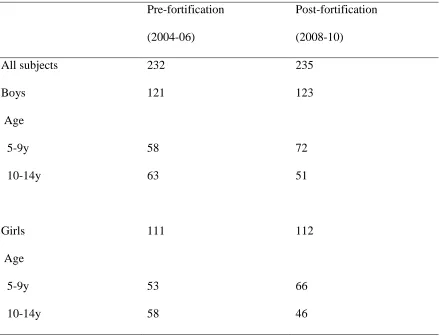
Sample sizes for indices of anemia, prevalence and likehood of anemia for the study are presented in Table 1. From 467 selected participants, 232 were included in pre-fortification period and 235 in post-pre-fortification period. 121 boys and 111 girls were from the pre-fortification period and 123 boys and 112 girls were from the post-fortification period.
Means of hemoglobin and hematocrit by sex, age and socio economic status in pre-fortification and post-fortification periods are presented in Table 2. Overall mean hemoglobin concentration was 10.9 g/dL and did not change from 2004-2006 to 2008-2010. In boys, mean hemoglobin concentration was 10.7 g/dL and did not differ from 2004-2006 to 2008-2010. Also in girls the mean hemoglobin concentration remained constant between 2 periods and was 11.1 gdL. In other demographic categories, mean hemoglobin did not differ significantly.
Overall mean hematocrit increased from 32.7% in 2004-2006 to 32.9% in 2008-2010 (p=0.9). This trend was also observed in stratified analysis. In boys, mean
hematocrit percent increased from 32% in 2004-2006 to 32.2% in 2008-2010 (p=0.9) and in girls, it increased from 33.4% in 2004-2006 to 33.7% in 2008-2010 (p=0.9). However, the differences were not significant.
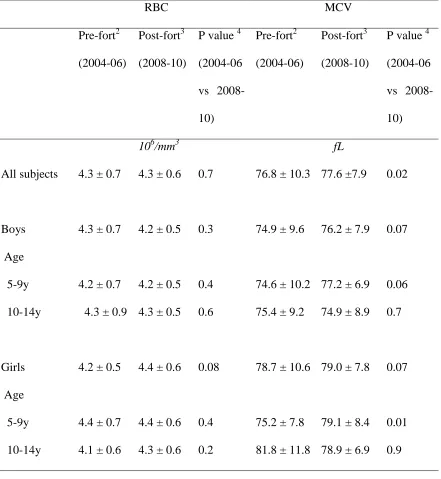
during the 2 fortification periods. In boys, mean RBC decreased from 4.3.106/mm3 in 2004-2006 to 4.2.106/mm3 in 2008-2010 (p=0.3), and in girls, mean RBC increased from 4.3.106/mm3 in 2004-2006 to 4.4.106/mm3 in 2008-2010 (p=0.08). In all demographic categories examined, the difference in mean RBC was not significant.
Overall mean MCV significantly increased from 76.8 fL in 2004-2006 to 77.6 fL in 2008-2010 (p=0.02). This trend was also observed in boys and girls. In boys, mean MCV increased from 74.9 fL in 2004-2006 to 76.2 fL in 2008-2010 (p=0.07), and in girls mean MCV increased from 78.7 fL in 2004-2006 to 79 fL in 2008-2010 (p=0.07). In all demographic categories, the difference of mean MCV was not significant except for girls aged 5-9 years where we observed a significant increase of mean MCV from 75 fL in 2004-2006 to 79.1 fL in 2008-2010 (p=0.01).
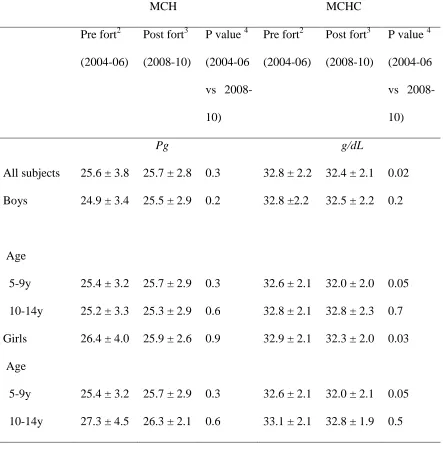
Means of MCH and MCHC by sex and age in pre fortification and post
fortification periods are presented in Table 4. In boys, mean MCH increased from 24.9 pg in 2004-2006 to 25.5 pg in 2008-2010 (p=0.2) whereas in girls mean MCH decreased from 26.4 pg in 2004-2006 to 25.9 pg in 2008-2010 (p=0.9). However, these differences were not significant. Overall mean MCHC significantly decreased from 32.8 g/dL in 2004-2006 to 32.4 g/dL in 2008-2010 (p=0.02). However, this reduction was significant only in girls (p=0.03) not in boys. When data on girls were stratified by age in girls aged 5-9 years the mean MCHC decreased from 32.6 g/dL in 2004-2006 to 32.0 g/dL in 2008-2010 (p=0.05).
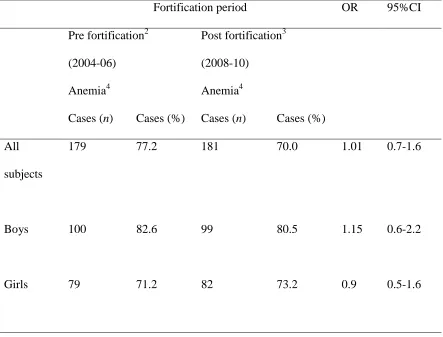
examined. The likehood of having anemia in the pre fortification period relative to the post fortification period is presented in Table 6. Overall, the odds of having anemia were similar in pre fortification and post fortification period, OR=1 (95%CI: 0.7-1.6).
Table 1
Sample sizes for indices of anemia, prevalence, and likehood of anemia by sex and age in the retrospective study on the children of Ivory Coast1
Folic acid and iron fortification periods2
Pre-fortification Post-fortification (2004-06) (2008-10)
All subjects 232 235
Boys 121 123
Age
5-9y 58 72
10-14y 63 51
Girls 111 112
Age
5-9y 53 66
10-14y 58 46
1
The data are based on examination and complete blood count of children from 5 to 14 years, n=467.
2
Table 2
Means of hemoglobin and hematocrit by sex and age in the retrospective study on the children of Ivory Coast1
Hemoglobin Hematocrit
Pre-fort2 Post-fort3 P value 4 Pre-fort2 Post-fort3 P value 4 (2004-06) (2008-10) (2004-06
vs 2008-10)
(2004-06) (2008-10) (2004-06 vs 2008-10)
g/dl %
All subjects 10.9 ± 1.5 10.9 ± 1.4 0.8 32.7 ± 4.5 32.9 ± 4.3 0.9 Boys 10.7 ± 1.4 10.7 ± 1.3 0.9 32.0 ± 4.2 32.2 ± 4.3 0.9 Age
5-9y 10.4 ± 1.3 10.6 ± 1.2 0.5 31.3 ± 3.9 31.9 ± 3.8 0.4 10-14y 10.9 ± 1.4 10.8 ± 1.5 0.5 32.7 ± 4.4 32.6 ± 5.0 0.6 Girls 11.1 ± 1.6 11.1 ± 1.4 0.8 33.4 ± 4.6 33.7 ± 4.2 0.9 Age
5-9y 10.9 ± 1.6 10.1 ± 1.3 0.7 32.8 ± 4.8 33.8 ± 4.1 0.3 10-14y 11.3 ± 1.5 11.2 ± 1.5 0.6 33.9 ± 4.4 33.5 ± 4.4 0.4
1
The data are based on examination and complete blood count of children from 5 to 14 years, n=467. All values are means ± SEMs
2
3
The data for the post fortification period were collected after the mandated fortification began.
4
Table 3
Means of RBC and MCV by sex and age in the retrospective study on the children of Ivory Coast1
RBC MCV
Pre-fort2 Post-fort3 P value 4 Pre-fort2 Post-fort3 P value 4 (2004-06) (2008-10) (2004-06
vs 2008-10)
(2004-06) (2008-10) (2004-06 vs 2008-10)
106/mm3 fL
All subjects 4.3 ± 0.7 4.3 ± 0.6 0.7 76.8 ± 10.3 77.6 ±7.9 0.02
Boys 4.3 ± 0.7 4.2 ± 0.5 0.3 74.9 ± 9.6 76.2 ± 7.9 0.07 Age
5-9y 4.2 ± 0.7 4.2 ± 0.5 0.4 74.6 ± 10.2 77.2 ± 6.9 0.06 10-14y 4.3 ± 0.9 4.3 ± 0.5 0.6 75.4 ± 9.2 74.9 ± 8.9 0.7
Girls 4.2 ± 0.5 4.4 ± 0.6 0.08 78.7 ± 10.6 79.0 ± 7.8 0.07 Age
5-9y 4.4 ± 0.7 4.4 ± 0.6 0.4 75.2 ± 7.8 79.1 ± 8.4 0.01 10-14y 4.1 ± 0.6 4.3 ± 0.6 0.2 81.8 ± 11.8 78.9 ± 6.9 0.9
1
2
The data for the pre fortification period were collected before the mandated fortification began.
3
The data for the post fortification period were collected after the mandated fortification began.
4
Table 4
Means of MCH and MCHC by sex and age in the retrospective study on the children of Ivory Coast1
MCH MCHC
Pre fort2 Post fort3 P value 4 Pre fort2 Post fort3 P value 4 (2004-06) (2008-10) (2004-06
vs 2008-10)
(2004-06) (2008-10) (2004-06 vs 2008-10)
Pg g/dL
All subjects 25.6 ± 3.8 25.7 ± 2.8 0.3 32.8 ± 2.2 32.4 ± 2.1 0.02 Boys 24.9 ± 3.4 25.5 ± 2.9 0.2 32.8 ±2.2 32.5 ± 2.2 0.2
Age
5-9y 25.4 ± 3.2 25.7 ± 2.9 0.3 32.6 ± 2.1 32.0 ± 2.0 0.05 10-14y 25.2 ± 3.3 25.3 ± 2.9 0.6 32.8 ± 2.1 32.8 ± 2.3 0.7 Girls 26.4 ± 4.0 25.9 ± 2.6 0.9 32.9 ± 2.1 32.3 ± 2.0 0.03 Age
5-9y 25.4 ± 3.2 25.7 ± 2.9 0.3 32.6 ± 2.1 32.0 ± 2.1 0.05 10-14y 27.3 ± 4.5 26.3 ± 2.1 0.6 33.1 ± 2.1 32.8 ± 1.9 0.5
1
2
The data for the pre fortification period were collected before the mandated fortification began.
3
The data for the post fortification period were collected after the mandated fortification began.
4
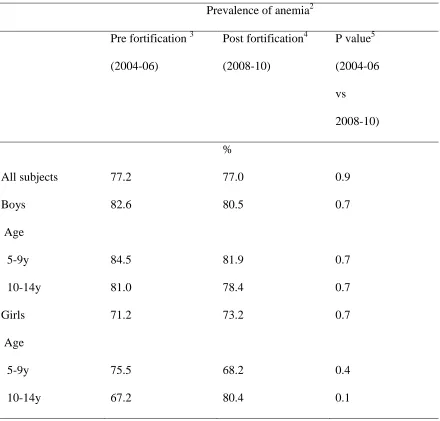
Table 5
Prevalence of anemia by sex and age in the retrospective study on children of Ivory Coast1
Prevalence of anemia2 Pre fortification 3
(2004-06)
Post fortification4 (2008-10)
P value5 (2004-06
vs 2008-10)
%
All subjects 77.2 77.0 0.9 Boys 82.6 80.5 0.7 Age
5-9y 84.5 81.9 0.7 10-14y 81.0 78.4 0.7
Girls 71.2 73.2 0.7 Age
5-9y 75.5 68.2 0.4 10-14y 67.2 80.4 0.1
1
The data are based on examination and complete blood count of children from 5 to 14 years, n=467.
2
3
The data for the pre fortification period were collected before the mandated fortification began.
4
The data for the post fortification period were collected after the mandated fortification began.
5
Table 6
Odds ratios (ORs) and 95% CIs of having anemia before and after iron and folic acid fortification of wheat flour began in the retrospective study on children of Ivory Coast1
Fortification period OR 95%CI Pre fortification2
(2004-06) Anemia4
Post fortification3 (2008-10)
Anemia4
Cases (n) Cases (%) Cases (n) Cases (%) All
subjects
179 77.2 181 70.0 1.01 0.7-1.6
Boys 100 82.6 99 80.5 1.15 0.6-2.2
Girls 79 71.2 82 73.2 0.9 0.5-1.6
1
The data are based on examination and complete blood count of children from 5 to 14 years, n=467.
2
The data for the pre fortification period were collected before the mandated fortification began.
3
4
CHAPTER V
DISCUSSION AND CONCLUSION
In this study, we report the first data on the impact of mandated fortification of folic acid and iron in Ivory Coast children. We compared indices, prevalence and likehood of anemia in children aged 5-14 years old before and after the fortification began in the pediatric unit of the university hospital of Treichville. The main finding is that the mandated fortification of wheat flour with folic acid and iron did not result in a significant change in indices of anemia and prevalence of anemia in these children. Hemoglobin concentration, hematocrit, prevalence, and likehood of anemia in children of Ivory Coast did not change from the pre to the post fortification period. Interestingly, MCV significantly increased during this period.
Similar trends were found among several studies. In an Indian placebo control trial, hemoglobin concentrations did not change in schoolchildren after a community level micronutrient fortification program (35). A South African study also reported no improvement in hemoglobin concentration in schoolchildren after an iron fortification program (36).
improvement in hemoglobin (38, 39). Another study conducted in central Asian countries demonstrated a beneficial effect of iron fortification program. In the study, a significant decrease in prevalence of anemia and a significant increase in hemoglobin were
observed (40). In the United States, iron fortification of infant formulas has significantly reduced anemia in young children (31). In Venezuela, the fortification of wheat and maize flour with 50 mg/kg of iron, vitamin A, and B vitamins has been associated with a significant decrease in anemia prevalence from 19% to 10% in school children one year later (11, 13, 32). In this study, the change in anemia after fortification cannot be solely attributed to iron although it may have played a major role. The fortification of milk with iron and vitamin C in Chile and folic acid in Mexico also resulted in lower prevalence of anemia in children (15, 33). Finally, studies have revealed that in Morocco, the
fortification of wheat flour with 45 mg/kg of iron with various B vitamins has
significantly improved the mean of hemoglobin and decreased anemia in children (14). The lack of apparent beneficial effects of iron and folic acid mandated
estimated to more than 100 g/capita/day, wheat flour is the best vehicle (42). In Ivory Coast, however, only 43 g/capita/day of wheat flour is available versus 167 g/capita/day of rice (30). The consumption of wheat flour is therefore too low to deliver sufficient fortifying micronutrients. In this specific case, rice could be a logical choice. Efforts in iron fortification of rice have begun in countries like Philippines, Papua New Guinea, Indonesia but no large scale programs have been implemented (41). In Philippines, evidence reported effectiveness of iron-fortified rice in reducing anemia in preschool children (43). Further research is therefore needed to develop rice fortification and ensure an efficient alternative to wheat flour.
Second, hemoglobin concentrations are commonly used to estimate the
prevalence of anemia in population but not to determine the causes. In addition to low iron intake, infectious diseases, intestinal parasitic diseases, and congenital
hemoglobinopathies (sickle-cell and thalassemies) are causes of anemia in tropical conditions such as Ivory Coast (44, 45). Because inflammation impairs iron absorption and utilization, the efficacy of iron fortification may be jeopardized in population in sub-Saharan Africa with high rates of infections (17). A randomized controlled trial
about 9% of sickle-cell trait (5). Therefore, the high prevalence of inflammatory condition could explain the inefficacy of fortification efforts in Ivorian children.
Finally, the hospital setting of the study could justify our results. Overall mean hemoglobin concentrations were low during the 2 fortification periods (10.9 g/dL) and prevalence of anemia were high (>70%) because our participants were sick children. We might have apparent benefits of fortification program if the study has been conducted in normal children.
Strengths and limitations
To our knowledge, this is the first study to examine the effectiveness of mandated fortification of iron and folic acid in Ivory Coast. This is important because the study gives first picture of a program begun 5 years ago. Moreover, it will guide further investigations needed to adjust fortification efforts to the Ivorian context. However, the results of the present study should be viewed in the light of some limitations. Because this study is a retrospective study, data on some variables are not available for some subjects. Also due to observational study, the causality should not be assumed. Because the study was conducted in one hospital in the capital city of Ivory Coast, it was not known whether these results can be applied to the Ivorian children at large.
Moreover, the present study mainly used hemoglobin as indicator of anemia but did not use any indicators of iron deficiency. As hemoglobin and serum ferritin are considered as the most efficient indicators of population response to iron interventions, we should have also included serum ferritin in our analysis (50).
and given data if children with iron deficiency ate enough processed wheat products at regular intervals.
Recommendations and conclusion
REFERENCES
1.Van den Briel T, Cheung E, Zewari J, Khan R. Fortifying food in the field to boost nutrition: case studies from Afghanistan, Angola, and Zambia. Food Nutr Bull. 2007 Sep; 28(3):353–64.
2.WHO | Micronutrient deficiencies [Internet]. WHO. [Cited 2012 Nov 8]. Available from: http://www.who.int/nutrition/topics/ida/en/
3.Balarajan Y, Ramakrishnan U, Ozaltin E, Shankar AH, Subramanian SV. Anaemia in low-income and middle-income countries. Lancet. 2011 Dec 17; 378(9809):2123–35. 4.Charles CV, Summerlee AJS, Dewey CE. Anemia in Cambodia: prevalence, etiology and research needs. Asia Pac J Clin Nutr. 2012; 21(2):171–81.
5.Asobayire FS, Adou P, Davidsson L, Cook JD, Hurrell RF. Prevalence of iron deficiency with and without concurrent anemia in population groups with high
prevalences of malaria and other infections: a study in Côte d’Ivoire. Am. J. Clin. Nutr. 2001 Dec; 74(6):776–82.
6.Lynch SR. The impact of iron fortification on nutritional anaemia. Best Pract Res Clin Haematol. 2005 Jun; 18(2):333–46.
7.Zimmermann MB, Hurrell RF. Nutritional iron deficiency. Lancet. 2007 Aug 11; 370(9586):511–20.
8.Al Khatib L, Obeid O, Sibai A-M, Batal M, Adra N, and Hwalla N. Folate deficiency is associated with nutritional anaemia in Lebanese women of childbearing age. Public Health Nutr. 2006 Oc; 9(7):921–7.
9.Milman N. Anemia--still a major health problem in many parts of the world! Ann. Hematol. 2011 Apr; 90(4):369–77.
10.Baltussen R, Knai C, Sharan M. Iron fortification and iron supplementation are cost-effective interventions to reduce iron deficiency in four subregions of the world. J. Nutr. 2004 Oct; 134(10):2678–84.
11.Laxminarayan R, Mills AJ, Breman JG, Measham AR, Alleyne G, Claeson M, et al. Advancement of global health: key messages from the Disease Control Priorities Project. Lancet. 2006 Apr 8; 367(9517):1193–208.
13.Layrisse M, Chaves JF, Mendez-Castellano, Bosch V, Tropper E, Bastardo B, et al. Early response to the effect of iron fortification in the Venezuelan population. Am. J. Clin. Nutr. 1996 Dec; 64(6):903–7.
14.El Hamdouchi A, El Kari K, Rjimati L, El Haloui N, El Mzibri M, Aguenaou H, et al. [Impact of flour fortification with elemental iron on the prevalence of anaemia among preschool children in Morocco]. East. Mediterr. Health J. 2010 Nov; 16(11):1148–52. 15.Shamah T, Villalpando S. The role of enriched foods in infant and child nutrition. Br. J. Nutr. 2006 Aug; 96 Suppl 1:S73–77.
16.Zimmermann MB, Chassard C, Rohner F, N’goran EK, Nindjin C, Dostal A, et al. The effects of iron fortification on the gut microbiota in African children: a randomized controlled trial in Cote d’Ivoire. Am. J. Clin. Nutr. 2010 Dec; 92(6):1406–15.
17.Rohner F, Zimmermann MB, Amon RJ, Vounatsou P, Tschannen AB, N’goran EK, et al. In a randomized controlled trial of iron fortification, anthelmintic treatment, and intermittent preventive treatment of malaria for anemia control in Ivorian children, only anthelmintic treatment shows modest benefit. J. Nutr. 2010 Mar; 140(3):635–41. 18.Guide_food_fortification_micronutrients.pdf [Internet]. [Cited 2013 Mar 11]. Available from:
http://www.who.int/nutrition/publications/guide_food_fortification_micronutrients.pdf 19.Shils ME. Modern Nutrition in Health and Disease, 10e. Lippincott Williams & Wilkins; 2006.
20.WHO | Iron deficiency anaemia: assessment, prevention and control [Internet]. WHO. [Cited 2013Mar11].Availablefrom:
http://www.who.int/nutrition/publications/micronutrients/anaemia_iron_deficiency/WHO _NHD_01.3/en/index.html
21.WHO | the world health report 2002 - Reducing Risks, Promoting Healthy Life
[Internet]. WHO. [Cited 2013 Mar 11]. Available from: http://www.who.int/whr/2002/en/ 22.Martins JM. Considerations on the food fortification policy in Brazil. Rev Bras
Hematol Hemoter. 2011; 33(2):158–63.
23.WHO | Assessing the iron status of populations [Internet]. WHO. [Cited 2012 Nov 8]. Available from:
24.Assessing the Iron Status of Populations: Report of Joint World Health
Organization/Centers for Disease Control and Prevention Technical Consultation on the Assessment of Iron Status at the Population Level, Geneva, Switzerland, and 6-8 April 2004. World Health Organization, Department of Nutrition for Health and Development; 2005.
25.Lozoff B, Jimenez E, Hagen J, Mollen E, Wolf AW. Poorer behavioral and
developmental outcome more than 10 years after treatment for iron deficiency in infancy. Pediatrics. 2000 Apr; 105(4):E51.
26.De Benoist B. Conclusions of a WHO Technical Consultation on folate and vitamin B12 deficiencies. Food Nutr Bull. 2008 Jun; 29(2 Suppl):S238–244.
27.Oakley GP Jr. The scientific basis for eliminating folic acid-preventable spina bifida: a modern miracle from epidemiology. Ann Epidemiol. 2009 Apr; 19(4):226–30.
28.Berry RJ, Li Z, Erickson JD, Li S, Moore CA, Wang H, et al. Prevention of neural-tube defects with folic acid in China. China-U.S. Collaborative Project for Neural Tube Defect Prevention. N. Engl. J. Med. 1999 Nov 11; 341(20):1485–90.
29.Charoenlarp P, Dhanamitta S, Kaewvichit R, Silprasert A, Suwanaradd C, Na-Nakorn S, et al. A WHO collaborative study on iron supplementation in Burma and in Thailand. Am. J. Clin. Nutr. 1988 Feb; 47(2):280–97.
30.Flour Fortification Initiative. Country profile-Cote d`Ivoire [Internet]. [Cited 2013 Mar 16]. Available from:
http://www.ffinetwork.org/country_profiles/country.php?record=107
31.Fomon S. Infant feeding in the 20th century: formula and beikost. J. Nutr. 2001 Feb; 131(2):409S–20S.
32.Layrisse M, García-Casal MN, Méndez-Castellano H, Jiménez M, Henry O, Chávez JE, et al. Impact of fortification of flours with iron to reduce the prevalence of anemia and iron deficiency among schoolchildren in Caracas, Venezuela: a follow-up. Food Nutr Bull. 2002 Dec; 23(4):384–9.
33.Hertrampf E. Iron fortification in the Americas. Nutr. Rev. 2002 Jul; 60(7 Pt 2):S22– 25.
34.WHO | Assessing the iron status of populations [Internet]. WHO. [Cited 2012 Aug 20]. Availablefrom:
35.Osei AK, Rosenberg IH, Houser RF, Bulusu S, Mathews M, Hamer DH. Community-level micronutrient fortification of school lunch meals improved vitamin A, folate, and iron status of schoolchildren in Himalayan villages of India. J. Nutr. 2010 Jun;
140(6):1146–54.
36.Van Stuijvenberg ME, Smuts CM, Lombard CJ, Dhansay MA. Fortifying brown bread with sodium iron EDTA, ferrous fumarate, or electrolytic iron does not affect iron status in South African schoolchildren. J. Nutr. 2008 Apr; 138(4):782–6.
37.Beinner MA, Lamounier JA. Recent experience with fortification of foods and beverages with iron for the control of iron-deficiency anemia in Brazilian children. Food Nutr Bull. 2003 Sep; 24(3):268–74.
38.Van Stuijvenberg ME, Smuts CM, Wolmarans P, Lombard CJ, Dhansay MA. The efficacy of ferrous bisglycinate and electrolytic iron as fortificants in bread in iron-deficient school children. Br. J. Nutr. 2006 Mar; 95(3):532–8.
39.Cabalda AB, Tengco LW, Solon JAA, Sarol JN Jr, Rayco-Solon P, Solon FS. Efficacy of pandesal baked from wheat flour fortified with iron and vitamin a in improving the iron and anthropometric status of anemic schoolchildren in the Philippines. J Am Coll Nutr. 2009 Oct; 28(5):591–600.
40.Tazhibayev S, Dolmatova O, Ganiyeva G, Khairov K, Ospanova F, Oyunchimeg D, et al. Evaluation of the potential effectiveness of wheat flour and salt fortification programs in five Central Asian countries and Mongolia, 2002-2007. Food Nutr Bull. 2008 Dec; 29(4):255–65.
41.Darnton-Hill I, Mora JO, Weinstein H, Wilbur S, Nalubola PR. Iron and folate fortification in the Americas to prevent and control micronutrient malnutrition: an of iron-fortified rice: effects on anemia status. Food Nutr Bull. 2011 Mar; 32(1):3–12. 42.Sadighi J, Mohammad K, Sheikholeslam R, Amirkhani MA, Torabi P, and Salehi F, et al. Anaemia control: lessons from the flour fortification programme. Public Health. 2009 Dec; 123(12):794–9.
43.Moy RJ. New approaches to the detection and prevention of iron-deficiency anaemia. J. Trop. Pediatr. 1999 Dec; 45(6):320–1.
44.Yip R. The challenge of improving iron nutrition: limitations and potentials of major intervention approaches. European Journal of Clinical Nutrition. 1997; 51 Suppl 4:S16– S24.
46.Yip R. The challenge of improving iron nutrition: limitations and potentials of major intervention approaches. European Journal of Clinical Nutrition. 1997; 51 Suppl 4:S16– S24.
Appendices B
Order Fortper Age Sex Anemia Hb Hct % RBC MCV MCH MCHC 1 1 10 2 1 9.3 31.6 4.45 71 20.9 29.4 2 1 6 2 1 11.7 36.4 4.59 79.3 25.5 32.2 3 1 13 2 1 10.5 31.6 4.23 74.5 24.9 33.4 4 1 10 1 1 10.7 31.9 4.32 73.8 24.8 33.56
5 1 11 1 1 9.1 28 3.01 91 30 32
6 1 5 1 2 11 36.9 4.32 85.2 25.3 29.7 7 1 8 2 1 9.7 33.8 4.82 70.2 20.2 28.7 8 1 11 1 1 10.1 29.6 3.67 80.7 31 34.8 9 1 10 1 1 11.9 37.2 4.7 88.9 25.6 30.8 10 1 5 2 2 13.6 39.3 5.38 73 25.3 34.7 11 1 9 2 1 11.9 34.28 4.2 78.3 27.4 33.02 12 1 10 1 1 10.8 31.6 3.09 76.2 25.3 31.6 13 1 11 1 1 9 25.6 3.67 69.8 24.5 35.1 14 1 6 1 1 10.8 30.4 3.92 79.6 28.2 33.4 15 1 12 1 1 11.3 38.2 5.21 73.8 21.7 29.9
16 1 13 2 2 12.8 39 5.4 74 23 33
39 1 7 1 1 11.4 36.4 4.91 74.4 23.2 31.1 40 1 11 2 1 11.8 34.5 5.36 64.5 22 34.1 41 1 9 2 1 11.5 35.5 4.3 83.2 27.5 30.7 42 1 12 2 1 10.5 33.2 5.12 64.8 20.6 31.8 43 1 8 1 1 11.1 31.5 4.57 69 24.3 35.2 44 1 12 2 1 10.9 31.1 4.46 69.7 24.4 34.9 45 1 9 2 1 9.3 27.4 2.86 68.5 24.3 30.9 46 1 12 2 1 8.2 26.4 3.68 71.9 22.4 31.2 47 1 13 2 2 12.1 34.9 4.13 84.5 29.2 34.5 48 1 11 1 1 8 26.5 3.3 80.4 24.4 30.3 49 1 12 2 1 10.3 31.8 4.28 74.3 24.1 32.4 50 1 12 1 1 9.1 28.3 4.14 80.2 22.6 30.2 51 1 14 2 1 10.8 34.3 4.03 84.9 26.7 31.5 52 1 12 2 1 11.6 36.5 5.31 68.7 21.9 31.8 53 1 11 1 1 11.4 35.2 5.13 68.5 22.3 32.5 54 1 8 1 1 9.8 29.1 3.44 84.4 26.5 30.8 55 1 7 2 1 9.8 27.6 4.17 66.3 23.5 35.2 56 1 12 1 1 9.5 31.4 4.41 71.4 21.6 30.3 57 1 7 2 2 12.4 35.9 3.96 90.7 31.3 34.5 58 1 13 2 1 11 36 4.9 73 22.6 31.1 59 1 11 1 1 9.3 26.8 3.74 71.7 24.9 34.7 60 1 10 1 2 12.2 40.3 5.13 78.5 23.9 30.4 61 1 12 1 1 9.9 30.2 4.11 73.2 23.3 30.8 62 1 12 1 1 9.8 29.5 4.65 63.4 21.1 33.2 63 1 5 1 2 13.4 39.6 5.9 98.3 28.2 37.1 64 1 11 1 1 10.3 31.9 4.66 70.6 22.1 31.3 65 1 9 2 1 10.2 30.9 4.2 80.6 24.8 33.3 66 1 13 1 1 9 28.2 3.23 87.3 28 32.1 67 1 14 2 2 13.6 42.4 3.97 106.7 34.2 32.1 68 1 7 2 1 10.6 31.2 3.6 86.6 33.9 29.4 69 1 11 1 1 10.9 33.1 4.26 77.8 25.5 32.9 70 1 10 2 1 10.5 30.3 3.92 77.3 26.8 34.7 71 1 12 2 1 9.7 32.6 4.29 75.8 22.7 29.9 72 1 11 1 2 13.2 39.5 5.17 75.3 27.3 32.2 73 1 7 1 1 9.4 30.2 5.61 63.6 20.8 25.9 74 1 7 2 2 12.9 38.2 4.73 80.8 27.4 33.8
75 1 12 1 1 11 34 5.26 65 20 32
76 1 8 1 1 11.1 34 4.13 64 27 32
219 1 5 2 2 11.3 33.6 4.47 75 25.2 33.6 220 1 6 1 1 8.1 23.3 2.98 78.1 27.3 35 221 1 6 1 2 11.4 35.7 4.81 74.2 23.7 32 222 1 12 1 1 12.6 35.6 4.56 78.2 27.6 35.3 223 1 8 1 1 11.5 34.2 4.47 83.6 25.8 30.9 224 1 10 1 1 10.1 31.8 3.72 72.8 26.2 32.5 225 1 5 2 1 10.4 32.7 4.52 72.3 23 32 226 1 9 2 1 10.9 32.4 4.28 76 25.4 33.6 227 1 11 1 1 9.3 28.5 4.1 72.5 23.1 28.6 228 1 11 1 2 13.2 38.6 5.24 73.7 25.2 34.3 229 1 9 2 1 10.9 32.4 4.28 76 25.4 33.6 230 1 5 2 2 11 33.8 4.3 80.6 26.5 29.8 231 1 6 2 1 11.5 34.8 4.2 78.6 27.4 31.9 232 1 7 2 1 11.8 36.4 4.35 83.8 27.1 32.4 233 2 12 1 2 12.1 36.8 4.2 86.7 28.9 34.1 234 2 12 2 1 10.6 29.4 4.45 65.9 23.8 36.1 235 2 11 1 1 10.3 32.5 4.28 79.4 26.1 30.7
236 2 8 1 1 10.4 33 3.8 70 24 32
237 2 12 2 1 9 28 3.6 78 25 32
238 2 5 2 1 9.2 29.7 3.5 85 26 31
264 2 5 2 2 12.3 38.8 4.62 83.2 28.4 32.6 265 2 5 2 2 13.5 39.5 5.38 83.3 26.5 36.6 266 2 9 1 1 10.6 30.4 4.5 67.6 23.6 34.8 267 2 9 1 1 10.7 30.8 4.5 74 24 34 268 2 5 1 2 11.3 34.5 4.35 83.7 26.5 30.2 269 2 6 2 2 13.7 41.5 4.65 86.5 29.5 34.1 270 2 7 2 1 9 29.8 3.25 75.4 28.3 33.7 271 2 5 1 1 9.6 29.5 3.25 77 29.5 32.5 272 2 9 2 1 10.6 33.1 4.39 79.1 26.2 30.5 273 2 5 1 2 13.6 40.7 4.6 82.7 27.6 33.6 274 2 5 2 1 10.5 29.1 4.12 65.9 25.4 36 275 2 6 1 1 9.7 29.4 4.02 79.2 23.3 30.3 276 2 8 1 1 10.8 33.6 4.11 76.6 23.9 34.7 277 2 12 1 1 9.6 30.9 4.39 71 22 31 278 2 11 2 2 15.4 43.4 5.08 85.4 30.3 35.5 279 2 6 2 1 11.2 33 4.4 75 25.5 33.9 280 2 7 1 2 13.7 41.5 4.66 86.4 28.2 33.1 281 2 7 1 1 10.2 30.9 4.35 79.4 26 31.2 282 2 5 1 2 12.2 35.3 5 81.3 26.5 34.6 283 2 5 2 2 11.5 35.4 4.36 84.7 26.8 30.5 284 2 7 1 1 11.6 31.2 4.21 69.9 22.2 34.1 285 2 6 1 1 10.1 27.2 4.63 68.5 21.8 32.4 286 2 7 1 1 11.2 33.6 4.07 82.6 27.5 33.32 287 2 5 1 1 9.2 28.3 4.21 69 24 32 288 2 7 1 1 10.2 33.6 4.03 83 25.2 30.2 289 2 7 1 1 11.8 35.4 4.39 83.1 26.5 30.6 290 2 8 2 2 12.1 36.8 4.37 86.5 29.5 33.2 291 2 5 1 1 10.8 32.5 4.48 72.6 24.1 33.2
292 2 6 2 1 9.6 31 4.44 80 24 30
309 2 14 2 2 12.4 38.5 4.39 86.5 28.2 33.1 310 2 6 1 1 10.2 29.6 2.99 90 32 36 311 2 7 1 2 14 42.5 4.73 86.5 29.4 33.1 312 2 5 2 2 14.3 43.89 4.78 86.5 28.4 33.2 313 2 5 2 1 10.3 31.1 4.4 79.5 26.4 30.5
314 2 6 2 2 12.8 42 5.6 76 23 30
315 2 8 2 1 9.1 27.6 3.46 78.4 26.3 34.5 316 2 12 2 1 11.6 35.5 3.2 90 28 33.5 317 2 11 2 1 10.3 31.2 3.57 87.3 28.8 33 318 2 8 1 1 9.9 29.9 3.97 80.6 26.3 32.9 319 2 6 2 1 9.7 29.4 3.83 80.6 26.8 33.7 320 2 8 2 2 13 39.2 5.01 87 28.9 33 321 2 14 2 1 9.8 30.7 3.86 79.6 25.3 31.9 322 2 5 2 1 11 33.8 4.3 80.6 26.5 29.8 323 2 13 2 1 10.4 33.7 3.44 80.7 26.9 34.5 324 2 11 1 1 9.4 29.3 4 81 26.9 30.1 325 2 12 2 1 11.7 30.9 4.52 68.4 25.8 35.2 326 2 14 2 1 10.8 30.9 4.06 76.2 26.6 34.9 327 2 12 1 1 9.1 25.1 4.42 57 20 36.2 328 2 13 1 2 15.3 49.6 4.72 89 32.4 34.6 329 2 13 1 1 10 30.9 4.34 73.9 23 32.9 330 2 6 2 1 9.4 27.8 4.84 57.4 19.4 33.8 331 2 12 1 1 9.1 27.8 4.09 68 22.2 32.72 332 2 12 2 1 9.3 28.7 4.15 75.1 24.3 30.4 333 2 5 2 2 11.5 35.2 4.29 84.1 26.5 30.2 334 2 6 2 1 10.3 31.5 4.22 78.5 25.2 28.4 335 2 8 2 2 12.2 40.3 5.48 73.7 22.2 30.2 336 2 9 2 1 11 34.7 4.2 76.6 23.6 32.8
337 2 13 1 2 13.2 39 5.1 81 26 34
338 2 11 1 1 10.9 31 4.5 68 27 33
339 2 10 1 1 9.3 29 4.15 78.5 26.1 30.3 340 2 13 2 1 11.2 31.2 4.71 66.2 23.7 35.8 341 2 11 1 1 9.3 30.6 3.65 72.9 25.6 30.7 342 2 7 1 1 8.9 27.6 3.85 75.4 24.3 27.6 343 2 6 2 1 10.4 37.8 6.14 62 17 27.5 344 2 8 2 1 9.1 28.9 3.97 78 25.7 27.3
345 2 6 2 1 9.3 30.7 4 80 27 30.3
399 2 9 1 2 12.5 36.5 5.5 65.4 22.3 34.2 400 2 5 2 1 10 32.1 4.73 80 25.3 30.4 401 2 13 2 2 13.7 39.1 5.01 88 30.1 33.9 402 2 8 2 1 10.7 32.5 4.29 78.4 25.6 29.8 403 2 13 2 1 11.7 34.6 4.73 80 26.9 32.7 404 2 14 1 1 11.1 34.8 3.64 80.6 27.1 31.8 405 2 8 1 1 10.6 30.9 4.09 81 27.2 31.4 406 2 11 1 1 9.5 30.6 4.01 79.6 23.7 35.5 407 2 5 1 1 10.7 33.1 4.25 79.4 25.6 30.2 408 2 7 2 1 9.5 30.8 3.16 78 26.1 29.3 409 2 11 2 1 11.7 34.1 4.3 81 27.3 30.9 410 2 12 2 1 11.4 31.6 4.24 74.6 26.8 36 411 2 5 2 1 9 29.3 3.03 96.7 29.7 30.7 412 2 5 2 1 9.7 30.3 3.16 81 26.3 30.4 413 2 6 1 1 10.6 31.7 3.06 80 26.3 30.1 414 2 14 2 1 10.6 30 4.15 72.5 25.5 35.3 415 2 10 1 1 10.2 30.7 4.03 80 26.3 30.1 416 2 9 2 2 12.9 41.7 5.7 73 22.6 30.8 417 2 7 2 1 11.9 35.7 4.69 76.3 25.3 33.3 418 2 9 1 1 10.2 28.3 4.36 65.1 23.3 36 419 2 6 2 2 12.9 37.4 5 89 31.6 34.7 420 2 5 2 1 10.8 31 4.9 63.3 22 34.8 421 2 5 1 1 9.1 30.1 4.1 89 26.9 30.4 422 2 9 1 1 9.6 27.9 4.21 66.3 22.3 34.2 423 2 5 1 1 10.6 31.5 4.05 76.3 24.2 30.8 424 2 8 1 1 10 30.7 4.22 77.5 25.1 30.1 425 2 11 1 1 9 29.9 4.51 66.3 20 30.1 426 2 7 2 2 12.4 37.2 4.74 79 26.1 33.3 427 2 12 2 2 13.2 39.6 4.72 82.2 28.6 32.7 428 2 8 2 1 11.2 34.5 4.28 82.6 26.5 30.7 429 2 6 1 1 11.3 34.8 3.59 80.1 26.9 32.4 430 2 5 1 1 9.8 27.1 3.78 78.4 25.9 34.5 431 2 5 1 2 11.3 31.4 4.17 82.5 27.1 32.8 432 2 7 2 2 12.4 34.8 5.54 68 22.3 35.5
433 2 6 1 1 9.9 29 3.79 77 26 34
444 2 8 2 1 10.1 30.3 5.54 54.7 18.2 33.3 445 2 13 2 2 12.3 38.7 5.02 77 24.5 31.7 446 2 12 2 1 11.5 35.4 4.41 83.1 26.7 29.1 447 2 6 1 1 9.6 28.5 3.42 83.3 28 33.6 448 2 5 2 2 11.8 35.8 4.2 83.4 27.4 32.9 449 2 10 2 1 10.6 31.2 3.2 79.6 26.9 30.4 450 2 11 2 1 11.9 36.5 4.41 85.3 27.7 32.4 451 2 5 1 1 10.2 30.8 4.57 67 22 33 452 2 10 1 1 9.5 26.3 3.95 54.2 21.5 35.6 453 2 11 1 2 12.5 38.5 4.75 80.8 26.2 32.8 454 2 11 1 1 9.8 26.1 3.41 69.2 25.2 31.5 455 2 5 2 1 9 28.9 3.98 81 27.1 30.6 456 2 14 2 1 10.4 31.2 5.7 78.4 26.1 33.3 457 2 6 1 1 11.6 35.2 4.26 82.1 26.5 30.4 458 2 8 2 1 10.9 34.6 4.92 78 25.5 30.1 459 2 13 1 2 12.8 43.1 4.51 90.7 28.3 33.8 460 2 12 1 1 9.9 27.9 4.51 61.8 21.9 35.4 461 2 8 1 2 12.6 36 4.8 85 27.2 33.5 462 2 12 2 1 11.9 36 4.38 86.4 26.3 30.6 463 2 6 1 1 11.8 36.7 4.8 86 27.4 32.1 464 2 11 2 2 14.3 42 4.4 96 32.5 34 465 2 5 1 1 9 24.8 3.81 65.1 23.6 36.2
466 2 11 1 1 10.7 27 3.7 72 28 35