ScholarWorks @ Georgia State University
ScholarWorks @ Georgia State University
English Dissertations Department of English
Summer 8-11-2011
Walker Percy and the Magic of Naming: The Semeiotic Fabric of
Walker Percy and the Magic of Naming: The Semeiotic Fabric of
Life
Life
Karey L. Perkins
Follow this and additional works at: https://scholarworks.gsu.edu/english_diss
Part of the English Language and Literature Commons
Recommended Citation Recommended Citation
Perkins, Karey L., "Walker Percy and the Magic of Naming: The Semeiotic Fabric of Life." Dissertation, Georgia State University, 2011.
https://scholarworks.gsu.edu/english_diss/76
by
KAREY PERKINS
Under the Direction of Thomas McHaney
ABSTRACT
Walker Percy thought a paradigm for the modern age, human beings, and life does not exist,
and no paradigm vying for supremacy (religion, scientism, new age physics and philosophies) succeeds.
He sought to create a “radical anthropology” to describe human beings and life. His anthropology has
existential roots and culminates in the philosophy and semeiotic of American pragmatist Charles
Sanders Peirce. Unlike any other creature, humans have symbolic capacity, first manifested in a child’s
naming and demonstrated in human being’s unique language ability, the ability to communicate through
symbol and not just sign. Percy conveyed his anthropology in his last three novels through a number
symbolism corresponding to the theme of each novel based on Peirce’s Cenopythagoreanism, viewing
the world through the paradigm of number. In Lancelot, Percy uses the symbol of the inverted three to
illustrate Lancelot’s inverted search for evil. In The Second Coming, he uses diamonds and squares and
fours to illustrate community and authentic communication in the novel. In The Thanatos Syndrome, he
uses twos and sixes to represent the search for dyadic solutions to triadic problems. Percy sees a
synechistic and synchronistic interconnected “fabric of life” to the universe, enabled by human symbolic
capacity, or Peirce’s concept of relations.
INDEX WORDS: Walker Percy, Charles Sanders Peirce, Kenneth Laine Ketner, Radical anthropology, Symbol, Semeiotic, Semiotics, Naming, Language theory, Susanne Langer, Thirdness, Dyad, Triad, Tetrad, Scientism, The Thanatos Syndrome, The Second Coming, Lancelot, The Moviegoer, Paradigm, Sacrament, Intersubjective, Community, Synechism, Synchronicity, Fabric of life, Pragmaticism, The Message in the Bottle, A Thief of Peirce, Coupler, Interpretant,
by
KAREY PERKINS
A Dissertation Submitted in Partial Fulfillment of the Requirements for the Degree of
Doctor of Philosophy
in the College of Arts and Sciences
Georgia State University
Copyright by Karey Lea Perkins
by
KAREY PERKINS
Committee Chair: Thomas McHaney
Committee: Kenneth Laine Ketner
Pearl McHaney
Electronic Version Approved:
Office of Graduate Studies
College of Arts and Sciences
Georgia State University
DEDICATION
This dissertation is dedicated to the most meaningful triad in my life: my parents, Rex and Ann
ACKNOWLEDGEMENTS
I have many people to thank for making this dissertation possible, especially Thomas McHaney,
my dissertation advisor, and Kenneth Laine Ketner, whose name appears frequently within these pages,
who served on my committee with insightful editing, and whose correspondence with Walker Percy set
off a light bulb within me. I would like to also thank my family, whose encouragement and belief in me
along the way have kept me going. Last but not least, I would especially like to thank my friend Ken
Denney, who patiently listened to and read bits and pieces of the dissertation while it was in progress
TABLE OF CONTENTS
ACKNOWLEDGEMENTS ... v
LIST OF FIGURES ... viii
LIST OF ABBREVIATIONS ... ix
1 THE PROBLEM: PARADIGM LOST ... 1
1.1 The Mystery of Human Beings ... 1
1.2 The Background: Some Biographical and Cultural Influences on Percy ... 8
1.3 Some Literary and Intellectual Influences on Percy ... 17
1.4 The First Failure: Psychology ... 30
1.5 The Second Failure: Scientism... 48
1.6 The Third Failure: New Age Physics and Philosophies ... 61
1.7 Existential Roots: The Moviegoer ... 71
2 THE CHILDREN: THE MAGIC AND MYSTERY OF NAMING ... 94
2.1 The Children: Crossing the Symbolic Threshold ... 94
2.2 Symbol as Joyful Affirmation ... 106
2.3 Symbol as Pairing and Denotation ... 111
2.4 Symbol as Empty, Different, and Arbitrary ... 117
2.5 Symbol as World and Myth ... 121
2.6 Symbol as Art, Music, and Religion ... 124
2.8 Symbol as Existential ... 127
3 PARADIGM FOUND: SEMEIOTIC: FROM SIGN TO SYMBOL ... 134
3.1 Charles Sanders Peirce Takes on Charles Morris ... 134
3.3 Twos and Dyads: Cause-Effect Sign ... 155
3.4 Threes and Triads: Uniquely Human Symbol ... 159
3.5 Fours and Tetrads: Symbol as Intersubjective Communication... 169
3.6 Symbol as Consciousness ... 174
3.7 The Coupler: Dyadic Semioticians Fail to Describe the Triadic Event ... 178
3.8 The Coupler: Waltzing Toward the Interpretant ... 193
3.9 The Semeiotic Fabric of Life: Reality as Continuous ... 209
4 THE NOVELS: ARITHMECRIT ... 224
4.1 To Be or Not to Be (a Novelist) ... 224
4.2 ArithmeCrit ... 230
4.3 Lancelot: The Inverted Three: The Moviemakers ... 242
4.4 The Second Coming: The Treasure Hunt for Diamonds, Fours, and Community ... 268
4.5 The Thanatos Syndrome: Dyadic Solutions and the Mark of the Beast—A Brave New World ... 299
5 THE DIVINE: FROM SYMBOL TO SACRAMENT ... 318
5.1 Symbol as Order in the Midst of Disorder: The Fabric of Life ... 318
5.2 Symbol as Magic and Mystery ... 324
5.3 Symbol as Divine: “The Word” ... 336
5.5 Symbol as Divine: Sacrament ... 341
5.6 The Wanderer and the Wayfarer ... 362
WORKS CITED AND WORKS CONSULTED ... 371
APPENDICES ... 381
Appendix A: The Four Stages of Symbolic Transformation ... 381
LIST OF FIGURES
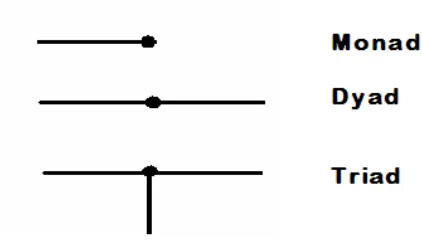
Figure 1: Peirce’s Monad, Dyad, and Triad ... 153
Figure 2: Dyadic Interaction ... 156
Figure 3: Balloon Dyad ... 157
Figure 3: Banana Dyad ... 157
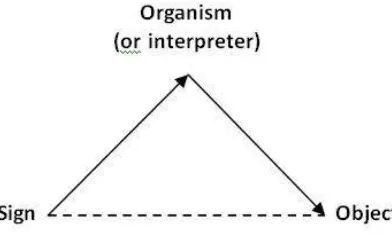
Figure 4: Triadic Interaction ... 160
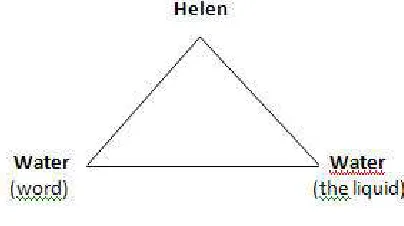
Figure 5: Helen-Water Triad ... 160
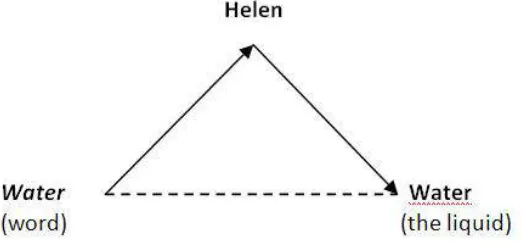
Figure 6: Helen-Water Triad II ... 161
Figure 7: Relationship of Quasi-Identity ... 162
Figure 8: Linear “Symbol” ... 163
Figure 9: Helen-Water Linear “Symbol” ... 163
Figure 10: Helen’s Simultaneous Reception of Water (“Word”) and Water (“Liquid”) ... 165
Figure 11: The Human Symbolic Event ... 165
Figure 12: Koko’s Linear Communication to Get a Banana... 166
Figure 13: Human Symbolic Experience of “Banana” ... 167
Figure 14: Tetradic, or Intersubjective, Communication ... 172
LIST OF ABBREVIATIONS
THE NOVELS
MG = The Moviegoer (1961)
LG = The Last Gentleman (1966)
LR = Love in the Ruins (1971)
L = Lancelot (1977)
SC = The Second Coming (1980)
TS = The Thanatos Syndrome (1987)
NON-FICTION
MB = Message in the Bottle (1975)
LC = Lost in the Cosmos (1983)
SSL = Signposts in a Strange Land (1991)
SE = Symbol and Existence: A Study of Meaning (Percy’s unpublished manuscript in the UNC-
Chapel Hill archives)
LETTERS AND INTERVIEWS
Con I = Conversations with Walker Percy (1985)
Con II = More Conversations with Walker Percy (1993)
KK = Ketner, Kenneth Laine. Letter to author. 21 June 2011.
1 THE PROBLEM: PARADIGM LOST
1.1 THE MYSTERY OF HUMAN BEINGS
Juliet:
"What's in a name? That which we call a rose By any other name would smell as sweet."
Romeo and Juliet (II, ii, 1-2), William Shakespeare
* * *
I believe that an impartial empirical analysis of the extraordinary act of symbolization will bridge the gap between the behavioristics of Mead and the existentialia of Marcel. (MB 272)
* * *
What’s in a name? For Walker Percy (1916-1990) – American scientist, philosopher, novelist,
and medical doctor – naming was the secret to unlocking the mystery of human beings. Arising from the
uniquely human capacity for “symbol-mongering,” naming is the crossing of the symbolic threshold from
animal to human. Naming is a joyful, powerful event – from our first naming to every symbolic activity
thereafter. Naming is an encounter and affirmation of the named, of the “other.” For Percy, naming is
magical and even divine.
While Percy would agree with Shakespeare that a rose may smell as sweet no matter what it is
named, he believed that, unless it has a name, it can never be known, never experienced. Naming
(specifically) and symbolization (more generally) make us qualitatively different from our animal cousins.
It is the doorway to our humanity.
Walker Percy wanted to find a cohesive and decisive explanatory theory for humans. He
observed that our culture is riddled with conflicting and competing theories resonating through our
social fabric and our confused and divided American consciousness – both individual and group. We no
longer have an accepted coherent or adequate view of humankind or the universe. Percy found human
…time ran out and the old modern world ended and the old monster theory no longer works. Man knows he is something more than an organism in an environment, because for one thing he acts like anything but an organism in an environment. Yet he no longer has the means of understanding the traditional Judeo-Christian teaching that the “something more” is a soul somehow locked in the organism like a ghost in a machine. What is he then? He has not the faintest idea…. When man doesn’t know whether he is an organism or a soul or both, and if both how he can be both, it is good to start with what he does know. This book [The Message in
the Bottle: How Queer Man Is, How Queer Language Is, and What One Has to Do with the Other,
Percy’s study of language] is about two things, man’s strange behavior and man’s strange gift of language, and about how understanding the latter might help understanding the former. (MB 9)
Percy felt current anthropological theories had failed, and so he sought to create a “radical
anthropology,” based on human capacity for language, and beginning with the magical act of naming.
He had twin kings to depose – kings that had ruled over Western culture since the
Enlightenment – Newtonian science and Cartesian dualism. In Percy’s academic world, the scientific
paradigm took precedence over Descartes’ “ghost in a machine” and certainly over the conservative
Christian view. But it was inadequate when it came to describing human beings, Percy discovered. The
cause-and-effect model of an organism responding to stimuli is linear and dyadic. While dyadic science
had dominated the world view of Western culture since the medieval church and was certainly
competent for describing the rest of the world, Percy realized that this kind of science alone could not
fully explain many characteristics of humans, especially those described by the existentialists, including
consciousness, symbolic capacity (language, art, culture), and the human need for meaning.
Yet as a scientist himself, he was skeptical of how well pure philosophy and art could explain
human beings, and so he found himself reluctant to abandon entirely the scientific method as a tool for
investigation, even though he now found scientism1 an inadequate philosophy to explain the nature of
humanity. He sought a new science – one that could provide an explanation for human behavior
1
“Scientism” refers not to the method of science – testing an hypothesis to determine if evidence supports it –
through the method of science, yet one that, ironically, disproved scientism as the singular explanation
for the nature of man. “A theory of man must account for the alienation of man. The modern age
began to come to an end when men discovered that they could no longer understand themselves by the
theory professed by the age…. The scientists and humanists were saying one thing, but the artists and
poets were saying something else…. Someone was wrong” (MB 23, 25). Dyadic science could not
account for humans when it came to such things as existential alienation. Bodily processes, brain
chemicals, yes; consciousness, existential longings, no. The existential dilemma had no satisfactory
answer.
In mid-life, Percy found an answer, a quite traditional one; he returned to the old reigning
paradigm of thousands of years – Catholicism – as the best for understanding and describing human
beings, as the best guide by which to live life.
Still he wanted some kind of science involved. He became an apologist for the faith – he wanted
a rational and intellectual defense of his solid religious faith, of his observation that humans were more
than biological creatures; they were creatures that sought meaning, a search manifested in language,
art, and culture, but ultimately satisfied by God. And he wanted it through the scientific method. It was
his admiration of science as well as the dominance of science in the mid-twentieth century that
compelled him to seek to understand humans through an at least partially scientific means – language
theory – rather than a purely philosophical or religious means, even as he rejected scientism and the
solely dyadic cause-effect principles of behaviorism to describe humans.
Percy was not just disillusioned with scientism as a world view (one of any numbers of
world-views and one usually mistaken for the more accurate, self-correcting method of science), he also
concluded Descartes’ philosophy had to go – Descartes separated mind from body, creating a rift inside
of the individual, who is now a “mind” in a “body” or a ghost in a machine. Individuals become too
the world. The Cartesian individual is an overly rational, overly independent being, rather than a
communal being. The Cartesian rift also is a social rift, having created a spiritual, philosophical, and
scientific split which led to numerous other schisms, including, according to Percy, the psychological,
political, and social split in America today. In fact, no paradigm for understanding humans escapes his
criticism, especially the newer ones; the new psychology of self-actualization as well as new age
philosophies are also rejected by Percy. Even the new physics, quantum mechanics (which is not a
dyadic science), is questioned by traditional Percy, who was skeptical of using quantum findings as a
new paradigm for understanding humans. Science, psychology, and anthropology all fail to construct a
competent modern theory of humankind. The era has lost its reigning paradigm. Catholicism has lost its
supremacy while its successor, the dyadic scientistic worldview, proves inadequate to understand
human consciousness.
These two most prevalent paradigms – traditional Christianity and traditional science – battle
for power ideologically, politically, socially, morally, scientifically. Neither can claim to dominate the
world view as universally and summarily as the Catholic Church did in the first millennium after Christ.
Neither have full explanatory power to describe humans or the universe, and the two conflict to boot.
Percy’s third novel, Love in the Ruins, presciently characterizes these conflicts in America: “The
scientists, who are mostly liberals and unbelievers, and the businessmen, who are mostly conservative
and Christian… make much of their differences – one speaking of outworn dogmas and creeds, the other
of atheism and immorality, etcetera etcetera – to tell the truth, I do not notice a great deal of difference
between the two” (LR 15). The paradigm indecision is mirrored in present-day political partisanship –
which Percy predicted in the 1970s with his Knothead and Leftpapas parties in Love in the Ruins. 2
Respective believers adhere belligerently to their chosen view, each blindly ignoring the anomalies that
2
are clearly present in each. Religious beliefs run the gamut, even within denominations, as Percy
parodies with his three branches of the Catholic Church. In addition, dozens of other competing
worldviews vie for attention. The paradigm vacuum has allowed all kinds of competing theories,
religions, splits, and philosophies to surface, which Percy illustrates throughout his novels, especially in
this third novel, Love in the Ruins, that ends in an out-and-out civil war between cultural groups and
ideologies.
The problem has only become worse in the 21st century, though Percy would hardly have been
surprised. Today, court cases are tried over whether to teach “creationism” or evolution in the schools
– with each side equally adamant that the other side is in grave error. Gay marriage is repeatedly
debated in the courts, with conservative Christians finding the idea immoral and abhorrent, and liberal
scientists espousing civil liberties and individual freedoms. Conservatives would like to dismiss global
warming dangers rather than challenge established business practices; however, scientists are sure the
world is in imminent danger. (Republicans have even sprouted an off-shoot - “tea partiers”- more
outlandish than even Percy imagined with his fictional Knotheads in his third novel.)
Percy felt a new kind of anthropology was needed, one that was entirely different from any
heretofore proposed, one that took into account characteristics of humanity that no current view could
entirely encompass.
Percy’s search for a paradigm to replace the void created by the incompleteness of scientism
and outdatedness of religious views began in existential philosophy and eventually led him to
“semeiotic” – the original version of the more well known and popular “semiotics” of his day. Percy sees
answers in a study of language and “symbol-mongering,” especially as illuminated by 19th century
scientist, semeiotician, and founder of pragmatism, Charles Sanders Peirce (1839-1914). Percy’s novels
began to move from pure existentialism to his unique science-philosophy hybrid of language theory as
Percy’s language theory, derived from Peirce’s science and philosophy, was radically different
from the language theorists of his day who based their views in cause-effect science. Dyadic traditional
science and its psychological cousin, behaviorism, could not comprehend triadic organisms – human
beings – who do not operate solely by cause and effect. Language, a uniquely human activity, is a triadic
event, and could not be understood by dyadic semiotic theory, which Percy rejected. For Percy, the
naming event entails three elements, an object to be named (referent or signified) and the name
(signifier), as well as a third element, a coupler for those two entities, for which Percy had a variety of
terms: interpretant, organism, namer. Percy and Peirce have a triadic “semeiotic,” while most language
theorists espouse a “semiotics,” which omits the integral and important coupler, keeping the naming
event at a dyadic level, never rising above behaviorism or scientism. Nor can a Percy-Peirce triad be
reduced to a series of dyadic interactions; it is a qualitatively different phenomenon than a cause-effect
event.
Much of Percy’s non-fiction writing was focused on discovering and conveying just what this
phenomenon was. His fiction portrays humans entirely indecipherable by behaviorist theory, and his
latter fiction includes symbols from his triadic theory of language as the primary symbols in each novel.
For Percy, as one “comes face to face with the nature of language, one also finds himself face to face
with the nature of man” (MB 150). His language theory was one of the most formative influences on his
novels and his creation of fictional characters, especially in his last three novels.
For Percy, language also solves the Cartesian rift inside the individual. Language enables
consciousness. Consciousness is not simply a state of being alive, but it is an awareness, a consciousness
of something. We must have a word to name something to be conscious of it. For Percy, unlike
Descartes, both language and consciousness are communal entities, for language does not occur in
isolation and is always an agreed-upon event. Our name for something is because an “other” told us it
is nothing if not social. Indeed, he can be understood as a construct of his relations with others” (SSL
289). The individual self is not primary; the community is, and relations are – just as they are for Percy’s
mentor, Peirce. And ultimately all is related, all is connected. All of Percy’s novels reflect the
importance – in fact, the salvation – of intersubjective community. At the beginning of each of his
novels, his characters are alone and wandering; by the end of each novel, they settle down into a
marriage and start building a community. They become wayfarers.
Not only did Percy find insights into meaning and purpose unique to humans in his study of
language and symbol, he saw a metaphysical fabric of life – connectedness and patterns and
relationships in the structure of the universe, patterns classified using a theory of numbers. Peirce
called this “Cenopythagoreanism,” literally, a “new Pythagoras,” as Pythagoras also saw number as the
basis of the universe. Percy’s language theory was a classification system, with geometric shapes and
their corresponding numbers as his means of categorization. These permeate his writing, not just his
non-fiction, but also his fiction, in subtle and not-so-subtle ways, in ways rarely noticed. He uses the
dyad and triad originating from Peirce’s theories, and adds his own tetrad, as recurring symbols
dominating his latter three novels, intertwining his fiction and non-fiction.
Percy’s first three novels were heavily influenced by existential philosophy, especially that of
Søren Kierkegaard and Gabriel Marcel, and occasionally by exhibited triad symbolism. Even then, the
triads were not semeiotic ones, but more reflective of the Catholic symbolism of the divine trinity and of
sacrament. His last three novels were written after the publication of his collection of essays on
language, The Message in the Bottle, and with that, his philosophical emphasis veered into this new
direction in both his fiction as well as non-fiction, reflecting a transformation now profoundly affected
by his obsession with his semeiotic search. The semeiotic lens had become a better paradigm than the
A different number, each with semeiotic roots, is emphasized in each of these novels to
correspond with differing themes. For Percy, twos represent a dyadic, cause-effect worldview – a
physicalist, materialist, or behaviorist approach to the world; threes represent the presence of a
mysterious third element, a spiritual element, that separates humans from animals or mere physical
entities; fours represent the community of humans which must exist for language and symbol to occur,
and for faith in God to be manifested. In Percy’s fourth novel, Lancelot, threes and triangles correspond
to protagonist Lancelot Andrewes Lamar’s attempt to find some higher element to human beings than
mere physical impulses. Next, The Second Coming’s fours, squares, and diamonds correspond with the
love story, and the theme of community in general, of humans needing each other. And finally, The
Thanatos Syndrome’s twos (and sixes) correspond to humans receiving chemical or physical solutions to
spiritual problems or dilemmas, essentially transforming into “beasts” and losing important elements of
their humanity, including their capacity for language, a result both behavioristic and diabolic.
Percy hoped his study of humankind’s unique language capacity, in particular the naming event
and the symbolic act, would hold the key to his search for a radical anthropology. While he never solved
some aspects of the mystery of naming and symbol, such as the coupler, he did find a coherent theory
of who human beings are and how they should live their lives.
1.2 THE BACKGROUND: SOME BIOGRAPHICAL AND CULTURAL INFLUENCES ON PERCY
By far, Walker’s favorite activity was observing others, as almost everybody who has known him at any point in his life attests. (Tolson 85)
* * *
From the influence of many factors, including Percy’s prolific and diverse reading as well as his
life, would come six novels, many essays, and three books of non-fiction.
As an aristocratic Southerner, from a family of plantation owners, lawyers, writers, and senators
(Walker Percy’s great-uncle Leroy Percy was a U.S. Senator and hunting companion of Teddy Roosevelt),
professional fields open to a man of a his stature: “the law, the military, gentlemanly farming, the
ministry, and medicine” (Tolson 107). Percy chose medicine – an apt choice, and for more than just
family stature. Firmly planted in the scientific tradition, he found it a good fit for him philosophically.
Percy had not only the compelling philosophy of scientism and the two-centuries-old aristocratic Percy
dynasty behind his decision, but a family heritage of mental illness and melancholy that haunted him
and that he was determined to escape. Percy’s concern about the pathology of humans had more
personal roots: his father and grandfather had committed suicide, the former when Percy was only 11
years old. Speculation has it that even his mother’s “accidental” death two years later may have been a
suicide (Tolson). Percy and his two brothers were then adopted and raised by his bachelor cousin
William Alexander Percy, son of Delta planter and political figure Leroy Percy, in Greenville, Mississippi.
Uncle Will (as the three orphaned Percy boys called him) was famous in his own right – a poet
planter and author of one of the essays in the so-called “Agrarian Manifesto” I’ll Take My Stand (1930)
and of Lanterns on the Levee (1941) about the 1927 Mississippi flood. Life with Uncle Will exposed Percy
to many experiences he might not have had otherwise, literary experiences including famous authors
(Faulkner among them) visiting the Percy household not uncommonly.
Understanding the existential dilemmas suffered by his family and avoiding the same fate
consumed him. Understanding the “mess that [his] life revealed itself to be… in order to avoid being
sucked down into it himself” (Tolson 97), and rendering life finally explicable, also motivated Percy’s
search for the clean absolutes and clear certainties of traditional science rather than the messy
complexities of philosophy and art. Tolson writes: “Since science would eventually explain everything,
including the unhappiness of man, the best way to proceed in life, he believed, was to be in the
vanguard of science. As a convinced convert to this secular gospel, Walker knew that the core of his
undergraduate studies would be a scientific discipline” (107). Percy’s worship of dyadic science was in
he was sure to have been influenced by this philosophy. This scientism migrated to America during
World War II and permeated the culture of Percy’s youth in the early-to-mid 20th century.
An undergraduate degree at Chapel Hill in science and a graduate degree in medicine from
Columbia University, “the leading center of ‘scientific’ medicine” (Tolson 132), ensured a successful
future, but perhaps was not his true calling. In college, he did better in literature than science (Tolson
114, 122), and he was more attracted to the “idea of science than science itself” (Tolson 115), and in
fact, he “liked the idea of medicine but not the reality of it” (Tolson 170). However, science was his
philosophy of life and world view – a view that he would later attack in all of his fiction and non-fiction.
(A convert is the most enthusiastic of disciples.) Biographer Jay Tolson writes of Percy’s early
philosophical (and anthropological) beliefs:
Total immersion in the sciences, besides keeping Percy busy, had at least one other result: It brought his faith in the behaviorist model, then firmly entrenched in the Carolina science departments, to its highest pitch. Percy’s education during these years [1933-1937] strengthened his belief that science would eventually explain everything. The world might be headed to hell and war, economists might be predicting nothing but greater woes to come, theologians might be lamenting spiritual decline…, but young man Percy believed that science would somehow bring mankind through. A man of science could survive even in a world without honor…. Percy’s rather hard-nosed scientism encouraged his cynical tendencies. If man can be reduced to the sum of his chemical and biological properties, he reasoned, why worry about his ideals, or lack thereof? (Tolson 128-129)
Percy’s need for absolutes and certainty was not confined to scientific pursuits. He was also
fascinated by the absolute sense of truth surrounding strong belief systems – political or religious
ideologies that provided their adherents with the sense of being and centeredness that he himself
craved. Percy, the detached observer, was drawn to his opposite. While he was still an undergraduate,
his brief but meaningful sojourn to Germany in 1934, in which he encountered some fledgling young
Nazi supporters before the insidious evil of the Nazi movement became obvious, profoundly affected
Percy. He did not notice the anti-Semitic campaign that was beginning to flourish as much as he noticed
the “Teutonic romanticism” (Tolson 118), the sense of purpose and the devoted enthusiasm of the Hitler
“I had been an ordinary Boy Scout, …not very good, a second-class Scout – but he was not like an American Boy Scout. He was dead serious, with this impressive uniform… I
remember he talked about the Teutonic knights, and taking the oath at Marienburg, the ancient castle. There was a tremendous mystique there.” (Percy, qtd. in Tolson 117)
Of course, the sinister nature of all this revealed itself – but only later. Percy, laid back, often
apathetic, who never got involved, was easily dazzled by and envious of the commitment to a cause at
this time – whether it was the commitment of a Catholic or a Nazi. The southern stoic tradition that
William Alexander Percy writes of valued war and going to war to fight nobly and passionately for a
cause. Walker Percy inherited this value from his family as well, going back generations. His closest
father figure, Uncle Will, felt that “life had never had more meaning than it had during the war” (Tolson
119). In an early (1957) essay on the Civil War, “The American War,” Percy admires the “suicidal
abandon” and “selfless intensity” with which soldiers (on both sides) fought (Tolson 268), and he feels
that the war seemed “twice as real, twice as memorable” as the following peace (SSL 75, Tolson 268).
In his later writings, he speaks of Schadenfreude, delight in disaster, that the excitement of
life-threatening dangers such as hurricanes and war are preferable to the boredom of four p.m. on a
Wednesday afternoon.
Percy notes that total commitment to a cause – any cause – is exhilarating and invigorating to
our everyday mundane lives. Our anxieties are temporarily relieved. However, our commitment must
be to real, individual people – not causes – or the end result is devastating and often evil. With the
Nazis, it was, eventually, genocide. Percy later became, like Gabriel Marcel, “wary of mass movements
or causes” (Con II 278). Commitment engendered by abstract theory for the purpose of idealist
do-gooding leads to such horrors as Hitlerian mass genocide, according to Percy.
What he discovered later is that these feelings of loyalty, devotion, and commitment to an
abstract cause are illusions. To what is one committing? The cause, whether helpful, harmless, or evil,
must have its grounds in an objective, ontological absolute and must be experienced through
warm feelings it may engender. As Percy matured, saw history play out, and found faith himself, he
realized this. The year before he died, he wrote on “The Holiness of the Ordinary” (SSL 368), with a
quite different attitude towards the fulfillment of the simplicities of everyday life.
These themes would surface repeatedly throughout his novels, especially Lancelot and The
Thanatos Syndrome. He often echoes Flannery O’Connor’s phrase that “sentimentalism leads to the gas
chamber” in criticism of unexamined romanticism, sentimentality, patriotism, loyalty to passing causes
or random groups. Percy says Gabriel Marcel “despises the mass movements all over Europe. But he
says what people overlook is the excitement and the fact that mass movements answer an emptiness in
a Western soul” (Con II 79). One of Percy’s favorite themes in his fiction is “the secret yearning for
apocalyptic times” (Tolson 260), a need writer Ernest Becker called the causa sui. Becker explains in his
Pulitzer prize winning book, The Denial of Death, that a cause for being, or causa sui, especially one that
attempts to eradicate evil, is dangerous. While these causa sui address our subconscious anxiety
regarding inevitable death, giving us “eternal life” through the cause we die for, their ironic attempt to
eradicate or kill evil ends up ostracizing or demonizing others – to the point even of death, or in the case
of the Nazis, genocide. The cause to fight evil, in the end, propagates evil. History eventually
illuminated the error of Percy’s early admiration for such enthusiasm for a cause as the Hitler youth had;
it was something he would never forget, and a lesson he would repeat often for others in his writings.
Percy’s fascination with Catholics and Catholicism developed around this time, too, and it
seemed to meet the same need for commitment and certainty that scientism (and the Hitler Youth
movement) did. Tolson writes of Percy’s interest in a roommate’s Catholic commitment: “Percy never
forgot Stovall’s [moral] admonition – or the conviction behind it” (127). A later friend, Frank Hardart,
with whom Percy traveled the West after medical school, also impressed Percy with his religious
ask, “Why are they so sure of themselves?” (Tolson 156). Percy reflects later on his reaction to
Catholicism:
I was brought up by a good agnostic and a scientist. I went to medical school with two Catholic students. They’d get up and go to Mass, and hang one of those garish Catholic calendars on the wall. They struck me as outrageous. I was offended by Catholicism. The offense is part of the clue, of course, part of the secret. I began to wonder, how dare any Church make this outrageous claim, that it’s unique in time? I think that what offends is the singularity of it, the singularity of the Judeo-Christian claim. The first offense is Jewish. The Jewish claim is equally outrageous. (Con II 126)
Catholicism offered the same absolutes as science, but explained the characteristics of humans outside
the realm of science. Still, Percy was not ready to investigate or commit to Catholicism – or anything or
anyone – yet.
Percy’s need for the clear absolutes of a scientific world view continued throughout medical
school. When choosing between his two favorite specialties, pathology and psychiatry, he favored
pathology due to its “purely scientific quality…, its neatness and precision, its intellectuality” (Tolson
148). In fact, even medicine was not enough of an absolute for Percy: he was dissatisfied with “what he
called the ‘sloppiness’ of medicine…, an impure science because it involved an extremely difficult
variable, the individual patient” (Tolson 148). This observation was a seed for the basis of his future
“radical anthropology” and his conclusions that humans were different from the rest of the physical
world. He would later realize science could explain the physical world, but it needed something more to
explain humans, and Percy himself needed something more for real fulfillment. Science was a security
blanket of familiarity – and not where his true talents lay.
Later, once immersed in his internship right out of medical school, Percy would find pathology
also unfulfilling. Always a reader, always captivated by “story,” whether print or film (his first novel was
entitled The Moviegoer), he longed to escape in story. As an undergraduate, moviegoing had been a
throughout his life and becomes reflected throughout his fiction, with a major presence in two novels:
The Moviegoer [1961] and Lancelot [1977].
Percy contracted tuberculosis in 1942, his first year of a pathology internship, plunging him into
depression and isolation. He would later call it a “stroke of good fortune” (Tolson 163, Con 185). It
meant that the doctor became a patient. Percy’s recuperation from this nearly fatal illness led to an
extended convalescence spent in reading and meditation during a time in which he became acutely
aware of mortality and the transience of life in the physical world. And in convalescence that Percy’s
view of dyadic science changed; he found it inadequate to explain characteristics of human beings that
existentialists could better describe. This realization was another seed that began his lifelong search for
a new, better, and radical anthropology – a more coherent theory of human beings than science or
social science had to offer.
The doctor in Percy wished to diagnose the “modern malaise” of humankind, especially that of
modern America. But first it was necessary to obtain a foundational “theory of man,” 3 one that
transcended an outdated mechanical Newtonian science but did not contradict this science to which he
had so completely and loyally adhered. Raised and educated in the heyday of the Vienna Circle’s logical
positivism, he still respected science as an adequate method for discovering most of the physical and
biological world, but his profound and highly personal philosophical evolution after his brush with death
through tuberculosis now allowed him to see the inadequacies of dyadic science at explaining the
intangibles – meaning, purpose, culture, symbolic capacity, death, and the uniqueness of humankind.
After college, medical school, tuberculosis, recuperation, and during extended travels to Santa
Fe and Taos, New Mexico, Percy was completely free and without obligation of any sort. He came to the
low point of his life, his personal “ground zero” (Tolson 207), “living from second to isolated second in
3
the rarefied atmosphere of pure possibility… oddly dissatisfied, even a little fearful,” feeling irrelevant,
and, Tolson speculates, perhaps even suicidal (192). He had now grown from Kierkegaard’s “aesthetic
stage” to readiness to participate in the “ethical stage.”4 Or in Percy’s own terms, he changed from an
aimless experience-seeking “wanderer” – merely partaking of the enjoyments of life to no real end – to
a committed and directed “wayfarer,” traveling, yes, but yearning to travel now with a purpose,
direction, and connection to community. (Later, community would become an important theme in his
novels.) He had now come to a time in his life for real commitment.
For years, he had conducted a primarily long-distance, episolatory friendship with Mary Bernice
Townsend (“Bunt”), a woman he met in his hometown of Greenville, Mississippi, as he was just out of
medical school and before his Columbia residency. Shortly thereafter, during his medical internship in
New York, where he contracted tuberculosis, the romance was sidetracked by illness, recuperation, long
distance, and work in New York. Geographically separated from Bunt, he spent his romantic time
“trifling” with other women, so that some began to “view him as a cad” and “something of a Lothario,”
though in truth “there was no woman he would rather be with” than Bunt (Tolson 187). “To Percy, Bunt
was a cause of mild astonishment. He was not only attracted to her romantically. He liked her” (Tolson
158). Still, he didn’t act on his feelings, other than occasionally seeing her on weekends. After
recuperation, Percy lived the life of his fictional wanderers, traveling to the literary Southwest with
friends and alone, while Bunt, for her part, ever practical and not willing to wait on a man who showed
little sign of settling down, dated others and took a new job in New Orleans.
Yet during his travels, Percy had his ground-zero experience and his unexpected transformation:
after his, by now, no longer fulfilling or stimulating aimless wandering, he was ready to be a seeking
“wayfarer.” He finally realized what he wanted – to be a writer, to live in New Orleans, and to marry
Bunt. And he did. Due to his inheritance from his well-to-do family, he was financially independent. He
4
moved to New Orleans, courted an initially reluctant Bunt – since Percy had by now “taken her on an
emotional rollercoaster for five years” (Tolson 193). When he finally proposed a couple of months later,
no one was more surprised than she. And, when marriage brought him great happiness and
contentment, no one was more surprised than he. Tolson writes that it was one of the happiest times in
his life (202).
Perhaps this influenced his novels; each of them, with the exception of one, concludes with the
protagonist settling down with a good woman in a leafy enclave.5 When asked, he explained that his
characters “did mostly get married. It seems that the nearest approximation, humanly speaking, of
happiness is love. You would like your characters to get out of whatever fix they were in and achieve
some kind of happiness. The best way to do it, the easiest way to do it, is to fall in love” (Con II 107).
This kind of pledge to human love is the penultimate one, however. His next life step introduced him to
the ultimate commitment.
The decision to marry was followed by a second commitment, a real investigation into and deep
thought about his religious belief and affiliation. Catholicism, as he came to see it, offered the absolutes
of science, but also offered answers to what science did not: the nature of human beings.6 However,
the faith now attracted him for deeper reasons now than just certainty, its original allure. He was
searching deeper, for something grounded in reality, something that offered a lifestyle he could adhere
to and live daily. Other attractions of the Catholic Church were the ritual, the idea of community that it
offered the loner in Percy, and its lack of Protestant fuzziness. Faith, a satisfying, lifelong faith, came to
Percy after much thought. As much as he admired the Protestant Kierkegaard, he did not find faith
irrational as Kierkegaard did. He says, “I was always put off by Kierkegaard’s talk about inwardness,
5
In The Last Gentleman, Percy later says in an interview that he assumed Will married Kitty (though in the sequel, he marries Allie, her daughter). In Lancelot, Lance plans not to marry, but to settle down tougher with Anna and her daughter in her cabin in Virginia, creating a family.
6
subjectivity, and the absurd, and the leap into the absurd. I didn’t think it was necessary to go that far”
(Con I 120). Kierkegaard also abandoned the world, life, and people to find God; the liberal Catholic
theologians that Percy began to study found the world and community the ground through which God’s
presence is manifested. Percy’s conversion was intellectual, based in and a product of a process of
careful reason, as well as faith and grace (Tolson 198). In the end, it was theologian Gabriel Marcel’s
Catholicism, not Kierkegaard’s Protestantism, that shaped his theology – and his fiction - more.
His Catholicism would stay with him throughout his life and profoundly affect his writings. He
would later say that his Catholic faith was the most important influence on his works. With his
commitment to the Church, he found the ultimate cause for living, God, that would permeate all his
novels. Like Marcel, Percy believed the human love that his heroes find at the end of his novels (first
marriage, then community) is a manifestation of, and an actual though lesser mirror of, a greater divine
love, and human love is a conduit through which his characters experience God in human life. The
subject of all his novels is his protagonists’ search for this love. Percy says, “Life is a mystery, love is a
delight. …one should settle for nothing less than the infinite mystery and the infinite delight, i.e.: God”
(Con I175).
1.3 SOME LITERARY AND INTELLECTUAL INFLUENCES ON PERCY
Leary: What were perhaps your most significant transitions?
Percy: From Tolstoy to Dostoyevsky. From Sartre to Marcel. From Plato to Aristotle. From Wolfe to Faulkner. Though, in no case did I lose admiration for the former
performance. It was a matter of further discovery. (Con II 63)
* * *
An avid reader before his illness, Percy deepened and expanded his reading during his years of
forced convalescence. The range of Percy’s sources is too wide to list in their entirety here. To presume
to summarize Percy’s influential sources into a few dozen writers and philosophers is to limit him and
even for a thinker of his significant stature, yet far less than has been explored by students of Percy.
However, from these sources, a few can be (and have been) named by both Percy students and Percy
himself as the strongest influences.
Were such a list to be complied, it would include and extend beyond the often-named and much
written about Kierkegaard and Marcel to other existential philosophers like Heidegger and Dostoevsky
and Pascal. It would include poets and novelists (Gerard Manly Hopkins, Aldous Huxley, Flannery
O’Connor, William Faulkner, Tennessee Williams, Sartre, Camus, Tolstoy); theologians (Fulton Sheen,
Teilhard de Chardin, John of St. Thomas, Jacques Maritain, Roman Guardini, Rahner Mounier) (Con II74,
118); social scientists (Thomas Griffith, Vance Packard, Franz Boas) (Samway 197); contemporary
psychotherapists (Freud, Jung, and Fromm); and the ancient scholastics (Thomas Aquinas and Duns
Scotus). He also cites Arthur Koestler (The Ghost in the Machine), Edward Sapir and Benjamin Lee
Whorf, Heinz Werner and Bernard Kaplan (Symbol Formation). Patrick Samway says that Percy’s first
essay was influenced by as many thinkers as James Collins, Susanne Langer, William E. Hocking,
Christopher Dawson, C.K. Ogden, I.A. Richards, Charles Morris, Freud, and Kant (176). Alfred North
Whitehead’s “fallacy of misplaced concreteness” occurs in a later essay (“Culture” SSL). And Samway
also includes David Rioch, Harry Stack Sullivan, George H. Mead, Martin Buber, Paul Weiss, and Lucien
Levy-Bruhl as influential in Percy’s later essays (212).
Percy’s journey towards his radical anthropology rooted in language theory began with the
existentialists. His existential search led to his Catholic conversion which led to his apologist endeavors
by way of language. The two main influences most often cited on Percy’s existential philosophy,
especially as seen in his novels, were the theistic existentialists Søren Kierkegaard and Gabriel Marcel.
Walker Percy was profoundly affected by Kierkegaard's thoughts, and Percy's characters and
themes reveal this influence in all his novels. Kierkegaard, a Danish philosopher who lived from 1813 to
beings, considering, as Percy does, the question of who we are and why we are here. A devout Christian,
Kierkegaard also extensively considers faith and the individual's relationship with God. Kierkegaard the
author employed irony to get his points across, using narrators of many different pseudonyms with
diverse personalities, and both fiction and non-fiction formats to accomplish his goal of conveying his
thoughts without teaching or preaching. His thoughts anticipated those of other pivotal thinkers of this
time and beyond, including Sigmund Freud and Jean-Paul Sartre. Many of Freud's ideas such as the
"pleasure principle," the "death drive," and the reason man "sins" echo Kierkegaard's philosophy. A
summary of Kierkegaard’s contributions includes the concepts of "dread," "despair," "rotation," and
"repetition" of which Percy writes about in detail in his non-fiction, and mirrors in his fiction. Other
concepts are "the double movement of infinity," that is, that of the "knight of infinite resignation" and
the "knight of faith."
Percy, the scientist who liked systematization, was particularly attracted to Kierkegaard's three
"stages on life's way" - the aesthetic, ethical, and religious spheres. Percy’s novels often end with his
protagonists making the movement from one stage to the next, specifically, aesthetic to ethical.
Kierkegaard’s stages are developmental; one must travel through each. The first stage, the “aesthetic
stage,” is the stage in which an individual acts in such a way that will bring pleasure or happiness to him
or herself, which is the main motivation and concern. Some may call this a "hedonist" stage, though
hedonism takes many different forms, as does the aesthetic stage, which has different stages within it.
The lowest aesthetic stage is that of the least sophisticated individual, one who exists merely to satisfy
his physical senses. This may take the form of self-indulgence and an "eat, drink, and be merry"
philosophy or a "wine, women, and song" lifestyle, or today’s equivalent, “sex, drugs, and rock’n’roll.”
Have fun and enjoy the moment. Higher up but still within the aesthetic stage is the "busy man of
affairs" as Kierkegaard calls him. This man is still living for a worldly and selfish pleasure, but instead of
business deal. Engaging in activities in the world that bring success to self, in whatever way one defines
that, is still motivated by the pleasure of that success for one's self gain, so remains part of the aesthetic
stage. The highest level of the aesthetic stage is more aristocratic – that of the cultivated sophisticate.
The appreciation of culture including art, music, and literature may be more refined than the lower
levels, but is still motivated by pleasure and pleasure-seeking. (This is not to say that appreciation, study,
and/or mastery of art is to be eschewed, just that the pursuit of art for self-pleasure is not the
realization of the fullness of art's purpose.)
The transition from one Kierkegaardian stage to the next also has certain characteristics. The
aesthetic stage, characterized by the pursuit of pleasure as the motivation for one's actions and one's
purpose, eventually leads to satiety and boredom. Eventually the sought after-pleasure ceases to
satisfy, and the individual seeks a solution. The solution, if he chooses to remain an aesthete, is
"rotation." The aesthete constantly "rotates" the roles, the places, and the people in his life to avoid
commitment(s) to any one particular thing or person or role in life. By remaining outside of life as a
spectator of life, the aesthete can continually pursue new and different experiences of the generalized
abstraction of the chosen pleasure and discard them once he becomes bored, moving on to a new one.
For example, the generalized abstraction of “beautiful woman” may be filled by any beautiful woman
that walks by, but just as easily discarded for the next one, who also satisfies the abstraction. The
particulars of each individual woman are irrelevant. Careers or jobs may also be rotated, discarded once
they cease to become amusing; as can places – with the aesthete moving from place to exotic or more
desirable place, abandoning one when it becomes dull for something else that seems more adventurous
or interesting. In this way, the aesthete avoids intense pleasures or pains associated with close intimacy
and commitment (whether to a love, a friend, a cause, a role, a place, a community); therefore, he must
continually distract himself with variety of pleasures, experiences, persons and/or vocations. As one
that all actions lead to regret. The aesthete has been merely role-playing up to this point and reveals to
no one his true, inner self; in fact, he has no true, inner self to reveal at this point. The multiple roles are
pleasurable distractions for his own narcissistic satisfaction, but are no reflection of a caring or
investment in any of these apparent choices. In reality, his inner self is a splintered, fragmented one.
Rather than being free of society's dictates as the aesthete thinks he is, he inadequately defines himself
by a multiplicity of socially defined roles, all of which are incoherent and complicated in the one person.
Stated harshly, his life is a masquerade of role-playing to hide his inner emptiness.
The successful transition to the second stage, the ethical stage, is characterized by a “leap”: if
the aesthete is to leave the aesthetic stage and move to the next, he must abandon this early stage
blindly, and take a "leap." The individual loses his or her own self, not yet knowing what new self will be
created. Until this point, the aesthete has been "morally neutral" in that choices are not in the ethical
realm; it is not that one chooses evil over good, but that one is not even in the sphere of good and evil.
In the leap to the next stage, the aesthete will choose to enter the realm of good and evil, where every
choice is a moral one – for good or for bad – which did not even "exist" for the aesthete before.
The leap to the ethical stage is the result of the distracted aesthete, tired of "rotation," making a
commitment to one particular role in relationship to persons, society, and all of life. For Kierkegaard, at
this point, any commitment will suffice (he advocates no one particular dogma or cause or religion or
person at this point), as long it is both a commitment to self-perfection as well as a commitment to
other human beings. The ethical person now has a genuine and non-fragmented identity, role, and place
in life, defined by his commitment to others and self. He or she has now chosen himself whereas before,
in the aesthetic stage, there was no self behind the empty and transient role. In addition, instead of
acting for self-pleasure, one's actions in the role are motivated by the commitment to others and caring
for the well-being of others. So, the person in the ethical stage considers the needs of others and
the deal, selfish gain, or social accolades (as in the aesthetic stage), but for the benefit of community
and society. At this point, every decision that the individual makes is an ethical one. The aesthete might
have to decide between steak or fish for dinner, or between wearing a suit or sweats to work, but no
ethical implications are involved for him. In the ethical stage, the ethics and effects of the situation on
others and the world (which is determined by the role or commitment one has chosen) enter into every
decision the individual makes.
Percy’s New Mexico “Ground Zero” experience fostered such a realization within himself. His
decision to commit to a career of writing and to a wife and to a home in New Orleans was his leap from
the aesthetic stage to the ethical stage. His protagonists in his first three novels make this same
movement at the end of each of these novels; Kierkegaard’s journey through the aesthetic stage and
finally, the leap to the ethical stage is Percy’s primary theme in the first half of his fictional works. Percy
says:
I want to pay due homage to Kierkegaard. Insofar as one thinks in a philosophical frame of reference, when I was writing The Moviegoer, also The Last Gentleman, and maybe also Love in
the Ruins, I was thinking in terms of the three spheres of existence. It is a very convenient frame
of reference, particularly when you are writing a novel of quest, pilgrimage, or search about a young man “on life’s way,” as Kierkegaard would say, to think of him going through the
aesthetic stage, the ethical stage, and then the religious. Although most of the novels are about the aesthetic stage. (Con I 203)
So Percy, whose first three novels are about this movement from the aesthetic stage into the
ethical, has his protagonists enter into this ethical stage at the novels’ end by way of marriage. Percy
says, “I think that Kierkegaard regarded marriage as the highest state of ethical existence” (Con I 48).
(However, Kierkegaard does not feel marriage is primary in the next stage, the religious stage.) All
heroes of the first three novels but Will Barrett, protagonist of the second novel, marry at the end.
Percy’s last three novels either restore a previous marriage or portray a commitment to a woman
exclusively to live together and marry later; (the times had changed and marriage was no longer the only
Gentleman (though he does reach out to Sutter Vaught), Percy ascribes it to Will being “sicker” than the
others, though he speculates that, after the novel is over, “Of course he married Kitty Barrett [sic], and I
think maybe he lived tolerably. But who knows?” (Con I 48). Percy’s own journey from aesthetic to
ethical ended in a marriage and a family, a home in a permanent place, and a commitment to a career of
writing. His wanderings had ended; his wayfaring had begun.
For Kierkegaard, the individual's spiritual journey does not end with the ethical stage.
Commitment to others, to a "cause," to a mission or purpose, to our "role" in this life, whatever we have
chosen that to be, must eventually give way to the ultimate commitment – to God. If the individual's
commitment to others and to his role in the world remains primary and all that there is for him, these
obligations then become "god" for him. These must be given up for the transcendent God. While
Kierkegaard sees marriage as the highest state of the ethical sphere, in the religious stage, the believer
must be ready to give up everything for God, even marriage. In fact, he must give up any relationship in
the religious stage, and the entire world itself. This leap of faith into the religious sphere is much more
difficult than the first leap from the aesthetic to the ethical sphere. Before, the aesthete gives up a poor
sense of self and spiritually unfulfilling life for a better one; in the second leap, a good and rewarding life
is sacrificed for nothing but God.
This can perhaps best be exemplified with the biblical story about the "rich young ruler" who
comes to Christ and asks how he can enter the Kingdom of Heaven. Christ responds that he must obey
the commandments. The rich young ruler answers that he has, and Christ knows that he is a good man
(ethical sphere) and is ready for the next stage of spiritual growth (religious sphere). So Jesus asks the
man to give up everything he has, and come and follow him (Christ). The young man walks away in
disappointment, for he cannot make this leap of faith. (Christ's response: “It is easier for a camel to go
through the eye of a needle than for someone who is rich to enter the kingdom of God.” Matthew
Does commitment to God contradict or conflict with living an ethical life in this world? Does
following God ever get in the way of commitments to others and society? Kierkegaard answers
unequivocally in the affirmative. He calls this the "Teleological Suspension of the Ethical" and believes
that faith in God is logically absurd, but absolutely essential for true being. Percy says that, for
Kierkegaard, “Faith is not a form of knowledge, it is a leap into the absurd” (Con I 204).
Others, including Walker Percy himself as well as Gabriel Marcel, disagree with Kierkegaard on
this point. Percy says, “It is the classical dispute between Catholics and Protestants whether faith is a
form of knowledge… Aquinas [says]… faith is a form of knowledge. It is different from scientific
knowing, but it is a form of knowledge. I tend to agree with Aquinas there” (Con I 204). However,
Kierkegaard's argument for the absurd ironically makes a kind of logical sense from one point of view. If
we are unwilling to sacrifice ALL, everything in this life, including commitments to others and including
ethics, then those things are still “before” (in front of or more important than) commitment to God.
Kierkegaard uses the story of Abraham and Isaac to illustrate his point. Perhaps the strongest
commitment or bond of love a human can have is that of parent and child; for a father, too (especially in
Abraham's day and culture), the son represents the father's future and "immortality" (through
descendants) in this world. There is nothing greater in the world that Abraham could sacrifice, yet he is
asked by God to sacrifice his son. Abraham goes to the mountaintop with Isaac and builds the altar; at
the last minute, he is stopped by God. Abraham has passed the test of faith; his ultimate commitment is
to God. However, his actions which were right in the religious sphere seemed absurd in the ethical
sphere: God's commandment to Abraham to sacrifice Isaac was requiring him to act like a murderer.
This is Kierkegaard’s “teleological suspension of the ethical”; however, it does not abolish the ethical.
The suspension is only temporary.
This is what Kierkegaard means by the "knight of infinite resignation" and "knight of faith."
God – his son, his future, and even his ethics. He is willing to renounce the world, himself, and even his
position as a moral agent. Yet he is the knight of faith because he never gives up hope in God. He
believes God's promise and goodness, though it was not logical given what he was asked to do. He
believes two mutually exclusive ideas at the same time, what Kierkegaard calls "divine madness." This is
Kierkegaard's "double movement of infinity." The wisdom of God is foolishness to the world.
Gabriel Marcel (1889-1973), the second major existential influence on Percy, is a theistic
existentialist as Kierkegaard is, but differs in his vision of what faith is. Marcel is French, a Jew, and a
Catholic convert, and Percy too was a Catholic convert. Marcel’s Catholic viewpoint resonated more
with Percy than Kierkegaard’s Protestant stance. While Kierkegaard sees the "knight of infinite
resignation" sacrificing community and earthly relationships in the journey to God, Marcel sees the
opposite. Faith is not irrational; the individual is not in isolation. For Marcel, the community and
relationship with others are vastly important, and, in fact, are the medium through which transcendent
faith is found and lived.
Since Marcel sees the human spirit in social context, one of his main concerns is the state of
modern society and its effect on modern man. Like Percy, Marcel believes modern man is not at ease
with himself – a stranger to himself – and one of the reasons for this is the loss of the "ontological"
sense in the modern world. Humans are no longer valued for their ontological worth; they are valued
for their “functional” worth. Ontologically, humans have value just by virtue of the fact that they exist,
that they are born and live. There is simply a sacredness of being that is what gives dignity and worth to
the individual. In modern society, however, individuals are valued not for the sacredness of their being,
for the fact that they simply ARE; they are valued instead for what they DO. They are valued
functionally. Human worth is the same thing as their work – what they produce and contribute to the
world. A functionalized world is one that emphasizes "process without a purpose, utilisation of means
creatures filling up time with "productive" activities that have no real ontological purpose. With the loss
of the ontological sense, there is a loss of a sense of mystery and wonder in life and the world.
The functional orientation to life is more concerned with "having" than "being." Sam Keen illustrates the
polarities of these two different approaches to the world (14):
Ontological Being Participation Mystery Presence I-Thou relationships Thought which stands
in the presence of.... Concrete thinking Secondary reflection Functional Having Objectification Problem Object I-It relationships Thought which proceeds
by interrogation Abstraction Primary reflection
Marcel associates functional thinking with technological thinking. Like Heidegger, Marcel sees
technology, in and of itself, as morally neutral. It is when technological thinking deteriorates into
"technomania" and "technolatry" that there is a loss of the ontological sense. Technological thinking
causes an anthropocentrist world view – a loss of humility, that is, a pride that man's technological
products and an inadequate scientific worldview, i.e.: scientism, are the answers to life and to all
knowledge – which is Percy’s complaint against and rejection of “scientism” (not science or the scientific
method, however). One then becomes one’s own source of meaning and value to life.
In addition, technology has created a loss of particularity and individuality and uniqueness and
intimacy to real people and concrete places. We live in a society of mass production, standardized
products, brand names, and uniform workers. The loss of concrete particular and unique identity results
in a "spirit of abstraction." Like technology, abstraction itself can be useful – it is necessary for reason
and thought. It helps us to theorize and to order and understand the world. However, it becomes
negative and dangerous when the concreteness from which it arises is lost. Keen explains:
categories wholly fit, that a flower that can be understood in scientific terms is also a thing of beauty existing in its own right, we yield to the fascination of abstraction and betray a contempt for concrete reality. (13-14)
Percy believes like Marcel that it is abstraction, generalization, functionalization, and the loss of the
particular individual that sends modern humans astray.
Percy’s appreciation of nature is another indication of the Marcellian manifestation of the
human need to be in the reality and presence of the physical world and not be divorced from it. Nature
suffuses Percy’s novels. He does not split spirit from world any more than he splits mind from body.
Percy’s theology, as much as he used Kierkegaard’s stages, is ultimately far more similar to Marcel’s.
Interviewer Bradley R. Dewey explains:
In Kierkegaard’s view, there seems to be a narrow vertical line straight up and down from God to man, not touching the believer’s earthly surroundings at all. How strikingly different it is for Percy.
His novels are suffused with nature. No fewer than twelve species of birds appear in
The Moviegoer. We are kept constantly, but gently, aware of the look of the sky, sounds, smells,
the feel of things. (Con I 123)
Kierkegaard had “stark landscapes” (Dewey, Con I 123), as one’s earthly surroundings are unimportant
and superfluous to faith in Protestant theology. Percy is more like the Catholics – both Marcel and
Gerard Manley Hopkins. “It is as if the whole universe is filled with grace. It’s not just gracious Jesus,
which is so Protestant” (Dewey, Con I 124), Percy says of Hopkins’ writing. Of his own writing, Percy
says it is a “consciously Catholic attitude toward nature – nature, created nature, as a sacramental kind
of existence” (Con I 124). Such an orientation is directly opposed to the mind-body split of the
Enlightenment; in Percy’s view, the Catholics, before and after Descartes, have always had it right in this
way.
While Kierkegaard’s religious stage would require the believer to give up the entire world,
including all earthly relationships (if asked by God), for Marcel and Percy the opposite is true. Not only
is nature a kind of sacrament, a conduit to the transcendent, but relationships and community also are a